Braz. J. Biol., 2012, vol. 72, no. 2, p. 311-321 311
Water beetles in mountainous regions in southeastern Brazil
Segura, MO.
a*, Fonseca-Gessner, AA.
b, Spies, MR.
cand Siegloch, AE.
daPrograma de Pós-Graduação em Ecologia e Recursos Naturais, Universidade Federal de São Carlos – UFSCar, Rod. Washington Luiz, Km 235, CP 676, CEP 13565-905, São Carlos, SP, Brasil
bLaboratório de Entomologia Aquática, Departamento de Hidrobiologia, Universidade Federal de São Carlos – UFSCar, CP 676, CEP 13565-905, São Carlos, SP, Brazil
cDepartamento de Ciências Biológicas, Faculdade de Ciências e Letras de Assis, Universidade Estadual Paulista – UNESP, CEP 19806-900, Assis, SP, Brazil
dCentro de Ciências Biológicas, Departamento de Ecologia e Zoologia, Universidade Federal de Santa Catarina – UFSC, CEP 88040-900, Florianópolis, SC, Brazil
*e-mail: [email protected]
Received May 11, 2011 – Accepted June 17, 2011 – Distributed May 31, 2012 (With 4 figures)
Abstract
Inventories provide information on the state of biodiversity at a site or for a geographic region. Species inventories are the basis for systematic study and critical to ecology, biogeography and identification of biological indicators and key species. They also provide key information for assessments of environmental change, for natural resource conservation or recovery of degraded ecosystems. Thus, inventories play a key role in planning strategies for conservation and sustainable use. This study aimed to inventory the fauna of water beetles, larvae and adults, in two mountainous regions in the state of São Paulo, in Serra da Mantiqueira (Parque Estadual de Campos do Jordão and Pindamonhangaba region) and in Serra do Mar (Santa Virgínia and Picinguaba Divisions) as well as to generate information about the habitats used by the different genera recorded. Specimens were collected in lotic and lentic systems, between the years 2005 to 2010. In total 14,492 specimens were collected and 16 families and 50 genera of Coleoptera were identified. This study in mountainous regions showed a significant portion of the faunal composition of South America and the state of São Paulo. The composition of the fauna, in terms of richness and abundance by family, indicated the predominance of Elmidae, followed by Hydrophilidae and Dytiscidae. Despite the diversity found, the results of estimated richness indicated the need for additional sampling effort for both regions, since the curves of estimated richness did not reach an asymptote, suggesting that new species can be found in future surveys.
Keywords: survey, Parque Estadual da Serra do Mar, Parque Estadual de Campos do Jordão, aquatic insects, Coleoptera, richness estimator.
Coleoptera aquáticos em regiões montanhosas no sudeste do Brasil
Resumo
Os inventários fornecem informações do estado da biodiversidade de um local ou uma região geográfica. O inventário de espécies é a base para o estudo de sistemática e é essencial para a ecologia, a biogeografia e a identificação de bioindicadores e espécies-chave. Eles também fornecem informações fundamentais para avaliações de alterações ambientais, para a conservação de recursos naturais ou a recuperação de ecossistemas degradados. Assim, os inventários cumprem um importante papel no planejamento de estratégias de conservação e uso sustentável. Este trabalho teve como objetivo inventariar a fauna de Coleoptera aquáticos, larvas e adultos, em duas regiões montanhosas no Estado de São Paulo, na Serra da Mantiqueira (Parque Estadual de Campos do Jordão e região de Pindamonhangaba) e na Serra do Mar (Núcleos Santa Virgínia e Picinguaba), bem como gerar informações sobre os hábitats utilizados pelos diversos gêneros registrados. Os espécimes foram coletados, em sistemas lóticos e lênticos, entre os anos de 2005 e 2010. No total, foram coletados 14.492 exemplares e identificados 16 famílias e 50 gêneros de Coleoptera. Este estudo em regiões montanhosas apresentou uma porção significativa da composição faunística da América do Sul e do Estado de São Paulo. A composição da fauna em termos de riqueza e abundância por família indicou a predominância de Elmidae, seguida por Hydrophilidae e Dytiscidae. Apesar da alta riqueza encontrada, os resultados indicaram a necessidade de maior esforço amostral para ambas as regiões, uma vez que as curvas de estimativa de riqueza não atingiram a assíntota, sugerindo que novas espécies podem ser encontradas em levantamentos futuros.
Braz. J. Biol., 2012, vol. 72, no. 2, p. 311-321 Segura, MO. et al.
312
1. Introduction
Coleoptera is the most specious order of Insecta of the Animal Kingdom, with about 1/5 of the organisms described, and occurring in all continents except Antarctica. The order has approximately 400,000 species described in 170 families, from which 12,600 species and 30 families have aquatic representatives from the Neotropical Region (Jach and Balke, 2008; Archangelsky et al., 2009).
The knowledge about the group in South America is very uneven, as some families have a greater amount of research, but most are poorly studied (Archangelsky et al., 2009).
The aquatic Coleoptera has been widely studied around the world (Jach and Balke, 2008). This is due in part to the importance this group in aquatic environments, both in abundance and diversity (Gray, 1981; Ramirez and Pringle, 1998; Stenert et al., 2004; Tupinambas et al., 2007; Paula and Fonseca-Gessner, 2010), as well as in the dynamics of aquatic systems, as part of the energy flow and nutrient dynamics (Larson, 1997; Peterson et al., 1999; Casatti et al., 2009; Vinnersten et al., 2009; Cobbaert et al., 2010). In recent years, water beetles have been gaining attention in monitoring programmes and environmental assessments, due to the sensitivity of some families to environmental change (Hilsenhoff, 1977; Ribera and Foster, 1992; Ribera, 2000; Garcia-Criado and Fernandez-Aláez, 2001; Compen and Céréghino, 2003).
Water beetles occur in a wide variety of habitats from temporary ponds to small water deposits in bromeliads or in hollow tree trunks (Larson, 1997). These insects are abundant and diverse in lotic systems in water source areas, riffle and pool areas, but also live in lentic environments, particularly in shallower areas near margins along with macrophytes (Ribera et al., 2002; Merritt and Cummins, 1996).
In Brazil, there are an increasing number of papers that mention water beetle fauna, but most are of an ecological nature and about the family. This problem is due to difficulties in identification because of the lack of specialists for most families and lack of identification keys for lower taxa (genera and species). The studies of Archangelsky et al. (2009), Merritt and Cummins (1996), Bertrand (1972) and Leech and Chandler (1956) are noteworthy for quoting various genera found in Brazil. In recent years, studies related to taxonomy of water beetles (Spangler, 1990; Costa et al., 1996; Vanin and Costa, 2001; Benetti et al., 2003; Benetti et al., 2006; Ferreira Junior et al., 2006; Passos et al., 2007; Braga and Ferreira Junior, 2009; Fernandes et al., 2010; Queney, 2010) and ecology (Benetti and Hamada, 2003; Passos et al., 2003a, b; Segura et al., 2007a, b) are increasing. However, because of the incipient stage of knowledge of the water beetles in the country, further studies are needed.
Knowledge about water beetles is still incipient in Brazil and particularly in the state of São Paulo, with the increasing human occupation and the subsequent exploitation of natural areas, the generation of knowledge of taxa and their natural environment is essential to help establish priority areas for biodiversity conservation. Thus,
studies on this group could be used in the generation of tools to assess environmental impacts on water resources in the region. This study had the purpose of surveying the water beetle fauna in two mountainous regions in the state of São Paulo, as well as to generate information about the habitats used by different recorded genera.
2. Material and Methods
2.1. Study area
Sampling of water beetles was carried out in mountainous regions of the state of São Paulo: Serra da Mantiqueira and Serra do Mar (Figure 1).
In Serra da Mantiqueira, the samplings were concentrated in the Parque Estadual de Campos do Jordão (PECJ) (22° 39’ to 22° 42’ S and 45° 26’ to 45° 31’ W), also covering areas of the county of Pindamonhangaba (Reserva Particular São Sebastião do Ribeirão Grande and Parque Municipal de Trabijú) (22° 44’ to 22° 50’ S and 45° 27’ to 45° 31’ W). PECJ has an area of 8,385 ha and is located in the city of Campos do Jordão, with an average altitude of 1,650 m. Vegetation consists predominantly of Tropical Rain Forest and Mixed Forest (Araucaria angustifolia (Bertol.) Kuntze) and Altitude Fields (Seibert, 1975). The climate of the region, according to Köppen’s classification, is Cfb type, subtropical of altitude, and average annual rainfall of 1,800 mm. In the city of Pindamonhangaba, collections were made in private areas of the company Votorantim (Forest Reserve São Sebastião do Ribeira Grande) and in the Parque Natural de Trabijú. The predominant vegetation at both sites is composed of Altitude Fields and Montane Tropical Rain Forest (Hueck, 1972). The climate of Pindamonhangaba, according to the Köppen classification, is of Cwa type, humid subtropical with dry winter and hot summer, with annual average rainfall of 1,000 mm.
The collections in Serra do Mar were conducted in Santa Virgínia (23° 19’ to 23° 26’ S and 45° 03’ to 45° 14’ W) and Picinguaba Divisions (23 15’ to 23° 27’ S and 44° 45’ to 45° 13’ W).
Braz. J. Biol., 2012, vol. 72, no. 2, p. 311-321
Water beetles in southeastern Brazil
313 temperatures and high rainfall, without water deficit seasons
(Silveira, 1964). The annual average rainfall is 2,200 mm.
2.2. Sampling and identification
Samples were collected in 16 sampling periods between August 2005 and February 2010, by using three techniques in order to sample the different available habitats: Network “D” and Surber sampler (0.0361 m2 area), both with mesh of 0.25 mm and manual collection of substrates (woody debris). Additionally, samples were collected by using light traps of sheet type and a tray with alcohol and lights (white and black-UV) near the banks of streams, but these were not effective for obtaining specimens of water beetles. The mesohabitats explored were the most varied, from ponds and lakes with macrophytes (lentic systems), waterfalls, riffles and pools areas with deposits of leaves, roots and sand, woody debris and hygropetric environments. The material collected was fixed in 4% formalin and transported to the laboratory, washed in a mesh of 0.25 mm, then sorted under a stereomicroscope and preserved in 80% ethanol.
The identification at the genus level was based on the key proposed by: Hinton (1940), Brown (1972), Tremouilles et al. (1995), Glaister (1999), Manzo (2005), Passos et al.(2007), Manzo et al. (2008) and Archangelsky et al. (2009).
All material is now kept in the Aquatic Insects Collection of the Ecology Laboratory at the Federal University of São Carlos, São Carlos (SP) and part of this will be transferred and deposited in the Museu de Zoologia, Universidade de São Paulo.
2.3. Data analysis
The total taxa richness in Serra da Mantiqueira and Serra do Mar was estimated by nonparametric richness estimators: Jackknife (1 and 2), Chao (1 and 2), Bootstrap, ICE and ACE. These estimates allow us to evaluate the efficiency of inventory and methods (Colwell and Coddington, 1994). Furthermore, accumulation curves were built to assess how close the study is to capturing all species of the site. For this analysis Estimate S 7.5.0 software was used (Colwell, 2005). The curves of genera accumulation and estimators were generated from 500 randomisations.
Species richness is an extremely useful measurement as a diversity variable, but may be influenced by the number of individuals collected and the sampling effort (Fisher et al., 1943). For these reasons, the technique of abundance rarefaction was used to compare richness between Serra da Mantiqueira and Serra do Mar based on the calculation of the expected number of species for a standardized sample size. Curves were generated
Br
az. J
. Biol., 2012, vol. 72, no. 2, p. 311-321
Segura, MO. et al.
314
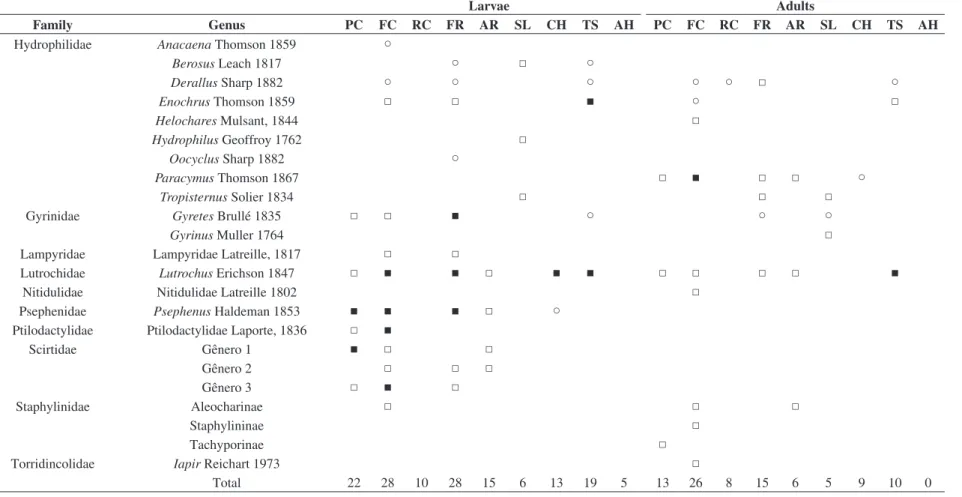
Table 1. Taxonomic composition of water beetles larvae and adults collected in mountainous regions (Serra do Mar and Serra da Mantiqueira) in mesohabitats stone/riffles (PC), leaf/ riffles (FC), root/ riffle (RC), leaf/pool (FR) sand/pool (AR), waterfall (CH), wood debris (TS) in streams, hygropetric environments (HA) and lentic systems (SL).
Larvae Adults
Family Genus PC FC RC FR AR SL CH TS AH PC FC RC FR AR SL CH TS AH
Chrysomelidae Chrysomelidae Latreille 1802 □ □
Curculionidae Curculionidae Latreille 1802 □ □ □ □ □ ○ ○
Dryopidae Dryops Olivier 1791 □ ■ ■ □ ○ ○ ■ □ ■ ■
Helichus Erichson 1847 □
Dytiscidae Amarodytes Régimbart 1900 □
Copelatus Erichson 1832 ○
Desmopachria Babington 1841 □ ○
Hydrovatus Motschulsky 1855 □
Laccodytes Régimbart 1895 ○
Laccophilus Leach 1817 ○ ○ ○ ○ ○ ○
Liodessus Sharp 1882 □
Elmidae Austrolimnius Carter & Zeck 1929 ■ ■ ■ □ □ □ ■ ■ ○ ■
Cylloepus Erichson 1847 ■ ■ ■ ○
Heterelmis Sharp 1882 ■ ■ ■ ■ □ ■ ■ ○ ■ ■ ■ ■ ■ ■
Hexacylloepus Hinton 1940 ■ ■ ■ ■ □ □ ■ ○ □
Hexanchorus Sharp 1882 ○ ○ ○
Huleechius Brown 1981 □ □ ■ □ ○
Elmidae M □ ■ ■ ■ ■ □
Elmidae A ■ □ □ □ ○
Elmidae S ○ ○ ○
Macrelmis Motschulsky 1859 ■ ■ ■ ■ □ ○ ■ ■ ■ □ □
Microcylloepus Hinton 1935 ■ ■ ○ ■ ■ ■ □ ○ ■ ■ ■ ■ □ ■
Neoelmis Musgrave 1935 ■ ■ ■ ■ ■ □ ○ ○ ■ ■ ○ ■ □ □ ○
Phanocerus Sharp 1882 ■ ■ ■ ■ □ ■ ■ ○ ■ ■ ■ ○ ○
Elmidae X ■ ■ ○ ■ □ ■ □ □
Xenelmis Hinton 1936 ■ ■ ■ ■ ■ ○ □ ■ ○ ■ ■ ○ ■ ■
Hydraenidae Hydraena Kugelann 1794 □
Br
az. J
. Biol., 2012, vol. 72, no. 2, p. 311-321
Water beetles in southeastern Brazil
315
Larvae Adults
Family Genus PC FC RC FR AR SL CH TS AH PC FC RC FR AR SL CH TS AH
Hydrophilidae Anacaena Thomson 1859 ○
Berosus Leach 1817 ○ □ ○
Derallus Sharp 1882 ○ ○ ○ ○ ○ □ ○
Enochrus Thomson 1859 □ □ ■ ○ □
Helochares Mulsant, 1844 □
Hydrophilus Geoffroy 1762 □
Oocyclus Sharp 1882 ○
Paracymus Thomson 1867 □ ■ □ □ ○
Tropisternus Solier 1834 □ □ □
Gyrinidae Gyretes Brullé 1835 □ □ ■ ○ ○ ○
Gyrinus Muller 1764 □
Lampyridae Lampyridae Latreille, 1817 □ □
Lutrochidae Lutrochus Erichson 1847 □ ■ ■ □ ■ ■ □ □ □ □ ■
Nitidulidae Nitidulidae Latreille 1802 □
Psephenidae Psephenus Haldeman 1853 ■ ■ ■ □ ○
Ptilodactylidae Ptilodactylidae Laporte, 1836 □ ■
Scirtidae Gênero 1 ■ □ □
Gênero 2 □ □ □
Gênero 3 □ ■ □
Staphylinidae Aleocharinae □ □ □
Staphylininae □
Tachyporinae □
Torridincolidae Iapir Reichart 1973 □
Total 22 28 10 28 15 6 13 19 5 13 26 8 15 6 5 9 10 0
Legend: □ - Serra da Mantiqueir; ○ - Serra do Mar and; ■ - Serra da Mantiqueira and Serra do Mar.
Braz. J. Biol., 2012, vol. 72, no. 2, p. 311-321 Segura, MO. et al.
316
from 1000 randomisations with a confidence interval of 95%. The rarefaction was performed using the ECOSIM 7.0 program (Gotelli and Entsminger, 2010).
3. Results
This study collected 14,492 specimens in 50 genera of Coleoptera belonging to 16 families, based on the joint effort of different sampling techniques in different sampled environments (Table 1). Among the families, Elmidae was the most representative, found in all sampled environments. This family was represented by 15 genera and genus Huleechius
was recorded for the first time in Brazil. Approximately 50% of the families are represented by one genus (Figure 2).
In streams of Serra da Mantiqueira, 43 genera and 16 families were recorded, eleven genera occurred exclusively in this area: Amarodytes, Hydrovatus, Helochares, Hydrophilus, Iapir, Helichus, Liodessus, Tropisternus, Gyrinus, Hydraena and Scirtidae Gênero 2. Besides these, Chrysomelidae, Lampyridae, Nitidulidae and Staphylinidae families were also recorded exclusively in Serra da Mantiqueira.
In Serra do Mar 33 genera were collected distributed in 11 families. The genera with exclusive occurrence in this
Figure 2. Contribution of genera of each family of water beetles recorded in mountainous regions in Southeastern Brazil, between August 2005 and February 2010.
Braz. J. Biol., 2012, vol. 72, no. 2, p. 311-321
Water beetles in southeastern Brazil
317 region were: Anacaena, Oocylus, Laccophilus, Laccodytes,
Copelatus, Hexanchorus and Elmidae S.
Some families were collected only in the larval stage, such as Lampyridae, Scirtidae, Psephenidae, Ptilodactylidae and some genera of Elmidae, while others like Torridincolidae, Nitidulidae, Hydraenidae and most genera of Dytiscidae were collected only in adults.
The richest mesohabitat, among all the explored ones, was leaf/riffle (38 genera), and the lowest richness was recorded in hygropetric environments (05 genera) (Table 1). In Serra da Mantiqueira, it was not possible to sample in temporary ponds, but only in lakes and dams, while in Serra do Mar, dam samples collected showed a weak current mischaracterising the lentic environment.
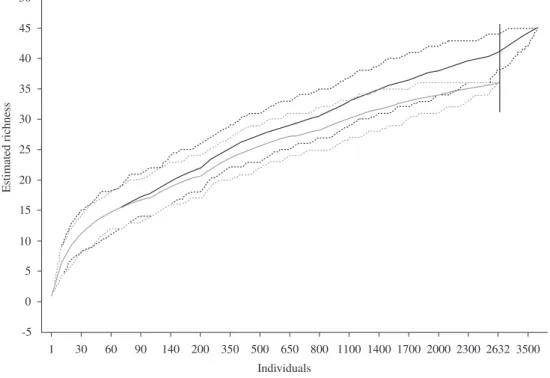
Figure 4. Graphs of taxa accumulation curves for Serra do Mar (a) and Serra da Mantiqueira (b) and richness estimators of
water beetles collected in various environments, between 2005 and 2010, produced from 500 randomizations. Solid lines represent the average curves and dotted lines the standard deviation of each curve. Qualitative non-parametric estimates of genera richness are presented for the full sample.
Braz. J. Biol., 2012, vol. 72, no. 2, p. 311-321 Segura, MO. et al.
318
An abundance of specimens of Lutrochidae family was recorded in pool areas with woody debris.
Rarefaction curves confirmed higher genera richness in Serra da Mantiqueira (Figure 3). Accumulation curves of genera for Serra da Mantiqueira and Serra do Mar presented ascending shape, with great confidence interval (Figure 4). These results, combined with the richness estimates, showed a trend of increasing number of genera with increasing sampling effort.
4. Discussion
Currently there are about 30 recognised families of Coleoptera with aquatic representatives (Jach and Balke, 2008) in the world. From these, 29 families are recorded in South America with approximately 190 genera (Archangelsky et al., 2009; Tremouilles et al., 1995). In Brazil there are no records of the total number of families of Coleoptera with aquatic representatives. Only two surveys were conducted in Brazil, one in the Northern Region (Manaus), which recorded 12 families in 50 genera (Benetti and Hamada, 2003) and in marshes in the state of Rio de Janeiro (Ferreira Junior et al., 1998) which recorded six families in 33 genera. More recently, three papers have been published for the state of Rio de Janeiro, particularly for the families Dytiscidae, Noteridae, Hydrophilide and Elmidae (Ferreira Junior and Braga, 2009; Passos et al., 2009; Santos et al., 2009). In the state of São Paulo, 17 families are registered with aquatic representatives in at least one life stage (Segura et al., 2011). Thus, the present study, which covers the mountainous regions of São Paulo state, recorded a significant portion of the fauna composition of South America (59%) and state (94%).
These results emphasize that these mountainous regions of the state of São Paulo harbour a high diversity of aquatic insects, as demonstrated in several studies (Bispo and Oliveira, 2007; Spies and Froehlich, 2009; Siegloch, 2010). Thus, the high proportion of Coleoptera and other insects is possibly related to peculiarities of local conditions such as altitude and vegetation formations (Tropical and Mixed Rain Forest) and especially by the state of preservation of the regions concerned.
In general, Serra do Mar and Serra da Mantiqueira have a similar richness, but some genera have been recorded exclusively for each strand. The genus Hexanchorus, found only in Serra do Mar, has a preference for streams and their larvae are collected on rock surface and in waterfall areas (Splanger and Santiago-Fragoso, 1992). The genus Gyrinus was registered only in the Parque Estadual de Campos do Jordão associated with the only lentic environment sampled in this area. The genus is common in habitats with lower water velocity, being abundant in lentic systems and pool areas.
The results of richness and abundance of Coleoptera found in this study corroborate with the patterns reported in the literature on water beetles, in which some authors highlight Elmidae as the most common and numerous inhabitants of streams and rivers (Brown, 1987; Spangler,
1981) and most samples in this study were collected in lotic environments.
The high richness of genera of the Elmidae family recorded in this study (15 genera) is highlighted when compared to the richness found in other studies in different areas of Brazil. As an example, studies conducted in the state of Rio de Janeiro, where 12 genera were recorded (Passos et al., 2007) and the state of Amazonas, with 16 genera recorded (Fernandes, 2010).
Some groups were collected only at the larval stage such as: Scirtidae, Psephenidae, Ptilodactylidae, Lampyridae, some genera of Elmidae, Hydrophilidae and Dytiscidae. Among families Scirtidae, Psephenidae and Ptilodactylidae, adults are terrestrial and live in the riparian zone, flying or walking on rocks or vegetation (Spangler, 1981; Brown, 1987), Lampyridae is mainly terrestrial with few aquatic representatives in larval stage (Jach and Balke, 2008). Other representatives of family Elmidae (Hexanchorus) belong to subfamily Larainae, most of whose species are only truly aquatic in the larval stage; adults can be found on the banks of the water body or on emerged rocks and tree trunks. They enter the water only to lay eggs and/ or to feed on periphyton (Brown, 1972; Spangler and Santiago-Fragoso, 1992; Spangler and Staines, 2003).
On the other hand, the opposite situation was observed for other genera, for which only adults were found in the samples. Most water beetles present larval stage or both stages (larvae and adult) predominantly submerged. Adults of genera Helichus (Dryopidae) and Hydraena (Hydraenidae) occur widely distributed in streams, while their larvae are terrestrial or riparian, living on stones, wood and fallen leaves on the banks of aquatic environments (Jach et al., 2005; Brown, 1987 ).
Braz. J. Biol., 2012, vol. 72, no. 2, p. 311-321
Water beetles in southeastern Brazil
319 The estimates in both areas indicated a need to broaden
the sampling effort, since the curves of estimated richness did not stabilize, suggesting that new records can be made in future surveys. However, communities that have many rare genera hardly reach the asymptote (Santos, 2003). So, the use of other sampling techniques (e.g. the use of traps with trays buried in the ground near water) and sampling of other habitats (e.g. on the banks of streams in moist areas on leaves and fallen tree trunks) may result in a significant increase of the recorded genera, since many genera, not yet registered in Brazil, are known to South America (Archangelsky et al., 2009).
The high richness of water beetles found in this study as well as records for the state, emphasizes the importance of conservation and preservation programmes in these areas, since they are fragmented landscapes and subject to pressure from the surrounding areas. In Serra da Mantiqueira, especially in the Parque Estadual de Campos do Jordão, there are records of annual burning and grazing in some areas (Spies and Froehlich, 2009). In Pindamonhangaba, the environment is marked by vast plantations of Eucalyptus (Siegloch, 2010). Therefore, considering the importance of these areas for biodiversity protection, including Coleoptera, it is of utmost importance to create new protected areas and the effective maintenance of existing protected areas.
Acknowledgements – We are grateful to L. M. Béber, F. Valente-Neto and R. Koroiva for fieldwork assistance. IBAMA institute for the collection permit (nº. 247/05), Dras. C. Costa, M.I.S. Passos, V. Manzo, and S. Casari for taxonomic assistance. We also thank the Fundação de Amparo a Pesquisa do Estado de São Paulo (FAPESP) (proc. nº. 05/50370-2) and the Coordenação de Aperfeiçoamento de Pessoal de Nível Superior (Capes) for student fellowships to M.O.S. This work is part of the thematic project of the BIOTA/FAPESP Program - The Biodiversity Virtual Institute Program (www.biota.org.br) “Levantamento e Biologia de Insecta e Oligochaeta Aquáticos de Sistemas Lóticos do Estado de São Paulo” (proc. nº. 2003/10517-9).
References
ARCHANGELSKY, M., MANZO, V., MICHAT, MC. and TORRES, PLM., 2009. Coleoptera. In DOMINGUEZ, E. and FERNÁNDEZ, HR. (Eds.). Macroinvertebrados bentônicos sudamericanos. Sistemática y biologia. Tucumán: Fundación Miguel Lillo. p. 411-468.
BENETTI, CJ., CUETO, JAR. and FIORENTIN, GL., 2003. Gêneros de Hydradephaga (Coleoptera: Dytiscidae, Gyrinidae, Haliplidae, Noteridae) citados para o Brasil, com chaves de identificação. Biota Neotropica, vol. 3, no. 1. Available from: <http://www.biotaneotropica.org.br/v3n1/pt/abstract?identification-key+BN00803012003>.
BENETTI, CJ. and HAMADA, N., 2003. Fauna de Coleópteros aquáticos (Insecta: Coleoptera) na Amazônia Central, Brasil. Acta Amazonica, vol. 33, no. 3, p. 1-10.
BENETTI, CJ., CUETO, JAR. and FIORENTIN, GL., 2006. Chaves de identificação para famílias de coleopteros aquáticos ocorrentes no Rio Grande do Sul, Brasil. Neotropical Biology and Conservation, vol. 1, no. 1, p. 24-28.
BERTRAND, HPI., 1972. Larves et nymphes des coléoptères aquatiques du globe. Parise: Paillart; Abbevill. 804 p.
BISPO, PC. and OLIVEIRA, LG., 2007. Diverstiy and structure of Ephemeroptera, Plecoptera and Trichoptera (Insects) assemblages from riffles in mountain streams of Central Brazil. Revista Brasileira de Zoologia, vol. 24, no. 2, p. 283-293. http://dx.doi. org/10.1590/S0101-81752007000200004
BRAGA, RB. and FERREIRA-JUNIOR, N., 2009. Three new species of Bidessodes Regimbart (Insecta, Coleoptera, Dytiscidae) from the Amazon river floodplain. Zootaxa, vol. 2034, p. 43-48.
BROWN, HP., 1972. Aquatic dryopoid beetles (Coleoptera) of the United States. Washington: United States Environmental Protection Agency. 82 p. Biota of Freshwater Ecosystems Identification Manual no. 6. Water, Pollution Conference Series.
-, 1981. A distribution survey of the Word genera of aquatic dryopoid Beetles (Coleoptera: Dryopidae, Elmidae and Psephenidae Sen. Lat). Pan-Pacific Entomologist, vol. 57, no. 1, p. 133-148. -, 1987. Biology of Riffle Beetles. Annual Review of Entomology, vol. 32, p. 253-273. PMid:3545054. http://dx.doi.org/10.1146/ annurev.en.32.010187.001345
CASATTI, L., VERONEZI-JÚNIOR, JL. and FERREIRA, CP., 2009. Dieta do cascudo Aspidoras fuscoguttatus (Ostariophysi, Callichthyidae) em riachos com diferentes características limnológicas e estruturas. Biota Neotropica, vol. 1, no. 1. Available from: <http://www.biotaneotropica.org.br/v9n1/en/abstract?article+ bn02109012009>.
COBBAERT, D., BAYLEY, SE. and GRETER, JL., 2010. Effects of a top invertebrate predator (Dytiscus alaskanus; Coleoptera: Dytiscidae) on fishless pond ecosystems. Hydrobiologia, vol. 644, no. 1, p. 103-114. http://dx.doi.org/10.1007/s10750-010-0100-7 COMPIN, A. and CÉRÉGHINO, R., 2003. Sensitivity of aquatic insect species richness to disturbance in the Adour-Garonne stream stystem (France). Ecological Indicators, vol. 3, p. 135-142. http:// dx.doi.org/10.1016/S1470-160X(03)00016-5
COLWELL, RK., 2005. EstimateS: Statistical Estimation of Species Richness and Shared Species from Samples. version 7.5. User’s Guide and application. Available from: <http://viceroy. eeb.uconn.edu/estimates>.
COLWELL, RK. and CODDINGTON, JA., 1994. Estimating terrestrial biodiversity through extrapolation. Philosophical Transactions of the Royal Society of London, vol. 345, p.101-118. COSTA, C., IDE, S., VANIN, SA. and TEIXEIRA, EP., 1996. Larvae of Neotropical Coleoptera. XXIII: Lutrochus germari Grouvelle, description of immature, redescription of adult and bionomics (Dryopoidea, Lutrochidae). Revista Brasileira de Entomologia, vol. 40, no. 1, p. 47-56.
CUMMINS, KW. and KLUG, MJ., 1979. Feeding ecology of stream invertebrates. Annual Review of Ecology, Evolution and Systematics, vol. 10, p. 147-172. http://dx.doi.org/10.1146/annurev. es.10.110179.001051
CUMMINS, KW. and LAUFF, GH., 1969. The influence of substrate particle size on the microdistribution of stream macrobenthos. Hydrobiologia, vol. 34, p. 145-181.
Braz. J. Biol., 2012, vol. 72, no. 2, p. 311-321 Segura, MO. et al.
320
FERNANDES, AS., PASSOS, MIS. and HAMADA, N., 2010. The genus Portelmis Sanderson, 1953 (Coleoptera: Elmidae: Elminae) first report in Brazil, description of two new Amazonian species and species key for males. Zootaxa, vol. 2517, p. 33-43.
FERREIRA-JUNIOR, N., MENDONÇA, EC., DORVILLÉ, LFM. and RIBEIRO, JRI., 1998. Levantamento preliminar e distribuição de besouros aquáticos (Coleoptera) na restinga de Marica, RJ. In NESSIMIAN, J.L. and CARVALHO, AL. (Eds.). Ecologia de insetos aquáticos. Rio de Janeiro: PPGE-UFRJ. vol. 5, p.129-140. Série Oecologia Brasiliensis.
FERREIRA-JUNIOR, N., NICOLINI, LB. and NESSIMIAN, JL., 2006. Description of the third instar larvae of Megadytes latus (Fabricius) (Coleoptera, Dytiscidae), with an identification key for described larvae of the genus. Revista Brasileira de Zoologia, vol. 23, no. 3, p. 792-795. http://dx.doi.org/10.1590/ S0101-81752006000300025
FERREIRA-JUNIOR, N. and BRAGA, RB., 2009. Dytiscidae e Noteridae (Insecta: Coleoptera) recorded from Rio de Janeiro State, Brazil. Arquivos do Museu Nacional, vol. 67, no. 3-4, p. 321-327. FISHER, RA., CORBET, AS. and WILLIANS, CB., 1943. The relation between the number of species and the number of individuals in a random sample of a animal population. Journal of Animal Ecology, vol. 12, no. 1, p. 42-58. http://dx.doi.org/10.2307/1411 GARCIA-CRIADO, F. and FERNANDEZ-ALÁEZ, M., 2001. Hydraenidae and Elmidae assemblages (Coleoptera) from a Spanish river basin: good indicators of coal mining pollution? Archiv fur Hydrobiologie, vol. 150, no. 4, p. 641-660. GLAISTER, A., 1999. Guide to the identification of Australian Elmidae larvae (Insecta: Coleoptera). Cooperative Research Centre for Freshwater Ecology. 49 p.
GOTELLI, NJ. and ENTSMINGER, GL., 2010. EcoSim: Null models software for ecology. Version. 7. Acquired Intelligence & Kesey-Bear . Available from: <http://garyentsminger.com/ ecosim.htm>.
GRAY, LJ., 1981. Species Composition and Life Histories of Aquatic Insects in a Lowland Sonoran Desert Stream. American Midland Naturalist, vol. 106, no. 2, p. 229-242. http://dx.doi. org/10.2307/2425159
HILSENHOFF, WL., 1977. Use of arthropods to evaluate water quality of streams. Wisconsin: Wisconsin Department of Natural Resources. 16 p. Technical Bulletin, no. 100.
HINTON, HE., 1940. A Monographic Revision of the Mexican Water Beetles of the Family Elmidae. Novitates Zoologicae, vol. 42, no. 2, p. 217-396.
HUECK, K., 1972. As florestas do América do Sul. São Paulo: Editora Polígono. 466 p.
IDE, S., COSTA, C. and VANIN, SA., 2005. Lutrochidae Kasap & Crowson, 1975. In BEUTEL, RG. and LESCHEN, RAB. (Eds.). Coleoptera, Beetles Volume 1: Morphology and Systematics (Archostemata, Adephaga, Myxophaga, Polyphaga partim). Arthropoda: Insecta; Berlin: De Gruyter. p. 508-512. Handbook for Zoology, vol. 4.
JACH, MA., BEUTEL, RG., DELGADO, JA. and DIAZ, JA., 2005. Hydraenidae Mulsant, 1844. In BEUTEL, RG. and LESCHEN, RAB. (Eds.). Coleoptera, Beetles Volume 1: Morphology and Systematics (Archostemata, Adephaga, Myxophaga, Polyphaga partim). Arthropoda: Insecta; Berlin: De Gruyter. p. 224-251. Handbook for Zoology, vol. 4.
JACH, MA. and BALKE, M., 2008. Global Diversity of Water Beetles (Coleoptera) in Freshwater. Hydrobiologia, vol. 595, p. 419-442.
LARSON, DJ., 1997. Habitat and community patterns of tropical Australian Hydradephagan water beetles (Coleoptera: Dytiscidae, Gyrinidae, Noteridae). Australian Journal of Entomology, vol. 36, no. 3, p. 269-285. http://dx.doi.org/10.1111/j.1440-6055.1997. tb01469.x
LEECH, HB. and CHANDLER, HP., 1956. Aquatic Coleoptera. In USINGER, RL. (Ed.). Aquatic Insects of California. Berkeley: University of California Press. p. 293-371.
MANZO, V., 2005. Key to the South America Genera of Elmidae (Insecta: Coleoptera) with distributional data. Studies on Neotropical Fauna and Environment, vol. 40, no. 3, p. 201-208. http://dx.doi. org/10.1080/01650520500140619
MANZO, V. and ARCHANGELSKY, M., 2008. A key to the Larvae of South America Elmidae (Coleoptera: Byrrhoidea) with a description of the mature larva of Macrelmis saltensis Manzo. Annales de Limnologie, vol. 44, no.1, p. 63-74. http://dx.doi. org/10.1051/limn:2008023
MERRIT, RW. and CUMMINS, KW., 1996. An introduction to the Aquatic Insects of North America. 3rd ed. Iowa: Kendall, Hunt Publishing Co. p. 862.
PASSOS, MIS., NESSIMIAN, JL. and DORVILLÉ, LFM., 2003a. Distribuição Espaço-temporal da Comunidade de Elmidae (Coleoptera) em um Rio Na Floresta da Tijuca, Rio de Janeiro, RJ. Boletim do Museu Nacional, Zoologia, no. 509, p. 1-9. -, 2003b. Life Strategies in an Elmidae (Insecta: Coleoptera: Elmidae) Community from a First Order Stream in the Atlantic Forest, Southeastern Brazil. Acta Limnologica Brasiliensia, vol. 15, no. 2, p. 29-36.
PASSOS, MIS., NESSIMIAN, JL. and FERREIRA-JUNIOR, N., 2007. Chaves para identificação dos gêneros de Elmidae (Coleoptera) ocorrentes no Estado do Rio de Janeiro, Brasil. Revista Brasileira de Entomologia, vol. 51, no. 1, p. 42-53. PASSOS, MIS., SAMPAIO, BHL., NESSIMIAN, JL. And FERREIRA-JUNIOR, N., 2009. Elmidae (Insecta: Coleptera) from Rio de Janeiro State: list of species and new records. Arquivos do Museu Nacional, vol. 67, no. 3-4, p. 377-382.
PAULA, MC. and FONSECA-GESSNER, AA., 2010. Macroinvertebrates in low-order streams in two fragments of Atlantic Forest in different states of conservation, in the State of São Paulo (Brazil). Brazilian Journal Biology, vol. 70, no. 3, p. 899-909.
PETERSON, MS., NICHOLSON, LC., SNYDER, DJ. and FULLING, GL., 1999. Growth, Spawning preparedness and diet of Cycleptus meridionalis (Calastomidae). Transactions of the American Fisheries Society, vol. 128, no. 5, p. 900-908. http://dx.doi.org/10.1577/1548-8659(1999)128%3C0900:GSPADO%3E2.0.CO;2
QUENEY, P., 2010. Two new species of Berosus Leach from Brazil (Coleoptera: Hydrophilidae . Zootaxa, vol. 2506, p. 51-58. RAMIREZ, A. and PRINGLE, CM., 1998. Structure and production of a benthic insect assemblage in a neotropical stream. Journal of the North American Benthological Society, vol. 17, no. 4, p. 443-463. http://dx.doi.org/10.2307/1468365
Braz. J. Biol., 2012, vol. 72, no. 2, p. 311-321
Water beetles in southeastern Brazil
321 RIBERA, I., 2000. Biogeography and conservation of Iberian
water Beetles. Biological Conservation, vol. 92, p. 131-150. http://dx.doi.org/10.1016/S0006-3207(99)00048-8
RIBERA, I., AGUILERA, P., HERNANDO, CY. and MILLÁN, A., 2002. Los coleópteros acuáticos de La península Ibérica. Quercus, vol. 201, p. 38-42.
RIBERA, I. and FOSTER, GN., 1992. Uso de coleópteros acuáticos como indicadores biológicos (Coleoptera). Elytron, vol. 6, p. 61-75.
RICHARDSON, JS., 1992. Food, microhabitat or both - macroinvertebrate use of leaf accumulations in a montane stream. Freshwater Biology, vol. 27, p.169-176. http://dx.doi. org/10.1111/j.1365-2427.1992.tb00531.x
SANSEVERINO, AM., NESSIMIAN, JL. and OLIVEIRA, ALH., 1998. A fauna de Chironomidae (Diptera) em diferentes biótopos aquáticos na Serra do Subaio (Teresópolis, RJ). In NESSIMIAN, JL. and CARVALHO, AL. (Eds.). Ecologia de Insetos Aquáticos. Rio de Janeiro: Serie Oecologia Brasiliensis PPGE-UFRJ. p. 253-263.
SANTOS, AD., CLARKSON,B. and FERREIRA-JUNIOR, N., 2009. Hydrophilidae (Insecta: Coleoptera) from Rio de Janeiro State, Brazil: list of species and new records. Arquivos do Museu Nacional, vol. 67, no. 3-4, p. 329-336.
SANTOS, AJ., 2003. Estimativas de riqueza em espécies. In CULLEN-JUNIOR, L., RUDRAM, R. and VALLADARES-PADUA, C. (Orgs.). Métodos de Estudos em Biologia da Conservação e Manejo da Vida Silvestre. Curitiba: Editora da UFPR, Fundação O Boticário de Proteção à natureza. p. 19-41.
SEAGLE, HH., 1982. Comparison of the food habitats of three species of riffle beetles, Stenelmis crenata, Stenelmis mera, and Optioservus trivittatus (Coleoptera, Dryopoidea, Elmidae). Freshwater Invertebrate Biology, vol. 1, p. 33-38. http://dx.doi. org/10.2307/3259452
SEIBERT, P., 1975. Plano de Manejo do Parque Estadual de Campos do Jordão. Boletim Técnico do Instituto Florestal, vol. 19, p. 1-153.
SEGURA, MO., FONSECA-GESSNER, AA. and BATISTA, TCA., 2007a. Associação forética entre larvas de Rheotanytarsus (Chironomidae, Tanytarsini) e adultos de Elmidae (Coleoptera), coletados em córregos no Parque Estadual de Campos do Jordão, São Paulo, Brasil. Revista Brasileira de Zoologia, vol. 24, no. 2, p. 503-504.
-, 2007b. Composition and distribution of aquatic Coleoptera (Insecta) in low-order streams in the state of São Paulo, Brazil: influence of environmental factors. Acta Limnologia Brasiliensia, vol. 19, p. 247-256.
SEGURA, MO., VALENTE-NETO, F. and FONSECA-GESSNER, AA., 2011. Chave de famílias de Coleoptera aquáticos (Insecta) do Estado de São Paulo, Brasil. Biota Neotropica, vol. 11, no. 1. Available from: <http://www.biotaneotropica.org.br/v11n1/en/ab stract?article+bn02711012011>.
SIEGLOCH, AE., 2010. Estrutura especial das comunidades de Ephemeroptera Haeckel, 1896 (Insecta) em riachos da Serra da Mantiqueira e da Serra do Mar, Estado de São Paulo. Ribeirão Preto: Universidade de São Paulo. 136 p. Tese de Doutorado em Entomologia.
SILVEIRA, JP., 1964. Morfologia do litoral. In AZEVEDO, A. (Coord.). Brasil: A terra e o homem - as bases físicas.São Paulo: Companhia Editora Nacional. p. 253-305.
SPANGLER, PJ., 1981. Coleoptera. In HURLBERT, SH., RODRIGUEZ, G. and SANTOS, ND. (Eds.). Aquatic Biota of Tropical South America Part 1. Arthropoda. California: San Diego State University. p. 129-220.
-, 1990. A new species of water Scavenger beetle, Guyanobius – Simmonsorum, from Brazil (Coleoptera, Hydrophilidae). Proceedings of the Entomological Society of Washington, vol. 92, no. 3, p. 411-415.
SPANGLER, PJ. and SANTIAGO-FRAGOSO, S., 1992. The Aquatic Beetle Subfamily Larainae (Coleoptera: Elmidae) in Mexico, Central America and the West Indies. Smithsonian Contributions to Zoology, no. 528. 74 p.
SPANGLER, PJ. and STAINES, CL., 2003. Three new species of Hexanchorus Sharp, 1882 (Coleoptera: Elmidae: Larainae) from South America. Insecta Mundi, vol. 17, no. 1, p. 45-48. SPIES, MR. and FROEHLICH, CG., 2009. Inventory of caddisflies (Trichoptera: Insecta) of the Campos do Jordão State Park, São Paulo State, Brazil. Biota Neotropica, vol. 9, no. 4, p. 211-218. STENERT, C., SANTOS, EM. and MALTCHIK, L., 2004. Levantamento da diversidade de macroinvertebrados em áreas úmidas do Rio Grande do Sul (Brasil). Acta Biologica Leopoldensia, vol. 26, no. 2, p. 225-240.
TAVARES, AF. and WILLIAMS, DD., 1990. Life histories, diet, and niche overlap of three sympatric species of Elmidae (Coleoptera) in a temperate stream. Canadian Entomologist, vol. 122, p. 563-577. http://dx.doi.org/10.4039/Ent122563-5 TREMOUILLES, ER., OLIVA, A. and BACHMANN, AO., 1995. Insecta Coleoptera. In LOPRETTO, EC. and TELL, G. (Eds.). Ecosistemas de aguas continentales: metodologías para su estudio. La Plata: Ediciones Sur, La Plata. p. 1133-1197.
TUPINAMBAS, TH., CALLISTO, M. and SANTOS, GB., 2007. Estrutura das assembléias de macroinvertebrados bentônicos em dois córregos de cabeceira no sudeste do Brasil. Revista Brasileira de Zoologia, vol. 24, no. 4, p. 887-897.
VANIN, SA. and COSTA, C., 2001. Description of immature stages of Claudiella ingens Reichardt & Vanin, 1976 and comparative notes on other Torridincolidae (Coleoptera, Torridincolidae). Aquatic Insect, vol. 23, no. 1, p. 1-10.