Biological aspects of
Cyclocephala tucumana
Brethes, 1904 and
Cyclocephala melanocephala
(Fabricius, 1775)
(Coleoptera: Scarabaeidae)
Gerson Aler de Lima Nogueira1, Sérgio Roberto Rodrigues1,2 & Elison Floriano Tiago1
1Departamento de Entomologia,Universidade Estadual de Mato Grosso do Sul – UFMS,
Rod. Aquidauana/CERA, Km 12, CEP 79200-000, Aquidauana, MS, Brasil 2Corresponding author: Sérgio Roberto Rodrigues, e-mail: [email protected]
NOGUEIRA, G.A.L., RODRIGUES, S.R. & TIAGO, E.F. Biological aspects of Cyclocephala tucumana Brethes, 1904 and Cyclocephala melanocephala(Fabricius, 1775)(Coleoptera: Scarabaeidae). Biota Neotrop. 13(1): http://www.biotaneotropica.org.br/v13n1/en/abstract?article+bn01713012013
Abstract:The studies were conducted on the biological aspects of Cyclocephala tucumanaBrethes, 1904and C. melanocephala (Fabricius, 1775) in Aquidauana, MS, Brazil. From January to December 2009 a light trap was installed to make collections of adults of C. tucumana and from January 2010 to February 2011 for collections of adults of C. melanocephala, at the experimental farm of the Universidade Estadual de Mato Grosso do Sul. Adults were maintained in plastic containers with soil and complete plants of Brachiariadecumbens Stapf cv. Basilisk to oviposition and start biological studies. Adults of C. tucumana were collected from September to November
in the field; the embryonic period lasted on average 14.7 days, and the first, second and third larval instars
lasted 47.7, 66.1 and 78.6 days, respectively. Pre-pupa and pupa phases lasted 98.2 and 15.1 days, respectively, and longevity of the adults was 13.3 days. From the egg to adult stage of C. tucumana was a period of average 211.2 days. Adults of C. melanocephala were collected from September to October 2010 and February 2011. The
embryonic period lasted 17.8 days, and larvae in the first, second and third instars lasted 22.3, 21.0 and 27.0 days,
respectively. The pre-pupa stage lasted 11.3 days and pupa phase lasted 13.3 days. The longevity of adults was 26 days, and the cycle from egg to adult lasted 113 days.
Keywords: life cycle, Cyclocephalini, Dynastinae, insects of the soil.
NOGUEIRA, G.A.L., RODRIGUES, S.R. & TIAGO, E.F. Aspectos biológicos de Cyclocephala tucumana
Brethes, 1904 e Cyclocephala melanocephala (Fabricius, 1775) (Coleoptera: Scarabaeidae). Biota Neotrop. 13(1): http://www.biotaneotropica.org.br/v13n1/pt/abstract?article+bn01713012013
Resumo: Foram desenvolvidos estudos sobre os aspectos biológicos de Cyclocephala tucumanaBrethes, 1904 e C. melanocephala (Fabricius, 1775)em Aquidauana, MS. Foi instalada uma armadilha luminosa de janeiro a dezembro de 2009 para obter adultos de C. tucumana e de janeiro de 2010 a fevereiro de 2011 para obter adultos de C. melanocephala, na fazenda experimental da Universidade Estadual de Mato Grosso do Sul. Adultos foram mantidos em recipientes de plástico, contendo solo e plantas de Brachiariadecumbens Stapf cv. Basilisk, para oviposição e início dos estudos biológicos. Os adultos de C. tucumana foram coletados de setembro a novembro no campo, o período embrionário durou em média 14,7 dias, e o primeiro, segundo e terceiro instar larval duraram 47,7, 66,1 e 78,6 dias, respectivamente. As fases de pré-pupa e pupa duraram 98,2 e 15,1 dias, respectivamente, e a longevidade dos adultos foi de 13,3 dias. A fase de ovo a adulto de C. tucumana durou em média 211,2 dias. Os adultos de C. melanocephala foram coletados em setembro e outubro de 2010 e em fevereiro de 2011. O período embrionário durou 17,8 dias, as larvas no primeiro, segundo e terceiro instar duraram 22,3, 21,0 e 27,0 dias, respectivamente. A fase de pré-pupa durou 11,3 dias a pupa durou 13,3 dias. A longevidade dos adultos foi de 26 dias, e o ciclo de ovo a adulto durou 113 dias.
biological aspects of the Cyclocephala species occurring in Brazil are scarce. Based on the lack of information studies were developed with the objective of understanding the biological aspects of C. tucumana and C. melanocephala in Aquidauana, MS, Brazil.
Materials and Methods
The study was developed at the Universidade Estadual de Mato Grosso do Sul (UEMS), in the municipality of Aquidauana, MS. Adults of Cyclocephala tucumana and Cyclocephala melanocephala were collected with a “Luiz de Queiroz” light trap installed daily
between the pasture and field areas, at 6:00 PM and collected at
6:00 AM on the following day. Adults of C. tucumana were collected from January to December 2009, and C. melanocephala from January 2010 to February 2011.
During the periods of trapping, adults of C. tucumana and C. melanocephala were separated and quantified in the laboratory for observation of behavior and the oviposition period, as was performed by Rodrigues et al. (2010) when studying Cyclocephala verticalis.
Adults were maintained in plastic recipients (20 × 5 × 30 × 12 cm in depth) containing soil and complete plants of Brachiaria decumbens Stapf cv. Basilisk(Poaceae) so that the insects would mate and oviposition. Recipients were covered with a voile fabric that allowed plant growth and prevented escape of the insects.
Containers were inspected daily for acquisition of eggs and initiation of the biological study. When encountered, eggs were measured, transferred to Petri dishes containing sieved soil, moistened and maintained in laboratory conditions (26 °C, 12h photoperiod). Periodically (every two days) the plates were observed and larvae
that hatched had their head capsule measured and durations verified,
followed by transfer to individual 500 mL plastic containers containing soil and B. decumbens where plants were replaced weekly to monitor development and change of instar. When larvae reached the pre-pupae phase they no longer fed, but larvae remained on the soil at the surface of the recipient where they remained until reaching the adult phase (adapted from Rodrigues et al. 2010).
Biological variables evaluated for both species were the duration of the embryonic period, duration of the larval and pupal periods, and also longevity of the adults.
Specimens were deposited in the entomology collection of the Universidade Estadual de Mato Grosso do Sul, in Aquidauana, MS, Brazil.
Results
1. Cyclocephala tucumana
Regarding population dynamics of adults of C. tucumana was
verified that these were found in the field during a short period of time,
where 34 adults were collected in September (28.1%), in October 52 (43.0%) and in November 35 (28.9%) (Figure 1).
When dissecting some of the females it was found that in September there was an average of 10.5 eggs (4-14) (n = 6) per female, in October 10.8 (5-15) (n = 6) and November 6.5 (1-12) (n = 6). Thus, it can be inferred that the period in which females are encountered
in flight in the field is also the oviposition period.
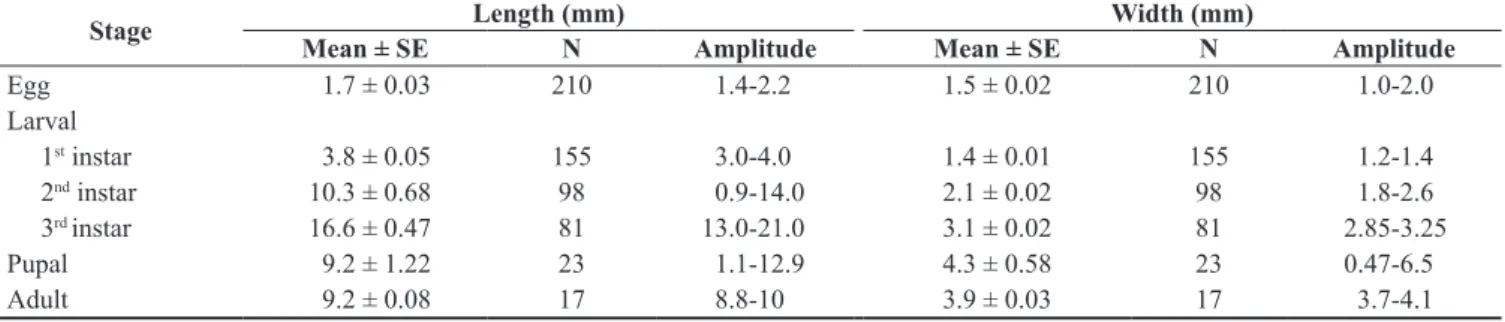
Eggs of C. tucumana were found individually at the bottom of recipients where adults were maintained, protected in chambers within the soil with average dimensions of 2 to 3 mm in diameter (n = 20), probably constructed with saliva from adults as well as soil. Eggs are white with average dimensions of 1.5 × 1.7 mm (n = 20). The embryonic period of C. tucumana lasted 14.7 days (Table 2).
In the first instar larvae possess an average width of 1.4 mm
and body length of 3.8 mm, width of 1.4 mm and average weight of
Introduction
According to Ratcliffe & Cave (2002) there are approximately 300 known species in the American genus Cyclocephala Dejean, 1821. In the various regions of Brazil, 83 species of the genus Cyclocephala are registered (Morón 2004).
In the city of São Gabriel da Cachoeira, AM, Brazil, Andreazze & Mota (2002) used light traps for attract Cyclocephala guianae Endrödi, 1969, C. lunulata Burmeister, 1847, C. simulatrix Hohne, 1923, and three Cyclocephala spp.. Andreazze & Fonseca (1998) collected 18 species of Dynastinae in Itacoatiara, AM with light traps, where nine species were of the genus Cyclocephala, identified as C. colasi Endrödi, 1964, C. bicolor Castelnau, 1840, C. affinis Endrödi, 1966, C. hardyi Endrödi, 1975, C. testacea Burmeister, 1847, C. mecynotarsis Hohne, 1923, C. acellata Burmeister, 1847, C. variabilis Burmeister, 1847 and C. verticalis Burmeister, 1847.
Andreazze (2001) collected 11 species of Cyclocephala in
the National Park of Jaú, AM using light traps, being identified as C. colasi Endrödi, 1964, C. bicolor Castelnau, 1840, C.guianae Endrödi, 1969, C. hardyi Endrödi, 1975, C. paraflora Martinez, 1978, C. testacea Burmeister, 1847 and C. verticalis Burmeister, 1847, as
well as four species identified only at the genus level.
In an area of Eucalyptus grandis in Santa Bárbara, MG, Brazil, Freitas et al. (2002) obtained Cyclocephala laminata Burmeister, 1847 with a light trap. Nine species of Cyclocephala were collected by Ronqui & Lopes (2006) in Tamarana, PR, Brazil with light traps,
which were identified only at the genus level. In five locations of
Paraná, in southern Brazil, Riehs (2006) used light traps to collect C. variabilis Burmeister, 1847, C. clarae Höhne, 1923, C. suturalis Ohaus, 1911, C. signaticollis Burmeister 1847, C. paraguayensis Arrow, 1903 and C. variolosa Burmeister, 1847.
In 23 municipalities in the region of Planalto, Rio Grande do Sul, Brazil, Cherman (2011) sampled larvae of Scarabaeidae in
different cultures, and identified Cyclocephala flavipennis Arrow, 1914, C. modesta Burmeister, 1855, C. putrida Burmeister, 1847, C. tucumana Brethes, 1904 and C. metrica Steinheil, 1874. Salvadori & Pereira (2006) found that C. flavipennis feeds on decaying organic matter and Salvadori (1999) reported that this species, even at the densities sampled of approximately 80 to 100 larvae/m2 in the field
do not cause damage to crops.
In the Midwest region of Brazil, the occurrence of C. melanocephala (Fabr., 1775) was registered in sunflower crop (Camargo & Amabile
2001). In Aquidauana, MS, Brazil, Rodrigues et al. (2010) collected adults of C. verticalis with a light trap. In soybean fields of Macaraju, MS, Brazil, Santos & Ávila (2007) encountered larvae of C.forsteri Endrödi, 1966 feeding of roots of this legume. In a sugar cane field in
Sidrolândia, MS, Brazil, Coutinho (2010) found larvae of C. verticalis and C. forsteri feeding of the root system. Cyclocephala verticalis was found feeding of roots of Acrocomia aculeata (Puker et al. 2009). According to observations of Prance & Arias (1975) in the region of Manaus, AM, adults of Cyclocephala hardyi were encountered in flowers of Victoria amazonica, where they were frequently encountered feeding on and cross pollinizing this plant species. In experiments conducted in the municipalities of Goiânia and Vila Propício in Goiás, Brazil, Cavalcante et al. (2009) found as visitors to
flowers araticum (Annona crassiflora) (Annonaceae), Cyclocephala atricapilla Mannerheim, 1829, Cyclocephala latericia Hohne, 1923 and Cyclocephala octopunctata Burmeister, 1847, being considered as important pollinators.
0.0039 g. Larvae of the second instar had an average head capsule width of 2.1 mm, body length of 10.3 mm, width of 2.1 mm and weight of 0.0485 g (Table 1).
The third instar larvae presented head capsule width of 3.1 mm and body length of 16.6 mm, width of 3.1 mm, and weight of 0.1649 g
(Table 1). From the first to third instar, it was observed that larvae significantly increase in size, showing an increase of 4.4 times its
length and 2.2 times its width (Table 1). With regards to larvae weight,
from the first to third instar the weight increased from 0.0039 g in the first instar to 0.1649 g in the third instar, an increase of roughly
42.2 times.
Larvae remained in the first instar for 47.7 days (Table 2). The
second instar stage lasted 66.1 days and third instar phase 78.6 days (Table 2). The pre-pupal stage lasted 98.2 days on average, thus, duration of the larval stage was on average 191.9 days (Table 2).
When reaching the pre-pupa stage the larvae acquired a white color and no longer feed, and when transforming into pupae prepare a chamber in the soil where they remain protected. Normally chambers where the pupae remained were at the bottom of the recipients. Pupae presented average dimensions of 9.2 mm in length and in 4.3 mm
width (Table 1), and the average duration was 15.1 days on average (Table 2).
Upon reaching adult hood, it was observed that the average longevity was 13.3 days (Table 2). The adults measure 9.1 mm long by 4.1 mm in chest width (n = 10). They have light brown thorax and elytra. The head is dark tending to black in the frontal region between the eyes, and on the clypeus the color is dark brown. The biological cycle was completed with an average of 211.2 days, which allows for the formation of one generation per year, characterizing the species as univoltine.
2. Cyclocephala melanocephala
Adults of C. melanocephala were encountered in small quantity,
finding two (28.6%) adults in September and five (71.4%) in October
of 2010, and only one adult (12.5%) was obtained in February of
2011. Flight activity in the field thus occurred during a very short
period (Figure 2).
In the rearing recipients eggs were encountered, which were isolated in chambers constructed of soil and saliva which have
Table 1. Means (±SE) of the length and width of the development stages of Cyclocephala tucumana in the laboratory (26 ± 1 °C, 12h photoperiod).
Stage Length (mm) Width (mm)
Mean ± SE N Amplitude Mean ± SE N Amplitude
Egg 1.7 ± 0.03 210 1.4-2.2 1.5 ± 0.02 210 1.0-2.0
Larval
1st instar 3.8 ± 0.05 155 3.0-4.0 1.4 ± 0.01 155 1.2-1.4
2nd instar 10.3 ± 0.68 98 0.9-14.0 2.1 ± 0.02 98 1.8-2.6
3rd instar 16.6 ± 0.47 81 13.0-21.0 3.1 ± 0.02 81 2.85-3.25
Pupal 9.2 ± 1.22 23 1.1-12.9 4.3 ± 0.58 23 0.47-6.5
Adult 9.2 ± 0.08 17 8.8-10 3.9 ± 0.03 17 3.7-4.1
Figure 1. Number of adults of Cyclocephala tucumana collected in trap light from January to December 2009, in Aquidauana, MS.
Table 2. Duration (mean ± SE) of the development stages of Cyclocephala tucumana in the laboratory (26 ± 1°C, 12h photoperiod).
Stage Duration (days) N Interval of variation Viability (%)
Egg 14.7 ± 0.24 210 9-22 73.8
1st instar 47. 7 ± 1.69 155 29-93 63.2
2nd instar 66.1 ± 2.04 98 28-109 82.6
3rd instar 78. 6 ± 1.77 81 34-113 66.6
Pre-pupal 98.2 ± 2.01 54 76-121 42.5
Larval duration 191.9 ± 0.79 54 185-201 25.7
Pupal 15.1 ± 0.63 23 12-23 73.9
Adult 13.3 ± 1.05 17 8-20 100
average dimensions of 9.7 to 9.75 mm in diameter (n = 4). Eggs have a white color and average dimensions of 2.65 × 2.30 mm (Table 3). It is possible that the chambers were constructed by females, which provide a protective environment for the egg.
The incubation period of eggs was on average 17.8 days (Table 4).
Larvae of the first instar remained 22.3 days in this phase, in the
second instar larvae remained 21.0 days and in the third instar an average of 27.0 days (Table 4). The pre-pupal stage lasted 11.3 days on average. Thus, larval duration was 70.7 days (Table 4).
First instar larvae of C. melanocephala had an average length of 5 mm, weight of 0.0163 mg and average head capsule width of 1.4 mm. Second instar larvae had an average length of 10.7 mm, weight of 0.0405 mg and head capsule width of 2.45 mm. The third instar larvae had an average length of 21.0 mm, weight of 0.1882 mg and
head capsule width of 3.50 mm (Table 3). From the first to third instar
the larvae increased 4.2 times, showing a considerable increase in their size.
Upon reaching the pre-pupae phase the insects stop feeding and remain in chambers with external average length of 32.0 mm and average width of 18.0 mm, and inner average length of 22.0 mm and width of 14.0 mm, constructed at the bottom of the rearing recipient. In this stage the pre-pupae have a greyish to white color.
The pupal stage lasted 13.3 days and adults had an average longevity of 26.0 days (Table 4). Pupae of C. tucumana had an average length of 12.1 mm and average width of 5.3 mm, and the adults had an average length of 11.9 mm and average chest width of 4.9 mm (Table 3). The elytra of adults are light brown, but the chest is red.
Duration of the egg to adult phase of C. melanocephala lasted 113 days on average in the laboratory, where the formation of two generations per year may be possible. In the laboratory a single moment of mating was observed when inspecting the rearing recipients, and on this occasion it was observed that copulation lasted seven minutes followed by the male remaining on top of the female for three minutes.
Discussion
The period of flight activity of two species studied was similar
to other Scarabaeidae collected in the region of Aquidauana, MS, as observed by Rodrigues et al. (2008a, b, 2010).
Eggs of C. tucumana had dimensions similar to those of C. verticalis which measured 1.5 × 1.8 mm (Rodrigues et al. 2010) and C. parallela with average diameter of 1.9 mm (Cherry 1985), however, the eggs of C. melanocephala are larger. Regarding the
Table 3. Means (±SE) of the length and width of the development stages of Cyclocephala melanocephala in the laboratory (26 ± 1 °C, 12h photoperiod).
Stage Length (mm) Width (mm)
Mean ± SE N Amplitude Mean ± SE N Amplitude
Egg 2.65 ± 0.07 10 2.45-2.80 2.30 ± 0.06 10 2.20-2.55
Larval
1st instar 5.0 ± 0.03 8 4.8-5.0 1.2 ± 0.03 8 1.1-1.3
2nd instar 10.7 ± 0.43 6 9.0-11.0 2.3 ± 0.02 6 2.20-2.35
3rd instar 21.0 ± 0.45 6 19.0-22.0 3.3 ± 0.02 6 3.25-3.40
Pupal 12.1 ± 0.35 6 11.0-13.0 5. 3 ± 0.14 6 4.9-5.7
Adult 11.9 ± 0.48 6 9.5-12.5 4.9 ± 0.96 6 4.2-5.0
Table 4. Duration (mean ± SE) of the development stages of Cyclocephala melanocephala in the laboratory (26 ± 1 °C, 12h photoperiod).
Phase Duration (days) N Interval of variation Viability (%)
Egg 17.8 ± 0.20 10 17-18 80.0
1st instar 22.3 ± 0.75 8 21-24 75.0
2nd instar 21.0 ± 1.53 6 19-24 100.0
3rd instar 27.0 ± 1.73 6 24-30 100.0
Pre-pupal 11.3 ± 0.67 6 10-12 100.0
Larval duration 70.7 ± 1.76 6 68-74 100.0
Pupal 13.3 ± 0.67 6 12-14 100.0
Adult 26.0 ± 0.58 6 25-27 100.0
Egg to adult 113 ± 3.5 6 112-117 60.0
embryonic period, C. tucumana exhibited shorter duration in this phase when compared with C. melanocephala.
The head capsule width of C. tucumana and C. melanocephala present similar values. However, Santos & Avila (2007) found that the average width of the head capsule of C. forsteri was greater than the two mentioned species, measuring 2.49, 4.18 and 7.04 mm in
first, second and third instar, respectively.
The larval phase of C. tucumana lasts 191.9 days, being longer than that of C. melanocephala which lasted 70.7 days. The larval phase of C. verticalis is 195.7 days (Rodrigues et al. 2010), very similar to that observed for C. tucumana.
The behavior observed for construction of chambers by pre-pupae of the two species studied was also observed by Rodrigues et al. (2010) for C. verticalis reared in the laboratory.
Duration of the cycle from egg to adult of C. tucumana allows for the formation of one generation per year, as observed for C. verticalis by Rodrigues et al. (2010). According to Santos & Ávila (2007), C. forsteri completes its life cycle in one year, and according to Mondino et al. (1997), C. signaticollis Burmeister, 1847 also completes its cycle in one year.
The cycle from egg to adult of C. melanocephala, was similar to that observed for Anomala testaceipennis Blanchard, 1856 which required 139.4 days to complete its development (Rodrigues et al. 2008a).
The coupling behavior of C. melanocephala, which remained on top of the female after terminating coupling was reported by Rodrigues et al. (2010) for C. verticalis, where even after finishing copulation the male remained fixed on the female, presenting a
defensive position, possibly trying to ensure fertilization of the egg with its genetic material.
Acknowledgments
The authors thank Dr. Miguel Angel Morón (Instituto de Ecología,
México) for identification of C. tucumana and Dr. Fernando Zagury Vaz-de-Mello (Universidade Federal de Mato Grosso, Brazil) for
identification of C. melanocephala.
References
ANDREAZZE, R. 2001. Dinastíneos (Coleoptera, Scarabaeidae, Dynastinae) do Parque Nacional do Jaú, Amazonas, Brasil. Acta Amaz. 31(3):431-435.
ANDREAZZE, R. & MOTTA, C.S. 2002. Besouros dinastíneos (Coleoptera, Scarabaeidae, Dynastinae) de Querari, Município de São Gabriel da Cachoeira, Estado do Amazonas, Brasil. Acta Amaz. 32(4):725-727.
ANDREAZZE, R. & FONSECA, C.R.V. 1998. Dinastíneos (Coleooptera,
Scarabaeoidea, Melolonthidae) em uma área de terra firme na Amazônia
Central, Brasil. Acta Amaz. 28(1):59-66.
CAVALCANTE, T.R.M., NAVES, R.V., FRANCESCHINELLI, E.V. & SILVA, R.P. 2009. Polinização e formação de frutos em araticum. Bragantia. 68(1):13-21. http://dx.doi.org/10.1590/S0006-87052009000100002
CAMARGO, A.J.A. & AMABILE, R.F. 2001. Identificação das Principais
Pragas do Girassol na Região Centro-Oeste. Ministério da Agricultura e do Abastecimento, Embrapa/CNPDF, Brasília, 4p. Comunicado Técnico, n.50.
CHERMAN, M.A. 2011. Análise populacional de Melolonthidae (Coleoptera) da região do Plananto do Rio Grande do Sul. Dissertação de Mestrado, Universidade Federal de Santa Maria, Santa Maria.
CHERRY, R.H. 1985. Seasonal phenology of white grubs (Coleoptera:
Scarabaeidae) in Florida sugarcane fields. J. Econ. Entomol. 78(4):787‑789.
COUTINHO, G.V. 2010. Aspectos biológicos e densidade de larvas de
Scarabaeidae fitófagos em cultura de cana‑de‑açúcar, em Sidrolândia,
na região central de Mato Grosso do Sul. Dissertação de Mestrado, Universidade Estadual de Mato Grosso do Sul, Aquidauana.
FREITAS, F.A., ZANUNCIO, T.V., LACERDA, M.C. & ZANUNCIO, J.C. 2002. Fauna de Coleoptera coletada com armadilhas luminosas em plantio de Eucalyptus grandis em Santa Bárbara, Minas Gerais. Rev. Árv. 26(4):505-511.
MONDINO, E.A, LÓPEZ, A.N., ALVAREZ-CASTILLO, H.A. & CARMONA, D.M. 1997. Ciclo de vida de Cyclocephala signaticollis Burmeister, 1847 (Coleoptera, Scarabaeidae, Dynastinae) y su relación con los factores ambientales. Elytron. 11:145-156.
MORÓN, M.A. 2004. Melolontídeos edafícolas. In Pragas de Solo no Brasil (J.R. Salvadori, C.J. Ávila & M.T.B. Silva, eds.). Embrapa-CNPT, Passo Fundo, Embrapa-CPAO, Dourados, Fundacep Fecotrigo, Cruz Alta, p.133-166.
PRANCE, G.T. & ARIAS, J.R. 1975. A Study of the Floral Biology of Victoria amazonica (Poepp.) Sowerly (Nymphaceae). Acta Amaz. 5(2):109-139.
PUKER, A., RODRIGUES, S.R., TIAGO, E.F. & SANTOS, W.T. 2009.
Espécies de Scarabaeidae fitófagos (Insecta: Coleoptera) associadas
ao sistema radicular de Acrocomia aculeata (Jacq.) Lodd. ex Mart. (Arecaceae). Biota Neotrop. 9(3):105-109. http://dx.doi.org/10.1590/ S1676-06032009000300009
RATCLIFFE, B.C. & CAVE, R.D. 2002. New species of Cyclocephala from Honduras and El Salvador (Coleoptera: Scarabaeidae: Dynastinae: Cyclocephalini). The Coleopt. Bull. 56(1):152-157. http://dx.doi.
org/10.1649/0010‑065X(2002)056[0152:NSOCFH]2.0.CO;2
RIEHS, P.J. 2006. Fenologia de algumas espécies do gênero Cyclocephala (Coleoptera, Scarabaeidae) do Leste e Centro-Oeste do Paraná, Brasil. Rev. Ciênc. Ex. Nat. 8(2):201-223.
RODRIGUES, S.R., NOGUEIRA, G.A.L., ECHEVERRIA, R.R. & OLIVEIRA, V.S. 2010. Aspectos biológicos de Cyclocephala verticalis Burmeister (Coleooptera: Scarabaeidae). Neotrop. Entomol. 39(1):15-18. http://dx.doi.org/10.1590/S1519-566X2010000100003
RODRIGUES, S.R., PUKER, A., ABOT, A.R., BARBOSA, C.L., IDE, S. & COUTINHO, G.V. 2008a. Ocorrência e aspectos biológicos
de Anomala testaceipennis Blanchard (Coleoptera, Scarabaeidae).
Rev. Bras. Entomol. 52(1):68-71. http://dx.doi.org/10.1590/S0085-56262008000100012
RODRIGUES, S.R., BARBOSA, C.L., PUKER, A., ABOT, A.R. & IDE, S. 2008b. Occurrence, biology and behavior of Liogenys fuscus Blanchard (Insecta, Coleoptera, Scarabaeidae) in Aquidauana, Mato Grosso do Sul, Brazil. Rev. Bras. Entomol. 52(4):637-640. http://dx.doi.org/10.1590/ S0085-56262008000400015
RONQUI, D.C. & LOPES, J. 2006. Composição e diversidade de Scrabaeoidea (Coleopera) atraídos por armadilha de luz em área rural no norte do Paraná, Brasil. Iheringia. 96(1):103-108. http://dx.doi.org/10.1590/ S0073-47212006000100018
SANTOS, V. & ÁVILA, C.J. 2007. Aspectos bioecológicos de Cyclocephala forsteri Endrödi, 1963 (Coleoptera: Melolonthidae) no estado de Mato Grosso do Sul. Rev. Agric. 82:298-303.
SALVADORI, J.R. & PEREIRA, P.R.V.S. 2006. Manejo integrado de corós em trigo e culturas associadas. Embrapa CNPT, Passo Fundo, 9p. Comunicado Técnico online, n. 203. Disponível em: http://www.cnpt. embrapa.br/biblio/co/p_co203.htm. Acesso em 01.12.2008.
SALVADORI, J.R. 1999. Manejo de corós em cereais de inverno. Comunicado Técnico online n.º 3. Passo Fundo, Embrapa CNPT, 3p. http://www.cnpt. embrapa.br/biblio/p_co03.htm (ultimo acesso em 27/11/2008.