SOUTHERN
MODERNISMS:
from A to Z
and back again
SO
U
T
H
ER
N
M
O
D
ER
N
IS
M
S: fr
om A to Z and back again
Joana Cunha Leal
Maria Helena Maia
Begoña Farré Torras
Editors
C
E
A
A -
IH
A
Project Southern Modernisms (EXPL/CPC-HAT/0191/2013)
SOUTHERN
MODERNISMS:
from A to Z and back again
Editors
Joana Cunha Leal, Maria Helena Maia and Begoña Farré Torras © 2015 by authors CESAP/CEAA and IHA/FCSH-UNL
Graphic design
Jorge Cunha Pimentel and Joana Couto
Typesetting
Joana Couto
Edition
CEAA | Centro de Estudos Arnaldo Araújo da CESAP/ESAP IHA | Instituto de História da Arte da FCSH-UNL
Print and finishing
Gráfica SerSilito
1st Edition, Porto, May 2015
Print run: 500 copies ISBN: 978-972-8784-66-9 Legal Deposit:
This publication was conducted under the project Southern Modernisms
(EXPL/ CPC-HAT/0191/2013), funded by national funds through FCT under Project 3599 - Promoting the Research Production, Technological Development and Innovation.
The authors of the texts have the exclusive responsibility of image copyrights printed in the correspondent texts. The editors do not accept any responsibility for any improper use of images and any consequences following.
Centro de Estudos Arnaldo Araújo Escola Superior Artística do Porto Largo de S. Domingos, 80 4050-545 PORTO, PORTUGAL Telef: 223392130; Fax: 223392139 e-mail: [email protected]
www.ceaa.pt
Instituto de História da Arte
Faculdade de Ciências Sociais e Humanas Universidade Nova de Lisboa
INTRODUCTION
Joana Cunha Leal, Maria Helena Maia and Begoña Farré Torras
THE QUEST FOR A BRAZILIAN CHARACTER: DIACHRONIC DIALOGUES
Anat Falbel and Gustavo Peixoto
CATALONIA AND MODERN ARCHITECTURE. AN UNFINISHED TALE
Antoni Remesar Betlloch
A CRITICAL INSIGHT INTO MODERNIST ARCHITECTURE IN SPAIN. RUMOURS AND TRUTHS
Concha Diez-Pastor e Iribas
MEDITERRANEITÀ DESIRED AND REALISED: THE IMPOSITION OF THE FASCIST AESTHETIC IDEOLOGY OF MEDITERRANEAN-NESS OVERSEAS FROM 1935 TO 1940
George Epolito
URBAN AESTHETICS. ON THE MODERNITY OF VENTURA TERRA, ARCHITECT AND TOWN PLANNER
Gerbert Verheij
FROM THE POPULAR TO THE SUPER NORMAL
Iván Yllera
9
13
35
53
79
99
125
MODERNISM AND THE PORTUGUESE TEATRO DE REVISTA
Jorge Palinhos
MODERNISM IN LATIN AMERICA: THE CONSTRUCTION OF AN AESTHETIC REPERTOIRE
Maria José de Azevedo Marcondes
JOSÉ-AUGUSTO FRANÇA’S ‘QUIET MODERNISM’ AND THE WORK OF ARCHITECTS CARLOS AND GUILHERME REBELO DE ANDRADE. INSTANCES OF SURVIVAL AND PERMANENCE IN THE HISTORIOGRAPHY OF PORTUGUESE ARCHITECTURE
Mariana Mata Passos
THE VERNACULAR TRADITION IN THE ART OF NOUCENTISME
Mercè Vidal i Jansà
HISTORICAL PRECONDITIONS OF “GREEK MODERNISM”: THE CASE OF VISUAL ARTS
Nikos Daskalothanassis
VERNACULAR ARCHITECTURE IN CRETE: CONTINUITIES IN CONCRETE
Nikos Skoutelis
HOUSING, NATIONALISM AND SOCIAL CONTROL: THE FIRST YEARS OF THE PORTUGUESE ESTADO NOVO’S AFFORDABLE HOUSES PROGRAMME
Sérgio Dias Silva and Rui Jorge Garcia Ramos
PRIMORDIAL GESTURES, ARCHAIC ROOTS, POPULAR CULTURE – A LOOK AT MODERNISM IN THE SCULPTURE OF SOUTHERN EUROPE
Sílvia Vieira de Almeida
The book now being published results from a research project entitled Southern
Modernisms that ran from March 2014 to May 2015 with FCT funding.1
The aim of the project was to explore the possibility of constructing a more inclusive, plural notion of modernism through the revision of Modernism’s prevailing definition – its stylistic focus, its formalist and anti-representative bias, as well as its autonomic assumptions, or, as far as architecture is concerned, its functionalist credo. This critical undertaking was grounded on the hypothesis that southern European modernisms featured a strong entrenchment in popular culture (folk art and vernacular architecture), and that this characteristic could be understood as anticipating some of the premises of, what would later become known as, critical regionalism.2 It was, therefore, our purpose to explore parallel
key claims on modernism’s intertwining with bourgeois society and mass
1 Southern Modernisms (EXPL/CPC-HAT/0191/2013) was funded by national funds through the
Portuguese Science Foundation (FCT) under Project 3599 – Promoting the Research Production, Technological Development and Innovation.
2 Liane Lefaivre and Alexander Tzonis, “The grid and the pathway. An introduction to the work of
Dimitris and Suzana Antonakakis,” in Architektonika themata. Architecture in Greece, N. 15, Athens, 1981; Critical Regionalism: Architecture and Identity in a Globalized World, Munich 2003; Kenneth Frampton, “Towards a Critical Regionalism: Six Points for an Architecture of Resistance,” in The Anti-Aesthetic: Essays on Postmodern Culture, ed. Hal Foster, Seattle, 1993 [1983], 16-30.
INTRODUCTION
JOANA CUNHA LEAL,
MARIA HELENA MAIA AND
culture.3 This was done by questioning the idea that aesthetically significant
regionalism – regionalism that resists the colonization of international styles through its critical awareness – only occurred in the context of postmodernist architecture.4
This research was set up on the basis of case studies drawn from Spanish (especially Catalan), Italian and Greek contexts, even though Portuguese modernism of the first thirty years of the 20th century was the focal point for
questioning that initial hypothesis. The chosen case studies set the background for discussing not only the artworks, but also the conceptual basis of the project, namely the troublesome definition of the very concepts we were working with: modernism(s), regionalism, folk art, vernacular architecture, etc., as well as those of the tangent notions of the avant-garde, tradition, primitivism, popular or mass culture. In so doing, we were also impelled to ponder the effects of the common art historical assumption of the straightforward divide between center and periphery, or high and low art, and of the limits of national histories. In fact, privileging the meridional Europeanness of artistic production resulted in comparative approaches, focused on trans-national dialogues, cultural transfers and artistic exchanges rather than on national specifics.
Moreover, since the discussions we were engaged in apply a fortiori to other parts of the globe, particularly to the southern hemisphere, we eventually arrived at a crossroads where our lines of work met with other research experiences. Therefore, we opened a dialogue with scholars working the south beyond the geographical and cultural background of the Mediterranean shared by Portugal, Spain, Italy and Greece.
This dialogue was key for two different reasons. Firstly, it contributed significantly to bringing this book into being, in that the discussions we are presenting here
3 T. J. Clark, The painting of Modern Life: Paris in the Art of Manet and His Followers, New Jersey1984
and Farewell to an Idea, New Haven 1999; see also Thomas Crow, Modern Art in the Common Culture, New Haven 1996.
had their preliminary stage at the project’s conference held at Oporto in February 2015. The call for papers for the Southern Modernisms: critical stances through
regional appropriations conference stressed our interest in modernist eruptions in
the southern hemisphere. Thus, we were happy to welcome to Oporto scholars working not only on southern European countries, but also on South America, Tunisia and Egypt,5 and a significant number of them are now contributing to
this volume.
Secondly, and more importantly, the early decision to widen the scope of the conference beyond Portugal, Spain, Italy and Greece made us aware that these four European countries are situated in the northern hemisphere. Furthermore, in accordance with the hierarchical distinctions implicit in that northern location, Portugal and Spain maintained colonies for centuries, and Italy strove to posess some, finally succeeding at the close of the 19th century. Nevertheless,
the divide between northern and southern Europe is deeply rooted in historical and cultural terms and has deeply negative connotations associated with the latter.6 Today, this divide has a renewed relevance because large sections of
the European population living in these southern countries are threatened by poverty, facing the effects of a severe financial crisis. Therefore, a glaring paradox arises from such a background: south and its symbolic meanings change along with the viewers’ geographical and historical position. This paradox in turn illuminated the challenging and productive parallax effect of the very notion of south assimilated into our work. What is more, the fact that there are further ‘souths’ in the south paralleled our effort to construct a more inclusive, plural, notion of modernism eventually tying the critical double knot linking the revision of Modernism’s standard notion with the idea that a central position is always as dependent on a standpoint as is that of the periphery. They are but
5 See Joana Cunha Leal, Maria Helena Maia and Begoña Farré Torras, eds., Southern Modernisms. Critical
stances through regional appropriations. Conference Proceedings, Porto 2015.
6 See, for instance, Alexandro Mejias-Lopez, The Inverted Conquest: The Myth of Modernity and the
Transatlantic Onset of Modernism, Nashville 2009.
representations, and only as representations did they become real (they were experienced). Again, they are as dependent on a parallax effect as the moving line that separates north and south.
Southern Modernisms from A to Z and back again brings together fifteen texts
THE QUEST FOR A
BRAZILIAN CHARACTER:
DIACHRONIC DIALOGUES
ANAT FALBEL AND
GUSTAVO PEIXOTO
1.
While defending a unique Brazilian architecture expression, the modernists of the era of Getulio Vargas’ dictatorship, denounced the neocolonial movement that had spread in the architecture milieu during the 1920s. It was said to be a mistake for its incapacity to apprehend the true features of the traditional architecture, as well as its inability to adapt and make use of these former elements in contemporaneous programs.1 In the new political and cultural
context of the Estado Novo, this later argument was quite understandable because, for the modern architects co-opted by the State, it was more than a theoretical or conceptual question. The national argument was embedded in a larger project founded on the binomial nationalism and modernity within which modern architecture became the expression of a teleology.2 Accordingly,
architect Lucio Costa, who naturally assumed the intellectual leadership of
1 On his involvement with the neo-colonial movement at the beginning of Lucio Costa‘s career, see
Lucio Costa, Lucio Costa Registro de uma Vivência, São Paulo 1995, 55-65; 461-462; Lucio Costa “Muita construção, alguma arquitetura e um milagre,” in: Lucio Costa Registro de uma Vivência, 165.
2 Sergio Miceli, Intelectuais a Brasileira, São Paulo 2001; Otavio Leonidio, Carradas de Razões, Lucio Costa
modern architects, proposed a seminal construction with lasting effects on Brazilian modern architecture and its historiography until the 1980s. Costa established a figural relationship between the colonial past and modern architecture, the latter understood as completing the former. In his Depoimento
(1948), he extended the argument even further proposing the same relationship between architect sculptor Antonio Francisco Lisboa, known as Aleijadinho, and
his figura Oscar Niemeyer: “...our own national genius that was expressed through
the elected personality of this artist, in the same way it has been in the 18th century,
under very similar circumstances, through the individuality of Antonio Francisco
Lisboa, o Aleijadinho...”.3
Lucio Costa’s figural relationship between past and modern was founded on two main hypotheses. The first was the environmental and functionalist approach which associated the modern program and forms to the vernacular or traditional architecture4 - understood as the result of exigencies of climate and situation,
the nature of the materials and the means of execution at the command of the builder - as revealed by two of Costa’s writings “Documentação necessária” and “Mobiliário luso-brasileiro” in which the author unfold his argument through the evolvement of the local architecture and furniture since colonial times.5 If, in
fact, the vernacular architecture had already been observed under a functionalist key by the 19th century’s architecture historians and theorizers such as Viollet
Le Duc6 and Horacio Greenough7 - whose work Costa probably knew as an
architecture student – his elaboration was also in tune with the contemporaneous
3 Costa, Lucio Costa Registro de uma Vivência, 198-199; Anat Falbel, Arquitetos imigrantes no Brasil uma
questão historiográfica. Anais 6 DOCOMOMO arquitetura e urbanismo (Niteroi, Universidade Federal Fluminense, 1-20. http://www.docomomo.org.br/seminario%206%20pdfs/Anat%20Falbel.pdf; Anat Falbel, “Immigrant Architects in Brazil: A Historiographical Issue,” in: DOCOMOMO Journal 34, 58-65.
4 Liane Lefaivre and Alexandre Tzonis, Architecture of Regionalism in the Age of Globalization. Peaks and
Valleys in the Flat World, London 2012.
5 Lucio Costa “Documentação necessaria”; “Mobiliario luso-brasileiro,” in: Lucio Costa Registro de uma
Vivência, 457-462 and 463-471.
6 Eugène-Emmanuel Viollet-Le-Duc, L’Habitation humaine depuis les temps préhistoriques jusqu’a nos
jours, Paris 1875.
THE QUEST FOR A BRAZILIAN CHARACTER: DIACHRONIC DIALOGUES
inquiries carried on by modern architects searching for new possibilities of architectural expression. In fact, during the 1930s while Le Corbusier was using stone and wood to create new contrasts and spatial effects in the Swiss Pavillon, at the Cité Universitaire (1930-1932) and Vila Mandrot (1932), Alvar Aalto was operating new spacialities and materials in Finland in the same way that Rudolf Schindler and Richard Neutra in California, Gropius and Marcel Breuer in New England confront and conform the European modern vocabulary to the American local specificities. In addition, the teleological nature that provides the background for the Brazilian modern architecture narrative proposed by Costa in the 1930s, could also be identified during the interwar period. Other new regimes and diverse political systems had embraced the Modern Movement from Fascism in Italy, with Marcello Picentini’s, Giuseppe Terragni’s and Giuseppe Pagano’s Italian discourse on mediterraneità, to zionism in Israel, then under British Mandate, with the unique elaboration on modern and tradition by Erich Mendelsohn, as well as kemalism in Turkey.8
Costa’s second hypothesis addressing the manifestation of a national character - later defined as the national soul or spirit9 - through race and language had
its sources in 19th century European nationalistic literature. This had identified
the people’s character with its architecture and traditional dwellings following Jean Phillippe Schmidt’s expression in the middle of that century, “… language
and architecture are indeed the two representative signals of all nationality…”.10
If the analysis of an architecture language using the concept of race, similar
8 Alona Nitzan-Shiftan, “Contested Zionism – Alternative Modernism Erich Mendelsohn and the
Tel Aviv Chug in Mandate Palestine,” in: Architectural History, 39 (1996), 147-180. Sibel Bozdogan,
Modernism and Nation Building. Turkish Architectural Cultural in the Early Republic. Seattle 2001, 5.
9 Lucio Costa “O Aleijadinho e a arquitetura tradicional,” in: Alberto Xavier (ed.), Lúcio Costa: Sobre
Arquitetura, Porto Alegre 2007, 15.
10 Jean Philippe Schmit, Nouveau manuel complet de l’architecture des monuments religieux, Encyclopédie
to that used by Daniel Ramee in his Histoire générale de l’architecture (1860),11
seems in our times to be extremely problematic, Costa’s elaboration avoided the expression and contemplated the issue of race considering the Brazilian people as an independent unit: “...our unique, unmistakable, Brazilian way of being...”.12
Thereby, nationalizing - or ethnicizing - the original bedrock made up of Portuguese, Africans, and the indigenous element, Costa suggested the existence of a natural community13 which maintained its continuity and distinctiveness
despite later waves of European and Oriental immigrations.
To address the matter of language, Costa chose to investigate the origins of the national architecture language for the immutable element, the one responsible for the historic coherence.14 He claimed the emergence of a ‘legitimate’ Brazilian
language during the colonial period in the works of the early Portuguese settlers. Having adopted an ambiguous, but continuously reiterated argument, Costa claimed that the architectural production in the colony could not be
11 Daniel Ramee, Histoire générale de l’architecture, Paris 1860, vol. 1, 20-21. ‘’...il y a eu et qu’il y a
toujours de puissantes et d’indestructibles différences entre les dispositions naturelles des races humaines... Si ces différences sont prouvées para la religion, la politique, les moeurs et les langues, elles le sont enconre davantage par les beaux-arts, et surtout par l’Architecture...’’.
12 “Assume and respect the original bedrock – Portuguese, African, indigenous. Recognize the great
importance for today’s Brazil of the contribution of the European migrations, Mediterranean and Nordic, as well as those from the Near East and Far East. Accept the results of this merging as both legitimate and fruitful, but consider as fundamental to this absorption the contribution of our unique, unmistakable, Brazilian, way of being. Preserve and cultivate those differentiating and unique characteristics. Resist subservience, including cultural, but absorb and assimilate foreign innovation”, Lucio Costa, “Recommendations,” in: Lucio Costa Registro de uma Vivência, 382. On the affinities between Costa’s elaborations and writer and literary critic Silvio Romero, see Silvio Romero, “Literatura y nacionalismo,” in: Ensayos Literarios, ed. Antonio Candido, Caracas 1982, 35-36; Antonio Candido, “Introdução,” in:
Silvio Romero Teoria, crítica e história literária. LTC/EDUSP, 1978, ix-xxx. On the contribution of each ethnic group to the establishment of a Brazilian architecture, Lucio Costa also seems to echo the racial theories of Silvio Romero, which in turn evoke the formulation of Gobineau on “mestizaje”: “...not that the works lose their quality or connotation of Portuguese works – the indigenous and African contribution was too fragile in this case to denaturalize it...” See Lucio Costa, “Introdução à um relatório,” in: Lucio Costa Registro de uma Vivência, 456. Both authors, Costa and Romero pointed out the Inconfidência Mineira, the tentative colonial independence gesture aborted in 1789, as the emergence of a national consciousness.
13 Étienne Balibar, “La forme nation: histoire et idéologie,” in: Race, nation, classe. Les identities ambiguës,
130.
14 Margaret Olin, “From Bezal’lel to Max Lieberman. Jewish Art in Nineteenth-Century Art-Historical
considered an imitation of the works of the mother country. On the contrary, it was as legitimate “... as those (works) from there, because the colonist, par
droit de conquête, was ‘at home’… just as in speaking Portuguese he was not
imitating anyone, but speaking, whether with or without an accent, in his own language...”.15 Hence, still before his more systematic studies on the vernacular
Portuguese architecture developed during his three journeys to the old continent (1948, 1952, 1962),16 Lucio Costa identified the Portuguese architectural
culture, and particularly the vernacular language including its regional variables, as the first and only source of Brazilian architecture. Accordingly, Costa was echoing the elaborations of the Brazilian intellectuals of the early decades of the 20th century including historians such as Oliveira Viana,17 Gilberto Freyre,18
Sergio Buarque de Holanda,19 and the writer and critic Silvio Romero on the
Portuguese Brazilian dimension of the colonial origins. Not by chance, he observed the emergence of a national character during the second half of the 18th century in Minas Gerais, from where the first political ideas of colonial
15 Lucio Costa, “Tradição local,” in: Lucio Costa Registro de uma Vivência, 454.
16 José Pessoa and Maria Elisa Costa, (eds.) Bloquinhos de Portugal – a arquitetura portuguesa no traço de
Lucio Costa, Rio de Janeiro 2013; Madalena Cunha Matos and Tania Beisl Ramos “Um encontro, um desencontro. Lucio Costa, Raul Lino e Carlos Ramos”, Proceedings of the 7th DOCOMOMO Brasil (Porto Alegre, UFPA, October 22-24, 2007) URL: http://www.docomomo.org.br/seminario%207%20 pdfs/034.pdf (accessed 27 February 2015).
17 José Francisco Oliveira Viana Populações meridionais do Brasil: história, organização, psicologia, Rio de
Janeiro 1952 (1920).
18 Gilberto de Mello Freyre, Casa-Grande e Senzala, Rio de Janeiro 1978. (1933). Freyre associated culture
and ethnicity, considering the Brazilian people as an extension of the Iberic population assimilated with indigenous and African elements. However, he also identified the Portuguese psychological profile as shaped by the miscegenation of Arab and Jewish elements. See Elide Rugai Bastos, “Gilberto Freire. Casa – Grande & Senzala,” in: Lourenço Dantas Mota (ed.), Introdução ao Brasil. Um Banquete no Tropico, São Paulo 1999, 225; Maria Lúcia Garcia Pallares-Burke, Gilberto Freyre. Um vitoriano dos trópicos, São Paulo 2003.
independence had spread.20
Therefore, from within the particular nationalistic cultural conjuncture of the
Estado Novo, the Brazilian architecture historiography construction revealed
itself as mono-national refusing to acknowledge the dialogue common to what could be defined as the interfaces of other cultural planes, represented either by a larger number of cultural sources or, in particular, by the work of foreign professionals and immigrants. Apparently, the only exception admitted by Costa beyond the closed space of his definition of an authentic Brazilian expression was the contemporaneous influence of Le Corbusier whose impact on the Brazilian modern architecture would be also explained using a figural relationship in Costa’s Depoimento (1948):
“...the pioneering work of our beloved Gregório and the unique personality of Flávio avail us nothing, because what happened here would had happened without altering even one line, even though the former had carried out his work elsewhere, and the latter had spent his time in exile, since newborn, in Paris or in Passárgada. And this is because the achievements following the “coming” of the architect...Oscar Niemeyer ...are directly linked to the original sources of the global renovation movement aim at restoring architecture to its legitimate functional foundations. It was not through second or third hand due to the work of Gregório that the process operated. The authentic seeds planted here at just the right time by Le Corbusier, in 1936, have borne fruit…”.21
Nevertheless, a close analysis of Costa’s historiographical construction suggests yet another important source. Indeed, despite his criticism toward the
20 The reference to Minas Gerais as the cradle of the Brazilian political and cultural independence
movement in the 18th century was a consensus in the intellectual milieu during the first decades of
the 20th century. Regarding the field of architecture, Myriam Andrade Ribeiro de Oliveira suggested
that the hypothesis that considers the Baroque expression in Minas Gerais as the first evidence of a national artistic identity is an anachronism. It shows that the studies on geography of art, especially in Portugal, confirmed that the architectural scene in Minas Gerais during the 18th century was related to
the emergence of the Rococo. See Myriam Andrade Ribeiro de Oliveira, O Rococó Religioso no Brasil e seus antecedentes europeus, São Paulo 2003.
neocolonial ideas, Costa’s main arguments were profoundly embedded in their conceptions and particularly in the writings of Ricardo Severo (1869-1940), the Portuguese-born engineer, recognized as the first leader of the neocolonial movement in Brazil. In fact, Costa’s involvement with that movement dated back to his formative years because of the initiatives of José Marianno Carneiro da Cunha Filho (1881-1946), the movement’s promoter in Rio de Janeiro. It was José Marianno Filho who, as the director of the Sociedade Brasileira de
Belas Artes (SBBA), funded the survey of Brazilian traditional architecture by
commissioning young artists to inventory the colonial buildings of the former gold mining towns in the state of Minas Gerais. Among them Lucio Costa, in 1924 while still a student, was sent to the city of Diamantina. Later on, already an architect, Costa continued to operate the neocolonial until the end of the 1920s.22 Apparently, Ricardo Severo’s thought on Brazilian traditional
architecture had a lasting impression on Costa’s own developments concerning the Portuguese dimensions of Brazilian architecture, including his rhetorical artifice apropos the national identity of the colonizer - that for the historian was
due par droit de conquête -, as well as the recognition of the environmental and
functionalist character of the colonial architecture that enable its association with modern architecture.
Effectively, in two different lectures (1914, 1917), Ricardo Severo praised the Portuguese colonizer suggesting that his vicissitudes in the new country “nationalized him”:
“…the colonizer …adapted himself to the environment and established the
national tradition that he had inherited from his ancestors and is characteristic of the race…”.23
“ …(the colonizer) organized the colony and explored it following his resources
22 Maria Lucia Bressan Pinheiro, Neocolonial, Modernismo e Preservação do Patrimônio no Debate Cultural
dos anos 1920 no Brasil, São Paulo 2011.
23 Ricardo Severo, “A arte tradicional no Brasil. A casa e o templo”, lecture given on 20 July 1914, in
Conferencias 1914-1915. Sociedade de Cultura Artistica, 1916, 47.
and needs… the cosmovision and the stage of civilization… no one colonized better… occupied the land, populate it… defended it… a population fixed to the ground, in which in a moment the Portuguese blood dominate, in the other it merged into a mestizaje of steady adaptation to ambiance, one language uniting all the habitants of this colonial country and one tradition that connect them all more intimately under the same sky and ground… the scenario of the Brazil colony is transformed… the colonizer ancestor, unfairly maligned in memoriam, is with full justice reinstated in the real stage of his natural ambience, in the political and historical cycle of his social environment: from a tyrant to a victim, from a martyr to a national hero…”.24
The issue of the essentiality of forms and elements of the colony’s architecture as developed by Lucio Costa in order to justify the pre-figuration of the modern architecture vocabulary and ethics in the already-mentioned “Documentação necessaria” and “Mobiliario luso-brasileiro”, were also mentioned by Severo in his 1917 conference following the regionalist approach of his:
“…the dwelling was reduced to the home shelter, conforming its forms to the nature of the materials and climate; the population snuggled around the primitive temple, whose protection was for a long period the only guard of the first colony, being distributed according to the layout of the terrain, snaking their alleys in the valleys or surrounding the slopes, achieving this picturesque character, the result of a perfect cohesion between the work of man and nature, the harmony that constitutes the regional character of architecture of a village or town…”.25 And yet, the research carried out in the last twenty years showed
that the cultural sources that operated in the colony were way beyond the
24 Ricardo Severo, “A arte tradicional no Brasil” (originally published in Revista do Brasil, year II,
vol. 4, jan-abr, 1917, 394-424), in: 19&20, Ed. Alessandra Xavier dos Santos; Andressa Amaral Da Silva e Wesley Nunes Dantas, Rio de Janeiro, v. VII, n. 1 jan/mar. 2012. Available on: <http://www. dezenovevinte.net/txt_artistas/rsevero_atb.htm>.
25 Ricardo Severo, “A arte tradicional no Brasil” (originally published in Revista do Brasil, year II, vol.
exclusiveness of an alleged Portuguese traditional architecture, in the same way that the settlements founded in the colony were not simply conformed to the topographical, climactic and material conditions to which the colonizer was submitted. They were the result of a European architectural and urban culture matured through transfers and exchanges over centuries, crossing the Atlantic by way of religious orders such as the Jesuits or Franciscans who carried in their luggage the architectural treatises of Serlio, Alberti, Vitruvius or Vredeman de Vries, building manuals and all kinds of iconographic documentation.26 Even
the Portuguese professionals engaged in the colony’s royal projects as at the time of the Treaty of Madrid (1750) were followed by a number of Europeans who engrossed demarcation missions in Brazil.27
In this context, the mono-national historiographical approach suggested by Costa and Severo is closer than the Brazilian historian would have recognized. Severo’s appeal for a traditional art expressing “…the evolutionary history of a social organism and preserving the indelible imprint of its ancestry, the dominant character of his moral being… an art that is not the one of historical monuments in which foreign influences may have predominated…, but an art of more rudimentary expression forms presenting itself in the modest extensions of the popular soul”.28
Ricardo Severo’s elaborations were permeated by the nationalist atmosphere and discourse that covered Europe after the wave of the 1848 uprisings, the ‘Spring of Nations’. These led to a redefinition of the concept of regionalism under an array
26 See Hanno-Walter Kruft, “The Theory of fortification,” in: A History of Architectural Theory from
Vitruvius to the Present, Princeton 1994, 110-117; Nestor Goulart Reis, Imagens de vilas e cidades do Brasil Colonial, São Paulo 2000; Beatriz Piccolotto S. Bueno, Desenho e Desígnio. O Brasil dos Engenheiros Militares (1500-1822). Ph. D dissertation, Universidade Estadual de São Paulo/FAUSP, São Paulo, 2001; Nestor Goulart Reis, As Minas de Ouro e a formação das Capitanias do Sul, São Paulo 2013; Gauvin Alexander Bailey, “Asia in the Arts of Colonial Latin America,” in: Joseph J. Rishel and Suzanne Stratton-Pruitt (eds.), The Arts in Latin America 1492-1820, Philadelphia 2006, 57-69; Gauvin Alexander Bailey,
Art on the Jesuit Missions in Asia and Latin America 1542-1773, Toronto 2001.
27 Benedito Lima de Toledo, O Real Corpo de Engenheiros na Capitania de São Paulo, São Paulo, 1981;
Myriam Andrade Ribeiro de Oliveira, O Rococó Religioso no Brasil e seus antecedentes europeus, 298.
28 Ricardo Severo, “A arte tradicional no Brasil. A casa e o templo”, 43.
of contradictory agendas that pervaded the 20th century and the interwar period.
From Viollet-le-Duc’s modern environmental and functionalist approach to the nationalistic and xenophobic “regionalist engagement” of the French architects who followed the leadership of Charles Maurras and Maurice Barrès, in the last quarter of the 19th century, to the German regionalist-nationalist Heimat
movement, or even the English developments and the vernacular regionalist movement inspired by John Ruskin’s writings.29 In this sense one can also
understand his assertion considering the traditional art as ethnographical “… being intimately close to the way of being of peoples, from their origins to their primitive habits and customs…”.30
Accordingly, using the same argument used by the Brazilian modern architects31
to criticize their European and American colleagues who had embraced the regionalist approach, Severo described the 19th century and its eclectic architecture
as the age of fashion and pastiche.32 In this sense, his assertion of a Brazilian
traditional architecture challenged what he called “the damaging effect of this cosmopolitan and de-nationalizing chain”,33 with disastrous consequences “…for
its being phony and a lie in the form of a definitive and lasting architecture..”.34
For Severo traditional architecture, that which maintained its Latin character,35
was a promise of a Rebirth Age, an expression that would be used as well for arts
29 Liane Lefaivre and Alexander Tzonis, Architecture of Regionalism in the Age of Globalization. Peaks
Valleys in the Flat World, London 2012, 94.
30 Ricardo Severo “A arte tradicional no Brasil. A casa e o templo”, 44.
31 Architect Henrique Mindlin (1911-1971) also defined the arrival of the royal family to Rio de Janeiro
in 1808 in a very similar way considering it as a disruption to the continuity of the authentic Brazilian architecture: “…An artificial and supervised Europeanization was hurriedly introduced into a provincial capital… But this new and alien movement, completely rootless, boasting a history and a culture very different from the Portuguese, could not help but be a disintegrating force. The art of building in Brazil was split in two. On one side, building of Portuguese origin, but bearing a genuinely ‘native’ stamp, went on, and on the other, under the regulating and rationalizing French influence, a more erudite and sophisticated architecture appeared…” Henrique E. Mindlin, Modern Architecture in Brazil (preface by S. Giedion), Rio de Janeiro/Amsterdam 1956.
and literature at the beginning of the 20th century.
However, it should be pointed out that although he was critical of academicism, Severo recognized the importance of the so-called French Mission in the creation of the Imperial Academy of Fine Arts as well as the Brazilians attempt to create a new nationality, one that could be “…different for the colony and the metropolis… a new fatherland, with no trace of the ominous times of the Portuguese domain, a unique Brazilian fatherland”. Among the French Mission's main protagonists, Severo recognized the importance of Jean-Baptiste Debret and his short study on Brazilian colonial architecture published in Voyage
pittoresque et historique au Brésil (1834), which he used as an historical source in
his own writings.
2.
Effectively in April 1831, the first Brazilian Emperor Dom Pedro I36 abdicated
because of a strong anti-Portuguese movement that included serious street riots between Brazilians and Portuguese. Public opinion was armed against the foreigners. The Imperial Academy of Fine Arts was then five years old. The teachers were French artists connected to the Revolution and to Napoleon who arrived in Brazil after the second fall of Napoleon in 1816. As an architect, Grandjean de Montigny was responsible for the architects’ formation within the
Academia and the professor of historic painting was Jean-Baptiste Debret
(1768-1848). Other important names were Nicolas-Antoine Taunay and Joachim Lebreton. All of them graduated from the Parisian Beaux-Arts at the end of the 18th century involved by the atmosphere of revolutionary classicism, and
therefore engaged to an internationalist ideology against the ancien régime and the absolute monarchy.
Immediately after the abdication and the return of Dom Pedro to Europe, Debret decided to go back to France. He took with him the young Manuel
36 Dom Pedro was born in Portugal in 1798.
de Araújo Porto-alegre (1806-1879)37, who had recently graduated from the
Imperial Academy of Fine Arts. In Paris, Porto-alegre would follow the lessons of architecture of François Debret, the architect brother of Jean-Baptiste in the
Beaux-Arts, and the atelier of painter baron de Gros. By this time, Paris was
experiencing the early period of Romanticism. Nationalist ideas grew up against the classic international art of Revolutionary and Napoleonic days while Victor Hugo helped to vulgarize the search for French roots in the Middle Ages. In France, Araújo Porto-alegre and his friends Gonçalves de Magalhães and Torres Homem formed a literary circle called Grupo de Paris. They developed a strong romantic and patriotic consciousness, which fed on the texts of Porto-alegre and Magalhães. In the theatre, writer Martins Pena operated with the colloquial language of the Brazilian countryside and the prosaic everyday scenes of the small villages.
In 1854, Francisco Adolfo de Varnhagen published História Geral do Brasil, a seminal work of national self recognition.38 At the same time, novelists Joaquim
Manoel de Macedo and Manoel Antônio de Almeida approached Brazilian themes and scenes. The romantic indigenismo treated the native Indians as heroes: Os Timbiras by Gonçalves Dias and O Guarany by José de Alencar, were both published in 1857. Between 1831 and 1875, the Brazilian painters kept the academic composition rigor, but more and more national themes, types and landscapes, besides tropical fruits, started to come out in their canvases.
Actually, Porto-alegre never openly discussed the issue of a Brazilian expression in arts and architecture, as apparently that was not his main concern. However, a close analysis of his writings uncover his distinctive thoughts on the subject. A review dedicated to an open exhibition at the Academia in 1843 suggests the first clue:
37 Between 1827 and 1831, he followed the lessons of Debret (historical painting) and Grandjean de
Montigny (civil architecture).
38 Manoel Luiz Salgado Guimarães. “Nação e civilização nos trópicos,” in: Revista Estudos Históricos 1
“…Since the academy opened its doors to all artists, exposing their works, art reached a great development, and we hope it will soon sing its independence anthem, like in other nations of Europe after having acquired proper character and mastering all predicaments that constitute a school. To reach that point it is needed that all the elements of civilization rise to a higher level; that industry progresses, that idealists appear, that we become, eventually, a nation with a character of our own…”.39
French, British and German Romanticism looked for their character in the mediaeval past and in folk art, but Porto-alegre was convinced that Brazil still had no character of its own. The existence of Brazilian art would depend on the existence of Brazil as a nation, with a character of its own. Hence, it seems to be a project for the future, depending on a gradual public achievement. In 1853, he resumed his concept in the text “Notes on the practical means to develop the taste and the necessity of the Fine Arts in Rio de Janeiro”,40 commissioned
by Emperor Pedro II. According to Porto-alegre, there should be a set of three practical actions to be taken by the government: the creation of an art museum, a necropolis and the establishment of an artistic commission.
Unlike the modernist definition of a Brazilian expression based in the analysis and renewal of vernacular architecture from colonial times, Porto-alegre and the Empire faced the task of deconstructing the world inherited from colonization to invent Brazil as an autonomous entity.
In addition, a year before that, in 1841, in the journal of the Brazilian Historic and Geographic Institute (IHGB), he published an article entitled, “The ancient school of painting in Rio de Janeiro” in which he claimed the existence of a native school of painting with a character of its own in Rio de Janeiro during the 18th century. In a speech made in the Academia in 1855, he was even more
emphatic assuming a nationalizing discourse based on the recognition of three
39 Manuel de Araújo Porto-alegre, “Bellas Artes,” in: Minerva Brasiliense 4, (15 December 1843), 118. 40 Manuel de Araújo Porto-alegre, “Bellas Artes”; “Apontamentos sobre os meios práticos de desenvolver
o gosto e a necessidade das Belas-artes no Rio de Janeiro,” in: Revista do IHGB 166 (1932), 603-611.
artists who worked before independence:
“…When our concerns will be those of Europe; when we could look at time and extension as two vital preciosities, then art will rise and the value of Brazilian nature, that so highly shined in Valentim, Caldas and José Maurício will glow also in the spirit of a courageous intelligent youth, who more than once has been on the battlefields, the lyceums and in the sublime flights of poetry...”.41
Porto-alegre understood the building of the nation as a task of the state for which art and architecture should contribute. For him, the Beaux-Arts classicism understood the Brazilian architecture as a nation-building tool, as well as an independent expression updated with internationally established practices. Porto-alegre accepted the thesis of the primitive hut set by Laugier in his “Essai sur l’architecture” considering that:
“…We know that the columns and the gabble are no more than the form of the primitive hut, we know that the form of Greek architecture is the simplest, as well as the Chinese, which has the character of the primitive tent…”.42
One should remember that he studied at the Ecole des Beaux-Arts under the strict classicist direction of Quatremère de Quincy. In this sense, architecture should have a universal basis – classic, Greco-Roman. A fixed and indeclinable normative since – if one accepted Laugier – it was given by Nature itself. Ornamentation was due upon that basis as something supplementary – significant, but that could be suppressed, be substituted or evolve.
“…Every architecture stripped of its ornaments is reduced to its simplest expression. And if it preserves a peculiar character, it becomes a new architecture. The lines that give birth to forms are few, but the combination and multiplication of a so small germ gives an immense result. And Nature proves with his infinite variations in the scale of all beings…”.43
41 Porto-alegre, Lecture given on 2 June, 1855 at Academia Imperial de Belas-artes, manuscript belonging
to the IHGB collection.
Anything added to the classical and indeclinable form of architecture was the expression of the nation or people. Since the Greeks – taken as the inventors and theorizers of the classic model – there was something more than the primitive nature in architecture:
“... but what a progression one can observe from the primitive hut to the Parthenon, from the tent to those great pagodas, from the druid’s stone to the Pantheon, and from the catacombs of San Sebastian to the magnificence of Hagia Sophia in Constantinople and many other cathedrals!...”.44
Moreover, Porto-alegre revealed insecurities as a creator. If national expression was important, beauty (which still remains as the essence of art) was more than the former and came first. And for him beauty represented the ideal laws discovered by the Greek:
“…Without … perception of the Beauty, … without the revelation of ideal beauty, man couldn’t contemplate the other faces of the work of creation, couldn’t find those laws the Greek found, and from which it is impossible to divert because nature in its continuous renovations, in its order, in its simplicity, only varies in special circumstances…”.45
In that context what would be the limits between the respect for the universal form and the national character? What would make architecture be Brazilian? The answer must be sought somewhere far behind the primitive framework of Laugier. The academic regulation of classic qualities came along with the theory of the natural origin of architecture that Porto-alegre could not substitute despite his romantic inspiration. For him, perfection in architecture still depended on universal regulation defined by the Ecole de Beaux-arts – that Porto-alegre called
the School of Paris.
In fact, the definition of these limits is somehow deceiving:
“…In the general mass or perimeter there is the gender, and in the details the
44 Porto-alegre, Minerva, 73. 45 Manuscript IHGB.
style. The whole expresses mobility or immobility; and the style the ideas and the people it belongs to. These elements comprehend great documents, because they are the book that says a supplement to history…”.46
In this sense, if classical was the universal and neutral support through which any valid architecture could find an expression, it would be necessary to overlay the neutral basis with the decorative choices capable of assuring the national character - banish all Hellenizing or European mythological references and use the space with americanities. This may explain the decorative use of native vegetable species, Indians, parrots, alligators and other species of the national flora and fauna. Even if Porto-alegre’s architecture works were not numerous, his projects or those directly influenced by his authority, showed copious examples of this kind of Brazilianist ornament.
Porto-alegre’s contribution to our theme was mainly theoretical and political. He helped with defining concepts and was responsible for political injunctions and conspiracies in order to accomplish some examples. His counterpoint Francisco Joaquim Bethencourt da Silva (1831-1911) wrote only a few texts, but was responsible for a florilegium of architecture projects and accomplishments that challenged the quest for a Brazilian architecture expression. Bethencourt da Silva was born in 1831 when J-B. Debret, Porto-alegre and even Dom Pedro I were leaving Brazil for Europe. Coincidentally, he came to this world in the ship in which his family was emigrating from Portugal to Brazil. Enrolled in the
Academia in 1843, he was among the last disciples of Grandjean de Montigny,
and graduated the same year his master died (1850). He also studied under Job Justino de Alcântara and Porto-alegre himself, former students of academy. He was not a polymorphic humanist like Porto-alegre or a theoretician, but a practical maker with a good soul, who believed in instruction and was committed to human and social promotion. Bethencourt da Silva left a full set of works of different scales varying from furniture design to urban planning.
Under at least two aspects, Porto-alegre and da Silva’s trajectories are complimentary as the latter resumes the issue of a national character in Brazilian architecture operating alternatives to the classicism that so much bothered the
Grupo de Paris. Some of his buildings were plain and regular following a serial
composition of single clusters of elements. However, he also explored new ways of composition and considerably widened the decorative vocabulary searching for innovative space articulations. The historian Paulo Santos considered him as the introducer of architectural eclecticism in Rio de Janeiro.47 It is within this
eclectic key that the issue of a national character in architecture was taken up again.
A soft start to that argument appeared in a speech he gave in 1857 at Sociedade
Propagadora das Bellas-Artes and dedicated to the artistic teaching to be promoted
at the future Liceu de Artes e Ofícios (Arts and Crafts Lyceum):
“…what advantages will result from this artistic teaching for the people and the nation! What value will have the works of national industry as the Fine Arts will have enriched the adornments of all our productions, improving their manufacture, harmonizing their lines, giving them a new form, applying all the resources of Brazilian nature!... Only then will we know and will we demonstrate to the nations in Europe the superiority of American intelligence so far sacrificed by routine and abandonment”.48
Even if his call was far from a manifesto for a national style, or a plea for a genuine or essentially Brazilian art, it could be understood as a quiet echo of Porto-alegre’s proposals, as well as a reminder that from then on any new form of art in Brazil should express a Brazilian nature.
In her recent PhD thesis, Doralice Duque49 demonstrated that Bethencourt da
Silva pioneered in the research and intensive use of local stone (mainly the beige
47 Paulo F. Santos, Quatro séculos de arquitetura, Rio de Janeiro 1981, 59.
48 Francisco Joaquim Bethencourt da Silva, lecture given at Sociedade Propagadora das Belas-artes
November 28, 1856. O Brasil Artístico 2, Rio de Janeiro: SPBA May 1857.
49 Doralice Duque Sobral Filha, Bethencourt da Silva e a cultura arquitetônica do Rio de Janeiro século XIX.
Rio de Janeiro: PROARQ, 2015 (PhD dissertation).
gneiss form the Serra do Mar) and Brazilian woods that were left unpainted as a manifestation of regional magnificence. The façades of many of his works showed wide surfaces of elaborately cut stone. Between his most important projects were the parish church of São João Batista da Lagoa, the primary schools of Glória and Harmonia, the former Caixa Econômica and the Bourse of Commerce. Bethencourt da Silva not only innovated over the classical models, but also constituted a new, essentially Brazilian, style through shapes and materials using references from the traditional religious architecture of Rio de Janeiro.
The larger and luxuriant expressions of his initiatives were embodied in one of the most significant buildings erected in Brazil by the end of the 19th century:
the third Bourse of Commerce of Rio de Janeiro which he designed in 1880. One technical dispute at the construction site provoked a major and important debate in the architectural milieu concerning the issue of a national expression in buildings. The Associação Comercial, the league formed by the local traders, hired the contractor Moraes & Mello to build Bethencourt da Silva’s project and commissioned the engineer Luiz Schreiner (1838-1892) to supervise part of the works. The dispute between the architect and the engineer over the composition of a stucco coating ended with the dismissing of Schreiner who, feeling offended in his professional pride, presented four lectures at the Instituto
Polytechnico Brazileiro between 1883 and 1884.50 In those sessions he discussed
architectural theory and addressed different aspects of Bethencourt da Silva’s architectural work, arguing the Academia Imperial de Bellas-Artes’s teaching. One of his arguments interests us directly. Schreiner began praising Grandjean de Montigny for his teaching and architecture which recognized the Academia as a noble foundation. Nevertheless, without mentioning Bethencourt da Silva’s name, he inquired:
“…However, how have his successors carried on? Immediately when they reached the Master’s chair, they emphasized their individuality; wanted to show
that they are more artists than him and intended to invent a new essentially Brazilian architectural style…”.51
The engineer not only denounced the Academy and Bethencourt da Silva, but the architect’s project of a national architecture. Schreiner’s allegation developed through a long historically led discourse including two lines of reasoning: first, it is impossible create a style out of individual will; and, second, our time requires an international style because we live the age of communications between peoples and not of isolation.
“…To better appreciate the absurdity of that pretension we will investigate the origin of the main styles, and through this study it strikes the eye that only the lack of communication among peoples in Antiquity could favor the partial development of a style that one could then consider national; however as communications were wide open, with the contact between people, architecture is so generalized that – mainly from the Chrisitan age on, it ceased presenting the character of nationality, like among people of earlier times, Assyrians, Persians, Egyptians and – to a certain point – Greek. But the Romans, by their cosmocracy and collective acceptance of other architectural forms, had prepared the soil for the cosmopolitan importance of the future reigning styles.
And, if in those epochs already art started to be cosmopolitan, what should we say of today, in this century of steam and telegraph, in which distances that once separated people are shortened day after day? To create an essentially Brazilian architecture is equivalent to isolate Brazil from the whole world through a Chinese wall...”.52
This is only a short extract of a much longer speech which went through different ages demonstrating Schreiner’s thesis and showing off his encyclopedic historical knowledge. The passionate dispute that took place during the last quarter of the 19th century testified to the contemporary debate on the pertinence of a national
51 Luiz Schreiner, As obras da Praça do Comércio, Rio de Janeiro 1884, 78 (author’s emphasis). 52 Luiz Schreiner, As obras da Praça do Comércio, Rio de Janeiro 1884, 90.
architecture, and the actors involved in both sides: the Academia, the architects and the artists under Bethencourt da Silva’s leadership championing for a national architecture, and the engineers and the Polytechnica school representing the counter-force for an international style.
The reception of Schreiner’s ideas among his contemporaries can be measure by the edition of the Novo vinhola brazileiro53 (the ‘New Brazilian Vignola’)
published by Alexandre Speltz six years after Schreiner’s death. In this, Speltz not only incorporated many of Schreiner’s concepts on architecture and stylistics, but also pasted entire pages of the engineer’s lectures, with no mention of the author, in order to advocate the absurdity of proposing a national style as the world moved into the 20th century.
3.
The search for a Brazilian expression in arts and architecture saw its first awakening in the beginnings of the 19th century with a small group of
professionals debating ideas and a few practices. Porto-alegre recognized the idea of a Brazilian art as a project for the future. Bethencourt da Silva and (one can suppose) some of his partners in the Academia and the Liceu conceived and practiced an eclectic architecture based on fragments of the Portuguese/Brazilian architectural tradition. Schreiner and (one can suppose) some of his partners in
the Polytechnica aligned against it. After the First World War, the ‘Missions Style’
– invented in California – started spreading throughout the Americas. In Brazil, it was converted into a nationalist movement championed by architects Ricardo Severo and Jose Marianno da Cunha Filho around the symbolic year 1922 when the country celebrated the first centenary of its Independence.
The patriotic feelings of the Romantics and the nation-orientated system of political, sociological and historical thinking that spread throughout western
53 Alexandre Speltz, Architectura clássica no Brazil: tratado elementar das 5 ordens da arquitetura classica –
civilization from 1848 on the issue of nation, gained the creations of painters, musicians, writers and architects. Those 19th century seeds germinated in Brazil
during the 1920’s and 1930’s with vigorous force of thought and through a plain and somehow puerile stylistic manifestation.
While neocolonial plastic options deeply differ from modernist ones, the feeling of love for Brazil and the will to give it an artistic expression seems to have unified theoretical discourses casting a dark shadow over the different world-views and antagonistic political orientations among the protagonists.
Effectively Carlos Kessel54 quotes the restlessness of Mario de Andrade, one of
the main modern intellectuals in 1929:
“…in my view Modernist architecture will not remain, in its present anonymity and internationalism. If it normalizes it will have … to distinguish itself between ethnic factions and to depreciate its individual function. If so, there is nothing more correct than the search and appropriation of the elements of Brazilian architectural constancy. It is with them that, from within modern architecture, Brazil will give the contribution which it must give…”.55
And, on the other hand, traditionalist Ricardo Severo had written one decade earlier:
“Traditional art does not mean, thus, literal reproduction of traditional things… of houses made out of mud …Traditional art is the stylization of former artistic forms that integrate in a particular time the local milieu, the moral character of a people, the imprint of a civilization… [the] rhythmic evolution of successive cycles of art and styles and a collective expression… determinant in peoples of definite tradition in which the aesthetic feeling is stable like the feeling for patriotic nationality…
instead of copying, try to imitate them only by adapting them… to the traditional character of the people… you will have done…traditional art..”.56
54 Carlos Kessel, Arquitetura neocolonial no Brasil entre o pastiche e a modernidade, Rio de Janeiro 2008. 55 Mario de Andrade, “Arquitetura colonial,” in: Diário Nacional (23 August 1928).
56 Ricardo Severo, “A arte tradicional no Brasil”.
Among the debates between our main protagonists around the first decades of the 20th century, one can feel the need for national roots acting together with
international contemporary expression. Regionalism and universalism are not necessarily opposites, but frequently appear as twin aspects of the anguish to find one’s position in the vast globe of our planet.
Under the soil of the main achievements of modern architecture, lie the consistent bed of tradition, as suggested by Lucio Costa’s confession concerning his contribution to two other colleagues engaged in the invention of Brasilia during the 1950s at the highest peak of the modern consecration:
“...Oscar Ribeiro de Almeida Niemeyer Soares, architect artist: master of plastics, of spaces, and of structural flights… – the creator. João da Gama Filgueiras Lima, the architect who brought … together art and technology – the builder. And I, Lucio Marçal Ferreira Ribeiro de Lima e Costa, carrying a bit of both of them … I am after all the link with our past, the foundation, – the tradition...”57.
From today’s point of view, we must conclude that for them all the deep dive into regional roots was a means to communicate to the world. To radically state local architectural tradition in the new architecture constituted the only possible way for Brazilian architecture to have its voice heard all around the world.
CATALONIA AND
MODERN ARCHITECTURE.
AN UNFINISHED TALE
ANTONI REMESAR BETLLOCH
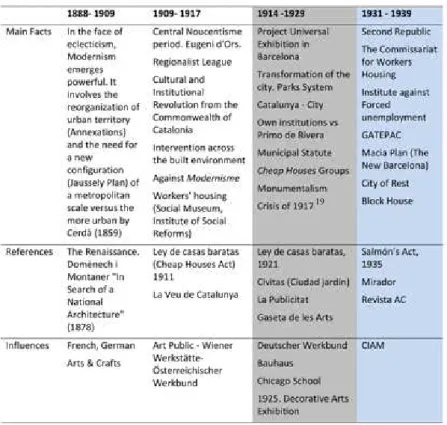
As Sambricio1 points out, when focusing our analysis on the perspective of the
housing problem, we should note that it has to be analyzed in two distinct phases. The first, which began in the late 19th century and is framed in the
general European context of providing housing for workers in crowded cities, was to be implemented in Spain through the development of various “Casas Baratas” (1911; 1921) regulations.2 The second phase of analysis refers to the
more general problem of “city organization” derived from the influences of thinking about Municipalism3 (even during the dictatorship of Primo de Rivera)
and of territorial planning, a thought that represents the emergence of the role of the state as a regulatory body on urban problems. This line of thought led to planning proposals for Madrid and Barcelona, and to the development of various laws. These not only regulated the problem of providing affordable
1 Carlos Sambricio, Cuando se quiso resucitar la Arquitectura, Murcia 1983.
2Casas baratas is a name for low cost dwellings. Both from the perspective of the influence of the legislation
of other countries (France, UK ...) on this type of housing, and for the underlying organizational models (Garden City, Lineal City ....).
3 As is well known, the first phase of the welfare state starts with the transfer to municipal ownership of
some urban infrastructure developed since the late 19th century. Public transport and, in part, housing
housing, but also addressed the more general problem of Spain’s modernization and reorganization of the production system, especially since the economic crises of the 1930s.
“Our age is characterized by a large universal renewal movement. New social structures appear. Modern societies tend to be governed by the same collective needs for all civilized countries. Factories, Schools, Sports. Housing, Leisure. Transport, Roads. URBANISM”.4
In brief, following Flores5 and Bohigas6, I argue that the flourishing Spanish
‘rationalism’ / ‘functionalism’ is articulated in relation to two positions in principle, antagonistic to each other.
On the one hand, in Madrid and Barcelona, architects such as Lacasa, Fernández Shaw, Rubio i Tudurí, without giving up rationalist thought, avoided the mimetic ism of a certain stylistic trend or fad that would configure the repertoire of modern architectural language. As Lacasa7 suggests:
“(…) Now, the issue is just the plastic and aesthetic aspect of architecture, after having witnessed the spectacle of post-expressionists, who consider Cezanne as remote as Amenhotep the IVth. One can but smile seeing a new group that believes they get their hands on the true truth.
As for the list, Oud, Poelzig, Le Corbusier, etc., contain very different qualities, it is not the same Taut, rationalist, Hoffmann, artist and Le Corbusier, journalist and charlatan. (...) However, rationalism is not there in the intellectualized circles but in the work. British architects have absolutely no willingness for the architecture of the cubes, but, instead, have a very solid understanding of what architectural rationalism is. I believe in the current rationalist architecture as a moment of eternal evolution of ideas, even if you will, a radical change in direction, but later
4 GATEPAC, “Editorial”. AC (Actividades Contemporáneas) year 1, 1 (1931). 5 Carlos Flores, Arquitectura española contemporánea, Madrid 1961. 6 Oriol Bohigas, Arquitectüra española la Segunda República, Barcelona 1970.
7 Luis Lacasa, “Respuesta a la Encuesta sobre la Nueva Arquitectura confeccionada por Fernando García
CATALONIA AND MODERN ARCHITECTURE. AN UNFINISHED TALE
other ideas will displace the present, because the technicians do not have the force of Joshua to stop the race of the sun.”
What degree of acclimatization has modern architecture achieved among us? asked himself Rubió i Tudurí8 a couple of years later:
“Here is a question - and then an answer - in which we must not waste much time nor deepen. Though I myself cultivate this architecture of Germanic origins, it would be wrong to attribute great importance to it, even less to burn incense in front of its practitioners. No one a better architect because they follow a fad, even if it is a more intellectual one. In fact, as uninteresting is he who copies the Romans as he who mimics Mies Van der Rohe or Le Corbusier, unless he has other qualities other than being a follower and imitator.”
The architects who showed some resistance to uncritically adopting some postulates of modern architecture are those who Bohigas (1970) dubbed “the side-lines rationalists”. This trend also kept alive the flame of the role and value of the “regional / vernacular architecture” as a way of experimentation and modernization of Spanish architecture in order to allow it to jump to the modern rationalism / functionalism postulates.9
The other trend would group together architects who assumed the tenets of the CIAM’s New Architecture. In this regard, it is important to clarify that we cannot carry the dichotomy to the extreme. Indeed, two years after the Literary
Gazette of Madrid developed its survey on the New Architecture, the Barcelona
newspaper Mirador developed a similar survey. One of those who answered was Josep Lluis Sert, for some, the clearest example of the defence of CIAM principles.
8 N.M. Rubió i Tudurí, “L'aclimatació de l'arquitectura moderna a Barcelona,” in Mirador 93 (1930). 9 See Mónica Vázquez Astorga, La arquitectura vernácula como laboratorio de experimentación y vía de