Offi cial Publication of the Brazilian Society of Anesthesiology www.sba.com.br/rba/index.asp
REVISTA
BRASILEIRA DE
ANESTESIOLOGIA
Abstract
Background and objective: There is not an ideal predictor of weaning from mechanical ventilation (MV). In a large meta-analysis, despite methodological limitations, respiratory rate (RR) was considered a promising predictor. The aim of this study was to evaluate RR as a predictor of weaning failure from MV.
Methods: We prospectively evaluated 166 patients scheduled for weaning from MV. RR and other essential criteria for weaning were evaluated at an early stage of screening. Patients who met the essential screening criteria for weaning underwent spontaneous breathing trial. RR was compared with the following outcomes: weaning success/failure or extubation failure.
Results: Weaning success was present in 76.5% and weaning failure in 17.5% of patients. There were 6% of reintubations. The predictive power for RR weaning failure, RR best cut-off point > 24 breaths per minute (rpm), was: sensitivity 100%, specifi city 85%, and accuracy 88% (ROC curve, p < 0.0001). Of the patients with weaning failure, 100% were identifi ed by RR during screening (RR cut-off > 24 rpm). There were 15% false positives, weaning successes with RR > 24 rpm. Conclusion: RR was an effective predictor of weaning failure. The best cut-off point was RR > 24 rpm, which differed from those reported in the literature (35 and 38 rpm). Only 6% of patients were reintubated, but RR or other weaning criteria did not identify them.
© 2013 Sociedade Brasileira de Anestesiologia. Published by Elsevier Editora Ltda. All rights reserved.
Respiratory Rate as a Predictor of Weaning
Failure from Mechanical Ventilation
Emídio Jorge Santos Lima*
11. MD Intensivist, Associacao de Medicina Intensiva Brasileira (Amib); Coordinator and Daily Physician at the Intensive Care Unit, Hospital Geral de Camacari; Master of Computational Modeling; PhD in Knowledge Diffusion, Universidade Federal da Bahia (UFBA), Salvador, BA, Brazil
Received from the Intensive Care Unit of Hospital Geral de Camacari, Camacari, BA, Brazil.
Submitted on January 27, 2012 Approved on April 2, 2012.
Keywords:
Respiration, Artifi cial; Respiratory Rate; Ventilator Weaning.
SCIENTIFIC ARTICLE
ISSN/$ - see front metter © 2013 Sociedade Brasileira de Anestesiologia. Published by Elsevier Editora Ltda. All rights reserved. * Corresponding author: Rua Manoel Gomes de Mendonça,
207/104 Pituba 41810-820 – Salvador, BA, Brazil E-mail: [email protected].
Introduction
According to the 6th International Consensus Conference in
j) Maximum inspiratory pressure less than 20 cm H2O (MIP < 20 cm H2O);
l) RR/VT < 105 breaths.min-1.L-1;
m) RR ≤ 35 breaths per minute (rpm).
We excluded patients accidentally extubated (n = 4), tracheostomized (n = 24), and those who did not meet the essential criteria for weaning (n = 6).
Clinical and demographic data (Table 1) were collected from medical records and, in dubious cases, from doctors and physiotherapists.
Patients who presented with improvement of the condi-tion that lead to VM, hemodynamic stability, oxygenacondi-tion parameters mentioned above and absence of fever were subjected to the following screening measures, using the ventilator Vela (Viasys, USA) for monitoring:
1) Static compliance (Cst), with sedated patient, in volume control mode, and performing an inspiratory pause;
2) Minute volume (VE) and RR, with unsedated patient, awake and on PSV mode of 7 cm H2O, FiO2 ≤ 40% and PEEP = 5 cm H2O for one minute;
3) VT: resulted from the division of VE by RR;
Table 1 Clinical Characteristics of 166 Patients on Mechanical Ventilation.
Clinical Characteristics Age (years ± DP) 53 ± 22
Female, n 72
Male, n 94
Death, n (%) 29 (17.5)
Discharge, n (%) 137 (82.5)
Duration of MV before weaning (days ± DP)
4 ± 3.6 Weaning success, n (%) 127 (76.5) Weaning failure (SBT failure), n (%) 29 (17.5) Extubation failure, n (%) 10 (6) MV cause, n (%)
Pneumonia 23 (13.8)
Nonrespiratory sepsis 13 (7.8)
Coma 17 (10.2)
Chronic obstructive pulmonary disease 4 (2.4)
Asthma 3 (1.8)
Postoperative 43 (25.9)
Acute Pulmonary Edema 16 (9.6)
Shock 5 (3.0)
Bronchoaspiration 8 (4.8)
Convulsion 7 (4.2)
Exogenous intoxication 12 (7.2)
Drowning 3 (1.8)
Metabolic acidosis 4 (2.4)
Arrhythmias 3 (1.8)
Stridor 1 (0.6)
Traumatic brain injury 1 (0.6)
Miscellany 3 (1.8)
SD: standard deviation; n: number of occurrences; SBT: spontaneous breathing trial.
weaning. In this context, a predictor, such as the rapid shal-low breathing index (RSBI), is initially used as screening and if the result is positive for weaning success, a spontaneous breathing trial (SBT) is started. If the patient passes this test, MV is discontinued and followed by extubation 1. The problem
is that, despite all systematization of the weaning process, backed by different studies that establish the various steps of this process, the average rate of weaning failure is 30%, which is associated with increased morbidity and mortality 1-7.
According to Epstein et al. 6, weaning failure, particularly
extubation failure, is associated with 43% mortality compared to 12% among those with weaning success.
In addition to the previous problem, there is not an ideal predictor of successful weaning. In the largest systematic review of predictors of successful weaning conducted by Meade et al. 8 and involving 65 studies, the studied indices’
predictive ability was considered modest, with RR and RSBI considered promising (sensitivity 88%/specifi city 47% and sensitivity 96%/specifi city 73%, respectively). In most of the 65 analyzed studies, methodological fl aws, such as less than 50 patients per study and statistical defi ciencies, decreased the results’ accuracy 8. In a recent publication, a new
predic-tor resulting from the integration of three other predicpredic-tors was presented: oxygen saturation (SaO2), RSBI (obtained by dividing RR by tidal volume: RR/VT), and static compli-ance (Cst). However, the study’s major limitation was the measurement of this last variable with the patient without sedation and breathing spontaneously, which usually hinders Cst measurement 9.
The aim of this study was to evaluate RR as a predictor of weaning failure from MV.
Method
After approval by the Ethics Committee (025/2006), this prospective study was conducted from March 2009 to August 2011, during which we analyzed the weaning of 166 patients admitted to the Intensive Care Unit (ICU) - with eight beds - of the Hospital Geral de Camaçari (BA). All patients (or their guardians) included in the study signed an informed consent form (ICF).
Patients underwent discontinuation of MV, according to the ICU medical staff guidance.
The study included 166 patients aged over 18 years who met the essential criteria for weaning, according to the 6th International Consensus Conference in Intensive Care
Medicine:
a) Improvement of the condition that lead to VM; b) Discontinuation of sedatives and neuromuscular
blockers;
c) Patient vigil and without agitation; d) Absence of fever or new infection; e) Hemodynamically stable;
f) Absence of metabolic and/or electrolytic disorders; g) Effective cough;
h) Patient with an inspired oxygen fraction less than or equal to 40% (FiO2 ≤ 40%) and positive end-expiratory pressure less than or equal to 5 cm H2O (PEEP ≤ 5 cm H2O) with SaO2 > 90% and ratio of arterial oxygen pressure by the fraction of inspired oxygen greater than 200 (PaO2/FiO2 > 200);
i) Tidal volume greater than 5 mL.kg-1 (V
4) RR/VT: resulted from the division of RR by VT in liters;
5) MIP was measured from the inspiratory occlusion valve.
During screening measurements, patients who had Cst > 25 mL.cm H2O-1; RR ≤ 35 bpm; V
T > 5 mL.kg -1,
f/VT < 105 breaths.min-1.L-1; MIP < -20 cm H
2O underwent
SBT for 30 minutes on PSV mode of 7 cm H2O, FiO2 ≤ 40% and PEEP = 5 cm H2O. RR, VE, and VT were recorded during SBT, minute by minute, using the respirator monitor. Additionally, vital signs data and pulse oximetry were recorded continu-ously on a multiparameter monitor. Throughout the test, the physiotherapist and/or doctor on duty constantly monitored the patient looking for signs of SBT failure 1, namely:
a) RR > 35 bpm;
b) RR/VT > 105 breaths.min-1.L-1;
c) SaO2 < 90%;
d) Tachycardia > 140 bpm or ≥ 20% increase;
e) Systolic blood pressure < 90 mm Hg or > 180 mm Hg or ≥ 20% increase;
f) Arrhythmias;
g) Psychomotor agitation and/or reduced level of consciousness;
h) Dyspnea.
In the presence of any signs described, SBT was interrupted and the patient placed in a ventilation mode that would pro-vide comfort. Data collection was performed by the investiga-tors or by a previously trained physiotherapy team.
Outcomes
a) Weaning success: the patient underwent SBT, was extubated, and without mechanical ventilation for more than 48 hours;
b) Weaning failure: the patient had signs of SBT failure; c) Extubation failure: the patient underwent SBT and
was extubated, but returned to MV within 48 hours after extubation.
All patients were followed-up until discharge or death in the ICU.
Statistical Analysis
Continuous variables were expressed as mean and standard deviation and categorical variables as frequency and percent-age. Mann-Whitney test and Fisher’s exact test were used to compare nonparametric variables and Student’s t-test to compare parametric variables. The following parameters were used to assess the predictive power of RR: sensitivity (SE), specifi city (SP), positive predictive value (PPV), nega-tive predicnega-tive value (NPV), likelihood ratio for a posinega-tive test (LR+), likelihood ratio for a negative test (LR-), accuracy, and area under the ROC curve. The statistical programs used were MedCalc version 11.5.1.0 and BioEstat version 5.0 10,11.
A p-value < 0.05 was considered signifi cant.
Results
In total, 166 patients were evaluated during weaning from MV from March 2009 to August 2011. The mean age of the study population was 53 ± 22 years, with 94 males and 72
females, and mean duration of MV before weaning was 4 ± 3.6 days. Postoperative period was the most common cause of MV (25.9%), followed by pneumonia (13.8%), coma (10.2%), acute pulmonary edema (9.6%), sepsis (7.8%), exogenous intoxication (7.2%), aspiration (4.8%), and seizures (4.2%) (Table 1).
At the end of the study, 137 (82.5%) patients were dis-charged from the ICU and 29 (17.5%) died in that unit. Weaning success occurred in 127 (76.5%); weaning failure in 29 patients (17.5%), and extubation failure in 10 patients (6%).
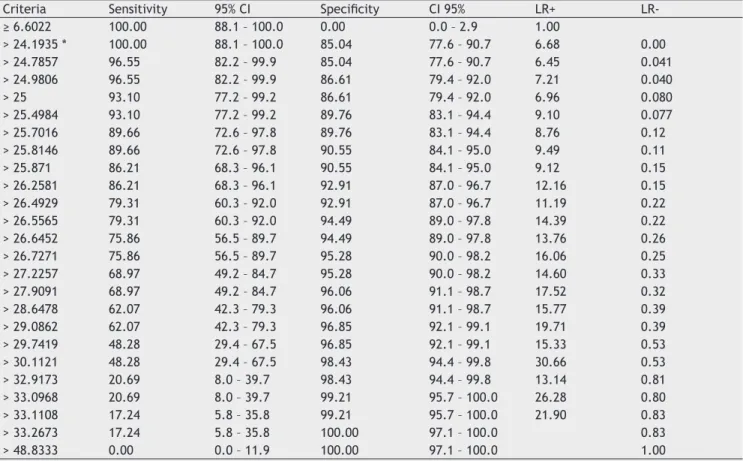
Of the patients with weaning failure, 100% presented with RR > 24 bpm during screening measurement and SBT (Graphic 1 and Table 2). This pattern of tachypnea remained throughout SBT up to suspension, with the onset of signs of SBT failure. The major cause of extubation failure was acute pulmonary edema (APE), present in fi ve out of 10 patients (50%), followed by bronchospasm in three patients (30%). The two remaining cases of failure were laryngeal edema and respiratory infection (Table 3).
There was a lower mortality rate (12.6%) among patients with weaning success (16/127), followed by the rate (20.7%) among patients with weaning failure (6/29). Patients with extubation failure had the highest mortality rate (70%), and compared with that observed among the successes, the dif-ference was statistically signifi cant (p = 0.0001).
Considering the best cut-off point as RR > 24.19 bpm, the RR generated by the ROC curve presented the follow-ing predictive power for weanfollow-ing failure: SE 100%, SP 85%, NPV 100%, PPV 60%; LR+ 6.68; LR- 0.00, and accuracy 88% (p < 0.0001; Table 2 and Graphic 1). During screening and SBT stages, RR behavior was characterized by increased weaning failure (RR = 31 ± 6 bpm) and normal among suc-cesses (RR = 19 ± 5 bpm) (p < 0.0001). There was no dif-ference in RR behavior among patients with extubation failure (RR = 18 ± 6 bpm) compared to the success cases (RR = 19 ± 5 bpm); p = 0.7313.
Discussion
On average, 46% of the patients admitted to the ICU require MV as fundamental life support, but this procedure is as-sociated with signifi cant rates of morbidity and mortality, which are directly proportional to the duration of MV and weaning failure 5,6,12-16. The need to develop new
strate-gies to remove the patient from MV as early as possible is evident. According to Coplin et al. 7, delayed extubation
was associated with a statistically signifi cant increase in mortality (RR for death 2.2, 95% CI: 1.0-4.7). Boles et al. 1
have proposed the early investigation of weaning capacity to avoid its delay.
A systematic daily evaluation of the possibility of wean-ing is an independent predictor of successful extubation and survival 12. In this context, the investigation of predictors
that, combined with clinical experience, improve the success rates of weaning is essential and justifi ed our study.
The rates of weaning success (76.5%) and failure (23.5%) in the present study are close to those reported in the literature (70% and 30%, respectively 1). The causes of MV
Table 2 Predictive Power of Respiratory Rate for Different Cut-off Points in 156 Patients during Weaning (127 weaning successes and 29 failures).
Criteria Sensitivity 95% CI Specifi city CI 95% LR+
LR-≥ 6.6022 100.00 88.1 – 100.0 0.00 0.0 – 2.9 1.00
> 24.1935 * 100.00 88.1 – 100.0 85.04 77.6 – 90.7 6.68 0.00
> 24.7857 96.55 82.2 – 99.9 85.04 77.6 – 90.7 6.45 0.041
> 24.9806 96.55 82.2 – 99.9 86.61 79.4 – 92.0 7.21 0.040
> 25 93.10 77.2 – 99.2 86.61 79.4 – 92.0 6.96 0.080
> 25.4984 93.10 77.2 – 99.2 89.76 83.1 – 94.4 9.10 0.077
> 25.7016 89.66 72.6 – 97.8 89.76 83.1 – 94.4 8.76 0.12
> 25.8146 89.66 72.6 – 97.8 90.55 84.1 – 95.0 9.49 0.11
> 25.871 86.21 68.3 – 96.1 90.55 84.1 – 95.0 9.12 0.15
> 26.2581 86.21 68.3 – 96.1 92.91 87.0 – 96.7 12.16 0.15
> 26.4929 79.31 60.3 – 92.0 92.91 87.0 – 96.7 11.19 0.22
> 26.5565 79.31 60.3 – 92.0 94.49 89.0 – 97.8 14.39 0.22
> 26.6452 75.86 56.5 – 89.7 94.49 89.0 – 97.8 13.76 0.26
> 26.7271 75.86 56.5 – 89.7 95.28 90.0 – 98.2 16.06 0.25
> 27.2257 68.97 49.2 – 84.7 95.28 90.0 – 98.2 14.60 0.33
> 27.9091 68.97 49.2 – 84.7 96.06 91.1 – 98.7 17.52 0.32
> 28.6478 62.07 42.3 – 79.3 96.06 91.1 – 98.7 15.77 0.39
> 29.0862 62.07 42.3 – 79.3 96.85 92.1 – 99.1 19.71 0.39
> 29.7419 48.28 29.4 – 67.5 96.85 92.1 – 99.1 15.33 0.53
> 30.1121 48.28 29.4 – 67.5 98.43 94.4 – 99.8 30.66 0.53
> 32.9173 20.69 8.0 – 39.7 98.43 94.4 – 99.8 13.14 0.81
> 33.0968 20.69 8.0 – 39.7 99.21 95.7 – 100.0 26.28 0.80
> 33.1108 17.24 5.8 – 35.8 99.21 95.7 – 100.0 21.90 0.83
> 33.2673 17.24 5.8 – 35.8 100.00 97.1 – 100.0 0.83
> 48.8333 0.00 0.0 – 11.9 100.00 97.1 – 100.0 1.00
CI: confi dence interval; LR+: likelihood ratio for a positive test; LR-: likelihood ratio for a negative test; *: best cut-off point.
Table 3 Clinical Characteristics of 10 Reintubated Patients.
Sex Age (years) Intubation cause Reintubation cause
Time interval for reintubation (hours)
Outcome Observation
Male 72 AMI/APE APE 12 Death
Female 54 Sepsis/UTR APE 6 Death WBC 17200
Female 62 APE/SAH APE 6 Death WBC 31900
Male 65 Uremia APE 24 Death WBC 20300
Female 68 CHF APE 4 Death
Male 79 Sepsis BESP 12 ICU discharge
Male 75 Seizures BESP 4 ICU discharge
Female 64 PO BESP Death WBC 15400
Female 29 Pneumonia Stridor 6 ICU discharge 1 previous FE
Male 77 Aspiration Pneumonia 24 Death
AMI: acute myocardial infarction; APE: acute pulmonary edema, UTR: pneumonia; WBC: white blood cell count; SAH: systemic arterial hypertension, CHF: congestive heart failure; BESP: bronchospasm; EF: extubation failure.
Extubation failure (EF) was associated with higher mortal-ity rate (70%). Several studies show that EF is associated with increased mortality 2,3,6,18-20. According to Epstein et al. 6, the
mortality rate in patients with EF was 43% compared to 12% among those with weaning success (p < 0.0001).
Identifying patients with the possibility of extubation failure remains a major challenge for all who study weaning. The current predictive indices do not distinguish patients who, after a satisfactory SBT, will be reintubated from those who will be successfully extubated 3,19.
In our series, the group of patients who were reintu-bated was characterized by elderly individuals (mean age 64 ± 15 years); 40% had severe comorbidities (AMI Killip class III, CHF, SAH, renal failure), and 40% had signifi cant leukocytosis (over 15,000), which could indicate an under-lying infl ammatory process, a new or persistent infection. One patient had laryngeal edema after two tracheal intuba-tions and another had pneumonia 24 hours after extubation (Table 3). According to Esteban et al. 3, respiratory failure
leading to reintubation is due to conditions arising after extubation, such as bronchospasm, laryngeal edema, and pneumonia. In our patients, cardiovascular comorbidities (CHF, SAH, AMI) predispose the occurrence of APE, the most frequent cause of reintubation (50%). Study of conditions leading to reintubation should create strategies to reduce EF rates 3. It is noteworthy that the rate of reintubation of
6% was lower than that reported in the literature(13%) 1,
which may be due to the rigor of including only patients who met all essential criteria for weaning.
During analysis, RR proved to be a practical and effi cient predictive index (SE 100%, SP 85%, and accuracy 88% for a cut-off point of RR > 24 bpm), able to identify 100% of patients with weaning failure during screening and SBT stages on PSV mode. In other words, all patients with weaning failure had a RR > 24 bpm during the screening stage and maintained it during SBT.
There were 15% of false positive cases of weaning success with RR > 24 rpm; in these patients, the response to mental suffering or adaptation to pathological conditions was identi-fi ed (Table 4), with increased RR during screening and SBT stages, without cardiorespiratory involvement. In this con-text, the continuous monitoring of patients by the team that identifi ed the conditions responsible for isolated tachypnea
100
80
60
40
20
0
0 40 80
Sensitivity
Sensitivity 100% Specificity 85% Cut-off RR > 24.19 bpm
Specificity-100
Graphic 1 ROC Curve of Respiratory Rate and Best Cut-off Point in 156 patients (127 weaning successes and 29 failures). RR: respiratory rate; bpm: breaths per minute.
Table 4 Conditions Related to Respiratory Rate (RR) > 24.19 bpm and Weaning Success (false positive) in 19 Patients.
RR (bpm) Condition Management during SBT
25 Attempted suicide/odynophagia Analgesia and anxiolytic
26 ICH sequel/paresis Observation
33 Pulmonary fi brosis Observation
27 Pneumonia treatment Observation
29 IS/CRF/AF sequel Observation
25 Congestion Diuretics and fl uid restriction
26 Anxiety and agitation Anxiolytic
25 Abdominal pain Analgesia
25 IS sequel/coma vigil Observation
26 CHF/EF = 34% Observation
26 Anxiety and agitation Anxiolytic
25 Pneumonia treatment Observation
25 Congestion Diuretics and fl uid restriction
26 Anxiety and agitation Anxiolytic
33 Anxiety and agitation Anxiolytic
28 Chronic asthma/dehydration Rehydration
30 Compensated metabolic acidosis Observation
26 Anxiety and agitation Observation
30 Attempted suicide Anxiolytic
and correctly chose weaning was important. Patients with psychiatric disorders characterized by psychomotor agita-tion were treated with doses of sedative for anxiety, which enabled the weaning process.
Conclusion
In this study population, RR was an effi cient predictor of weaning failure easy to be recorded from the respirator, exempting calculations by the assistants. In the initial screening phase, RR > 24 bpm was present in 100% of pa-tients who would have a weaning failure during SBT (sen-sitivity 100%). RR ≤ 24 bpm was found in the initial stage of screening in 85% of patients who would have a weaning success (specifi city 85%). The 15% of false positive cases (successful weaning with RR > 24 bpm) are acceptable and were identifi ed by clinical evaluation. A predictor of weaning failure has to have a sensitivity of 100%, even if it involves some loss of specifi city, because it decreases the chance of early MV discontinuation and associated cardiorespiratory risks. In this study, the best cut-off point of 24 bpm generated by the ROC curve suggests that the cut-off points of 35 and 38, mentioned in the literature, are too high for our reality 1,8.
References
1. Boles JM, Bion J, Connors A et al. – Weaning from mechanical ventilation. Eur Respir J, 2007; 29(5):1033-1056.
2. Esteban A, Alía I, Tobin MJ et al. – Effect of spontaneous breathing trial duration on outcome of attempts to discontinue mechanical ventilation. Spanish Lung Failure Collaborative Group. Am J Respir Crit Care Med, 1999;159(2):512-518. 3. Esteban A, Alía I, Gordo F et al. – Extubation outcome after
spontaneous breathing trials with T-tube or pressure support ventilation. The Spanish Lung Failure Collaborative Group. Am J Respir Crit Care Med, 1997;156(2 Pt 1):459-465.
4. Esteban A, Alía I – Weaning from mechanical ventilation. Crit Care, 2000;4(2):72-80.
5. Torres A, Gatell JM, Aznar M et al. – Reintubation increases the risk of nosocomial pneumonia in patients needing mechanical ventilation. Am J Respir Crit Care Med, 1995;152(1):137-141.
6. Epstein SK, Ciubotaru RL, Wong JB – Effect of failed extubation on the outcome of mechanical ventilation. Chest, 1997;112(1):186-192.
7. Coplin WM, Pierson DJ, Cooley KD et al. – Implications of extubation delay in brain-injured patients meeting standard weaning criteria. Am J Respir Crit Care Med, 2000;161(5):1530-1536.
8. Meade M, Guyatt G, Cook D et al. – Predicting success in weaning from mechanical ventilation. Chest, 2001; 120(Suppl 6):400S-424S.
9. Nemer SN, Barbas CS, Caldeira JB et al. – A new integrative weaning index of discontinuation from mechanical ventilation. Crit Care, 2009;13(5):R152.
10. MedCalc 11.5.1.0. Disponível em: http://www.medcalc.org/ download.php. Acessado em: 11/9/2011.
11. BioEstat 5. Disponível em: http://www.mamiraua.org.br/ download/. Acessado em: 11/9/2011.
12. Ely EW, Baker AM, Evans GW et al. – The prognostic signifi cance of passing a daily screen of weaning parameters. Intensive Care Med, 1999;25(6):581-587.
13. De Lassence A, Alberti C, Azoulay E et al. – Impact of unplanned extubation and reintubation after weaning on nosocomial pneumonia risk in the intensive care unit. A prospective multicenter study. Anesthesiology, 2002;97(1):148-156. 14. American Thoracic Society – Guidelines for the management
of adults with hospital-acquired, ventilator-associated, and healthcare-associated pneumonia. Am J Respir Crit Care Med, 2005;171(4):388-416.
15. Esteban A, Alía I, Ibañez J et al. – Spanish lung collaborative group. Modes of mechanical ventilation and weaning. A national survey of Spanish hospitals. Chest, 1994;106(4):1188-1193.
16. Yamauchi LY – Falência do desmame: risco, fatores associados e prognóstico de pacientes sob ventilação mecânica prolongada [Tese]. São Paulo, Faculdade de Medicina, Universidade de São Paulo, 2004, p. 87.
17. Esteban A, Anzueto A, Frutos F et al. – Characteristics and outcomes in adult patients receiving mechanical ventilation. A 28-day international study. JAMA, 2002;287(3):345-355. 18. Seymour CW, Martinez A, Christie JD et al. – The outcome of
extubation failure in a community hospital intensive care unit: a cohort study. Crit Care, 2004;8(5):R322-R327.
19. Vallverdú I, Calaf N, Subirana M et al. – Clinical characteristics, respiratory functional parameters, and outcome of a two-hour T-piece trial in patients weaning from mechanical ventilation. Am J Respir Crit Care Med, 1998;158(6):1855-1862.