ABSTRACT:Objective: To describe the prevalence and to analyze the factors associated with hearing problems in an agricultural company. Methods: This was a cross-sectional study, and the participants consisted entirely of employees of an agricultural company in southern Brazil. The workforce of the company was composed of several diferent occupations. The research instrument was a semi-structured questionnaire administered by interview. Results: Of the 326 workers of the company, there were 273 (83.8%) respondents, and the prevalence of hearing problems was n = 42 (15.4%) among the participants of the study. The hearing problems were associated with lower schooling, with the operating occupational group, the technical assistance group and the general services group. The self-reported health conditions associated with hearing problems were depression and nervousness or irritation. The occupational exposures associated with hearing problems were noise, dust, vibration, oils and solvents, and toxic gases. Conclusion: There was an intermediate prevalence of hearing problems in relation to other studies. It was possible to observe the need to implement strategies aiming at the prevention of hearing problems that primarily contemplate modiiable aspects, such as the use of personal protective equipment, as well as improvements in the conditions, organization and work environment.
KEYWORDS: Hearing loss. Occupational exposure. Occupational health. Epidemiology. Agricultural workers’
diseases. Chemical compounds.
Prevalence of hearing problems
and associated factors in an
agricultural company in southern Brazil
Prevalência de problemas auditivos e fatores
associados em uma empresa agropecuária do sul do Brasil
Rafael HaefnerI, Leila Maria Mansano SarquisII, Rita Maria HeckIII, Vanda Maria da Rosa JardimIII
IGraduate program in Epidemiology, Universidade de São Paulo – São Paulo (SP), Brasil.
IINursing School, Universidade Federal do Paraná – Curitiba (PR), Brazil.
IIINursing School, Universidade Federal de Pelotas – Pelotas (RS), Brazil.
Corresponding author: Rafael Haefner. Rua Joaquim Nabuco, 2.060, Centro, CEP: 85003-160, São José dos Pinhais, PR, Brasil. E-mail: [email protected]
Conlict of interests: nothing to declare – Financial support: none.
INTRODUCTION
Globalization and the expansion of economies around the world result in great impact on the health of workers, for they impose higher productivity and loads of adverse occupational exposures to workers, especially to the hearing system. Hearing may be considered one of the most important senses, being mostly in charge of communication, and generates the psychosocial development of people1. Hearing conditions will be one of the ten most
common health problems in the world up until 20302.
Hearing problems, especially the ones that might be related to work, must be considered in the context of occupational health, for the impaired social communication may reduce productivity at work, besides compromising the quality of sleep for workers. It is noticeable in this sense the importance and great socioeconomic impact these problems may bring upon society3.
Hearing problems are generated by several associated factors, with multiple causes, such as noise, occupation, working hours, chemicals, solvents, toxic gases, among other labor issues3-6. Such aggravations may be associated to other health conditions, such as mental and
cardiovascular disorders7-9. There are studies indicating the prevalence of 10 to 15% people
afected by hearing problems in the overall population2. Part of these studies also analyzes
hearing problems in relation to gender and age.
Studies assessing hearing problems of occupational origin under the light of several aspects are of great relevance, once that such studies are scarce in Brazil and the workforce in the country increases, with approximately 96 million workers nowadays10. The objective
RESUMO:Objetivo: Descrever a prevalência e analisar os fatores associados a problemas auditivos em uma empresa agropecuária. Métodos: Foi realizado um estudo de corte transversal, os participantes do estudo foram os trabalhadores de uma empresa agropecuária do sul do Brasil. A força de trabalho da empresa contava com as mais diversas ocupações. O instrumento da pesquisa foi um questionário semiestruturado aplicado por meio de entrevistas. Resultados: Dos 326 trabalhadores da empresa foram entrevistados 273 (83,8%) e foi encontrada uma prevalência de problemas auditivos de n = 42 (15,4%) entre os participantes da pesquisa. Os problemas auditivos foram associados com níveis mais baixos de escolaridade e ao grupo ocupacional operacional, técnico assistencial e serviços gerais. As condições de saúde autorreferidas com associação para problemas auditivos foram depressão e irritação ou nervosismo. As exposições ocupacionais associadas aos problemas auditivos foram barulho, pó, vibrações, óleos e solventes e gases tóxicos. Conclusão: Houve uma prevalência intermediária de problemas auditivos em relação a outras pesquisas. Observou-se a necessidade da implantação de estratégias que visem à prevenção de problemas auditivos que contemplem principalmente os aspectos modiicáveis, como a utilização de equipamento de proteção individual, e melhorias nas condições, organização e ambiente de trabalho.
of this study was to describe the prevalence and to analyze the factors associated to hearing problems in an agricultural company in Southern Brazil.
METHODS
This is a quantitative, observational, cross-sectional study. It is part of the research project from the Nursing School at Universidade Federal de Pelotas, Rio Grande do Sul. It was carried out in a midsized agricultural company, in Southern Brazil, and it is connected to the Ministry of Agriculture, Livestock and Supply. The participants of the study were all workers from the aforementioned company, aged 18 years old or older. For the inclusion of participants, the following criterion was used: being an efective worker in the company. The informed consent form was signed by the participants of the research. The population of agricultural workers included the following ields: administrative assistance, supervision/ management, operational, scientiic technician, assistencial technician, research and general services. The sectors were divided into support, research, laboratory and ield.
A brief description was given for the composition of occupational groups: administrative assistance (secretary, administrative auxiliary and board counselors); supervision/management (supervisors, managers and company managers); operational (machine and vehicles operators, general staf, drivers, doormen, guards, telephone operators, ilders and “laborers”); research (researchers from several ields in the company); scientiic technician (workers with academic education); assistencial technician (mid-leveled workers with a technical course in a working ield); general services (workers responsible for the cleaning and sanitization of the company). As for sectors, they were divided into support sector (regarding administration, management, inancial, communication, marketing, culture, purchasing and human resources areas); research sector (regarding the diferent areas of proiciency involved in animal and vegetal agricultural research, genetic improvements, agroecology, climatology and agrometeorology); laboratory sector (regarding the most numerous laboratories for analysis from the company); ield sector (includes all work performed in the ield, regarding the treatment of animal in research; planting, growing and harvesting of the vegetal specimens researched).
The instrument used for data collection was multidimensional, semi-structured with open and closed questions, consisting of socioeconomic and demographic questions about lifestyle, occupation, organization and work conditions, occupational exposure/load, perception of overall morbidity related to work11. The interviews were conducted in the
company during the work shift with a previous authorization from the company. For data collection, nursing school students were skilled to conduct the interviews. The period of data collection was between the months of June and October, 2008. In the case of workers who were not at the company at the moment of the interviews, there were at least three other attempts of approaching these workers.
collected through the questionnaires. The data were inserted through independent double typing, using the Epi Info software, version 6.04. After veriication and correction of errors and inconsistencies, data analysis was performed by the STATA software, version 12.
Qualitative variables such as dichotomous, polytomous and continuous ones were analyzed. The variables analyzed were: gender; age/age range (up to 44 years of age, 45 – 50 years of age, 51 years of age onward); schooling (elementary school, high school, higher education and higher education with post-graduation). The occupational groups and job sectors in the company, as well as time working in the occupation (up to 72 months, 73 – 240 months, and from 241 months on) were also analyzed. The occupational aggravation of hearing problems, exposures due to the process and organization of work, and the comorbidities were guided by the following questions: Do you think your job usually causes you diiculties hearing/ buzzing (yes/no)?; Did you have hearing problems within the last 30 days (yes/no)?; Do you endure the following situations at work (yes/no)? (noise, exposure to dust, vibrations, use of oils and solvents, exposure to smoke or toxic gases); Do you think your job usually causes you to feel irritation or nervousness (yes/no)?; Do you have any of these diseases (yes/no)? (depression, congestive heart failure [CHF], cardiac arrhythmia).
Data analysis used absolute and relative frequencies for the socioeconomic, demographic and work organization variables; besides, the 95% conidence interval (95%CI) was calculated, for the occupational aggravation hearing problems related to work. For the variable age and time of work we calculated the mean, median, standard deviation, maximum and minimum value.
The calculation of prevalence ratio (PR) was performed to obtain the measure of efect for association12 with 95%CI between the dependent variable (hearing problems related to
self-reported work) and the variables independent of occupational exposure (noise; exposure to dust; vibrations; use of oils and solvents at work; exposure to toxic gases). The PR of hearing problems was also measured with other health conditions or comorbidities, such as irritation or nervousness related to work; self-referred depression; CHF; cardiac arrhythmia; considering p < 0.05 to be signiicant.
After gross analysis, an adjusted analysis was performed with the Poisson regression13
for the variables occupational exposure and comorbidities mentioned for the variables with potential confounding factors for the outcome, hearing problems, the variable gender, and especially age because of the presbycusis which might occur within older age ranges14,
considering p < 0.05 to be signiicant; 95%CI was described. The variables that obtained p < 0.20 in the Gross analysis were maintained.
Perason’s χ2 test was used in order to compare the diferences in the proportions of
hearing problems as for gender, age range, schooling, hearing problems in the last 30 days, occupational groups, working sectors of the workers and the time of work in the occupation, considering p < 0.05 to be signiicant
The research project was sent to the Research Ethics Committee of the School of Dentistry
at Universidade Federal de Pelotas, Rio Grande do Sul, in accordance to Resolution 196/96 of
RESULTS
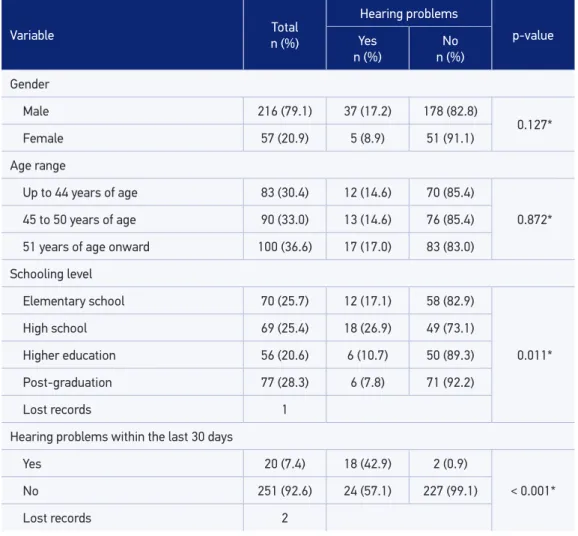
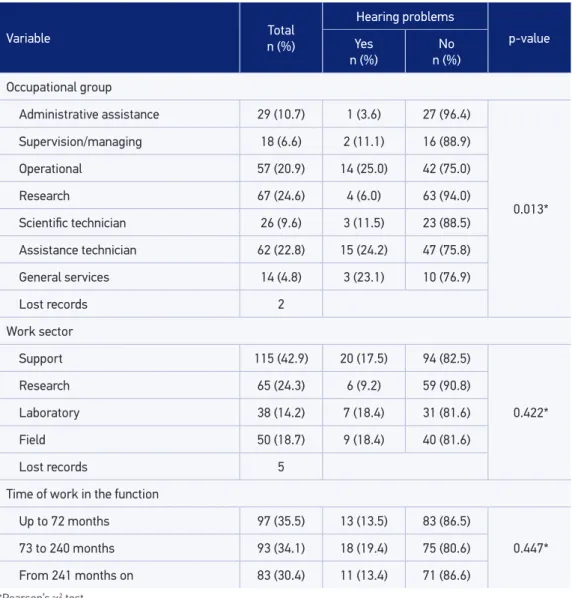
In the period of the interviews the company had 326 workers, from which 10 were on leave for professional improvement and technical trips, 8 were on leave for medical reasons and 4 were on vacation, totaling 304 workers who performed activities in company ground at the time of data collection. Between losses and refusals, this research had the participation of 273 (83.8%) workers. In the results found in Table 1, regarding the sociodemographic characteristics of the company, there is prevalence of male workers (79.1%). The average age of the workers was 47.6 years, the median was 49 years of age, the standard deviation (SD) was 8.2 years of age, the minimum age was 19 and the maximum was 69 years of age. Almost one third of the workers (27.8%) have a graduation degree when it comes to schooling level. The mean time in the function was 167.3 months, the median was 132 months, the SD was 127.2 months, the minimum time was 1 month and the maximum was 624 months in the function (Table 2).
The prevalence of hearing problems related to work in the company was 15.4% (95%CI 11.3 – 20.2). For the variable gender, the diference between men and women for hearing problems was not signiicant; males were more often afected, with 17.2% (n = 37), and for females we found 8.9% (n = 5) of workers with hearing problems. The age range which has drawn more attention for hearing problems was from 51 years of age onward (17%). As to schooling level, there was a signiicant diference (p = 0.011) between groups, showing that the ones with elementary school (17.2%) and high school (26.9%) were mostly afected by hearing problems related to work. And 42.9% (n = 18) of the workers with hearing problems related to work referred having had hearing problems within the last 30 days before the interview, whereas only 0.9% (n = 2) who did not report the aggravation had hearing problems within the last month, with a signiicant diference (p < 0.001).
According to Table 2, it is observed that there was a signiicant diference (p = 0.01) between occupational groups for hearing problems related to work, prevailing in the operational group (25%), in the assistencial group (24.2%) and in the general services one (23.1%). For the remaining variables described in this table we did not ind signiicant diferences between the groups. The working sector which had fewer problems was the research one (9.2%) and in the other sectors the occurrence was similar, at around 18%. The time in the function often related to hearing problems was from 6 to 20 years (19.4%).
Table 1. Prevalence of hearing problems and the distribution of workers according to gender, age range, schooling level and hearing problems within the past 30 days (n = 273), Southern Brazil, 2008.
*Pearson’s χ2 test.
Variable n (%)Total
Hearing problems
p-value Yes
n (%) n (%)No
Gender
Male 216 (79.1) 37 (17.2) 178 (82.8)
0.127*
Female 57 (20.9) 5 (8.9) 51 (91.1)
Age range
Up to 44 years of age 83 (30.4) 12 (14.6) 70 (85.4)
0.872*
45 to 50 years of age 90 (33.0) 13 (14.6) 76 (85.4)
51 years of age onward 100 (36.6) 17 (17.0) 83 (83.0)
Schooling level
Elementary school 70 (25.7) 12 (17.1) 58 (82.9)
0.011*
High school 69 (25.4) 18 (26.9) 49 (73.1)
Higher education 56 (20.6) 6 (10.7) 50 (89.3)
Post-graduation 77 (28.3) 6 (7.8) 71 (92.2)
Lost records 1
Hearing problems within the last 30 days
Yes 20 (7.4) 18 (42.9) 2 (0.9)
< 0.001*
No 251 (92.6) 24 (57.1) 227 (99.1)
Lost records 2
DISCUSSION
This study presented a prevalence of 15.4% (95%CI 11.3 – 20.2) hearing problems and associations especially with low schooling, occupational group, exposure to noise and health conditions, such as irritation due to work and depression.
In other countries around the world the prevalence of hearing problems varied. In Switzerland it was 31%2,15. In Norway, in a research conducted with various occupations,
the prevalence of this problem was 16.4%3, In the United States it was 16.1%8, and in Korea,
Table 2. Prevalence of hearing problems and distribution of workers according to the variables of the occupational group, work sector and time of work in the function (n = 273), Southern Brazil, 2008.
Variable n (%)Total
Hearing problems
p-value Yes
n (%) n (%)No
Occupational group
Administrative assistance 29 (10.7) 1 (3.6) 27 (96.4)
0.013*
Supervision/managing 18 (6.6) 2 (11.1) 16 (88.9)
Operational 57 (20.9) 14 (25.0) 42 (75.0)
Research 67 (24.6) 4 (6.0) 63 (94.0)
Scientiic technician 26 (9.6) 3 (11.5) 23 (88.5)
Assistance technician 62 (22.8) 15 (24.2) 47 (75.8)
General services 14 (4.8) 3 (23.1) 10 (76.9)
Lost records 2
Work sector
Support 115 (42.9) 20 (17.5) 94 (82.5)
0.422*
Research 65 (24.3) 6 (9.2) 59 (90.8)
Laboratory 38 (14.2) 7 (18.4) 31 (81.6)
Field 50 (18.7) 9 (18.4) 40 (81.6)
Lost records 5
Time of work in the function
Up to 72 months 97 (35.5) 13 (13.5) 83 (86.5)
0.447*
73 to 240 months 93 (34.1) 18 (19.4) 75 (80.6)
From 241 months on 83 (30.4) 11 (13.4) 71 (86.6)
*Pearson’s χ2 test.
related to work, in this country the prevalence varied a lot, from 5.66 to 45.9% among workers17,18. In a population-based study7, a prevalence of 5.21% of hearing problems
was found. Other analyses showed diferent prevalence rates from the previous ones, one involving farmers, in which the prevalence was 15.7%6, and another one, that surveyed
and smoking, found 15% of prevalence for hearing deicit19. Such results corroborate the
indings of this research.
Hearing problems more often affect males. According to some studies3,15,20-23, this
susceptibility related to male gender for hearing problems may be explained due to the protective functions of estrogens in women, considering estradiol is an important regulator of hearing in females15.
As for other sociodemographic questions, the low schooling levels may be associated to higher occurrence of hearing problems8. In this study, the highest occurrence of hearing
problems was in low schooling levels, this relation was associated signiicantly (p = 0.11). This may have occurred because workers with low schooling levels were in positions of higher exposure and consequently more vulnerable to hearing problems. Another signiicant association was the one of workers with hearing problems in relation to the recurrence of hearing problems within the last 30 days, with p < 0.001.
The diference in the prevalence of hearing problems among professionals in the same occupational group may be similar, however, when different occupational groups are compared, these data may vary, considering the diference between them for the multiplicity of occupational exposures and response doses to which each one is submitted. The operational workers, assistencial and general service technicians, crane operators, miners, metal board handlers, mechanics, tractor operators, among others have higher chances of having hearing
Table 3. Gross and adjusted analysis for gender, age of association of the hearing problems according to the variables of exposure and comorbidities (n = 271), Southern Brazil, 2008.
Variable Gross analysis Adjusted analysis
PR* (95%CI) p-value PR** (95%CI) p-value
Noise 4.22 (2.02 – 8.82) < 0.001 4.25 (2.00 – 9.01) < 0.001
Dust 2.17 (1.11 – 4.24) 0.023 2.12 (1.09 – 4.15) 0.028
Vibrations 2.72 (1.49 – 4.99) 0.001 2.54 (1.35 – 4.76) 0.004
Use of oils, solvents at work 2.39 (1.29 – 4.44) 0.005 2.38 (1.28 – 4.41) 0.006
Toxic gases 3.07 (1.67 – 5.66) < 0.001 3.00 (1.62 – 5.54) < 0.001
Irritation or nervousness at work 2.72 (1.47 – 5.04) 0.001 3.09 (1.65 – 5.79) < 0.001
Self-referred depression 2.16 (1.00 – 4.68) 0.050 2.36 (1.08 – 5.13) 0.031
Congestive Heart Failure 3.12 (1.11 – 8.76) 0.030 2.82 (0.98 – 8.11) 0.054
Cardiac arrhythmia 1.92 (0.85 – 4.34) 0.115 1.89 (0.83 – 4.31) 0.126
problems in relation to those who have administrative, teaching and research professions3,18,
similar to the results of this research.
In relation to time of work in the occupation, studies1,5,19,24 show that as the time of work
progresses, the workers have worse hearing function. This fact is understandable, as there is higher exposure to risk factors in relation to the shorter time of work in the function. In this study it was observed, in relation to the time in the function, that the workers afected had from 6 to 20 years of time in the function, without signiicant associations.
In this research we found some occupational exposure which stood out with signiicant association with hearing problems of work, dust, vibrations, oils and solvents, toxic gases and irritation or nervousness caused by the work, considering that the hearing problems of occupational origin may be associated with other exposures besides noise25.
The noise in its diferent qualities may be harmful and one of the main occupational causes of hearing problems related to work, which were found in other studies and corroborate our results1,5,14,17,22,24,26,27.
The exposure to excessive noise may histologically change cochlea hair cells, or even lead to the hair loss, among other vascular damages and damages to the neural structures responsible for hearing28. In Brazil there are rules for the prevention of diseases related to
work, such as Norma Regulamentadora 15 (NR-15), which establishes the parameters of limits of tolerance for continuous or intermittent noise among labor risks, considering that this is one of the main factors for hearing loss of occupational origin29. Norma Regulamentadora 6
(NR-6) regards the use of Personal Protective Equipment (equipamentos de proteção individual – EPI), which is a set of tools against one or more occupational risks. In the case of hearing diseases origined at work, one of the main EPI is an earplug protector, a very efective barrier against noises30.
This study showed that the vibration is associated to hearing problems, despite the lack of studies conirming this inding. The vibrations, whether focused on an anatomical regions or throughout the body, have been related to hearing deicit14,27.
The ear and neurotoxicity of chemical agents from dust, oils and solvents, for example, toluene, benzene, styrene and others, may cause damage both to the peripheral and central hearing systems, in general being absorbed by the respiratory system and skin, also being able to cause cochlear dysfunction4,31,32. The gases and toxic smokes, such as carbon monoxide,
carbon disulide and pesticides with high toxicity levels, have ototoxic efects and induce deleterious changes to hearing, especially when the prolongs exposure of the worker to this risk factor occurs16,19,28.
The irritation or nervousness caused by organization situations at work may lead to high cortisol levels in blood and consequently to stress; and when it occurs in a continuous way it may cause work diseases such as the Burnout syndrome, in addition to hearing deicit without apparent organic cause3,7,15.
emotional and psychosocial origin3,9. The psychopathologies may be related to heading
loss, as a result from exhaustion of cognitive reservation, social isolation or a combination of those aspects7,21. Still, cardiovascular diseases may be associated to hearing problems,
according to researches8,9.
Among the limitations of the study, the potential for memory biases is stressed, since it is a cross-sectional study. Another limitation was the losses, accounting for 16.2% of the workers in the company, which enables the biases of possible selection, however diicult in which the sample efect of a “healthy worker” occurred, once the losses occurred mostly due to the license to professional capacitation, vacation or work. The instrument dealt with hearing problems in general in a non-speciic way. However, there was the advantage of the instrument being multidimensional and having the “blind” efect between interviewee and interviewed, for the alternance of subjects during the interview33. The guarantee for
anonymity may have reduced the information bias. This study is hard to be generalized, once it was carried out only in one company and with losses.
In the period of the research, the company used to have the Serviço Especializado em
Engenharia de Segurança e em Medina do Trabalho (SESMT) and the Comissão Interna de Prevenção
a Acidentes (CIPA). The SESMT consisted of two technicians in work security and one work
engineer. Besides that, they fulilled NR-6, providing EPI and monitoring work practices of workers as much as possible. The company had more than two work substations, in addition to occupying an extense territorial area, which possibly hinders the simultaneous and constant monitoring of the workers.
The company researched adopts the Policy of 100% Tobacco-Free Environments (Política
de Ambientes 100% Livres de Tabaco), through the federal Law No. 9.294/96, in order to avoid
passive smoking and to promote a healthier work environment; and for the prevention of comorbidities in general and to avoid the potentialization of work diseases. For such, actions such as distributions of information and posters throughout the company on the subject are performed, mapping of the amount of smokers in the company and of educational talks to workers.
CONCLUSION
This study presented a intermediate prevalence of self-related hearing problems (15.4%) among agricultural workers in relation to the literature found. The low levels of schooling, the groups of operational workers, assistance technicians and general services presented higher proportion of hearing problems in a signiicant way. As for the exposures and health conditions, the ones with the highest association were noise, toxic gases and vibrations, irritation or nervousness and self-related depression.
associate best to the aggravation. The performing of talks and workshops to company employees in general on this subject may be one of the strategies for building awareness of self-care in work activities, especially the ones more susceptible to the aggravation.
There is a need for new studies on occupational hearing aggravations, especially for the establishment of cause between the diferent and possible work risk factors and hearing problems.
1. Bisi RF, Coifman JDS, Ferreira MIDC, Mitre EI. Correlação entre o perfil audiométrico, idade e o tempo de atividade em motoristas de ônibus. Rev CEFAC 2013; 15(4): 749-56.
2. Hasson D, Theorell T, Westerlund H, Canlon B. Prevalence and characteristics of hearing problems in a working and non-working Swedish population. J Epidemiol Community Health 2010; 64(5): 453-60.
3. Engdahl B, Krog NH, Kvestad E, Hofman HJ, Tambs K. Occupation and the risk of bothersome tinnitus: results from a prospective cohort study (HUNT). BMJ Open 2012; 2(1): e000512.
4. Fuente A, McPherson B, Hickson L. Auditory dysfunction associated with solvent exposure. BMC Public Health 2013; 13: 39.
5. Chung IS, Chu IM, Cullen MR. Hearing efects from intermittent and continuous noise exposure in a study of Korean factory workers and ireighters. BMC Public Health 2012; 12: 87.
6. Sena TRR, Vargas MM, Oliveira CCC. Saúde auditiva e qualidade de vida em trabalhadores expostos a agrotóxicos. Ciênc Saúde Coletiva 2013; 18(6): 1753-61.
7. Cruz MS, Oliveira LR, Carandina L, Lima MCP, César CLG, Barros MBA, et al. Prevalência de deiciência auditiva referida e causas atribuídas: um estudo de base populacional. Cad Saúde Pública 2009; 25(5): 1123-31.
8. Agrawal Y, Platz EA, Niparko JK. Prevalence of hearing loss and diferences by demographic characteristics among US adults: data from the National Health and Nutrition Examination Survey, 1999-2004. Arch Intern Med 2008; 168(14): 1522-30.
9. Henry JA, Dennis KC, Schechter MA. General review of tinnitus: prevalence, mechanisms, effects, and management. J Speech Lang Hear Res 2005; 48(5): 1204-35.
10. Instituto Brasileiro de Geograia e Estatística (IBGE). Pesquisa Nacional por Amostra de Domicílios (PNAD): pesquisa básica, 2012. Disponível em: http://www.sidra.ibge.gov.br/bda/tabela/protabl. asp?c=1869&z=pnad&o=3&i=P (Acessado em 06 de janeiro de 2015).
11. Fassa AG. O trabalho como determinante de morbidade comum em uma indústria de celulose e papel [Dissertação de mestrado]. Pelotas: Universidade Federal de Pelotas; 1995.
12. Francisco PMSB, Donalisio MR, Barros MBA, Cesar CLG, Carandina L, Goldbaum M. Medidas de associação em estudo transversal com delineamento complexo: razão de chances e razão de prevalência. Rev Bras Epidemiol 2008; 11(3): 347-55.
13. Barros AJ, Hirakata VN. Alternatives for logistic regression in cross-sectional studies: an empirical comparison of models that directly estimate the prevalence ratio. BMC Med Res Methodol 2003; 3: 21.
14. Krishnamurti S. Sensorineural hearing loss associated with occupational noise exposure: effects of age-corrections. Int J Environ Res Public Health2009; 6(3): 889-99.
15. Hasson D, Theorell T, Wallén MB, Leineweber C, Canlon B. Stress and prevalence of hearing problems in the Swedish working population. BMC Public Health 2011; 11: 130.
16. Kim KS. Occupational hearing loss in Korea. J Korean Med Sci 2010; 25(Suppl): S62-69.
17. Azevedo AN, Bernardo LD, Shing SCAC, Santos JN. Peril auditivo de trabalhadores de um entreposto de carnes. Rev CEFAC 2009; 12(2): 223-34.
18. Miranda CR, Dias CR, Pena PGL, Nobre LCC, Aquino R. Perda auditiva induzida pelo ruído em trabalhadores industriais da região metropolitana de Salvador, Bahia. Inf Epidemiol SUS 1998; 7(1): 87-94.
19. Ferreira DG, Oliveira GL, Meira AL, Lacerda A. Efeitos auditivos da exposição combinada: interação entre monóxido de carbono, ruído e tabagismo. Rev Soc Bras Fonoaudiol. 2012; 17(4): 405-11.
20. Lao XQ, Yu ITS, Au DKK, Chiu YL, Wong CCY, Wong TW. Noise exposure and hearing impairment among Chinese restaurant workers and entertainment employees in Hong Kong. PLoS ONE 2013; 8(8): e70674.
21. Lin FR, Metter EJ, O’Brien RJ, Resnick SM, Zonderman AB, Ferrucci L. Hearing loss and incident dementia. Arch Neurol 2011; 68(2): 214-20.
22. Choi YH, Hu H, Tak SW, Mukherjee B, Park SK. Occupational noise exposure assessment using O*NET and its application to a study of hearing loss in the US general population. Occup Environ Med 2012; 69(3): 176-83.
23. Weber SR, Périco E. Zumbido no trabalhador exposto ao ruído. Rev Soc Bras Fonoaudiol 2011; 16(4): 459-65.
24. Leensen MCJ, van Duivenbooden JC, Dreschler WA. A retrospective analysis of noise-induced hearing loss in the Dutch construction industry. Int Arch Occup Environ Health 2011; 84(5): 577-90.
25. Brasil. Ministério da Saúde. Secretaria de Atenção à Saúde. departamento de Ações Programáticas Estratégicas. Perda Auditiva Induzida por Ruído (Pair). Saúde do Trabalhador. Protocolos de Complexidade Diferenciada 5. Série A. Normas e Manuais Técnicos. Brasília: Ministério da Saúde; 2006. Disponível em: http://bvsms.saude.gov.br/bvs/publicacoes/protocolo_ perda_auditiva.pdf (Acessado em 28 de junho de 2014).
26. Helvik AS, Krokstad S, Tambs K. Hearing loss and risk of early retirement. The HUNT study. Eur J Public Health 2012; 23(4): 617-22.
27. Rabinowitz PM, Galusha D, McTague MF, Slade MD, Wesdock JC, Dixon-Ernst C. Tracking occupational hearing loss across global industries: a comparative analysis of metrics. Noise Health 2012; 14(56): 21-7.
28. May JJ. Occupational hearing loss. Am J Ind Med 2000; 37(1): 112-20.
29. Brasil. Norma Regulamentadora 15 (Atualização). NR-15 - Atividades e Oper ações Insalubres. Brasília: Ministério do Trabalho e Emprego; 2011. Disponível em: http://portal.mte.gov.br/data/ files/8A7C816A36A27C140136A8089B344C39/ NR-15%20(atualizada%202011)%20II.pdf (Acessado em 30 de junho de 2014).
30. Brasil. Norma Regulamentadora 6 (Atualização). NR6 - Equipamento de Proteção Individual - EPI. Brasília: Ministério do Trabalho e Emprego; 2010. Disponível em: http://portal.mte.gov.br/data/ files/FF8080812DC56F8F012DCDAD35721F50/ NR-06%20(atualizada)%202010.pdf (Acessado em 30 de junho de 2014).
31. Fuente A, McPherson B, Hormazabal X. Self-reported hearing performance in workers exposed to solvents. Rev Saúde Pública 2013; 47(1): 86-93.
32. Santos MP, Sebben VC, Farenzena PR, Dexheimer CF, Santos CP, Stefen VM. Exposição a agentes químicos e ruído em indústria de couro. Rev Bras Saúde Ocup 2005; 30(111): 51-6.
33. Straube A, Aicher B, Förderreuther S, Eggert T, Köppel J, Möller S, et al. Period prevalence of self-reported headache in the general population in Germany from 1995-2005 and 2009: results from annual nationwide population-based cross-sectional surveys. J Headache Pain 2013; 14(1): 11.
Received on: 07/16/2014