REVISTA
BRASILEIRA
DE
ANESTESIOLOGIA
OfficialPublicationoftheBrazilianSocietyofAnesthesiologywww.sba.com.br
SCIENTIFIC
ARTICLE
Comparative
effects
of
vitamin
C
on
the
effects
of
local
anesthetics
ropivacaine,
bupivacaine,
and
lidocaine
on
human
chondrocytes
Jun
Tian
∗,
Yan
Li
DepartmentofAnesthesiology,XinxiangCentralHospitalofHenanProvince,Xinxiang,China
Received16January2015;accepted26January2015 Availableonline9October2015
KEYWORDS
Chondrocytes; VitaminC; Localanesthetics; Ropivacaine; Bupivacaine; Lidocaine
Abstract
Background: Intra-articularinjectionsoflocalanestheticsarecommonlyusedtoenhance post-operativeanalgesiafollowingorthopedicsurgeryasarthroscopicsurgeries.Nevertheless,recent reportsofseverecomplicationsduetotheuseofintra-articularlocalanesthetichaveraised concerns.
Objectives: ThestudyaimstoassessuseofvitaminCinreducingadverseeffectsofthemost commonlyemployedanesthetics---ropivacaine,bupivacaineandlidocaine---onhuman chon-drocytes.
Methods:The chondrocyteviabilityfollowingexposureto0.5%bupivacaineor0.75% ropiva-caine or1.0%lidocaineand/or vitaminCatdoses 125,250and500Mwas determinedby LIVE/DEADassayandannexinVstaining.Expressionlevelsofcaspases3and9wereassessed usingantibodiesbyWesternblotting.Flowcytometrywasperformedtoanalyzethegeneration ofreactiveoxygenspecies.
Results:On exposure tothelocalanesthetics, chondrotoxicitywas foundintheorder ropi-vacaine<bupivacaine<lidocaine. Vitamin C effectively improved the reduced chondrocyte viabilityanddecreasedtheraisedapoptosislevelsfollowingexposuretoanesthesia.Athigher doses,vitaminCwasfoundefficientinreducingthegenerationofreactiveoxygenspeciesand aswelldown-regulatetheexpressionsofcaspases3and9.
Conclusions: VitaminCwasobservedtoeffectivelyprotectchondrocytesagainstthetoxicinsult oflocalanestheticsropivacaine,bupivacaineandlidocaine.
© 2015SociedadeBrasileirade Anestesiologia.Publishedby ElsevierEditoraLtda.Allrights reserved.
∗Correspondingauthor.
E-mail:[email protected](J.Tian).
http://dx.doi.org/10.1016/j.bjane.2015.01.006
PALAVRAS-CHAVE
Condrócitos; VitaminaC; Anestésicoslocais; Ropivacaína; Bupivacaína; Lidocaína
EfeitoscomparativosdevitaminaCsobreosefeitosdosanestésicoslocais ropivacaína,bupivacaínaelidocaínaemcondrócitoshumanos
Resumo
Justificaiva:Injec¸õesdeanestésicoslocaisporviaintra-articularsãocomumenteusadaspara melhoraraanalgesianoperíodopós-operatóriodecirurgiaortopédicacomoartroscopias.No entanto,relatos recentesdecomplicac¸ões gravesdevidoao usodeanestésico localporvia intra-articularcausoupreocupac¸ões.
Objetivos: OobjetivodoestudofoiavaliarousodevitaminaCparareduzirosefeitosadversos dosanestésicosmaiscomumenteusados(ropivocaína,bupivacaínaelidocaína)sobre condróc-itoshumanos.
Métodos: Aviabilidadedoscondrócitosapósaexposic¸ãoàbupivacaínaa0,5%ouropivacaína a0,75%oulidocaínaa1,0%e/ouvitaminaCemdosesde125,250e500Mfoideterminada peloensaioVIVO/MORTOecolorac¸ãocomanexinaV.Osníveisdeexpressãodascaspases3e9 foramavaliadosusandoanticorpospelatécnicaWesternblot.Citometriadefluxofoirealizada paraanalisaragerac¸ãodeespéciesreativasaooxigênio.
Resultados: Naexposic¸ãoaosanestésicoslocais,condrotoxicidadefoiencontradanaseguinte ordem:ropivacaína<bupivacaína<lidocaína.AvitaminaCefetivamentemelhorouareduc¸ão daviabilidade doscondrócitosediminuiuosníveis elevadosdeapoptoseapósaexposic¸ãoà anestesia.Emdosesmaisaltas,avitaminaCfoieficienteparareduziragerac¸ãodeespécies reativasaooxigênioeassimregularnegativamenteaexpressãodascaspases3e9.
Conclusões:Observamos que a vitamina C foi eficaz na protec¸ão dos condrócitos contraa agressãotóxicadosanestésicoslocaisropivacaína,bupivacaínaelidocaína.
©2015SociedadeBrasileiradeAnestesiologia.PublicadoporElsevierEditoraLtda.Todosos direitosreservados.
Introduction
Localanesthetics arecommonlyemployedinvarious clini-calsettingsforeither preventionor for symptomatic pain relief.Duringorthopedicpractice,theyareadministeredby manyroutesasspinal, epiduralor intra-articularfor post-operative pain relief, or as a modality in the treatment inosteoarthritis.Multipleclinical studieshave shownthat intra-articularinjectionsoflocalanestheticshavehigh suc-cessrateswhenusedforpost-operativeanalgesia.1---3
Concernaboutthedetrimentaleffectsoflocal
anesthet-icscametonotewhenmultiplecasestudiesdemonstrated
severe toxicity to cartilage and chondrolysis after local
anesthetic infusions into the glenohumeral joint post
arthroscopy.4---8 As the evidence of chondrotoxicity due to thelocalanestheticshasbeenincreasing,investigationson theuseofothersubstancestoeitherinhibitorreducethe toxicityarebeingdone.Inorthopedicsurgeries,addingto theeffectsoflocalanestheticslimitedhealingpotentialof hyalinearticularcartilageisalsoawell-knownproblem.9
Among local anesthetics that are often used for pain
relief, lidocaine and bupivacaine are members of amide
group, but the duration of action of lidocaine is about
one-halfasthatofbupivacaine.10Ropivacaineisalong
act-ingaminoamidememberofthepipecoloxylididegroupof
localanesthetics andisa promisingsubstitute for bupiva-cainefor spine anesthesia.1 However,recentstudies have
presented thedeleterious effects of theseanesthetics on
chondrocytes.11---14 Lo et al.14 demonstrated that bupiva-caine,ropivacaine,andlidocainehaveanegativeeffectin
adose-andduration-dependentmannerontheviabilityof
chondrocytes.
Invitro studies have shown that lidocaineand
bupiva-cainecanhavecytotoxiceffectsonneuronsandmyocytes,
withcelldeathoccurringbybothnecrosisandapoptosis.15,16
In chondrocytes,exposure to theseanesthetics also leads
to cell death by both necrosis and apoptosis in a
dose-andduration-dependentmanner.1,17Fedderetal.18reported
that exposure to ropivacaine, lidocaine and bupivacaine
reduced the viability of fibroblasts which is linked to
generation of reactive oxygen species (ROS).
Apopto-sis is a highly regulated process distinct from necrosis
that occursin response totrauma, toxins, cytokines,and
pathogens.19,20Thus,inhibitionofchondrocyteapoptosishas
beendescribedasaprospectivemeanstoreduce
chondro-cyteloss.20,21
Vitamins have been considered to be vital for living.
Vitamin C, an exogenous water-soluble substance,22 is a
cofactorin buildingbloodvesselsandtakestheroleofan
antioxidant,23 by acting as an electron donor and
reduc-ing agent and thus preventing lipid, protein and DNA
oxidation.24 There is growing recognition of the
impor-tance of nutritional factors in the maintenance of bone
and jointhealth.25 Bonematrix contains over90% of pro-tein as collagen26 and vitamin C is an essential cofactor
for collagen formation and synthesis of hydroxyproline
and hydroxylysine.27 Therefore, vitamin C may help in
strengtheningbone and preventfractures.Experimentally
induceddeficiencyofvitaminCinanimalsleadstoimpaired
follow-up study by Sahni et al.29 demonstrated that
vita-min C supplementationdecreases risk of hipfracture and
osteoporosis.ThusconsideringtheeffectsofvitaminC,the presentstudyinvestigatesifvitaminCinhibitschrondocyte loss and protects cartilage against the adverse effects of localanesthetics.
Methods
Chemicalsandcells
Normal human chondrocytes were procured from
Promo-cell, Germany and were cultured in chondrocyte growth
medium (Promocell, Germany) under standard laboratory
conditions(humidifiedatmosphereof 95%air and5%CO2,
37◦C). Monolayer culture of chondrocytes has long been
used as a method for assessing in vitro cell response to
treatment. The cells at passage5 wereseeded at a
den-sityof 103cells/cm2into96-wellplatesandcultureduntil
75---80%confluence.Uponreachingthedesiredconfluence, thecells wereexposedtolocalanesthetics. Allchemicals
usedin the studywere obtained fromSigma-Aldrich,MO,
USA;otherwise,theyarementioned.
Anestheticexposure
Chondrocytes were exposedfor 1h to1mL of local
anes-theticsolutions:0.5% bupivacaineor 0.75%ropivacaineor 1.0%lidocaine,21,30obtainedfromSigma---Aldrich,MO,USA.
Allsamplesweretreatedusingthesameprotocol.
Specif-ically,culturemedium wasaspirated;1mLof 0.9%normal
salinesolutionoranestheticwereaddedtoeachwell; sam-pleswereincubatedin5%CO2 at37◦Cfor60min;andthe
treatmentsolutionwasaspiratedandfreshculturemedium
was added. Samples were returned tothe incubator and
chondrocyteviabilitywasmeasured24hlater.Inseparate
experiments, following exposure to anesthesia, the cells
were incubatedin fresh medium supplemented with
vita-minC(125or250or500M)for24h, followingwhichthe cellswereassessedforviability.
Apoptosisanalysis
Chondrocytesexposedtoanestheticsand/orvitaminCwere
rinsedwithPBSandusedforcellviabilityanalysis.To mea-sureapoptosis,theLIVE/DEADcellviability(LIVE/DEADcell
viability kit, Invitrogen) assay was performed. The assay
determines the intracellular esterase activity and plasma
membrane integrityto assess theviability of cells. Chon-drocytes,treatedoruntreatedcellswithanesthesiaand/or
vitaminC,werestainedwith5mol/Lethidiumhomodimer
and5mol/Lcalcein-AMandincubatedat37◦Cfor30min.
ThecellswerethenanalyzedunderaNikonlabophot-2
fluo-rescencemicroscope.Livechondrocytesretaincalcein-AM,
anon-fluorescentpolyanionicdye,andproduceagreen fluo-rescencethroughenzymatic(esterase)conversion.Further,
ethidium homodimer enters damaged membranes of the
deadcellsandbindstonucleicacidstherebyyieldingared fluorescence.
Apoptosis was also detected by measuring the loss of
membraneasymmetry by assessing thebinding properties
ofannexinV.ThebindingpropertyofannexinVwas evalu-atedusingannexinVstainingkit(SantaCruzBiotechnology,
SantaCruz,CA,USA).AnnexinVantibody wasconjugated
withaFluoresceinisothiocyanate(FITC)dye.Briefly,1×106
cellswereexposedtobupivacineorropivacaineorlidocaine
for 1h following treatment withvitamin C, or only those
exposedtoanestheticsweresubjected toannexinV
stain-ing.The cellswerewashedin PBS,resuspendedin 100L
ofbindingbuffercontainingaFITC-conjugatedanti-annexin
Vantibody,and then analyzed withflow cytometer (FACS
Calibur,BDBiosciences).
Westernblotting
To further analyze as to whether caspase activation was
involved in the initiation of apoptosisfollowing exposure
tolocalanesthetics, western blotanalysis wasperformed
to determine the expression of caspase-3 and caspase-9
usingrespectiveantibodies(CellSignalingTechnology, Dan-vers,MA,USA).Forisolationoftotalcellularproteins,cells werelysedincelllysing buffer(Cell SignalingTechnology,
Danvers, MA, USA) and processed according to the
man-ufacturer’s instructions. Proteins were then fractionated
by SDS-PAGE, electrotransferred to nitrocellulose
mem-branes,blottedwithrespectiveantibodiesanddetectedby
enhanced chemiluminescence (GE Healthcare). The band
signals of other proteins were normalized to those of 
-actin using anti--actin at 1:2000 dilution (Cell Signaling
Technology,Danvers,MA,USA).
Determinationofreactiveoxygenspecies(ROS)
Thegenerationofintracellular ROSwasmeasured byflow
cytometryusing 2′,7′-dichlorofluoresceindiacetate
(DCFH-DA)staining.DCFH-DA isanon-fluorescentcompoundthat
canbeenzymaticallyconvertedtoDCF,ahighlyfluorescent compound,inthepresenceofROS.Cellsfollowingexposure toanestheticand/orvitaminCwerefurtherincubatedwith DCFH-DA(10M)for30minat37◦Cindark.Thecellswere
thenwashedtwice withPBSandintensity offluorescence
wasmeasuredbyflowcytometry.31
Statisticalanalysis
Theresultsarerepresentedasmean±SD.Valuespresenting p<0.05areconsideredsignificantasdeterminedbyoneway
analysisofvariance(ANOVA).Theanalyseswereperformed
usingversion17.0SPPSSpackage.
Results
VitaminCimprovesviabilityofchondrocytes followinganestheticexposure
Chondrocyteviabilityinresponsetoanestheticexposurewas
analyzed by LIVE/DEAD assay. After exposure of
chondro-cyteculturestolocalanestheticsfor 24h,chondrotoxicity
∗
∗
∗
∗
∗
∗
∗
∗
∗
∗
100
75
50
25
0
Control
Cell viability
, %
Control
Bupivacaine + 250 μM vitamin C Bupivacaine + 500 μM vitamin C
Bupivacaine + 125 μM vitamin C 0.5% Bupivacaine
Ropivacaine + 250 μM vitamin C
0.75% Ropivacaine
Ropivacaine + 250 μM vitamin C Ropivacaine + 500 μM vitamin C 1.0% Lidocaine
Lidocaine + 500 μM vitamin C
Lidocaine + 125 μM vitamin C Lidocaine + 250 μM vitamin C
Bupivacaine Ropivacaine Lidocaine
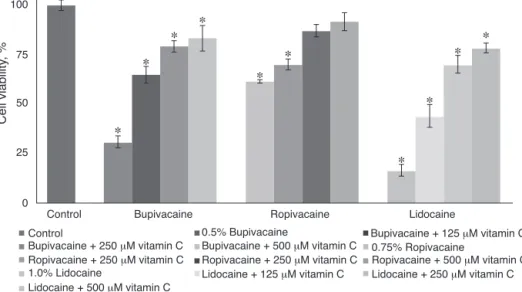
Figure1 InfluenceofvitaminConthecellviabilityofchondrocytes.Valuesarerepresentedasmean±SD;n=6.*Represents
p<0.05comparedwithcontrolasdeterminedbyonewayANOVA.
0.75%ropivacaine(Fig.1).Therewasamarkeddecreasein cellviabilitypercentageafterexposuretolidocaine,
ropiva-caineorbupivacaine.Comparingequipotentconcentrations
ofropivacaine(0.75%)andbupivacaine(0.5%),thecell via-bility rates were significantly higher 24h after treatment
with0.75%ropivacainethanwith0.5%bupivacaine.
Chon-drotoxicitywasmorepronouncedonexposuretolidocaine
followed bybupivacaine. Exposure tovitamin C following
anesthesiaresulted ina significant(p<0.05)improvement incellviabilitypercentage.Theviablechondrocytecounts increasedwithincreasingconcentrationsofvitaminC.The 500Mconcentrationcausedamarkedraiseinchondrocyte viabilitywhencomparedtolowerdoses(125and250M).
Apoptosisofthechondrocytesfollowinganesthesia
expo-surewasalsodetectedbymeasuringthelossofmembrane
asymmetrybyannexinVstaining.Theapoptoticcellcounts weremarkedlyhigher(p<0.05)followinganesthesia
expo-sure. Ropivacaine at 0.75% caused considerably lower
apoptosis as compared to 1% lidocaine and 0.5%
bupiva-caine.IncubationwithvitaminCresultedinraisedviability percentagewithdecreasedapoptoticcellcounts.VitaminC
at500Mconcentrationwasmorepotentthanlowerdoses
in reducing apoptosis after exposure to local anesthetics
(Fig.2).
VitaminCsuppressesapoptosisbydown-regulating expressionofcaspase-3andcaspase-9
Toevaluatethepossibleinvolvementofcaspaseactivationin anesthesiainducedchondrotoxicity,expressionof
caspase-3 and caspase-9 was determined 24h following exposure
to anesthesia. One hour exposure to anesthetics caused
up-regulation of caspase-3 and caspase-9 in the order,
lidocaine>bupivacaine>ropivacaine(Fig.3).Thought
ropi-vacaine at 0.75% caused raised expressions of caspases,
itwas found tobea non-significant raiseascompared to
controlchondrocytesnotexposedtoanesthetics.
Neverthe-less,1% lidocaineresulted inmarked enhancementinthe
levelofexpressionsindicatingcaspasecascadeactivationin
apoptosis. Incubation with vitamin C for 24h markedly
reduced the expression of caspases in a dose-dependent
manner thatwasinlinewiththeresultsoftheLIVE/DEAD
assayandannexinVstaining.VitaminCat 250and500M
weremoreeffectiveindown-regulatingtheexpressionsof
caspases3and9.
InfluenceofvitaminConROSgeneration
We determined the levels of ROS by flow cytometry
using2′,7′-dichlorofluoresceindiacetate(DCFH-DA)staining.
Lidocaine, bupivacaine and ropivacaine caused a marked
increase in ROS production. Lidocaine caused twice as
much raised ROS generation as compared to ropivacaine
and almost nearly 10% more than bupivacaine. This raise
however was suppressed in chondrocytes incubated with
vitamin C as against cells without vitamin C. Treatment
withvitaminCsignificantlyreducedROSproductioninthe order125<250<500M(Fig.4).The antioxidantcapacity
of vitamin C couldhave been responsible for the marked
suppressionofROS.
Discussion
Intra-articularinjectionsoflocalanestheticsarefrequently
employed in peri-operative and ambulatory settings.32
Intra-articular injections of local anesthetics enhance
post-operative analgesia.1,2,33 Lidocaine, bupivacaine and
ropivacaineareamide-typelocalanesthetics.Recent
pub-licationshavesuggestedpotentialadverseeffectsofthese threelocalanestheticsonarticularchondrocytesinvitro.1,11
Severalstudies have described the detrimental effects
of local anesthetics on chondrocyte viability. Chuet al.34
demonstrated severe toxicity of bupivacaine. The study
evidencedonexposureto0.5%bupivacaineand>99%ofthe bovinechondrocyteswerefoundtobekilledinallexposed cultures.Gomoll etal.35 reportedmarked histopathologic
andmetabolicchangesinrabbitshoulderswithcontinuous
100 101
a
a
102 103 104
10 0 10 1 10 2 10 3 10 4
100 101
b
102 103 104
10 0 10 1 10 2 10 3 10 4
100 101
c
102 103 104
10 0 10 1 10 2 10 3 10 4
100 101
d
102 103 104
10 0 10 1 10 2 10 3 10 4
100 101
e
102 103 104
10 0 10 1 10 2 10 3 10 4
100 101
f
102 103 104
10 0 10 1 10 2 10 3 10 4
100 101
g
102 103 104
10 0 10 1 10 2 10 3 10 4
100 101
h
102 103 104
10 0 10 1 10 2 10 3 10 4
100 101
i
102 103 104
10 0 10 1 10 2 10 3 10 4
100 101
j
102 103 104
10 0 10 1 10 2 10 3 10 4
100 101
k
102 103 104
10 0 10 1 10 2 10 3 10 4
100 101
l
102 103 104
10 0 10 1 10 2 10 3 10 4
∗
∗
∗
∗
∗
∗
∗
∗
∗
∗
∗
100b
75 50 25 0 ControlApoptotic cell count, %
Control
Bupivacaine + 250 μM vitamin C Bupivacaine + 500 μM vitamin C
Bupivacaine + 125 μM vitamin C 0.5% Bupivacaine
Ropivacaine + 125 μM vitamin C
0.75% Ropivacaine
Ropivacaine + 250 μM vitamin C Ropivacaine + 500 μM vitamin C 1.0% Lidocaine
Lidocaine + 500 μM vitamin C
Lidocaine + 125 μM vitamin C Lidocaine + 250 μM vitamin C
Bupivacaine Ropivacaine Lidocaine
Figure2 Chondrotoxicityinducedbyanestheticexposure:(a)0.5%bupivacaine;(e)1%lidocaine;(i)0.75%ropivacaine.Vitamin Coneffectofanesthetics: (b) 0.5%bupivacaine+125MvitaminC; (c)0.5%bupivacaine+250MvitaminC; (d) 0.5% bupiva-caine+500MvitaminC;(f)1%lidocaine+125MvitaminC;(g)1%lidocaine+250MvitaminC;(h)1%lidocaine+500Mvitamin C;(j) 0.75%ropivacaine+125M vitaminC;(k)0.75% ropivacaine+250MvitaminC; (l)0.75% ropivacaine+500MvitaminC. Apoptoticcellcounts.Valuesarerepresentedasmean±SD;n=6.*Representsp<0.05comparedwithcontrolasdeterminedbyone wayANOVA.
Lidocaine at 1% and 2% doses was reported to exhibit
chondrocyte toxicity.11 Further, chondrocyte toxicity was
reported by Piper and Kim1 following exposure of human
cartilage explants and chondrocytes to local anesthetics,
bupivacaine and ropivacaine. In line with the previous
reports,inourstudy,0.5%bupivacaine,0.75% ropivacaine and1%lidocaineinducedapoptosisandreducedtheviability
∗ ∗
∗
∗ ∗
∗ ∗ 200
150
100
50
0
Relative expression, %
Control
Bupivacaine + 250 μM vitamin C Bupivacaine + 500 μM vitamin C 0.5% Bupivacaine
0.75% Ropivacaine Ropivacaine + 125 μM vitamin C Ropivacaine + 500 μM vitamin C
Lidocaine + 125 μM vitamin C
Control Bupivacaine
Bupivacaine L1
a
b
c
d
L2 L3 L4 L5
Ropivacaine Ropivacaine
Lidocaine Lidocaine
Bupivacaine
L1 L2 L3 L4 L5
Ropivacaine
Lidocaine
Lidocaine + 250 μM vitamin C
Control
Bupivacaine + 125 μM vitamin C
Ropivacaine + 250 μM vitamin C 1.0% Lidocaine
Lidocaine + 500 μM vitamin C
∗ ∗ ∗
∗ ∗
∗ ∗ 200
150
100
50
0
Relative expression, %
Control
Bupivacaine + 250 μM vitamin C Bupivacaine + 500 μM vitamin C 0.5% Bupivacaine
0.75% Ropivacaine Ropivacaine + 125 μM vitamin C Ropivacaine + 500 μM vitamin C
Lidocaine + 125 μM vitamin C Control
Bupivacaine Ropivacaine Lidocaine
Lidocaine + 250 μM vitamin C Control
Bupivacaine + 125 μM vitamin C
Ropivacaine + 250 μM vitamin C 1.0% Lidocaine
Lidocaine + 500 μM vitamin C
Figure3 EffectofvitaminConcaspase-3(aandb)andcaspase-9(candd)expressionsinchondrocytesfollowinganesthetic expo-sure.L1,control;L2,anestheticalone;L3,anesthesia+125MvitaminC;L4,anesthesia+250MvitaminC;L5,anesthesia+500M vitaminC.(bandd)Valuesarerepresentedasmean±SD;n=6(bandd).*Representsp<0.05comparedwithcontrolasdetermined byonewayANOVA.
more toxic that bupivacaine and ropivacaine. Similar to
earlierstudies,ropivacainewasfound tobeless chondro-toxicthanbupivacaineinhumanchondrocytes.1,36 Vitamin Csignificantlyimprovedcellviabilityofthechondrocytes. StudieshavedemonstratedthepositiveeffectofvitaminC onbonehealth.29
Apoptosiscanbeinducedthroughintrinsicandextrinsic
pathways, both involving the activation of cellular
cas-pases. Caspases are key enzymes involved in regulating
thehighlyspecificproteolyticcleavageofcellularproteins
leading to cell death. Evidence suggests that caspase-3
mayalsobeinvolvedinDNAfragmentation.21 Inourstudy,
∗ ∗
∗
∗ ∗
∗
∗
200
150
100
50
0
Relative oxygen species, %
Control
Bupivacaine + 250 μM vitamin C Bupivacaine + 500 μM vitamin C
0.5% Bupivacaine
0.75% Ropivacaine Ropivacaine + 125 μM vitamin C
Ropivacaine + 500 μM vitamin C
Lidocaine + 125 μM vitamin C
Control
Bupivacaine Ropivacaine Lidocaine
Lidocaine + 250 μM vitamin C
Control
Bupivacaine + 125 μM vitamin C
Ropivacaine + 250 μM vitamin C
1.0% Lidocaine
Lidocaine + 500 μM vitamin C
Figure4 InfluenceofvitaminConROSgenerationbyflowcytometry.Valuesarerepresentedasmean±SD;n=6.*Represents
localanesthetics---lidocaine,ropivacaineandbupivacaine
were observed to induce caspase expression levelswhich
isindicative ofinduction ofapoptosisin thechondrocytes viacaspaseactivation. Perez-Castroetal.16 demonstrated
activation of caspase-3/-7 in human neuroblastoma cells
followingincubation withlidocaine,ropivacaineand bupi-vacaine.Nevertheless,vitaminCsuppressedtheexpression ofcaspases3and9,markedlysuggestingitsanti-apoptotic efficacy.
Themechanismsthatleadtothechondrotoxicityoflocal
anestheticsarenotcompletelyunderstood.Toanalyzethe
involvementofROS-mediatedapoptosis,ROSgenerationin
the chondrocytes wasassessed. Marked raise in ROS
gen-erationfollowingexposuretoanestheticswasconsiderably
normalizedtoalmostnormallevelsonincubationof
chon-drocytes with various concentrations of vitamin C. This
couldbeduetothepotentantioxidantpropertyofvitamin
C.VitaminC wouldhaveeffectivelyprevented generation
of ROS and/or neutralized ROS. However,we observed a
strikingcorrelationbetweencell viability,caspase expres-sion and the levelsof ROS production. Park etal.37 have
shown increased ROS concentration correlating with cell
deathofSchwanncells afterincubationwithbupivacaine.
Inourstudy,ROSconcentrationsincreaseduponexposureto lidocaineandbupivacaine, butnon-significant levelswere
observed following ropivacaine exposure. Similar raise in
ROSgenerationfollowingexposuretolocalanestheticswas reportedbyGrishkoetal.38
To summarize, we have shown that 0.75% ropivacaine,
though toxictohuman chondrocyte cells following 60min
exposure, is considerably on the lower toxic range as
against 0.5% bupivacaine and 1% lidocaine. Lidocaine at
1%concentrationpresentsmorechondrotoxicityamongthe
anesthetics studied. Enhanced ROS production evidenced
in our study suggests that chondrotoxicity could be
pos-sibly due to ROS and ROS-mediated apoptosis. However,
incubationwithvitaminCsignificantlyofferedchondrocyte
protection, which we could possibly be attributed to its
antioxidantcapacity.
Conclusion
Vitamin C was able to markedly protect the condrocytes
againstthetoxiceffectsoflocalanesthetics---ropivacaine, bupivacaineandlidocaine.
Conflicts
of
interest
Theauthorsdeclarenoconflictsofinterest.
References
1.PiperSL,KimHT.Comparisonofropivacaineand bupivacaine toxicityinhumanarticularchondrocytes.JBoneJointSurgAm. 2008;90:986---91.
2.PiperSL,KramerJD,KimHT,etal.Effectsoflocalanesthetics onarticularcartilage.AmJSportsMed.2011;39:2245---53.
3.Dragoo JL, Braun HJ, Kim HJ, et al. The in vitro chondro-toxicity of single-dose local anesthetics. Am J Sports Med. 2012;40:794---9.
4.PettyDH,JazrawiLM,EstradaLS,etal. Glenohumeral chon-drolysisaftershoulderarthroscopy:casereportsandreviewof theliterature.AmJSportsMed.2004;32:509---15.
5.KamathR, StrichartzG, RosenthalD.Cartilagetoxicityfrom localanesthetics.SkeletalRadiol.2008;37:871---3.
6.GomollAH,YankeAB,KangRW,etal.Long-termeffectsof bupi-vacaineoncartilageina rabbitshouldermodel. AmJSports Med.2009;37:72---7.
7.Solomon DJ, Navaie M, Stedje-Larsen ET, et al. Gleno-humeral chondrolysisafterarthroscopy: asystematic review of potential contributors and causal pathways. Arthroscopy. 2009;25:1329---42.
8.Anderson SL, Buchko JZ, Taillon MR, et al. Chondrolysis of theglenohumeraljoint afterinfusion ofbupivacainethrough an intraarticularpain pump catheter: a report of 18cases. Arthroscopy.2010;26:451---61.
9.Hepburn, Walsh P, Mulhall KJ. The chondrotoxicity of local anaesthetics: any clinical impact? Joint Bone Spine. 2011;78:438---40.
10.McLure HA, Rubin AP. Review of local anaesthetic agents. MinervaAnestesiol.2005;71:59---74.
11.KarpieJC,ChuCR.Lidocaineexhibitsdose-andtime-dependent cytotoxiceffectsonbovinearticularchondrocytesinvitro.Am JSportsMed.2007;35:1621---7.
12.Baker JF, Walsh PM,Byrne DP, et al. In vitro assessmentof humanchondrocyteviabilityaftertreatmentwithlocal anaes-thetic,magnesiumsulphateornormalsaline.KneeSurgSports TraumatolArthrosc.2011;19:1043---6.
13.ParkJ,SutradharBC,HongG,etal.Comparisonofthe cyto-toxic effects of bupivacaine, lidocaine, and mepivacaine in equine articular chondrocytes. Vet Anaesth Analg. 2011;38: 127---33.
14.LoIK,ScioreP,ChungM,etal.Localanestheticsinduce chon-drocytedeathinbovinearticularcartilagedisksinadose-and duration-dependentmanner.Arthroscopy.2009;25:707---15.
15.ZinkW,GrafBM.Localanestheticmyotoxicity.RegAnesthPain Med.2004;29:333---40.
16.Perez-CastroR,PatelS,Garavito-AguilarZV,etal. Cytotoxic-ityoflocalanestheticsinhumanneuronalcells.AnesthAnalg. 2009;108:997---1007.
17.DragooJL,KorotkovaT,KimHJ,etal.Chondrotoxicityoflow pH,epinephrine,andpreservativesfoundinlocalanesthetics containingepinephrine.AmJSportsMed.2010;38:1154---9.
18.FedderC,Beck-SchimmerB,AguirreJ,etal.Invitroexposure ofhumanfibroblaststolocalanaestheticsimpairscellgrowth. ClinExpImmunol.2010;162:280---8.
19.Costouros JG, Dang AC, Kim HT. Inhibition of chondro-cyte apoptosis in vivo following acute osteochondral injury. OsteoarthritisCartilage.2003;11:756---9.
20.TakahashiT, YamamotoH, OgawaY, et al.Role ofapoptosis inhibitioninvariouschondrocyteculturesystems.IntJMolMed. 2003;11:299---303.
21.RaoA,JohnstonTR,HarrisAH,etal.Inhibitionofchondrocyte andsynovialcelldeathafterexposuretocommonlyused anes-theticschondrocyteapoptosis afteranesthetics.AmJSports Med.2014;42:50---8.
22.Gaby AR. Natural approaches to epilepsy. Altern Med Rev. 2007;12:9---24.
23.Gasiorowski A, Dutkiewicz J. Weight training and appropri-ate nutrient supplementation as an alternative method to pharmacologicaltreatmentinrehabilitationofpost-myocardial infarctionpatients.AnnAgricEnvironMed.2012;19:333---8.
24.PadayattySJ,KatzA, WangY, etal.VitaminCas an antiox-idant:evaluationofitsroleindiseaseprevention.JAmColl Nutr.2003;22:18---35.
26.TermineJD.AmericanSocietyforBoneandMineralResearch. Bonematrixproteinsandthemineralizationprocess.California: Kelseyville;1990.
27.Peterkofsky B. Ascorbate requirementfor hydroxylation and secretionofprocollagen:relationshiptoinhibitionofcollagen synthesisinscurvy.AmJClinNutr.1991;54:1135S---40S.
28.Kipp DE, McElvain M, Kimmel DB, et al. Scurvy results in decreasedcollagensynthesis andbone densityintheguinea piganimalmodel.Bone.1996;18:281---8.
29.SahniS,HannanMT,GagnonD,etal.Protectiveeffectoftotal andsupplementalvitaminCintakeontheriskofhipfracture ---a17-yearfollow-upfromtheFraminghamOsteoporosisStudy. OsteoporosInt.2009;20:1853---61.
30.Breu A,EcklS,ZinkW,et al.Cytotoxicityoflocal anesthet-ics onhuman mesenchymal stemcells in vitro. Arthroscopy. 2013;29:1676---84.
31.LuHF, SueCC,Yu CS,et al.Diallyl disulfide(DADS) induced apoptosisundergocaspase-3activityinhumanbladdercancer T24cells.FoodChemToxicol.2004;42:1543---52.
32.Koyonos L, Yanke AB, McNickle AG, et al. A randomized, prospective,double-blind studyto investigatethe effective-nessofaddingDepoMedrol toa localanestheticinjectionin
postmeniscectomypatientswithosteoarthritisoftheknee.Am JSportsMed.2009;37:1077---82.
33.DragooJL,KorotkovaT, KanwarR,etal. Theeffectoflocal anestheticsadministeredviapainpumponchondrocyte viabil-ity.AmJSportsMed.2008;36:1484---8.
34.Chu CR, IzzoNJ, PapasNE, et al. In vitroexposure to 0.5% bupivacaine is cytotoxic to bovine articular chondrocytes. Arthroscopy.2006;22:693---9.
35.GomollAH, Kang RW,Williams JM,et al. Chondrolysisafter continuousintra-articularbupivacaineinfusion:an experimen-talmodelinvestigatingchondrotoxicityintherabbitshoulder. Arthroscopy.2006;22:813---9.
36.Farkas B,Kvell K, CzompolyT, et al. Increased chondrocyte death after steroid and local anesthetic combination. Clin OrthopRelatRes.2010;468:3112---20.
37.ParkCJ,ParkSA,YoonTG,etal.Bupivacaineinducesapoptosis viaROSintheSchwanncellline.JDentRes.2005;84:852---7.