STRIKETHROUGHS CONNECTED TO WORD SEGMENTATION IN WRITING ACQUISITION
Tatiane Henrique Sousa Machado*
Universidade Paranaense (UNIPAR) Cristiane Carneiro Capristano**
Universidade Estadual de Maringá (UEM)
AbSTRACT: Based on the premise that strikethroughs connected to word segmentation consist in important vestiges of conflicts experienced by children in order to limit the (ortho)graphic word, this research aimed at introducing and describing possible factors that contribute to the emergence of strikethroughs. Three hundred and sixty-four strikethroughs (364) were
identiied in a corpus consisting of one thousand, six hundred and
ninety-nine (1,699) text productions created by Elementary school children of level
one, during 4 years. The analysis allowed to conclude the important inluence of literacy for the instauration of conlicts on how the segmentation works.
In the strikethroughs connected to segmentation, it is clear that, on principle, even the children’s course in oral social practices are interlinked to children’s course during literacy practice. Results show that children’s writing cannot be interpreted as a mere spoken tracing, but, mainly, as a product of children’s
trafic by historically constituted social practices.
Keywords: Orality. Literacy. Writing. Erasure. Graphic segmentation.
*http://dx.doi.org/10.1590/0102-4698143874
* M.A. in Languages from the Universidade Estadual de Maringá (UEM). Professor (Undergraduate) at
the Universidade Paranaense (UNIPAR) Campus Umuarama. Member of the Research Groups Studies on Writing Acquisition (CNPq) and Studies on Language (CNPq). E-mail: [email protected]
** Ph.D. in Applied Linguistics from the Universidade Estadual de Campinas (UNICAMP). Professor
RASURAS LIGADAS À SEGMENTAÇÃO DE PALAVRAS NA AQUISIÇÃO DA ESCRITA
RESUMO: Com base no pressuposto de que rasuras ligadas à segmentação
de palavras podem constituir indícios importantes de conlitos vivenciados pelas crianças para delimitar a palavra (orto)gráica, este trabalho teve como
objetivo central apresentar e descrever possíveis fatores que concorrem para
a emergência dessas rasuras. Foram analisadas 364 rasuras identiicadas em
corpus constituído por 1.699 produções textuais elaboradas por crianças da primeira etapa do Ensino Fundamental I ao longo de quatro anos. A análise permitiu constatar a influência capital do letramento para a instauração de conflitos sobre como segmentar. Nas rasuras ligadas à segmentação,
ica patente que mesmo a circulação das crianças por práticas sociais orais
está, desde o princípio, entrelaçada à circulação dessas crianças por práticas letradas. Essas constatações permitem concluir que a escrita infantil não pode ser interpretada como um mero decalque do falado, mas, sobretudo, como fruto do trânsito das crianças por práticas sociais historicamente constituídas. Palavras-chave: Oralidade. Letramento. Escrita. Rasura. Segmentação gráica.
INTRODUCTION
One of the tasks children have to face during writing acquisition
is the need to need to ind out, with or without the help of a teacher,
the use or, yet, the meaning of the blank spaces used in conventional writing to limit the (ortho)graphic word. This discovery is not an easy one and, maybe for this reason, several studies are dedicated to the analysis of how children learn to segment in accordance with orthographic rules. Studies such as Abaurre (1991), Silva (1994), Chacon (2004, 2008, 2009), Capristano (2007a, 2007b, 2013, 2014a, 2014b), Cunha (2004), Ferreiro and Pontecorvo (1996), Paula (2007), Capristano and Chacon (2014), Serra, Tenani and Chacon (2006), and Serra (2007), have shown, among other things, the existence of
great luctuation in how children distribute blank spaces to limit the
(ortho)graphic word in their written productions.
Most of these studies have analyzed non-conventional segmentation of blank spaces, classified as (a) hyposegmentation: allocation of fewer blank spaces than those prescribed by written conventions, which generate junctions of words in unexpected places, such as in “jalicotei” (já lhe contei – I have told you); (b)
hypersegmentation: allocation of more blank spaces than those prescribed
Serra, Tenani and Chacon (2006), Serra (2007), Capristano (2007b, 2010, 2013 and 2014) and Capristano and Chacon (2014), however, have dedicated themselves to researching how children start segmenting in compliance with orthographic standards, analyzing what we will call strikethroughs connected to word segmentation, corresponding to the moments in which writers, for instance, erase and/or strikethrough their written productions, signaling some concern with the distribution of blank spaces1. In these papers, strikethrough is understood as the
privileged location to observe the relation subject/language and the paths treated by children to limit the (ortho)graphic word.
For Capristano (2013, p. 677), these strikethroughs also signal “a particular moment in the relation subject/language, with a different order than that observed in orthographic ‘errors’ and in ‘hits’, acting as an indication of the writer’s negotiations with sensitive points of the language. For the author, these would be moments to materialize the writer’s enunciative division among the possibilities offered by the language, and which would show “in a constant manner, two segmentation possibilities that collide and expose the conflict between the writing subject and the facts that determine (his/her) written enunciation” (CAPRISTANO, 2014, p. 8, emphasis added), which are facts associated to children’s circulation through oral and lettered sociohistorical practices.
The adoption of the theoretical-methodological perspective proposed by Capristano (especially 2013 and 2014), in this paper, we intend to present and describe possible factors responsible for the emergence of strikethroughs connected to segmentation, present in children’s written productions, examining each one of the segmentation possibilities that are exposed by these strikethroughs. Due to the characteristics of this paper’s corpus – provided in a subsequent section – and to the relevance of longitudinal studies for understanding children’s writing acquisition, we observe, in addition to this, how these factors operate throughout the years/school years investigated.
In order to attain these goals, we start with a bried discussion on how the speech/writing relationship will be considered in this paper and, from then on, we will provide further details on the theoretical interpretation herein attributed to the strikethrough connected to segmentation.
THEORETICAL fRAMEWORK
that there are pure enunciation modes and that better writing is that which the characteristics of spoken enunciates are not observed.
Several studies in the realm of linguistic theories have questioned this common view of speech/writing relations – as, for example, Corrêa (1998, 2004, 2006, 2013a, 2013b), Marcuschi (2001), Signorini et al. (2001) and Tfouni (2010). Among these studies, Corrêa’s stands out. For this author, “the presence of speech in writing not only records the relation between two technologies, but the relation between two modes of enunciation that are mutually constitutive” (CORRÊA, 2006, p. 269). In this perspective, speech and writing are the fruit of meetings between oral/spoken and lettered/written practices. The author proposes, therefore, in the opposite direction of more traditional views, that speech observed in writing is a clue for heterogeneity of writing, rather than heterogeneity accidentally present in writing. The argument that heterogeneity constitutes writing is explained considering the relationship between the writer-subject and language in the spoken and written enunciation modes. In the author’s word,
[...] the phenomena that refer to the spoken ield are not seen as “interferences” from speech on writing, but as constituting written production, that is, conceived as the mode of enunciation, writing goes beyonda merely textualist perspective to paying attention to the subject and his/her relation to language. What is speciic to the so-called oral and written modalities becomes, thus, the fact that they are both, heterogeneous, that is to say, they it in themselves the presence of social practices of different manners of expression, which enables saying that, in each one of them, constitutive alterity is present […] (CORRÊA, 2013a, p. 504).
In studies on non-conventional segmentations, authors such as Chacon (2004, 2005), Capristano (2007a, 2007b), Paula (2007) and Tenani (2011), supported by Côrrea’s proposal, understand these segmentations that diverge from orthographic standards “not as marks of imperfection of a product viewed as a model, or, in the words of Abaurre, Fiad & Mayrink-Sabinson (1997), as ‘imperfect manifestations of an ‘adult’ grammar” (CHACON, 2004, p. 79). On the other hand, they would be marks that “would indicate the learner’s circulation through the different language enunciation modes” (CHACON, 2004, p. 79).
In this sense, hyposegmentations, hypersegmentation and mixtures are indications of heterogeneity of writing and, therefore, of the images built by the writer in the writing process, about (his/ her) writing. These authors highlight, nevertheless, that, although these non-conventional segmentations arise from the same general principle – as a result of writing’s heterogeneity itself -, they operate
predominance, would indicate writers circulate through oral practices, as, in them, writers, in general, “by appropriating writing (…), tend to take it as the representation of orality term by term” (CORRÊA, 2004, p. 10). Hypersegmentations, also in terms of predominance2,
would signal the circulation of writers through lettered practices, as they would, generally more connected to the image writers would have of that which is exclusive/characteristic of writing.
We assume strikethroughs connected to segmentation operate quite similarly to non-conventional segmentations. They also result from images formed by the writers about (their) writing; images enabled by the circulation of these writers through oral and lettered practices. However, in the strikethroughs, these images and this circulation are different, because, as we have mentioned, strikethroughs allow view two divergent segmentation possibilities, indicating the conlict
between the writing subject and the facts that determine (his/her) written enunciation. That is to say, in strikethroughs, as warned by Capristano (2014, p. 8), “one always sees segmentation alternatives in concurrence, coexisting, albeit undivided: one of these alternatives is always favored and the other, always refused”.
Strikethroughs connected to segmentation would have, thus, the
speciicity of staging at least two directions that open themselves to the
writer at the time of segmentation. Here, these two directions will be
conceived as two gestures. The irst gesture refers to the writer’s irst
choice, the one observed prior to striking through itself and that, for
some reason, is refused. The last gesture, in turn, refers to the writer’s inal
decision, that segmentation option that remains after the strikethrough.
MATERIAL AND METHODOLOGy
To develop this paper, we had access to a database of textual productions colleted by members of the Research Group Studies on language (CNPq), which also subsidizes, nowadays, research conducted by the Research Group Studies on writing acquisition (CNPq). These textual productions were collected during four years. Texts were collected in order to organize data on writings of children under schooling process that enable research of longitudinal nature. The composition of this textual production database required monitoring the same groups
from the irst to the fourth grades in Elementary School, from two
municipal schools in the city of São José do Rio Preto (SP).
database, by means of 55 written production activities. In this corpus,
364 strikethroughs connected to segmentation were identiied3.
In order to identify strikethroughs connected to segmentation, we started from categories created by Capristano (2007b, 2010) based on Abaurre (1991, 1994), Abaurre, Fiad and Mayrink-Sabison (1997), Calil (1997, 2007), and Felipeto and Calil (2007). We consider strikethroughs connected to segmentations, erasures, insertions, overlapping writing and false starts, as signals, in different forms, of children’s concerns about limiting blank spaces.
Erasures are related to moments when the writer goes back over the written material, in order to delete a segment. This segment may be a letter, a syllable, a word or even a dash. Erasure is usually done with an eraser, and, in these cases, the analysis also focused on the “shadow” left by the unsuccessful erasure. On occasion, students in the beginner grades, especially those in the former 4th grade, use
a pen. In these cases, erasure is done by means of overlapping lines, that is to say a “crossed” strikethrough (CALIL, 2008) that, in our study, was categorized as an erasure. Insertions may be identiied in
the moments when the writer returns to the written material and adds letters, syllable, words or dashes. In insertion, the fact that the writer did not suppress the previously written materials, but rather
changed the low of his/her say, by means of the added material.
The overlapping writing, in turn, refers to moments when the writer returns to the written material and adds letters, syllables, words or dashes. Differently from erasures, the “destroyed” and “constructed” elements coexist. Finally, false starts refer to the moments in which hesitations may be noticed, features that evidence the start of a writing project abandoned in favor of another. In these events, the writer starts recording a letter, a syllable or a word and refuses it.
In analyzing each one of the 364 strikethroughs identiied in
this paper’s corpus we observed the two gestures signaled by erasure named, as previously mentioned, the irst gesture (prior to the erasure) and last gesture (after the erasure), as described in the sequence, by means of the analysis of some examples (Figures 1 to 4):
Figure 1 – São José do Rio Preto4
In the erasure shown in Figure 1, the first gesture by the writer was that of recording “do” and “rio” using hyposegmentation. However, the writer returns to the written material, erases the grapheme “R”, visible through the residual writing left, recording, as the last gesture “do rio”, in accordance with conventional writing.
Events such as that shown in Figure 1 show us that: (a) the irst gesture
signals the option for hyposegmentation of two words in the language (“do” and “rio”), a hyposegmentation probably caused by the action of oral practices through which the child circulates; and (b) the last gesture (after the erasure) signals the option for the separation of the words “do” and “rio”, complying with orthographic conventions, a separation probably caused by the action of lettered practices, school related or non-school related, through which the child circulates.
In addition to cases such as this one, in other events, the gestures denote other directions taken by the writer, as the erasures below exemplify:
Figure 2 – Devagar5
Source: Research group (CNPq) Studies on Writing Acquisition and Studies on Language.
Figure 3 – O preso (2004)6
Source: Research group (CNPq) Studies on Writing Acquisition and Studies on Language.
The erasure in Figure 2, to record the word “Devagar”, the writer first records “Devagar”, in consonance with orthographic
conventions; the writer, then, refuses this record, erasing it. The irst gesture may be identiied by observing the mark left by means of
an unsuccessful erasure. After the erasure, the word “devagar” is recorded in a hypersegmented manner, as “de vagar”.
the letter “p” (well separated from the article record). For some reason, the writer returns to the written material, inserting a dash to link both words (“o” and “preso”), producing, in the last gesture, a hyposegmentation.
In other cases, not as frequent, the writer records the irst and the
last gesture in a conventional manner, as in the example provided below:
Figure 4 – Arábia Saudita7
Source: Research group (CNPq) Studies on Writing Acquisition and Studies on Language.
In this example, the writer seems to have returned to his writing to record both words “Arábia” and “Saudita”, with more space between them, an action that seem to ratify the existence of two words rather than a single one. From a different theoretical perspective, erasures such as this one could be excluded, as there seem to be no changes in the direction of the segmentation, and the words were and remained separate. In spite of this, events as this one are considered in this paper because, after the erasure, according to our interpretation, it is not the same word, but rather the “word itself, altered by this slip in the middle, of the unlimited alanguage body” (AUTHIER-REVUZ, 2011. p. 662,
emphasis added), pointing to a possibility of the say to be other.
In summary, as we consider it may be observed, each one of the gestures implied in the erasure may take three directions: hyposegmentation, hypersegmentation or conventional record. To analyze these gestures and the directions they took, we have also performed a quantitative analysis, to identify the factors that are responsible for the emergence of these gestures throughout the grades/years researched. In the next section, we provide the main results obtained by means of these analyses.
RESULTS AND DISCUSSION
The irst gesture: hyposegmented, hypersegmented or conventional
In the 364 strikethroughs connected to segmentation, the
examination of the irst gesture in relation to the possibilities of
Chart 1 – Record of the first gesture: hypo, hyper and conventional writing.
Source: Prepared by this article’s authors.
Chart 1 shows that, along the four grades researched, the irst
gesture by the writer was predominantly that of hyposegmentation. In
the irst grade, 66% (69) of the strikethroughs started by this gesture, and this percentage increased in the subsequent years, recording 69% (82) for the second grade, 79% (66) for the third grade and, inally, 83% (49) for the fourth grade.
acquisition, oral practices constitute an important reference, albeit not exclusive, for children’s written production and, consequently, for their circulation through lettered practices.
Also regarding the strikethroughs in which the irst gesture is a
hyposegmentation, Chart 1 enables observing the similarity between the
percentages obtained for the irst two grades (66% and 69%) between the percentages for the final grades (79% and 83%). Based on this
similarity, it is possible to infer a difference regarding the representation
of word segmentation between initial and inal grades. It is possible to notice, in the latter, that refusal of hyposegmentations is intensiied, that it, the presence of hypo as irst gestures in striking through is increased.
In the qualitative analysis of strikethroughs in which the writers choose hypersegmentation first, it is ascertained that the
emergence of these strikethroughs is caused, mainly, by the conlict
clitics cause to the writing subject8. In fact, in a large part of these
strikethroughs, the writer seems to be in doubt as to the graphic status of these language units, as the examples below demonstrate9:
Figure 5 – Do lado10
Source: Research group (CNPq) Studies on Writing Acquisition and Studies on Language.
fIGURE 6 – Na loja11
Source: Research group (CNPq) Studies on Writing Acquisition and Studies on Language.
Both examples pinpoint a conflict generated for not recognizing the graphic autonomy of the clitics “do” and “na”. In these
strikethroughs, the writer, at irst, seems to interpret these clitics as
pre-tonic syllables in trisyllable words: “dolado” and “naloja”. That is to say, they seem to recognize the phonologic dependence of these clitics in relation to their host words and, on the other hand, they do not seem to notice these clitics’ graphic autonomy. In this sense, these strikethroughs signal, in a predominant manner, the moments when the writer assumes the characteristics of spoken enunciates – namely, the dependence of phonologic clitics such as “do” and “na” in relation to their hosts – could be transferred to written enunciates with no changes. They show, consequently, that the image the writer has of (his/her) writing is, at this moment, shaped in the oral enunciation mode.
Chart 1 also enables us to ascertain the lower occurrence of
hypersegmentations as a irst gesture by the writers. If we go back to this chart, we may notice that, in irst grade, these occurrences represent 22% (23) of the total number of strikethroughs, in second grade, 20% (23), in third grade, 10% (8), and, inally, in fourth grade, 7% (4). The data identified indicate that, starting in first grade,
occurrences in which the initial gesture is hypersegmentation are
much less frequent than those in which the irst gesture is that of
hyposegmentation and, as the literacy process advances throughout the years – consequently, with greater participation of children in institutionalized lettered social practices, school related or non-school related –, this percentage is reduced.
The lower number of strikethroughs in which the writers’
irst gesture is hypersegmentation, from the irst grade on, may be
motivated by the preferred association between hypersegmentation and lettered practices. It is also important to keep in mind that the
irst gesture implied in strikethroughs is always refused, a segmentation possibility abandoned by the writer. Therefore, the writers, in this first gesture, refuse information connected to their circulation through lettered practices less often. This leads us to suggesting that the lower number of occurrences of these strikethroughs is associated to the fact that, at the start of the writing acquisition practices, lettered practices constitute an important reference, although not exclusive, in children’s written production.
In the qualitative analysis of strikethroughs in which writers
choose hypersegmentation irst, it is noticed that the emergence of
within other words. That is, strikethroughs usually establish themselves in moments when “a letter or a short sequence of letters may both be part of a word and correspond to a whole word” (CHACON, 2005, p. 83). The following example illustrates this behavior:
Figure 7 – Copos descartáveis13
Source: Research group (CNPq) Studies on Writing Acquisition and Studies on Language.
In this strikethrough, the writer’s initial gesture generated the hypersegmentation “de cartaveis”. The sequence of letters “de” may be used, at least, in two writing forms: (a) as part of a word, as, for instance, “descartáveis” or “padecer”; (b) as a word (preposition) “cheguei de Recife” (I have arrived from Recife). In the strikethrough
shown in Figure 7, therefore, it seems the writer irst considered that
the pre-tonic syllable “de” would graphically work as a preposition and, thus, should be limited by blank spaces.
An analogous operation may be observed in the strikethrough provided in Figure 8 below. In it, while spelling “aconteceu”, the
writer irst records “aconteceu”, signaling that he/she interpreted
“ceu” as a word in the language (seu or, not as likely, céu):
Figure 8 – Aconteceu14
Source: Research group (CNPq) Studies on Writing Acquisition and Studies on Language.
Chart 1 allows us to view, lastly, that throughout the grades researched, in a quite regular manner, the initial spelling was
conventional: in irst grade, 12% (12), in second grade, 11% (13), in third grade, 10% (09), and, in fourth grade, also 10% (06). The
Figure 9 – Tinha lá15
Source: Research group (CNPq) Studies on Writing Acquisition and Studies on Language.
The lower number of strikethroughs in which the writer’s irst
gesture corresponds to the prescribed by lettered practices. Similarly
to what had happened to strikethroughs in which the irst gesture
corresponds to hypersegmentation, these strikethroughs indicate
that the writers, in this irst gesture, refuse less often the information
connected to their circulation through lettered practices and show, therefore, that, at the start of writing acquisition, lettered practices are a strong reference for these children’s written productions.
From a qualitative standpoint, those strikethroughs in which the
irst gesture is conventional are characterized by their uniqueness, as the
factors that enable the emergence of each one of them are quite particular.
We have identiied only one trend: 9 (22.5%) out of the 40 strikethroughs
analyzed relate to the spelling of homonyms, as, for example, in:
Figure 10 – Por que16
Source: Research group (CNPq) Studies on Writing Acquisition and Studies on Language.
Among these night events, eight referred to the use of the
word “porque”, one of them referred to the word “Bonim”. Both
are homophones (porque/por que/porquê/por quê and Bonfim/bom
im), whose graphic instability contributes to the installation of the
conlict, as they may be spelled in different forms, maintain the
phonic similarity. In this case, as well as in other previously analyzed
cases, the conlict seems to be motivated by the writers’ circulation
If we summarize the results regarding the irst gesture, we may
state that writers, most times, resource to hypersegmentation. This
trend increases throughout the grades, denoting the strong inluence
of the writer’s circulation through oral practices. As the occurrence
decreases, the irst gesture became hypersegmented or conventional,
evidence the role played by children’s circulation through lettered practices in the decisions they make on how to segment.
The last gesture: hyposegmented, hypersegmented or conventional
In their last strikethrough assumed gesture, writers could head or be lead towards three different directions: hyposegmentation, hypersegmentation, or conventional record. In order to verify the
writers’ choices, we have quantiied the data considered as the last gesture, similarly to what we did for the irst gesture. Based on this quantiication, we have arrived to results shown in Chart 2:
Chart 2 – Record of the “last gesture”: hypo, hyper, conventional writing
Source: Prepared by this article’s authors.
Chart 2 enables noticing that, in irst grade, in 83% (86) of the strikethroughs, inal writing corresponded to what is prescribed by
orthographic conventions. This percentage increased throughout the
and, for third grade, 93% (77 strikethroughs). In fourth grade, we notice a slight decrease: 90% (53) of the records.
The fact that, regardless of the grade researched, most times, the last gesture corresponds to conventional writing may be interpreted as important indicator of the alphabetization process and of the literacy of these writers. We should keep in mind that the
last gesture corresponds to the child’s inal choice, that is to say, the
direction chosen for segmentation. In these strikethroughs, thus, it is
clear that these writers’ inal choices are product of their circulation
through lettered practices (school related or non-school related). A qualitative analysis of strikethroughs in which the last gesture is conventional shows us that, most times, the writer’s decision involves the graphic status of clitics, as evidenced by the examples below:
Figure 11 – A bruxinha18
Source: Research group (CNPq) Studies on Writing Acquisition and Studies on Language.
Figure 12 – Se você19
Source: Research group (CNPq) Studies on Writing Acquisition and Studies on Language.
In the strikethrough shown in Figure 11, the writer irst chose to
as “mi”, in “miquiser”. The conventional spelling of “se”, contrasting with the non-conventional spelling of “me”, demonstrating, once
again, the heavy lettered inluence on this child’s written production.
Chart 2 also shows that, not as frequently, the last gesture was either a hypersegmentation or a hyposegmentation. We notice that, in irst
grade, 10% (11) of the events were hypersegmentations. This percentage decreased throughout the two subsequent grades: in second grade,
9% (11) and, in third grade, 1% (1). In fourth grade, we notice an increase to 5% (3). However, this increase happened because two of
the three events are related to homonyms “porque”. As mentioned before, data such as these have a special behavior, given their graphic instability, already given in the language (cf. note 19).
Regarding the strikethroughs in which the last gesture correspond to hyposegmentations, Chart 2 allows us to ascertain that,
in 2001, 7% (7) of the events operated as such. This number remained pretty much the same in the subsequent years: 4% (4 strikethroughs) in 2002, 6% (5 strikethroughs) in 2003 and 5% (3 strikethroughs) in 2004.
The low number of events in which the last gesture is a
hypersegmentation or a hypsegmentation may be equally explained by the
child’s circulation through lettered practices. More speciically, on the
one hand, this circulation enables children, regarding segmentation, pull away from oral practices and, therefore, move towards canonical ways of limiting ortho(graphic) words, and hyposegmentation becomes a possibility of segmenting. On the other hand, the movement towards the canonical ways of limiting orthographic words also leads children to avoid hypersegmentation, as, although hypersegmentation is interpreted in this work as predominantly determined by children’s insertion in literacy practices, it is still an orthographic error, and, therefore, is still divergent from what is prescribed by orthographic conventions.
In qualitative analysis of strikethroughs in which the last gesture is a hypersegmentation, most part of the records – 9 (34.6%) out
of the 26 records identiied – works as the example provided below:
Figure 13 – Alerta20
In the last gesture explained in Figure 13, the writer inserts a blank space between “a” and “lerta”, creating a sequence that could correspond to a clitic and a pseudoword21, which enables
demonstrating that circulation through lettered practices does not lead the writer to being correct. This type of event signals the recognition of words within others, as “a”, in writing and in language, may both be the pre-tonic syllable in a word (alerta), and a grammar word, as in, for instance “a casa”; therefore the isolated syllable keeps a homonym relation with a clitic in language.
We add to that the fact that “lerta” is a possible disyllable in the language. On this topic, Abaurre (1991) had already explained the fact that children seem to privilege paroxytone disyllabic words. For this author, events such as this one allow us to infer that “children may be operating with some type of canonical form of the word in the language, and the perception they already have on the rhythmic and prosodic organization of enunciates may be contributing to establishing it” (ABAURRE, 1991, p. 208).
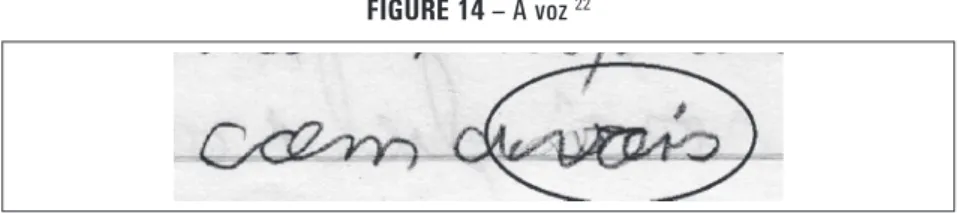
If we examine qualitatively strikethroughs in which the last gesture is a hyposegmentation, we observe that this gesture occurs mainly in moments when the writers must record clitic elements, as
exempliied by the strikethrough below:
Figure 14 – A voz 22
Source: Research group (CNPq) Studies on Writing Acquisition and Studies on Language.
In the task of spelling ‘a voz’, the writer performs the first record in consonance with orthographic conventions; the last gesture, in turn, is the hyposegmented record: “avois”. In this event, the clitic ‘a’ seems to be considered the pre-tonic syllable of the noun preceding it.
Circulation: oral and lettered practices
In this study, we were also interested in examining the crossing
between the irst and the second gesture, in order to determine the
paths treaded by writers as they strikethrough. Separate analyses of
the irst and last gesture, performed in the previous sections, have
provided us with indications on how this crossing takes place. In this section, we will only address that which, as we see it, may have been implicit in the previous analyses.
In order to analyze the crossing between the first and last gesture, anchored on the studies developed by Corrêa (2004, 2013a, 2013b), Chacon (2004, 2005), Capristano (2007a, 2007b) and Paula (2007), we start with the assumption that: (a) hyposegmented initial or
inal records would signal, in terms of predominance, inluences from oral practices; (b) hypersegmented initial or inal records, in terms of predominance, would signal the inluence of lettered practices; and, inally, (c) conventional initial or inal records, in terms of predominance, would indicate, similarly, the inluence of lettered practices.
Based on this assumption, the paths identiied were: from oral
to lettered, from lettered to oral, and from lettered to lettered23. These paths
are distributed as follows throughout the years:
Chart 3 – Trends in strikethrough directions (lettered practices and oral practices)
As it is possible to notice in Chart 3, the oral → lettered path was the most recurrent in all grades analyzed, increasing throughout
the years, as, in irst grade, the percentage of strikethroughs with this trajectory was 67.3% (70), and reached, in fourth grade, 79.6% (47).
The path lettered → oral was the least frequently treaded path, and
records showed, for irst grade, 8.7% (9), for second grade, 3.4% (4), for third grade, 7.2% (6) and, for fourth grade, 3.4% (2). Lastly, the
path lettered → lettered was more frequent in the irst grade, in which
we identiied a percentage of 24% (25), a percentage that is reduced to 22.1% (26) in second grade, and reaches, later on, in third grade, a rate of 16.8% (14) and, in fourth grade, 17% (10).
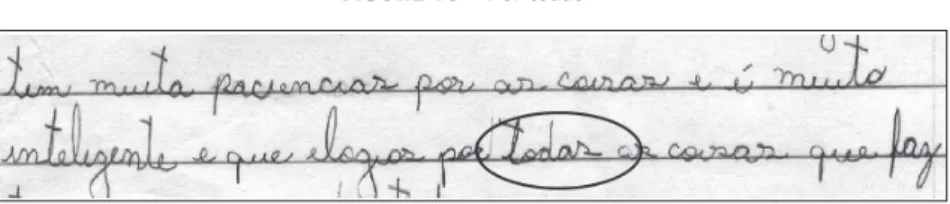
In the oral → lettered path, as exempliied in Figures 15 and 16,
the irst gesture is anchored in oral practices, and, after strikethrough
(erasure, insertion, overlapping writing, or other analogous gesture), writers show they have circulated through lettered practices:
Figure 15 – A carta24
Source: Research group (CNPq) Studies on Writing Acquisition and Studies on Language.
Figure 16 – Por todas25
Source: Research group (CNPq) Studies on Writing Acquisition and Studies on Language.
Strikethroughs shown in Figures 17 and 18 exemplify the cases in which the path taken went from lettered to oral practices:
Figure 17 – Estou com26
Source: Research group (CNPq) Studies on Writing Acquisition and Studies on Language.
Figure 18 – No trânsito27
Source: Research group (CNPq) Studies on Writing Acquisition and Studies on Language.
In Figure 17, the writer needs to spell “estou com dor”. As
a irst gesture, the writer spelled “estou com”, in consonance with
orthographic conventions, separating the lexical item “estou” from the preposition “com”, probably anchored on lettered practices. However, the writer strikes through it, spelling “estoucom”. The
last gesture may have been motivated by the conlict the writer has
with the clitic “com”: a syllable in a word (as in comprido) or an independent autonomous element (as in com certeza)?
In this context, the spelling of the preposition “com” poses barriers to the writer, as, from the morphosyntactic standpoint, this preposition is provided with meaning, as it is a grammar word, but, from the phonologic standpoint, it is a dependent form, a clitic. When
Brazilian children ind it dificult to recognize phonologic clitics as
words to be limited by blank spaces in writing, they usually link the clitic to the phonologic word after it (cf. CUNHA, 2010). However, in the occurrence “estoucom”, the child subverts this general trend, linking the word “com” to the word preceding it “estoucom”, possibly challenged by the fact that the word following the preposition “com” is the central topic of the text from which this strikethrough was cut out: the word “dor” (ache). That is to say, our hypothesis is that the option for linking estou and com (uncommon in textual production
In the strikethrough shown in Figure 18, the writer spell “no trânsito”, separating the clitic “no” from the prosodic word “trânsito”. In this strikethrough, as in the previous one, the writer’s lettered experiences seem to echo. However, subsequently, the writer adds an insertion dash, in order to link both words, forming “notrânsito”. The last gesture seems to assume writing as a representation of spoken sequences, as the clitic gains the status of initial syllable for the word “trânsito”.
Lastly, the strikethroughs shown in Figures 19 and 20 exemplify the most infrequent path, through which the writers seem to circulate from lettered practices to lettered practices:
Figure 19 – Dezembro28
Source: Research group (CNPq) Studies on Writing Acquisition and Studies on Language.
Figure 20 – Era29
Source: Research group (CNPq) Studies on Writing Acquisition and Studies on Language.
In these strikethroughs, the writers need to spell the words
“dezembro” and “era”. In the irst gesture, writers spell these words
in a hypersegmented form (“de zembro” and “é ra”) and, in the last gesture, they spell in accordance with what is prescribed by orthographic conventions. Both gestures emerge, probably, from knowledges originating in the lettered experiences lived by the writer.
word “é”, in turn, indicate the writers may have recovered a memory that the words era and dezembro need to be limited by blank spaces. Not by coincidence, these are rather common words in institutional
school practices: the irst one is frequent in children’s tales (Era uma vez...- Once upon a itme...) and the second one is commonly object of teaching, as it refers to one of the months of the year.
Other strikethroughs that show the writers circulation from
lettered practices to other lettered practices involves the graphic space
of the school notebook and, more speciically, the margins that limit
the space reserved to the written production:
Figure 21 – Pintinhas brancas30
Source: Research group (CNPq) Studies on Writing Acquisition and Studies on Language.
The writer spells “branc” and, given the impossibility to continue spelling the word “brancas” on the same line, as the writer recognized the margin as a graphic limit to be observed, erases, and spells this word on the following line. We interpret occurrences such as this one as indexes of a movement which leads the writer from lettered practices towards other lettered practices, as, in them, information on the need to comply with the school notebook margins (lettered information) and an attempt to ratify that “brancas” is a unit, i.e., a single word coexist.
In the entire corpus, 11 events were found involving conlicts between margins and the limits of graphic words, which represent 3% of the
occurrence of strikethroughs connected to segmentation.
The observations made here about the crossing between the
irst and the second gestures enable determining that the strikethroughs
these strikethroughs, is that from oral practices to lettered practices, that is
to say, conlicts experienced by the child on how to segment are installed
in the crossing/intertwining of oral practices and lettered practices.
fINAL CONSIDERATIONS
In this paper, developed under the theoretical-methodological perspective open by Capristano’s studies (especially, 2013, 2014a and 2014b), we intended to present and describe some factors that are responsible for the emergence of strikethroughs connected to segmentation present in children’s written productions. We sought to detail factors that determine the emergence of each one of the gestures presupposed in the
strikethrough action, which, here, have been named irst and last gestures.
As a more general result, we noticed that strikethroughs connected to segmentation signal that children learn how to segment in accordance with what is prescribed in orthographic conventions, guided by information obtained in their circulation through oral and lettered practices, preferably
having, in the irst gesture, strong inluence of the irst and, in the last gesture, strong inluence of the latter.
This article’s corpus also enabled determining how these factors behaved throughout the grades/years researched. On this
topic, we identiied great similarity in the behavior of strikethroughs,
if observed longitudinally: from the first grade, the writer’s first gesture tends to anchor in their oral practices, whereas the last
gesture, also starting in irst grade, tends to arise as the result of the
writer’s circulating through lettered practices.
By means of these results, it was possible to determine the capital
inluence of literacy for installing the conlicts on how to segment. In
strikethroughs connected to segmentation, it is clear that, even the circulation of children through oral practices is, from the start, crossed by and/or intertwined with the simultaneous circulation of these children
through their lettered experiences. These indings authorize us to conclude
that children’s writing, in its incipient steps, may not be interpreted as a mere tracing of speech, but, above all, as the result of children’s circulating through oral and lettered social practices, historically constituted.
Finally, we also hope to have contributed to the demystiication
of the dirt status usually attributed to the strikethrough, as the discussions entailed in this article corroborate the thesis that strikethroughs indicate
conlicts the writer have with tongue/language, and which stage one of
the different facets of the complex subject/language relationship.
REfERENCES
ABAURRE, M. B. M. Indícios das primeiras operações de reelaboração nos textos infantis. Estudos Linguísticos, São Paulo, v. 1, p. 367-372, 1994.
______. A relevância dos critérios prosódicos e semânticos na elaboração de hipóteses sobre segmentação na escrita inicial. Boletim da Abralin, Curitiba, v. 11, p. 203-217, 1991. ABAURRE, M. B. M.; FIAD, R.; MAYRINK-SABINSON, M. L. T. Cenas de aquisição da escrita: o trabalho do sujeito com o texto. Campinas: Mercado de letras, 1997.
ABAURRE, M. B. M.; SILVA, A. O desenvolvimento de critérios de segmentação na escrita. Temas em psicologia, São Paulo, v. 1, p. 89-102, 1993.
AUTHIER-REVUZ, J. Paradas sobre as palavras: a língua em prova na enunciação e na escrita. Educação e Realidade, Niterói, v. 36, n. 3, p. 651-679, 2011.
BISOL, L. O clítico e seu hospedeiro. Letras de Hoje, Cidade, v. 40, n. 3, p. 163-184, 2005. Disponível em <http://revistaseletronicas.pucrs.br/ojs/index.php/fale>. Acesso em 02 out. 2014. CALIL, E. A topologia do sujeito na rasura. Revista Veredas, Juiz de Fora, v. 7, p. 83-92, 1997. ______. Escutar o invisível: escritura e poesia na sala de aula. São Paulo: UNESP, 2008. ______. Trilhas da Escrita: autoria leitura e ensino. São Paulo: Cortez Editora, 2007. CAPRISTANO, C. C. Segmentação na escrita infantil. São Paulo: Martins Fontes, 2007a. ______. Mudanças na trajetória da criança em direção à palavra escrita. 2007.263 f. Tese (Doutorado em Linguística Aplicada) –Instituto de Estudos da Linguagem, Universidade Estadual de Campinas, Campinas, 2007b.
______. Notas sobre o papel das reelaborações no processo de aquisição da escrita: vínculos entre práticas letradas e orais. In: COLÓQUIO INTERNACIONAL SOBRE LETRAMENTO E CULTURA ESCRITA, 3., 2010, Belo Horizonte. Anais...Belo Horizonte, 2010.
______. Rastros de uma escrita em construção, 2014.
CAPRISTANO, C. C; CHACON, L. Relações metafóricas e metonímicas: notas sobre a “aquisição” da noção de palavra. In: TFOUNI, L. V.; TONETO, D. J. (Org.) O (In)esperado de Jakobson. Campinas: Mercado de Letras, 2014. p.197-218.
CHACON, L. Constituintes prosódicos e letramento em segmentações não-convencionais. Letras de Hoje, Porto Alegre, v. 39, p. 223-232, 2004.
______. Hipersegmentações na escrita infantil: entrelaçamentos de práticas de oralidade e de letramento. Estudos Linguísticos, São Paulo, v. 34, p. 77-86, 2005.
______. Para além de vínculos diretos entre características fonético-segmentais e ortográicas na escrita infantil. Revista de Estudos da Linguagem, v. 16, p. 215-230, 2008.
______. Concepções de “palavra” em escolas de educação infantil. Scripta, Belo Horizonte, v. 13, n. 24, p. 173-186, 2009.
______. O modo heterogêneo de constituição da escrita. (1997) 422 f. Tese (Doutorado em Linguística) – Instituto de Estudos da Linguagem, Universidade Estadual de Campinas, Campinas, 1997b.
______. O modo heterogêneo de constituição da escrita. São Paulo: Martins Fontes, 2004.
_______. Heterogeneidade da escrita: novidade da adequação e a experiência do acontecimento. Filologia linguística portuguesa, São Paulo,n. 8 , p. 269-286, 2006.
______. Bases teóricas para o ensino da escrita. Linguagem em (Dis)curso, Tubarão, v. 13, p. 481-513, 2013a.
______. Heterogeneidade da escrita no ensino: das modalidades às relações intergenéricas. In: PEREIRA, L. A.; CARDOSO, I. (Org.). Relexão sobre a escrita: o ensino de diferentes gêneros de textos. Aveiro, Portugal: UA EDITORA (Universidade de Aveiro-PT), 2013b. v. 1, p. 67-91. CUNHA, A. P. N. A hipo e a hipersegmentação nos dados de aquisição da escrita: um estudo sobre a inluência prosódica. 2004. 132 f. Dissertação (Mestrado em Educação) – Faculdade de Educação, Universidade Federal de Pelotas, Pelotas, 2004.
FELIPETO, C.; CALIL, E. Sobre os mecanismos lingüísticos subjacentes ao gesto de rasurar. Revista do GELNE, v. 9, p. 147-159, 2007.
FERREIRO, E.; PONTECORVO, C. Os limites entre as palavras: a segmentação em palavras gráicas. In: FERREIRO et.al. Chapeuzinho Vermelho aprende a escrever. São Paulo: Ática, 1996. p. 38-66.
MARCUSCHI, L. A.Da fala para a escrita: atividades de retextualização. São Paulo: Cortez, 2001. PARANHOS, F. A ortograia de palavras em textos de alunos do ensino fundamental II: as hipo e hipersegmentações. Revista Gel, São Paulo, 2014.
PAULA, I. F. V. Movimentos na escrita inicial de crianças: um estudo longitudinal de hipersegmentações. 2007. 132 f. Dissertação (Mestrado em Estudos Linguísticos) – Instituto de Biociências, Letras e Ciências Exatas, Universidade Estadual Paulista, São José do Rio Preto, 2007.
SERRA, M. P. Segmentação das palavras: prosódia e convenções ortográficas na reelaboração da escrita infantil. 2007. 102 f. Dissertação (Mestrado em Estudos Linguísticos) – Instituto de Biociências, Letras e Ciências Exatas, Universidade Estadual Paulista, São José do Rio Preto, 2007. SERRA, M. P.; TENANI, L.; CHACON, L. Reelaboração da segmentação: um olhar para a escrita infantil. Estudos Linguísticos, São Paulo,v. 35, p.1247-1254, 2006.
SIGNORINI, I. et. Al (Org.). Investigando a relação oral/escrito e as teorias do letramento. Campinas: Mercado de Letras, 2001.
SILVA, A. Alfabetização: a escrita espontânea. São Paulo: Contexto, 1994.
TENANI, L. E. A segmentação não convencional de palavras em textos do ciclo II do ensino fundamental. Revista Abralin, São Carlos, SP, v. 10, n. 2, p. 91-119, 2011.
TFOUNI, L. Letramento e alfabetização. São Paulo: Cortez, 2010.
NOTES
1 In these papers, there is a variation in how these marks – erasing, strikethroughs, etc. – are
named (strikethroughs, re-elaboration, correction marks) and, as a consequence, in how they are interpreted from a theoretical standpoint.
2 We choose to use the word “predominance” because we assume hyposegmentations
hypersegmentations may be the product of child’s circulating through oral practices. On this topic, refer to Capristano (2007a, 2007b).
3 In the identiication of the strikethroughs, the corpus was identiies three times by different
people, so as to enable the actual identiication of strikethroughs connected to segmentation. In addition, the identiication work was done with the help with a magnifying glass LL-975 (2X magnifying power, with light).
4 Preferred reading: São José do Rio Preto, 09/05/2001. 5 Preferred reading: Devagar se chega lá.
6 Preferred reading: O preso.
7 Preferred reading Ué Arábia Saudita? Nem tanto.
8 Clitics are unaccented monosyllables that comprise a large part of the so-called function
words. As they do not have accent, they are, phonologically, dependent forms that are attached to the accent of a subsequent or preceding host word (cf. BISOL, 2005, p. 163).
9 This behavior by the strikethroughs connected to segmentation is also observed in studies on
non-conventional segmentations – on this topic, refer to, for instance, Tenani’s research (2010).
10 Preferred reading: Mas a polícia vê que tem um cemitério ali do lado mas nem ligam acham. 11 Preferred reading: Comprar um sapato na loja.
12 These two strikethroughs exemplify what we have called false start in the Material and
Methodology section.
13 Preferred reading: Copos descartáveis.
14 Preferred reading: Um dia aconteceu uma tragédia o carro da mulher. 15 Preferred reading: Admirado com as comidas que tinham lá. 16 Preferred reading: Não acho certo porque não aconteceu.
17 Paranhos (2014) highlights the inluence of homonyms in non-conventional segmentation
events detected in textual productions by students in 5th to 8th grade. According to the author, hypersegmentations in which the writer faces a conlict generated by homonyms “result in graphic representations of sequences in which a prosodic clitic corresponds to function words or grammar items” (PARANHOS, 2014, s.p) as is the case of “por” (preposition). For this author, these hypersegmentations must receive a speciic theoretical and methodological treatment, given its morphosyntactic and semantic speciicity.
18 Preferred reading: A bruxinha e o elefante.
19 Preferred reading: Se você não me quiser, tudo bem outra quer. 20 Preferred reading: Alerta (entre linhas)
21 In Cunha (2004) and Tenani (2011) studies, data such as “lerta” are named pseudowords, as,
although they do not have a known meaning in the language, in terms of structure, they are equipped with primary accent and, therefore, could conigure a word.
22 Preferred reading: com a voz.
23 We have not identiied, in any of the grades, strikethroughs in which the writer treaded the
path from oral to oral. This information, in itself, is signiicant enough and is in tune with the conclusions in this paper, presented in the inal section.
24 Preferred reading: O rato recebeu a carta do rato.
27 Preferred reading: as pessoas no trânsito. 28 Preferred reading: eu vou dezembro. 29 Preferred reading: os carros eram diferentes. 30 Preferred reading: pintinhas brancas (inal de linha). 31 cf. CORRÊA, 2013.
Received: 11/12/2014 Approved: 23/11/2015