Restorative Dentistry
Alexandre Morais(a)
Alline Rachid Abreu dos Santos(a) Marcelo Giannini(b)
Andre Figueiredo Reis(a) José Augusto Rodrigues(a) César Augusto Galvão Arrais(a)
(a)Department of Restorative Dentistry, Dental Research Division, Guarulhos University – UnG, Guarulhos, SP, Brazil.
(b)Department of Operative Dentistry, University of Campinas, Piracicaba School of Dentistry, Piracicaba, SP, Brazil.
Corresponding author: César Augusto Galvão Arrais E-mail: [email protected]
Received for publication on Oct 27, 2011 Accepted for publication on Jan 04, 2012
Effect of pre-heated dual-cured resin
cements on the bond strength of
indirect restorations to dentin
Abstract: This study evaluated the effects of resin luting agents (LA) po-lymerized using increased temperature on the in vitro microtensile bond strength (µTBS) of indirect restorations to dentin. The occlusal dentin surfaces of 40 human third molars were exposed and lattened. The teeth were assigned to 8 groups (n = 5) according to the LA temperature (25°C or 50°C), curing mode (dual- or self-curing mode), and product (Excite DSC / Variolink II [VII] and XP Bond / Calibra [Cal]). The bonding agents were applied to the dentin surfaces according to manufacturers’ instruc-tions. For preheated groups, the LAs were heated to 50°C, subsequently mixed on a heated stirrer surface, and applied to the previously heated pre-polymerized resin discs (2 mm thickness, TPH-Spectrum). The discs were bonded to the dentin surfaces, and the LAs were either exposed to a curing light according to manufacturers’ instructions or allowed to self-cure. Specimens were stored in relative humidity at 37°C for 7 days. Specimens were mesio-distally and bucco-lingually sectioned to obtain multiple bonded beams with a 1-mm2 cross-sectional area for µTBS
test-ing. Data (MPa) were analyzed by 2-way ANOVA and Tukey’s post hoc test (α = 5%) for each product. Specimen failure patterns were analyzed using a scanning electron microscope. VII groups showed higher µTBS at 50°C than at 25°C regardless of curing mode (p = 0.05). Cal groups showed similar µTBS at 25°C and 50°C in all activation modes. The use of some dual-polymerizing LAs at 50°C may improve the µTBS of indi-rect restorations to dentin.
Descriptors: Resin Cements; Temperature; Dental Bonding.
Introduction
Dual-polymerizing resin luting agents (LAs) are widely used to bond esthetic indirect restorations because of their low solubility, low viscos-ity, clinically acceptable ilm thickness, better mechanical properties than conventional cements, ability to bond tooth to restorative material when used with bonding agents, and lower microleakage compared to other luting materials.1-3 In addition to the presence of photoiniators in
their composition, self-curing components are added to ensure an op-timal polymerization even when activating light is severely attenuated due to the presence of an indirect restoration interposed between LA and light-curing unit tip.4-8 However, these components are not as effective as
the dual-curing mode to provide an optimal polymerization.4,5,7,9,10 Such Declaration of Interests: The authors
a low effectiveness is related to the slow activation and propagation rates of polymerization observed in the self-curing mechanism.11
Composite resin preheating to 60°C prior to resin polymerization decreases the resin viscosity and al-lows for an increased free radical mobility.12-15
Con-sequently, these materials achieve higher monomer conversion at high temperature than when they are achieved at room temperature.12,13,16-18 When
mono-mer conversion is closely related to the polymono-mer me-chanical properties,19-21 improved bond strength of
indirect restorations to dentin would be expected even when LA polymerization relies solely on self-curing components. Although concerns about the possible effects of temperature on pulp may arise, previous indings have demonstrated that any in-crease in composite resin temperature to 54°C and 60°C does not signiicantly change the intrapulpal temperatures.18 However, few studies have
evalu-ated the effects of preheating resin LAs on the bond strength of indirect restorations to dentin.22,23
The aim of this study was to evaluate the effects of preheating dual-polymerizing LAs on the bond strength of indirect restorations to dentin. The re-search hypothesis was that preheated LAs provide greater bond strength to dentin than cements used at room temperature regardless of activating mode.
Methodology
Indirect restorative procedures
Forty freshly extracted, erupted human third mo-lars were used. The research protocol was approved by the Human Assurance Committee of Guarulhos University (90/09). Teeth were stored in saturated thymol (Symrise GmbH & Co, Holzminden, Ger-many) at 5°C for no longer than 3 months and were sectioned perpendicular to the long axis using dou-ble-face diamond discs (7020; KG Sorensen, Cotia, Brazil) to expose middle-depth occlusal dentin sur-face. The dentin surfaces were wet ground (Arotec, Cotia, Brazil) with 600-grit SiC papers (Carborun-dum; Saint-Gobain Abrasivos, Guarulhos, Brazil) to create a lat surface with a standard smear layer.
Forty pre-cured resin composite discs (2-mm thickness and 10-mm diameter; A2 shade, TPH Spectrum; Dentsply Caulk, Milford, DE, USA) were
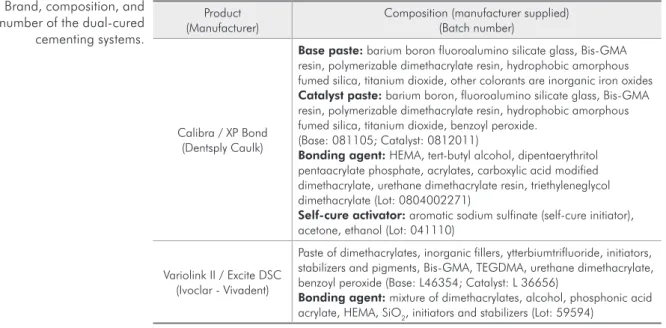
created to simulate overlying laboratory-processed composite resin restorations that had one surface airborne-particle abraded using 50-µm aluminum oxide particles (Asfer Industria Quimica Ltd., Sao Caetano do Sul, Brazil) for 10 s (distance from the tip: 1.5 cm; Bio-Art, São Carlos, Brazil). The dentin surfaces were acid etched with 35% phosphoric acid (Brazil Dentsply, Rio de Janeiro, Brazil) for 15 s and thoroughly water-rinsed. The excess water was re-moved using an absorbent paper. Two dual-polym-erizing cementing systems (bonding agents / LAs) were used (Table 1):
• Excite DSC / Variolink II (Ivoclar Vivadent, Schann, Liechtenstein) and
• XP Bond / self-cure activator / Calibra (Dentsply Caulk, Milford, USA).
The adhesive systems were applied and light ac-tivated (Optilux 501; power density: 650 mW/cm2,
Demetron Kerr, Danbury, CT, USA) according to the manufacturers’ instructions. Curing light inten-sity was continuously measured using a radiometer (Cure Rite, Dentsply Caulk). The LAs were applied at 25°C or were heated to 50°C prior to their use and were exposed to light from the same light-cur-ing unit used to polymerize the bondlight-cur-ing agents (du-al-curing mode), or were allowed to self-cure (self-curing mode), resulting in 8 experimental groups (n = 5). For experimental groups using LAs heated to 50°C, base and catalyst pastes were equally dis-pensed on a glass plate laying on a heating stirrer surface (Cientec, Piracicaba, Brazil) that was previ-ously set to 50°C. Cement and glass plate tempera-tures were continuously measured using a K-type thermocouple (Novus, Porto Alegre, Brazil) to en-sure that both pastes reached 50°C. Based on the temperature control as measured using the thermo-couple, it took approximately 30 s to 40 s for the LAs to reach 50°C. Only a small portion of the LA to be used for the cementing procedure was heated immediately before use; therefore, only one LA was heated at a time.
mixed on the heated glass plate and were applied to abraded resin disc surfaces. For the room tempera-ture groups (25°C), the same procedures were per-formed without heat. For the dual-cured groups, the disc was positioned and ixed to the adhesive-coated dentin surfaces under a 500-g load for 5 s, and a light-polymerizing unit tip was placed against it. The LA layer was then exposed to a curing light for 40 s. For the self-cured groups, the disc laying on the adhesive-coated dentin surface was subjected to the same load for 5 min. A 3-mm layer of self-curing composite resin (Alpha Plast, DFL Industria e Com-ercio S.A., Rio de Janeiro, Brazil) was placed on an untreated, pre-cured resin disc surface to facilitate specimen gripping during the testing process.
Microtensile bond strength test (µTBS)
The restored teeth were dark-stored in relative humidity at 37°C for 7 days. The teeth were sec-tioned vertically and serially into several 1.0-mm slabs using a diamond saw (Buehler Ltd, Lake Bluff, USA). Each slab was further sectioned to produce beams with a cross-sectional area of approximately 1.0 mm2 at the bonded interface. Each bonded stick
was attached to the testing jig grips with cyanoac-rylate glue (Loctite Super Bonder Gel; Henkel, Düs-seldorf, Germany) for µTBS testing using a
univer-sal testing machine (EZ Test; Shimadzu Co., Kyoto, Japan) at a crosshead speed of 1 mm/minute until failure. After testing, the specimens were carefully removed from the ixtures with a scalpel blade, and the cross-sectional area at the site of the fracture was measured to the nearest 0.01 mm using a digital micrometer (Mitutoyo America Corp., Aurora, IL, USA). Specimen cross-sectional area was calculated to produce µTBS data in units of stress (MPa). Five beams were tested per tooth, and µTBS average ob-tained from these beams represented the value for each restored tooth. Therefore, the experimental unit was the restored tooth.
Statistical analysis
Two-way analysis of variance (ANOVA) (tem-perature and polymerizing mode factors) was per-formed for each product. The statistical tests in-dicating signiicant differences were followed by Tukey HSD post hoc test at a preset alpha of 5%. The statistical analyses were performed using soft-ware (SAS for Windows V8; SAS Institute, Cary, NC, USA). Post hoc power analysis was performed for the statistical analysis of the µTBS data using statistical software (IBM SPSS 19, SPSS Inc., IBM Company, Armonk, NY, USA).
Product
(Manufacturer) Composition (manufacturer supplied)(Batch number)
Calibra / XP Bond (Dentsply Caulk)
Base paste: barium boron fluoroalumino silicate glass, Bis-GMA resin, polymerizable dimethacrylate resin, hydrophobic amorphous fumed silica, titanium dioxide, other colorants are inorganic iron oxides Catalyst paste: barium boron, fluoroalumino silicate glass, Bis-GMA resin, polymerizable dimethacrylate resin, hydrophobic amorphous fumed silica, titanium dioxide, benzoyl peroxide.
(Base: 081105; Catalyst: 0812011)
Bonding agent: HEMA, tert-butyl alcohol, dipentaerythritol pentaacrylate phosphate, acrylates, carboxylic acid modified dimethacrylate, urethane dimethacrylate resin, triethyleneglycol dimethacrylate (Lot: 0804002271)
Self-cure activator: aromatic sodium sulfinate (self-cure initiator), acetone, ethanol (Lot: 041110)
Variolink II / Excite DSC (Ivoclar - Vivadent)
Paste of dimethacrylates, inorganic fillers, ytterbiumtrifluoride, initiators, stabilizers and pigments, Bis-GMA, TEGDMA, urethane dimethacrylate, benzoyl peroxide (Base: L46354; Catalyst: L 36656)
Bonding agent: mixture of dimethacrylates, alcohol, phosphonic acid acrylate, HEMA, SiO2, initiators and stabilizers (Lot: 59594)
TEGDMA: triethylene glycol dimethacrylate; Bis-GMA: bisphenol A diglycidyl ether methacrylate; HEMA: hydroxyethyl methacrylate; SiO2: silicon dioxide.
Failure mode analysis
All fractured surfaces of the tested specimens were allowed to air-dry overnight at 37°C, sputter coated (MED 010-Balzers, Balzers, Liechtenstein) with a thin gold layer, and examined using a scan-ning electron microscope (SEM - LEO 435 VP; LEO Electron Microscopy Ltd, Cambridge, UK). The failure patterns were classiied as follows:
• adhesive along the dentin surface, • cohesive within the dentin, • cohesive within the LA and
• mixed, when simultaneously exhibiting the rem-nants of both the hybrid layer and the LA.
Results
Microtensile bond strength
Post hoc power analysis demonstrated statisti-cal power greater than 95% at a pre-set alpha of 0.05. For Calibra, no signiicant differences in any factors were detected by ANOVA. In contrast, for Variolink II, ANOVA detected signiicant differ-ences for the temperature (p = 0.05) and activation mode (p < 0.0001) factors. No signiicant difference in µTBS values was noted between teeth that were restored using Calibra at 50°C and 25°C, regard-less of the activation mode (Table 2). Additionally, for all temperatures, no signiicant µTBS difference was observed between the dual- and the self-curing groups. In contrast, Variolink II at 50°C promoted
higher µTBS values than at 25°C in both activation modes (p = 0.05), whereas the dual-curing mode promoted higher µTBS values than the self-curing mode regardless of temperature (p < 0.0001).
Failure pattern analysis
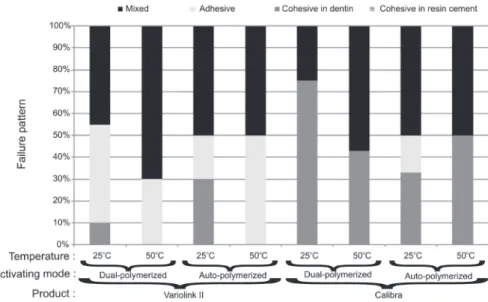
The distribution of failure modes among groups is shown in Figure 1. Figures 2A and 2B show SEM images of a mixed failure that was predominantly observed in the experimental groups. Only dual-polymerizing Calibra groups polymerized at 25°C exhibited failures predominantly located within the dentin. A decrease in cohesive failures within dentin was observed when Calibra was heated to 50°C. For Variolink II, the cohesive failures within dentin in both the dual-polymerizing and auto-polymerized groups at 25°C were eliminated when both groups were polymerized at 50°C.
Figure 1 - Failure pattern of fractured specimens from all experimental groups.
Table 2 -µTBS values of dual-cured LAs submitted to differ-ent curing modes and temperatures.
Dual-polymerized Self-polymerized
Variolink II 25°C 33.38 (8.74) Ba 17.34 (9.07) Bb 50°C 47.12 (8.58) Aa 21.65 (10.20) Ab
Calibra 25°C 37.45 (9.64) Aa 28.58 (8.94) Aa 50°C 36.17 (8.07) Aa 28.83 (10.10) Aa
Discussion
In this study, the temperature of 50°C was cho-sen based on previously reported data.12,13,18
How-ever, it must be emphasized that a temperature de-cline is expected, similar to the temperature dede-cline observed in the preheated composite resins that are placed in tooth cavities.16 For this reason, the
indi-rect restoration was also heated to delay any reduc-tion in the LA temperature. Therefore, the present results should not be extrapolated to clinical situ-ations in which the LA is heated and the indirect restoration is maintained at room temperature. Moreover, any comparison between products was neglected because the evaluated resin cements use different bonding agents. For this reason, if product comparisons were made, the possible differences in the µTBS values could be related to the differences in bonding agent compositions rather than to in-creased LA temperature.
Variolink II at 50°C promoted higher µTBS than at 25°C in both curing modes. Therefore, the research hypothesis was accepted for this product regardless of the activation mode. This inding is in agreement with those of studies that evaluated preheated LAs,22,23 and demonstrates that the
pre-viously shown24 increased LA monomer conversion
and improved mechanical properties do increase bond strength to dentin. Possibly, decreased resin viscosity and high radical mobility were not the only factors contributing to the greater bond strength.
The self-curing component benzoyl peroxide (BPO) from Variolink II is unstable and can be activated by heat.25,26 Thus, BPO decomposes faster at higher
temperatures and creates more radicals more rap-idly than it does at room temperature.26 As a
con-sequence, more radical formation may have contrib-uted to the increased µTBS values. Moreover, the use of this LA at a high temperature also reduced the percentage of the cohesive failures within the dentin. Therefore, a high temperature could have in-luenced the mechanical properties at the bonding interface below the LA layer. However, further stud-ies evaluating such effects are needed to conirm this observation.
Regardless of temperature, lower µTBS was ob-served when Variolink II relied solely on the self-polymerizing components rather than when the LA was exposed to curing light. Therefore, the self-curing mode was less effective than the dual-curing mode, even at a high temperature. This ind-ing might be attributed to the low BPO content in Variolink II (information from the manufacturer’s material safety data sheet), which explains why this product is not indicated in clinical situations in which the activating light is entirely blocked by an indirect restoration.10
Conversely, Calibra was not inluenced by heat because no signiicant difference in the µTBS values was noted between the groups polymerized at 25°C and 50°C. Therefore, the research hypothesis was
Figure 2 - Illustrative scanning electron microscope image of a mixed failure pattern at a lower (A: 57×) and a higher (B: 196×) magnification to exhibit the hybrid layer (HL), the adhesive layer (AD), and the luting agent (LA).
rejected for this LA. Curiously, at 25°C, no signii-cant difference in the µTBS was noted between the dual- and curing groups, indicating that the self-curing mode in Calibra was as effective as the dual-curing mode. This inding might be attributed to the higher BPO content (approximately 2%) in Calibra compared to Variolink II (approximately 1%), ac-cording to the manufacturers’ material safety data sheets. Because an increased temperature decom-poses BPO more quickly, LAs with higher BPO con-tent at a high temperature may set faster than those with low BPO content. This was observed during specimen preparation when Calibra started setting immediately after the indirect restoration was ce-mented onto the tooth. Therefore, the polymer net-work may have been rigid during the light exposure. Thus, any possible beneit from a high temperature on the bond strength was masked by the tension
cre-ated at the bonding interfaces caused by the prema-ture LA setting. This observation conirmed previ-ous indings.22,23 For this reason, the use of Calibra
at 50°C is concerning because its working time was apparently not suficient to allow for a proper seat-ing of the indirect restoration on the prepared tooth. For this reason, manufacturers should provide more detailed information regarding the content of the self-curing components to allow clinicians to choose when to heat LAs prior to their application.
Conclusion
An increased temperature prior to polymeriza-tion can promote higher µTBS to dentin in indirect restorations. However, the effectiveness of LA pre-heating on µTBS was product-dependent because these effects were observed in the LAs with a low content of self-curing components.
References
1. Hill EE, Lott J. A clinically focused discussion of luting ma-terials. Aust Dent J. 2011 Jun;56 Suppl 1:67-76.
2. Fonseca RG, Santos JG, Adabo GL. Influence of activation modes on diametral tensile strength of dual-curing resin ce-ments. Braz Oral Res. 2005 Oct-Dec;19(4):267-71.
3. Leinfelder KF. Indirect posterior composite resins. Compend Contin Educ Dent. 2005 Jul;26(7):495-503.
4. Arrais CA, Giannini M, Rueggeberg FA. Kinetic analysis of monomer conversion in auto- and dual-polymerizing modes of commercial resin luting cements. J Prosthet Dent. 2009 Feb;101(2):128-36.
5. Braga RR, Cesar PF, Gonzaga CC. Mechanical properties of resin cements with different activation modes. J Oral Rehabil. 2002 Mar;29(3):257-62.
6. El-Mowafy OM, Rubo MH. Influence of composite inlay/ onlay thickness on hardening of dual-cured resin cements. J Can Dent Assoc. 2000 Mar;66(3):147.
7. Arrais CA, Rueggeberg FA, Waller JL, de Goes MF, Gi-annini M. Effect of curing mode on the polymerization characteristics of dual-cured resin cement systems. J Dent. 2008 Jun;36(6):418-26.
8. el-Mowafy OM, Rubo MH, el-Badrawy WA. Hardening of new resin cements cured through a ceramic inlay. Oper Dent. 1999 Jan-Feb;24(1):38-44.
9. Pereira SG, Fulgencio R, Nunes TG, Toledano M, Osorio R, Carvalho RM. Effect of curing protocol on the polymerization of dual-cured resin cements. Dent Mater. 2010 Jul;26(7):710-8.
10. Pegoraro TA, da Silva NR, Carvalho RM. Cements for use in esthetic dentistry. Dent Clin North Am. 2007 Apr;51(2):453-71, x.
11. Warnock RD, Rueggeberg FA. Curing kinetics of a photo-polymerized dental sealant. Am J Dent. 2004 Dec;17(6):457-61.
12. Daronch M, Rueggeberg FA, De Goes MF. Monomer conver-sion of pre-heated composite. J Dent Res. 2005 Jul;84(7):663-7.
13. Daronch M, Rueggeberg FA, De Goes MF, Giudici R. Po-lymerization kinetics of pre-heated composite. J Dent Res. 2006 Jan;85(1):38-43.
14. Deb S, Di Silvio L, Mackler HE, Millar BJ. Pre-warming of dental composites. Dent Mater. 2011 Apr;27(4):e51-9. 15. Froes-Salgado NR, Silva LM, Kawano Y, Francci C, Reis A,
Loguercio AD. Composite pre-heating: effects on marginal adaptation, degree of conversion and mechanical properties. Dent Mater. 2010 Sep;26(9):908-14.
16. Daronch M, Rueggeberg FA, Moss L, de Goes MF. Clinically relevant issues related to preheating composites. J Esthet Re-stor Dent. 2006 18(6):340-50; discussion 51.
17. Blalock JS, Holmes RG, Rueggeberg FA. Effect of temperature on unpolymerized composite resin film thickness. J Prosthet Dent. 2006 Dec;96(6):424-32.
19. Ferracane JL. Correlation between hardness and degree of conversion during the setting reaction of unfilled dental re-storative resins. Dent Mater. 1985 Feb;1(1):11-4.
20. Ferracane JL, Berge HX, Condon JR. In vitro aging of dental composites in water--effect of degree of conversion, filler vol-ume, and filler/matrix coupling. J Biomed Mater Res. 1998 Dec 5;42(3):465-72.
21. Peutzfeldt A. Dual-cure resin cements: in vitro wear and effect of quantity of remaining double bonds, filler volume, and light curing. Acta Odontol Scand. 1995 Feb;53(1):29-34. 22. Cantoro A, Goracci C, Carvalho CA, Coniglio I, Ferrari
M. Bonding potential of self-adhesive luting agents used at different temperatures to lute composite onlays. J Dent. 2009 Jun;37(6):454-61.
23. Cantoro A, Goracci C, Papacchini F, Mazzitelli C, Fadda GM, Ferrari M. Effect of pre-cure temperature on the bonding potential of self-etch and self-adhesive resin cements. Dent Mater. 2008 May;24(5):577-83.
24. Franca FA, Oliveira M, Rodrigues JA, Arrais CA. Pre-heat-ed dual-curPre-heat-ed resin cements: analysis of the degree of con-version and ultimate tensile strength. Braz Oral Res. 2010 Apr;25(2):174-9.
25. Smith DC, Bains ME. The acrylic denture base - some effects of residual monomer and peroxide. British Dental Journal. 1959;106:331-6.