*Correspondence: S. Basu. NSHM College of Pharmaceutical Technology, 124, B. L. Saha Road, Kolkata, 700053, India. E-mail: [email protected]
A
vol. 47, n. 4, oct./dec., 2011
Characterization of mucoadhesive nasal gels containing midazolam
hydrochloride prepared from
Linum usitatissimum
L. mucilage
Shyamoshree Basu
1,*, Amal Kumar Bandyopadhyay
2*1NSHM College of Pharmaceutical Technology, West Bengal University of Technology, India, 2Department of Pharmaceutical Technology, Jadavpur University, Kolkata, India
Nasal drug delivery systems prepared from natural materials are gaining importance in the ield of pharmaceutical technology. Mucilage isolated from Linum usitatissimum L. (LUM) seeds was reported to be an effective natural mucoadhesive agent. The present study deals with a comparison of various characteristics of nasal gels containing midazolam hydrochloride (HCl) prepared from mucoadhesive agent extracted from Linum usitatissimum L. seeds and synthetic polymers like HPMC and Carbopol 934P in terms of texture proile analysis, mucoadhesive strength, and in vivo drug absorption proiles.
It was observed that gels formulated with the natural mucilage showed better results than the synthetic gels in all aspects like hardness, adhesiveness, cohesiveness and mucoadhesive strength. The absolute bioavailability of midazolam hydrochloride from the natural gel was 97.55% whereas that of synthetic gels was 57.33% and 76.81% respectively.
Uniterms: Nasal drug/delivery systems. Midazolam hydrochloride/bioavailability. Linum usitatissimum L./ pharmacognosy. Linum usitatissimum L./mucoadhesive agent. Natural mucilage/nasal gel.
Sistemas de liberação nasal preparados com produtos naturais estão ganhando importância no campo da tecnologia farmacêutica. A mucilagem isolada de sementes de Linum usitatissimum L. (LUM) mostrou-se agente mucoadesivo eicaz. O premostrou-sente estudo trata da comparação de várias características de géis nasais contendo cloridrato de midazolam preparados com agente mucoadesivo extraído das sementes de Linum usitatissimum L. e com polímeros sintéticos, como HPMC e Carbopol 943P, com relação ao
peril de textura, força mucoadesiva e peris de absorção do fármaco in vivo. Observou-se que os géis
formulados com mucilagem natural apresentam melhores resultados do que os sintéticos em todos os aspectos, como dureza, adesão, coesão e força mucoadesiva. A biodisponibilidade absoluta do cloridrato de midazolam a partir do gel natural foi de 97,55%, enquanto que nos géis sintéticos foi de 57,33% e 76,81%, respectivamente.
Unitermos: Gel nasal/sistema de liberação. Cloridrato de midazolam/biodisponibilidade. Linum usitatissimum L./farmacognosia. Linum usitatissimum L./agente mucoadesivo. Mucilagem natural/gel nasal.
INTRODUCTION
Mucoadhesive nasal gels provide a irmer platform of drug delivery to the nasal cavity than other types of nasal formulations like solutions, sprays and insuflations, since the mucoadhesive agents make a better contact with the nasal mucosa, which helps enhancing drug bioavail-ability. Various synthetic agents are available like HPMC,
Carbopol 934P, sodium alginate and so on. Nowadays, natural mucilages are isolated from various plant parts and are used as mucoadhesive agents. It has been observed that natural materials are biocompatible and biodegradable, hence they are preferred to synthetic polymers. In our previous work, mucoadhesive nasal gels of midazolam were prepared from mucilages isolated from Linum usita-tissimum L. seeds and it was observed that they gave better results than synthetic polymers in terms of viscosity and
in vitro release proiles (Basu et al., 2009).
arabi-nose, glucose, galactose, galacturonic acid, rhamnose and fructose (Cui et al., 1994; Erskine et al., 1957; Hunt et al., 1962; Muralikrishna et al., 1987). It has good water-holding capacities, owing to its marked swelling capacity and high viscosity in aqueous solution (Basu et al., 2009). It has been reported that the presence of many oligo- and polysaccharides in many substances imparts mucoadhe-sive properties (Hunt et al., 1962). Since this mucilage is a rich source of polysaccharides and has remarkable swell-ing capacity and high viscosity, it was selected to prepare nasal gels of midazolam.
Midazolam is a fast acting benzodiazepine with a short elimination half-life (1.8 to 6.4 hr) (Tschirch et al., 2008). It is, therefore, a very useful drug for short minor procedures such as dental extraction. However, due to very poor bioavailability of this drug from the gastro-intestinal system (≈ 36%), it is administered through intramuscular injection only where bioavailability is over 90% (Lahat et al., 2000; Scheepers et al., 2000; Pecking et al., 2002; Har-bord et al., 2004; Mahmoudian et al., 2004; McCormick et al., 2008). Nasal cavity is lined with a thin epithelial layer of mucosa and highly vascularized. Therefore, this route will be one of the best alternative routes of administration of this drug to intramuscular injection which is one of the most hazardous routes of drug administration as well as one of the most dificult to manufacture due to stringent its rules and regulations.
Hence, an attempt was made to prepare mucoad-hesive nasal gels of midazolam, which may replace the conventional midazolam injection and widen the scope of novel drug delivery system.
The present study focuses on the preparation of mucoadhesive nasal gels containing midazolam hydro-chloride (HCl) and on a comparison of texture profile analyses, mucoadhesive strengths and in vivo drug ab-sorption proiles from nasal gels prepared with mucilage
isolated from Linum usitatissimum L. seeds and synthetic polymers like HPMC and Carbopol 934P.
MATERIAL AND METHODS
Midazolam hydrochloride was obtained as a gift from Sun Pharmaceutical Industries Ltd., Gujarat, India.
Linum usitatissimum L. seeds were purchased from the
local market. HPMC, Carbopol 934P and sodium tau-rocholate were purchased from Loba Chemie Pvt. Ltd., Mumbai, India. All other reagents and chemicals used were of analytical grade.
Preparation of nasal gel containing midazolam
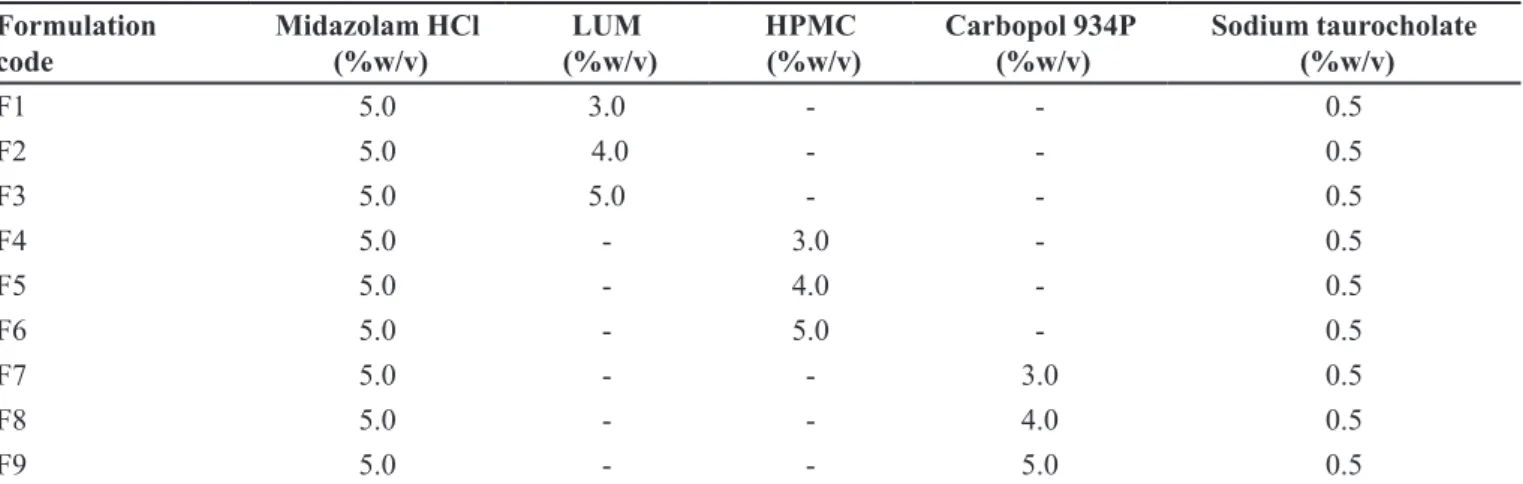
Mucoadhesive nasal gels were prepared by dissolv-ing midazolam hydrochloride in nasal solution that con-sists of 0.65% NaCl, 0.04% KH2PO4, 0.09% K2HPO4 and 0.02% benzalkonium chloride (pH 6), in a constant stir-ring condition. Required amounts of LUM and synthetic polymers (HPMC and Carbopol 934P) and penetration enhancer like sodium taurocholate (0.5% w/v) were added to the solution and stirred on a magnetic stirrer until a uniform solution was obtained. This homogenous solution was kept at 4 °C overnight to allow complete swelling so that a homogenous gel was formed. The composition of nasal gels used in the present study is provided in Table I.
Characterisation of gels
Determination of texture profile analysis
Texture proile analyses of the gels were evaluated using QTS-25 Texture Analyser (Brookield Engineering Labs., USA) to determine the mechanical parameters like hardness, cohesiveness and adhesiveness. An analytical probe of 1.2 cm in diameter was depressed twice into
TABLE I - Composition of nasal gels along with formulation codes
Formulation code Midazolam HCl (%w/v) LUM (%w/v) HPMC (%w/v) Carbopol 934P (%w/v) Sodium taurocholate (%w/v)
F1 5.0 3.0 - - 0.5
F2 5.0 4.0 - - 0.5
F3 5.0 5.0 - - 0.5
F4 5.0 - 3.0 - 0.5
F5 5.0 - 4.0 - 0.5
F6 5.0 - 5.0 - 0.5
F7 5.0 - - 3.0 0.5
F8 5.0 - - 4.0 0.5
each sample to a ixed depth (15 mm), at a deined rate (30 mm/min), with a deined recovery period (15 s), be -tween the end of the irst compression and the beginning of the second. A trigger force of 4 g was applied. At least six replicate analyses of each sample were performed at 37±1°C. Data collection and evaluation were done by Texture pro software, version 2.1 (Cevher et al., 2008; Basu et al., 2010).
Evaluation of mucoadhesive strength
Mucoadhesive strengths of the gels were determined by measuring the force required to detach nasal mucous membrane from the gel using the same texture analyser. Freshly excised goat nasal membrane was attached to the upper probe of the instrument, and the ixed amount of gel was kept below that. The upper probe was then lowered at a speed of 10 mm/min to touch the surface of the gel. A force of 0.1 Newton was applied for 5 min to ensure intimate contact between the membrane and the gel. The surface area of exposed mucous membrane was 1.13 cm2.
Calibration curve of midazolam in rabbit plasma
Stock solutions of midazolam were prepared in a mixture of 10 mM phosphate buffer (pH 6.0): acetonitrile (80:20) to give inal concentrations of 1 mg/mL. Plasma standards for calibration curves were prepared by spiking 1.0 mL aliquots of pooled drug free plasma with 100 µL of the above mentioned working solutions, to make mid-azolam plasma standards ranging from 10 to 1000 ng/mL.
In vivo drug absorption study
Selection of animals
The In vivo drug absorption study was conducted
with prior approval of the Institutional Animal Ethics Committee and it was conducted according to the insti-tutional guidelines of Animal Ethics Committee of Dr. B. C. Roy College of Pharmacy and Allied Health Sciences, West Bengal University of Technology, as recognized by the Committee for the Purpose of Control and Supervision on Experiments on Animals, India.
In vivo studies were conducted on 12 New Zealand
albino male rabbits weighing between 2 and 2.5 kg. Based on results of texture proile analyses, mucoadhe -sive strengths and in vitro drug release pattern (Basu et al., 2009), nasal gels containing 3% w/v LUM, 5% w/v Carbopol 934P and 5 % w/v HPMC along with 0.5% sodium taurocholate were selected for in vivo study. The animals were kept in individual metal cages and main-tained at 25 °C for 10 days prior to the experiment. They were provided with standard diet and water ad libitum.
The rabbits were kept in fasting condition for 24 h before the experiment commenced. The rabbits were grouped into four (group I, II, III and IV), each group contain-ing three rabbits. Group I was administered intravenous bolus injection of midazolam. Groups II, III and IV were administered nasal gels of midazolam prepared with LUM, Carbopol 934P and HPMC. A single dose of midazolam (2 mg/kg body weight of rabbit) was administrated intra-venously to compare the pharmacokinetic parameters. No anesthesia was used for the intravenous study. Midazolam was injected through cannulated marginal ear vein. After every 20 min, each rabbit was administered one-third of the initial dose of xylazine and ketamine intramuscularly to maintain a light plane of anesthesia. In case of nasal gels, the dose of midazolam administered was also 2 mg/ kg rabbit body weight.
Collection of blood samples
Two milliliters of blood samples were collected be-fore intravenous injection and then at 5-, 10-, 15-, 20-, 30-, 45-, 60-, 90-, 120-, 180-, 240- and 300-min intervals in ep-pendorffs containing heparin sodium (100 U/mL). Imme-diately after each blood sample collection, the catheter was lushed with 0.2 mL of a 10% (v/v) heparin/normal saline solution to prevent blood clotting inside the catheter. The blood samples were kept on ice and centrifuged at 3,000 rpm for 10 min immediately after collection to separate the plasma and stored at −20 °C until the time of analysis.
HPLC analysis
Reverse phase HPLC was used to quantitate mid -azolam in plasma samples. Mid-azolam was extracted with 3 mL of cyclohexane/diethyl ether (3:7) after the addition of 10 μL of 2% sodium hydroxide (Shih et al., 2002). The organic phase was removed and evaporated to dry-ness under nitrogen, and the residue was reconstituted in 200 μL of the mobile phase (10 mM phosphate buffer (pH 6.0)/acetonitrile, 80:20). From the mixture, 100 μL was injected for chromatographic analysis. The mobile phase consisted of phosphate buffer/acetonitrile (80:20) v/v. The mobile phase was delivered into the HPLC apparatus at a low rate of 1 mL/min (isocratic pump, Model LC-10AS, Jasco, Japan). The detection wavelength was 218 nm (ul-traviolet variable wavelength detector, Model SPD-10A), and a C18 column was used. All assays were performed at ambient temperature.
Pharmacokinetic analysis
mean residence time (MRT), elimination half-life (t1/2)
and total body clearance (CL) were calculated following non-compartment model by Kinetica 4.4, PK/PD Analy-sis, Thermoelectron Corporation. All the parameters were calculated for i.v. bolus injection of midazolam and in situ
nasal gels. Fraction of dose absorbed (F) was calculated by the following equation:
where Dose(iv)=dose of midazolam given as i.v. solution, Dose(nasal)=dose of midazolam in nasal gels, AUC(i.v.)=AUC
after i.v. administration of midazolam and AUC(nasal)=AUC after nasal administration of midazolam.
STATISTICS
Data were analyzed by one-way ANOVA followed by Tukey’s HSD test using Vassar stat software (USA). p<0.01 has been considered to be signiicant statistically.
RESULTS
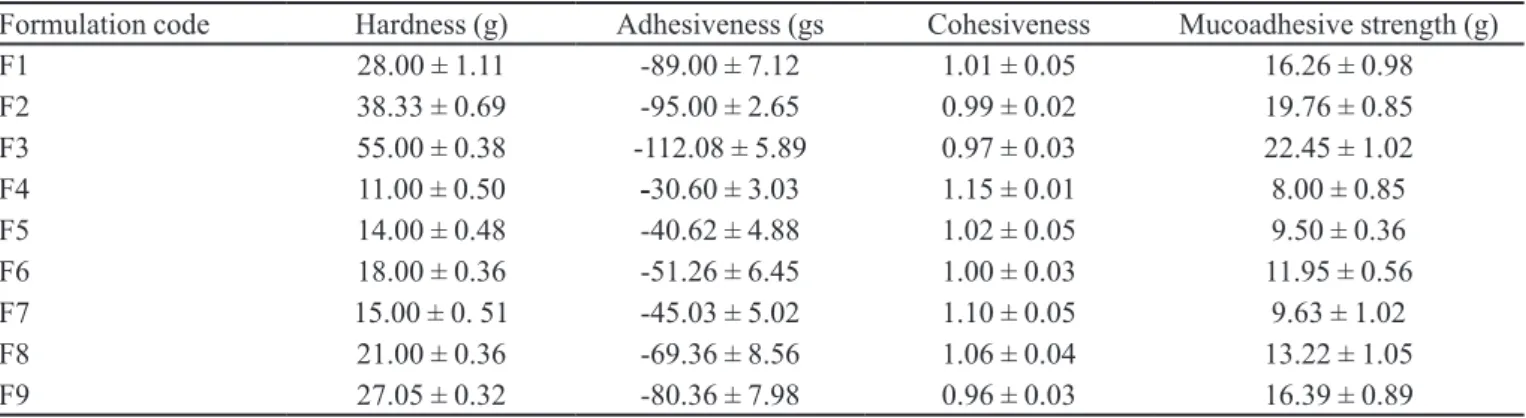
The present study determines the various mechanical properties as well as mucoadhesive strengths of the gels with the help of QTS – 25 Texture Analyser. Results of the texture proile analysis and mucoadhesive strengths are
tabulated in Table II. Hardness of LUM gels ranges from 28.00 ± 1.11 g to 55.00 ± 0.38 g. In case of HPMC gels, it ranges from 11.00 ± 0.50 g to 18.00 ± 0.36 g and for Car-bopol 934P it varies from 15.00 ± 0.51 g to 27.05 ± 0.32 g. Values of adhesiveness of LUM, HPMC and Carbopol 934P gels varies from -89.00 ± 7.12 g to -112.08 ± 5.89 g, -30.60 ± 3.03 g to -51.26 ± 6.45 g and -45.03 ± 5.02 g to -80.36 ± 7.98 g, respectively. In a texture proile analysis graph, the curves of adhesiveness are obtained in the nega-tive X-axis and hence, the values are neganega-tive. Cohesive-ness of LUM gels ranges from 1.01 ± 0.05 to 0.97± 0.03. For HPMC gels, it varies from 1.15 ± 0.01 to 1.00 ± 0.03 and for Carbopol 934P gels, it varies from 1.10 ± 0.05 to 0.96 ± 0.03.
Values of mucoadhesive strengths of the gels are also displayed in Table II, which shows that with an increase in concentration of the gels from 3% to 5%, mucoadhe-sive strengths of LUM gels varies from 16.26 ± 0.98 g to 22.45 ± 1.02 g. For HPMC gels and Carbopol 934P gels, it ranges from 8.00 ± 0.85 g to 11.95 ± 0.56 g and from 9.63 ± 1.02 g to 16.39 ± 0.89 g respectively.
The calibration curve of midazolam hydrochloride prepared in rabbit plasma was found to be linear over the concentration range of 10-1,000 ng/mL (r2=0.9999).
The experiment was repeated six times a day and for six consecutive days. Interday and intraday accuracy and precision values are displayed in Table III.
Plasma concentration–time proiles of midazolam
TABLE II - Values of texture proile analysis and mucoadhesive strength of conventional gels. Data represent mean ± SD (n=6)
Formulation code Hardness (g) Adhesiveness (gs Cohesiveness Mucoadhesive strength (g) F1 28.00 ± 1.11 -89.00 ± 7.12 1.01 ± 0.05 16.26 ± 0.98 F2 38.33 ± 0.69 -95.00 ± 2.65 0.99 ± 0.02 19.76 ± 0.85 F3 55.00 ± 0.38 -112.08 ± 5.89 0.97 ± 0.03 22.45 ± 1.02 F4 11.00 ± 0.50 -30.60± 3.03 1.15 ± 0.01 8.00 ± 0.85 F5 14.00 ± 0.48 -40.62 ± 4.88 1.02 ± 0.05 9.50 ± 0.36 F6 18.00 ± 0.36 -51.26 ± 6.45 1.00 ± 0.03 11.95 ± 0.56 F7 15.00 ± 0. 51 -45.03 ± 5.02 1.10 ± 0.05 9.63± 1.02 F8 21.00 ± 0.36 -69.36 ± 8.56 1.06 ± 0.04 13.22± 1.05 F9 27.05 ± 0.32 -80.36 ± 7.98 0.96 ± 0.03 16.39± 0.89
TABLE III - Interday and intraday accuracy and precision data for quantitation of midazolam in rabbit plasma
Amount of drug added (ng/mL)
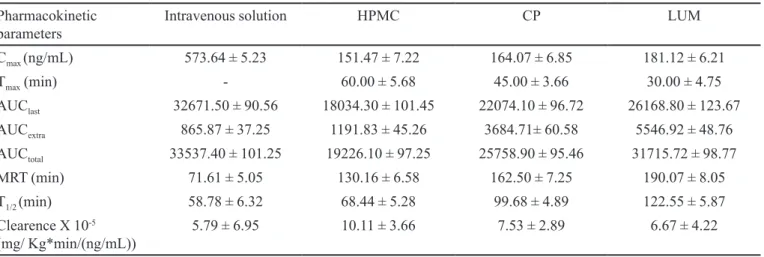
TABLE IV - Comparative pharmacokinetic parameters of midazolam hydrochloride following administration of intravenous and nasal gels in rabbits (dose=2 mg/kg)
Pharmacokinetic parameters
Intravenous solution HPMC CP LUM
Cmax (ng/mL) 573.64 ± 5.23 151.47 ± 7.22 164.07 ± 6.85 181.12 ± 6.21
Tmax (min) - 60.00 ± 5.68 45.00 ± 3.66 30.00 ± 4.75
AUClast 32671.50 ± 90.56 18034.30 ± 101.45 22074.10 ± 96.72 26168.80 ± 123.67
AUCextra 865.87 ± 37.25 1191.83 ± 45.26 3684.71± 60.58 5546.92 ± 48.76
AUCtotal 33537.40 ± 101.25 19226.10 ± 97.25 25758.90 ± 95.46 31715.72 ± 98.77
MRT (min) 71.61 ± 5.05 130.16 ± 6.58 162.50 ± 7.25 190.07 ± 8.05 T1/2 (min) 58.78 ± 6.32 68.44 ± 5.28 99.68 ± 4.89 122.55 ± 5.87
Clearence X 10-5
(mg/ Kg*min/(ng/mL))
5.79 ± 6.95 10.11 ± 3.66 7.53 ± 2.89 6.67 ± 4.22
FIGURE 1 - Plasma concentration–time proiles of midazolam
hydrochloride after administration of intravenous solution and the nasal gels in rabbits. Data represent mean ± SD (n=3).
122.55 ± 5.87, 68.44 ± 5.28 and 99.68 ± 4.89 min, re-spectively.
DISCUSSION
The hardness of a gel determines the drug release pattern from the gel. From the results it can be said that gel containing 3% LUM showed optimum hardness. Ad-hesiveness determines proper gel contact and retention at the site of application, thereby leading to enhanced bioavailability of the drug. In the present study, the ad-hesiveness of gels was enhanced signiicantly with the increase in amount of mucoadhesive agent. Cohesiveness was observed to be reduced with the increase in amount of mucoadhesive agents. This happens because with an increase in amount of dispersed solids, that are the muco-adhesive agents, the semisolid nature of the gels increased, which caused the gel to become less coherent (Cevher et al., 2008).
Mucoadhesive strength of LUM gels was found to be higher than those prepared with synthetic muco-adhesive polymers and it increased with corresponding increase in concentration of mucoadhesive agent used. This may be due to the presence of certain functional groups in the mucilage, which were able to establish a more intimate contact with mucin of the mucosa (Basu
et al., 2009).
In our previous work it was shown that sodium taurocholate produced better drug release proiles than sodium thioglycollate, and the histopathological study conirmed that LUM can be used safely as a mucoadhesive agent (Basu et al., 2009). Hence, for the in vivo study, na-sal gels containing 0.5 % w/v sodium taurocholate were administered to the rabbits. Higher plasma concentration after administration of i.v. solution and the nasal gels are
shown in Figure 1. Pharmacokinetic parameters were displayed in Table IV. Cmax values of i.v. injection, LUM,
of midazolam hydrochloride is observed in case of LUM gels in comparison to HPMC and Carbopol 934P gels (Figure 1), and accordingly, absolute bioavailabilities of midazolam from LUM, HPMC and Carbopol gels were reported to be 97.55%, 57.33% and 76.81%, respectively. From the in vivo study we can conclude that bioavailability of midazolam from nasal gels prepared from LUM was better than those prepared from synthetic polymers. This conirms that LUM can be effectively used as a mucoad -hesive agent instead of synthetic polymers for delivery of midazolam via nasal route.
CONCLUSION
From the above study, it is conirmed that mucoad -hesive nasal gels of midazolam hydrochloride prepared with mucilage isolated from Linum usitatissimum L. seeds exhibited better mechanical properties as well as
in vivo drug absorption pattern. Also, bioavailability of midazolam was higher from the gels prepared with this natural mucilage than from synthetic gels. Hence, this new dosage form of midazolam prepared with a natural mucilage is a safe and cost-effective form of nasal drug delivery system.
REFERENCES
BASU, S.; CHAKRABATORTY, S.; BANDYOPADHYAY,
A.K. Development and evaluation of a mucoadhesive nasal gel of midazolam prepared with Linum usitatissimum L. seed mucilage. Sci. Pharm., v.77, p.899-910, 2009.
BASU, S.; BANDYOPADHYAY, A.K. Development and
Characterization of Mucoadhesive In Situ Nasal Gel of Midazolam Prepared with Ficus carica Mucilage. AAPS Pharm Sci Tech., v.11, p.1224-1231, 2010.
CEVHER, E.; TAHA, M.A.M.; ORLU, M.; ARAMAN, A.
Evaluation of mechanical and mucoadhesive properties of clomiphene citrate gel formulations containing carbomers and their thiolated derivatives. Drug Dev., v.15, p.57-67, 2008.
CUI, W.; MAZZA, G.; BILIADERISS, C.G. Chemical structure, molecular size distributions, and rheological properties of
laxseed gum. J. Agric. Food Chem., v.42, p.1891-1895, 1994.
ERSKINE, A.J.; JONES, J.K.N. The structure of linseed
mucilage (Part I). Can. J. Chem., v.35, p.1174-1182, 1957.
FEDENIUK, R.K.; BILIADERIS, C.G. Composition and physicochemical properties of linseed mucilage. J. Agric. Food Chem., v.42, p.240-247, 1994.
GOLDMAN, R.D. Intranasal drug delivery for children with
acute illness. Curr. Drug Ther., v.1, p.127-130, 2006.
HARDING, S.E. Mucoadhesive interactions. Biochem. Soc. Trans., v.31, p.1036-1041, 2003.
HUNT, K.; JONES, J.K.N. The structure of linseed mucilage.
Can. J. Chem., v.40, p.1266-1279, 1962.
HARBORD, M.G.; KYRKOU, N.E.; KYRKOU, M.R.; KAY, D.; COULTHARD, K.P. Use of intranasal midazolam to
treat acute seizures in paediatric community settings. J. Paediatr. Child H., v. 40, p.556-558, 2004.
LAHAT, E.; GOLDMAN, M.; BARR, J.; BISTRITZER, T.; BERKOVITCH, M. Comparison of intranasal midazolam
with intravenous diazepam for treating febrile seizures in children: prospective randomised study. BMJ (Clin. Res. Ed.), v.321, p.83-86, 2000.
MAHMOUDIAN, T.; ZADEH, M.M. Comparison of intranasal
midazolam with intravenous diazepam for treating acute seizures in children. Epilepsy Behav., v.5, p.253-255, 2004.
MCCORMICK, A.S.; THOMAS, V.L.; BERRY, D.; THOMAS,
P.W. Plasma concentrations and sedation scores after nebulized and intranasal midazolam in healthy volunteers.
Br. J. Anaesth., v.100, p.631-636, 2008.
MURALIKRISHNA, G.; SALIMATH, P.V.; THARANATHAN, R.N. Structural features of an arabinoxylan and a rhamnogalacturonan derived from linseed mucilage.
Carbohydr. Res., v.161, p.265-271, 1987.
PECKING, M.; MONTESTRUC, F.; MARQUET, P.; WODEY, E.; HOMERY, M.C.; DOSTERT, P. Absolute bioavailability
of midazolam after subcutaneous administration to healthy volunteers. Br. J. Clin. Pharmacol., v.54, p.357-362, 2002.
SCHEEPERS, M.; SCHEEPERS, B.; CLARKE, M.; COMISH, S.; IBITOYE, M. Is intranasal midazolam an effective
rescue medication in adolescents and adults with severe epilepsy? Seizure, v.9, p. 417-422, 2000.
TSCHIRCH, F.T.C; SUTER, K; FROEHLICH, J.M.;
STUDLER, U.; NIDECKER, A.; ECKHARDT, B.; BERANEK-CHIU, J.; SURBER, C.; WEISHAUPT, D. Multicenter trial: comparison of two different formulations and application systems of low-dose nasal midazolam for routine magnetic resonance imaging of claustrophobic patients. J. Magn. Reson. Im., v.28, p.866-872, 2008.
Received for publication on 06th May 2011