__________________________________________________________________________________________________________________
64
Design and Evaluation of the Electronic Class Record for
LPU-Laguna International School
RHOWEL M. DELLOSA
College of Engineering, Lyceum of the Philippines-Laguna PHILIPPINES
Date Received: May 2, 2014; Date Published: August 15, 2014
Abstract - This study aimed to design, develop, deploy and evaluate an electronic class record (e-class
record). Microsoft Excel is used to develop the electronic class record and several Microsoft Excel arithmetic operands and functions like VLOOKUP, IF, AVERAGE, COUNTIF are used. A worksheet template was developed to accept name of teacher, course code, course title, section, schedule, room, student number, student name, grade level, gender, date of each classes, base grade, test items attendance, and performance of the students. These serve as the input of the e-class record. The e-class record automatically computes the grades of the students following the standard grading system. Developmental process and prototyping method were utilized to develop the e-class record. Testing, deployment and evaluation have been initiated to observe its acceptability. It is found out that the e-class record can generate the quarterly and final grade of the students, total number of absences and tardiness of the students, grade sheet with corresponding level of evaluation of each student in the class and summary of the total number of students for each of the level of proficiency. It is recommended that further study may be initiated to utilize the output of this study as an input of an online application such as online grade viewer. Security of previous submitted grades from being changed by the teacher accidentally or intentionally must be also taken into consideration. A report card may be also included in the system.
Keywords:vlookup, countif, e-class record, LPU-Laguna international school
I.INTRODUCTION
The class record of the teachers is one of the most important things that the student records were kept. It serves as the record book of all of the class performance of the students. Class record is also known as record book. Record book is available in the market.
The study entitled “e-DoX: DEPED Student Grade Records Management System with Implementation of Advanced Encryption Standard and PKI Infrastructure for the Department of Education in the Province of Cavite (2013)” which aims to develop an online based application to aid private and public schools in submission of reports on promotions in the province of Cavite was used to guide the researcher on how to treat and interpret data and results.
DEPED Order No 73, Series of 2012 entitled “Guidelines and Assessment and Learning Outcomes
under the K-12 Basic Education Curriculum” was used
to guide the researcher as the basis of computation of grades. The level of assessment that includes knowledge, process or skills, understanding and product and level of proficiency are some of the useful information that serves as inputs in the completion of the study.
According to Chua, B.B. & Dyson, L.E. (2004), there is a widespread use of e-learning systems and investment in them but there is no consensus on a standard framework for evaluating the quality of the output. In their study, they used ISO 9126 Quality Model as a useful tool for evaluating systems, particularly for teachers and educational administrators. They also demonstrated the validity of the model and used to detect design loopholes. The ISO 9126 is used by the researcher as a guide to come up with a survey and evaluation instrument.
65
standards by providing a single set of standards that would be recognized and followed (Praxiom Research Group). The ISO 9126 was developed in 1991 to provide a framework for evaluating software quality. It was refined over a ten year period (Abran, 2003). The metrics introduced and validated from this study were considered and became the basis of the researcher to come up with the survey evaluation form of the electronic class records.
An electronic class record for the LPU-Laguna and LPU-St. Cabrini is developed as a substitute to the conventional ways of recording the performance of the students. The researcher based his method of developing the electronic class record to lessen the activities and customized the content of the output (Dellosa, 2013).
Sommerville (2011) discussed that security is one of the important attributes of the system to protect itself from accidental or incidental attacks. He also tackled some of the methodology on how to develop the system including Rapid Application Development, prototyping and formal methods. The researcher focused on the use of prototype method information and applied it in this study.
Chen‟s (1997) study entitled “Computer-based
Document Management System”, leads to an efficient way to automatically import, index, categorize, store, search, retrieve, manipulate and archive electronic documents. This will be entrant information for online application. The researcher used the discussion and output of this study to come up with a study recommendation that online grade viewer is possible.
The field of technology will benefit for the reason that this is another innovation in information technology. This study serves as a starting point of computerization and may lead to online technology. The end users will benefit for the reason that the study will make their life easier for grade computation. The institution will also benefit because this would contribute for creating an image to the institution as technology-driven.
Most of the teachers are aware on how to use the class record. Due to fast evolution of technology, existence of laptops and notebooks and application software, worksheet is made available as software to support computations of grades. The intention of this study is to come up with a design of electronic class records that will be utilized by the teachers of LPU-Laguna International School.
II. OBJECTIVES OF THE STUDY
The general objective of this study is to develop an electronic class record for LPU-Laguna International School. Specifically, the study aimed to develop an electronic class record following the standard set by LPU-Laguna International School; to test the functionality of the electronic class record; and determine the acceptability of the electronic class record using ISO 9126.
III.MATERIALS AND METHODS
Research Design
In this study, the researcher used developmental method that includes designing, developing, testing and evaluating the study. Series of tests were conducted to determine its functionality in terms of accuracy and reliability of computation of grades.
Locale of the study
The researcher conducted a survey and evaluation from the principal, teachers and secretary of LPU Laguna International School to determine the accuracy,
efficiency, reliability, security, user-friendliness,
flexibility, validity of the system and determine the usefulness of the electronic class record.
Respondents
The researcher conducted a survey and evaluation from the principal, teachers and secretary of LPU-Laguna International School. Brainstorming with the principal was conducted last February 22, 2013 and May 2, 2013. The development stage was conducted
from May –June 2013 wherein principal, teachers and
secretary are involved in information gathering.
Instrument and technique used
66
evaluation instrument are composed of respondent‟s
profile, software characteristics in terms of accuracy, efficiency, reliability, flexibility, security, user-friendliness and validity and respondent‟s suggestions and recommendations for the improvement of the developed electronic class record.
Procedure
The study was conducted in Lyceum of the Philippines-Laguna from April 30, 2013 to January 20, 2014. A computer with Windows Operating System and with Microsoft Excel is used to develop the electronic class record. Inputs from the end users, the principal and teachers, were carefully analyzed. During
deployment, revisions were made for further
improvement and acceptance. Training sessions on how to use the electronic class record were also conducted. Other unexpected events such as power outage and the Microsoft Excel issues and updates from Microsoft are no longer part of the study.
Data Analysis
The researcher used descriptive statistics to determine the mean, standard deviation, frequency and percentage as the basis of the interpretation and analysis of data. This is also the basis of the software characteristics in terms of accuracy, efficiency, reliability, flexibility, security, user-friendliness and
validity and respondent‟s suggestions and
recommendations for the improvement of the developed electronic class record. The numerical rating scale used in the study to interpret the result of the evaluation of
acceptability: Strongly Agree: 3.50 – 4.00; Agree: 2.50
- 3.49; Disagree: 1.50 – 2.49; Strongly Disagree: 1.00 – 1.49
Research Process
Prototype model was used in developing the electronic class record and the users are involved in planning and analysis, testing, deployment and evaluation.
1) Planning and analysis
This phase is one of the very important components of the study wherein information are gathered to be able to determine the need of the study. This will also guide the researcher on what approaches to be used in conducting the study. The type of user, capability of the
output, implementers and the environment where output will be used must be captured during this stage. It will also determine and investigate the things that are currently used by the users and introduce new idea on how to apply the output of the study that will make their work easier compared with the current system. This will also determine how the output will operate in terms of all aspects needed to come up with an improved system.
2) Testing
This phase will determine the output‟s performance
in terms of accuracy and reliability. A series of test will be conducted to ensure the output‟s capability of performing same task as what the current system is performing in a fastest and easiest way.
3) Deployment
This phase will let the prospect users utilize the system and provide feedback and areas for improvement.
4) Evaluation
This phase will let the prospect users answer the survey and evaluation form to determine the acceptability of the output.
The following presents the summarized step-by-step procedure of the activities from the start to the end of the study:
1. Establish the project objectives.
2. Gather necessary data from concerned personnel.
3. Design the electronic class record using Microsoft
Excel.
4. Present the electronic class record to concerned
personnel for critiquing and enhancement.
5. Revise the electronic class record.
6. Deploy the output to the teachers.
7. Conduct training sessions to end-users.
8. Get feedback from the teachers and revise as
necessary.
9. Evaluate the electronic class record.
10. Finalize the study document.
11. Submit the end product and the document to the
67
IV.RESULTS AND DISCUSSION
A. The Electronic Class record of the LPU-Laguna International School
Figure 2. Worksheet Attendance Tab Output of Electronic Class Record
Figure 2 above shows the workheet attendance tab of electronic class record. The user inputs for every attendance column are the date and letter „L‟ for late student and „A ‟for absence student.
Total(Late) is computed based on the formula: =IF(C12="","",COUNTIF(F12:Y12,"L")) Total absence is computed based on the formula : =IF(C12="","",COUNTIF(F12:Y12,"A")) Total overall late is computed based on the formula :
=Z12+AV12+BR12+CN12+DJ12+EF12+FB12+FX12+GT12+HP12 Total overall absence is computed based on the formula below:
=AA12+AW12+BS12+CO12+DK12+EG12+FC12+FY12+GU12+HQ12 Note:
Formula above represents the computation of absences and tardiness of students on row number 12, however the formula in rows are reflected from row12 to row 46 of the worksheet with varying cell locations.
68
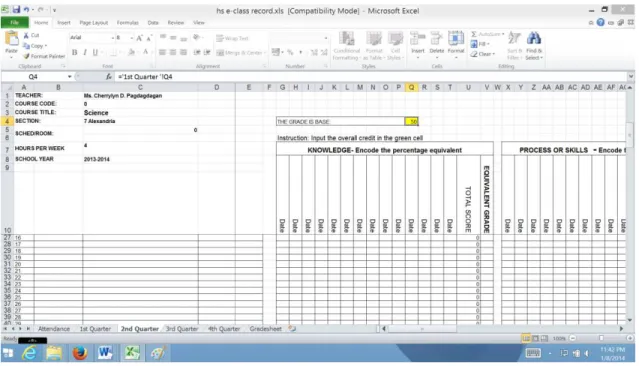
Figure 4. Worksheet 2nd Quarter Tab Output of Electronic Class Record
69
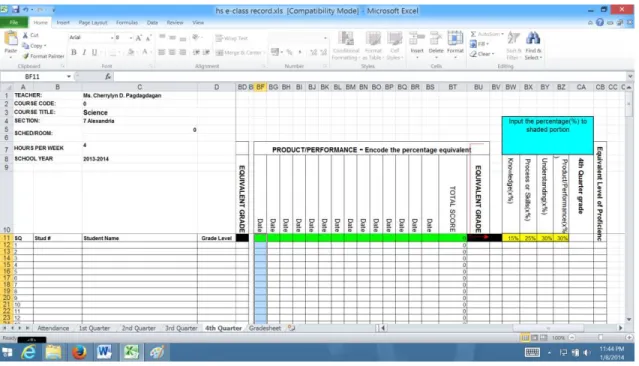
Figure 6. Worksheet 4th Quarter Tab Output of Electronic Class Record
Figures 2, 3, 4, 5, and 6 are the 1st, 2nd , 3rd , and 4th quarter tab that perform the computation of grades of
students. Initial setup of electronic class record should be done prior to its use. User inputs such as grade base and percentage per level of assessment must be encoded to the designated cell locations. Grade base remain to be variable for future use. User inputs such as date, total score per activity and the raw score of student for each level of assessment must be also first encoded by the user.
Total score of assessment and total score of student are computed based on the formulas below: =SUM(G11:T11)
=SUM(G12:T12)
Equivalent grade is computed based on the formula below:
=IF(C12="","",IF(G12="","",$Q$4+(100-$Q$4)*U12/$U$11))
The formula above are applicable to all of the levels of assessment with varying cell locations.
To compute the percentage of knowledge, process or skills, understanding, and product the formulas below are used:
=IF(V12="","",V12*$BW$11) - Knowledge
=IF(AM12="","",AM12*$BX$11) - Process or skills
=IF(BD12="","",BD12*$BY$11) - Understanding
=IF(BU12="","",BU12*$BZ$11) - Product
Quarter grade is computer based on the formula below:
=IF(C12="","",IF(V12="","",IF(AM12="","",IF(BD12="","",IF(BU12="","",SUM(BW12:BZ12)))))) Equivalent level of proficiency is determined based on the formula below:
=IF(CA12="","",VLOOKUP(CA12,$CM$13:$CN$18,2,TRUE)) Note:
70 SY:2013-2014 1 2 3 4 5 6 7 8 9 10 11 12 13 14 15 16 17 18 19 20 21 22 23 24 25 26 27 28 29 30 31 32 33 34 35
SUMMARY OF FINAL GRADE LEVEL OF PROFICIENCY 1st 2nd 3rd 4th Final
0 0 0 0 0
0 0 0 0 0
0 0 0 0 0
0 0 0 0 0
0 0 0 0 0
TOTAL 0 0 0 0 0
Ms. Cherrylyn D. Pagdagdagan Received by:
Signature over printed name of teacher
Date Received:
Signature over printed name of principal
LYCEUM OF THE PHILIPPINES-LAGUNA
Km 54, National Highway, Makiling, Calamba, Laguna LPU INTERNATIONAL SCHOOL
Course Code: 0
Descriptive Title: Science
Section: 7 Alexandria
GRADE SHEET
STUDENT(Family Name First) LEVEL 1st Quarter 1st LP
2nd Quarter 2nd LP
3rd Quarter
Submitted by:
3rd LP 4th Quarter 4th LP
FINAL GRADE
FINAL GRADE LEVEL OF PROFICIENCY
A - for Advanced (90 percent and above)
Signature over printed name Date Submitted:
Attested by:
P - for Proficient (85-89 percent)
AP - for Approaching Proficiency (80-84 percent)
D - for Developing (75-79 percent)
B - for Beginning (74 percent and below)
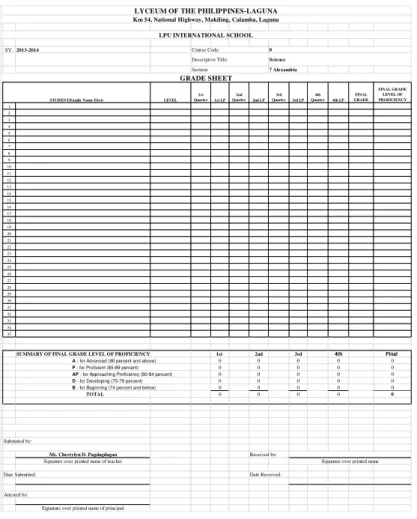
Figure 7. Worksheet Gradesheet Tab Output of Electronic Class Record
Figure 7 shows the grade sheet of class record. It is the summary of all computed grades per quarter. The formula below is just an example of transferring the content from one worksheet tab to another.
='1st Quarter '!CA12
The final grade and its final level of proficiency are computed based on the formula below:
=IF(C12="","",IF(E12="","",IF(G12="","",IF(I12="","",IF(K12="","",AVERAGE(E12,G12,I12,K12)))))) =IF(M12="","",VLOOKUP(M12,$Q$12:$R$16,2,TRUE))
The formula below is an example on how to display the total number of students whose grade belongs to a certain level of proficiency
=COUNTIF(F12:F46,"A")
Note: VLOOKUP data are found at Q12, Q13, Q14, Q15, Q16, R12, R13, R14, R15, and R16.
B. Result of test of functionality
A series of tests were conducted to determine the functionality of the electronic class record in terms of accuracy and reliability. These series of tests were conducted from June 2013 to October 2013. Feedbacks from the end users were collected to ensure that the output provides accurate and reliable result. This will also serves as the guide for the revisions of electronic class record. Feedbacks from the end users are accuracy of grade computation, worksheet tab dedicated only for the attendance of the students, variability of grade base
and the output‟s capability to compute the grade based
on the encoded grade base and revision of worksheet labeling to become more user-friendly.
C. Result of acceptability evaluation
71
mean, standard deviation, interpretation and rank of each level of acceptability measures.
Table 2. Result of Acceptability Evaluation
Level of Acceptability
Measures Mean
Standard
Deviation(SD) Interpretation Rank
1.Accuracy 3.29 0.654 Agree 5
2.Efficiency 3.38 0.561 Agree 4
3.Reliability 3.20 0.616 Agree 6
4.Security 3.55 0.510 Strongly Agree 2
5.User-friendliness 3.80 0.410 Strongly Agree 1
6.Flexibility 3.55 0.510 Strongly Agree 2
7.Validity 3.43 0.504 Agree 3
Average Mean and SD 3.46 0.538 Agree
Table 2 shows that the overall finding and evaluation of the electronic class record study has an average mean of 3.46 and average standard deviation of 0.538 with an
overall interpretation of agree result. User-friendliness
ranked as first with the highest mean value of 3.8.
Moreover, the output‟s security and flexibility were
rated with strongly agree with an equal average mean
value of 3.55. In terms of accuracy, reliability, validity,
and efficiency, the output was rated with agree which also implies that the evaluators were satisfied on the developed system. Based on the results of evaluation, the researcher can conclude that the electronic class record is acceptable in terms of accuracy, efficiency, reliability, security, user-friendliness, flexibility and validity.
V.CONCLUSION AND RECOMMENDATION
Based on the findings of the study, the researcher concluded that the electronic class record is developed for the teachers of the LPU-Laguna International School. It follows the grading standards of the institution. With the aid of computer system, class record can be easily used. Computation of grades can be done in a convenient way. With the help of the principal, teachers and secretary of LPU-Laguna International School, the electronic class record is initially deployed and simultaneously tested. Immediate feedbacks are collected and all of these feedbacks are addressed to ensure the accuracy and reliability of electronic class record. Finally, the electronic class record is acceptable in terms of accuracy, efficiency,
reliability, security, user-friendliness, flexibility and validity.
Several recommendations are made by the end users and administrators like the security of previous encoded grade must not be changed anymore once it is submitted. The output of the electronic class record may be the basis for report card. Moreover, the output of the electronic class record may be considered as an input to an online grade viewer.
REFERENCES
Chua, B.B. & Dyson, L.E. (2004). Applying the ISO 9126 Model to the Evaluation of an E-learning System. In R. Atkinson, C. McBeath, D. Jonas-Dwyer & R. Phillips (Eds), Beyond the Comfort zone: Proceedings of the 21st ASCILITE Conference (pp. 184-190). Perth, 5-8 December.
http://www.ascilite.org.au/conferences/perth04/procs/chua.html Chen (n.d.). Computer-based Document Management
System. Los Gatos, California: Caere Corporation. Dellosa R.M. (2012). Design and Evaluation of Electronic
Class Record for the LPU-Laguna and LPU-St. Cabrini.
DEPED Order No 73, Series of 2012 Entitled “ Guidelines and Assessment and Learning Outcomes Under the K-12 Basic Education Curriculum
Dya, R.B., Laridab, M.A. & Tanguilig, B.T (2013). e-DoX:DEPED Student Grade Records Management System with Implementation of Advanced Encryption Standard and PKI Infrastructure
Software Evaluation Criteria (n.d.). Retrieved February 2012,
from associationdatabase.com/aws/NCDA/asset_
manager/get_file/3404