Reinforced concrete structures are, certainly, one of the most used types of structure around world. When it is located in non-aggressive environments, it respects, in general, the structural life predicted. Unless the structure be used improperly. However, the durability of these structures is strongly connect-ed to degradation processes whose origin is environmental and/or functional. Among these processes, it is worth to mention those relatconnect-ed to corrosion of reinforcements. The reinforcement’s corrosion is directly related to the durability and safety of concrete structures. Moreover, the chlorides diffusion is recognized as one of major factors that triggers the corrosion. Therefore, at modelling accurately the chloride diffusion, the corrosion of reinforcements can be better evaluated. Consequently, design criteria can be more realistically proposed in order to assure safety and economy into reinforced concrete structures. Due to the inherent randomness present on chloride diffusion and corrosion, these phenomena can only be properly modelled considering probabilistic approaches. In this paper, the durability of a beam designed using the criteria proposed by ABNT NBR 6118:2003 [1] is assessed using probabilistic approaches. The corrosion time initiation is determined using Fick’s diffusion law whereas Faraday’s corrosion laws are adopted to model the steel loss. The probability of structural failure is determined using Monte Carlo simulation. The mentioned beam is analysed considering different
failure scenarios in order to study the inluence of water/cement ratio and environmental aggressiveness on the probability of failure. Based on these
results, some remarks are performed considering NBR recommendations and the real probability of failure.
Keywords: corrosion of reinforcement, reinforced concrete, Fick’s second law, Faradays’s laws.
As estruturas de concreto armado estão certamente entre as mais utilizadas no mundo da construção civil moderna. Quando tais estruturas estão localizadas em ambientes não agressivos, elas respeitam, em geral, a vida útil para a qual foram projetadas, a menos, evidentemente, que sejam utilizadas de maneira imprópria, violando as funções para as quais foram projetadas. No entanto, a durabilidade destas estruturas está fortemente vinculada a processos de degradação de origem ambiental, que ocorrem em ambientes considerados agressivos. Dentre estes processos de degradação, destacam-se aqueles que desencadeiam a corrosão das armaduras. Dessa forma, a durabilidade está di-retamente associada à corrosão das armaduras, que por sua vez, tem como um dos fatores de maior importância, a difusão de íons cloreto como agente desencadeador do processo corrosivo. Assim, efetuando a modelagem precisa deste fenômeno, a corrosão das armaduras pode ser mais bem avaliada e, consequentemente, critérios mais adequados podem ser propostos para proteger o aço dentro do elemento de concreto, garantindo maior segurança estrutural e, portanto, durabilidade da obra. Neste trabalho, os procedimentos descritos pela ABNT NBR 6118:2003 [1] para o dimensionamento de vigas em concreto armado são avaliados por meio de análises probabilísticas. O tempo de início da corrosão das armaduras via penetração de íons cloreto também é analisado a partir do cálculo de probabilidades de ocorrência desse estado
limite. Por im, as leis de Fick e Faraday são utilizadas para a análise da perda de seção transversal de armaduras do elemento estrutural em
estudo, submetido à penetração de íons cloreto ao longo do tempo. Para a determinação das probabilidades de falha, o método de simulação
de Monte Carlo é utilizado. São apresentados alguns exemplos que mostram a direta inluência do fator água/cimento e do ambiente agressivo ao qual o elemento estrutural está inserido na avaliação inal probabilidade de falha.
Palavras-chave: corrosão de armaduras, concreto armado, segunda lei de Fick, leis de Faraday.
Inluence of the reinforcement corrosion on the bending
moment capacity of reinforced concrete beams:
a structural reliability approach
Inluência da corrosão da armadura na capacidade
resistente à lexão de vigas em concreto armado: uma
abordagem via teoria da coniabilidade estrutural
E. A. P. LIBERATI a
[email protected] E. D. LEONEL a
[email protected] C. G. NOGUEIRA a
a Universidade de São Paulo, Escola de Engenharia de São Carlos, Departamento de Engenharia de Estruturas, São Carlos, Brasil.
Abstract
1. Introduction
Concrete properties, such as versatility in the design of complex architectural geometries, competitive cost when compared to other structural materials and suitable mechanical properties for a wide range of structural requirements, all enhanced with the addition of steel for structural ductility and tensile resistance, make reinforced concrete the most used construction material in the world since the 1950s [2]. Construction techniques and mathematical models for the design of reinforced concrete structures are currently well developed and consolidated in the context of modern engineer-ing. Although safety, economic and functionality requirements are considered during the design process, structural durability has frequently been neglected. The latest review of the Brazilian de-sign code, ABNT NBR 6118 [1], which addresses the dede-sign and construction of reinforced and pre-stressed concrete structures,
provided signiicant improvements to accurately consider durabil -ity. The inclusion of environmental aggressiveness classes and the correlation with the quality of concrete, the consideration of limits for water/cement ratios and compressive resistance, the im-provement on concrete cover values and on the control of concrete
cracking relect the importance and priority of concrete structural
durability in actual engineering applications [3].
According to [3], the following factors are primarily responsible for
pathological structural manifestations: deiciencies in design, in
-adequate concrete cover thickness, in-adequate speciications for the concrete and constituent materials, ineficient construction pro
-cesses, ineficient maintenance procedures and the effects of an
aggressive environment at the structure’s location. Among these factors, environmental aggressiveness cannot be manipulated and
modiied by human intervention. Environmental aggressiveness
is more severe in coastal zones and industrial neighbourhoods,
which are classiied as classes IV and III, respectively, by ABNT
NBR 6118:2003 [1].
Reinforcement corrosion directly affects the durability of reinforced concrete structures. The diffusion of chloride is recognised as one of most important triggers of the corrosion process [4]. The high costs associated with steel loss, structural material mechanical degradation and repair, the loss of structural stability and the recur-rence of these problems make the corrosion of reinforcements the principal pathological manifestation in reinforced concrete struc-tures [5].
The corrosion of reinforcements leads to an expansive reaction that causes concrete cracking. Consequently, the concrete poros-ity increases [6]. A loss of steel is also observed, which leads to the decrease of both the cross-sectional area of the reinforcing bars and the bending and shear structural resistances. Therefore, rein-forcement corrosion directly affects the safety of structures. In general, the mechanical degradation process of reinforced con-crete structures resulting from reinforcement corrosion can be di-vided into two stages: initiation and propagation. During the ini-tiation period, chlorides penetrate into the concrete cover by the diffusion mechanism. Over time, the chloride concentration grows until a threshold value is reached, leading to reinforcement depas-sivation and, consequently, the start of corrosion. The propagation period includes the development of corrosion, i.e., the period in which the reduction of steel is observed. The propagation period is relatively short when compared to the initiation period. Therefore, the process of chloride diffusion into concrete pores (the initiation
period) is often used to indicate the durability and service life of reinforced concrete structures in the framework of reinforcement corrosion [7, 8]. Thus, by modelling the chloride diffusion phenom-enon, from exterior surface to concrete cover, and determining the chloride concentration growth along the concrete cover over time, the corrosion of reinforcements and concrete damage because of
corrosive reactions can be eficiently evaluated. These last two
processes begin when a threshold level of chloride concentration is reached near the reinforcements [9-11].
The chloride ingress is controlled by complex interactions between physical and chemical mechanisms in which several sources of
uncertainties are observed. This phenomenon is often simpliied, without signiicant loss of accuracy, to a process controlled only
by diffusion. Therefore, this problem can be modelled considering the second Fick’s law for diffusion, which requires the following
as-sumptions: the apparent diffusion coeficient is constant over time
and homogeneous in space, the concentration of chloride in the environment is constant, and the concrete is assumed to be fully saturated. Uncertainties surrounding material properties, environ-mental conditions and the mathematical/numerical models that simulate corrosion exist. These uncertainties make the modelling
of this problem a dificult task. Therefore, purely deterministic ap -proaches cannot properly assess the durability of reinforced con-crete structures subject to the corrosion process [12].
After the reliability theory was irst applied to structural analyses
in the 1980s, the modelling of structural phenomena considering uncertainties became attractive. This approach allows the inclu-sion of uncertainties in several analyses in a consistent theoretical manner through statistical associations [13]. Therefore, the combi-nation of a mechanical model based on Fick’s laws and reliability algorithms allows for a more consistent, comprehensive and reli-able framework than a purely deterministic approach. Such models are robust, for instance, in estimating the probability of corrosion start, supporting several maintenance and repair procedures. Several studies have dealt with the problem of reinforcement cor-rosion affecting only the reinforcement cross-sectional area with-out considering the concrete damage effect [10-12]. These meth-odologies can be considered as preliminary because they do not consider the consequences of corrosion on the concrete mechani-cal behaviour. However, these approaches may be used in deter-mining pre-design goals.
In this paper, a study on the bending structural resistance loss in reinforced concrete beams subjected to chloride penetration and reinforcement corrosion is performed. The analyses are conduct-ed using a reliability approach, which involves the combination of Fick’s laws, empirical laws for corrosion evolution and the bending resistance equations given by [1]. The primary goal is to assess the probability of corrosion initiation and the increase in this probabil-ity when the reinforcement corrosion begins. Therefore, this study
aims to contribute to the structural durability ield, using equilibrium equations deined by a standard code [1], and assess structural
safety when mechanical degradation processes are present.
2. Simple bending case
a) the structural cross-sections remain plane until structural failure and normal strains along the cross-section are linearly distributed; b) the concrete and reinforcement have perfect adherence.
Bond-slip behaviour is not considered;
c) the resistance contribution of tensiled concrete is not considered; d) the reduction in failure conditions for concrete not fully in
com-pression is equal to 3,5 ‰ (domains 3, 4 and 4a);
e) the maximum elongation allowed for tensiled reinforcement is
10 ‰. This value is deined to prevent excessive plastic strains;
f) the distribution of compressive stresses in the concrete follows a parabolic-rectangle stress-strain diagram. However, a
simpli-ied rectangular diagram is used, which states that the height of
the reinforced concrete is y = 0,8x. This last diagram assumes that height y is subjected to a constant compressive stress
equal to σcd.
The strains in the reinforced concrete components subjected to
bending belong to domains 2, 3 and 4, which are deined by [1].
Based on these assumptions, the neutral surface is contained within the structural cross-section. Therefore, the cross-section area includes an area in compression and a complementary area in tension.
2.1 Design of reinforced concrete considering
single and double layer reinforcement
The structural cross-sections with a single layer of reinforcement are cross-sections in which the reinforcement layers are located at the tensile face, whereas cross-sections with a double layer of re-inforcement are those in which rere-inforcement layers are positioned at both compressive and tensile faces. The formulation adopted in this study assumes that reinforcements are positioned in one layer, at either tensiled, compressed or both faces; even in practical ap-plications, more than one layer may be possible. Figure 1 shows the nomenclature used in the adopted formulation, states the strain
distribution and the simpliied rectangular diagram for stress distri -bution on concrete, with height y = 0.8x and the equivalent forces (RC, RS and R′S) associated with the rectangular structural cross-section considering double layer of reinforcement (AS and A′S). The
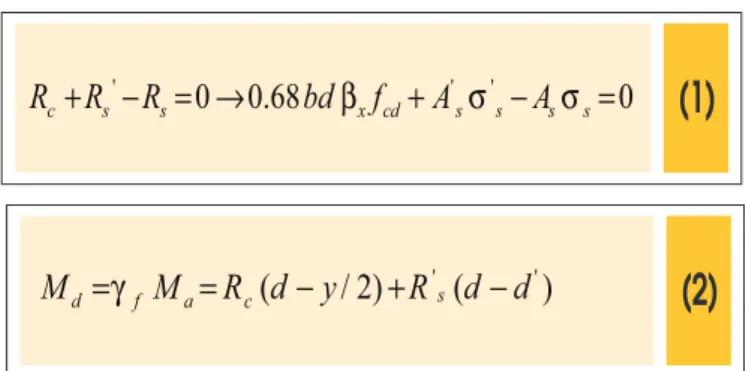
cross-section width is deined as b and the effective depth as d. Thus, considering Figure 1, the equilibrium of forces and bending moments can be written as follows:
(1)
'
0 0.68
' '0
c s s x cd s s s s
R R R
+ - = ®
bd f
b
+
A
s
-
A
s
=
(2)
)
(
)
2
/
(
d
y
R
'd
d
'R
M
M
d=g
f a=
c-
+
s-Using the deinitions presented in Figure 1, Eq. (2) can be rewritten
as follows:
(3)
' ' '
0.68 ²
(1 0.4 )
(
)
d x cd x s s
M
=
bd
b
f
-
b
+
A
s
d d
-If the single layer of reinforcement case is considered, Eq. (3) can be simpliied because A′S is null. Then, Eq. (1) and Eq. (3) are re -written, for the single reinforcement layer, as follows:
(4)
0.68
bd
b
x cdf
-
A
ss
s=
0
(5)
0.68 ²
(1 0.4 )
d x cd x
M
=
bd
b
f
-
b
If a simple bended beam subjected to a uniformly distributed load is considered, the maximum exterior bending moment is given by:
(6)
² ( . )
8
a
PL
M
=
kN m
where the external load P is composed of:
(7)
)
/
(
kN
m
Q
G
P
=
+
where G is the permanent load and Q is the accidental load. Based on the reinforcement area and cross-section dimensions, the resistance bending moment of a beam is calculated as follows:
(8)
0.408 ²
²
(1
)
r cd x s s x
M
=
bd f
b
+
A
s
d
-
b
+
' '
(
') (
)
s s x
A
s
d
b -
d
kNm
The structural resistance in terms of bending moment is given by
Eq. (8). This equation will be adopted to evaluate the structural
resistance over time to assess the probability of structural failure because of reinforcement corrosion.
3. Fick’s diffusion laws
In 1885, Fick was the irst researcher to describe the phenomenon
of diffusion through an adaptation of Fourier’s empirical heat con-duction equations [14]. The transport phenomenon associated with the movement of chlorides along structures exposed to aggressive environments is primarily attributed to the diffusion of chloride ions
into concrete pores under a concentration gradient. The coeficient
of chloride diffusion, which depends on the pore structure of the
con-crete, characterises this low under a given external concentration
of chloride. This parameter is a characteristic of hardened concrete. To simulate the chloride ingress and its transport into concrete pores, Fick’s diffusion laws [15] have been widely considered ac-ceptable models. Fick’s laws for diffusion are applicable for homo-geneous, isotropic and inert materials [16]. The mechanical prop-erties related to the diffusion process are assumed identical along all directions and kept constants over time. Because concrete is well known as a heterogeneous, anisotropic and chemically re-active (continued hydration and microcracking process) material,
these hypotheses are not completely satisied. However, the meth -ods commonly adopted for chloride transportation modelling in concrete consider this process to be governed by ionic diffusion only. The concrete cover is assumed to be completely saturated. Therefore, the hypotheses of Fick’s laws are acceptable for the chloride ingress modelling. In this case, the material is assumed to
be completely saturated, with unidirectional chloride lux, i.e., from
the exterior surface into the concrete depth. When chloride dif-fuses into concrete, a change in chloride concentration, C, occurs at time, t, at every point, x, of the concrete, i.e., it is a non-steady state of diffusion. To simplify the analysis, the diffusion problem
is considered one-dimensional. Numerous chloride ingress engi-neering problems, such as those discussed in this paper, can be
solved using this simpliication. Figure 2 shows a typical proile of
chloride penetration into the concrete cover.
The assumption of Fick’s diffusion theory is that the transport of chloride into concrete through a unit section area of concrete per
unit of time (the lux F) is proportional to the chloride concentration gradient normal to the section. Then:
(9)
cC
F
D
x

=-
The negative sign in the equation above signiies that the diffusion
of chlorides occurs in the direction opposite the increasing concen-tration of chlorides. The constant of proportionality Dc, presented
in Eq. (9), is called the chloride diffusion coeficient. In general, Dc
is not constant but depends on many parameters, including the time diffusion occurred, location in the concrete and composition
of concrete. If the chloride diffusion coeficient is constant, Eq. (9) is usually referred to as Fick’s irst diffusion law. If this is not the case, the relation is referred to as Fick’s irst general diffusion law.
This simple relation should not always be applied, particularly when the diffusion process may be irreversible or has a history of dependence. In such cases, Fick’s diffusion laws are not valid and the diffusion process is considered anomalous. However, non-observation so far indicates that the chloride diffusion into concrete pores should be characterised as an anomalous diffusion. Fick’s second law can be derived considering the mass balance principle. Therefore:
(10)
c
C
D
C
t
x
x

=

æ
-

ö
ç
÷


è

ø
To apply Fick’s second diffusion law in this form, for concrete ex-posed to chloride over a long period, the variation of the chloride
diffusion coeficient over time, t, is required. If only a few
observa-tions exist in a speciic case, it is possible to estimate the upper
and lower boundary for the variation of D over time. Despite this dependence, a unique case can be considered when the chloride
diffusion coeficient is independent of location, x, time, t and chlo-ride concentration, C. In this case, Fick’s second law can be written in this simple form:
(11)
22 0
x
C
D
t
C


=


where
D
0 is the constant coeficient of diffusion.The solution of the differential equation presented above, for a
semi-ininite domain with a uniform concentration at the structural
surface, is given by:
(12)
( )
ú
ú
û
ù
ê
ê
ë
é
=
t
D
x
erfc
C
t
x
C
0 02
,
where
C
0 is the chloride concentration at the structural surface, assumed constant over time; and erfc is the complementary error function.In a physical sense, field conditions deviate significantly from the assumptions implicit in Fick’s laws. For instance, the con-crete cover is not always saturated with water, and chloride ions penetrate concrete by diffusion and advection provided by the penetrating moisture front. Concrete is not homogeneous because of the presence of microcracking and interconnected pores, and the diffusion coefficient will change over time as hydration proceeds. Hence, Fick’s laws are not the ideal model for this phenomenon. However, Fick’s laws are often used be-cause the diffusion equation provides the best approximation of laboratory or field data in many cases. Predictions using this approach are valid only if best-fit parameter values are applied to structures with similar material, environmental and field conditions. It is preferable, in using this approach, that concentrations are given in terms of water-soluble chloride be-cause it is generally accepted that corrosion is influenced by the free chloride concentration present in the concrete pore solution [17].
In this paper, Eq. (12) is used to evaluate the time at which the
corrosion process starts. After the corrosion initiation phase, the reinforcement areas deteriorate using the relations that will be pre-sented in next section.
If the threshold chloride concentration value at the steel reinforce-ments is known, then the time for steel depassivation and, conse-quently, the time for corrosion initiation can be determined. In this case, the time for corrosion initiation can be explicitly obtained as follows:
(13)
4. Reinforcement corrosion modelling
Corrosion can be deined as the mechanical degradation process
that occurs in metallic materials as a result of chemical or electro-chemical actions. This process can also be associated with ex-ternal loads [18]. In corrosion of metallic materials, the material is converted into a non-metallic material. When corrosion occurs, the metal loses some essential properties such as mechanical resis-tance, elasticity and ductility [19].
The corrosion process can be classiied as chemical or electro
-chemical. The irst type of corrosion, also known as dry corro -sion or simple oxidation, occurs by a gas-metal reaction, which
produces an oxide ilm. It is a slow process and does not cause
substantial deterioration of the metal surfaces, except in the
pres-ence of extremely aggressive gases. Electrochemical corrosion
produces effective material damage because this type of corro-sion involves the conduction of electrons among different regions of the metal [19].
According to the classical corrosion model proposed by [17], the reinforcement corrosion phenomenon occurs in two distinct stag-es: initiation and propagation. The initiation period is limited by the time required for reinforcement depassivation resulting from the penetration of chlorides. The propagation period includes that time when the cross-sectional area of the reinforcement steel is lost.
Therefore, in this inal corrosion phase, maintenance and repair
are mandatory to avoid structural failure resulting from a decrease in structural resistance. Figure 3 shows the evolution of the cross-sectional diameter of the reinforcements as a function of time,
where the initiation and propagation periods are clearly deined.
The amount of reinforcement corrosion during the propagation period will depend on environmental moisture and the amount of
available oxygen. These two parameters signiicantly inluence the
cathodic process and the concrete resistivity. Temperature also ca-talyses the corrosion process.
4.1 Modelling of reinforcement cross-section
area loss
Mathematical approaches for modelling the propagation period of corrosion are not often available in literature because many
researchers consider the initiation period as the structural lifetime. However, the reduction in steel is consistently represented by the models presented in [4, 20]. This model was determined empiri-cally, considering a tropical climate.
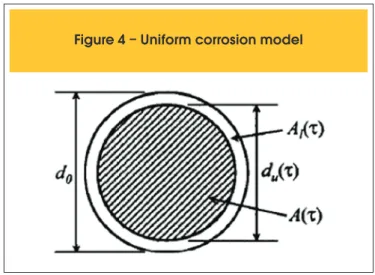
In this study, the steel loss is evaluated using the model presented in [4, 20], which assumes that steel corrodes uniformly along its perimeter, as presented in Figure 4. For this model, the diameter of corroded reinforcements is determined as follows:
(14)
where
d
initial is the reinforcement diameter before depassivationin mm;
t
0 represents the time of corrosion initiation in years; andcorr
i
indicates the corrosion ratio given by 2A cm
µ .
The corrosion ratio is calculated using the expression presented in [4], which was determined empirically.
(15)
where
w c
/
indicates the water/cement ratio andcvr
represents the concrete cover thickness in cm.5. Structural reliability theory
and analysis methods
5.1 General concepts
The goal of the reliability analysis is to calculate the probability of
failure given a speciic failure scenario, known as the limit state.
Reliability, R, and probability of failure Pf are complementary con-cepts, and R=1- Pf.
The irst step in the reliability assessment is to identify the basic
set of random variables
X
=
[
x x
1,
2,...,
x
n]
Tfor which uncer-tainties must be considered. For all of these variables, probabil-ity distributions are assigned to model the randomness. Theseprobability distributions can be deined by physical observations,
statistical studies, laboratory analysis and expert opinion. The number of random variables is an important parameter to deter-mine the computing time utilised during the reliability analysis. To reduce the size of the random variable space, it is strongly recom-mended that all variables whose uncertainties minimally affect the probability of failure should be considered deterministic.
The second step consists of deining a number of potentially critical
failure modes. For each mode, a limit state function
G X
( )
separates the space into the following two regions as described in Figure 5: the safe domain, whereG X
( )
>
0
, and the failure domain where( )
0
G X
<
. The boundary between these two domains is deined by( )
0
G X
=
, known as the limit state itself. An explicit expression for the limit state function is not often possible. In this study, the limit statefunctions are those presented in Eq. (5), Eq. (8) and Eq. (13).
The probability of failure is evaluated by integrating the joint den-sity function over the failure domain [21]:
(16)
where
f
X(
x x
1,
2,
,
x
n)
is the joint density function of thevari-ables X. The evaluation of the above integration is impossible in practice because the joint density function does not have an explic-it form; alternative procedures have thus been developed based on the concept of reliability index, β [22]. This parameter is deined by the distance between the mean point and the failure point placed at the limit state function
G X
( )
=
0
in the normalised space of random variables. The reliability index allows the calculation of the probability of failure as follows:(17)
( )
-
b
F
=
f
P
Figure 4 – Uniform corrosion model
where
Φ
( )
⋅
is the standard Gaussian cumulated distribution function. There are alternative procedures available to calculate probabili-ties of failures that are based on numerical simulation techniques. The Monte Carlo simulation is adopted in this study to determine the probability of structural failure. This approach will be discussed in the following section.5.2 Monte Carlo simulation
Monte Carlo methods are numerical simulation procedures widely used in reliability problems. In this method, a sampling of random vari-ables is used to construct a set of values to describe the failure and
safe spaces to calculate Eq. (16). The sampling is constructed based
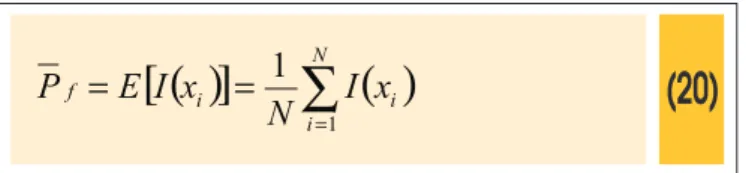
on the statistical distribution assigned for each random variable con-sidered in the problem. Because this method addresses the simula-tion of the limit state funcsimula-tion, the larger the sample, the more accurate the spaces’ description and the probability of failure calculation. The kernel of this method consists of the construction of a sampling for the random variables involved in the problem, as described in Figure 6. The probability of failure is calculated, using a Monte Carlo simulation, using the following equation:
(18)
The function
I
( )
x
i can be estimated as follows:(1
9)
( )
î
í
ì
>
®
£
®
=
0
0
0
1
G
G
x
I
iBy simulating the limit state function for a convenient number of samples, the mean value of
I
( )
x
i will be an estimator for the prob-ability of failure:(20)
( )
[ ]
å
( )
=
=
=
Ni i
i
f
I
x
N
x
I
E
P
11
The disadvantage of this method is the large number of simulations required to accurately compute the probability of failure. Normally, to accurately estimate a probability of failure of
10
−n, the number of simulations must be greater than
10
n+2or10
n+3. Thus, for engineer-ing structures, when the probability of failure is between 310
− and 610
− ,10
5 to10
9 realisations of the limit state function are required. When complex numerical mechanical models are involved,requir-ing signiicant computational times, this method may not be reliable.
However, theoretically, when the number of simulations tends to
in-inity, the calculated probability of failure tends to its real value. Other
details about the Monte Carlo simulation can be found in [23].
6. Analysis methodology
The structural element analysed in this study is a simple supported bended beam constructed of reinforced concrete and subjected to a uniform distributed load, as shown in Figure 7. The computa-tional codes developed for the design of the analysed beam and all reliability approaches considered were written in FORTRAN. The following deterministic values were adopted for the analyses performed: beam length (L): 6.0 m; cross-section width (b): 17.0 cm; beam height (h): 50.0 cm; stirrups diameter: 6.3 mm; structural lifetime (tP): 50 years; and time assumed for corrosion develop-ment (tcorr): 30 years.
Considering the standard procedures described in [1], the irst ex -ample of this study determines the probability of structural failure considering the beam presented in Figure 7 without corrosion
ef-fects. Several values of βx are analysed, which are related to the strain domains considered. For the irst example, structural failure
is observed when the bending moment resulting from an external load is greater than the resistance bending moment of the concrete and steel. The main parameters considered in this reliability analy-sis are the following:
n Permanent load: G; n Accidental load: Q; n Resistance of concrete: f
ck;
nYield resistance of steel: σS.
The modelling of the corrosion phenomenon in reinforced concrete structures considers two different stages: initiation and propaga-tion. The initiation period is related to the chloride penetration into
Figure 6 – Monte Carlo's simulation
considering two random variables
the concrete pores over time but steel loss does not occur. During this period, the chloride concentration along the structural cover increases. The corrosion process starts when a threshold level of chloride concentration at the steel reinforcements is reached, lead-ing to the loss of passive chemical protection provided by the con-crete (depassivation). The second beam example considered in this paper assesses the probability of failure considering the time for corrosion initiation as the failure scenario. Therefore, failure is observed when the chloride concentration surrounding the steel reinforcements reaches the threshold value. The following param-eters are considered in this reliability analysis:
n Threshold level of chloride concentration required to begin the
corrosion process [4]: C(x, t);
n Chloride concentration at the structural surface [10]: C
0;
n Concrete diffusion coeficient [24]: D0; n Structural cover thickness [1]: x.
According to [4], the chloride concentration at the structural sur-face depends on the aggressiveness of the environment where the structure is located. The structural cover thickness is deter-mined according to the level of environmental aggressiveness, as
described in [1]. The concrete diffusion coeficient, which describes
the concrete resistance against chloride ingress, is a function of the water/cement ratio.
In the inal beam presented, a probabilistic analysis combines the
mechanical model given by [1], Fick’s laws and corrosion equa-tions. Therefore, the last application assesses the probability of failure considering the effects of the corrosion process on struc-tural resistance, i.e., the loss of reinforcement area. The reinforced
concrete beam is evaluated considering different values of βx. The
parameters considered in this last reliability analysis are identical to those presented above.
The probabilistic analyses considered in this study were performed
based on different limit state functions to evaluate the inluences
of an aggressive environment and the water/cement ratio on the development of corrosion process. In the following examples, the analyses were performed considering two aggressive
environ-ments, with four different water/cement ratios for each aggressive-ness category. The initial cracks resulting from concrete hardening and creep were not considered.
7. Results and discussion
7.1 Example 1
In this example, the reinforced concrete beam was designed as
follows: βx = 0.259; βx = 0.500; βx =0.628 for a single layer of reinforcement; and βx = 0.628 for a double layer of reinforcement.
Table 1 presents the values used based on this beam design. The Monte Carlo simulation was then used together with the
mechani-cal model, Eq. (6) and Eq. (8), to assess the probability of struc -tural failure.
For the irst evaluation of probability of structural failure, the follow -ing limit state function was considered:
(21)
G
1= M
r- M
awhere Mr is the resistant bending moment and Ma is the bending moment from external loads.
Table 2 presents the random variables considered in this analysis and the statistical properties.
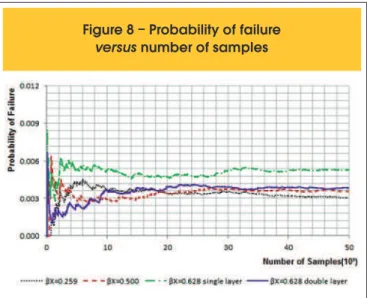
The analyses based on Monte Carlo simulation were performed considering 50,000 samples for each random variable, which pro-duced 50,000 simulations of the limit state function. The relation-ship between the probability of structural failure and the number of samples can be observed in Figure 8. In all studied cases, the probability of structural failure tends toward convergence as the number of samples increases. This behaviour is expected because when using a Monte Carlo simulation, the larger the sample ad-opted, the more accurate the results. Therefore, the sample range
Table 1 – Results of the design of the reinforced concrete beam analyzed
Variables βx=0.259 βx=0.5 βx=0.628 single reinforcements' layer βx=0.628 double reinforcements' layer
d (cm) d' (cm) As (cm²) A's (cm²) 44.12 – 7.5 – 42.50 – 12.50 – 40.87 – 15.00 – 40.87 4.26 17.50 2.50
Table 2 – Statistic data for random variables
Random variable Mean Coefficient of variation Statistic distribution
Table 3 presents the random variables considered and the statisti-cal properties.
The concrete diffusion coeficient depends on the water/cement
ratio (w/c), used during the concrete production. The chloride con-centration at the structural surface and the concrete cover thick-ness depend on the environmental aggressivethick-ness (CA). In this study, the environmental aggressiveness CA II (urban environ-ment) and CA III (marine environenviron-ment) were considered. For each CA, the following four w/c ratios were considered: w/c=0.4, w/c= 0.5, w/c= 0.6 and w/c= 0.7.
In this example, Monte Carlo simulations were performed consid-ering a range sample of 25,000 for each random variable, resulting in 25,000 limit state function simulations. The results of this analy-sis are shown in Figures 9 and 10.
According to the results presented in these igures, the probability
of corrosion initiation converges to the response as the number of samples increases. In Figure 9, a dependence on the probability of failure values and the w/c ratio is observed. When the w/c ratio is 0.70, the probability of failure is 0.70. These values were expected because a larger w/c ratio indicates a more porous concrete and it is easier for the chloride to penetrate into the structure. This in-creases the probability of failure.
In addition to the inluence of the w/c ratio on the probability of fail -ure, the chloride concentration at the structural surface also has a
Figure 8 – Probability of failure
versus
number of samples
used in this example provides suficiently accurate results. Figure 8 also shows that the choice of βx values results in differ -ent probabilities of structural failure. The calculated probabilities of structural failure are consistent with the safety values rec-ommended by [25], which range from 10-3 to 10-4. The use of
different positions for the neutral surface, i.e., different design domains, results in different values of probability of failure, even with the use of identical partial safety factors and other design parameter values.
7.2 Example 2
This example assessed the probability of failure considering the
failure scenario deined as the time for corrosion initiation. The limit state function for this example is deined as follows:
(22)
G
2= t
R- t
Pwhere tR is the time of corrosion initiation calculated using Fick’s law and tP is the predicted structural life, considered as 50 years.
Figure 9 – Probability of failure
versus
number of samples for CAII
Table 3 – Statistic data for random variables
Random variable Mean Coefficient of variation Statistic distribution
C(x,t) C0
D0
x
3
0.9kg/m
3
CA II – 1.15kg/m
3
CA III – 2.95kg/m w/c = 0.4 – 14.2mm²/year w/c = 0.5 – 41.0mm²/year w/c = 0.6 – 86.4mm²/year w/c = 0.7 – 162.7mm²/year
CA II – 30mm CA III – 40mm
19% 50% 70% 75% 75% 75% 75% 50% 50%
major inluence on the probability of corrosion initiation. As shown
in Figure 10, the change in the environmental aggressiveness
sig-niicantly increases the probability of failure. For instance, when
the structural element is located in a CA III environment, with a w/c ratio of 0.7, the probability of failure reaches 0.85.
The initiation and propagation periods were also studied
assum-ing the mean values for all random variables that inluence the
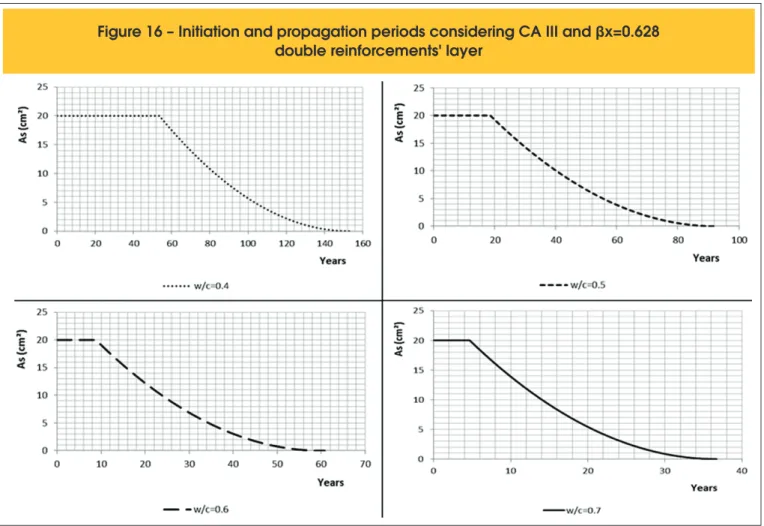
corrosion process, i.e., [C(x, t), D0, C0, x]. Figures 11, 13 and 15 show the results obtained when the analysed beam is located in a CA II environment. The initiation and propagation periods were
de-termined based on the following design conigurations: βx=0.259;
βx=0.628 for a single reinforcement layer; and βx=0.628 for a
dou-ble reinforcement layer. Different w/c ratio values were adopted.
As observed in previous results, the propagation period for CA II is considerably shorter than the initiation period. Therefore, for this environmental aggressiveness class, the initiation period should be used to evaluate durability.
However, for CA III and high w/c ratios, the opposite behaviour is observed. This behaviour is expected because more porous con-crete has larger w/c ratios and the ingress of chloride is easier. When large w/c ratios are considered and the environment is ag-gressive, the initiation period is short compared to the propagation period. According to [4] and [9], the larger the w/c ratio, the less severe the corrosion rate. This is another factor that reduced the initiation period in this analysis. However, the structural lifetime (ini-tiation and propagation periods together) for CA III is considerable shorter than for the CA II scenario.
Therefore, it can be concluded that for concretes with a low w/c ra-tio, the initiation period is larger than the propagation period. For concretes with a high w/c ratio, the initiation period is shorter than the propagation period. The durability, i.e., the sum of the initiation and propagation periods, is higher for concretes with a low w/c ratio.
7.3 Example 3
In this example, the reinforced concrete beam was analysed
con-sidering the following strain domains: βx=0.259; βx=0.628 for a
single reinforcement layer; and βx=0.628 for a double
reinforce-ment layer to evaluate the probability of structural failure result-ing from the loss of structural resistance because of reinforcement
When the initiation period inishes, the corrosion of reinforce -ments is considered and the reinforcement cross section
deterio-rates using Eq. (14). After determining the initial reinforcements cross-section from Equations (1), (3) or (4) (for beam with single
or double layer reinforcement) the diameter of the corroded
rein-forcements is determined using Eq. (14). The probabilistic analy -ses were performed considering a structural lifetime equal to 30 years (tcorr).
The corrosion rate (iCORR) was calculated using CA II (urban en-vironment) and CA III (marine enen-vironment) and the following water/cement ratios were used: w/c=0.4, w/c=0.5, w/c=0.6 and w/c=0.7.
After determining the diameter of the corroded reinforcements, the neutral surface within the beam cross-section and the rein-forcement areas were updated and the resistant bending moment
was evaluated using Eq. (8).
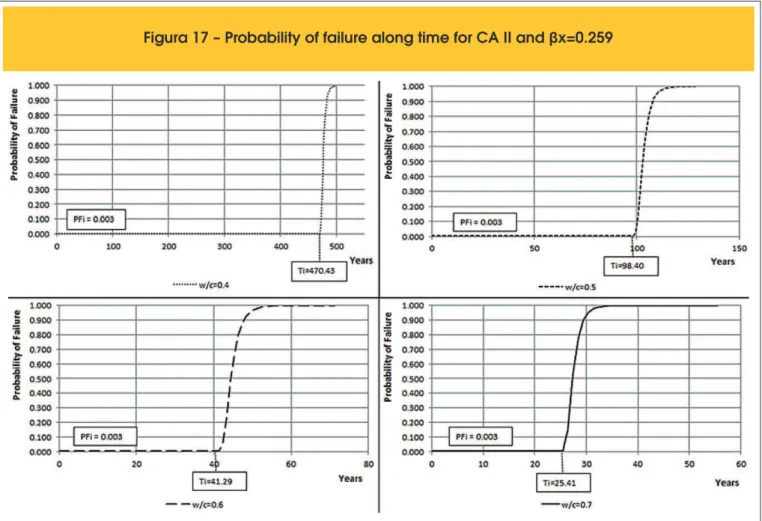
The probabilistic analyses were performed using Monte Carlo sim-ulations with 500,000 samples for each random variable. The
re-sults are shown in Figures 17–22. These igures illustrate the prob -ability of structural failure over time considering two aggressive environments, three strain domains and four water/cement ratios. Based on the results, the probabilities of failure of 0.003, 0.005
and 0.004 calculated for the strain domains of βx=0.259, βx=0.628 for single reinforcement layer and βx=0.628 for double
reinforce-Figure 16 – Initiation and propagation periods considering CA III and
β
x=0.628
double reinforcements' layer
aggressiveness (CA III) triggered earlier corrosion of the reinforcements.
8. Conclusions
The results from the studied examples indicate that the design procedures presented in [1] result in a safe structural level. The calculated probabilities of failure are in the range 10-3 – 10-4,
which is acceptable according to [25].
The start of reinforcement corrosion depends on several factors. Of particular importance are the chloride concentration at the structural surface, which is associated with an aggressive
envi-ronment, and the water/cement ratio, which relects the porosity
of the material. The chloride ingress increases with the porosity of the material.
The durability of reinforced concrete structures should be associ-ated with more accurate cover thickness and water/cement ratio values. By specifying more accurate concrete cover values, the chloride ingress and its concentration over time are improved, de-laying reinforcement corrosion. The probabilistic approach,
con-sidering the inherent randomness of the variables that inluence
this mechanical problem, has proven adequate for determining the times for corrosion initiation and reinforcement cross-section deterioration.
Sponsorship of this research project by CAPES is greatly appre -ciated. This research is a part of the activities scheduled by the
research project USP/COFECUB 2012.1.672.1.0.
10. References
[01] ASSOCIAÇÃO BRASILEIRA DE NORMAS TÉCNICAS.
ABNT NBR 6118: Projeto de estruturas de concreto - pro-cedimento. Rio de Janeiro, 2003.
[02] MEHTA, P.; MONTEIRO, P.J. Concrete: Microstructure,
Properties and Materials, Third edition, McGraw Hill, 2006.
[03] BICZÓK, I. Corrosión y protección del hormigón. España: Urmo S. A. De Ediciones, 1972.
[04] VU, K.A.T.; STEWART, M.G. Structural reliability of concrete
bridges including improved chloride-induced corrosion mod-els. Structural Safety, v.22, p.313-333, 2000.
[05] NOGUEIRA, C.G.; LEONEL, E.D.; CODA, H.B. Reliability al -gorithms applied to reinforced concrete structures durability
assessment. Revista IBRACON de Estruturas e Materiais,
v.5, 440-450, 2012.
[06] NOGUEIRA, C.G.; LEONEL, E.D. Probabilistic models ap -plied to safety assessment of reinforced concrete structures
subjected to chloride ingress. Engineering Failure Analysis,
v.31, p.76-89, 2013.
[07] JUNG, W.Y.; YOON, Y.S.; SOHN, Y.M.Predicting the remain-ing service life of land concrete by steel corrosion. Cement and concrete research, v.33, p.663–677, 2003.
Figura 17 – Probability of failure along time for CA II and
β
x=0.259
failure modelling of reinforced concrete structures subjected to chloride penetration. International Journal of Advanced
Structural Engineering, v.4, p.10, 2012.
[10] VAL, D.V.; STEWART, M.G. Life-cycle cost analysis of rein -forced concrete structures in marine environments. Struc-tural Safety, v.25, p.343-362, 2003.
[11] BASTIDAS-ARTEAGA, E.; CHATEAUNEUF, A.; SÁNCHEZ-SILVA, M.; BRESSOLETTE, P.; SCHOEFS, F. A comprehen -sive probabilistic model of chloride ingress in unsaturated
concrete. Engineering Structures, v.51, p.259-266, 2011. [12] EL-HASSAN, J.; BRESSOLETTE, P.; CHATEAUNEUF, A.;
EL TAWIL, K. Reliability-based assessment of the effect of
climatic conditions on the corrosion of RC structures
subject-ed to chloride ingress. Engineering Structures, v.32,
p.3279-3287, 2010.
[13] LEONEL, E.D.; BECK, A.T.; VENTURINI, W.S. On the per -formance of response surface and direct coupling approach-es in solution of random crack propagation problems. Struc-tural Safety, v.33, p.261-274, 2011.
[14] DURACRETE. Statistical quantiication of the variables in the limit state functions. The European Union Brite EuRam 3 contract BRPR-CT95-0132 Project BE95-1347, Report BE95-1347/R7, May, 2000.
[15] CRANCK, J. The mathematics of diffusion, 2nd Ed., Claren
-don Press, Oxford, Lon-don. 414 p, 1975.
[19] CASCUDO, O. O controle da corrosão de armaduras em concreto: inspeção e técnicas eletroquímicas. São Paulo:
Pini; Goiânia: Editora UFG, 1997.
[20] BASTIDAS-ARTEAGA, E.; SCHOEFS, F.; STEWART, M.G.; WANG, X. Inluence of global warming on durability of cor
-roding RC structures: A probabilistic approach. Engineering
Structures, v.51, p.259-266, 2013.
[21] DITLEVSEN, O.; MADSEN, H.O. Structural reliability meth -od, New York: John Wiley and Sons, 1996.
Figure 22 – Probability of failure along time for CA II and
β
x=0.628 double reinforcements' layer
[24] PAPADAKIS, V.G.; ROUMELIOTIS, A.P.; FARDIS, M.N.; VA
-GENAS, C.G. Mathematical modeling of chloride effect on
concrete durability and protection measures. In Dhir, R.K., Jones, M.R., editors. Concrete repair, rehabilitation and
pro-tection. London, E&FN Spon, 1996.