DOI: http://dx.doi.org/10.1590/1980-5373-MR-2015-0478
Materials Research. 2016; 19(1): 183-186 © 2016
*e-mail: [email protected]
1. INTRODUCTION
Glass-iber reinforced plastic (GFRP) laminates are used as lightweight materials in a wide variety of commercial and military structures as well as in sporting equipment. In the maritime ield, for example, GFRP is used in cargo, passenger, naval ships, surfboards, canoes and racing yachts, small submersibles, on the ins and fairings of submarines, and on off-shore oil drilling platforms 1, 2. Besides this signiicant growth, the need to understands and measures the lexural parameters, which control the structure–property relationships in such composites are mandatory.
Polyurethane belongs to one of the most versatile classes of polymers and can exist as both thermosetting and thermoplastics depending upon the choice of the initial reactants. Polyurethanes have many advantages such as low viscosity, excellent bonding with the matrix material without special sizing of the ibers, relatively low price and fast reaction time. The thermoset polyurethanes are a class of polymer materials with desirable properties, such as high abrasion resistance, tear strength, excellent shock absorption, lexibility and elasticity 3-5. It is a polymer composed of a chain of organic units joined by carbamate (urethane) links most commonly formed by reacting a di- or polyisocyanate with a polyol. Both the isocyanates and polyols used to make polyurethanes contain on average two or more functional groups per molecule 6-8.
They are usually used as adhesives, coatings, foams and also as matrix resins for composites. The attractiveness of polyurethanes come from their excellent processability (low viscosity), excellent bonding to different substrates, absence of volatile organic compounds (VOC) and favorable economics.
It has been documented that the rate-of-load application affects the lexural properties of solid wood 9, and that changes in strain rate affect the yield stress of plastics 10.
Increasing the strain rate leads to higher moduli because the polymer chains have reduced the relaxation time 11-16.
Repair and reinforce internally and externally corroded pipelines is one of the main application of such composite material system and therefore, understand its lexural behavior at different displacement rates is essential to proper execute the repair. The pipe or vessel segment is repaired by wrapping with concentric coils of composite material 17 that is also submitted to lexion.
Composites made with polyurethane resins are widely used in various applications ranging from medical devices to automotive body panels. The success of polyurethane is due to its ability to be produced in various forms from lexible to rigid structures 18, 19. Knowledge in processing and advances in reactivity control to extend working time have placed polyurethane in the running for composite applications long dominated by unsaturated polyesters and vinyl esters 20 . In the last two decades, polyurethane composites made inroads primarily in foamed structural automotive interior and exterior parts. In the last years, polyurethane composites processes were highly developed. Primarily non-foamed, full-density polyurethane composite systems are being used with these traditional composite processes for applications from electric poles and automotive large parts to window lineals and bathtubs.
Understand the lexural behavior, strength and modulus and its predictions are essential to mechanical engineering proper design such material.
This study, therefore, aims to reveal the relationship between displacement rate, lexural stiffness and strength. First, the lexural stiffness was measured by the calculation of the modulus of elasticity and the prediction was performed. Simultaneously, the effect of the ultimate lexural strength was incorporated into the work.
Displacement rate effect on the lexural properties
of glass iber reinforced polyurethane
João Marciano Laredo dos Reisa*
aTheoretical and Applied Mechanics Laboratory – LMTA, Mechanical Engineering Post-Graduate
Program – PGMEC, Universidade Federal Fluminense – UFF, Rua Passo da Pátria, 156, CEP 24210-240, Niteroi, RJ, Brazil
Received: August 19, 2015; Revised: October 6, 2015; Accepted: November 26, 2015
The object of this study was to evaluate the lexural strength of glass iber reinforced polyurethane composites under variable displacement rates. Flexural tests have been conducted at a range of displacement rates included 0.2, 2, 20, 100, 200, 1000 mm/min. Specimens with identical geometry have been used in all the tests. This particular composite has viscoelastic behavior with both elasticity modulus and ultimate lexural strength being strongly dependent of the displacement rate. Results showed that, both the lexural modulus and the ultimate lexural strength are increased with the increasing in the displacement rate.
Reis
184 Materials Research
2. Materials and Methods
2.1 Materials
In this research the commercial product from Neptune Research Inc. (NRI) called Syntho-Glass XT is used. It is
a polyurethane pre-impregnated, bi-directional (0º/90º) E-glass ibre composite used to repair and reinforce internal and external corrosion on pipeline or structures is used to evaluate the lexural performance at different displacement rate. This composite is water-activated polyurethane resin, which reduces composite preparation time in 50%. According to manufacturer gel time is 30 minutes and it is fully cured after 2 hours at 24ºC. Service temperature range from -46ºC to 90ºC and it can be applied in environment conditions from 4ºC to 65ºC.
2.2 Methods
Flexural test specimens were manufactured by hand lay-up. Each Syntho-Glass XT pre-pag sheet has 0.33 mm and
15 layers were laminated to produce a 5 mm thickness plate. After 2 hours at 24ºC the laminates are cured and coupons were water jet cutted in 250 mm x 25 mm. Syntho-Glass XT
composites were tested in lexion at 23°C in a Shimadzu AGX-100 universal testing machine according to ASTM
D790 21. Tests were performed at displacement rates of 0.2,
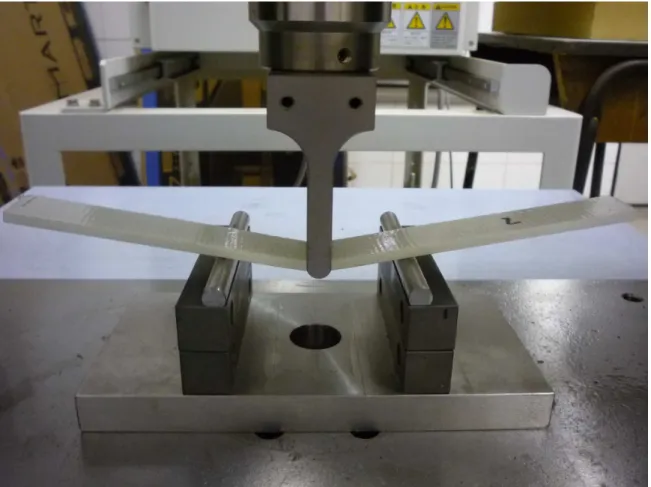
2, 20, 100, 200 and 1000 mm/min in order to obtain the displacement rate dependency. For the tested material, ive specimens were tested at a given rate. Flexural modulus was obtained from the initial slope of the stress–strain curve and the lexural strength from the maximum load. Figure 1 displays the 3-point bending test setup.
3. Results and Discussion
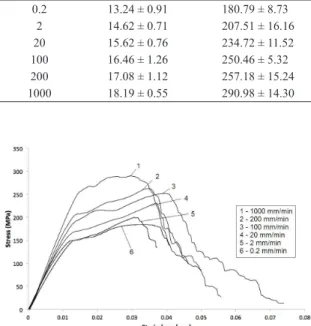
Figure 2 presents the lexural stress vs. strain curves for glass iber reinforced polyurethane obtained from the lexural tests performed with controlled displacement rates: 0.2, 2, 20, 100, 200 and 1000 mm/min.
The behavior is linear until rupture of the irst plies occurs. Then, the GFRP composites continue to retain energy until ultimate lexural strength is reached. After that, lexural strength start to decrease as laminate plies break. Nevertheless, both elasticity modulus and ultimate strength are rate-dependent (they tend to be higher for higher displacement rate). According to ASTM D79021, all the presented curves can be represented as curve b where specimens yield and then break before the 5% strain limit.
Table 1 presents the lexural test results of GFRP performed with controlled displacement rates of 0.2, 2, 20, 100, 200 and 1000 mm/min.
Displacement rate effect on the lexural properties of glass iber reinforced polyurethane
2016; 19(1) 185
It is clear from Table 1 that the lexural stiffness and ultimate lexural strength are displacement rate dependent. As displacement rate increases, both modulus of elasticity and maximum tensile strength increase. On increasing the displacement rate from 0.2 mm/min to 1000 mm/min it is observed that there is an elevation of 37.4% in the modulus of elasticity and of 60.9% in the ultimate lexural strength.
Figure 3 displays the modulus of elasticity as a function of the displacement rate.
The dependence of the average lexural modulus of elasticity on the displacement rate can be estimated using a power function, as follows:
0.0361 14.089R
E= (1)
where E is the modulus of elasticity in GPa and R represents the displacement rate in (mm/min). As presented in igure 3, GFRP ultimate lexural strength is sensible to displacement rate variation. Figure 4 presents the ultimate lexural strength at different displacement rate.
The ultimate lexural strength behaves similar to the lexural modulus of elasticity, as a power function as displacement rate increases:
0.0533 198.02R
=
UFS (2)
where UFS is the ultimate lexural strength in MPa and R represents the displacement rate in (mm/min).
Both lexural modulus of elasticity and ultimate lexural strength can be predict by the proposed equations within the range of the studied displacement rates, from 0.2 mm/min to 1000 mm/min. Similar behavior in tension can be observed when the GFRP composites are tested in tension 22. The tensile modulus of elasticity increases with the strain rate and higher ultimate tensile strengths are obtained for higher strain rates.
The inluence of displacement speed on modulus and stress by tensile-shear test were analyzed by an One-Way ANOVA with a 0.05 signiicance level.
Firstly, the null hypothesis of residue normality was evaluated using Shapiro–Wilks and Levene׳s tests (α=0.05). For both, modulus and stress data, residue normality null hypothesis was not rejected (p>0.05), as expected (modulus: Shapiro–Wilks p=0.45/Lilliefors p=1 and lexural stress: Shapiro–Wilks p=0.44/Lilliefors p=1). Secondly, homogeneity of variances was also evaluated for both sets using Brown-Forsythe and Levene׳s tests (α=0.05). Null hypothesis of homogeneity of variances was not rejected (p>0.05), as expected (modulus: Brown-Forsythe p=0.94/Levene׳s p=0.54 and lexural stress: Brown-Forsythe p=0.79/Levene׳s p=0.50).
Finally, the inluence of displacement rate on modulus and lexural stress was evaluated. In both cases, modulus and stress, p<0.05 (p→0), showing that displacement rate inluences both dependent variables for the adopted signiicance level of α=0.05. Additionally, considering Fisher LSD analysis at α=0.05, for modulus, displacement rate has led to dissimilar mechanical properties only for 0,2mm/min and stress presented similar lexural properties
only for 100 mm/min and 200 mm/min. Figure 4. strength of GFRP.Displacement rate inluence on the ultimate lexural
Table 1. Flexural results of GFRP at different displacement rates (avg ± st. dev.)
Displacement rate (mm/min)
Modulus of elasticity (GPa)
Ultimate lexural strength (MPa)
0.2 13.24 ± 0.91 180.79 ± 8.73
2 14.62 ± 0.71 207.51 ± 16.16
20 15.62 ± 0.76 234.72 ± 11.52 100 16.46 ± 1.26 250.46 ± 5.32 200 17.08 ± 1.12 257.18 ± 15.24 1000 18.19 ± 0.55 290.98 ± 14.30
Figure 2. Flexural stress vs. strain curves of GFRP at different displacement rate.
Reis
186 Materials Research
4. Conclusions
Quasi-static and high displacement rate lexural tests were performed on glass iber reinforced polyurethane. The experimental analysis shows that the mechanical response of this composite is strongly displacement rate dependent. The lexural modulus of elasticity increases with the displacement rate and higher ultimate strengths are obtained for higher displacement rates. Both modulus of elasticity and ultimate lexural strength can be represented by a power function. This study is a step to obtain a simple
but effective failure criterion for composite reinforcement systems used for corroded pipelines in oil industry.
5. Acknowledgements
The authors would like to thank the Neptune Research Inc. (NRI) for providing the composites for testing, Research Foundation of the State of Rio de Janeiro (FAPERJ) and The Brazilian National Council for Scientiic and Technological Development (CNPq) for supporting part of the work presented here.
6. References
1. Smith CS. Design of marine structures in composite materials. London: Elsevier Applied Science; 1990.
2. Mouritz AP, Gallagher J and Goodwin AA. Flexural strength and interlaminar shear strength of stitched GRP laminates following repeated impacts. Composites Science and Technology. 1997; 57(5):509-522.
3. Chiou BS and Shoen PE. Effect of crosslinking on thermal and mechanical properties of polyurethanes. Journal of Applied Polymer Science. 2002; 83:212-223.
4. John J, Bhattacharya M and Turner RB. Characterization of polyurethane foams from soybean oil. Journal of Applied Polymer Science. 2002; 86(12):3097-3107.
5. Desai S, Thakore IM, Sarawade BD and Devi S. Effect of polyols and diisocyanates on thermo-mechanical and morphological properties of polyurethanes. European Polymer Journal. 2000; 36(4):711-725.
6. Delebecq E, Pascault JP, Boutevin B and Ganachaud F. On the versatility of urethane/urea bonds: reversibility, blocked isocyanate, and non-isocyanate polyurethane. Chemical Reviews. 2013; 113(1):80-118.
7. Javni I, Hong DP and Petrovic ZS. Polyurethanes from soybean oil, aromatic, and cycloaliphatic diamines by nonisocyanate route. Journal of Applied Polymer Science. 2013; 128(1):566-571.
8. Ogunniyi DS, Fakayejo WR and Ola A. Preparation and properties of polyurethanes from toluene diisocyanate and mixtures of castor oil and polyol. Iranian Polymer Journal. 1996; 5:56-59.
9. Gerhard CC and Link CL. Effect of loading rate on bending strength of Douglas-fir 2 by 4’s. Forest Products Journal. 1986; 36(2):63-66.
10. Hohfika YM and Stkori G. Temperature and strain rate independence of critical strains in polyethylene and poly(ethy1ene-co-vinyl acetate). Macromolecules. 2000; 33(5):1827-1833.
11. Hadal RS and Misra RD. The influence of loading rate and concurrent microstructural evolution in micrometric talc- and wollastonite-reinforced high isotactic polypropylene composites.
Materials Science and Engineering A. 2004; 374(1-2):374-389.
12. Brandt CW and Fridley KJ. Effect of load rate on flexural properties of wood-plastic composites. Wood and Fiber Science. 2003; 35(1):115-117.
13. Ramanathan T, Muthumanickam MA and Subramanian K. Study on the effect of loading rate on flexural strength of glass/ polyester composites as a function of span-to-depth ratio and fiber volume fraction. Materials and Manufacturing Processes. 2000; 15(6):845-852.
14. Sethi S, Rathore DK and Ray BC. Effects of temperature and loading speed on interface-dominated strength in fibre/polymer composites: an evaluation for in-situ environment. Materials & Design. 2015; 65:617-626.
15. Ullah H, Harland AR and Silberschmidt VV. Characterisation of mechanical behaviour and damage analysis of 2D woven composites under bending. Composites. Part B, Engineering. 2015; 75:156-166.
16. Milanese AC, Cioffi MO and Voorwald HJ. Flexural behavior of sisal/castor oil-based polyurethane and sisal/phenolic composites. Materials Research. 2012; 15(2):191-197. 17. Costa-Mattos HS, Reis JM, Sampaio RF and Perrut VA. An
alternative methodology to repair localized corrosion damage in metallic pipelines with epoxy resins. Materials & Design. 2009; 30:3581-3591.
18. Saunders JH and Frisch KC. Polyurethanes: chemistry and technology. New York: Interscience Publishers; 1962.
19. Szycher M. Handbook of polyurethanes. Boca Raton: CRC
Press; 1999.
20. Sherman LM. Polyurethane composites: new alternative to polyester and vinyl ester. Plastics Technology. March 2006
Available from: http://www.ptonline.com/articles/polyurethane-composites-new-alternative-to-polyester-and-vinyl-ester. Access in: 19 Aug. 2015.
21. American Society for Testing and Materials – ASTM. ASTM D790-10: Standard test methods for lexural properties of unreinforced and reinforced plastics and electrical insulating materials. West Conshohocken: ASTM; 2010.
22. Reis JM, Chaves FL and Costa Mattos HS. Tensile behaviour of glass fibre reinforced polyurethane at different strain rates.