Flexural strength and hardness of direct
and indirect composites
Abstract: The objective of this study was to evaluate the l exural strength (σf) and hardness (H) of direct and indirect composites, testing the hy-potheses that direct resin composites produce higher σf and H values than indirect composites and that these properties are positively related. Ten bar-shaped specimens (25 mm x 2 mm x 2 mm) were fabricated for each direct [D250 - Filtek Z250 Espe) and D350 - Filtek Z350 (3M-Espe)] and indirect [ISin - Sinfony (3M-Espe) and IVM - VitaVM LC (Vita Zahnfabrik)] materials, according to the manufacturer’s instruc-tions and ISO4049 specii cainstruc-tions. The σf was tested in three-point bend-ing usbend-ing a universal testbend-ing machine (EMIC DL 2000) at a crosshead speed of 0.5 mm/min (ISO4049). Knoop hardness (H) was measured on the specimens’ fragments resultant from the σf test and calculated as H = 14.2P/l2, where P is the applied load (0.1 kg; dwell time = 15 s) and l is the longest diagonal of the diamond shaped indent (ASTM E384). The data were statistically analyzed using Anova and Tukey tests (α = 0.05). The mean σf and standard deviation values (MPa) and statistical group-ing were: D250 - 135.4 ± 17.6a; D350 - 123.7 ± 11.1b; ISin - 98.4 ± 6.4c; IVM - 73.1 ± 4.9d. The mean H and standard deviation values (kg/mm2) and statistical grouping were: D250 - 98.12 ± 1.8a; D350 - 86.5 ± 1.9b; ISin - 28.3 ± 0.9c; IVM - 30.8 ± 1.0c. The direct composite systems ex-amined produce higher mean σf and H values than the indirect compos-ites, and the mean values of these properties were positively correlated (r = 0.91), coni rming the study hypotheses.
Descriptors: Composite resins; Dental materials; Hardness.
Márcia Borba(a)
Álvaro Della Bona(b)
Dileta Cecchetti(c)
(a) PhD Student, Dental Materials, University of São Paulo, SP, Brazil.
(b) PhD in Biomaterials, Research Coordinator and Senior Professor of Prosthodontics and Occlusion, Dental School, University of Passo Fundo, RS, Brazil.
(c) MSc in Statistics, Professor, Institute of Biological Sciences, University of Passo Fundo, RS, Brazil.
Corresponding author: Álvaro Della Bona
Faculdade de Odontologia, Universidade de Passo Fundo, Campus I, B. São José, BR 285, Km 171
Passo Fundo - RS - Brazil CEP: 99001-970 E-mail: [email protected]
Introduction
The development of adhesive materials and tech-niques represents an improvement for the use of indirect restorations, encouraging the research for materials with mechanical and esthetic properties more similar to those of the tooth structure. Indirect composite resin systems represent an alternative to overcome some dei ciencies of direct composite res-torations, such as polymerization shrinkage stresses, inadequate polymerization in interproximal areas, restoration of proximal contacts and adequate den-tal contour.1,2,3
The composition of indirect composite resin sys-tems is similar to that of direct syssys-tems, differing by the use of different methods of additional polym-erization, which allows a higher radical conversion. These additional polymerization procedures can in-volve photo-activation, heat, pressure, and a nitro-gen atmosphere.3,4,5
In the early 1980’s, the composite inlay tech-nique was introduced in Switzerland and France. The i rst generation of materials was constituted of microi lled indirect composite resin systems, with l exural strength ranging from 60 to 80 MPa, elastic modulus around 2.0-3.5 GPa, resin volume percent-age higher than 50% and microparticles with an average size of 0.04 μm. These features resulted in some disadvantages such as inadequate mechanical properties, low resistance to occlusal wear and color instability.2,3
The second generation of indirect composite resin systems was introduced in the 1990’s. These materi-als are microhybrid composites with a volume per-centage of inorganic i llers of approximately 66%, resulting in improved mechanical properties with l exural strength between 120 and 160 MPa and elastic modulus of 8.5-12 GPa. These systems are indicated for inlays and onlays, laminated veneers and jacket crowns, implant-support restorations, for adjustment of proximal contacts and for reduction of occlusal stresses in bruxism cases.2,3
Other indirect composite systems recently intro-duced, despite their excellent esthetics, are not clas-sii ed as second-generation systems because they do not feature all of the required characteristics, like high mechanical properties values, high percentage
of inorganic content and bond to metal.2,3 These composites are denominated intermediate laborato-ry composite resins. They have only a few properties of the second-generation composites but still can be effectively used in specii c clinical situations.3
The indirect composite system Sinfony (3M-ESPE) is a microhybrid material developed to be ap-plied using the layering technique because of its l ow consistence. According to the manufacturer, this material is indicated for inlays and onlays, veneers and full crowns. This system needs two polymeriza-tion phases: an initial polymerizapolymeriza-tion using the Visio Alfa unit (3M-ESPE) for 15 s for each layer, which reduces shrinkage stress; and a i nal polymerization under light and vacuum using the Visio Beta Vario unit (3M-ESPE) for 15 min, which allows a higher
monomer-polymerconversion.
The new system from Vita, Vita VM LC, is a light-curing microparticle indirect composite that can be used for the full and partial veneering of crowns, and as long-term temporary metal-free res-torations. According to the manufacturer, this sys-tem is composed of inorganic nano-sized i llers that ensure high translucency due to natural refraction. The light curing box must be equipped with a light source which has a wavelength of 350-500 nm.
The objective of this study was to evaluate the l exural strength (σf) and hardness (H) of direct and indirect composites, testing the hypotheses that direct resin composites produce higher l exural strengthand hardness values than indirect compos-ites and that these properties are positively related.
Material and Methods
400 mW/cm2) for 40 s per unit output diameter. The polymerization procedure of the indirect composite systems followed the manufacturer’s instructions. ISin was i rst light cured with a halogen lamp with intensity of 400 mW/cm2 (Visio Alfa unit, 3M-ESPE) for 15 s, and i nally cured under light and vacuum (Visio Beta Vario unit, 3M-ESPE) for 15 min. The IVM specimens were i rst light cured following the direct composite procedure and i nally cured in 2 cycles of 4 min using a polymerization box (EDG-LUX, EDG Equipamentos, São Carlos, SP, Brazil) containing four blue-light bulbs and a rotating tray, according to the manufacturer’s instructions.
All specimens were immersed in 37°C water for 15 min and polished with 600 to 1,200 grit SiC pa-per to remove excess material, following ISO4049 specii cation.8 The dimensions of the specimens were verii ed using a digital caliper (Digimatic cali-per, Mitutoyo Corp., Tokyo, Japan).
After storage in distilled water at 37ºC for 24 h, the specimens were submitted to the three-point bending test in a universal testing machine (EMIC
DL 2000, São José dos Pinhais, PR, Brazil) at a crosshead speed of 0.5 mm/min until fracture. The l exural strength values (σf), in MPa, were calculat-ed as follows:
σf = 3PL/ 2wb2 where:
P is the fracture load (N);
L is the distance between the supporting rollers (20 mm);
w is the specimen height (in mm); b is specimen width (in mm).
Knoop hardness (H) was measured on the speci-mens’ fragments (n = 10) resultant from the l exural strength test. Three indentations (load of 100 g, dwell time of 15 s) were made in each specimen and the diagonals were measured with an optical micro-scope (HMV-2T, Shimadzu Corporation, Tokyo, Japan) using 400 X magnii cation. Knoop hardness was calculated as follows (ASTM E384):
H = 14.2P/l2 where:
P is the applied load (0.1 kg);
l is the longest diagonal (in mm) of the diamond shaped indent.
The results were statistically analyzed using analysis of variance (ANOVA) and Tukey’s test at a signii cance level of 5%. Pearson’s correlation test was used to determine the relationship between the two properties.
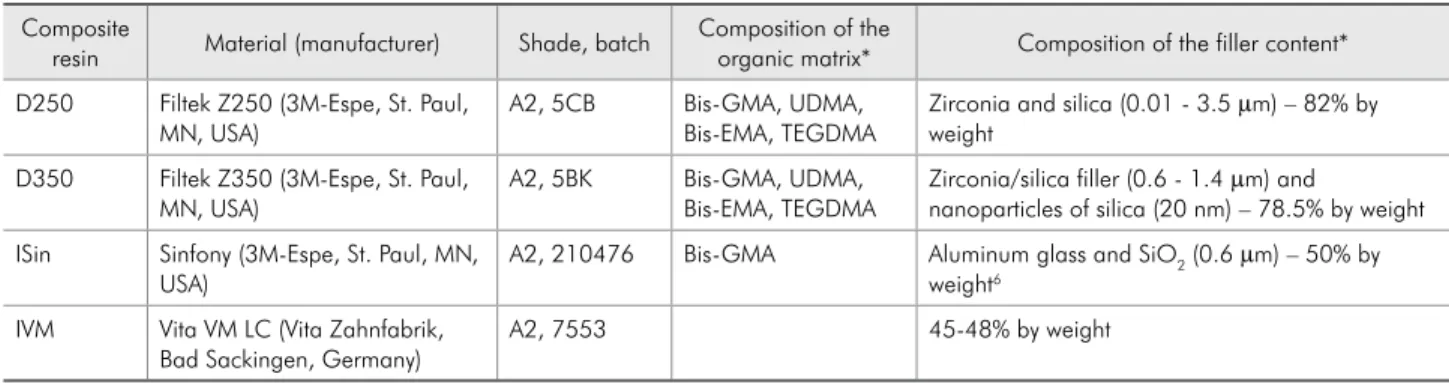
Table 1 - Information on the composite resin systems investigated in this study.
Composite
resin Material (manufacturer) Shade, batch
Composition of the
organic matrix* Composition of the filler content*
D250 Filtek Z250 (3M-Espe, St. Paul, MN, USA)
A2, 5CB Bis-GMA, UDMA, Bis-EMA, TEGDMA
Zirconia and silica (0.01 - 3.5 μm) – 82% by weight
D350 Filtek Z350 (3M-Espe, St. Paul, MN, USA)
A2, 5BK Bis-GMA, UDMA, Bis-EMA, TEGDMA
Zirconia/silica filler (0.6 - 1.4 μm) and
nanoparticles of silica (20 nm) – 78.5% by weight
ISin Sinfony (3M-Espe, St. Paul, MN, USA)
A2, 210476 Bis-GMA Aluminum glass and SiO2 (0.6 μm) – 50% by weight6
IVM Vita VM LC (Vita Zahnfabrik, Bad Sackingen, Germany)
A2, 7553 45-48% by weight
* The composition of the organic matrix and fillers was provided by the manufacturers.
Table 2 - Mean and standard deviation values of flexural strength (σf) and hardness (H), and statistical grouping.
Groups σf (MPa) H (kg/mm²)
D250 135.4 ± 17.6 A 98.1 ± 1.8 a
D350 123.7 ± 11.1 B 86.5 ± 1.9 b
ISin 98.4 ± 6.4 C 28.3 ± 0.9 c
IVM 73.1 ± 4.9 D 30.8 ± 1.0 c
Results
The mean values and standard deviations (MPa) of l exural strength (σf) and hardness (H), and sta-tistical grouping, are shown in Table 2.
The mean σf values were signii cantly different for all the tested groups. The direct composite systems presented statistically higher mean σf values than the indirect composites (p < 0.05). The D250 com-posite exhibited the highest σf values (135.4 ± 17.6 MPa) and the IVM composite exhibited the lowest
σf values (73.1 ± 4.9 MPa).
The direct composite systems showed the high-est H mean values. The mean H value of D250 was statistically greater than that of D350 (p < 0.05), which was also signii cantly greater than the mean H values of ISin and IVM (p < 0.05).There was no signii cant difference between the mean H values of the indirect systems (p ≥ 0.05).
The correlation test showed a high positive cor-relation (r = 0.91) between the mean σf and H values of the materials examined.
Discussion
The Sinfony (3M-ESPE) and VitaVM LC (Vita) indirect composite systems could be classii ed as in-termediate laboratory composite resins since they have lower percentage of inorganic content (50wt% and 45-48wt%, respectively) and lower values for the mechanical properties evaluated than expected for second-generation systems.2,3
The direct composite systems examined produce higher mean l exural strength and hardness values than the indirect composites, coni rming the i rst study hypothesis. These results are in agreement with previous studies.4,5,9,10
Cesar et al.4 (2001) evaluated the l exural strength, l exural modulus and hardness of four indirect composite systems (Artglass, Belleglass, Sculpture and Targis) and one direct composite system (Z100). Their results partially agree with those of the present study because Z100 showed the highest mean hardness values, although this mate-rial presented a mean l exural strength value similar to that of the indirect composite systems (Artglass, Targis and Sculpture).
A previous study showed that the mean wear
val-ue of the indirect composites was signii cantly great-er than the wear of Z100. In addition, the authors reported that Targis and Z100 showed a signii cant-ly greater elastic modulus than Artglass old formula and Vita Zeta LC, and Z100 showed a greater mean fracture strength value than Artglass and Vita Zeta LC.10
Another study investigated the mechanical prop-erties of a direct composite resin (Z100), a feldspatic porcelain (Noritake) and three indirect composites (Artglass, Solidex and Targis). The porcelain showed the greatest mean hardness value, followed by Z100. Solidex and Z100 showed greater mean compressive strength values than the other materials tested.9
Soares et al.5 (2005) evaluated the hardness and diametral tensile strength of two direct composites (TPH Spectrum and Filtek P60) and one indirect system (Solidex). The authors also reported that the direct composites showed better mechanical proper-ties than the indirect composite system.
The objective of a secondary polymerization is to maximize the degree of conversion of composites in order to improve mechanical and physical prop-erties, durability, solvent resistance and biocompat-ibility.11 The presence of unpolymerized monomer in the matrix negatively affects the properties of composite materials and may induce surface degra-dation and discoloration.12,13 The additional curing allows higher mobility and reactivity of free radicals formed by light irradiation or by thermal decom-position with an increase in collision probability among the unreacted active groups.14-16 When the composite is heated to a temperature above its glass transition, there is an increase in the molecular mo-bility of the polymer chains. Therefore, it may be possible to further the chemical reaction by enhanc-ing the molecular mobility of existenhanc-ing free radicals and other reactive species.8
de-gree of conversion improves composites’ mechanical properties, such as diametral tensile strength and hardness. Reinhardt et al.17 (1994) observed an 11% increase in l exural strength when a secondary cur-ing procedure was used.
The above results and rationale are indications of improvement in the properties of indirect com-posite resin systems, but do not mean that indirect composites have a better clinical performance than direct composite systems. An improvement in the degree of conversion itself does not necessarily re-sult in better mechanical properties, because these are also related to other factors, such as resin com-position,18 i ller content, particle size and distribu-tion.3,9,10,12,17,19-21
The i ller content could be an important factor when evaluating physical and mechanical properties of different composite materials. Li et al.20 (1985) reported that increasing the i ller content resulted in greater hardness, compressive strength, and stiff-ness, while water sorption decreased.
Chung19 (1990) observed a positive relation be-tween volume fraction of i ller and diametral ten-sile strength and hardness. But no correlation was observed between the degree of conversion and the mechanical properties evaluated. Neves et al.12 (2002) also concluded that the i ller content directly affects the hardness values.
Other studies also investigated the association
between the mechanical properties of composites and the difference in i ller volume. The authors re-ported that the materials with higher i ller volumes showed better mechanical properties.9,17,21
These observations seem to be coni rmed by the results of this study, especially when the materials’ i ller volumes (Table 1) are compared with the mean
σf and H values (Table 2). The composite resins with higher i ller contents, D250 (82wt%) and D350 (78.5wt%), showed signii cantly higher mean σf and H values than the composites with lower i ller con-tents, ISin (50wt%) and IVM (45-48wt%). There-fore, the i ller content inl uenced the mechanical properties of the composite resins investigated.
The second study hypothesis was also coni rmed, since there was a high positive correlation (r = 0.91) between the σf and H properties of the composites systems examined. This correlation can be explained because the σf provides information on the bulk properties and the H measures the materials surface properties,22 and both properties are clinically rel-evant in characterizing a restorative material.
Conclusion
The direct composite systems examined had higher mean σf and H values than the indirect com-posites, and the mean values of these properties were positively correlated (r = 0.91), coni rming the study hypotheses.
References
1. Roulet JF. Benefits and disadvantages of tooth-coloured al-ternatives to amalgam. J Dent. 1997;25(6):459-73.
2. Touati B. The evolution of aesthetic restorative materials for inlays and onlays: a review. Pract Periodontics Aesthet Dent. 1996;8(7):657-66; quiz 668.
3. Touati B, Aidan N. Second generation laboratory composite resins for indirect restorations. J Esthet Dent. 1997;9(3):108-18.
4. Cesar PF, Miranda Jr. WG, Braga RR. Influence of shade and storage time on the flexural strength, flexural modulus, and hardness of composites used for indirect restorations. J Prosthet Dent. 2001;86(3):289-96.
5. Soares CJ, Pizi EC, Fonseca RB, Martins LR. Mechanical properties of light-cured composites polymerized with several additional post-curing methods. Oper Dent. 2005;30(3):389-94.
6. Kakaboura A, Rahiotis C, Zinelis S, Al-Dhamadi YA, Silikas N, Watts DC. In vitro characterization of two laboratory-processed resin composites. Dent Mater. 2003;19(5):393-8. 7. International Standards Organization. ISO 4049 Dentistry
– Polymer-based filling, restorative and luting materials; 2000.
8. Ferracane JL, Condon JR. Post-cure heat treatments for composites: properties and fractography. Dent Mater. 1992;8(5):290-5.
9. Da Fonte Porto Carreiro A, Dos Santos Cruz CA, Vergani CE. Hardness and compressive strength of indirect composite resins: effects of immersion in distilled water. J Oral Rehabil. 2004;31(11):1085-9.
compos-ites and their matrices. J Biomed Mater Res A. 2004;69(1):65-9.
11. Freiberg RS, Ferracane JL. Evaluation of cure, properties and wear resistance of Artglass dental composite. Am J Dent. 1998;11(5):214-8.
12. Neves AD, Discacciati JA, Orefice RL, Jansen WC. Correla-tion between degree of conversion, microhardness and inor-ganic content in composites. Braz Oral Res. 2002;16(4):349-54.
13. Satsukawa H, Koizumi H, Tanoue N, Nemoto M, Ogino T, Matsumura H. Properties of an indirect composite material polymerized with two different laboratory polymerizing sys-tems. Dent Mater J. 2005;24(3):377-81.
14. Cook WD, Johannson M. The influence of post-curing on the fracture properties of photo-cured dimethacrylate based dental composite resin. J Biomed Res. 1987;21(8):979-89. 15. Ho CT, Vijayaraghavan TV, Lee SY, Tsai A, Huang HM, Pan
LC. Flexural behaviour of post-cured composites at oral-simu-lating temperatures. J Oral Rehabil. 2001;28(7):658-67. 16. Wendt Jr. SL. The effect of heat used as secondary cure
upon the physical properties of three composite resins.
II. Wear, hardness, and color stability. Quintessence Int. 1987;18(5):351-6.
17. Reinhardt JW, Boyer DB, Stephens NH. Effects of secondary curing on indirect posterior composite resins. Oper Dent. 1994;19(6):217-20.
18. Wendt Jr. SL, Leinfelder KF. The clinical evaluation of heat-treated composite resin inlays. J Am Dent Assoc. 1990;120(2):177-81.
19. Chung KH. The relationship between composition and proper-ties of posterior resin composites. J Dent Res. 1990;69(3):852-6.
20. Li Y, Swartz ML, Phillips RW, Moore BK, Roberts TA. Effect of filler content and size on properties of composites. J Dent Res. 1985;64(12):1396-401.
21. Manhart J, Kunzelmann KH, Chen HY, Hickel R. Mechanical properties of new composite restorative materials. J Biomed Mater Res. 2000;53(4):353-61.