*e-mail: [email protected]
Presented at the International Symposium on High Temperature Corrosion in Energy Related Systems, Angra dos Reis - RJ, September 2002.
Metallic Materials in Solid Oxide Fuel Cells
Willem Joseph Quadakkers*, Javier Pirón-Abellán, Vladimir Shemet
Forschungszentrum Jülich
Institute for Materials and Processes in Energy Sytems 52425 Jülich, FRG
Received: September 2, 2002; Revised: September 4, 2002
Fe-Cr alloys with variations in chromium content and additions of different elements were studied for potential application in intermediate temperature Solid Oxide Fuel Cell (SOFC). Re-cently, a new type of FeCrMn(Ti/La) based ferritic steels has been developed to be used as con-struction material for SOFC interconnects. In the present paper, the long term oxidation resistance of this class of steels in both air and simulated anode gas will be discussed and compared with the behaviour of a number of commercial available ferritic steels. Besides, in-situ studies were carried out to characterize the high temperature conductivity of the oxide scales formed under these con-ditions. Main emphasis will be put on the growth and adherence of the oxide scales formed during exposure, their contact resistance at service temperature as well as their interaction with various perovskite type contact materials. Additionally, parameters and protection methods in respect to the volatilization of chromia based oxide scales will be illustrated.
Keywords: Solid Oxide Fuel Cell, interconnect, ferritic steel, high temperature conductivity
1. Introduction
Metallic materials for be used as interconnects in SOFCs should fulfil a number of specific requirements1,2. Crucial
properties of the materials are high oxidation resistance in both air and anode environment, low electrical resistance of the oxide scales formed on the alloy surface as well as good compatibility with the contact materials. Additionally, the value of the coefficient of thermal expansion (CTE) should match with those of the other cell components3. These
re-quirements can potentially be achieved with high chromium ferritic steels4, however, previous studies5 have shown that
none of the commercially available ferritic steels seems to possess the suitable combination of properties required for long term reliable cell performance.
One of the most important problems found during stack operation using metallic interconnect materials is the for-mation of volatile chromium oxides and/or oxy-hydroxides6,7
at the cathode side of the cell leading to serious deteriora-tion of the cell performance7. Several authors proposed
vari-ous protective coating types to prevent the deleterivari-ous ef-fect of volatile Cr-species8.
Recently, a new class of FeCrMn(La/Ti) ferritic steels (see Table 1) has been developed to be used as construction materi-als for SOFC interconnects4,9. The steels contain a Cr content
in the range 20 – 24 wt.%, a Mn content of a few tenths of a percent whereas the additions of La and Ti are in the range of a few hundred ppm. In the present study, the long term oxida-tion resistance of some of these FeCrMn(La/Ti) steels in both air and simulated anode gas has been studied and compared with the behaviour of a number of commercially available ferritic steels. Main emphasis was put on the growth and ad-herence of the oxide scales formed during exposure, their con-tact resistance at service temperature as well as their interac-tion with various perovskite type contact materials.
2. Experimental details
204 Quadakkers et al. Materials Research
in Table 2. For oxidation studies, samples of dimensions 20 × 10 × 2 mm were cut from the prevailing semi-finished products, ground to 1200 grit surface finish and finally cleaned in acetone. Discontinuous oxidation tests were car-ried out at 800 °C in air and in a simulated anode gas (Ar-4%H2-2%H2O). For weight measurements the exposures were interrupted every 250 h. For more detailed analysis of the oxidation kinetics, isothermal oxidation tests using a SETARAM thermobalance were carried out. The oxide scales formed during oxidation in the various atmospheres were studied by light optical microscopy, scanning electron
microscopy (SEM) with energy dispersive X-ray analysis (EDX) and X-ray diffraction (XRD). The contact resistances of the oxide scales were measured using a conventional four point method. For these studies, samples of 10 × 10 × 2 mm were ground to 1200 grit surface finish and finally pre-oxi-dized for 100 h at 800 °C in air. Subsequently, a layer of Pt-paste was applied to both oxidized surfaces. For the electri-cal connection a Pt-mesh was used. The contact resistance was monitored in-situ during 500 h exposure at 800 °C in air.
For studies concerning the compatibility of the steels with contact layers, samples of 20 × 10 × 2 mm were ground to 1200 grit surface finish and pre-oxidized for 100 h at 800 °C in air. Subsequently, various La-based perovskite type con-tact pastes10 were applied on top of one side of the samples
which were then exposed for 1000 h at 800 °C in air.
3. Results and discussions
Figure 1 shows the oxidation behaviour under cyclic oxidation conditions for several FeCrMn model alloys with and without Ti and La additions compared with the behav-Table 1. Studied model and semi-commercial FeCrMn(La/Ti)
alloys.
Steels Batches Major features
designation
JS-1 HNA, HMZ high Mn, Ti, La
JS-2 HXV high Mn, low Ti, La
JS-3 HUF, JDA, Low Mn, Ti, La
JEW, JEX
Figure 1. Oxidation behaviour under cyclic conditions of several commercial and model ferritic steels at 800 °C in air. Table 2. Chemical compositions of the studied commercial ferritic steels (Mass.- %).
Alloy designation Fe Cr Mn Ti Al Ni Si
1.4509 Bal. 18 0.38 0.12 0.03 0.12 0.7
446 Bal. 25 0.5 0.05 - - 0.29
1.4016-3C Bal. 16 0.3 - - 0.26 0.41
1.4742 Bal. 17 0.31 0.01 1.04 0.18 0.93
iour of some of the most promising commercial ferritic steels. The JS-1 alloy (batch HNA) and the commercial al-loy ZGM232 show the highest weight changes mainly due to the extensive internal oxides formed beneath the scale. The other studied alloys show similar oxide scale growth rates because either no internal oxides are present at all or they appear in form of very fine internal precipitates. The two commercial alloys 1.4509 and 446 exhibited substan-tial scale spallation during the oxidation test but the chro-mium concentration is still sufficiently high to re-form the chromia based scale.
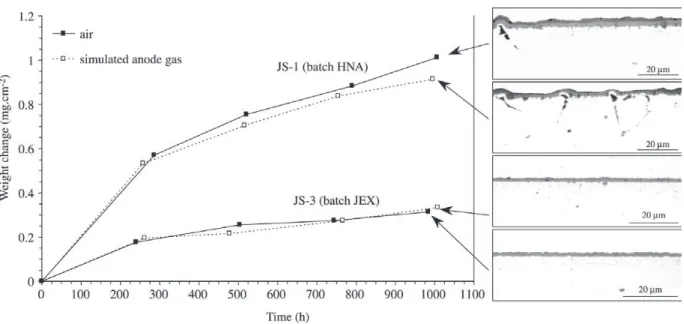
Figure 2 shows the oxidation behaviour of alloys JS-1
and JS-3 (batches HNA and JEX) oxidized in both air and simulated anode gas. A general tendency is that the oxide scales formed in anode gas are slightly thinner than those formed in air. As has previously been reported for Cr-based alloys11, for all studied alloys the scales formed in the
an-ode gas generally possess better adherence than those formed in air or oxygen.
Figure 3 shows the instantaneous Kp-values at 50 h de-termined during isothermal oxidation in Ar-O2 for a number of FeCr alloys with and without Mn, Ti and/or La additions in comparison with a number of other SOFC relevant alloys as function of the reciprocal temperature. The addition of Ti to the FeCr/Y alloy leads to a substantial increase in the oxidation rate. The enhancement increases with increasing Ti content, in agreement with previous findings related to the behaviour of NiCr-based alloys in steam reforming gas12.
Comparing the alloys FeCrMn and JS-1 (batch HNA) it is clear that in the entire range of temperatures studied, only minor changes in the Mn, La and Ti contents can substan-tially affect the oxidation rate. Based on these findings, suit-able oxidation resistance of the ferritic steels requires ad-equate addition and careful control of these elements in the alloy. By optimum additions of the oxygen active elements, oxidation rates can be achieved which are similar to those of chromium based ODS alloys, which have frequently been proposed as interconnect material for high temperature SOFCs13,14.
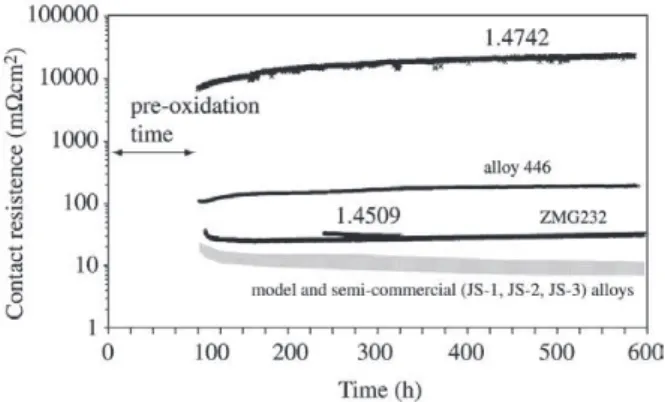
The electrical resistances of the oxides scales formed on different FeCrMn(La/Ti) alloys during exposure at 800 °C are shown in Fig. 4. The results are compared with data Figure 2. Oxidation behaviour of selected model ferritic steels at 800 °C in air and Ar-4%H2-2%H2O.
206 Quadakkers et al. Materials Research
obtained for a number of commercial alloys, i.e., 1.4742 (X10CrAl18), 1.4509 (X2CrTiNb18), alloy 446 and alloy ZGM232. The values obtained for alloys 1.4509, 446 and ZMG232 showed a very wide scatter range, although on all three materials, the oxides formed mainly consist of a du-plex MnCr2O4/Cr2O3 scale.
The highest values of approximately 20 Ω.cm2 were
ob-tained for the commercial alloy 1.4742 which has in some cases been considered as a potential candidate to be used as interconnect in intermediate temperature SOFCs.
These high values can be explained by the fact that this alloy, depending on the exact alloy composition and surface treatment, in some cases tends to form a very protective alumina scale5, which, however, possesses a very poor
elec-trical conductivity. In contrast, the new JS-3 alloys (batches JDA, JEW, and JEX) show very low contact resistance val-ues of approximately 10 mΩ.cm2, i.e., values which are two
to three orders of magnitude smaller than those of most
com-mercial alloys. In Fig. 5 the contact resistances as function of time for various JS-3 alloys compared with the commer-cial alloy 1.4016-3C are plotted. The contact resistance val-ues for 1.4016-3C are higher than those of newly developed JS-3 alloys and increase with decreasing temperature. The temperature dependence was more pronounced for the com-mercial alloy than for the JS-3 alloys. At lower tempera-tures the JS-3 alloys show relative higher conductivity com-pared to the commercial 1.4016-3C alloy.
In a planar cell configuration the connection between the interconnect and the cathode material is frequently achieved by using a contact layer which compensates geo-metrical irregularities of the cathode and/or interconnect surface5. Because the contact layers have to possess a high
electronic conductivity, they commonly consist of La-based perovskites15. In the present study, selected contact pastes,
La(Sr)MnO3, LaCoO3 and LaCoMnO3, were applied on top of pre-oxidized sample surfaces of a selected JS-1 alloy (batch HMZ) in form of a slurry coating. The coated sam-ples were then oxidized for 1000 h at 800 °C in air. Subse-quently, the alloy/coating interaction was studied by metallographic cross sections. The results in Fig. 6 illus-trate that the alloy/perovskite interaction strongly depends on the contact layer composition. In case of LaCoMnO3 a thin interaction layer is formed and the formation of the spinel MnCr2O4 was suppressed. When La(Sr)MnO3 is used, the formation of this spinel-type takes place at the interface with the contact paste. However, some chromium was de-tected on the surface of the contact layer. The use of LaCoO3 as contacting material might reduce the chromium diffu-sion through the contact paste because no enrichment of this element was observed. This effect may be due to the formation of a dense interaction layer which consists of a mixture of spinel and perovskite compounds which are vir-tually free of Cr.
4. Conclusions
Commercial high Cr ferritic steels as interconnect ma-terial have large drawbacks because the mama-terials tend to exhibit substantial scale spallation during long term oxida-tion, especially under cyclic oxidation conditions. Besides, the formed oxide scales frequently exhibit high electrical resistances. These effects are mainly related to a poor con-trol of the oxygen active minor alloy constituents. For these reasons, new alloys of the type FeCrMn(La/Ti) were devel-oped to be used as interconnect materials for SOFCs. These alloys form oxide layers with low growth rates being con-stituted by a duplex MnCr2O4/Cr2O3 scale. The formation of the external spinel layer considerably reduces the chro-mium evaporation8. Also, it has been demonstrated that this
type of scale has a low contact resistance, i.e., two to three orders of magnitude lower than that of alumina-rich scales Figure 4. Contact resistance of commercial ferritic steels and
FeCrMn(La/Ti) alloys (JS-1, JS-2, JS-3) at 800 °C in air.
208 Quadakkers et al. Materials Research
frequently formed on commercial ferritic steels. Besides, the combination of these new steels with suitable perovskite-type contact layers allows to achieve interaction layers with low electronic resistance10 which even further reduce the
formation of volatile Cr species.
Acknowledgement
The authors are grateful to their colleagues Mr. Mahnke and Mr. Cosler for carrying out the oxidation experiments, Mr. Schmidt for preparing the contact layers, Mr. Gutzeit for the metallographic investigations and Dr. Wessel for the SEM/EDX analyses.
References
1. Greiner, H.; Grögler, T.; Köck, W.; Singer, R.F. Proc. 4th
International Symposium Solid Oxide Fuel Cell (SOFC IV), Yokohama, Japan, 18- 23 June 1995, Edts. Dokiya, M.; Yamamoto, O.; Tagawa, H.; Singhal, S. The Electrochem. Soc., Pennington, NJ, USA, p. 841-849, 1995.
2. Badwal, S.P.S.; Deller, R.; Foger, K.; Ramprakash, Y.; Zhang, J.P. Solid State Ionics, v. 99, p. 297-310, 1997. 3. Malkow, Th.; Crone, U.v.d.; Laptev, A.M.; Koppitz, T.;
Breuer, U.; Quadakkers, W.J. Proc. of the 5th
Interna-tional Symposium on Solid Oxide Fuel Cells (SOFC-V), Aachen, Germany, 2-5 June 1997, Ed. Stimming, U.; Singhal, S.C.; Tagawa, H.; Lehert, W. Electrochemical, Society Inc., Penn., p. 1244-1252, 1997.
4. Quadakkers, W.J.; Malkow, Th.; Pirón-Abellán, J.; Flesch, U.; Shemet, V.; Singheiser, L. 4th European SOFC
Fo-rum, 10-14 July 2000, Lucerne, CH, Proceedings, Edt. A. McEvoy, p. 827-836, 2000.
5. Malkow, Th.; Quadakkers, W.J.; Singheiser, L.; Nickel, H. Report Forschungszentrum Jülich, Jül-3589, ISSN 0944-2952, October, 1998.
6. Quadakkers, W.J.; Greiner, H.; Köck, W.; Buchkermer, H.P.; Hilpert, K.; Stöver, D. 2nd European SOFC Forum,
6-10 May 1996, Oslo, Norway, Ed. Thorstensen, B., p. 297-306, 1996.
7. Jiang, S.P.; Zhang, J.P.; Apateanu, L.; Foger, K. Journal of the Electrochemical Society 147, p. 4013-4022, 2000. 8. Gindorf, C.; Singheiser, L.; Hilpert, K.; Schroeder, M.; Martin, M.; Greiner, H.; Richter, F. Proc. 6th International
Symposium on Solid Oxide Fuel Cells (SOFC-VI), Hono-lulu, Hawaii, 17-22 October 1999, Edt. Singhal, S.C.; Dokiya, M. The Electrochem. Soc., Pennington NJ, USA, p. 812-821, 1999.
9. Pirón-Abellán, J.; Shemet, V.; Tietz, F.; Singheiser, L.; Quadakkers, W.J. 7th International, Symposium on Solid
Oxide Fuel Cell (SOFC-VII), EPOCHAL, Tsukuba, Ja-pan, 3-8 June 2001, Proceedings The Electrochem. Soc., Pennington, NJ, USA, p. 811-819, 2001.
10. Teller, O.; Meulenberg, W.A.; Tietz, F.; Wessel, E.; Quadakkers, W.J. Proc. 7th International, Symposium on
Solid Oxide Fuel Cells (SOFC-VII), EPOCHAL, Tsukuba, Japan, 3-8 June, 2001, Proceedings The Electrochem. Soc., Pennington, NJ, USA, p. 895-903, 2001.
11. Quadakkers, W.J.; Norton, J.F.; Canetoli, S.; Schuster, K.; Gil, A. 3rd International conference on ‘Microscopy of Oxidation’ Cambridge, September 16-18th, 1996, Proceedings, The Institute of Materials, Edts. S.B. Newcomb, J. A Little, p. 609- 619, 1997.
12. Ennis, P.J.; Quadakkers, W.J. Conference High Tempera-ture Alloys - Their Exploitable Potential, 15-17 Oct. 1985, Petten, NL, Proceedings, Elsevier London, p. 465-474, 1988.
13. Crone, U.v.d.; Hänsel, M.; Quadakkers, W.J.; Vaßen, R.
Fresenius Journal of Analytical Chemistry, v.358, p. 230-232, 1997.
14. Quadakkers, W.J.; Hänsel, M.; Rieck, T. Materials and Corrosion, v. 49, p. 252-257, 1998.