*Correspondence: M. M. F. Fonteles. Centro de Estudos em Atenção Far-macêutica (CEATENF), Departamento de Farmácia, Universidade Federal do Ceará. R. Cel. Francisco Pedro, n.1210, 60430-170 - Fortaleza - CE, Brasil. E-mail: [email protected]
A
vol. 48, n. 4, oct./dec., 2012
Quality of life of HIV+ patients undergoing pharmacotherapeutic
follow-up
Catarine Vitor Loureiro
1, Henry Pablo Lopes Campos e Reis
1, Karla do Nascimento Magalhães
2,
Cristiane Policarpo Carmo
2, Francisca Ana Maria Leite
2,
Ana Cláudia de Brito Passos
3, Paulo Yuri
Milen Firmino
1, Nadir Kheir
1,4, David John Woods
1,5, Ângela Maria de Souza Ponciano
1, Marta
Maria de França Fonteles
1,*1Centre of Studies in Pharmaceutical Care (CEATENF)/Research Group on Pharmaceutical Care (GRUPATF)/ CNPq, Federal University of Ceará, 2José de Alencar Medical Specialties Center (CEMJA), 3Drug Information Center (CIM), Federal University of Ceará, 4Qatar University, Doha, 5School of Pharmacy, Otago University, and Best Practice Advocacy Centre,
BPAC, New Zealand
The inluence of pharmacotherapeutic follow-up (PTF) on quality of life was evaluated in 45 HIV+ patients, who were undergoing initial antiretroviral therapy at a specialized care center in northeast Brazil. PTF lasted nine months and quality of life was analyzed at the 1st and 9th meetings using a questionnaire validated for Brazil. The study identiied 643 problems related to antiretrovirals and there were 590 pharmaceutical interventions during the PTF. The comparative analysis between the results of the 1st and the 9th meeting was statistically signiicant for all domains of the questionnaire. For asymptomatic patients, only one domain was statistically signiicant. For symptomatic patients, six domains were signiicant. Patients with one year of HIV/AIDS diagnosis had statistically signiicant differences in ive domains. The results suggest that the PTF contributed to improving quality of life, particularly for symptomatic patients and those diagnosed for at least one year – important target groups
for Pharmaceutical Treatment.
Uniterms: Pharmacotherapeutic follow-up/inluence/quality of life. HIV patients/quality of life.
Pharmaceutical care.
A inluência do seguimento farmacoterapêutico (SFT) sobre a qualidade de vida foi avaliada em 45 pacientes HIV+ assistidos em serviço de atendimento especializado do nordeste brasileiro. O SFT teve duração de 9 meses e a qualidade de vida foi analisada no 1° e 9° encontros através de questionário validado no País. Identiicaram-se 643 problemas relacionados aos antirretrovirais e realizaram-se 590 intervenções farmacêuticas durante o SFT. A análise comparativa entre os resultados de qualidade de vida do 1° e 9° encontro foi estatisticamente signiicativa em todos os domínios do questionário. Quando analisados somente os pacientes assintomáticos, apenas um domínio apresentou signiicância estatística. Entre os sintomáticos, seis domínios foram signiicativos. Pacientes com até um ano de diagnóstico de HIV/AIDS apresentaram validade estatística em cinco domínios. Os resultados sugerem que o SFT contribuiu para a melhoria da qualidade de vida dos pacientes, sobretudo dos sintomáticos e/ou com até um ano de diagnóstico, representando grupos-alvo para a prática da Atenção Farmacêutica.
Unitermos: Seguimento farmacoterapêutico/inluência/qualidade de vida. Paciente de HIV/qualidade
INTRODUCTION
The first case of AIDS, a disease caused by the human immunodeficiency virus (HIV), was identified over 25 years ago; since then, there has been a signiicant decrease in morbidity and mortality among HIV-infected
people as a result of improvement in access to care,
pro-phylaxic treatment for opportunistic infections and anti
-retroviral therapy (ART) (Aberg et al.,2009).
The Brazilian STD/AIDS program has become internationally recognized for its widespread use of, and
access to, antiretroviral therapy, and for the improvements it has achieved in the indicators of morbidity, mortality and
quality of life. However, the proile of the disease has now become chronic-degenerative (Brasil, 2008).
Although ART has undoubtedly positive effects (it promotes a profound and constant suppression of HIV
replication, restores immune function, reduces morbidity and mortality and promotes positive therapeutic outcomes
for patients infected with HIV (Palella etal., 1998), there
are numerous factors that can hamper the achievement
of desired goals, including the pathogenicity of the virus
strain, a patient’s basal levels, the appearance of resistance
and non-adherence to treatment (Chesney, Morin, Sherr, 2000; Bartlett, 2002). Additionally, some people that have received antiretroviral therapy for a long period, live with the effects of drug toxicity such as lipodystrophy, and co-infections - Hepatitis B or C - (Brasil, 2008).
Antiretroviral treatment has many factors that can
hinder adherence: the use of more than one drug, a regi
-men involving more than one dose per day, the presence of adverse effects, prolonged treatment and asymptom
-atic patients (Chesney, Morin, Sherr, 2000; Walsh et al., 2001). These drawbacks of antiretroviral therapy directly interfere with the quality of life of HIV-infected patients.
According to the literature review by Canini et al. (2004), most studies that assess quality of life have been developed in the U.S. or developed countries; however, in recent years, scientists have recognized the need for world
-wide research on this subject, including in Brazil, where epidemiological data have shown a signiicant number of
people are affected by this disease.
In 2003, the American Society of Health-System Pharmacists (ASHP) produced a document with recom -mendations for the main fields of pharmacist practice
within the health care team, emphasizing the pharmacist’s role in the care of patients with HIV infection.
Among the recommendations are: 1. Systematic evaluation of interactions, adherence and adverse effects; 2. Actions related to the monitoring process of pharma
-cotherapy, with the detection, prevention and resolution
of other problems related to drug indication, effectiveness and safety; 3. Recognition and prevention of opportunistic infections and other potential clinical complications; 4. Education and prevention in public health, and 5. Forward
-ing of information and recommendations on the correct use of antiretroviral drugs, emphasizing the process of taking these drugs.
These recommendations constitute one of the areas of pharmaceutical professional practice: Pharmaceutical
Care. Pharmacotherapeutic follow-up, one of the
macro-components of Pharmaceutical Care, is carried out by the
pharmacist as a process of systematic work and document -ed in order to optimize the therapeutic results of patients
who are already undergoing medical care.
The aim of this study was to analyze the inluence of pharmacotherapeutic follow-up on quality of life of HIV positive patients who are starting antiretroviral therapy, and are treated by the Pharmaceutical Care program at a
specialized service in northeast Brazil.
MATERIAL AND METHODS
This is prospective controlled intervention study,
in which each patient served as his own control, was de
-veloped using Pharmacotherapeutic Follow-up (PTF) of patients with STD/HIV treated at an outpatient pharmacy at a specialized medical center in Fortaleza, Ceará, during the period from November 2008 to August 2010.
The PTF, with a duration of nine months, was based on monthly meetings; there was a total of nine meetings with each patient, which were carried out in line with the
Dáder method (Machuca, Fernández-Limos, Faus, 2003),
and involved the following steps: 1 . invitation to receive the service; 2. initial interview; 3. Situational diagnosis; 4. study phase; 5. global assessment; 6. pharmaceutical
intervention and 7. evaluation of results.
The patients were invited to participate in the PTF when they attended the pharmacy to start antiretroviral therapy, which was medically indicated. The study includ
-ed patients who: had never been treat-ed with antiretroviral drugs; began therapy during the study period; were aged over 18 years; had not participated in any pharmaceutical intervention study; and agreed to participate. Exclusion criteria were: patients who were not in a condition to reply to questions during interviews and pregnant women (who were referred to a different unit for specialized health).
The study was approved by the Ethics Committee in
Research of the Federal University of Ceará - UFC
(pro-tocol number: 191/08). When the invitation was accepted, an individual interview was carried out during which ex
signed. The interviews were conducted by the pharmacist of the health care unit with the help of an academic from the Pharmacy course at UFC. The interviewers received prior training by the Centre of Studies in Pharmaceutical
Care (CEATENF-UFC).
The collection of data on sociodemographic (gender, age, marital status, education, individual income) and clinical variables (time of diagnosis and presence of signs/ symptoms at the start of therapy) was carried out using the questionnaire that had been prepared by CEATENF after meetings and focus groups. The Drug-Related Problems (DRPs) and pharmaceutical interventions were recorded and classified according to the Second Consensus of Granada (Santos et al., 2004; Sabater et al., 2005). More than one problem related to the antiretroviral drugs and interventions could be identiied for a single patient.
The assessment of quality of life was divided into two phases: at the beginning (1st meeting) and at the end of PTF (9th meeting), using the instrument of Ware and Sherbourne (1992) according to the translation and vali
-dation to Brazilian-portuguese language by Ciconelli et al. (1999).
The instrument includes eight domains (physical functioning, role limitation due to physical health, bodily pain, general health perceptions, vitality, social function
-ing, role limitations due to emotional problems and mental health) and, for each area, a score was obtained by apply
-ing a scale measure with values from 0 to 100, where zero corresponds to the worst result and one hundred, to the best result (Siqueira, 2005).
Data regarding the clinical and socioeconomic pro
-iles, DRP and pharmaceutical intervention were entered
into an Excel 2007 database, and analyzed descriptively,
represented by tables and/or graphs. For the results regard
-ing quality of life, a comparison between the initial and inal proiles was carried out using the paired Student’s t test, and the Kolmogorov-Smirnov test was used to verify the normality of the scores. The Wilcoxon test was used for samples with less than 30 individuals that did not pass the normality test. The program Sigma Plot, version 10.0, was used for the statistical analysis of quality of life, with a signiicance level of 5%.
RESULTS
A total of 47 of the HIV + patients treated at the Unit during the study period fulilled the requirements to par
-ticipate in the project, but one patient died before the end
of treatment and another abandoned the treatment, only
returning after the end of the period for the PTF. Excluding these losses, the study worked with a sample of 45 patients.
The clinical and socioeconomic proile of these patients is presented in Table I. Most were male (62.2%) with a mean age of 37.04 years (SD=11.47), a “single” marital status and a schooling level that was “incomplete primary” or “complete secondary”. As for individual income, 42.2% reported having an income between 1 to 2 minimum wages, which at the time of study ranged from R$ 415.00 to R$ 510.00. Regarding the signs and symptoms, 16 pa
-tients (35.6%) reported, at the time of irst interview, that they were asymptomatic, and 29 (64.4%) reported already showing signs/symptoms of HIV infection. Regarding the time of diagnosis, more than half of patients (55.6%) had received a diagnosis of HIV infection within the previous
12 months.
The study identiied 643 problems related to anti
-retrovirals. The main problems were “security”, mainly referring to the occurrence of adverse reactions (58%, n=373) and the “necessity” for drugs, particularly related to the non-compliance to treatment/adherence problems (27.4%, n=176). Issues that were classiied as “effective
-ness”, related to the dose of antiretroviral drugs (in this case, underdosing) were also identiied (12.9%, n = 83).
There were 590 pharmaceutical interventions during the follow-up. Of these, 469 could be classiied according to Sabater, and were distributed in the following catego
-ries: “intervention regarding dosage” (19.6%, n = 92), “change in pharmacological strategy” (13.7%, n = 64) and “intervention in the education” of patients (66.7%, n = 313). Another 121 interventions were carried out, but these did not it into the Sabater categories and were
related to referrals to other professionals and support over biopsychosocial aspects.
When analyzing the data for question N° 2, which deals with the comparative evaluation between the current health status and that of one year ago, the most frequent response among respondents before the PFT was: “About the same as one year ago” (28.9%).
After the pharmacotherapy monitoring, 24 pa
-tients responded: “Much better now than one year ago”,
(53.3%). Another important fact is that before the follow-up, some patients (15.6%, n=7) responded to the above
item as: “Much worse now than one year ago”, while at
the end of the study, no participant had this response to
question No. 2 (Figure 1).
The analysis of data from the quality of life ques
-tionnaire domains, considering both symptomatic and
asymptomatic patients, revealed that the differences
between the means were statistically signiicant for all
the domains. Furthermore, the mean values obtained at
TABLE I - Distribution of socioeconomic and clinical proiles of HIV + patients under pharmacotherapeutic follow-up at a
specialized treatment centera (N = 45)
Variable Frequency Percent (%)
Gender
Male 28 62.2
Female 17 37.8
Age
20 to 30 years 15 33.3
30 <age <40 years 15 33.3
40 <age <50 years 9 20
50 <age <60 years 4 8.9
More than 60 years old 2 4.5
Marital Status
Single 23 51.1
Married 6 13.4
Divorced / Separated 5 11.1
Widower 1 2.2
Stable Relationship 10 22.2
Education
Illiterate 1 2.2
Reading and writing 1 2.2
Incomplete primary 15 33.3
Complete primary 8 17.9
Incomplete high school 2 4.4
Complete high 14 31.2
Incomplete higher 2 4.4
Complete higher 2 4.4
Individual income (in minimum wages - mw)
No income 13 28.9
<01 mw 4 8.9
01-02 mw 19 42.2
02-03 mw 6 13.4
03-04 mw 1 2.2
04-05 mw 0
> 05 mw 2 4.4
Diagnosis time
Up to 1 year 25 55.6
1 <time <3 years 10 22.2
3 <time <5 years 7 15.5
Unable to provide 3 6.7
Signs / symptoms
Asymptomatic 16 35.6
Symptomatic. 29 64.4
Source: Direct research- aJosé de Alencar Medical Specialties
Center, Fortaleza, Ceará, Nov/2008- Aug/2010
FIGURE 2 - Comparison between the mean values of the domains of the quality of life questionnaire for all patients before and after the PTF (N = 45), Specialized treatment centera,
Fortaleza, Ceará, Nov/2008 - Aug/2010. The paired Student t test was carried out for all domains. * P <0.05. a the José de Alencar
Medical Specialties Center.
FIGURE 1 -Distribution of responses to question No. 2 of the
quality of life questionnaire applied to all patients before and after the PFT (n = 45). Specialized treatment centera, Fortaleza,
Ceará, Nov/2008 - Aug/2010. a the José de Alencar Medical
Specialties Center.
The data was also analyzed by separating the symp -tomatic patients from the asymp-tomatic patients. For
the asymptomatic patients, the means found for the 9th follow-up visit were always higher than or equal to the values obtained at the 1st meeting; however, only the do
-main “General Health Perceptions” showed a statistically signiicant difference between the values obtained before and at the end of the PTF (p = 0.022).
TABLE II - Distribution of means, medians and standard deviations (SD) obtained for the domains of the quality of life questionnaire applied at the 1st and 9th PTF meeting for symptomatic HIV
+ patients (n=29). Specialized treatment center c, Fortaleza, Ceará
Domains
Symptomatic patients
* p value
Before the PTF After PTF
Mean Median SD Mean Median SD
Physical Functioning 65.172 75 31.124 81.897 95 23.957 0.005 ª
Role Limitation due to Physical Health 34.483 0 45.520 64.655 100 45.570 0.009 b
Bodily Pain 64.483 74 34.494 76.379 100 34.808 0.076 b
General Health Perceptions 49.979 54 29.504 67.724 77 29.446 0.006 a
Vitality 58.966 60 25.508 68.966 70 18.916 0.033 ª
Social Functioning 73.276 87.5 32.686 82.759 100 24.643 0.167 b
Role Limitation due to Emotional Problems 37.928 0 47.745 64.362 100 46.232 0.005 b
Mental Health 57.793 60 25.603 71.103 72 22.574 0.011 ª
Source: Direct Research Specialized treatment center c, Fortaleza, Ceará, Nov/2008 - Aug/2010. * Level of signiicance p <0.05. a The paired Student t test was carried out. b The Wilcoxon test was carried out. c the José de Alencar Medical Specialties Center
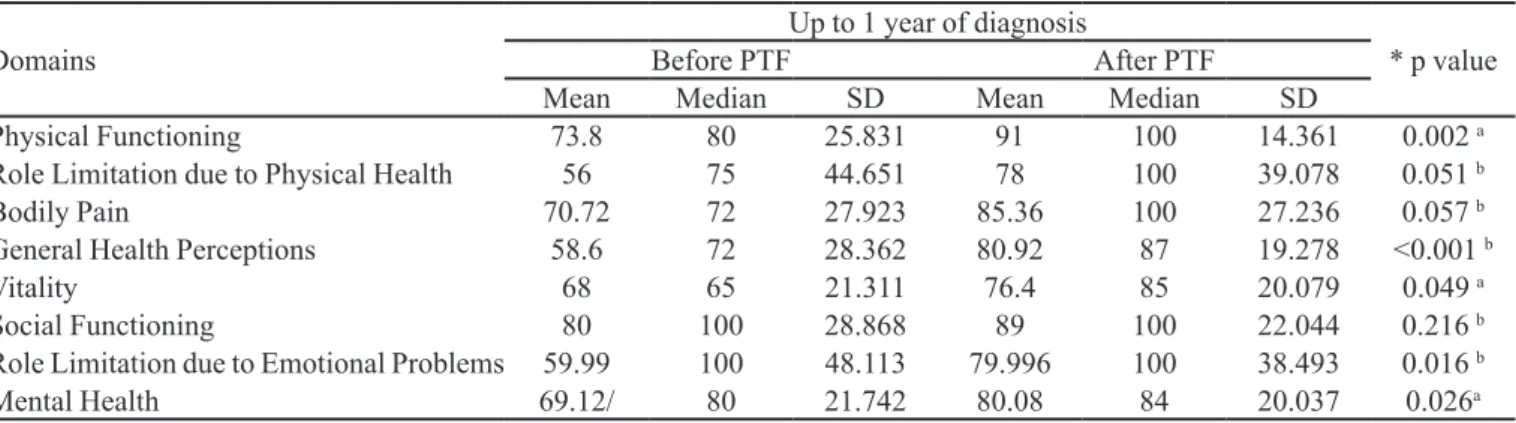
TABLE III - Distribution of means, medians and standard deviations (SD) obtained for the domains of the quality of life questionnaires used in the 1st and 9th PTF for patients with one year of diagnosis (n=25) Specialized Treatment Center, Fortaleza, Ceará
Domains
Up to 1 year of diagnosis
* p value
Before PTF After PTF
Mean Median SD Mean Median SD
Physical Functioning 73.8 80 25.831 91 100 14.361 0.002 a
Role Limitation due to Physical Health 56 75 44.651 78 100 39.078 0.051 b
Bodily Pain 70.72 72 27.923 85.36 100 27.236 0.057 b
General Health Perceptions 58.6 72 28.362 80.92 87 19.278 <0.001 b
Vitality 68 65 21.311 76.4 85 20.079 0.049 a
Social Functioning 80 100 28.868 89 100 22.044 0.216 b
Role Limitation due to Emotional Problems 59.99 100 48.113 79.996 100 38.493 0.016 b
Mental Health 69.12/ 80 21.742 80.08 84 20.037 0.026a
Source: Source: Direct Research Specialized Treatment Centerc, Fortaleza, Ceará, Nov/2008 - Aug/2010. * Level of signiicance
p <0.05. a The paired Student t test was carried out. b The Wilcoxon test was carried out. c the José de Alencar Medical Specialties
Center
the questionnaire had a statistically signiicant difference between the initial and inal mean or median: “Physical Functioning” (p=0.005); “Role Limitations due to Physi
-cal Health” (p = 0.009); “General Health Perceptions” (p=0.006); “Vitality” (p=0.033); “Role limitation due to emotional problems” (p=0.005); and “Mental Health” (p=0.011).
Regarding the time of diagnosis, separate analyses were carried out, separating the patients into three groups. The irst group included patients who claimed to have up to one year of diagnosis of HIV infection. Regarding the domains of the applied instrument, at the 9th follow-up visit, this group presented means that were higher than at the beginning of monitoring (Table III), with statistically signiicant differences between the initial and inal means and medians for the domains: “Physical Functioning” (p = 0.002); “General Health Perceptions” (p<0.001);
“Vitality” (p=0.049);”Role Limitations due to Emotional Problems” (p=0.016); and “Mental Health” (p=0.026). The domain “Role limitations due to Physical Health” had a
borderline p-value.
The second and third groups (that respectively in
-cluded, patients with a diagnosis of more than one year but less than three years, and patients with a diagnosis of more than three years) had higher mean values at the end of the PFT, when compared with baseline values. How
-ever, in both groups, there were no signiicant differences between the initial and inal means and medians in any of the domains of the quality of life questionnaire.
DISCUSSION
The profile of the participants of this study presented clinical and socioeconomic characteristics similar to those
observed in other studies (Seidl et al., 2007; Saldanha, An
-drade, Beck, 2009). The majority of patients interviewed were male, and the male-to-female ratio was 1.6:1, which is in line with a recent survey by the Ministry of Health, which revealed that, in Brazil, this ratio has been decreas
-ing over the years and has stabilized at 1.5:1 since 2002 (Brasil, 2009). Regarding their age, also according to the records of the Ministry of Health, the majority of AIDS cases reported from 1980 to 2009 was concentrated in the age group 25-49 years. The patients enrolled in this study
had a mean age of 37 years.
The majority of patients had a low level of schooling and income, which shows that there is a need to adopt mea
-sures and simple language throughout the development of the Pharmaceutical Care program for these patients. Regarding marital status, the study had a higher percent
-age of singles.
The profile of the patients in this study partially
agrees with the proile of patients in the study by Seild et al. (2007), which involved 110 HIV + patients. In the study by Seild, the number of singles was equal to those who live with a spouse or partner, 36.7% for each one.
The signiicant number of problems related to anti
-retroviral drugs and pharmaceutical interventions during
the study reinforces the importance of PTF for the detec-tion, resolution and prevention of problems related to
therapy and the role of the pharmacist in the planning of
care and treatment for each patient as part of a
multidisci-plinary team. In this study, problems of adherence to ART and adverse reactions were the most common problems related to speciic pharmacotherapy. These issues hamper
the clinical management of patients and the achievement
of positive outcomes and have been observed in several
other studies (Walsh et al., 2001; Bartlett, 2002; Padua et al., 2007; Guimarães et al., 2008). The pharmaceutical
in-terventions were focused on the category “Patient Educa
-tion”, in line with the proile of the patients, and consisted of educational measures that stress the importance of drug
therapy and adherence to it.
The questionnaire translated and validated by
Ciconelli et al. (1999) to evaluate the quality of life of
patients in the study was chosen because this type of generic instrument can accurately assess all signiicant aspects related to health and show the impact of a disease
on a particular individual (Ciconelli et al., 1999; Fayers,
Machin, 2000).
Question No. 2 of the questionnaire assessed current
health status and baseline status (one year previously), and
the vast majority of responses had higher values at the end
of the PTF when compared to those obtained at the irst visit. This shows that, at the end of the study, most patients considered their health to be better than before starting the follow-up.
The inal means of the eight domains of the question
-naire were always higher than the initial means. At the irst PTF meeting, the domains “Social Functioning”, “Physical Functioning” and “Bodily Pain” had the highest means. At the end of PFT, these domains had the best results when
compared to the other areas.
The study carried out by Romeo et al. (2009) found
that pharmaceutical interventions during the PTF of HIV+ pregnant women were effective and helped reduce symp
-toms due to inadequate pharmacotherapy and contributed to the quality of life of patients.
When a distinction was made between asymptomatic
and symptomatic patients, the latter had better results at
the end of PTF, with a statistically signiicant difference for six domains, whereas among asymptomatic patients, only the domain “General Health Perceptions” was sig
-niicant. This can be attributed to the fact that since they did not have any symptoms at the start of ART and during follow-up, and because the indication at the initiation of therapy was mainly determined by the results of a CD4+ cells count, the changes in quality of life were “minimal”, since the treatment signiicantly reduces the progression
of infection.
In contrast, when analyzing the patients who were symptomatic when they started ART and pharmacothera
-peutic follow-up, it is easy to detect the improvement in the quality of life from the minimization and / or termination of the signs and symptoms after a few months of treatment and monitoring. It is worth emphasizing that the group of asymptomatic patients was smaller than the symptomatic group, which could explain a lack of statistically signii
-cant changes in the asymptomatic group.
As for the time of diagnosis, cross-sectional studies (Reis, 2008; Santos, França Júnior, Lopes, 2007) have demonstrated that individuals with a more recent diag
-nosis have lower scores in relation to certain domains of the questionnaires used in assessments of quality of life.
In this study, the group of patients with less than a year of diagnosis had the lowest scores for quality of life in the irst meeting, a result that is consistent with other stud
-ies; however, after PTF, the quality of life of these patients improved, with statistical differences between the initial and inal means or medians and statistical validity in ive
domains. This reinforces the idea that PTF contributes to
improving the quality of life.
changes resulting from HIV seropositivity (Reis, 2008), and present lower changes in the perception of quality of life throughout follow-up.
The results obtained in this study point towards a positive inluence of pharmacotherapeutic follow-up on the quality of life of patients with HIV. It must be noted that the study population consisted of patients starting antiretroviral therapy, and thus represents a more speciic
population.
Furthermore, these satisfactory and significant results of the process of care were observed with only nine months of follow-up. Some authors report that a
minimum of 12 months of PTF (Mazroui et al., 2009;
Clifford et al, 2005), are needed to achieve beneicial
results on the quality of life. Also, it is important to note that since the study was carried out at a specialized care center, which its into the secondary level of health care, this suggests that pharmaceutical care programs
can be more successful at this level of attention. One of the possible factors for this success is the facility of
multidisciplinary access, integration and interaction in the planning of care and present and active participation
of the pharmacist in specialized care.
CONCLUSION
Pharmacotherapeutic follow-up is developed through the detection, resolution and prevention of drug-related problems and by carrying out pharmaceutical interventions. The results of this study suggest that PTF may be able to contribute to improving the quality of life of HIV patients, undergoing early antiretroviral therapy, especially for patients who were symptomatic and/or with up to one year of diagnosis; these represent important target groups for the practice of pharmaceutical care at a secondary health care level. However, more researches are needed to reinforce the results obtained, including studies using control groups.
REFERENCES
ABERG, J.A.; KAPLAN, J.E.; LIBMAN, H.; EMMANUEL, P.; ANDERSON, J.R.; STONE, V.E.; OLESKE, J.M.; CURRIER, J.S.; GALLANT, J.E. Primary care guidelines for the management of persons infected with human immunodeiciency virus: 2009 update by the HIV Medicine Association of the Infectious Diseases Society of America.
Clin. Inf. Dis., v.49, n.5, p.651-681, 2009.
AL MAZROUI, N.R.; KAMAL, M.M.; GHABASH, N.M.; YACOUT, T.A.; KOLE, P.L.; MCELNAY, J.C. Inluence of pharmaceutical care on health outcomes in patients with
Type 2 diabetes mellitus. Braz. J. Clin. Pharm., v.67, n.5,
p.547-557, 2009.
AMERICAN SOCIETY OF HOSPITAL PHARMACY. ASHP
statement on the pharmacist’s role in the care of patients
with HIV infection. Am. J. Health-Syst. Pharm., v.60, n.19,
p.1998-2003, 2003.
BARTLETT, J.A. Addressing the challenges of adherence. J.
Acquir. Immune Deic. Syndr., v.29, n.1, p.2-10, 2002.
BRASIL. Ministério da Saúde. Programa Nacional de DST e AIDS. Recomendações para terapia anti-retroviral em adultos infectados pelo HIV. Brasília: Ministério da Saúde,
Secretaria de Vigilância em Saúde, 2008. 244 p.
BRASIL. Ministério da Saúde. Boletim Epidemiológico
– AIDS e DST. Ano VI – nº 1 – 27ª a 52ª – semanas epidemiológicas – julho a dezembro de 2008; 01ª a 26ª – semanas epidemiológicas – janeiro a junho de 2009. Ministério da Saúde – Secretaria de Vigilância em Saúde – Departamento de DST, AIDS e Hepatites Virais. Available at: <www.aids.gov.br>. Accessed on: 10 nov. 2009
CANINI, S.E.M.; REIS, R.B. DOS; PEREIRA, L.A.; GIR, E.; PELÁ, N.T.R. Qualidade de vida de indivíduos com HIV/AIDS: uma revisão de literatura. Rev. Latino-Am. Enfermagem, v.12, n.6, p.940-945, 2004. Available at: <http://www.scielo.br/pdf/rlae/v12n6/v12n6a14.pdf>
Accessed on: 11 oct. 2009
CHESNEY, M.A.; MORIN, M.; SHERR, L. Adherence to HIV
combination therapy. Soc. Sci. Med., v.50, n.11,
p.1599-1605, 2000.
CICONELLI, R.M.; FERRAZ, M.B.; SANTOS, W.S.; MEINÃO, I.M.; QUARESMA, M.R. Tradução para a língua portuguesa e validação do questionário genérico de avaliação de qualidade de vida SF-36 (Brasil SF-36). Rev. Bras. Reumatol., v.39, n.3, p.143-150, 1999.
CLIFFORD, R.M.; DAVIS, W.A.; BATTY, K.T.; DAVIS, T.M.E. Effect of a pharmaceutical care program on vascular risk factors in type 2 diabetes. Diabetes Care, v.28, n.4,
FAYERS, P.; MACHIN, D. Quality of life: the assessment, analysis and interpretation of patient-reported outcomes.
Chichester: Wiley, 2000. 404 p.
GUIMARÃES, M.D.C.R; ROCHA, G.M.; CAMPOS, L.N.; FREITAS, F.M.T.; GUALBERTO, F.A.S.; TEIXEIRA, R.D.R.; CASTILHO, F.M. Dificulties reported by HIV-infected patients using antiretroviral therapy in Brazil.
Clinics, v.63, n.2, p.165-172, 2008.
MACHUCA, M.; FERNÁNDEZ-LLIMÓS, F.; FAUS, M.J.
Método Dáder. guía de seguimiento farmacoterapêutico.
GIAF-UGR. Granada: La Gráica S.C.And. Granada, 2003.
47 p.
NUNES, A.A.; SILVA-VERGARA, M.L.; MELO, I.M.; SILVA, A.L.A.; REZENDE, L.S.A.; GUIMARÃES, P.B. Peril clínico-epidemiológico de pacientes com HIV/Aids
internados em um hospital de ensino do Brasil Clinical and
epidemiologic proile of hospitalized patients with HIV/
Aids. Rev. Panam. Infectol., v.10, n.3, p.26-31, 2008.
PÁDUA, C.A.M.; CÉSAR, C.C.; BONOLO, P.F.; ACURCIO, F.A.; GUIMARÃES, M.D.C. Self-reported adverse reactions among patients initiating antiretroviral therapy in
Brazil. Braz. J.Infect. Dis., v.11, n.1, p.20-26, 2007.
PALELLA, F.J.P.; DELAEY, K.M.; MOORMAN, A.C.; LOVELESS, M.O.; FUHRER, J.; SATTEN, G.A.; ASCHMAN, D.J.; HOLMBERG, S.D. Declining morbility and mortality among patients with advanced human immunodeiciency virus infection. N. Engl.J. Med., v.338,
n.13, p.853-860, 1998.
REIS, R K. Qualidade de vida de portadores de HIV/AIDS:
inluência dos fatores demográicos clínicos e psicossociais. Ribeirão Preto, 2008. 274 f. [Thesis of PhD Degree. School of Nursing of Universaity of São Paulo, Ribeirão Preto].
RODRIGUES NETO, J.F.; LIMA, L.S.; ROCHA, L.F.; LIMA, J.S.; SANTANA, K.R.; SILVEIRA, M.F. Peril de adultos infectados pelo vírus da imunodeiciência humana (HIV) em ambulatório de referência em doenças sexualmente
transmissíveis no norte de Minas Gerais. Rev. Med. Minas
Gerais, v.20, n.1, p.22-29, 2010.
ROMEU, G.A.; PAIVA, L.V.; MOURA FÉ, M.M. Pharmaceutical care to pregnant women carrying human immunodeiciency
virus. Braz. J. Pharm. Sci., v.45, n.3, p.593-602, 2009.
SABATER, D.; FERNANDEZ-LLIMOS, F.; PARRAS, M.; FAUS, M.J. Tipos de intervenciones farmacéuticas en seguimiento farmacoterapéutico. Seguim. Farmacoter., v.3,
n.2, p.90-97, 2005.
SALDANHA, J.S.; ANDRADE, C.S.; BECK, S.T. Grau de
adesão ao tratamento com anti-retrovirais entre indivíduos
HIV positivos atendidos no Hospital Universitário de Santa
Maria. Saúde, v.35, n.1, p.4-9, 2009.
SANTOS, E.C.M.; FRANÇA Jr, I.; LOPES, F. Qualidade de vida de pessoas vivendo com HIV/Aids em São Paulo. Rev. Saúde Pública, v.41, n.2, p.64-71, 2007.
SANTOS, H.; IGLÉSIAS, P.; FERNÁNDEZ-LLIMÓS, F.; FAUS, M.J.; RODRIGUES, L.M. Segundo consenso de
Granada sobre problemas relacionados com medicamentos
- Tradução intercultural de Espanhol para Português
(europeu). Acta Med. Port., v.17, n.1, p.59-66, 2004.
SEIDL, E.M.F; MELCHÍADES, A.; FARIAS, V.; BRITO, A. Pessoas vivendo com HIV/AIDS: variáveis associadas à
adesão ao tratamento anti-retroviral. Cad. Saúde Pública,
v.23, n.10, p.2305-2316, 2007.
SIQUEIRA, S.M.F. O questionário genérico SF-36 como instrumento de mensuração da qualidade de vida relacionada à saúde de pacientes hipertensos. Ribeirão
Preto, 2005. 112 p. [Thesis of PhD degree. School of Nursing of Univerisity of São Paulo].
WALSH, J.C.; HORNE, R.; DALTON, M.; BURGESS, A.P.; GAZZARD, B.G. Reasons for non-adherence to
antiretroviral therapy: patient’s perspectives provide
evidence of multiple causes. AIDS Care, v.13, n.6,
p.709-720, 2001.
WARE, J.E.; SHERBOURNE, C.D. The MOS 36-Item Short-Form Health Survey (SF-36): I. Conceptual framework and
item selection. Medical Care, v.30, n.6, p.473-83, 1992.
Received for publication on 19th November 2011