Interactive Educational Multimedia, Number 11 (October 2005), pp. 38-59 http://www.ub.es/multimedia/iem
The students’ point of view about
quality of educational multimedia software
Abílio Cardoso Helena Peralta
Fernando Albuquerque Costa
[email protected] Faculdade de Psicologia e de Ciências da Educação
Universidade de Lisboa
Abstract
The study reported here is part of an international project supported by EU (PEDACTICE - Educational Multimedia in Compulsory School: From Pedagogical Assessment to Product Assessment8) and had as main goal to know the opinion and the perception of the Portuguese students about criteria of quality of educational multimedia software.
In order to obtain elements on the student`s point of view about educational multimedia software, we decided to interview small groups of pupils who are involved in the work with multimedia materials and than gather, organize and analyse the information got. The sample of interviewed pupils can be considered as representative of the Lisbon schools attended by teachers and pupils very much interested in multimedia materials which these students use not only as an aid to learning activities but also as a support to home and school work.
As main results of the study we can refer: a) the confirmation of the success of computers and multimedia among the young Portuguese student population, being manifest either in their attitudes or in the diversity of their experiences, including the technical mastery of informatics; b) the acknowledgment, by the students, of the role of the school and of those of their teachers who had till now led the process; c) an unexpected emphasis attached by the students, mainly by the older ones, to the use of computer as a resource for school work which, till now, was done without it; and d) the rare use of the computer for supporting tasks of creative or autonomous nature.
Keywords
Educational multimedia software, quality, assessment criteria, students’ view
Introduction
The ongoing technological development we have been assisting to in the last years and the dissemination of multimedia technologies at present are two central aspects that an attentive observer can not ignore. Computers and the associated technologies have become an integral part of everyday life. Society is now strongly overcome by the concern with the articulation of two poles: a society determined by its technological evolution and the individual person, the everyday life user of the products of that technology (Bouthors, 1987).
Computers are not considered anymore as inaccessible to a greater number of people. Nowadays they are even seen as a powerful tool to solve problems. In fact, in a short time, the new technologies became the principal means for information storage, transference and analysis: word processing, database and telecommunications are used nowadays as a daily routine in companies, institutions and other working places.
According to various authors (Papert, 1993, 1996; Friedman, 1983) children can adapt easier and quicker adapt to the enormous potentialities of computers. This may somehow be one of the reasons for the great acceptance that computers share in Education in our days. After some barriers and initial resistance were overthrown, other problems have to be faced and this new reality will demand that all the participants in the educational process have a clear idea, not only on the potentialities of these “new tools”, but mainly on the forms for their integration in the daily routine of schools. Notwithstanding we all acknowledge the discrepancy between the means supplied by the educational institution and those looked for by young people outside school and even at home.
Students are no doubt the most important stakeholders in what concerns the use of educational multimedia software. However they are seldom questioned about their interests, difficulties or suggestions on this matter. That’s why this study takes the students’ point of view about quality of educational multimedia software as its main concern.
Aims and research questions
The leading aim of this study is to get some well-founded information on what students think about and deal with multimedia materials9 in their learning process at school.
Some more specific objectives come out from the following four research questions: 1. How can the discourse of the EB and ES Portuguese students (either those
from the first school years [EB] as well as the more advanced ones [ES]) be characterized, regarding their use of multimedia materials?
2. How do they globally evaluate that use?
3. Can differences of opinion be detected, or hints of different practices, between the EB and the ES students, that help to identify steps in the evolution of the young users?
4. From the students’ point of view, explicit or inferred from their discourse, which are the main quality criteria to be considered in the evaluation of multimedia materials?
Methodology
Considering that this is a first approach to the problem, this is a study with exploratory characteristics. As an instrument for gathering information, we chose the semi-structured focus group interview. The choice of a semi-semi-structured interview is explained, since the aim of our study is to investigate the representations of the students of our schools on the multimedia products that are available to them, and on its use, which assumes, on one hand a considerable degree of freedom of speech from the interviewees and simultaneously precise information and with a certain level of objectivity.
The focus group interview
In order to obtain elements on the students’ point of view we decided to interview small groups of pupils who are involved in the work with multimedia materials and than gather, organize and analyze the information got. Due to the exploratory characteristics of our study, we did not hesitate in choosing the interviewees among those who attend some of the schools that are included in the project PEDACTICE. Therefore we can not say it a rigorously representative under any geographical, social or school circumstance. However, the sample of interviewed pupils can be considered as representative of the Lisbon schools attended by teachers and pupils very much interested in multimedia materials, which these students use not only as an aid to learning activities but also as a support to home and school work. 77 pupils were interviewed: 34 from the first school years (in this study, between 8 and 14 years old – EB students)) and 43 from more advanced years (in this study, between 15 and 18 years old – ES students).
The focus group interview, as used in the field of social sciences, implies, according to Martha Carey (1994, p. 226) “using a semi-structured group session, moderated by a group leader, held in an informal setting, with the purpose of collecting information on a designated topic”. In the same sense, Fontana and Frey (1994) find it as a data gathering technique that is essentially qualitative, and which can be more or less structured according to the aim of the interview.
The choice of a semi-structured interview is explained, since the aim of the interview, in our study, is to investigate the representations of the students of our schools on the multimedia products that are available to them, and on its use – which assumes a considerable degree of freedom of speech from the interviewees – obtaining simultaneously precise information and with a certain level of objectivity.
Very important in this technique is the interactive system of communication that is established at the group level. The nature of the relationship established among the members of the group, of which the interviewer/moderator is an important part,
contributes for the flow of the “discussion” and for the evolution of the communication process, from which the fundamental information will result.
The choice of this technique is due, on the one hand, to the necessity of interviewing a significant number of pupils, using a reduced number of interviewers, and in a very short period of time. On the other hand, we felt that the interactive nature of this kind of interview would bring the interviewees closer to their usual routines in the context where their day-by-day conversations take place, allowing them a greater ease and the providing of more information.
The qualities/capacities of an interviewer in a focus group interview aren’t much different from those needed for any other interview. Fontane and Frey (1994) refer nevertheless that, in this case, the interviewer should be “flexible, objective, empathic, persuasive, a good listener, and so on” (p.365), and it is not clear that a more experienced investigator has the necessary capacities, namely the interrelational, to moderate this kind of interview (Greenbaum, 1991; Ringo, 1992; Carey, 1994).
Carey (1994) in establishing the conditions for the carrying out of a focus group interview considers that “The leader of a focus group session may be someone other than the researcher.” (p. 227).
As any data gathering technique, its use demands a phase sequence: preparation, application, analysis and interpretation.
In the preparation phase, due to the number of pupils to interview, the short period of time available and the dispersion of the places where the interviews were carried out – the schools where the interviewees are from- we’ve decided to train some possible interviewers. The procedure was the following:
In a first moment we carried out a pilot interview in a school that doesn’t belong to the PEDACTICE project. This interview – recorded in video – was the responsibility of two elements of the research team of the Faculdade de Psicologia e de Ciências da Educação.
In a second moment, we asked for the participation of students attending the subject “Educational Technologies” in the last school year of the Licenciatura em Ciências da Educação da Faculdade, so that they would assume the role of interviewers.
These students, already familiar with the thematic that is being studied, observed and criticized the pilot interview, from the formal, attitudinal and content point of view, together with one of the teachers that was responsible for its conception. Afterwards, they discussed the theoretical fundaments of this kind of interview and carried out simulations of parallel situations. The interviewers were then organized in pairs, having each pair produced an interview guide, which was afterwards submitted to a discussion in the group and with the teacher. From this discussion resulted a consensual interview guide that served as the base for the interviews.
These took place at the pupils’ schools, in a room provided for this purpose by the Direction of the respective school.
Interview guide: setting up a framework with a priori categories.
As we want to get information fundamentally about what the students do in the area of the use of multimedia materials and how they evaluate what they do, we have selected a
along with some large dimensions which will permit to spread the anticipated questions (Annex III).
If we observe correctly (Table 1), what we expect with this framework of categories is to investigate what are the students concretely engaged in (cat. 2), the dimension of time (cat. 3) and space (allusion to teachers and school) and the evaluations made by the students (cat. 6), from which the following are emphasized and receive a separate mention: the experienced difficulties (cat. 5), the affective reception (cat. 4) and the level of initiative (cat. 1).
TABLE 1
Suggested Categories and Questions
1. Level of initiative
- Do they appreciate and look for more autonomy in the selection of information? - Do they enjoy moving through the informative multiplicity of the Internet? - How does the teachers’ role evolve?
2. Goals of use (what; why)
- Are the pupils aware that their knowledge is being enlarged? - Why does it favour school works?
- What is the role and the standard use of computer games?
3. Frequency of use / time spent
- Are they aware they are saving time?
- Is the time spent with school work increasing?
4. Affective variables (enthusiasm, frustration, etc.)
- Did he develop a liking for being informed and for learning?
5. Types of difficulties
6. Characteristics of multimedia products (emerging from the groups’ discourse) Techniques (tools, functionalities, etc.)
- How do they define usability?
- How do they define what they consider difficult?
Aesthetics (colours, animation, etc.)
- Are these aspects subject of attention and evaluation?
Contents (scientific and didactical, organization)
- Do they prefer mathematical-scientific or historical-humanistic contents? - What is the level or resort to encyclopaedias and «search engines»?
- Do they evaluate the programs and tools by criteria like rigor, clarity, structure? - Does the use of multimedia favour the relationship or closeness to the various school
Content analysis
All interviews were recorded and afterwards fully transcribed.
We have chosen a semantic content analysis (Ghiglione & Matalon, 1992), by which the recording and counting unit is the theme or idea. We have adapted the same perspective as M. Graves et al. (1998), who used the concept of «idea-unit» in the investigation of students’ compositions. The set of ideas is grouped in indicators, which are organized by categories.
Categories and indicators
The categories and indicators have a mixed character: they are in part decided a priori, in part emergent themes, according to the content analysis tradition. More precisely: in the final table, resulting from the content analysis (Table 1) the a priori categories reproduce grosso modo the categories that have guided the interviews. The emergent character explains more properly the choice of the indicators.
The small differences between the table of categories resulting from the content analysis and the table of categories organized by the interview guide are due to conveniences of the outline and organization of the elements of the discourse, in order to facilitate the separation of the favourable and unfavourable dimensions of the evaluations and to provide a cluster analysis with can be red more openly.
Then, we transcribe, in Table 2, the final set of categories and respective indicators, which is fixed by the content analysis.
This table presents, in comparison to the table that guided the interviews, the following differences in the structure of the categories:
we maintained category 1 which became category 5 we maintained category 2 which became category 1 we maintained category 3 which became category 2 we maintained category 5 which became category 3 categories 4 and 6 merged into category 4
a new category with the number 6 was created.
Although with a new numeration, the same frame synthesis is maintained: due to the students’ discourse on the use of multimedia materials, we embrace: what they say that they do (cat.1), the dimensions of time (cat.2) and space (cat.6), and the evaluations that they do (cat.4), from which arouse and are emphasized the mentioned difficulties (cat.3) and the expressions of progress in the autonomy of the intellectual work (cat.5).
TABLE 2
Students’ representations on multimedia materials Categories and Indicators
1. Multimedia Materials that are object of attention, work and preference
1.1. Various: generic work, writing, calculation and drawing. 1.2. Operating systems and Programs.
1.3. Internet.
1.4. School subjects they are related to. 1.5. Finished subjects or in project. 1.6. Encyclopedias.
1.7. Games.
1.8. Computer slang.
2. Allusion to time (duration, access, elaboration, etc.)
2.1. More time invested on the computer than on the library and other means of study. 2.2. Mention of the increasing time spent on multimedia.
2.3. Necessity of time to learn (mastery of the programs and search for information). 2.4. Quickness in working and obtaining information.
3. Expression of difficulties, displeasure, inhibitions
3.1. Technical difficulties (directly related to the machine, including «disliking computers»; the opposite Of 4.14).
3.2. Difficulties or displeasure that transcends the manipulation of the machine. 3.3. Mention of what they like the least.
3.4. Rendering of dangers on the Internet.
3.5. Declaration of ignorance or lack of information.
4. Evaluation of Programs and Multimedia materials
4.1. They stimulate the co-operation, fellowship and communication. 4.2. Esteem for opportunities of interculturalism.
4.3. Concurrence of accessibility and the value of information in multimedia. 4.4. Suggestions for the performance of the teachers.
4.5. Sensibility (and work) on the plan of the structure, of the link between contents and graphical resolution.
4.6. Appreciation of the pluridisciplinarity that is provided.
4.7. Superiority of the computer in comparison to the library and other means of study. 4.8. Esteem and reasons of esteem for multimedia.
4.9. Valuation of images, colors and graphics. 4.10. Valuation of sound and music.
4.11. The multimedia doesn’t replace books (and other aspects of the school tradition). 4.12. Emphasis on the friendliness of the materials.
4.13. CD-ROM and Internet contain repository of unending information (emotional statement that «everything is there»).
4.14. Enthusiasm for concrete technical resources (opposite of 3.11 and 3.2). 4.15. Evaluation of concrete products from editors.
4.16. Suggestions for the structuring of multimedia materials, including mechanisms for the evaluation of the students and the materials themselves.
5. Esteem for the autonomy in the intellectual work
5.1. Autonomy in choosing what to learn. 5.2. Metacognition, metalearning.
5.3. The work with multimedia encourages one to proceed.
5.4. The use of the words “explore”, “exploration”, “experimentation”. 5.5. The use of the words “research”, “researching”, “investigate”.
6. The Roles of Teachers and School
6.1. School as a place for work, support and initiation with computers. 6.2. The teacher’s aid and/or initiative is decisive.
6.3. Primacy of «school working» as occasion or motive to work with multimedia. 6.4. Allusions to alterations or improvements of curricular and/or learning nature.
6.5. Intention of charming the teachers (including: to achieve a «good visual appearance» in the work). 6.6. Teacher’s small or inexistent function.
6.7. Concrete critics to the teacher’s performance. 6.8. Support outside the school.
6.9. School is poor on software and/or computers.
Delimitation and counting of the discourse units
As previously said, the counting units are composed by discourse units. Each idea constitutes a discourse unit, every time it is mentioned. We should not do without recognizing that the delimitation and counting of the ideas made a constant appeal to the interpretation of the analysts, implicating a dimension of subjectivity. Nevertheless the two involved analysts submitted themselves to the following rules of procedure, which constituted their way of observing with objectivity, exhaustively and mutual exclusion, that are common praxis:
a) The extension of discourse of each idea is variable. Each expressed idea, that constitutes one discourse unit and one counting unit, can either be represented by a word, or by a sentence, by various sentences, by one or more paragraphs. It is intended to investigate the global significance of a certain portion of the significant.
b) Each indicator provides the sense converging from various ideas. The final numeric value of each indicator refers to the number of expressions of all ideas that were considered a part of this indicator.
c) Each discourse unit representing an idea constitutes just one counting unit integrated in just one of the indicators and in just one of the categories.
d) For each intervention of each interviewee the same idea is counted only once. But in the same intervention, the same interviewee could state various ideas classified within the same indicator and, a fortiori, various ideas that are distributed in various categories.
e) An idea, after being stated by one of the interviewees, can be subject of various counting units corresponding to the number of other group members that spontaneously and explicitly repeated that idea.
f) We didn’t record as discourse and counting units the simple answers of yes and no. These elements will only be counted when integrated in elaborated and personalized answer statements. That is: when the answer changes, in a
personalized manner, the way how the question was posed. We didn’t register any pure phatic utterances.
g) Any thematic that arouses discordant judgments originates as many discourse and counting units as the expressed opinions and as many interviewees that spontaneously and explicitly took a position.
As previously mentioned, the identification and counting of ideas, principally those that we have considered expressed in a large number of words, implicated operations of selection and interpretation that, naturally, don’t provide absolute guarantees of orienting towards the only possible choice, beyond the consensus between the two analysts. This is an open analysis, with an exploratory nature. It is our conviction that everything that we raised is defendable and true, but that doesn’t mean that it drained all the truth of the analyzed discourses.
The cluster analysis
The table constituted by the quantitative values, corresponding to the total number of discourse units found for each indicator, was submitted to a cluster analysis of the K-Means type. This form of analysis detects statistical regularities that lead to the formation of clusters, opened to well-founded interpretation of the analysts.
The present study intends to build up clusters of indicators that help to identify larger dimensions in the discourse – and consequently in the thought – of the interviewed students.
Firstly, we built up two tables, one for the EB interviews, and the other for the ES interviews. In these tables, the conventional place for the variables is occupied by the 15 interviews carried out, and the conventional place for the subjects is occupied by the 48 indicators, which are divided into 6 categories.
As one of the most relevant interests of cluster analysis is to facilitate the confrontation between EB pupils and ES pupils, the calculation was made with 48 indicators, which were crossed with only two «variables», that we called SUM_B e SUM_S. The variable SUM_B contains, for each one of the indicators, the sum of the values of the discourse units, obtained from the six interviews of the 34 EB pupils. The variable SUM_S contains, for each one of the indicators, the sum of the values obtained from the nine interviews of the 43 ES pupils.
The table, constituted by 48 indicators vertically sorted and two global values (SUM-B and SUM-S) horizontally aligned, was also totally standardized, according to the calculation of the
Z-score for each of the present values, in order to make the existing values comparable.
Effectively, the standardization of the variables is a demand in order to “melt” the effects of the unequal number of interviews from the EB (6 interviews) and from the ES (9 interviews), and also the different number of pupils in each group and the probable differences of rhetorical exuberance from group to group.
The Z- scores obtained in each interview for the values of each indicator don’t represent, as known, an absolute value of each one of these indicators, but a relative value of each indicator in a sorted comparison with all others.
Results
The analysis of table 3, transcribed bellow, allows the confrontation between the EB and the ES at the level of the values related to each category and, above all, provides a synthetic reading of the compared importance of the categories.
We can’t forget that the number of interviews with students from the EB correspond to two thirds of the interviews with students from the ES, which will also be reflected in the disparity of the values.
In both levels of teaching, in a total of 2104 discourse units, the most represented categories are: the one referring to what is done (cat. 1) and the one referring to the students’ evaluation of the multimedia materials (cat. 4). Being these the items, around which the main investigation aims were formulated, we can say that this is a symptom of validity in the gathering of information. Then follows, in quantitative volume, the value of the discourse units related to role of the teacher and the school, which turned to be much more important than we expected in the beginning.
TABLE 3
The units by category and school level
EB ES Totals 1. What 233 367 600 2. Time 43 95 138 3. Difficulties 55 157 212 4. Evaluation 142 466 608 5. Autonomy 46 98 144
6. Teacher and School 109 293 402
Totals 628 1476 2104
Interpretative reading of the main dimensions of the students’ discourse
Before presenting the results of the quantitative analysis that will allow to comprise the totality of the settled values - providing the identification of the more global tendencies of the students’ thought - we will point out some aspects that provide a more profound comprehension of those tendencies. This will be carried out by transcribing some students` statements.
1. Multimedia materials that are object of attention, work and preference
Category 1 gathers indicators that lead to what the students answered when faced with questions like: «How do you use the computer?», «What do you like to do on the computer?».
It should be reminded that only the students` spontaneous mentions were accounted, which allows us to interpret the values of the indicators as comparative signs of the
Only two indicators impose a word of clarification. Indicator 1.1. Various: generic writing work, calculation and drawing includes answers of the following type: «we write», «we type texts», «we look for information», «we write letters», «we work on the computer», «we draw», «we communicate», etc. Indicator 1.8. Computer slang gathered typical terms like «bug», «chat», «site», «software», «to crack», etc.
As to the results, in this sort of competition between objects of interest, the Internet leads. The web fill the young students with enthusiasm, which not only reproduce the current ideas on the intellectual and sociological importance of the massive information, but also put it in the front of the new resources for the school work.
Some examples, which express a great adherence to multimedia:
- «I think that for the future, multimedia is the base for everything. In the future, a person can be considered inferior if he can’t use it.» VI, p.51
- «Nowadays, computers are everywhere, they do everything (…) I think maybe computers are the base of the world… How can I tell? Not yet so, but in some years maybe they are in the whole world, and then you won’t be able to do anything without the computer.» VIII, p. 93
- «That thing, that program is spectacular!» X, p. 33
- «During this century, the computer was the means that lead us to progress in space and time.» VII, p.18
- «The Internet is the future.» VI, p. 52
- «I can’t imagine myself living without the computer.» VIII, p. 84 The fascination is sometimes expressed in terms of mechanized «vice»:
- «Sometimes we turn the computer on, and only then do we know what we are going to do» V, p. 97
- «We always have to find something to do on the computer» V, p. 94
At the lead of the most mentioned school subjects (1.4), in what concerns the use of multimedia materials, comes naturally ITI (Initiation to the Information Technologies). But, right ahead, the interviewees mentioned more frequently the Mother Tongue and Mathematics, what corresponds to the usual hierarchy of the subjects in the school universe. Sometimes the students use to throw oil upon troubled waters to their enthusiasm for computers. Their talks recall the permanent value of some educational instruments10:
- «To learn actually I think that the better way is the most basic, which is school, because we have someone there to explain to us, while on computer I read what is there
and if I don’t understand I don’t. At school it isn’t so. I speak to the teacher and I don’t speak to a computer, isn’t it?» VII, p. 24
- «Books are always books» IV, p. 4
- «R6 –I think that sometimes, the teacher’s problem is that he makes the class very monotonous (…)
R5 – Sometimes in class, a person is listening but gets uninterested. What a drag! I. – Do you think that (the multimedia) would replace the teacher?
R6 - No, I don’t think so. I think that the humans are here to stay.
R1 – Of course, of course. I like a good teacher. Only by computer… I don’t think so. I. – Do you have any idea of what a class will be in the future?
R2 – Perhaps it will be the teacher and the computer.» VI, p. 58
- «I wouldn’t exchange my teacher of Portuguese for a computer.» XIV, p 122
The subjects (1.5) that lead the students to use the computer more frequently aren’t those that are directly related to the work in class and to school curriculum, like for example: «Camões», «Garrett» or the «Ultimato inglês». We find more allusions to other kinds of subjects like «Cinema», «Sports», «Newspapers», «Fashion», «Music bands», «Travel» and, naturally, «Computers», which seem to indicate a fascination for a culture of communication and entertainment. It is in the younger group that we notice this tendency.
2. Allusion to time (duration, access, elaboration, etc.)
In category nr.2, we gathered and accounted the utterances regarding time. The indicators 2.1, 2.2 e 2.3 account for the time spent by the students on the learning process and on the work with multimedia, and they provide interesting elements for the confrontation between the EB and the ES, as we will see further ahead.
The indicator 2.4 accounts for the occasions, on which the students pointed out the speed and the accessibility of the information. Some statements:
- «The access to information is much faster. It saves people a lot of time and people have other tasks. That way, it helps more.» VIII, p. 84
- «R4 – It is faster than searching it in books. If we look for a subject in books from a library (…) there goes the lady, up and down the ladder: 'Ah! The book doesn’t exist anymore'
R5 – She brings 500 books…
R4 – Then she brings very big books… A person goes to the Internet, clicks on a button and gets all he wants to know, and that’s it» XIV, p. 120
- «The conversation is not only about what is good on the Internet. A person, with the Internet, has access to material, which never in life would get unless through the Internet» XIV, p. 128
3. Expression of difficulties, of displeasure, of inhibition
The technical difficulties (3.1) that are mentioned the most are «viruses», the incompatibility between versions of the same program, the insufficient or confusing «helps» and the programs’ «errors». For the youngest: the handling of the mouse, of the keyboard.
Regarding the difficulties that transcend the simple use of the machine, there are allusions, sorted by frequency, to:
the monopoly and barrier of the English language the difficulty of selecting information on the Internet slow transfer between links on the Internet
the cost of accessing the Internet at home insufficient number of computers at schools exiguity of information on Portuguese matters «Our language is very mistreated on the Internet» very few support for the learning of Mathematics lack of support from the Ministry of Education
The enthusiasm, the general euphoria for computers also arouses affective reactions in some students, the other way about, sometimes followed by curious «rationalizations». It should be noticed that these are feelings expressed by just three of the interviewed students, aged between 14-15 years old:
- «I. – When do you use multimedia material?
R5 – To make school work, to receive and send e-mail, to chat, it is basically that. R6 – I rarely use the computer, and therefore when I use it, it is to make school work. I. – Do you mind mentioning the reason why you rarely use it? Do you feel you don’t need it?
R6 - No. It’s because I just don’t like it. Neither to make school work, nor for the Internet. I don’t like it much» VIII, p. 82
- «I like computers, but I am not that fanatic over computers, sometimes they even irritate me a lot» VIII, p. 83
- «I use it less, much less then the others, for sure, because I am also not attracted to computers, I enjoy reading books, I’m a little more for the old method…» VIII, p. (13) - «I don’t want to be a spoil-sport but I think that, for example, we have only talked about the positive aspects of the computers and not about the negative, which aren’t many, isn’t it? For example,…ah…I don’t like computers much and I’m not that kind…I have nothing else to do then staying all day at home hooked on the keyboard. I rather
prefer life, outdoor life, the creative side of life. There, and I have options, like school.» VII, p. (12)
- «I rather play football then stay hooked on the computer. Only when it is raining, then I spend more time by the computer. (…) I’m not like that kind of kids with big glasses that stay there, hooked on the keyboard » VII, p. (13)
4. Evaluation of programs and multimedia materials
Although the indicators included in category n.4, the understanding of which, concerning either the sense and the relative importance, doesn’t need any comments, we register two important aspects:
Though in a small number there are students already involved in the vortex of the increasing innovation:
«In the end, in the end, there could be a much more interesting program (for the ITI discipline), instead of…instead of using Word or something like that, which I regard as basic, and that everybody knows how to use. The commands are really basic. They could be teaching stuff that is much funnier to learn. When they taught DOS they could have taught QBASIC instead. When they taught Windows they could teach the Windows programming system or they could teach a variant, because they also don’t know how to get out of windows. Even in the 11th grade, even those in the 12th grade, having their 3rd year of computers are still inside Windows and they could pass to LINUX… The teaching programs are a little bit too basic and maybe, in my opinion, this is a bit due to the Ministry of Education. Because maybe the Ministry of Education is not familiar with the way IT is organized in our curriculum years. With the IT development that we have nowadays, which is almost daily, well, what I mean is that a person that has a state of the art of computing today, in a month or month and a half, his computer is not even close to the latest state of the art, and there are much superior computers, there are new things coming out. And maybe they are not very informed, and maybe this is a point that they show they are more aware of, and more informed…» (15 years old pupil).
XV, p. 127
There is a great sensibility to the variety and the immediatism of the news on the Internet:
«R1 - «I play games, and I use the Internet a lot, sometimes I amuse myself creating my own programs, basic stuff, sometimes jokes to use with friends, which I make with QBASIC and VISUAL BASIC (…) but what I like to do the most are games and navigate the Net, search for the most recent information, more new, etc.
R2 – For me personally it’s the Internet definitely, and works, because I haven’t played a game for quite a long time… (…) Ah, but mainly the Internet in order to keep myself up-to-dated on…like Bernardo said, that today the information technologies evolve at an almost hallucinating speed. Therefore it is also to keep myself up-to-dated, besides reading many magazines, many things that come out.
R1 – Yes, this is only an example, which is a site that I visit very frequently on the Internet, which is the following: a person, even if he follows the TV news here, and watches the TV news every day, is not up-to-dated. For example, now, in the Kosovo war, in one hour of TV news, we have a maximum of 20 minutes about the Kosovo war… than, the rest is about football, about Portuguese politics, which… I’m not saying is important, but there are some things that take priority, isn’t it? One of the sites that I always visit…and it is updated, if I’m not mistaken, is the CNN page, because I find more recent information over there. Today, for example, I went to the site on the computer and in fact we heard yesterday that they had bombed … the Nato… that they had bombed...» XV, p. 130
5. Esteem for autonomy by the intellectual work
There are many assertions that show a new sensibility for learning. The familiarity with detailed design materials (like every kind of software) and the struggle to dominate the use of these materials seem to stimulate the capacity of critic and the lucidity of the metacognition:
- «I. – How do you evaluate the programs?
R1 – Sometimes it is important that they are full, but it is the same thing I mentioned previously. Normally a person by the computer searches…should always catch the essential.» II, p. 107
- «I. – Regarding programs at the school level, what to you valorize the most? R6 – I think that it is when it is well structured.» VI, p. 55
- «R1 – Every time you go to the Internet you will always find new stuff. R3 – Of course I will, I’m not saying the opposite.
R5 – Even in the newspapers that we promptly start to investigate, looking for new stuff. R1 - Fantastic! It is something that we can do for ourselves. We don’t get tired.
R6 – We will try it.
R4 - Right (silence) V, p. 96-97
- «Sometimes I go on discovering. Yes, in class I search for specific subjects. Outside class, when I go to the Internet, I go there to experiment » XI, p. 63
- «R4 - The Internet has many information, you must have the capacity to see what is that…
R4 – And what is not. If you haven’t got that capacity, I think that even if you take it, you print it, and you end up with lots of sheets, you start staring at it all, but what is there important?» XIV, p. 120
- «I. –What do you think is necessary in order to have less errors in the materials? R2 – Research work.
R5 – More research work, to wage on the efficiency of making lots of analysis, which is fundamental to avoid errors.
R3 - Right.
R1 – Before producing the program, a good research work must be done, a good project.
R2 – For example, in Access we have to do many things.
R3 – And than, everyone outside will only see the final product» V, p. 98
- «I. – Then, if you consult a CD-ROM, what to you valorize the most: the graphical aspect or any other aspect?
R6 – If think it may be the graphical resolution, and in some CD-ROMs that we use, the subject comes more synthesized.» VI, p. 53
- «Explore the software, it is basically what I do the most. Normally I take the program I see its capacities.» V, p. 94
6. The roles of teachers and school
In the last category we did not expect the emphasis the students gave to school, to teachers and, mainly, to school work as the occasion for using multimedia materials. In this case, the common sense was contradicted by the research. WE thought we could say of the computer the same we say about the television. The television seems to play a sort of competitive role against the school and the school is about to lose.
As long as we follow what the students` discourse suggests, this is not the case of the computer, which can be considered a sort of ally of the school. The first benefit the students see in the computer is the possibility it offers for conceiving, elaborating and presenting their homework. Moreover: The older the respondents are, the more they talk about school work as a main objective for consulting CDROMs and for surfing in the Internet.
Comparison between the pupils from the EB and the pupils form the ES
As previously referred, the results and interpretation of the cluster analysis were the main strategy for the studying of the differences of speech and thought between pupils of both school levels.
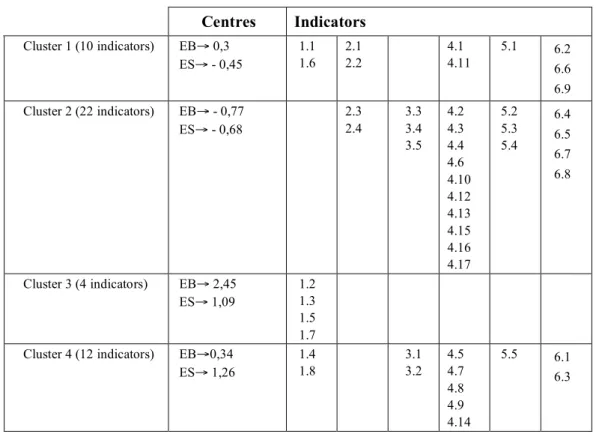
After various cluster analysis tests within the K-means modality, we focused on the solution that allowed a more clear and relevant interpretation, as usual in researches with an exploratory nature (U. Kelle, 1995). The solution of distributing the indicators through four clusters is the one that better harmonizes with other information elements, as shown ahead. Table 4 presents the composition of the four clusters, according to the processing output, and figure 2 shows, in each cluster, the relative prominence of the values of the EB and of the ES. The contrast in the distribution of values related to EB and those connected with ES can be seen in the results of the analysis of variance shown in the output. The clusters express a highly diversified dimension.
TABLE 4 Four-cluster solution
Centres Indicators
Cluster 1 (10 indicators) EB→ 0,3 ES→ - 0,45 1.1 1.6 2.1 2.2 4.1 4.11 5.1 6.2 6.6 6.9 Cluster 2 (22 indicators) EB→ - 0,77
ES→ - 0,68 2.3 2.4 3.3 3.4 3.5 4.2 4.3 4.4 4.6 4.10 4.12 4.13 4.15 4.16 4.17 5.2 5.3 5.4 6.4 6.5 6.7 6.8
Cluster 3 (4 indicators) EB→ 2,45 ES→ 1,09
1.2 1.3 1.5 1.7 Cluster 4 (12 indicators) EB→0,34
ES→ 1,26 1.4 1.8 3.1 3.2 4.5 4.7 4.8 4.9 4.14 5.5 6.1 6.3
To facilitate the interpretation of Figure 1. Cluster 3, which has comprised the indicators 1.2, 1.3, 1.5 e 1.7, shows a standardized value in the EB, (it is now applied to the value of the cluster and not to the value of each indicator) reasonably higher then the standardized value of the ES. This means, that indicators 1.2, 1.3, 1.5 and 1.7 are in a similar situation with each other and have for the EB, in comparison to the other indicators a higher value then those the indicators express for the ES, also in comparison to the other indicators.
FIGURE 1 Cluster analysis
The sum of 16 indicators integrated in clusters 3 and 4 represent the indicators to which both the ES and the EB give more importance, in opposition to what happens with 32 indicators integrated in clusters 1 and 2.
The indicators comprehended by clusters 3 and 4, where the level of importance has a symmetric outline in the EB and ES, also serve to identify the greater differences between both school levels. These 16 indicators (4+12) are the key of the difference. It should also be noted that the indicators that integrate cluster 1 favour, although slightly, the EB; the indicators that integrate cluster 2 favour, even more slightly, the ES.
Set of indicators that constitute cluster 3, by which the EB surpasses the ES:
1.2. Operating Systems and programs. 1.3. Internet.
1.5. Worked themes or themes in project. 1.7. Games.
Set of indicators that constitute cluster 4, by which the ES surpasses the EB:
3.1. «Technical» difficulties (directly related to the machine, including «disliking computers»; the opposite of 4.14).
3.2. Difficulties or displeasure that transcends the manipulation of machines.
4.05. Sensibility (and work) on the plan of the structure, of the link between contents and graphical resolution, of the investigation for programming aims.
4.07. Superiority of the computer in comparison to the library and other means of study. 4.08. Esteem and reasons of esteem for multimedia.
4.09. Valorizing of images, colours and graphics.
4.14. Enthusiasm for concrete technical resources (opposite of 3.1 and 3.2). 5.5. Use of the words «research», «researching», and «investigate». 6.1. School as a place for work, support and for the initiation in computers.
6.3. Primacy of «school work» as the occasion or motive to work with multimedia.
These are the most common topics in the discourse of both groups and we can promptly observe that the enumeration of objects with multimedia interest is prevalent in the EB, and “evaluation” and “school” in the ES. Speaking in general, the topics that are privileged by the ES students suggest, as already expected, more experience and maturity. They also refer more emphatically to school and school work.
Although it is possible and interesting to explore, item by item, the meaning of the values and of the reached set of values, we have chosen to produce a synthesis, which only aims at referring the most outstanding elements, or the most unexpected ones. The discourse of the EB students gives more emphasis than the ES students’ to themes (1.5) that are not directly related with school work. (As a matter of fact, only 25% of the references to concrete themes and concrete areas regard works that are directly related to the work in class. Most of the references to concrete themes (75%) are related to the culture of communication and entertainment.) The ES students’ discourse emphasizes school and school works (6.1 e 6.2).
The discourse of the EB students gives more emphasis to the enumeration of the basic resources (1.1, 1.2, 1.6). The ES students’ discourse emphasizes the concrete technical aspects of the machine and of the contents (3.1, 3.2, 4.9, 4.10, 4.12).
The discourse of the EB students emphasizes the time invested at the computer (2.1, 2.2: typical demand of the initiation?). The ES students’ discourse emphasizes the expression and the reasons of esteem for multimedia (4.7, 4.8).
The discourse of the EB students gives more emphasis to games (1.7). The ES students’ discourse emphasizes the applied work (1.4, 6.3).
The discourse of the EB student gives more emphasis to the mention of the Internet (1.3). The ES students’ discourse emphasizes the concrete consequences of its use (4.2, 4.6, 4.13, 5.4, 5.5).
The discourse of the EB students stresses the generic compliment and the generic critic to teachers and school (6.2, 6.6, 6.9). The ES students stresses the concrete critics to the teachers (6.7).
Conclusions and suggestions for further research
The available data, after the control analysis and cluster analysis, led to some results of technical interest, among others of a more general nature. Thus, we would like to emphasize the following points: The success of computers and multimedia among the young Portuguese student population is astonishing. Some students in the last years of schooling are in the front of knowledge and critical use of computing resources. The role of the school in initiating, motivating and facilitating content to the work of students with multimedia materials is of critical importance. It seems that the more the students become older the more they place the school work and the school content in the center of their interest for multimedia. We can probably say that the school (and in a certain sense, the teacher) keeps leading the process. With exception of investment in software technicalities, in some presentation materials (Access), and in encyclopedias, the use of computer by the students tends to be the use of an instrument for the elaboration of the same work (school work) which, still now, was done without it. The signs of use of the computer for supporting other creative tasks (like library or laboratory research, software for learning writing or solving quantitative problems, dramatic or plastic workshops) are very rare. Nevertheless there are signs of a culture which is different from the traditional school culture. With the impact of the multimedia involvement of the school students, the emergent culture is one considerably influenced by the direct communication, artistry and mass media. Important is the sense of innovation in the Portuguese schools, with the development of the multimedia materials, there are symptoms of a new style of learning and thinking. This creates chances for a new pedagogy, a new kind of instruction. We suspect that it is not only a new way of working the old curricula. It is a new form of thinking that calls for a different, not yet established, curriculum. If the enthusiasm of a number of students for multimedia materials is a legitimate reason for optimism, we have to go on developing more studies, with more rigorous surveys. First of all, we have to check the real number of the initiated. We live in the civilization of knowledge. Unfortunately there is a great danger of becoming the civilization of social differences. We, teachers, know that there is no real education without a real commitment for democracy.
In short: a) Confirmation of the success of computers and multimedia among the young Portuguese student population, being manifest either in their attitudes or in the diversity of their experiences, including the technical mastery of informatics; b) Acknowledgment, by the students, of the role of the school and of those of their teachers who had till now lead the process; c) unexpected emphasis attached by the students, mainly by the older ones, to the use of computer as a resource for school work which, still now, was done without it; d) rare use of the computer for supporting tasks of creative or autonomous nature.
To conclude, we would like to systematize some ideas directly immerging from the students’ discourses. These opinions can easily be taken both as an alert sign for those who have a word to say in these matters and, at the same time, as criteria of quality and good use of the multimedia materials in the school context and so as recommendations for those who work with them.
So about multimedia materials:
- In multimedia materials meant for school support, programming and graphical configuration errors should be avoided, because they cause loss of time and experiences of insecurity in students’ work.
- Colors, images and graphics are of a fundamental importance in multimedia materials. The importance of sounds and music is not so strongly highlighted. About the curriculum/multimedia relation:
- It is urgent to produce and to provide for more multimedia materials for supporting curricular content, specially for the more advanced students.
- Against the monopoly of the English language, there is a need for more materials in Portuguese language, which are very few at the moment.
- There is a need to improve clarity and accuracy of the Portuguese language, which has been “very mistreated” in multimedia, in particular in the Internet. - There is also a need for more multimedia materials dedicated to information
about Portuguese issues. There is a lack of production of this kind of materials. - There is a feeling that there is a lack of multimedia materials to support the
studying of Mathematics, specially in more advanced school years. About teachers and teaching:
- Even recognizing the competency of some teachers in dealing with these matters, most of them need urgently training and information both on the existing materials and on how to integrate them in their classroom practice.
- It is necessary that teachers understand that multimedia prodigiously stimulate motivation to learn and to work, teaching students how to learn and to develop their critical sense and autonomy.
- Multimedia resources are still very insufficient, their use should be intensified in practical work in the classroom..
About the school:
- Generally speaking, the number of computers available in our schools is much smaller than the number already justified by the students’ interest and necessity.
- School indifference towards the multimedia revolution, regarding accessibility, quantity and up-to-dated information, is unacceptable.
References
BOUTHOURS, M. (1987). La recherche en technologie de l'education 1970-1987. Perspectives Documentaires en Sciences de l'Education, 13.
CAREY, M. (1994). The group effect in focus groups: planning, implementing, and interpreting focus group research. In: J. Morse (ed.), Critical issues in qualitative research methods. Thousand Oaks: AGE Publications.
FONTANA, A. & J. H. FREY. (1994). Interviewing, the art of science. In: N. K. Denzin & Y. Lincoln, Handbook of qualitative research. Thousand Oaks: SAGE Pub., pp. 361-376.
FRIEDMAN, D. (1983) The impact of Educational Computing on Teacher Education, Journal of Teacher Education, Vol. XXXIV, nº 5, pp. 14-18
GHIGLIONE, R. & B. MATALON, (1992). O inquérito: teoria e prática. Oeiras: Celta Editora.
GRAVES, M. et al. (1998). Some characteristics of memorable expository writing. Research in the Teaching of English, vol. 22, n.º 3: 242-265.
GREENBAUM, T. (1991). Outside moderators maximize focus group results. Public Relations Journal, n.º 47/9: 31-32.
KELLE, U. (1995). Computer-aided qualitative data analysis. London: SAGE Publications.
PAPERT, S. (1993). The children's machine: Rethinking school in the age of the computer. New York: BasicBooks.
PAPERT, S. (1996). The connected family: Bridging the digital generation gap. Atlanta, Georgia: Longstreet.