Accepted Manuscript
Interaction of wine mannoproteins and arabinogalactans with anthocyanins Fernando J. Gonçalves, Pedro A.R. Fernandes, Dulcineia F. Wessel, Susana M. Cardoso, Silvia M. Rocha, Manuel A. Coimbra
PII: S0308-8146(17)31573-X
DOI: http://dx.doi.org/10.1016/j.foodchem.2017.09.097
Reference: FOCH 21766
To appear in: Food Chemistry
Received Date: 24 February 2017 Revised Date: 14 September 2017 Accepted Date: 18 September 2017
Please cite this article as: Gonçalves, F.J., Fernandes, P.A.R., Wessel, D.F., Cardoso, S.M., Rocha, S.M., Coimbra, M.A., Interaction of wine mannoproteins and arabinogalactans with anthocyanins, Food Chemistry (2017), doi:
http://dx.doi.org/10.1016/j.foodchem.2017.09.097
This is a PDF file of an unedited manuscript that has been accepted for publication. As a service to our customers we are providing this early version of the manuscript. The manuscript will undergo copyediting, typesetting, and review of the resulting proof before it is published in its final form. Please note that during the production process errors may be discovered which could affect the content, and all legal disclaimers that apply to the journal pertain.
Interaction of wine mannoproteins and arabinogalactans with
anthocyanins
Fernando J. Gonçalvesa,b+, Pedro A. R. Fernandesa+, Dulcineia F. Wessela,b, Susana M. Cardosoa, Silvia M. Rochaa, Manuel A. Coimbraa*
a
QOPNA, Department of Chemistry, University of Aveiro, Campus Universitário de Santiago, 3810-193 Aveiro, Portugal
b
School of Agriculture and 3 CI&DETS, Polytechnic Institute of Viseu, 3500-606 Viseu, Portugal;
+These authors equally contributed to the work
*Author to whom correspondence should be addressed. E-mail address: [email protected]
Phone: +351234 370706; Fax: +351234 370084.
Running title:
Abstract
Wine polymeric material (WPM), which includes polysaccharides, proteins, and polyphenolic compounds, interacts with anthocyanins. To determine the contribution of polysaccharides in these interactions, the diffusion performance of anthocyanins along a dialysis membrane was determined in the presence and absence of isolated
mannoproteins (MP) and arabinogalactans (AG) from WPM. Furthermore, to estimate the extent of the interaction between WPM and polyphenolic compounds, the activation energy (Ea) required for their diffusion in the presence of WPM was determined. AG,
generally more abundant than MP in wine, interact in a greater extent with
anthocyanins, showing their relevant contribution for WPM/anthocyanins interactions. The Ea for the diffusion of polyphenolic compounds in presence of WPM indicated the
occurrence of interactions with relative weak to strong intensities (2.6-50.8 kJ/mol). As not all polyphenolic compounds were able to be released from WPM, stronger
interactions, possibly by covalent linkages, are involved, providing new insights on WPM/polyphenolic compounds relationships.
Keywords: Polysaccharides; anthocyanins; interactions; wine polymeric material; bioaccessibility; polyphenolics.
1. Introduction
A moderate wine consumption is one of the standard premises associated with the health benefits of the Mediterranean diet (Nestle, 1995). Part of these benefits have been related to the richness of wine in polyphenolic compounds, i.e. plant secondary metabolites well known for their biological properties (Mazza, Fukumoto, Delaquis, Girard, & Ewert, 1999). Anthocyanins such as malvidin, delphinidin, cyanidin, petunidin, and peonidin are part of the polyphenolic pool found in red wine, occurring mainly as glycosylated or acylglycosilated derivatives (Santos, Nunes, Jourdes, Teissedre, Rodrigues, Amado, et al., 2016; Sun, Leandro, de Freitas, & Spranger, 2006). Anthocyanins, in addition to tannins, are responsible for the colour of red wine (Mazza et al., 1999) and contribute to the possible health benefits related to moderated wine consumption. These molecules have been shown to possess antioxidant (Ginjom, D’Arcy, Caffin, & Gidley, 2011), anti-proliferative (Mazue, Delmas, Murillo, Saleiro, Limagne, & Latruffe, 2014) and immunomodulatory properties (Bognar, Sarszegi, Szabo, Debreceni, Kalman, Tucsek, et al., 2013).
To exert their health benefits, anthocyanins, and polyphenolic compounds in general, need to be bioaccessible, a factor governed not only by their chemical features, but also by their interaction with others macromolecular components such as proteins and polysaccharides (Jakobek, 2015). When polysaccharides are involved, these interactions result from the establishment of hydrogen bonds, as well as hydrophobic interactions (Padayachee, Netzel, Netzel, Day, Zabaras, Mikkelsen, et al., 2012; Saura-Calixto, 2011). Additionally, ionic interactions also occur in the presence of charged molecules (Lin, Fischer, & Wicker, 2016). Therefore, polyphenolic compounds can be retained by a surface adsorption phenomenon or encapsulation through the formation of hydrophobic cavities established via spatial rearrangements of
the carbon backbones and hydroxyl groups of the carbohydrate residues, similarly to those encountered in cyclodextrins (Saura-Calixto, 2011).
Previous works have shown that polysaccharide/polyphenolic compounds interactions are highly dependent on the polyphenolic structure, such as their molecular weight (Watrelot, Le Bourvellec, Imberty, & Renard, 2013), charge, and substituent groups (Phan, Netzel, Wang, Flanagan, D’Arcy, & Gidley, 2015). For instance, polyphenolic compounds of higher molecular weight and with hydrophobic groups preferentially interact with polysaccharides, while the occurrence of more polar groups such as quinic acid moieties may lessen these interactions (Gonçalves, Rocha, & Coimbra, 2012; Phan et al, 2015; Watrelot et al, 2013. In the case of anthocyanins, although charged under acidic pH, the presence of hydrophobic groups, such as acetyl and coumaroyl derivative structures has been suggested to be a critical feature
(Gonçalves et al., 2012; Padayachee et al., 2012). In contrast, the knowledge regarding the effect of polysaccharide structure in the occurrence of
polysaccharide/polyphenolic compounds interactions is in general still poorly described, in particular for low molecular weight polyphenolic compounds. In fact, most of the studies do not establish structure/interaction relationships, which could be relevant for the understanding of several aspects related to the sensorial properties of foods (Soares, Mateus, & de Freitas, 2012), polyphenolic compounds bioaccessibility (Bouayed, Deußer, Hoffmann, & Bohn, 2012) and polyphenolic or polysaccharides extraction yields from fruits and their by-products (Cardoso, Guyot, Marnet, Lopes-da-Silva, Renard, & Coimbra, 2005; Ferreira, Guyot, Marnet, Delgadillo, Renard, & Coimbra, 2002).
In a previous work, it was shown that wine polymeric material (WPM), of which mannoproteins (MP) and type II arabinogalactans (AG) are the main constituent
polysaccharides, present the capability to interact with polyphenolic compounds, especially coumaroyl-glucosilated anthocyanins (Gonçalves et al., 2012). To understand these interactions, there is a need to clarify which, if any, of the major constituent polysaccharides have a relevant role as well as the extent of the interaction process. In this work, the potential capacity of MP- and AG- rich fractions to interact with anthocyanins was assessed towards nine monomeric structures from red wine, overall comprising glycosylated, acetyl-glycosylated, and coumaroyl-glycosylated structures. For this purpose, the diffusion efficiency of the anthocyanins through a dialysis membrane was determined in the presence and absence of MP- and AG-rich fractions along 5 dialysis steps with water renewal every 3 hours. The retention capacity was determined allowing to estimate the extent of the interactions between each individual anthocyanin with MP or AG. To provide evidences of the extent of polyphenolic compounds interaction with WPM, the velocity of release of polyphenolic compounds was determined, at different temperatures, for WPM submitted to different washing steps. This allowed the estimation of the kinetic constant and activation energy (Ea) associated with the interactions between polyphenolic compounds and WPM.
2. Materials and Methods
2.1. Preparation of mannoprotein (MP), arabinogalactan (AG) and anthocyanin-rich fractions
Dealcoholized wine (DW) was obtained by heat treatment of red wine from Dão Appelation, in Portugal, from 2009 vintage (Gonçalves et al., 2012). Briefly, the wine was heat-evaporated, at atmospheric pressure, until 75% of its initial volume. At the end of the distillation process, water was added in the same volume of the alcoholic
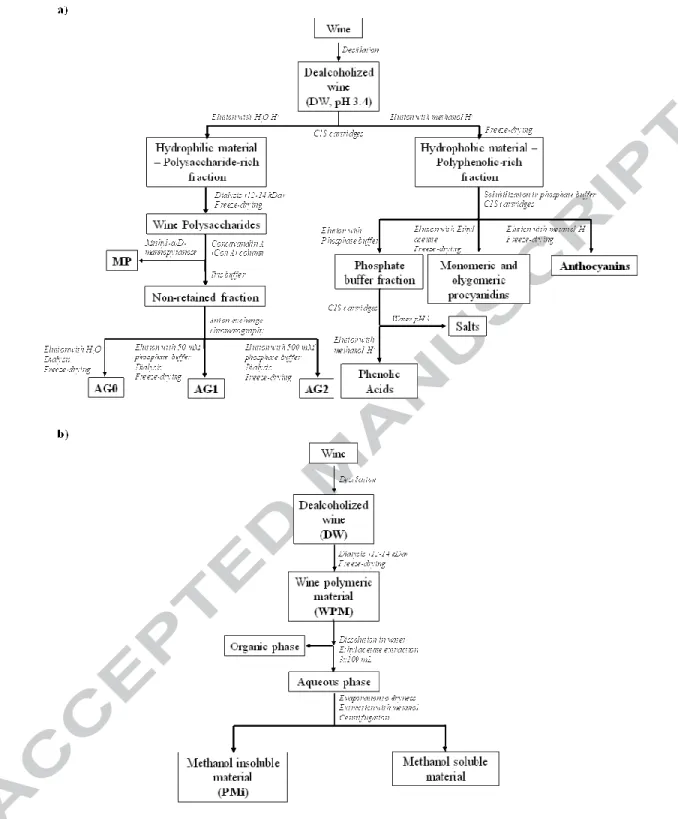
fraction removed maintaining the concentration of the wine components under study equal to the original wine. The DW was then subjected to solid-phase extraction with C18 sep-pak cartridges (SPE-C18, Supelco-Discovery, 20g) (Figure 1a),
preconditioned with 20 mL of methanol followed by 20 mL of water and 20 mL of 2% acetic acid. The column was then washed with water (pH 3.4) yielding a
polysaccharide-rich fraction. This fraction was dialyzed (12 kDa cut-off membrane, Medicell) to remove tartaric acid and other small molecules (Coimbra, Gonçalves, Barros, & Delgadillo, 2002). The retentate was concentrated, frozen and freeze-dried to give the wine polysaccharides as a powder. To obtain a MP-rich fraction from wine polysaccharides, an affinity medium of concanavalin A (Con A) Sepharose 4B (GE Healthcare, Uppsala, Sweden) was used, according to the procedure described by Coelho, Rocha, and Coimbra (2011). Anion-exchange chromatography was performed for the ConA non-retained fraction, which was rich in arabinogalactans (AG), using a HyperSep SAX 10 g (Thermo Fisher Scientific, U.K.). The neutral fraction (AG0) was obtained by elution with water. Two acidic fractions (AG1 and AG2) were obtained by sequential elution with 50 mM and 500 mM phosphate buffer (pH 6.5). All fractions were dialysed against water, and freeze-dried.
To elute the polyphenolic compounds retained in the C18 cartridge, acidified
methanol (0.1% HCl) was used to obtain a polyphenolic-rich fraction. This material was concentrated, frozen, freeze dried and dissolved in water yielding a wine polyphenolic solution. To obtain an anthocyanin-rich fraction (Figure 1a), this solution was adjusted to pH 7.0 by addition of 10 mM commercial phosphate buffer (Fisher Chemical) and submitted to solid-phase extraction (SPE-C18, Supelco-Discovery, 20 g) previously activated with methanol, washed with distilled water and pre-conditioned with buffer solution as described by Sun et al. (2006). The phenolic acids were removed with 50
mL of diluted phosphate buffer (1/8, v/v), introduced into a new cartridge, washed with water and the eluted with acidified methanol, representing 443±21 mg/L of DW. The first cartridge was then washed with water and dried under enhanced vacuum.
Monomeric flavanols and oligomeric procyanidins were removed with 50 mL of ethyl acetate, representing 870±49 mg/L of DW. Anthocyanins, polymeric proanthocyanidins, and other pigmented complexes were then eluted with 30 mL of methanol with 0.1% of HCl, concentrated under reduced pressure and freeze-dried, representing 2,187±123 mg/L of DW.
2.2. Dialysis conditions for measurement of diffusion of anthocyanins
To determine MP and AG interaction with anthocyanins, the dialysis membranes were filled with 10 mL of anthocyanin-rich solution (total anthocyanins at ≈0.28 mg of malvidin-3-O-glucoside (Mv3Glc) equivalents (determined using the SO2 bleaching
method described in section 2.6), in the presence of 1.50 mg of MP, which was the concentration occurring in the wine samples. To be directly comparable to MP, AG were tested using the same concentration. The concentration of anthocyanins used was optimized to obtain the maximum information about their interaction with
polysaccharides with the minimum number of dialysis steps able to determine 1) the retention coefficient in the first dialysis and 2) the asymptote of the diffusion behavior, only observed after several dialysis runs.
The dialysis was performed during 15 h, with water (190 mL) renewal every 3 h, allowing to obtain five dialysate solutions for each experiment: W1MP-W5MP for MP
trial, and W1AG-W5AG for AG trial. The blank assay consisted in the dialysis of the
anthocyanin-rich solutions in the absence of wine polysaccharides, also resulting in five dialysate solutions W1B-W5B. For each anthocyanin, a retention coefficient (RC) was
calculated based on the percentage of released anthocyanins in the first dialysate solution. The retention coefficient was calculated for each compound using the Equation 1.
Equation 1. RC = [1-(%W1PS/%W1B)]
%W1PS corresponds to the relative amount of each anthocyanin released to the
first dialysate solution in the presence of polysaccharides (MP or AG-rich fractions) and %W1B is the relative amount of anthocyanins released to the first dialysate solution in
the absence of polysaccharide. A RC=0 meant that MP or AG did not have any capacity of retention, i.e, absence of interactions, while RC=1 represents 100% of retention, i.e, that all anthocyanins interacted with the polysaccharides and were retained.
2.3. Preparation and washing of WPM
WPM was obtained by dialysis (12 kDa cut-off membrane, Medicell) of DW for 66 hours with water renewal every 6 hours (Figure 1b) as previously described by Gonçalves et al. (2012). An aqueous solution of 10 g/L of WPM was submitted to liquid-liquid extraction with ethyl acetate (1:1, v/v) for 1 h, at room temperature and constant stirring. The organic phase was discarded and the aqueous phase, containing the polymeric material, was evaporated to dryness, and extracted with acidic methanol (10 g/L) using the same procedure. The methanol insoluble material (PMi) was obtained by centrifugation (24,700 g; 10 min, 4 ºC).
2.4. Determination of the Ea of polyphenolic compounds interaction with WPM
DW, WPM and PMi were dialysed at different temperatures (25, 30, 35 and 40 ºC). The release of polyphenolic compounds from the polymeric material, at each temperature, was determined by their quantification in the dialysis water along time.
The amount of polyphenolic compounds in the dialysis water was plotted against the release time until reaching a steady state. The slope of the linear region corresponds to the release rate of polyphenolic compounds, expressed as µ g equivalents of gallic acid (GAE)/second. Each sample was assayed using three or four concentration levels, allowing the determination of three or four release rates. The kinetic constant was determined plotting the release rate against the initial amount of polyphenolic
compounds inside the dialysis bag. The activation energy was obtained from the slope of the logarithmic form of Arrhenius equation (Equation 2)
Equation 2 ln(k) = - (Ea/RT) + ln(k0)
where Ea is the activation energy (kJ/mol), k is the kinetic constant, k0 is the
pre-exponential constant, R is the gas constant (8.314 J.mol/K) and T is the mean absolute temperature of the considered dialysis temperature range (K).
2.5. Carbohydrate and protein analysis
Neutral sugars present in the polymeric material were determined by gas chromatography (GC) after acid hydrolysis and derivatization to alditol acetates (Nunes, Saraiva, & Coimbra, 2008). Uronic acids were quantified by the
3-phenylphenol colorimetric method (Coimbra, Delgadillo, Waldron, & Selvendran, 1996). Samples were prepared by pre-hydrolysis in 0.2 mL of 12 M H2SO4 for 3 h at
room temperature followed by hydrolysis for 1 h in 1 M H2SO4 at 100 ºC. The samples
were diluted 1:10 previously to analysis to prevent the appearance of the characteristic pink absorbance of anthocyanidins and proanthocyanidins formed upon acid hydrolysis. A calibration curve was made with D-galacturonic acid.
Protein was determined for MP and AG-rich fraction by the bicinchoninic acid method using bicinchoninic Acid Protein Assay Kit from Sigma (Aldrich-Chemie,
Steinheim, Germany) and bovine serum albumin as standard (calibration curve from 0.05-0.4 mg/mL) (Coelho et al., 2011). After 15 min in a water bath at 60° C the absorbance was measured at 562 nm (6405 Jenway UVvis spectrophotometer, U.K.). WPM and PMi protein content was determined by amino acid analysis after acid hydrolysis (6 M HCl) and derivatization for GC-FID (PerkinElmer Clarus 400 instrument - PerkinElmer, Massachusetts, USA) analysis as described by Coimbra, Nunes, Cunha, and Guiné (2011). The compounds were identified by their retention times and chromatographic comparison with standards. Quantification was based on the internal standard method using L-norleucine, and the calibration curves were built for 18 amino acids.
2.6. Total polyphenolic content, total anthocyanins and monomeric anthocyanins
The total anthocyanins were determined for W1MP-W5MP, W1AG-W5AG and
W1B-W5B fractions using the SO2 bleaching method as described by Santos et al.
(2016). Each sample (1 mL) was added to 1 mL of ethanol acidified by 0.1% HCl and 20 mL of 2% HCl solution. In one tube, 2 mL of previous solution was added to 0.8 mL of water (t1). In another tube (t2) were mixed 2 mL of previous solution and 0.4 mL of HNaSO3 solution (15% w/v) and 0.4 mL of water. After 20 min at dark room
temperature, the absorbance at 520 nm was measured. The total anthocyanins were calculated using the Equation 3 , where abst1 and abst2 means for the measured absorbance for the test tube 1 and 2, respectively. The results were expressed as µ g of malvidin equivalents.
Monomeric anthocyanins were analysed and identified according to Dallas and Laureano (1994) using a HPLC Dionex Ultimate 3000 Chromatographic System (Sunnyvale, CA, USA), equipped with a C18 Acclaim® 120 column (Dionex, Sunnyvale,
CA, USA) and a multiple Wavelength Detector MWD-300. Monomeric anthocyanins were quantified using Malvidin-3-O-glucoside (Extrasynthese, Genay, France) as standard as described by Gonçalves et al. (2012). The total polyphenolic content of DW, WPM, PMi and their dialysates along the dialysis process was determined by Folin-Ciocalteu reagent, as previously described by Singleton and Rossi (1965). Each sample (0.125 mL) was added to 0.5 mL of deionized water and 0.125 mL of Folin-Ciocalteu reagent (Sigma). After 6 min, 1.25 mL of 7.5% solution of sodium carbonate and 1.0 mL of deionized water were added. The mixture was left 90 min at room temperature in the dark and the absorbance at 760 nm was measured. The results were expressed in µg of gallic acid equivalents.
2.7. Statistics
All experiments were done in triplicate. t-Student test at a level of 0.05 of
significance was used in order to determine significant differences between the retention coefficient of polysaccharides for each one of the monomeric anthocyanins.
3. Results and Discussion
3.1. Contribution of MP-rich and AG-rich fractions to the retention of anthocyanins
In a previous work, it was shown that WPM presents the capability to interact with polyphenolic compounds, specifically anthocyanins (Gonçalves et al., 2012). As polysaccharides represented a significant fraction of WPM, jointly with previously described interactions between polyphenolic compounds and pure polysaccharide fractions (Le Bourvellec, Bouchet, & Renard, 2005; Watrelot, Le Bourvellec, Imberty, & Renard, 2014) it was suggested that the polysaccharide moiety of WPM can be in part responsible for the previously observed interactions between WPM and polyphenolic compounds. For this purpose, two of major wine polysaccharides were isolated from the WPM previously studied, namely mannoproteins (MP) and
arabinogalactans (AG).
MP fraction was obtained by separation through a Concanavalin A resin. It accounted for 117 mg/g of WPM (Table S1). Carbohydrate analysis revealed the presence of 62% of carbohydrates, mainly Man (93% mol), which represented about 24% of those present in WPM. This fraction was also composed by 9.4% protein (8.7% of the protein present in WPM), a characteristic feature of MP (Coelho et al., 2011; Coimbra et al., 2002; Doco, Vuchot, Cheynier, & Moutounet, 2003). To obtain representative AG fractions, the polymeric material was separated through an anion exchange column. The major fractions were eluted with water (AG0, 76.2 mg/g of WPM), and 50 mM phosphate buffer (AG1, 82.3mg/g of WPM). The fraction eluted with 500 mM phosphate buffer (AG2) only accounted for 17.3 mg/g of WPM. Among the three fractions, AG1 contained 60% of carbohydrates and a typical AG composition, with 50% Gal and 23% Ara (Coimbra et al., 2002). As AG1 represented 16.3% of the total carbohydrates present in WPM, against the 14.3% and 2.6% observed for the AG0 and AG2, this fraction was used as representative of polymeric material of AG for the interaction studies.
3.1.2. Total and monomeric anthocyanins composition of the dialysate solutions
To determine the occurrence of interactions between MP or AG with anthocyanins, an anthocyanin-rich solution isolated from wine was dialysed in the presence or absence of these polysaccharides. Five dialysate solutions were obtained for each experiment and named W1MP-W5MP for MP trial, W1AG-W5AG for AG trial and
W1B-W5B for blank trial, in accordance with the serial number of the water changes
performed. The total amount of anthocyanins initially present in the polyphenolic solution was 280.9 µ g of malvidin-3-O-glucoside (Mv3Glc) equivalents, as estimated colorimetrically. From these, 65% were monomers, estimated by HPLC (Table 1). Mv3Glc accounted for 129.5 µ g, representing 71% of total monomeric anthocyanins quantified. Malvidin-3-O-(6-acetyl)-glucoside (Mv3AcGlc) accounted for 16%, Malvidin-3-O-(6-p-coumaroyl)-glucoside (Mv3CmGlc) 5%, and Petunidin-3-O-glucoside (Pt3Glc) 4%. Peonidin-3-O-Petunidin-3-O-glucoside (Pn3Glc), Delphinidin-3-O-Petunidin-3-O-glucoside (Dp3Glc) and their acetylated derivatives accounted for 1-2% of monomeric
anthocyanins.
In the first blank dialysate solutions (W1B), after 3 h, 51% of the total
anthocyanins initially present diffused through the dialysis bag. However, for MP and AG, this diffusion was only 34% (W1MP) and 28% (W1AG), respectively (Figure 2a).
The same tendency was observed for the following dialysate solutions, where the amount of anthocyanins recovered was always lower in the presence of MP and AG, in comparison to the blank. After 15 h, only 58% of total anthocyanins initially present in the dialysis bag were released in the presence of AG and MP, which was lower than the 83% observed in the blank experiment (Figure 2a). The same tendency was observed
for monomeric anthocyanins in the presence of MP and AG (Figure 2b), where from the 183.2 µg Mv3Glc equivalents initially present, 114.8 and 111.2 µ g Mv3Glc were diffused after the five dialysate solutions, representing about 75% of the amount diffused from the blank solutions (151.2 µg Mv3Glc). These results are in accordance with those previously observed for the interaction of anthocyanins by the wine
polymeric material (WPM) (Gonçalves et al., 2012), showing that the MP and AG are relevant for the interaction of total and monomeric anthocyanins with WPM. To assess if, as observed for WPM (Gonçalves et al., 2012), the coumaroylated and acetylated anthocyanins have higher interaction with MP and AG than unsubstituted anthocyanins, the release of individual anthocyanins from the dialysis bag in the presence of MP-rich and AG-rich fractions was evaluated.
3.1.3. Determination of the retention capacity of monomeric anthocyanins by MP and AG polysaccharides
Figure 2 shows the amount of anthocyanin-3-O-glucoside (Antho 3-Glc) (Figure 2c), anthocyanin-3-O-(6-acetyl)-glucoside (Antho 3-AcGlc) (Figure 2d), and anthocyanin-3-O-(p-coumaroyl)-glucoside (Antho 3-CmGlc) (Figure 2e) retained inside the dialyses bag in the presence and absence of MP or AG. These values were obtained by difference between the amount of anthocyanins initially present and the amount that diffused. A retention of all anthocyanins families was observed by MP and AG when compared with the blank. For these two polysaccharide fractions, at the end of 15 h of dialysis, the amount of retained Antho 3-Glc was 50 µg (variance of 21.3) out of 140 µ g Mv3Glc eq. whereas that of Antho 3-CmGlc was 6 µ g (variance of 0.102) out of 11 µg Mv3Glc eq., thus representing higher retention percentages than those obtained for the blanks (32 and 1 µ g Mv3Glc eq., respectively). This is indicative that MP and
AG promote the retention of Antho 3-Glc and Antho 3-CmGlc in the same order of magnitude. However, the two polysaccharides exhibited a distinct retention ability of Antho 3-AcGlc (Figure 2d), with AG being able to retain 50% more anthocyanins than MP (18 and 12 µg, respectively, out of 34 µg Mv3Glc eq.).
As these results are indicative that MP and AG present selectivity towards the different anthocyanin structures, the retention coefficient for each anthocyanin was calculated based on the percentage of its release to the dialysis water during the first 3 h period in the presence of polysaccharide fractions and in their absence (Table 2).
For MP, the retention coefficient of total anthocyanins was 0.34 and the retention coefficient of total monomeric anthocyanins was 0.24. These values were lower than those observed for AG: 0.45 and 0.38, respectively. This difference resulted from the higher retention for all acetylated and coumarylated anthocyanins by AG when compared with MP: for Antho 3-AcGlc and Antho 3-CmGlc the average retention coefficient was 0.34 and 0.44 for MP and 0.62 and 0.61 for AG, respectively. These results are in accordance with the observations of Ortega-Regules, Romero-Cascales, Ros-García, López-Roca, and Gómez-Plaza (2006), which correlated the lowest extraction of anthocyanins from cell-wall grapes with the high content of cell-wall galactose. It is possible that the highly branched backbone of AG, with helical conformation under which the side chains are orthogonally positioned and packed (Pérez, Mazeau, & Hervé du Penhoat, 2000), favours the interaction with
anthocyanins, especially the acetylated and coumaroylated ones. These mechanisms, although in lower extension, may also occur in the case of MP. In fact, previous studies showed that the addition of commercial MP to wines exhibited a slight delay (ca ~30%) in the extraction of pomace anthocyanins at the end of alcoholic fermentation, when compared with control wines (no addition of MP) (Guadalupe & Ayestarán, 2008).
Nevertheless, MP have phosphate groups which provide a surface negatively charged, as well as an increased hydrophilicity (Bastos, Coelho, & Coimbra, 2015), explaining the lower retention capacity observed for acetyl and coumaroyl anthocyanin families when compared to AG. These observations allow to infer that the negative charges of MP could have higher influence on the retention of hydrophobic anthocyanins than the negative charges of AG. If additionally considering that all AG in wine (229 mg/L), which represent 1.5 times the amount of MP (153 mg/L), present similar behaviour for the interaction with anthocyanin, it is possible to suggest that AG is the main
polysaccharide contributing for the selectivity of WPM towards acetyl and coumaroyl anthocyanin structures. Furthermore, if the retention coefficient of AG increases in the same proportion as concentration, and the retention coefficient of WPM results from the sum of the contribution of the different polysaccharides according to their relative proportion, i.e. 40% of the retention coefficient for MP and 60% of the retention coefficient for AG, the RC values previously verified for WPM by Gonçalves et al. (2012) have a contribution of 70%, on average, of MP and AG. Therefore, it can be inferred that the polysaccharide fraction of WPM may be the major contributor for the interaction with anthocyanins.
The WPM used in this work accounted for 1.1 g/L in DW. Amino acid analysis allowed to determine 9% protein, of which Gly (14.8 mg/g) and Val (14.1 mg/g) were the major amino acids (Table S1 and S2). Polysaccharides represented 30% of WPM, being Man (78.4 mg/g), Gal (76.6 mg/g), Glc (35.9 mg/g), Ara (57.5 mg/g), Rha (9.7 mg/g) and UA (44.4 mg/g) the main monosaccharides. This composition reflects the macromolecular components of wine which include soluble proteins, MP carbohydrates, and pectic polysaccharides, including AG. The WPM contained 319 mg GAE/g of polyphenolic compounds, representing 27% (350.9 mg GAE/L) of those initially
present in dealcoholized wine (DW) (1.32 g GAE/L), which is in accordance with the retention capacity of polyphenolic compounds observed for WPM (Gonçalves et al., 2012) and its MP and AG isolated fractions, as well as for proteins (Ferrer-Gallego, Gonçalves, Rivas-Gonzalo, Escribano-Bailón, & de Freitas, 2012; Soares et al., 2012).
3.2. Intensity of the interactions between wine polyphenolic compounds and WPM
The diffusion of polyphenolic compounds from WPM subjected to new dialysis steps indicated that part of the polyphenolic compounds determined in WPM were possibly retained by interaction phenomena. In order to assess the intensity of these interactions, dialyses were performed with different concentrations of WPM and at distinct temperatures. The quantification of the diffused polyphenolic compounds through the dialysis membrane along the time allowed to estimate their rate of release for each tested condition. The plotting of these velocities against the initial amount of polyphenolic compounds inside the dialysis bag allowed to estimate the kinetic constants (kc) for the release at each temperature. Moreover, the plot of ln(kc) against
the inverse of the tested temperatures allowed the determination of the activation energy (Ea) for polyphenolic compounds release from WPM, according to the Arrhenius
equation.
The cumulative amount of the diffused polyphenolic compounds increased along dialysis. After a lag phase, where the release of polyphenolic compounds was slow, a linear phase was observed until the reaching of a stage where the amount of released compounds seemed to tend asymptotically to a plateau (Figure S1). The time required
to achieve the plateau varied from 36 to 63 h for WPM, depending on the tested concentrations and temperatures (Table 3).
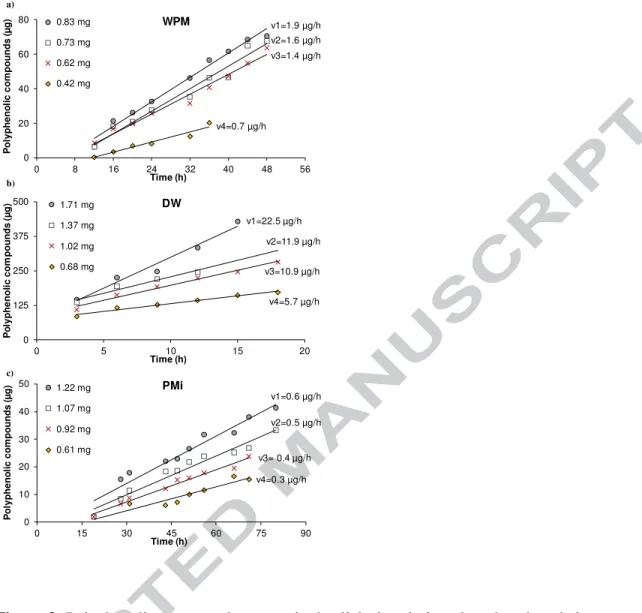
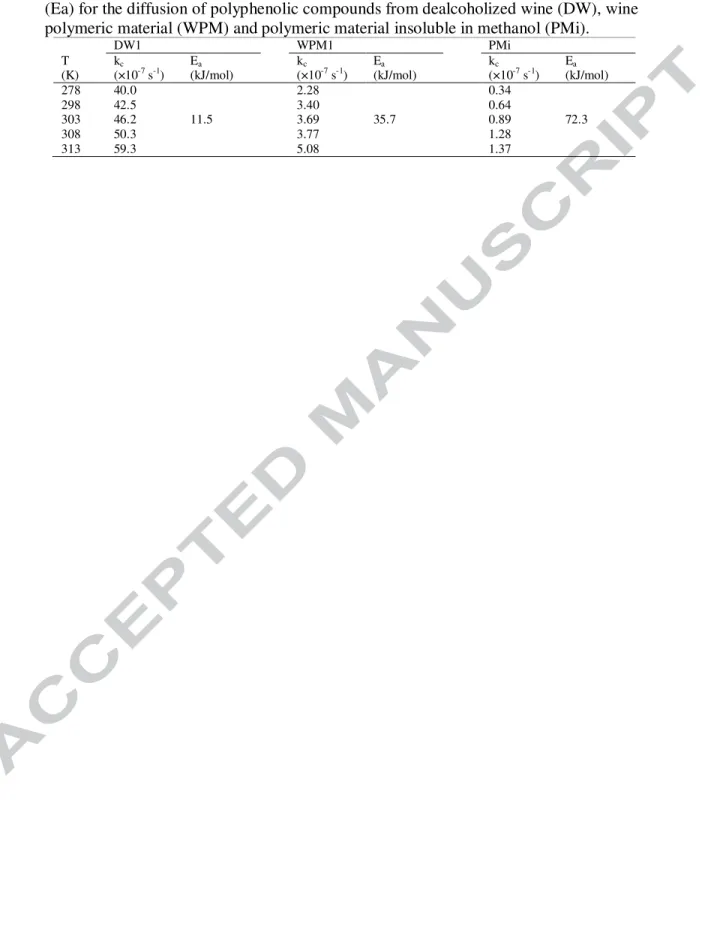
The release rate of polyphenolic compounds was determined using the slope of the linear phase, i.e, the cumulative amount of polyphenolic compounds released versus time, thus excluding the lag and plateau phases (Figure 3a). Correlation coefficients ranging from 0.73 to 0.99 were obtained, showing their suitability for use in the calculation of polyphenolic compounds release rate. For WPM, the release rate ranged from 0.6 to 2.2 µg/h, rising with the increase of the temperature (Table 3). The kinetic constant increased from 7.36×10⁻⁷ s-1 to 11.7×10⁻⁷ s-1 when the temperature increased from 25 ºC to 40 ºC, indicating a higher rate of release of polyphenolic compounds with temperature (Table 4). The resulting Ea for WPM was estimated as 25.4 kJ/mol.
To estimate the Ea for the diffusion of free polyphenolic compounds in the
presence of WPM, the same procedure was performed for DW. In contrast with WPM, DW did not present a lag phase for the diffusion of polyphenolic compounds (Figure 3b), presenting release rates in the range of 3.4 to 26.2 µg/h (Table 3), much higher than those observed for WPM (Table 3). This resulted in higher kc, 41.4×10⁻⁷ s-1 to
43.3×10⁻⁷ s-1, and consequently a lower Ea (2.6 kJ/mol) (Table 4). This energy level is
possibly established by the free polyphenolic compounds that interact with the WPM, as reported by Gonçalves et al. (2012). Nevertheless, these interactions are sufficiently weak to allow a fast diffusion through the membrane when compared with the compounds that are more retained in WPM. This Ea level are in accordance with the
self-association of anthocyanins (Fernandes, Bras, Mateus, & Freitas, 2015) which could occur possibly through low energy pi-stacking phenomena (Sinnokrot, Valeev, & Sherrill, 2002).
Because the association of polyphenolic compounds to plant cell wall material has been reported to be very strong (Renard, Baron, Guyot, & Drilleau, 2001), methanol was used to remove polyphenolic compounds from the WPM and the insoluble residue obtained (PMi) was dialysed under different temperatures and concentrations, as described for WPM and DW. This allowed to be estimated the Ea of
the compounds strongly associated to the WPM by measuring the amount of
polyphenolic compounds released under the different conditions, the release rate and the kinetic constants.
In comparison to WPM, PMi presented a lower polyphenolic composition (214 mg GAE/g) which resulted from the removal of 67% (235.6 out of 350.9 mg GAE/L) of the polyphenolic compounds retained to WPM by the methanol washing step. This variation outcomes from the chaotropic nature of methanol that causes the cleavage of hydrogen bounds and hydrophobic interactions involved onto polyphenolic compounds interactions with the polymeric material (Le Bourvellec, Guyot, & Renard, 2004) and hence their dissociation from WPM. The methanol treatment removed 27% of WPM carbohydrates: Man (-11%), Gal (-20%), UA (-27%) and Ara (-36%), which resulted in an increase of the polysaccharide fraction to 452 mg/g, indicating that the majority of MP and AG originally present in WPM were recovered in PMi. The protein fraction also increased to 11.8 mg/g, of which Ser (17%), Thr (16%), Glx (15%), and Asx (12%) were the main amino acids.
The dialysis of PMi, when compared to WPM, showed a more extended lag phase of diffusion of polyphenolic compounds (Figure 3c), as well as lower rates of release (0.3 to 0.8 µg/h). This resulted in lower kc (0.94×10⁻⁷ s-1 to 2.46×10⁻⁷ s-1), and
consequently a higher Ea (50.8 kJ/mol), twice the energy observed for the diffusion in
WPM are strongly retained. Although hydrogen bonds were suggested to be involved due to the higher elution rates with the increase of temperature, the diffusion of only 3-5 % of polyphenolic compounds suggests that the Ea observed should be mainly due to
strong hydrophobic interactions between polyphenolic compounds and WPM as it was proposed for the interaction between apple procyanidins and pectic hairy regions (Watrelot et al., 2014). In fact, pectic polysaccharides, which include the AG found in WPM, might be able to acquire a three-dimensional gel-like network, forming
hydrophobic pockets and hence, cause the encapsulation of polyphenolic compounds (Le Bourvellec et al., 2005; Saura-Calixto, 2011).
Considering the relevant fraction of proteins (10%) in the WPM, it is possible that they also contribute to the retention of polyphenolic compounds (Ferrer-Gallego et al., 2012; Soares et al., 2012), possibly by hydrophobic interactions stabilized by hydrogen bonds (Ferrer-Gallego et al., 2012). Nevertheless, their contribution to the retention of polyphenolic compounds by WPM should be lower than that of the polysaccharides, as observed by the experiments with MP and AG where a similar protein content showed different retention properties for anthocyanins. Furthermore, it has been shown that polysaccharides are able to inhibit protein-polyphenolic
compounds interactions (Soares et al., 2012). Therefore, it can be hypothesized that polysaccharides may be the main molecules responsible for the retention of
polyphenolic compounds observed for WPM, organized in different energy levels. As high the energy level, slower is the releasing process of polyphenolic compounds, i.e, more strongly retained are the polyphenolic compounds. This, together with the knowledge that the polyphenolic compounds association to polymeric material is a quasi-instantaneous process (Renard et al., 2001) may allow to contribute to the explanation of the limited bioaccessibility described for polyphenolic compounds in
fruits, vegetables or derived products along digestion (Jakobek, 2015). In fact, the energy involved in the interaction processes of polyphenolic compounds with polysaccharides may be sufficiently high, not allowing their complete release during digestion, explaining the minimal portion of anthocyanins released from bacterial cellulose/pectin composites at different gastrointestinal environments (Padayachee, Netzel, Netzel, Day, Mikkelsen, & Gidley, 2013).
4. Conclusion
Interactions between anthocyanins and wine polysaccharides were demonstrated. The MP and AG, which comprise the carbohydrate moiety of WPM, presented the capability to interact with all anthocyanin families. Nevertheless, AG have higher interactions with anthocyanins than MP. These interactions occur mainly for the more hydrophobic anthocyanin families. As a result, it is feasible that AG, which tends to be more abundant than MP in wine, are the main polysaccharide responsible for the described interactions of anthocyanins with WPM.
The interaction of polyphenolic compounds with WPM suggested to be organized in different energetic layers ruled by non-covalent interactions. The polyphenolic compounds can be loosely bound to WPM (Ea=2.6 kJ/mol), moderately
retained (Ea=25.4 kJ/mol), and strongly retained (Ea=50.8 kJ/mol). Other polyphenolic
compounds were not able to be released from WPM, supporting that stronger interactions and/or covalent linkages should be present.
In the nutritional and technological point of view, the results indicate that polyphenolic compounds interact with WPM, in particular polysaccharides, which may contribute to the understanding of polyphenolic compounds bioaccessibility along digestion. Nevertheless, it should be highlighted that the gastrointestinal tract possesses
a whole range of environments with different pH, salt and biliary salt concentrations, enzymes and microorganisms that somehow may affect the dynamics and extent of the interaction phenomena observed in this study. This should be considered in further studies to achieve a more complete understanding to what really happens in vivo.
5. Acknowledgements
The authors acknowledge to the FCT/MEC for the financial support to the QOPNA research Unit (FCT UID/QUI/00062/2013) through national founds and when
applicable co-financed by the FEDER, within the PT2020 Partnership Agreement and to the research unit CI&DETS of Viseu under the project UID/Multi/04016/2016.
Furthermore, we would like to thank the Polytechnic Institute of Viseu and CI&DETS for their support. Pedro A. R. Fernandes (SFRH/BD/107731/2015) was supported by FCT/MEC grants.
6. Bibliography
Bastos, R., Coelho, E., & Coimbra, M. A. (2015). Modifications of Saccharomyces pastorianus cell wall polysaccharides with brewing process. Carbohydrate
Polymers, 124, 322-330.
Bognar, E., Sarszegi, Z., Szabo, A., Debreceni, B., Kalman, N., Tucsek, Z., Sumegi, B., & Gallyas, F., Jr. (2013). Antioxidant and Anti-Inflammatory Effects in
RAW264.7 Macrophages of Malvidin, a Major Red Wine Polyphenol. PLoS
Bouayed, J., Deußer, H., Hoffmann, L., & Bohn, T. (2012). Bioaccessible and
dialysable polyphenols in selected apple varieties following in vitro digestion vs. their native patterns. Food Chemistry, 131(4), 1466-1472.
Cardoso, S. M., Guyot, S., Marnet, N., Lopes-da-Silva, J. A., Renard, C. M. G. C., & Coimbra, M. A. (2005). Characterisation of phenolic extracts from olive pulp and olive pomace by electrospray mass spectrometry. Journal of the Science of
Food and Agriculture, 85(1), 21-32.
Coelho, E., Rocha, S. M., & Coimbra, M. A. (2011). Foamability and Foam Stability of Molecular Reconstituted Model Sparkling Wines. Journal of Agricultural and
Food Chemistry, 59(16), 8770-8778.
Coimbra, M. A., Delgadillo, I., Waldron, K. W., & Selvendran, R. R. (1996). Isolation and Analysis of Cell Wall Polymers from Olive Pulp. In H. F. Linskens & J. F. Jackson (Eds.), Plant Cell Wall Analysis, (pp. 19-44). Berlin, Heidelberg: Springer Berlin Heidelberg.
Coimbra, M. A., Gonçalves, F., Barros, A. S., & Delgadillo, I. (2002). Fourier Transform Infrared Spectroscopy and Chemometric Analysis of White Wine Polysaccharide Extracts. Journal of Agricultural and Food Chemistry, 50(12), 3405-3411.
Coimbra, M. A., Nunes, C., Cunha, P. R., & Guiné, R. (2011). Amino acid profile and Maillard compounds of sun-dried pears. Relation with the reddish brown colour of the dried fruits. European Food Research and Technology, 233(4), 637-646. Dallas, C., & Laureano, O. (1994). Effects of pH, sulphur dioxide, alcohol content,
temperature and storage time on colour composition of a young Portuguese red table wine. Journal of the Science of Food and Agriculture, 65(4), 477-485.
Doco, T., Vuchot, P., Cheynier, V., & Moutounet, M. (2003). Structural Modification of Wine Arabinogalactans during Aging on Lees. American Journal of Enology
and Viticulture, 54(3), 150-157.
Fernandes, A., Bras, N. F., Mateus, N., & Freitas, V. d. (2015). A study of anthocyanin self-association by NMR spectroscopy. New Journal of Chemistry, 39(4), 2602-2611.
Ferreira, D., Guyot, S., Marnet, N., Delgadillo, I., Renard, C. M. G. C., & Coimbra, M. A. (2002). Composition of Phenolic Compounds in a Portuguese Pear (Pyrus communis L. Var. S. Bartolomeu) and Changes after Sun-Drying. Journal of
Agricultural and Food Chemistry, 50(16), 4537-4544.
Ferrer-Gallego, R., Gonçalves, R., Rivas-Gonzalo, J. C., Escribano-Bailón, M. T., & de Freitas, V. (2012). Interaction of phenolic compounds with bovine serum albumin (BSA) and α-amylase and their relationship to astringency perception.
Food Chemistry, 135(2), 651-658.
Ginjom, I., D’Arcy, B., Caffin, N., & Gidley, M. (2011). Phenolic compound profiles in selected Queensland red wines at all stages of the wine-making process. Food
Chemistry, 125(3), 823-834.
Gonçalves, F. J., Rocha, S. M., & Coimbra, M. A. (2012). Study of the retention capacity of anthocyanins by wine polymeric material. Food Chemistry, 134(2), 957-963.
Guadalupe, Z., & Ayestarán, B. (2008). Effect of Commercial Mannoprotein Addition on Polysaccharide, Polyphenolic, and Color Composition in Red Wines. Journal
of Agricultural and Food Chemistry, 56(19), 9022-9029.
Jakobek, L. (2015). Interactions of polyphenols with carbohydrates, lipids and proteins.
Le Bourvellec, C., Bouchet, B., & Renard, C. M. G. C. (2005). Non-covalent interaction between procyanidins and apple cell wall material. Part III: Study on model polysaccharides. Biochimica et Biophysica Acta (BBA) - General Subjects,
1725(1), 10-18.
Le Bourvellec, C., Guyot, S., & Renard, C. M. G. C. (2004). Non-covalent interaction between procyanidins and apple cell wall material: Part I. Effect of some environmental parameters. Biochimica et Biophysica Acta (BBA) - General
Subjects, 1672(3), 192-202.
Lin, Z., Fischer, J., & Wicker, L. (2016). Intermolecular binding of blueberry pectin-rich fractions and anthocyanin. Food Chemistry, 194, 986-993.
Mazue, F., Delmas, D., Murillo, G., Saleiro, D., Limagne, E., & Latruffe, N. (2014). Differential protective effects of red wine polyphenol extracts (RWEs) on colon carcinogenesis. Food & Function, 5(4), 663-670.
Mazza, G., Fukumoto, L., Delaquis, P., Girard, B., & Ewert, B. (1999). Anthocyanins, Phenolics, and Color of Cabernet Franc, Merlot, and Pinot Noir Wines from British Columbia. Journal of Agricultural and Food Chemistry, 47(10), 4009-4017.
Nestle, M. (1995). Mediterranean diets: historical and research overview. The American
Journal of Clinical Nutrition, 61(6), 1313S-1320S.
Nunes, C., Saraiva, J. A., & Coimbra, M. A. (2008). Effect of candying on cell wall polysaccharides of plums (Prunus domestica L.) and influence of cell wall enzymes. Food Chemistry, 111(3), 538-548.
Ortega-Regules, A., Romero-Cascales, I., Ros-García, J. M., López-Roca, J. M., & Gómez-Plaza, E. (2006). A first approach towards the relationship between
grape skin cell-wall composition and anthocyanin extractability. Analytica
Chimica Acta, 563(1–2), 26-32.
Padayachee, A., Netzel, G., Netzel, M., Day, L., Mikkelsen, D., & Gidley, M. J. (2013). Lack of release of bound anthocyanins and phenolic acids from carrot plant cell walls and model composites during simulated gastric and small intestinal digestion. Food & Function, 4(6), 906-916.
Padayachee, A., Netzel, G., Netzel, M., Day, L., Zabaras, D., Mikkelsen, D., & Gidley, M. J. (2012). Binding of polyphenols to plant cell wall analogues – Part 1: Anthocyanins. Food Chemistry, 134(1), 155-161.
Pérez, S., Mazeau, K., & Hervé du Penhoat, C. (2000). The three-dimensional structures of the pectic polysaccharides. Plant Physiology and Biochemistry, 38(1–2), 37-55.
Phan, A. D. T., Netzel, G., Wang, D., Flanagan, B. M., D’Arcy, B. R., & Gidley, M. J. (2015). Binding of dietary polyphenols to cellulose: Structural and nutritional aspects. Food Chemistry, 171, 388-396.
Renard, C. M. G. C., Baron, A., Guyot, S., & Drilleau, J. F. (2001). Interactions
between apple cell walls and native apple polyphenols: quantification and some consequences. International Journal of Biological Macromolecules, 29(2), 115-125.
Santos, M. C., Nunes, C., Jourdes, M., Teissedre, P.-L., Rodrigues, A., Amado, O., Saraiva, J. A., & Coimbra, M. A. (2016). Evaluation of the potential of high pressure technology as an enological practice for red wines. Innovative Food
Saura-Calixto, F. (2011). Dietary Fiber as a Carrier of Dietary Antioxidants: An Essential Physiological Function. Journal of Agricultural and Food Chemistry,
59(1), 43-49.
Singleton, V. L., & Rossi, J. A. (1965). Colorimetry of Total Phenolics with Phosphomolybdic-Phosphotungstic Acid Reagents. American Journal of
Enology and Viticulture, 16(3), 144.
Sinnokrot, M. O., Valeev, E. F., & Sherrill, C. D. (2002). Estimates of the Ab Initio Limit for π−π Interactions: The Benzene Dimer. Journal of the American
Chemical Society, 124(36), 10887-10893.
Soares, S., Mateus, N., & de Freitas, V. (2012). Carbohydrates Inhibit Salivary Proteins Precipitation by Condensed Tannins. Journal of Agricultural and Food
Chemistry, 60(15), 3966-3972.
Sun, B., Leandro, M. C., de Freitas, V., & Spranger, M. I. (2006). Fractionation of red wine polyphenols by solid-phase extraction and liquid chromatography. Journal
of Chromatography A, 1128(1–2), 27-38.
Watrelot, A. A., Le Bourvellec, C., Imberty, A., & Renard, C. M. G. C. (2013). Interactions between Pectic Compounds and Procyanidins are Influenced by Methylation Degree and Chain Length. Biomacromolecules, 14(3), 709-718. Watrelot, A. A., Le Bourvellec, C., Imberty, A., & Renard, C. M. G. C. (2014). Neutral
sugar side chains of pectins limit interactions with procyanidins. Carbohydrate
Figure captions
Figure 1 - Schematic representation of sample processing for: a) the contribution of mannoproteins (MP) and arabinogalactans (AG) to the retention of anthocyanins by wine polymeric material (WPM); and b) extent of the intensity of the interactions between wine polyphenolic compounds and wine polymeric material. Bold letters represent the material used in each one of the experiments.
Figure 2 - Percentage of recovery of a) total anthocyanins (TA) and b) total monomeric anthocyanins (TMA) in the different dialysate solutions and amount (µ g) of c)
anthocyanin 3-O-glucosides (Antho 3-Glc); d) anthocyanin-3-O-(6-acetyl)-glucosides (Antho 3-AcGlc); e) anthocyanin-3-O-(6-p-coumaroyl)-glucosides (Antho 3-CmGlc) families retained for blank (B), mannoproteins (MP) and arabinogalactan (AG).
Figure 3- Polyphenolic compounds present in the dialysis solution plotted against their release time, for a) wine polymeric material (WPM), b) dealcoholized wine (DW) and c) polymeric material insoluble in methanol (PMi) fractions, at 30 ºC for different initial amounts of polyphenolic compounds inside the dialysis bag. The mass of samples is expressed as µg of GAE.
Figure 1 - Schematic representation of sample processing for: a) the contribution of mannoproteins (MP) and arabinogalactans (AG) to the retention of anthocyanins by wine polymeric material (WPM); and b) extent of the intensity of the interactions between wine polyphenolic compounds and wine polymeric material. Bold letters represent the material used in each one of the experiments.
Figure 2 - Percentage of recovery of a) total anthocyanins (TA) and b) total monomeric anthocyanins (TMA) in the different dialysate solutions and amount (µ g) of c)
anthocyanin 3-O-glucosides (Antho 3-Glc); d) anthocyanin-3-O-(6-acetyl)-glucosides (Antho 3-AcGlc); e) anthocyanin-3-O-(6-p-coumaroyl)-glucosides (Antho 3-CmGlc) families retained for blank (B), mannoproteins (MP) and arabinogalactan (AG).
Figure 3- Polyphenolic compounds present in the dialysis solution plotted against their release time, for a) wine polymeric material (WPM), b) dealcoholized wine (DW) and c) polymeric material insoluble in methanol (PMi) fractions, at 30 ºC for different initial amounts of polyphenolic compounds inside the dialysis bag. The mass of samples is expressed as µg of GAE. v1=22.5 µg/h v2=11.9 µg/h v3=10.9 µg/h v4=5.7 µg/h 0 125 250 375 500 0 5 10 15 20 P o ly p h e n o li c c o m p o u n d s ( µ g ) Time (h) DW 1.71 mg 1.37 mg 1.02 mg 0.68 mg v1=1.9 µg/h v2=1.6 µg/h v3=1.4 µg/h v4=0.7 µg/h 0 20 40 60 80 0 8 16 24 32 40 48 56 P o ly p h e n o li c c o m p o u n d s ( µ g ) Time (h) WPM 0.83 mg 0.73 mg 0.62 mg 0.42 mg v1=0.6 µg/h v2=0.5 µg/h v3= 0.4 µg/h v4=0.3 µg/h 0 10 20 30 40 50 0 15 30 45 60 75 90 P o ly p h e n o li c c o m p o u n d s ( µ g ) Time (h) PMi 1.22 mg 1.07 mg 0.92 mg 0.61 mg a) b) c)
Table 1 - Amount of monomeric anthocyanin and the total anthocyanin (expressed as µg of equivalents of Mv3Glc) present in the initial polyphenolic solution (IPS) and in the dialysate solutions in absence of polysaccharides (B), and in presence of
mannoproteins (MP) or arabinogalactans (AG).
Fraction Df3Glc Pt3Glc Pn3Glc Mv3Glc Df3AcGlc Pn3AcGlc Mv3AcGlc Pn3CmGlc Mv3CmGlc TMA TA
IPS 1.63±0.13 7.42±0.23 1.62±0.12 129.46±7.9 1.88±0.05 3.39±0.13 28.61±1.13 1.62±0.16 9.24±0.45 183.24±4.16 280.88±13.34 Dialysis of blank experiment
W1B 1.09±0.02 2.78±0.01 0.75±0.01 61.00±3.28 0.93±0.01 1.56±0.07 16.78±0.24 0.98±0.03 3.83±0.04 89.69±1.86 144.64±3.96
W2B 0.48±0.04 0.90±0.01 0.24±0.03 23.31±1.15 0.32±0.02 0.62±0.03 6.89±0.00 0.50±0.03 1.72±0.03 36.44±2.14 52.47±1.37
W3B 0.17±0.00 0.45±0.02 0.12±0.01 8.19±1.20 0.09±0.01 0.21±0.10 3.17±0.00 0.15±0.01 0.91±0.05 13.39±0.39 18.19±1.13
W4B 0.08±0.01 0.24±0.00 0.06±0.00 5.47±0.08 0.06±0.00 0.09±0.01 1.82±0.09 0.11±0.01 0.44±0.02 8.37±0.30 12.06±0.84
W5B 0.05±0.02 0.14±0.08 0.04±0.02 2.33±0.12 0.02±0.01 0.04±0.03 0.47±0.03 0.03±0.00 0.15±0.02 3.26±0.04 4.52±0.13
Dialysis in the presence of mannoproteins fraction
W1MP 0.74±0.09 2.39±0.16 0.61±0.01 48.00±0.89 0.56±0.05 1.03±0.04 11.85±0.41 0.52±0.01 2.24±0.06 67.94±1.54 94.89±1.94
W2MP 0.37±0.02 0.95±0.00 0.24±0.00 20.26±0.20 0.16±0.00 0.37±0.01 4.13±0.21 0.21±0.01 0.99±0.10 27.68±0.53 40.44±1.09
W3MP 0.15±0.02 0.39±0.02 0.10±0.01 6.59±0.38 0.08±0.00 0.23±0.01 2.18±0.13 0.03±0.00 0.79±0.05 10.53±0.57 15.32±0.24
W4MP 0.05±0.00 0.18±0.01 0.04±0.00 3.94±0.17 0.03±0.00 0.09±0.01 0.92±0.03 0.05±0.01 0.35±0.07 5.65±0.23 7.95±0.22
W5MP 0.19 0.08 0.04 2.06 0.02 0.00 0.47 0.03 0.14 3.00 4.25±0.07
Dialysis in the presence of arabinogalactan fraction
W1AG 0.72±0.05 2.31±0.05 0.62±0.03 42.49±0.23 0.34±0.02 0.58±0.01 6.54±0.12 0.35±0.00 1.59±0.01 55.54±2.30 79.01±2.16
W2AG 0.52±0.04 1.36±0.18 0.33±0.05 24.43±1.46 0.19±0.03 0.39±0.05 3.34±0.24 0.34±0.04 1.09±0.28 31.97±0.24 48.91±1.21
W3AG 0.14±0.02 0.41±0.01 0.10±0.01 7.36±0.17 0.08±0.01 0.17±0.03 2.38±0.18 0.23±0.01 0.56±0.12 11.40±1.01 15.47±0.17
W4AG 0.11±0.06 0.30±0.01 0.06±0.02 5.80±0.44 0.05±0.01 0.08±0.00 0.82±0.06 0.07±0.00 0.49±0.06 7.78±0.66 11.63±0.88
W5AG 0.03 0.18 0.05 3.25 0.03 0.06 0.49 0.10 0.32 4.51 5.89±0.53
TA – Total anthocyanins; TMA – Total monomeric anthocyanins; Df3Glc – Delphinidin-3-O-glucoside; Pt3Glc – Petunidin-3-O-glucoside; Pn3Glc – Peonidin-3-O-glucoside; Mv3Glc – Malvidin-3-O-glucoside; Df3AcGlc – Delphinidin-3-O-(6-acetyl)-glucoside; Pn3AcGlc – Peonidin-3-O-(6-acetyl)-glucoside; Mv3AcGlc – Malvidin-3-O-(6-acetyl)-glucoside; Pn3CmGlc – Peonidin-3-O-(6-p-coumaroyl)-glucoside; Mv3CmGlc – Malvidin-3-O-(6-p-coumaroyl)-glucoside. Data are presented as mean of three replicates ± standard deviation.
Table 2 - Retention coefficient (Mean ± Std) of each anthocyanin by mannoproteins (MP) and arabinogalactans (AG).
Retention Coefficient MP AG TA 0.34±0.03b 0.45±0.02a TMA 0.24±0.01b 0.38±0.02a Dp3Glc 0.32±0.07a 0.37±0.03a Pt3Glc 0.17±0.01a 0.17±0.02a Pn3Glc 0.17±0.02a 0.19±0.01a Mv3Glc 0.21±0.01b 0.26±0.01a Dp3AcGlc 0.40±0.04b 0.64±0.02a Pn3AcGlc 0.34±0.01b 0.63±0.01a Mv3AcGlc 0.29±0.02b 0.61±0.00a Pn3CmGlc 0.46±0.02b 0.64±0.01a Mv3CmGlc 0.42±0.02b 0.59±0.01a
TA- total anthocyanins; TMA- total monomeric anthocyanins; Dp3Glc – Delphinidin-3-O-glucoside; Pt3Glc – Petunidin-3-O-glucoside; Pn3Glc – Peonidin-3-O-glucoside; Mv3Glc – Malvidin-3-O-glucoside; Dp3AcGlc – Delphinidin-3-O-(6-acetyl)-glucoside; Pn3AcGlc – Peonidin-3-O-(6-acetyl)-glucoside; Mv3AcGlc – Malvidin-3-O-(6-acetyl)-glucoside; Pn3CmGlc – Peonidin-3-O-(6-p-coumaroyl)-glucoside; Mv3CmGlc – Malvidin-3-O-(6-p-coumaroyl)-glucoside. Different letters (a-b) between polysaccharides indicate significant differences (p<0.05).
Table 3 - Amount of polyphenolic compounds inside the dialyses bag (mg GAE), time required for the plateau phase (h), amount of polyphenolic compounds released (µg GAE), correlation coefficient and release rate (µ g/h) for wine polymeric material (WPM), dealcoholized wine (DW) and polymeric material insoluble in methanol (PMi) for the different dialysis temperatures (25, 30, 35 and 40 ºC).
T (ºC) Fraction PC i (mg GAE) Time (h) PC released (µg GAE) r2 Rate released (µg/h) WPM 0.52 - 0.97 54 - 63 44 - 61 0.83 - 0.97 0.6 - 1.8 25 DW 0.68 - 1.71 16 - 24 166 - 422 0.73 - 0.99 3.4 – 19.8 PMi 1.47 – 1.80 75 - 86 24 - 31 0.89 - 0.95 0.3 - 0.4 WPM 0.42 – 0.83 36 - 56 26 - 83 0.95 - 0.99 0.7 - 1.9 30 DW 0.68 - 1.71 15 - 18 173 - 429 0.94 - 0.98 5.7 – 22.5 PMi 0.83 - 1.10 80 - 90 27 - 63 0.85 - 0.98 0.3 - 0.6 WPM 0.52 - 0.77 44 - 54 44 - 60 0.97 - 0.99 0.7 - 1.7 35 DW 0.68 - 1.71 12 - 16 169 - 441 0.93 - 0.99 7.7 – 23.1 PMi 0.83 - 1.10 64 - 72 34 - 50 0.92 - 0.99 0.6 - 0.8 WPM 0.58 - 0.77 44 – 46 62 - 83 0.95 - 0.98 1.4 – 2.2 40 DW 0.68 - 1.71 12 - 16 215 - 477 0.90 - 0.97 10.9 – 26.2 PMi 0.77 - 1.17 63 - 67 29 - 60 0.93 - 0.98 0.4 - 0.8 PCi – Polyphenolic compounds present initially inside dialysis bag; Time- time needed to reach the steady state; PC released – total amount of polyphenolic compounds released into dialysate solution when reaching the steady state.r2-
correlation coefficient of the curve of PC released against time; Rate released- rate of release of PC through the
Table 4 - Kinetic constants (kc) for different temperatures (T) and activation energy (Ea) for the diffusion of polyphenolic compounds from dealcoholized wine (DW), wine polymeric material (WPM) and polymeric material insoluble in methanol (PMi).
DW1 WPM1 PMi T (K) kc (×10-7 s-1) Ea (kJ/mol) kc (×10-7 s-1) Ea (kJ/mol) kc (×10-7 s-1) Ea (kJ/mol) 278 40.0 2.28 0.34 298 42.5 3.40 0.64 303 46.2 11.5 3.69 35.7 0.89 72.3 308 50.3 3.77 1.28 313 59.3 5.08 1.37
Highlights:
• Mannoproteins (MP) and arabinogalactans (AG) interact with anthocyanins; • The interaction with anthocyanins is higher for AG than for MP;
• Wine polymeric material (WPM) strongly interacts with polyphenolic compounds;