Developing New Electrical and Information
Engineering Related Curricula to Respond to the
Actual Global Challenges: The Renewable Energy
Curriculum
Marian-Silviu Poboroniuc
#1, Gheorghe Livint
#1, F. Maciel Barbosa
#2, Wojciech Mysiński
#3, Anna Friesel
#4, Bahar
Karaoglan
#5, Yoana Ruseva
#6, Dorin Popescu
#7, Tomislav Kilic
#8, Tony Ward
#9, Noel Jackson
#9, Ian Grout
#10 #1Faculty of Electrical Engineering, Gheorghe Asachi Technical University of Iaşi; #2Facculdade de Engenharia, Universidadedo Porto and INESC TEC; #3Cracow University of Technology;#4Technical University of Denmark;#5Ege University of Turkey; #6Ruse University, Bulgaria; #7University of Craiova, Romania;#8University of Split; #9York University, UK;#10University of
Limerick, Ireland, #1Bvd.D. Mangeron 21-22, 700050 Iaşi, Romania
1[email protected], 1[email protected], 2[email protected], 3[email protected], 4[email protected], 5[email protected], 6[email protected], 7[email protected], 8[email protected],
9[email protected], 9[email protected], 10[email protected]
Abstract— The Erasmus Lifelong Learning Programme “SALEIE” (Strategic Alignment of Electrical and Information Engineering in European Higher Education Institutions) project brings together a group of European universities experts aiming to provide higher education models in the EIE (Electrical and Information Engineering) disciplines that can respond to the key global technical challenges. One of the outcomes of the above mentioned project is related to a new Renewable Energy curriculum. In its early stage the SALEIE project identified the global technical challenges the EIE higher education may face nowadays. A survey of existing EIE programmes in the key challenge areas has been released and their results have been discussed during the workshops. The industry feedback related to the required EIE technical and non-technical skills has been fed within the project deliverables and finally two new proposed curricula on Renewable Energy (RE) and Information and Computer Technology (ICT) Security saw the daylight. This paper presents the main findings and steps which have been taken in order to propose a new Renewable Energy curriculum aiming to respond to actual global technical challenges.
I. INTRODUCTION
It has been more than 25 years since the European Association for Education in Electrical and Information Engineering (EAEEIE) contributes to support Electrical and Information Engineering (EIE) education across Europe. Its contribution to the Electrical and Information Engineering (EIE) education process improvement across Europe might be proven by means of several successful projects (e.g. ELLEIEC [1], THEIERE [2]). For example, the ELLEIEC project performed an analysis of the effective situation of the Life Long Learning (LLL) at bachelor, master, and doctorate levels, and came up with recommendations to harmonize the LLL procedures within the EIE education field. The Erasmus Lifelong Learning Programme “SALEIE” (Strategic Alignment of Electrical and
Information Engineering in European Higher Education Institutions (HEI)) project brings together a group of European universities experts aiming to provide higher education models in the EIE (Electrical and Information Engineering) disciplines that can respond to the key global technical challenges [3]. At European level, one of the proposed objectives counts on providing better education and training systems which target a 40% increase in young people finishing their higher education studies [4]. Among the other education fields, the EIE education has a major role to provide highly qualified young people to face the labour market global technical challenges.
Due to advances in telecommunications, ‘the movement from
industrial-based to knowledge-based work’ [5], embedding
new technologies in education, the “universities in the 21st
century will educate a much larger, more diverse population of students, foster scholarship countless new areas of inquiry, and offer opportunities in many new settings and formats, including online” [5]. Therefore, “the curriculum must go beyond helping students gain knowledge for knowledge's sake to engaging students in the construction of knowledge for the sake of addressing the challenges faced by a complex, global society”
[5].
Trying to respond to these challenges, as well as heading towards a better EIE higher education, the aims of the SALEIE project are to investigate and explore the key global technical challenges and to:
Build a shared understanding of the skills and competence needs of graduates to help European Companies respond to the current global technical challenges.
Enhance current understanding of academic programmes and modules in terms of technical content and level of learner achievement as a means of
improving clarity of learner skills and competence for mobility, academic progression and employment.
Build a common understanding of current practices and issues associated with marketing programmes and the support of students from unconventional backgrounds and those with special needs [3].
The SALEIE project work package three (WP3- Global Challenges) aims to produce a model programme and module curricula in the current global technical challenge subjects. The outcomes will provide European HEI's with model curricula optimised to the technical needs of the challenges whilst retaining the valued characteristics of Education within European Institutions [6], [7], [8]. The main work followed a well-designed path to accomplish the proposed outcomes: identifying the key global technical challenges the EIE graduates may face [6], [9], performing a questionnaire (39 questions) based survey of existing EIE programmes in the key challenge areas [8], gathering the industry feedback in terms of graduates required technical and non-technical skills [8], releasing a report on existing EIE programmes and their extend that they respond to key global technical challenges [3], [8] and finally proposing two curricula (Renewable Energy; Information and Computer Technologies Security) which emerged from various experts contributions among the 45 SALEIE project partners.
This paper presents one of the main outcomes of the WP3-SALEIE project, the proposed Renewable Energy (RE) curriculum, and discusses the steps which guided us to its final form.
II. PRELIMINARY FINDINGS
Europe 2020 is a 10-year strategy proposed by the European Commission on March 3rd, 2010 for advancement of the
economy of the European Union (EU). It aims at "smart, sustainable, inclusive growth" with greater coordination of national and European policy. It follows the Lisbon Strategy for the period 2000–2010. The strategy identifies five headline targets the European Union should take to boost growth and employment. Among these an important one is: “To reduce
greenhouse gas emissions by at least 20% compared to 1990 levels or by 30% if the conditions are right, increase the share of renewable energy in final energy consumption to 20%, and achieve a 20% increase in energy efficiency” [10]. The above
expressed data stress the importance of renewable energies field. Former work within the SALEIE-WP3 focused on identifying the key global technical challenges the EIE graduates may face nowadays and in the future. They include: ICT convergence, Science and Technology (including Robotics), Energy, Clean water and Sustainable development and climate change, Health issues etc., [6]. The SALEIE survey of existing EIE programmes in the key challenge areas stressed (more than 53% of responses aiming to identify the challenges) the importance of the actual challenges in energy field (e.g. High voltage and smart grids; Renewable energy), as well as ICT. A review of EIE programmes proposed in European countries in: i) Biomedical Engineering; ii) Systems Engineering, Systems and Control, Computers and Systems Engineering; iii) Power
Engineering, Electrical and Renewable Energies, Systems Technology, is given as well [3], [8]. Despite the claim that some programmes may respond to key challenges, it happens only to a limited degree, while only some modules contain specific elements that account for a response to key global technical challenges [8].
A general agreement on the degrees structures has been reached during the Bologna process. First degrees (Bachelor) should require 180 to 240 credits (ECTS) (equivalent to three to four years fulltime) and the Masters should require 90 to 120 credits (ECTS) after the first degree, with a minimum of 60 credits at Master level. Based on the national reports for 2012 related to the Bologna Process – EHEA, an average of 66.78% of first cycle study programmes falls within the ones requiring 180ECTS [11]. The main option for the Master level is for 120 ECTS. Usually, the main response to some technical challenges can be found at Master level as a ground for further PhD research. Based on these preliminary findings the SALEIE-WP3 experts group decided to concentrate on designing two new curricula on Renewable Energy and ICT Security. The first one will be presented on this paper.
III. THE RENEWABLE ENERGY CURRICULUM
Due to present concerns on energy security, increasing oil prices and the perspective of climate change the development of alternatives to conventional oil has to be taken into account. Filling the gap between the energy supply and demand of reliable, clean and low cost energy is a challenge of the 21st
century. Future EIE graduates face issues as: new technologies and significant breakthroughs (e.g. wind, biofuels, solar) for future energy supply, new transportation technologies, reducing environmental impact, increasing energy efficiency, energy sustainability etc.[12], [13], [14]. These are the ground ideas that enforced the SALEIE WP3 experts work to produce a Renewable Energy curriculum.
Within the EU countries there is a diversity in defining and understanding terms as modules, courses, programme and therefore the WP3 experts group manage to come-up with the following definitions in order to provide a clear understanding of the proposed curriculum:
Curriculum: The aggregate of modules of study given in
a learning environment. The modules are arranged in a sequence;
Syllabus: Is an outline and summary of topics to be
covered in an education or training programme; Programme: A plan of modules to be covered to achieve
a specific degree and/or qualification;
Module: Lectures, labs and other activities related to one
topic.
The Bachelor structure has to embed some fundamental, widely adopted modules (e.g. fundamentals in Mathematics, Applied physics, Circuit theory), accounting for 180ECTS over six semesters. However, during the final studies the Bachelor’s graduates will already get an inside within Renewable Energy topics (e.g. Foundations on Renewable Energy, Fabrication Technologies, Transmission and distribution systems, Protections in power systems).
Fig.1 The proposed structure of the Renewable energy curriculum for the Bachelor (180 ECTS)
Figure 1 shows the final form of the proposed Renewable Energy curriculum structure for the Bachelor. The first four semesters account for 120ECTS, the fifth one, which presents the graduates with the renewable energies issues and challenges, accounts for 30ECTS and the sixth one deals with the internship and/or bachelor project. Within the Bachelor structure, each of the four modules which presents issues related to Renewable Energy received a code and a proper description according to a template which will be presented within the following chapters. Figure 2 presents the proposed structure of the Renewable Energy curriculum for the Master. Each of the modules have been coded in a convenient sequence, they account for 6ECTS each and have been described on a template basis.
A. The template describing the Renewable Energy curriculum modules
Following the WP3 workshops a template aiming to present each of the Renewable Energy curriculum modules has been conceived and then used to describe these modules. It contains the seeds (e.g. especially within their topics) that will help students to tackle future global technical challenges. Being aware of a change of paradigms that took place during the last decade, the learning objectives are now learner-centred being oriented towards knowledge, skills and competences rather than the content, fact which has been reflected within each module description.
Each module description form contains the following points: Module name;
Programme (e.g. Energy or ICT);
ECTS (European Credit Transfer and
Accumulation System) number; Type: Bachelor or Master; Scope and form;
Duration (e.g. weeks, hours/week leading to a proper counting of hours of student workload); Type of assessment;
Qualified prerequisites; General module objectives; Topics and short description;
Learning outcomes (embed knowledge, skills and competences);
Module recommended literature; Other comments.
B. Example of a RE14M2 –Geothermic Energy module description form
The RE14M2-Geothermic Energy module is part of the Energy programme, accounts for 6 ECTS (e.g. 15 weeks lecturing (3 hours of lectures and 3 hours of laboratory classes/ 2 hours project), 1 week midterm exam, about 50 hours of self-study time) and aims to provide the students with the basic knowledge about potential and utilization opportunities of geothermal energy. RE1B- Foundations on renewable energy and RE5M1-Renewable Energy modules are to be mentioned as qualified prerequisites.
The ‘Topics and short description’ subchapter enlists: An overview of geothermic energy status around the world, Place
of geothermal energy among general energy portrait, Defining geothermal energy: basic issues, Formation and characterization of geothermal resources; Resource assessment and sustainability, Utilization of geothermal resources, Environmental impacts of geothermal energy; Environmental and legal regulations, Advanced geothermal technologies for the future, Economics of resource utilization, Training of specialists.
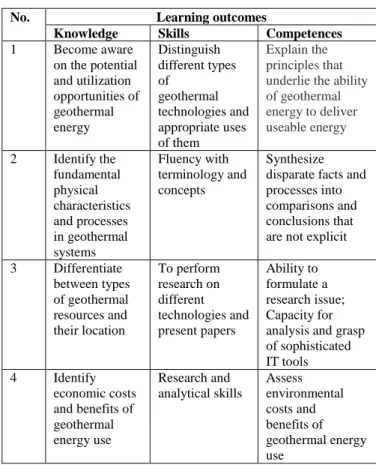
Learning outcomes are visualized in 3 dimensions:
knowledge, skills and competences as shown in Table 1 for geothermal energy module.
TABLEI LEARNING OUTCOMES
No. Learning outcomes
Knowledge Skills Competences
1 Become aware on the potential and utilization opportunities of geothermal energy Distinguish different types of geothermal technologies and appropriate uses of them Explain the principles that underlie the ability of geothermal energy to deliver useable energy 2 Identify the fundamental physical characteristics and processes in geothermal systems Fluency with terminology and concepts Synthesize disparate facts and processes into comparisons and conclusions that are not explicit 3 Differentiate between types of geothermal resources and their location To perform research on different technologies and present papers Ability to formulate a research issue; Capacity for analysis and grasp of sophisticated IT tools 4 Identify economic costs and benefits of geothermal energy use Research and analytical skills Assess environmental costs and benefits of geothermal energy use
Each module description enlists the relevant recommended literature (e.g. [15], [16]).
C. Modules description quality check
Once the first drafts of Renewable Energy curriculum modules have been drawn we started a quality check process in order to ensure the feedback that will improve the curriculum modules description. The first step has been to allocate these modules descriptions to different reviewers and the second to gather the required feedback from employers, academics and students. Both processes ran in parallel.
1) Quality check based on reviewers allocation of the first draft modules description
In order to speed up the process a checking points questionnaire Module Reviewer Form has been released which has been filled in by the reviewers once analysing the allocated
modules description. Once finished, the coded questionnaire along with the corrected module description have been returned to the WP3 leader as task responsible.
The Module Reviewer Form enlists the used definitions (e.g. curriculum, syllabus, programme, module), some reviewer’s details which are for internal use only and the following questions, which have to be answered with Yes of No and when necessary the comments should be inserted within the question corresponding rectangle:
1. Have all of the fields in the form been completed? [Yes/No]
2. Is the presentation of the material content appropriate? [Yes/No]
3. Is the content appropriate?
4. How many ECTS (European Credit Transfer and Accumulation System) credits ([17], [18], [19]) are assigned to the module? A standard module for the programme is 6 ECTS credits. [Enter a number] 5. How many hours of student workload (contact
hours and self-study time) are assigned to the module? [Enter a number].
6. Is the number of student workload hours appropriate to the number of assigned ECTS credits? 1 ECTS credit should be between 25 and 30 hours of student workload [19, pp.11].
7. Are the learning outcomes appropriate? [Yes/No] 8. Is the assessment method appropriate? [Yes/No] 9. Are the references relevant, sufficient and
up-to-date? [Yes/No]
10. Is there any other content which should be added? Have the correct definitions been used in the module description form? Other comments.
2) Quality check based from the feedback from employers, academics and students
The quality check and improvements of the Renewable
Energy modules description addressing the feedback from
employers, academics and students have been based on a two questions questionnaire aiming not to bother the responders and in the meantime to gather relevant responses. The two questions questionnaire contains the following items:
1. University/Department/SME where the assessment (What students, academics and employers think about the RE curriculum ?) took place:
a. Academics (university/faculty teachers): b. industrial advisory panels:
c. relevant employers (if any): d. students:
2. Programme (check it): Energy/ICT;
3. Do you think that the content of the course meet your needs or the needs of the employer?
4. Do you think that there is any content that is very obviously missing from that what is included?
In order to gather the questionnaire answers the SALEIE partners have been asked to provide at least three filled-in questionnaires by contacting and discussing RE curriculum modules with academics, employers and students.
IV. RESULTS AND CONCLUSIONS
The Erasmus Lifelong Learning Programme “SALEIE” (Strategic Alignment of Electrical and Information Engineering in European Higher Education Institutions) project brings together a group of European universities experts aiming to provide higher education models in the EIE (Electrical and Information Engineering) disciplines that can respond to the key global technical challenges. More specifically, the SALEIE project concerns the processes reactivity of EIE programmes curricula to the demand, the optimization and harmonization of policies and governance of curricula, therefore addressing one of the most common critic in the EU building process. The project consortium comprises 44 EU partners plus one associated partner from Russia which ensures a broader expertise within EU.
The work package 3 (EIE key challenges) gathers the largest number of partners due to a generous topics list and partners expertise around Electrical Engineering, Robotics, Information Technology, Power engineering etc. The EIE situation in the global challenges perspectives has been well discussed [6], [7], in particular with respect to the incidence on the number of the students committed in EIE fields, five global challenges (ICT, Energy, Science and Technology challenges, Environment, Health) have been selected and analysed, and finally two of them (ICT, RE) have been selected and will receive special attention in terms of new proposed curricula. This paper presents the overall process in the creation of the Renewable Energy curriculum.
The first skeleton of the RE curriculum has been refined by means of a feedback process which comprised the reviewing of each module and gathering the academics and industry feedback. The final form of the RE curriculum together with its modules description can be accessed on the SALEIE project website [3]. Anyway, at that moment the process of gathering the feedback from industry (e.g. RE1B should be placed asap
in semesters 1-4; The “Basic of entrepreneurship, project management” should be placed a bit later, when you know already better what the business is about, etc.) and academics
(e.g. ‘Nowadays and future electric grids have necessarily
associated IT, that is, IT networks and protocols like IEC 61850, SCADA software and topics like power plants or substation automation are missing (or not in depth) in the course’) by
means of the short questionnaire replays is still running, may be some of the modules description will receive some minor revisions, but overall the feedback from academics and industry is a positive one. A consent form has been released and provided to the employers and academics in order to be able to process their answers or data internally within the project or in any paper if agreed.
It is important that the employers and academics find a basis to discuss further improvements which are required in enhancing EIE education, in that case by improving the two curricula (RE, ICT) which are proposed at European level. Further work will finish gathering the feedback from industry and academics, refining the proposed curricula and implementing these curricula or some of the modules within the EIE university education.
ACKNOWLEDGMENT
The SALEIE Project is funded by the EU Lifelong Learning Programme, Project Reference No. 527877-LLP-1-2012-1-UK-ERASMUS-ENW.
REFERENCES
[1] Enhancing Lifelong Learning in Electrical and Information Engineering; Supported by EACEA. (2008-2012).ERASMUS NETWORK; N° 142814-LLP-1-2008-FR-ERASMUS-ENW [On-line reference http://greenelleiec.eu/, accessed on June 3rd, 2015].
[2] THEIERE project no. 10063-CP-1-2000-1-PT-ERASMUS-ETNE: http://www.eaeeie.org/theiere/; Towards the harmonisation of Electrical and Information Engineering Education in Europe.pdf, 2003.
[3] Strategic Alignment of Electrical and Information Engineering in European Higher Education Institutions, Agreement No. 2012-4434; Project Reference No. 527877-LLP-1-2012-1-UK-ERASMUS-ENW; [On-line reference http://saleie.euproject.org/, accessed on May 16th, 2015].
[4] Strategic framework for European cooperation in education and training ("ET 2020"); [On-line reference http://ec.europa.eu/education/lifelong-learning-policy/policy-framework_en.htm, accessed on February 24th, 2015].
[5] A.R. Clayton-Pedersen, N. O’Neill, “Curricula designed to meet 21st
-Century Expectations”. [Online; accessed on June 3rd, 2015]. Available:
http://www.educause.edu/research-and-publications/books/educating-net-generation/curricula-designed-meet-21st-century-expectations [6] M. S. Poboroniuc, D. Cojocaru, G. Livint, T. Ward, E. Cachia, N.
Bencheva, "Preliminary Findings to Design EIE Curricula Harmonized to the Technical Global Challenges," in Proc. of the 24th EAEEIE Annual Conference, pp. 198-203, Chania, Greece, May 2013. [7] M. S. Poboroniuc, G. Livint, L. Grindei, A. Friesel, A. Naaji, D.
Cojocaru, D. Popescu, T. Ward, "Trends and EIE Higher Education Response to the Current Global Technical Challenges," in Proc. of the 25th EAEEIE Annual Conference, pp. 79-82, Cesme, Turkey, May-June 2014.
[8] M. S. Poboroniuc, G. Livint, L. Grindei, N. Jackson, A. Naaji, D. Cojocaru, D. Popescu, T. Ward, " A survey results on existing electrical
and information engineering programmes oriented to key global technical challenge areas," in Proc. of the 13th International Conference on Technology Based Higher Education and Training ITHET2014, York, England, 11-13 September 2014.
[9] "The Millennium Project: Global futures studies&research: Global Challenges for Humanity," 2009, http://www.millennium-project.org/millennium/challeng.html [on-line reference, accessed March 28th, 2015].
[10] Europe 2020-A European strategy for smart, sustainable and inclusive growth, [on-line reference, accessed May 28th, 2015], Available:
http://ec.europa.eu/eu2020.
[11] Bologna process – European Higher Education Area: responses to Q5.1: Please provide the (approximate) percentages of first cycle study programmes across the following categories: 180ECTS, 240ECTS, Other. [Online; accessed on June 4th, 2015], Available:
http://www.ehea.info/article-details.aspx?ArticleId=86.
[12] Energy challenges-Why there isn’t an easy solution, [online reference, accessed May 28th, 2015], Available: http://energy4me.org/all-about-energy/energy-challenges/.
[13] J. Hossain and A.Mahmud (Eds.), Renewable Energy Integration-Challenges and Solutions, Ed. Springer Science+Business Media Singapore, 2014.
[14] G. Luft and A. Korin (Eds.), Energy security challenges for the 21st
century, Ed.ABC-CLIO,LLC Santa Barbara, California, 2009. [15] J. Egg, G. Cunniff, C. Orio, Modern Geothermal HVAC Engineering and
Control Applications, ISBN-13: 978-0071792684, ISBN-10:
0071792686, 2013.
[16] E. Barbier, Geothermal Energy Technology and Current Status: An Overview, Renewable and Sustainable Review 6(1-2):3-65, 2002. [17] European Commission, Erasmus+ Quality Framework [online].
Available:
http://ec.europa.eu/education/opportunities/higher-education/quality-framework_en.htm.
[18] European Commission: Education and Training, European Credit Transfer and Accumulation System (ECTS) [online]. Available:
http://ec.europa.eu/education/tools/ects_en.htm.
[19] European Commission: Education and Training, ECTS User’s Guide [online]. Available: http://ec.europa.eu/education/tools/docs/ects-guide_en.pdf.