pp. 77-99, Jan./Mar. 2013
Training Needs Assessment: Where We Are and Where We
Should Go
Rodrigo Rezende Ferreira *
E-mail address: [email protected] Universidade de Brasília - UnB Brasília, DF, Brazil.
Gardênia Abbad
E-mail address: [email protected] Universidade de Brasília – IP/UnB Brasília, DF, Brazil.
* Corresponding author: Rodrigo Rezende Ferreira
Campus Universitário Darcy Ribeiro, Instituto Central de Ciências, Departamento de Administração, Brasília, DF, 70910-900, Brazil.
Abstract
The aim of this article is to systematically review Training Needs Assessment (TNA) scientific literature. Based on two research questions (where are we? where should we go?), we hoped to evaluate the current state of scientific production on TNA and to point out some possible developments. The following databases were consulted: Web of Knowledge, Ovid, Proquest, Wiley Online Library, Emerald, PsycNet, CAPES Database and Scielo. Fifty-One articles were analyzed. The results show that: (a) there is little agreement on how to measure training needs; (b) most of the current TNA models and methods are reactive and do not consider contextual factors and multiple levels of analysis in a proactive way; (c) there are gaps in TNA and a need for theoretical definitions; (d) there is little concern with building theories and concepts related to TNA. Based on these findings, we point out that TNA practice and research should: (a) be based exclusively on measurable human competences gaps, in multiple possible levels of analysis; (b) not focus only on individual professional roles, but also on internal and external contextual factors that can be important in the future; (c) discuss and criticize in depth what work needs, training needs and training needs assessment mean; (d) elaborate and test TNA theories, concepts, models and methods.
New workplace demands and requirements are causing major changes in formal education as well as in professional training. Some factors seem to introduce a new scenario for organizations: the rapid pace of technological change in the information society, the increasing content knowledge required for production, the reduction in the product life cycle, and rapidly changing production processes. The need for workers’ continuous learning is one of the various effects of these pressures.
In this context, Training Needs Assessment (TNA) processes have a strategic role because they provide clear guidelines as to which professional skill deficiencies must be remedied and what the profile of future trainees should be. For McGehee and Thayer (1961), training needs come from underdeveloped skills, insufficient knowledge or inappropriate worker attitudes. Mager and Pipe (1979) define training needs as identified differences between the employees’ current performance and the performance that the organization expects of them.
Training Needs Assessment refers to the organizational process of collecting and analyzing data that supports decision making about when training is the best option (or not) to improve individuals’ performances, define who should be trained, and exactly what content should be taught (Clarke, 2003). For Wright and Geroy (1992) TNA should be a systematic process of collection, analysis and interpretation of data on individual, group and/or organizational skill gaps. They should have seven key characteristics: (a) be based mainly on culture and organizational philosophy; (b) be proactive instead of reactive; (c) have a method that permits the distinction between situations that can be addressed through training and those that cannot; (d) allow various organizational actors who are directly or indirectly interested and involved in training to participate; (e) be based on observable skills rather than leaders’, managers’ and professionals’’ perceptions; (f) consider the varied use of sampling techniques and data analysis; and (g) in the end, have a cost/benefit analysis.
However, despite its importance, research shows that training needs diagnoses have been done in an unsystematic manner in organizational settings (Clarke, 2003; Ferreira, Abbad, Pagotto, & Meneses, 2009; Ford & Noe, 1987; McGehee & Thayer, 1961; Moore & Dutton, 1978; Ostroff & Ford, 1989; Taylor, O’Driscoll, & Binning, 1998; Wexley, 1984). There is still relatively little theoretical and empirical research on TNA (Kraiger, 2003). Literature review devoted to the subject is rare. In Management, studies lack systematic theoretical and methodological approaches which may provide consistency to TNA research and practices. We can say that the theoretical and methodological characteristics of TNA scientific knowledge are, somehow, unknown. It seems that much of what was recommended by seminal authors (Mahler & Monroe, 1952; McGehee & Thayer, 1961; Moore & Dutton, 1978, among others) is still not completely incorporated into TNA research and practice.
For over 50 years, Training, Development and Education (TD&E) literature has been concerned with the importance of systematic procedures for TNA and the investigation of internal and external variables that influence or originate needs for training in work contexts (McGehee & Thayer, 1961). However, the scientific production in the area has yet to provide plausible answers to this and other important questions surrounding the topic.
Method
Article selection strategy
The search for articles was initially performed based on literature reviews about TD&E published in the Annual Review of Psychology (Aguinis & Kraiger, 2009; Latham, 1988; Salas & Cannon-Bowers, 2001; Tannenbaum & Yükle, 1992; Wexley, 1984) and reviews published in Brazilian scientific journals (Abbad, Pilati, & Pantoja, 2003; Borges-Andrade & Abbad, 1996), as well as summaries of dissertations and doctoral theses. As to the multilevel evaluation, two seminal texts were consulted: that of Ostroff and Ford (1989) and Koslowski, Brown, Weissbein, Cannon-Bowers and Salas (2000).
The following databases were consulted: Web of Knowledge (ISI), Ovid, Proquest, Wiley Online Library, Emerald, PsycNet (APA), CAPES Database and Scielo. The search for articles occurred in two steps, between the months of February and March 2008 and August and September
2010. The criterion year of publication was undetermined, given the research objectives. The key
expressions used were: training, training needs analysis, training needs analysis and learning, corporate training and university, training needs assessment, training needs evaluation, training, development and education, learning needs.
The primary criterion established for article selection was that it had to be published in a scientific peer reviewed journal. There were 90 articles, which, after reading the summaries, and assessing the adequacy of the subject, were reduced to 61, of which 51 will be analyzed in this study. Our decision to analyze 51 studies is based on operational questions, like the relationship between the complexity of data analysis, time and workforce. The articles examined in this study are a sample of convenience and do not overstrain the knowledge on TNA.
Criteria and procedures for article analysis
Twelve criteria for analysis of selected articles were determined, as shown in Table 1. The articles were analyzed by the authors and two members of a research group.
Table 1
Selected Articles’ Analysis Criteria and Their Definitions
# Analysis Criteria Definition
1 Country(ies) of research
Country(ies) in which data collection occurred (if theoretical, the country in which the article was written will be taken into account)
2 Research aim(s) Main aim(s) of the research
3 Main theoretical and/or empirical question(s) Issues present in the organizational and academic research contexts
4 Research design Survey, case study, action research, theoretical 5 Research’s nature Qualitative, quantitative, qualitative/quantitative 6 Instruments and measures Questionnaire, interview
7 Research field and participants Location(s) in which data collection occurred and description of participants.
# Analysis Criteria Definition
8 Independent Variable(s) Construct(s) that influence other construct(s)
9 Dependent Variable(s) Construct(s) that is(are) influenced by other construct(s)
10 Procedures for collecting/ analyzing data
Description of procedures for data collection and data analysis techniques
11 Subject Area Area for application of study
12 Level of analysis
Level of analysis focused on the study (macro = organizational / meso = macro processes, tasks, groups / micro = individual)
Results
We analyzed articles ranging from 1978 to 2010. The scientific literature on TNA experienced considerable quantitative growth between 1990 and 2010. Research in the area remained practically nonexistent in the period 1970 to 1989.
As to the country(ies) in which research data was collected, according to Table 2, there is a clear predominance which took place in England (15). There is also a considerable number of studies on TNA in the United States (11).
Table 2
Country(ies) in Which Data Collection Occurred
#. Country(ies) Number of studies conducted
1. England 15
2. United States 11
3. China 4
4. Canada 3
5. Indonesia 2
6. Transnational 2
7. Brazil 2
8. Greece 2
9. Kuwait 2
10. Spain 1
11. Australia 1
12. Netherlands 1
13. Ireland 1
14. Sri Lanka 1
15. Turkey 1
Table 3 shows the authors, countries, aims, and key research questions.
Table 3
Country(ies), Aims and Main Theoretical and/or Empirical Question(s)
Author(s) Country(ies) where Research was Conducted
Research Aim(s) Main Theoretical and/or Empirical Question(s)
Hicks and Hennessy (1997)
England Evaluate training needs of nurses.
Changes in context and nursing practice. Definition of the role of
the nurse. Al-Khayyat and Elgamal
(1997)
Kuwait Develop TD&E model. Deficiency of relevant theoretical and methodological approach
in the literature. Anderson (1994) Australia Describe challenges to
plan and develop educational actions.
Current approaches to TD&E based on traditional
models. Borges-Andrade and Lima
(1983)
Brazil Propose the adoption of a TNA approach. Evaluate training needs of a particular
occupational role.
Develop rigorous TNA research and practice. To align needs with strategic
goals. J. Brown (2002) - To describe steps for
performing an TNA process.
Need to develop rigorous TNA practices and
research. Fan and Cheng (2006) China Identify training needs of
life insurance salespeople.
Need to conduct an appropriate TNA process
for the reality of the organization. Gould, Kelly, White and
Chidgey (2004)
England To review the TNA literature.
ad-hoc TNA research and practices. Leat and Lovell (1997) England Propose an integrated
TNA model.
Performance analysis focused only on the
individual level. Miller (2001) England To describe the training
needs of transnational trade union representatives.
Change in the action context of the union
representative (transnational study). Moore and Dutton (1978) United States To review TNA literature. Little theoretical
development of TNA processes. Neglected organizational strategy of
the TNA processes. Reed and Vakola (2006) Ireland To investigate how the
TNA process can contribute to organizational changes.
Inaccurate decisions by TD&E professionals
performing TNA. Roberson, Kulik and
Pepper (2003)
United States Evaluate needs and design courses for minorities of
an organization
Minorities have specific training needs. Emphasis
on the fact that organizational level can
Author(s) Country(ies) where Research was Conducted
Research Aim(s) Main Theoretical and/or Empirical Question(s)
Sheperd (1995) England To describe the importance of the TNA
process for nurses.
TNA should take into account changes in the practice of nursing. The literature lacks empirical
studies. Ostroff and Ford (1989) - Propose a multilevel
approach to TNA
TNA focus on the individual. Taylor, O’Driscoll and
Binning (1998)
New Zealand/ United States
Propose a theoretical TNA model.
Ad-hoc approaches to TNA. Wright and Geroy (1992) Canada Describe the strengths and
weaknesses of a TNA process.
Ad-hoc approaches to TNA.
Cowley, Bergen, Young and Kavanagh (2000)
England To describe the training needs of nurses. Describe
the taxonomy of needs.
Changes in legislation imply changes in the
practice of nursing. Asku (2005) Turkey To propose an TNA
procedure.
The hotel industry does not have rigorous TNA
processes. Alliger, Tannenbaum,
Bennett, Traver and Shotland (1997)
United States To evaluate the relationship of training
evaluation variables.
New models for training evaluation are needed.
Bowman and Wilson (2008)
England To describe the experience of managers who
conducted TNA.
TNA process quality relies heavily on the agents who
conduct it. M. Brown and Dodd
(1998)
United States Test the effectiveness of the approach to competitive prices to evaluate training needs.
Changes of context generate training needs. TNA process can support
the change. Burke (1996) Canada To compare training needs
between hierarchical levels.
Changes in context may generate training needs.
Clarke (2003) England To analyze the influence of internal and external context in the process of
TNA.
Studies neglect the influence of context on
training needs. Social relationships are the primary influence in the
TNA process. Felstead and Ashton
(2000)
England To analyze the impact organizational innovations
have on training needs.
Innovative practices generate training needs. There are few systematic
studies on TNA. Gorman, McDonald,
Moore, Glassman, Takeuchi and Henry (2003)
United States To describe an experience of building a skill development model.
External economic crises and new technologies affect the needs for skill
development.
Table 3 (continued)
Author(s) Country(ies) where Research was Conducted
Research Aim(s) Main Theoretical and/or Empirical Question(s)
Haccoun and Saks (1998) Canada To describe the main contributions of Organizational Psychology
for understanding training results.
Individual and contextual variables generate needs for training and affect the
outcomes of courses.
Hansson (2007) Transnational (26 countries)
To examine variables that may cause training needs
in different countries.
TD&E processes performed in an unsystematic manner. Hennessy and Hicks
(1998)
England/ Australia/ United States
To test a TNA instrument in the U.S. and Australia.
Reforms in the context of nurses’ performance generate training needs. Markaki, Antonakis, Hicks
and Lionis (2007)
Greece Translate, adapt and validate a TNA instrument
in Greece.
Greece has no validated TNA instruments.
Pun and Chin (1999) China Compare training needs diagnosed using different
methods.
Policies and total quality programs generate new
levels of skill demand. F. W. Brown, Boyle and
Boyle (2002)
England Identify secondary school managers’ training needs.
Ad-hoc approaches to TNA. Skinner, Saunders and
Beresford (2004)
England Describe stakeholder perception of employees’
training needs.
To align educational programs and the institutional objective. Stakeholder participation
in the TNA process. Castley (1996) England To propose a sectoral
approach to evaluate training needs.
The need to develop sectoral TNA approaches
in the public sector. Smallbone, Supri and
Baldock (2000)
England To investigate current and emerging training needs in
the printing industry.
Technological changes generate training needs.
While, Ullman and Forbes (2007)
England Develop and validate a TNA scale.
Lack of TNA tools.
Erffmeyer, Russ and Hair (1991)
United States Describe how TNA has been used in TD&E
processes.
Little importance is given to the TNA processes in
organizations. Petridou and Spathas
(2001)
Greece Evaluate training needs based on personal and
professional characteristics.
Need to consider individual variables to
assess training needs.
Supino and Richardson (1999)
United States To describe university managers’ and academics’
perceptions of training needs.
The need to map leaders’ and medical students’
perceptions of their training needs. Holton, Bates and Naquin
(2000)
United States To develop and implement a TNA method in the
public sector.
Ad-hoc approaches to TNA. Employee participation in the TNA
Author(s) Country(ies) where Research was Conducted
Research Aim(s) Main Theoretical and/or Empirical Question(s)
Magalhães and Borges-Andrade (2001)
Brazil To develop a TNA method that includes attitudes. To
study the relationship between self and peer-based TNA evaluations.
Lack of studies comparing self and peer-based TNA
evaluations.
Versloot, de Jong and Thijssen (2001)
Netherlands To study the characteristics of organizational contexts
that favor each type of training.
There are few studies on the relationship between organizational context and
the training offered.
Wickramasinghe (2006) Sri Lanka To examine TNA practices Ad-hoc approaches to TNA. Hennessy, Hicks, Hilan
and Kawonal (2006)
Indonesia Validate an instrument to evaluate nurses’ training
needs.
The poor definition of nurses’ roles creates confusion about the actual
training needs. Hennessy, Hicks and
Koesno (2006)
Indonesia To evaluate midwives’ training needs.
The low number of midwives to meet the demand in Indonesia has generated extra work and poor quality in services. Blunch and Castro (2007) United States To identify training needs
based on productivity and organizational climate.
Emerging technologies and other context variables
can generate training needs. Tao, Yeh and Sun (2006) China To demonstrate how
web-based technologies can contribute to the TNA
process.
Need for approaches to assess training needs via
the Web.
Devitt and Murphy (2004) England To evaluate doctors’ training needs.
Needs to validate TNA methods directed toward
doctors' performances. Al-Khayyat (1998) Kuwait Propose a TNA model Ad-hoc approaches to
TNA. Lareki, Morentin and
Amenabar (2010)
Spain To address faculty members’ learning needs.
Lack of information on faculty members’ actual
needs and the type of format that should be utilized for training. Kaskutas et al. (2010) United States Conduct a needs
assessment to determine gaps in the school-based apprentice carpenters’ fall
prevention training.
Falls from heights in residential construction are
common, especially among inexperienced
workers. Taormina (2009) China Address two research gaps
in the literature between employee needs and organizational socialization.
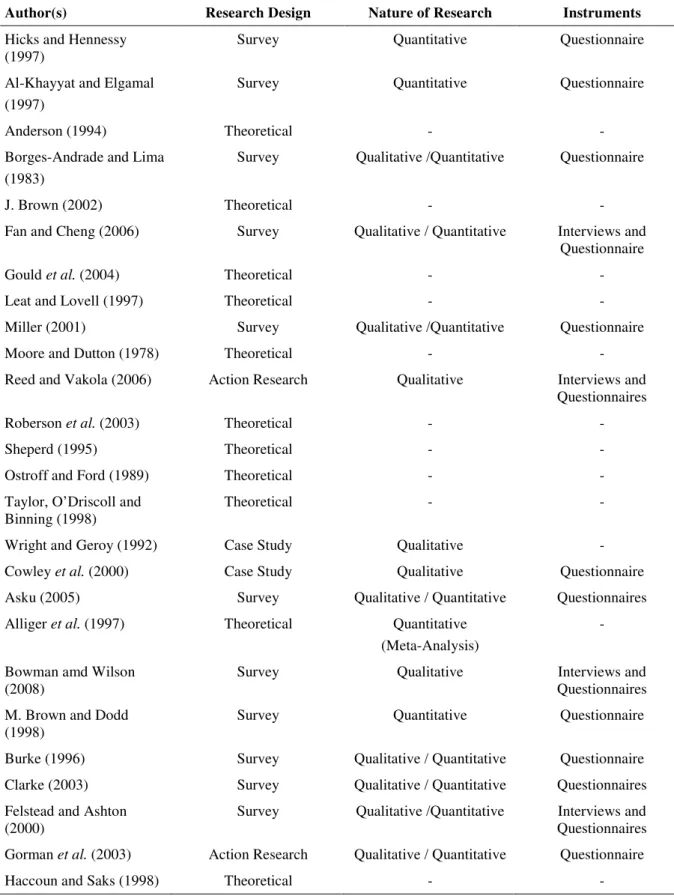
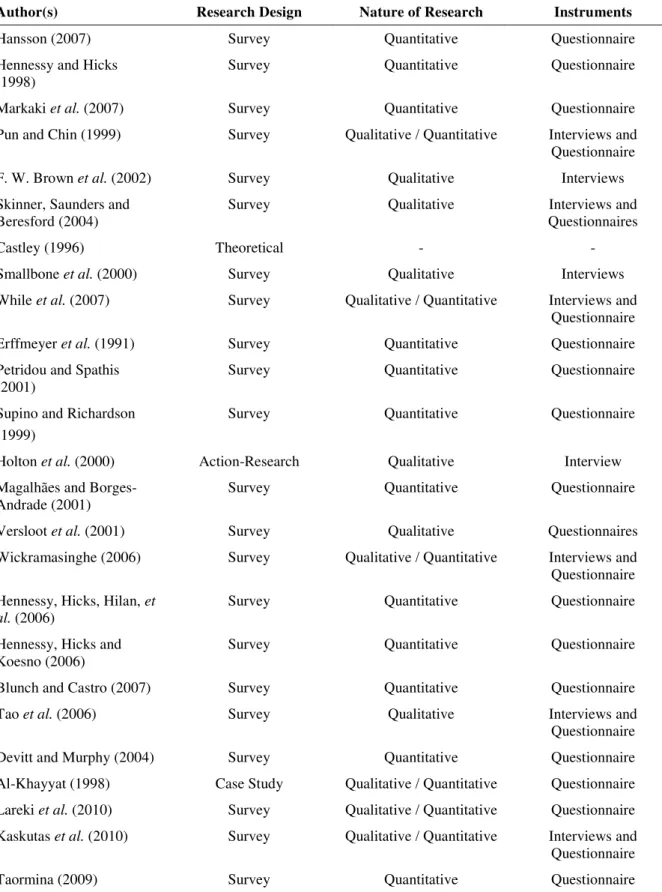
Table 4 shows the overall results according to design, nature and instruments.
Table 4
Design, Nature and Instruments of TNA
Author(s) Research Design Nature of Research Instruments
Hicks and Hennessy (1997)
Survey Quantitative Questionnaire
Al-Khayyat and Elgamal (1997)
Survey Quantitative Questionnaire
Anderson (1994) Theoretical - -
Borges-Andrade and Lima (1983)
Survey Qualitative /Quantitative Questionnaire
J. Brown (2002) Theoretical - -
Fan and Cheng (2006) Survey Qualitative / Quantitative Interviews and Questionnaire Gould et al. (2004) Theoretical - - Leat and Lovell (1997) Theoretical - - Miller (2001) Survey Qualitative /Quantitative Questionnaire Moore and Dutton (1978) Theoretical - - Reed and Vakola (2006) Action Research Qualitative Interviews and
Questionnaires Roberson et al. (2003) Theoretical - -
Sheperd (1995) Theoretical - -
Ostroff and Ford (1989) Theoretical - - Taylor, O’Driscoll and
Binning (1998)
Theoretical - -
Wright and Geroy (1992) Case Study Qualitative - Cowley et al. (2000) Case Study Qualitative Questionnaire Asku (2005) Survey Qualitative / Quantitative Questionnaires Alliger et al. (1997) Theoretical Quantitative
(Meta-Analysis)
-
Bowman amd Wilson (2008)
Survey Qualitative Interviews and Questionnaires M. Brown and Dodd
(1998)
Survey Quantitative Questionnaire
Burke (1996) Survey Qualitative / Quantitative Questionnaire Clarke (2003) Survey Qualitative / Quantitative Questionnaires Felstead and Ashton
(2000)
Survey Qualitative /Quantitative Interviews and Questionnaires Gorman et al. (2003) Action Research Qualitative / Quantitative Questionnaire Haccoun and Saks (1998) Theoretical - -
Author(s) Research Design Nature of Research Instruments
Hansson (2007) Survey Quantitative Questionnaire Hennessy and Hicks
(1998)
Survey Quantitative Questionnaire
Markaki et al. (2007) Survey Quantitative Questionnaire Pun and Chin (1999) Survey Qualitative / Quantitative Interviews and Questionnaire F. W. Brown et al. (2002) Survey Qualitative Interviews Skinner, Saunders and
Beresford (2004)
Survey Qualitative Interviews and Questionnaires
Castley (1996) Theoretical - -
Smallbone et al. (2000) Survey Qualitative Interviews While et al. (2007) Survey Qualitative / Quantitative Interviews and
Questionnaire Erffmeyer et al. (1991) Survey Quantitative Questionnaire Petridou and Spathis
(2001)
Survey Quantitative Questionnaire
Supino and Richardson (1999)
Survey Quantitative Questionnaire
Holton et al. (2000) Action-Research Qualitative Interview Magalhães and
Borges-Andrade (2001)
Survey Quantitative Questionnaire
Versloot et al. (2001) Survey Qualitative Questionnaires Wickramasinghe (2006) Survey Qualitative / Quantitative Interviews and Questionnaire Hennessy, Hicks, Hilan, et
al. (2006)
Survey Quantitative Questionnaire
Hennessy, Hicks and Koesno (2006)
Survey Quantitative Questionnaire
Blunch and Castro (2007) Survey Quantitative Questionnaire
Tao et al. (2006) Survey Qualitative Interviews and
Questionnaire Devitt and Murphy (2004) Survey Quantitative Questionnaire Al-Khayyat (1998) Case Study Qualitative / Quantitative Questionnaire Lareki et al. (2010) Survey Qualitative / Quantitative Questionnaire Kaskutas et al. (2010) Survey Qualitative / Quantitative Interviews and Questionnaire Taormina (2009) Survey Quantitative Questionnaire
Table 5
Research Field, Participants, Procedures, Level of Analysis and Area
Author(s) Research Field/
Participants
Collection Procedures/ Data Analysis
Level of Analysis
Area
Hicks and Hennessy (1997)
Public Hospital Sector. 420 nurses.
Questionnaire sent and returned by mail.
ANOVA.
Micro Medicine
Al-Khayyat and Elgamal (1997)
9 Banks. 387 subjects. Printed questionnaire. t-test, correlation, regression.
Macro Management
Anderson (1994) - - - Education
Borges-Andrade and Lima (1983)
Public Agricultural Technology Company.
Self-administered printed questionnaire (in person
and by mail).
Micro Psychology
J. Brown (2002) - - - Management
Fan and Cheng (2006) Subsidiary life insurance companies. 10 subjects.
Delphi technique. Content analysis. Wilcoxon Signed
Rank test.
Micro Management
Gould et al. (2004) - - - Medicine
Leat and Lovell (1997) - - - Management Miller (2001) Unions in Italy, Holland,
England, and Belgium. 100 subjects.
Questionnaire sent by Internet. Content analysis.
Average, Standard deviation, minimums and
maximums.
Micro Management
Moore and Dutton (1978) - - - Management Reed and Vakola (2006) Public health clinics. 632
subjects.
Research inside the organization. Collective
interviews. Content analysis.
Meso Management
Roberson et al. (2003) - - - Psychology
Sheperd (1995) - - - Medicine
Ostroff and Ford (1989) - - - Psychology Taylor, O’Driscoll and
Binning (1998)
- - - Management
Wright and Geroy (1992) Public TD&E business Telephone interview. - Management Cowley et al. (2000) Public health organization.
23 subjects.
Observation. Semi-structured interview.
- Medicine
Asku (2005) Private hotel. 114 subjects. Self-administered printed interview. One week to
respond. Average, Standard deviation,
frequency.
Micro Management
Alliger et al. (1997) - Bibliographic research on the Internet. Correlation of
averages. Confidence interval.
Author(s) Research Field/ Participants Collection Procedures/ Data Analysis Level of Analysis Area
Bowman and Wilson (2008)
Transportation business. Self-administered printed interview. Personal
interviews.
- Psychology
M. Brown and Dodd (1998)
Agricultural cooperative. 36 subjects.
Self-administered face-to-face interview. t-test, correlation of averages.
Macro Management
Burke (1996) Private services business. 1608 subjects.
Secondary data. Frequency.
Meso Management
Clarke (2003) Public social organization. 59 subjects.
Self-administered and printed interviews. Focal
groups and individual interviews. Content analysis, Mann-Whitney test (Z), significance test,
Average, Standard deviation.
Meso Management
Felstead and Ashton (2000)
2,224 subjects from various parts of the UK.
Questionnaires sent by mail. Semi-structured interviews by telephone.
Content analysis, multivariate statistics.
Macro Management
Gorman et al. (2003) Los Angeles City Hall. 162 subjects.
Focus groups. Semi-structured face-to-face interviews. Closed printed
questionnaires. Correlations (within), combined SAS linear
model, maximum restricted probability
(REML).
Meso Management
Haccoun and Saks (1998) - - - Psychology Hansson (2007) 5,824 private companies in
26 countries.
Regression, t-test, residual analysis.
- Management
Hennessy and Hicks (1998)
Public and private hospitals. 216 subjects.
Questionnaires sent by mail. ANOVA.
Micro Medicine
Markaki et al. (2007) 55 subjects from various medical areas.
Questionnaires sent by mail. Test of internal consistency, kappa cohen, oblique rotation (varimax),
Bartlett’s Test.
Micro Medicine
Pun and Chin (1999) 130 organizations from Hong Kong.
Questionnaires sent by mail. Levene’s test, t-test.
Micro Management
F. W. Brown et al. (2002) 21 public and private schools.
Semi-structured face-to-face interviews. Focus groups. Content Analysis.
Micro Education
Skinner et al. (2004) 31 subjects. Focus groups. Content analysis.
Macro Management
Table 5 (continued)
Author(s) Research Field/
Participants Collection Procedures/ Data Analysis Level of Analysis Area
Castley (1996) - - - Management
Smallbone et al. (2000) 39 small and medium businesses. 35 subjects.
Semi-structured face-to-face interviews. Focus groups. Content analysis.
Macro Management
While et al. (2007) 420 subjects from various regions of the UK
(workers and stakeholders).
Questionnaires sent by mail. Focus groups.
Semi-structured face-to-face interviews. Content analysis, Kendall Tau,
internal consistency, correlation within groups.
Micro Medicine
Erffmeyer et al. (1991) American Society of TD&E. 93 subjects.
Questionnaires sent by mail. Average, frequency.
Meso Marketing
Petridou and Spathis (2001)
444 public servants. Printed self-administered face-to-face questionnaire. Stepwise logistic regression.
Meso Management
Supino and Richardson (1999)
677 subjects. Questionnaires sent by mail. Fisher’s exact, Kruskal-Wallis and
Mann-Whitney, U test
Meso Medicine
Holton et al. (2000) About 2,000 public servants in two U.S. states
Questionnaires sent by mail, in person and phone
interviews. Content analysis, descriptive and inferential statistics (not
specified)
Macro Public Management
Magalhães and Borges-Andrade (2001)
370 subjects from a public banking institution.
Printed questionnaires sent by mail. Factor analysis, varimax rotation, internal consistency, t-test, Pearson
correlation (two-tailed).
Meso Psychology
Versloot et al. (2001) 7 private service providing organizations.
Semi-structured face-to-face interviews. Content
analysis.
- Education
Wickramasinghe (2006) 219 organizations. Questionnaires sent by mail. ANOVA, chi-square.
Macro Management
Hennessy, Hicks, Hilan, et al. (2006)
856 subjects from various public health institutions.
Document analysis, face-to-face interviews,
self-administered questionnaires. Factor
analysis, varimax.
Micro Medicine
Hennessy, Hicks and Koesno (2006)
332 subjects from different public health institutions.
Printed questionnaire self-administered in person. Factor analyses, varimax,
ANOVA.
Micro Medicine
Blunch and Castro (2007) Organizations from 5 countries (not specified)
Questionnaires sent by mail.
Macro Economy
Author(s) Research Field/ Participants
Collection Procedures/ Data Analysis
Level of Analysis
Area
Tao et al. (2006) - Content analysis - IT /
Management Devitt and Murphy (2004) Senior and junior doctors. Mann-Whitney test. - Medicine Al-Khayyat (1998) Members of the banking
studies institute.
There are no details in the article.
Micro Management
Lareki et al. (2010) University of the Basque Country. 472 faculty
members.
Questionnaires sent by the intranet. Factorial analysis,
Pearson’s Test.
Micro Education
Kaskutas et al. (2010) St. Louis Carpenters’ Joint Apprenticeship Program. 1061 subjects.
Focus groups, observation, questionnaire. Content
analysis, average, frequency.
Micro Management
Taormina (2009) Organizations in Hong Kong. 156 subjects.
Printed questionnaires. Correlation, regression,
SEM.
Macro Management
Table 6 presents the independent and dependent variables used in research sample.
Table 6
Independent and Dependent Variables Used in TNA Research
Author(s) Independent Variable(s) Dependent Variable(s)
Al-Khayyat and Elgamal (1997) Clarity of mission in the area of Personnel Development. Resource allocation. Personnel Development Policies. Managers’ attitudes
TNA, Instructional Design, Training Implementation, Training evaluation (independent related to →)
employee satisfaction, performance, productivity
Felstead and Ashton (2000) Organizational characteristics: total quality programs, formal evaluation systems, investment in personnel, organization of meetings, freedom of expression granted to employees.
Individual skills: problem solving, communication, teamwork.
Hansson (2007) Organizational characteristics: training policies, union action, employees over the age of 45, employees with university degrees, size.
Organizational characteristics: TD&E expenses, number of trained employees.
Petridou and Spathis (2001) Individual characteristics: gender, age, education, attitude towards training, hierarchy level and time on the job.
Type of training offered to individuals.
Blunch and Castro (2007) Organizational characteristics: have ISO 9000 or 14000 certification
Organizational characteristics: training implementation, trained employees.
Discussion
Keeping in mind our research questions and objectives and the recommendations by Baumeister and Leary (1997), we present the discussion as follows.
TNA: where are we?
This section is dedicated to show where our analysis suggests TNA scientific knowledge currently is, in methodological and theoretical terms. Our recommendations about what to do (where to go) given such results are presented in the next section. In sum, one can say that TNA approaches (in practice and research) had a considerable methodological advancement in past decades, shifting from ad-hoc frameworks (Clarke, 2003; Ferreira et al., 2009; Ford & Noe, 1987; McGehee & Thayer, 1961; Moore & Dutton, 1978; Ostroff & Ford, 1989; Taylor et al., 1998; Wexley, 1984) to a more professional and scientific basis. But there are still several methodological weaknesses and a very long path to move forward in theoretical terms. It is also important to say that TNA research experienced a great growth in publications in the last two decades, especially in the 2000’s (Kraiger, 2003).
Regarding the main research questions, one can say that the analyzed studies aimed, primarily,
to respond:
. How can one respond to workers’ qualification needs?
. How can one systematize and operationalize TNA processes and practices?
. How can one identify and measure training needs?
. What are the possibilities and limitations of practice, research and current TNA models?
As to the theoretical and empirical issues investigated, it can be said that most studies aimed
at addressing one or more of the following:
. Diagnose training needs for professionals;
. Describe challenges for TNA practice;
. Describe weaknesses in current TNA approaches;
. Describe/propose TNA procedures;
. Construct TNA instruments.
It seems that TNA practice and research still have an almost exclusively diagnostic/procedural
and reactive focus, concerning how to do it in the present. Apparently, prospective TNA approaches,
(11) theoretical essays, three (3) case studies and three (3) action research studies were also obtained. There is a relative predominance of quantitative studies (20). Mixed studies (qualitative/quantitative) and qualitative data showed moderate frequency (11 and 10, respectively). There is also a relative dominance of questionnaires as data collection instruments (26.49%). Some research (9) used questionnaires and interviews, which suggests consonance with qualitative/quantitative studies. Four (4) studies reported using only interviews. Thirteen (13) research theoretical reports were not subject to this analysis criterion. The methodological diversity of scientific knowledge on TNA must be prized (Baumeister & Leary, 1997). The use of multiple data collection methods (e.g. questionnaire, interviews, focus groups) and analysis (e.g. content analysis, descriptive and inferential statistics) is highly desirable to investigate complex phenomenon, as in the social and behavioral sciences. On the other hand, we can note that this methodological diversity is accompanied by a high diversity in results and conclusions as well, even regarding the same object (training needs at work). There is no convergence of results: some authors define training needs as a occupational competence gap (e.g. Borges-Andrade & Lima, 1983); others understand it as a performance gap at multiple levels (e.g. Asku, 2005); and others suggest it being the number of vacancies in an organizational sector (e.g. Castley, 1996). Therefore, we do not know if the methods are flawed, the object is too complex, or both (or even none of these). We risk saying that this area of knowledge is still seeking its object (consequently, the way(s) to theorize and measure it).
The research design most commonly employed in the analyzed studies also deserves attention. Survey-type studies, descriptive or correlational, and with purposive samples imply a series of limitations regarding external validity, generalization, inference robustness, and conclusion validity (among others). In practical terms (to managers' decision-making), this may be a minor problem, but, in scientific terms, we should look at this more carefully. As soon as we do not have robust research designs in the area (e.g. experimental or quasi-experimental), it is hard to separate what is the
phenomenon per si (training needs at work), its antecedents and consequents, and what are
methodological flaws.
As for the levels of analysis, in most studies (19) the question of levels does not apply, because
the author did not argue or discuss such a question. There is a relative predominance of studies that investigated the micro level of TNA (16). In relation to the meso and macro levels, there are a balanced number of studies (8). It seems that in Management research focus is on the macro level of analysis, while in Psychology there is a shift to the micro level. These results contradict the findings of Chiu, Thompson, Mak, and Lo (1999), who said that the most studied level of analysis was macro (organizational), followed by the meso (groups, tasks and processes), with the individual being the least studied. Otherwise, it is clear that multilevel analysis and modeling is still a neglected technique when it comes to TNA practice and research, even with clear indications that theory and data in this area can have a hierarchical structure (Koslowski, Brown, Weissbein, Cannon-Bowers, & Salas, 2000; McGehee & Thayer, 1961; Mossholder & Bedeian, 1983; Ostroff & Ford, 1989), which is recommended by multilevel literature as a premise to use such methods (Hox, 2010; Hox & Roberts, 2011; Kreft & De Leeuw, 1998; Raubendush & Bryk, 1986; Snijders & Bosker, 1994).
Regarding the area, there is a predominance of studies in Management (25), followed by
studies applied to Medicine (11) and Psychology (7). Others areas also include TNA techniques, Education, Public Management, Marketing and Information Technology. This is quite interesting and shows that needs at work is a multi/inter/trans-disciplinary research object, being of interest to multiple knowledge fields. Perhaps this justifies the field’s theoretical and methodological diversity.
Regarding the independent and dependent variables, few studies (6 out of 51) aimed to
important result is that training policies are positively related to training needs, showing how important is for organizations to have policies devoted to training and learning (Hansson, 2007). But is important to affirm that these results can have several alternative explanations, since the methods employed do not permit causality inferences (Baumeister & Leary, 1997).
TNA: where should (or could) we go?
According to the TNA strengths and weaknesses in practice and research presented earlier, we have a rich research agenda that could be structured.
First, TNA initiatives should have a broader and more proactive focus, shifting from exclusively reactive and diagnostic to a theory development and review framework. The issue on whether a competence gap should be faced by training or others types of instructional events (such as development, instruction, education or even informal learning at work) has not yet been discussed. It seems inappropriate to define a priori that a competence gap necessarily signifies a training need. We suggest that another types of needs should be discussed, such as learning needs, educational needs, development needs, among others. A deep theoretical and epistemological refinement of needs at work concepts and methods could achieve such an agenda.
It is also important that TNA practice and research do not focus only on present competences related to professional roles (Borges-Andrade & Lima, 1983), but also on emerging competences that can be important to the organization in the future (Felstead & Ashton, 2000). Besides promoting training events with higher probabilities of positive impact at work, this would also allow the development of long-term training and TNA policies, which, by the way, is neglected in the studies analyzed. Still, concerning competences, we noted that there is no consensus about it as the only construct that permits investigating training needs. This is of great concern since training investment decisions are being made based on a diversity of indicators that depend more on the context and less on the individual (Asku, 2005; Castley, 1996), constituting, in fact, other types of needs than training. Thus, we suggest that the literature on competence and competences management (Boyatzis, 1982; Cockerill, 1989; McClelland, 1973; Prahalad & Hamel, 1990; Sparrow & Bognanno, 1994) should be used as a primary resource for TNA practice and research, assuming that (gap of) competences are the only way to investigate human training needs at work.
Methodologically, we can say that TNA practice and research has advanced in the past decades, employing scientific techniques to develop instruments (Hennessy & Hicks, 1998), proposing TNA models (Al-Khayyat & Elagamal, 1997) and being marked by methodological diversity, for example. However, TNA current methods still present flaws, as we showed earlier. First of all, we should have more mixed techniques, based on qualitative and quantitative data simultaneously (While, Ullman, & Forbes, 2007). Research and practice should also utilize a more heterogeneous and probabilistic sample, avoiding questioning only top managers, and including randomly chosen employees at different levels. This would allow triangulation of evidence, highly important to scientific and professional decision-making. Secondly, studies, especially TNA research, should employ more robust designs, such as quasi-experimental or experimental studies. This would allow for a more reliable set of conclusions about whether or not to invest in training and would help to improve TNA theories and concepts.
Regarding level of analysis, the adoption of multilevel modeling in TNA research is urgent. Since 1950, several studies have suggested that TNA theory and data can have a hierarchical
arrangement (Koslowski et al., 2000; McGehee & Thayer, 1961; Mossholder & Bedeian, 1983;
antecedents and consequents and needs definitions between levels (including groups of individuals).
Regarding areas of application, TNA must continue to expand. We can suggest that TNA is applicable to several areas of knowledge, as our results indicated. Wherever one is interested in professional education planning and executing, TNA approaches can be employed (technology, medicine, management, marketing, mental health, education, psychology). Perhaps, this is why TNA is such an interesting and exciting theme.
References
Abbad, G., Pilati, R., & Pantoja, M. J. (2003). Avaliação de treinamento: análise da literatura e agenda
de pesquisa [Training evaluation: literature review and research agenda.] Revista de
Administração da USP, 38(3), 205-218.
Aguinis, H., & Kraiger, K. (2009). Benefits of training and development for individuals and teams,
organizations and society. Annual Review of Psychology, 60(1), 451-474. doi:
10.1146/annurev.psych.60.110707.163505
Al-Khayyat, R. (1998). Training and development needs assessment: a practical model for partner
institutes. Journal of European Industrial Training, 22(1), 18-27. doi:
10.1108/03090599810197658
Al-Khayyat, R. M., & Elgamal, M. A. (1997). A macro model of training and development: validation. Journal of European Industrial Training, 21(3), 87-101. doi: 10.1108/03090599710161793
Alliger, G. M., Tannenbaum, S. I., Bennett, W., Jr., Traver, H., & Shotland, A. (1997). A meta-analysis of the relations among training criteria. Personnel Psychology, 50(2), 341-358. doi: 10.1111/j.1744-6570.1997.tb00911.x
Anderson, G. (1994). A proactive model for training needs analysis. Journal of European Industrial Training, 18(3), 23-28. doi: 10.1108/03090599410056577
Asku, A. A. (2005). Defining training needs of five-star hotel personnel: an application in the antalya
region of Turkey. Managerial Auditing Journal, 20(9), 945-953. doi:
10.1108/02686900510625299
Baumeister, R. F., & Leary, M. R. (1997). Writing narrative literature reviews. Review of General Psychology, 1(3), 311-320.
Blunch, N-H., & Castro, P. (2007). Enterprise-level training in developing countries: do international
standards matter? International Journal of Training and Development, 11(4), 314-324. doi:
10.1111/j.1468-2419.2007.00284.x
Borges-Andrade, J. E., & Abbad, G. (1996). Treinamento e desenvolvimento: reflexões sobre suas pesquisas científicas. Revista de Administração da USP, 31(2), 112-125.
Borges-Andrade, J. E., & Lima, S. V. L. (1983). Avaliação de necessidades de treinamento: um método de análise de papel ocupacional. Tecnologia Educacional, 12(54), 6-22.
Bowman, J., & Wilson, J. P. (2008). Different roles, different perspectives: perceptions about the
purpose of training needs analysis. Industrial and Commercial Training, 40(1), 38-41. doi:
Boyatzis, R. E. (1982). The competent management: a model for effective performance. New York: John Wiley.
Brown, F. W., & Dodd, N. G. (1998). Utilizing organizational culture gap analysis to determine
human resource development needs. Leadership & Organization Development Journal, 19(7),
374-385. doi: 10.1108/01437739810242531
Brown, J. (2002). Training needs assessment: a must for developing an effective training program. Public Personnel Management, 31(4), 569-578.
Brown, M., Boyle, B., & Boyle, T. (2002). Professional development and management training needs
for heads of department in UK secondary schools. Journal of Educational Administration,
40(1), 31-43. doi: 10.1108/09578230210415634
Burke, R. J. (1996). Training needs at different organizational levels within a professional services firm. Industrial and Commercial Training, 28(5), 24-28. doi: 10.1108/00197859610122081
Castley, R. J. Q. (1996). The sectoral approach to the assessment of skill needs and training
requirements. International Journal of Manpower, 17(1), 56-68. doi:
10.1108/01437729610110620
Chiu, W., Thompson, D., Mak, W., & Lo, K. L. (1999). Re-thinking training needs analysis: a
proposed framework for literature review. Personnel Review, 28(1/2), 77-90. doi:
10.1108/00483489910249009
Clarke, N. (2003). The politics of training needs analysis. Journal of Workplace Learning, 15(4), 141-153. doi: 10.1108/13665620310474598
Cockerill, T. (1989). The kind of competence for rapid change. Personnel Management, 21(9), 52-56.
Cowley, S., Bergen, A., Young, K., & Kavanagh, A. (2000). A taxonomy of needs assessment elicited from a multiple case study of community nursing education and practice. Journal of Advanced
Nursing, 31(1), 126-134.doi: 10.1046/j.1365-2648.2000.01252.x
Devitt, N., & Murphy, J. (2004). A survey of the information management and technology training
needs of doctors in an acute NHS trust in the United Kingdom. Health Information and
Libraries Journal, 21(3), 164-172. doi: 10.1111/j.1471-1842.2004.00492.x
Erffmeyer, R. C., Russ, K. R., & Hair, J. F. (1991). Needs assessment and evaluation in sales training programs. Journal of Personal Selling and Sales Management, 11(1), 17-30.
Fan, C. K., & Cheng, C. (2006). A study to identify the training needs of life insurance sales
representatives in Taiwan using the Delphi approach. International Journal of Training and
Development, 10(3), 212-226.doi: 10.1111/j.1468-2419.2006.00255.x
Felstead, A., & Ashton, D. (2000). Tracing the link: organisational structures and skill demands. Human Resource Management Journal, 10(3), 5-21. doi: 10.1111/j.1748-8583.2000.tb00023.x
Ferreira, R. R., Abbad, G. S. da, Pagotto, C. P. do, & Meneses, P. P. M. (2009). Avaliação de necessidades organizacionais de treinamento: o caso de uma empresa Latino-Americana de
administração aeroportuária. Revista Eletrônica de Administração, 15(2), 1-26. Retrieved from
http://www.read.ea.ufrgs.br/edicoes/pdf/artigo_590.pdf
needs assessment for estrategic HR planning: the Los Angeles county experience. Public Personnel Management, 32(4), 475-496.
Gould, D., Kelly, D., White, I., & Chidgey, J. (2004). Training needs analysis: a literature review and
reappraisal. International Journal of Nursing Studies, 41(5), 471-486. doi:
10.1016/j.ijnurstu.2003.12.003
Haccoun, R. R., & Saks, A. M. (1998). Training in the 21st century: some lessons from the last one. Canadian Psychology, 39(1/2), 33-51. doi: 10.1037/h0086793
Hansson, B. (2007). Company-based determinants of training and the impact of training on company performance. Personnel Review, 36(2), 311-331. doi: 10.1108/00483480710726163
Hennessy, D., & Hicks, C. (1998). A cross-cultural tool to identify continuing education needs. International Nursering Review, 45(4), 109-114. doi: 10.1046/j.1466-7657.45.no.4issue340.4.x
Hennessy, D., Hicks, C., Hilan, A., & Kawonal, Y. (2006). A methodology for assessing the
professional development needs of nurses and midwives in Indonesia: paper 1 of 3. Human
Resources for Health, 4(8), 1-8. doi: 10.1186/1478-4491-4-8
Hennessy, D., Hicks, C., & Koesno, H. (2006). The training and development needs of midwives in Indonesia: paper 2 of 3. Human Resources for Health, 4(9), 1-12. doi: 10.1186/1478-4491-4-9
Hicks, C., & Hennessy, D. (1997). The use of a customized training needs analysis tool for nurse practitioner development. Journal of Advanced Nursing, 26(2), 389-398.
Holton, E. F., III, Bates, R. A., & Naquin, S. S. (2000). Large-scale performance-driven training needs assessment: a case study. Public Personnel Management, 29(2), 249-267.
Hox, J. (2010). Multilevel analysis: techniques and applications. New York: Routledge.
Hox, J., & Roberts, J. K. (2011). Handbook of advanced multilevel analysis. New York: Routledge.
Kaskutas, V., Dale, A. M., Lipscomb, H., Gaal, J., Fuchs, M., & Evanoff, B. (2010). Changes in fall prevention training for apprentice carpenters based on a comprehensive needs assessment. Journal of Safety Research, 41(3), 221-227. doi: 10.1016/j.jsr.2010.01.006
Koslowski, S. W. J., Brown, K., Weissbein, D., Cannon-Bowers, J., & Salas, E. (2000). A multilevel approach to training effectiveness: enhancing horizontal and vertical transfer. In K. Klein & S. W. J. Koslowski (Eds.), Multilevel theory, research and methods in organization (pp. 157-210). San Francisco: Jossey-Bass.
Kraiger, K. (2003). Perspectives on training and development. In W.C. Borman, D.R. Ilgen, & R. J. Klimoski (Eds.), Handbook of psychology: volume 12, industrial and organizational psychology (pp. 171-192). Hoboken, NJ: Wiley.
Kreft, I. G. G., & De Leeuw, J. (1998). Introducing multilevel modeling. London: Sage.
Lareki, A., Morentin, J. I. M. de, & Amenabar, N. (2010). Towards an efficient training of university faculty on ICTs. Computers & Education, 54(2), 491-497. doi: 10.1016/j.compedu.2009.08.032
Latham, G. P. (1988). Human resource training and development. Annual Review of Psychology, 39, 545-582. doi: 10.1146/annurev.ps.39.020188.002553
Magalhães, M. L., & Borges-Andrade, J. E. (2001). Auto e hetero-avaliação no diagnóstico de
necessidades de treinamento. Estudos de Psicologia, 6(1), 35-50. doi:
10.1590/S1413-294X2001000100005
Mager, R. F., & Pipe, P. (1979). Analysing performance problems. Belmont: Lake Publishing
Mahler, W., & Monroe, W. (1952). How industry determines the need for and effectiveness of training (Report Nº 929). Kentucky: Personnel Research Branch, Department of the Army.
Markaki, A., Antonakis, N., Hicks, C. M., & Lionis, C. (2007). Translating and validating a training needs assessment tool into greek. BMC Health Services Research, 7(65), 1-7. doi: 10.1186/1472-6963-7-65
Mcclelland, D. (1973). Testing for competence rather than intelligence. American Psychologist, 28(1), 1-14.
McGehee, W., & Thayer, P. W. (1961). Training in business and industry. New York: Wiley.
Miller, D. (2001). Transnational worker representation and transnational training needs: the case of European work councils. International Journal of Training and Development, 5(1), 34-51. doi: 10.1111/1468-2419.00120
Moore, M. L., & Dutton, P. (1978). Training needs analysis: review and critique. Academy of
Management Review, 3(3), 532-545. doi: 10.5465/AMR.1978.4305749
Mossholder, K. W., & Bedeian, A. G. (1983). Cross-level inference and organizational research: perspectives on interpretation and application. Academy of Management Review, 8(4), 547-558. doi: 10.5465/AMR.1983.4284651
Ostroff, C., & Ford, K. (1989). Introducing a levels perspective to training needs assessment. In I. Goldstein (Ed.), Training and Career Development (pp. 25-62). San Francisco: Jossey Bass.
Petridou, E. N., & Spathis, C. T. (2001). Designing training interventions: human or technical skills
training? International Journal of Training and Development, 5(3), 185-195. doi:
10.1111/1468-2419.00131
Prahalad, C. K., & Hamel, G. (1990). The core competence of the corporation. Harvard Business Review, 68(3), 79-91.
Pun, K. F., & Chin, K. S. (1999). Bridging the needs and provisions of quality education and training: an empirical study in Hong Kong industries. International Journal of Quality & Realiability Management, 16(8), 792-810. doi: 10.1108/02656719910289186
Raubendush, S. W., & Bryk, A. S. (1986). A hierarchical model for studying school effects. Sociology of Education, 59(1), 1-17.
Reed, J., & Vakola, M. (2006). What role can a training needs analysis play in organizational change?
Journal of Organizational Change Management, 19(3), 393-407. doi:
10.1108/09534810610668382
Roberson, L., Kulik, C. T., & Pepper, M. B. (2003). Using needs assessment to resolve controversies
in diversity training design. Group and Organization Management, 28(1), 148-174. doi:
10.1177/1059601102250028
3(6), 319-322. doi: 10.1111/j.1365-2834.1995.tb00115.x
Skinner, D., Saunders, M. N. K., & Beresford, R. (2004). Towards a shared understanding of skill
shortages: differing perceptions of training and development needs. Education + Training,
46(4), 182-193. doi: 10.1108/00400910410543973
Smallbone, D., Supri, S., & Baldock, R. (2000). The implications of new technology for the skill and
training needs of small and medium-sized printing firms. Education + Training, 42(4/5),
299-308. doi: 10.1108/00400910010347768
Snijders, T. A. B., & Bosker, R. (1994). Modeled variance in two-level models. Sociological Methods and Research, 22(3), 342-363. doi: 10.1177/0049124194022003004
Sparrow, P. R., & Bognanno, M. (1994). Competence requirement forecasting: issues for international selection and assessment. In C. Mabey & P. Iles (Orgs.), Managing learning (pp. 57-69). London: Routledge.
Supino, P. G., & Richardson, L. D. (1999). Assessing research methodology training needs in emergency medicine. Academic Emergency Medicine, 6(4), 280-285.
Tannenbaum, S. I., & Yulk, G. (1992). Training and development in work organizations. Annual
Review of Psychology, 43, 399-441. doi: 10.1146/annurev.ps.43.020192.002151
Tao, Y-H., Yeh, C. R., & Sun, S-I. (2006). Improving training needs assessment processes via the
internet: system design and qualitative study. Internet Research, 16(4), 427-449. doi:
10.1108/10662240610690043
Taormina, R. J. (2009). Organizational socialization: the missing link between employee needs and organizational culture. Journal of Managerial Psychology, 24(7), 650-676.
Taylor, P., O’Driscoll, M., & Binning, J. (1998). A new integrated framework for training needs
analysis. Human Resource Management Journal, 8(2), 29-50. doi:
10.1111/j.1748-8583.1998.tb00165.x
Versloot, B. M., Jong, J. A., & Thijssen, J. G. (2001). Organisational context of structured on-the-job
training. International Journal of Training and Development, 5(1), 2-22. doi:
10.1111/1468-2419.00118
Wexley, K. N. (1984). Personal training. Annual Review of Psychology, 35, 519-551.
While, A., Ullman, R., & Forbes, A. (2007). Development and validation of learning needs assessment
scale: a continuing professional education tool for multiple sclerosis specialist nurses. Journal
of Clinical Nursing, 16(6), 1099-1108.doi: 10.1111/j.1365-2702.2007.01693.x
Wickramasinghe, V. M. (2006). Training objectives, transfer, validation and evaluation: a sri lankan study. International Journal of Training and Development, 10(3), 227-247. doi: 10.1111/j.1468-2419.2006.00256.x
Wright, P. C., & Geroy, G. D. (1992). Needs analysis theory and the effectiveness of larg-scale
government-sponsored training programmes: a case study. Journal of Management