organizations
DOI: 10.1590/1809-5844201615
Carlos García Carballo
(Universidad de Málaga, Facultad de Ciencias de la Comunicación, Departamento de Comunicación Audiovisual y Publicidad. Málaga-Málaga, España)
Abstract
Social networks represent a change in the landscape of Communication for Spanish organizations today. Many of them are managing advertising and Public Relations campaigns to achieve communicative goals scored. Conducting analysis of the content of messages in social platforms, taking samples of the organizations that form this research during six months, the landscape of
personalized Communication in Spain will be deined. And through a survey to a community that
takes part of the sample, we will obtain data about the users of these social networks. The absence of
personalized messages was conirmed by appreciating just a simple loyalty with archaic techniques
that do not have the same effects.
Keywords: Social networks. Social Media. Public Relations. Personalization.
Introduction
Over the past few years, social networks have become a tool, to a greater extent in Public Relation campaigns, as in advertising campaigns. Currently, it has generated a global phenomenon related to the Communication in social networks. At the beginning, personal relation were made through social media, such as blogs, forums, and now, organizations have incorporated social networks as Facebook or Twitter to keep instantaneous contact with their costumers (as to enable a direct relation).
The social media is a new digital support in which this new form is developed. It must be effective, concise whilst leaving aside other media techniques where it is given use of rhetoric in their creative slogans/text, rather elaborate images for large campaigns etc.
The organizations are increasingly aware that it is the user who has the power in this new form of relationship, and they want that “this power must be respected by companies, facilitating contact and responding to their comments quickly and properly” (ALONSO ÁLVAREZ, 2012, our translation).
It is important to reconsider the status of Communication in social networks, and to observe where this new channel of Communication within the public domain is being addressed. It is worthwhile to recognise the signiicance of these relections and evaluations in order to progress positively and make improvements.
Our object of study is the users and custom messages; clarifying the relations between these two parts and their implication in the conservation of these links.
We pose two objectives in this study to be raised: a) To deine the proile of users in social networks and their habits on the Web. B) To determine the interaction with the community made by the organizations.
Two research techniques were carried out for this study: the analysis of the content and the survey. For the sample, we had selected the 20 Facebook organization pages deemed most important in Spain, published in September 2011 by SocialBakers and Hydra Social Media. It comprised of Starbucks Spain, Cash Converters, Salerm Cosmetics, McDonald’s, LG, Lancôme, Puriicación García, Gillette, María Mare, Peugeot, Decathlon, Yoigo, Citroën, BMW, Arag, C&A, Desigual, Evax & Tampax, Kiehl’s and Suzuki Ibérica. From this sample, was obtained not only a broad overview of the use of Facebook, but also their Twitter and Tuenti proiles were analyzed (in case of active proile). The period of data collection is comprised by the second semester of 2012, where a total of 155,147 posts have been analyzed.
To illustrate the information gathered within different Social Platforms, it has been drawn up a table with variables that provides quantitative and qualitative data for this study: date, day of the week, text, company, organization/community, categorization and Social Media.
By the aid of an online survey, the needs of the users of the Social Platforms in their contact with organizations through this channel will be studied. The questions of this survey will focus on knowing the sociodemographic proile, the use of Social Network in a day, the number of brands they follow, what kind of information interests them and their opinion about the utility of the presence of these organizations in social networks.
In order to determinate the number of respondents, the igure sought was achieved by taking the number of members from 1 July 2012, which was a total of 2.433.050 users. From this total, we have obtained a representative sample of 633. Once the representative sample was obtained, it was decided to conduct a stratiied sample with proportional allocation size stratum within the population of each of the organizations that it comprises.
Contextualization of the social media in the Communication plans
Many organizations now include in their Communication plans an allocated internet budget, including a view to generate a digital identity. Thus creating a community with which they keep short-term relationships that may become long-term.
Since social network arrived and decided to stay on internet, they had become “mechanism of communication, information and interactive dialogue between the public and the speakers of the websites, to thereby turn the Internet users into an informed active public” (SILVA ROBLES; ZAMBRANO, 2011, p.91, our translation).
We should not forget that the “success of Social networks on the internet is important both in terms of its proliferation, but also the high number of registered users and page views” (GARCIA GARCÍA; AGUADO GUADALUPE, 2011, p.176, our translation). That’s why this platforms has been growing exponentialy and becoming signiicant for providing further depth to other researches in the causes of such growth.
Orihuela (2011, p.78, our translation) states that “the talk about brands, products, services, news, characters and institutions are underway, it is not controlled by organizations and it can not be stoped”. They are not controlled, and neither must be. These platforms should not be seen as launchers by consumers/public domain, it should be recognized as a point of interaction, to become better acquainted to their consumers, as well as being important source of economic information. Critics of the organizations should not be deemed as negative, but as to provide constructiveness.
That is why today, with the complexity of the internet and social networks, to be able to control everything that is published about organizations is dificult and arduous. There are certainly applications and organizations that through search engineering accrue valuable information. Still, they have to get it synthesized productively and eficiently in order to achieve the established Communication purposes.
Organization and Communication 2.0
Web 2.0 is being consolidated within traditional values upon which civilized societies have been built and that turned into what Polo and Polo (2011, p.169-171) call the culture 2.0:
1. Honesty. It is the key in any Communication, as dishonesty and lies can carrying organizations into disrepute. Organizations would rather avoid their problems appearing online, but despite not having an online presence, this is inevitable.
2. Respect. Respect should be a key pillar within the digital culture, it is the essence of all civilized Communication and it allows us to express opinions without offending or disturbing. If an online presence is sought, then at least organizations will have control over what is being expressed online.
3. Humbleness. It must remember that the network is wide and there are many people connected to it, so there are always people who know more than others. Therefore, if there are comments with corrections or contributions to improve the content of the message, the receptor must not behave arrogantly or be inlexible. 4. Generosity. Sharing is the essence of this digital world, so acts of generosity
without expecting anything in return shall help the construction of identity.
6. Cooperation. Doing so (as others called P2P culture) allows the co-creation of cooperative works.
7. Openness. Free and open environments create greater value of information, that the opposite of being closed and private.
Therefore is relevant to highlight the importance of insisting on the participation within the organization with internal audiences (LOVETT, 2012, p.372), and to make sure that the media is well known and used luently. The purpose would be to make the members of these Organizations (mainly senior managers) listen to what is said about the brand and to reach generate corporate blogging with the community itself.
The study published by Hwang (2012, p.160, our translation) exposes that “the majority of respondents assess the use of Twitter by the CEO positively. This positive evaluation produces cognitive effects and positive attitudes in public relations”, so that organizations executives and senior managers should be involved and have presence in social networks, just as Men states (2012, p.171, our translation) “The CEO helps to deine
the image of the Organization to internal and external public”.
A plan of communication 2.0 within the organization
Figure 1 – Example the 6 degrees of separation theory
SUBJECT
Contact 1 Contact 2
Contact 3 Contact 4
Contact 5 LINKED
PERSON
In this example, it’s possible to see that the linked person (the one that aims to be related), is a friend of the contact 5, which in turn is related to contact 4, who is friend of contact 3, who is friend of contact 2, and friend of contact 1 who is our friend. Therefore, between the subject (us) and the linked person is 6 degrees of separation.
These people are connectors, people who link and join organizations around the world, and these people have a great ability to make friends and acquaintances (RODRÍGUEZ, 2011, p.37).
We have to keep in mind that “people have come together to create communities since the beginning of the online revolution” (JANAL, 2000, p.234, our translation). Internet has become essential in people’s life, and therefore, within this vast network, people have clustered in communities with similar characteristics and/or equal preferences.
It is well regarded, that each company must contemplate how to evaluate their research and rel ective Communication plan. That’s why the Communication 2.0 should be rel ected in the Communication plan itself or in a separate one to prevent contradictory messages.
The personalization of the message
With these marketing trends the networks are making the customization techniques (prices, products and distribution) their own, to reinforce their strategies and thus achieve their goals more eficiently.
An example of products customization by organizations was collected by Verdú (2006, p.130-139), from the 4 p’s established by Kotler, Communication is the only one that has not been adapted to personalization, being vital the importance to study it, getting to know the ways of managing and developing it in the most eficient way.
But this personalization concept is not new, these marketing techniques come from traditional commerce (GONZÁLEZ RECUENCO; SÁNCHEZ DETORO, SALUTREGUI PACIOS, 2004, p.4), neighborhood business, where the attention is personalized and knowing the public as more than simply mere consumers. The original relationship of customer-shopowner was closely bonded. The arrival of department stores/supermarkets fueled the loss of the original customer – shopkeeper bond. Nowadays, social networks has made a comeback of this relationship.
We have to pay attention in order to not confuse customization with what authors like Peguera Poch (2010, p.362-369) states when referring to the use of cookies in online advertising (when speaking of internet Communication). It can be confusing, but in this case the message is the same as the one shown to any user of a homogeneous niche, they only show ads based on the user’s browsing history or proile for geolocation.
This advertising based on online behavior (also known as online behavioral advertising, behavioral targeting or interest-based advertising) observes and tracks internet users through the internet, whose sole purpose is to offer future advertising adapted to the interest earned when browsing cookies.
The public demands more information, they want it timely and also to be treated in the same way they do with any other organization. The public wants the personal, human factor; to know that there is someone beyond the computer screen. (MOONEY; BERGHEIM, 2003, p.129). Hence the term, “humanization of the brands”.
It is known that “during the last few years, the relation between organizations and costumers has been developed quickly, as well there are certain types of costumers who are prepared for the personalisation, they can offer a high potencial of capitalization if we know how to seize it” (GONZÁLEZ RECUENCO et al, 2004, p.1, our translation).
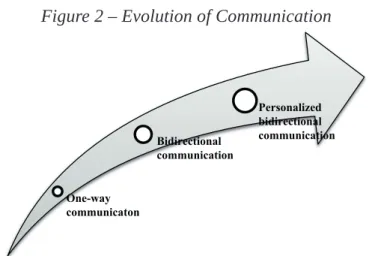
Figure 2 – Evolution of Communication
One-way communicaton
Bidirectional communication
Personalized bidirectional communication
This can be achieved in a similar way that is demonstrated by, for example Google
or Yahoo, which work with behavioral targeting, a segmentation technique based on the user’s browsing behavior. As one can say that it is possible to apply these same techniques to social networks, but not so as to study navigation behavior patterns, but the issues of interest, likes and dislikes, obtaining information about these to subsequently establish proi les of them and get to know more as individuals.
This whole process should always bear in mind that although they are all customers, they are above all people (GONZÁLEZ RECUENCO et al, 2004, p.7). This is why one should forget about the consumer being tokens or parts of the databases of organizations, and enter in the i eld of interactivity with customers as it was traditionally done (MOONEY; BERGHEIM, 2003, p.134) in days gone by, or neighborhood shops that currently remains. It is important to listen, talk to them, know their concerns etc., but above everything, get the customers to feel a communicational relationship with the brand, especially through the customized messages, treating them as individuals.
Results
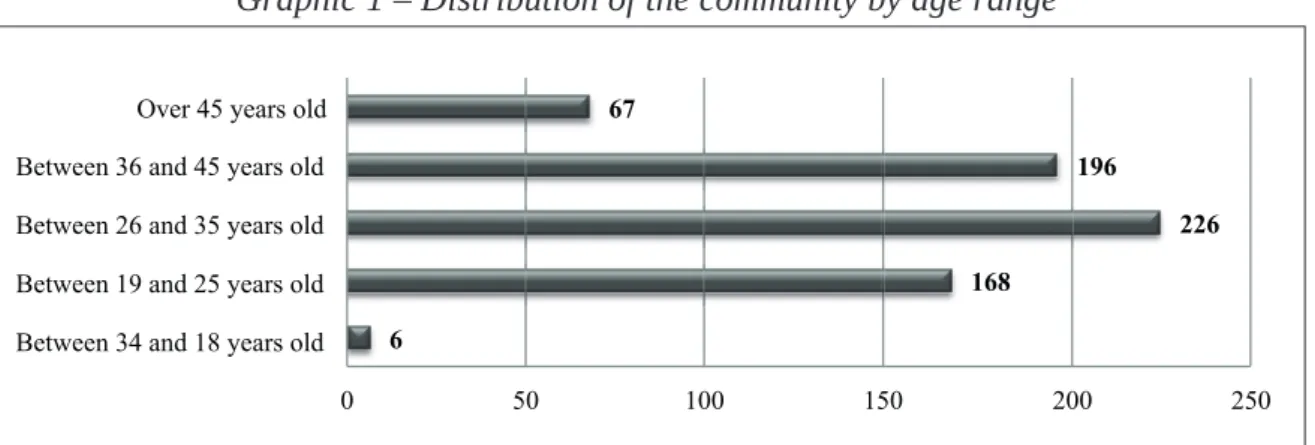
Graphic 1 – Distribution of the community by age range
6
168
226 196
67
0 50 100 150 200 250
Over 45 years old
Between 36 and 45 years old
Between 26 and 35 years old
Between 19 and 25 years old
Between 34 and 18 years old
The age groups are similar among those who are between the age of 19 and 45, with a difference of 8.75%. These three age groups make up 88.99% of the total number of members comprising the communities of the sample, that approximately 9 out of the 10 are aged between 19 and 45.
When we enquired about gender, these indexes are very signii cant, once 62.14% of the sample are females, whereas, 37.86% correspond to the male sex.
Graphic 2 – Distribution of the community by studies
31
79 58
193 184 118
0
0 50 100 150 200 250
PhD
Master’s Degree or MBA
Degree
Higher vocational qualification
Intermediate vocational qualification
High School
Elementary school
there are difference in educational levels. In the age group of 26 to 35, the study level is mainly make up by women and men who have a university degree and a master.
For age groups between 36 and 45 years it shows that both men and women often have studies in vocational training-higher or a degree.
For people over 45, men often have the high school level and vocational training-higher diploma. Women instead, are graduated to degree level.
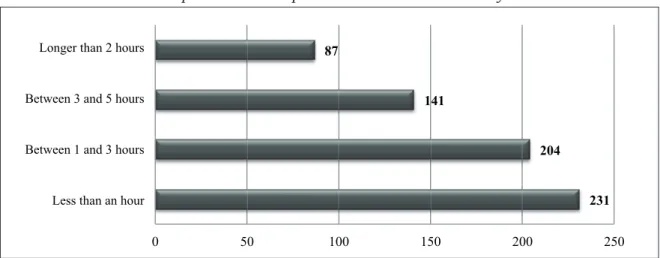
Talking about the connection time that users spend a day on social networks, 65.61% of the sample spend less than three hours a day connected to social networks. What emerges from this compendium is that 34.84% are connected less than an hour a day and that 30.77% are connected between 1 and 3 hours a day.
Graphic 3 – Time spent on social networks daily
231 204 141
87
0 50 100 150 200 250
Less than an hour Between 1 and 3 hours Between 3 and 5 hours Longer than 2 hours
The average of users connection time is 141.71 minutes, approximately 2 hours and 21 minutes a day. This data suggests that the average connection time of men is 116.05 minutes (1 hour and 56 minutes on average per day) versus the 157.35 minutes (2 hours and 37 minutes a day) of women.
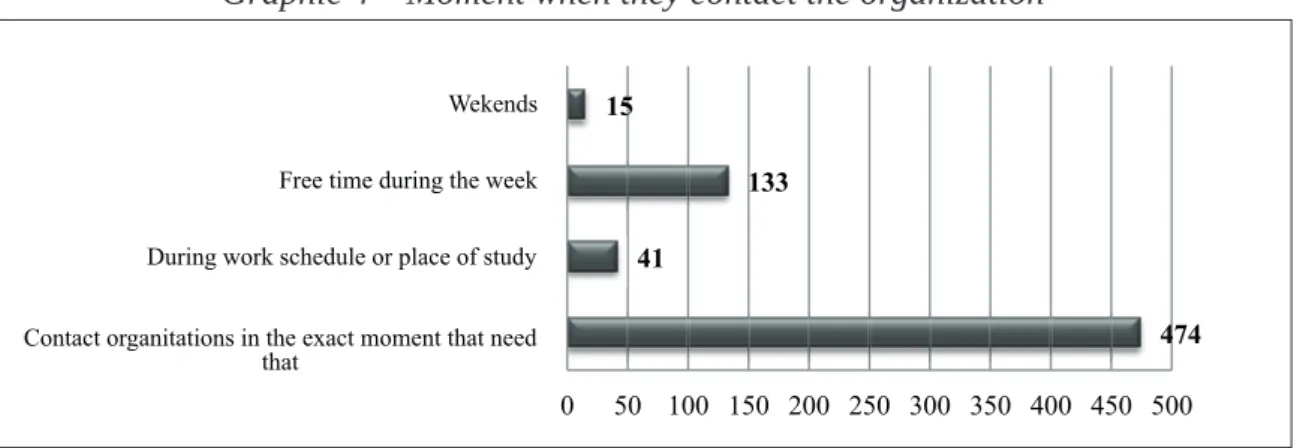
The fact that users contact organizations when they need, suggest that they want to do that immediately and they expect immediate responses.
Graphic 4 – Moment when they contact the organization
41
133 15
474
0 50 100 150 200 250 300 350 400 450 500 During work schedule or place of study
Contact organitations in the exact moment that need that
Wekends
Free time during the week
The device from which they usually make greater use of access to social networks is the desktop computer (65.31%), followed by laptops (54%), Smartphone (43.59%) and Tablet (15.38%).
These i gures may arise due to the immediate readiness to contact the organizations; and given that users may be in the work/study place may account for the use of devises such as computers and laptops being the preferred mode of contact.
This immediate need for contact with the community is what leads to the volume of interactions being higher on Monday, and remains steadily throughout the rest of the week, except for weekends. This is because of their schedules. The majority of these organizations in social networks operate during working hours. The community claims 24/7 hours service. This is advisable due to the immediacy offered by these platforms.
The volume of interactions for weeks has grown gradually during the six months of the sample. During these months, the average growth was approximately 2,000 messages (which is an average of 40% in growth).
Graphic 5 – Distribution of messages during the engagement
14.288 11.451
14.311
19.788 17.176 14.804
0 5.000 10.000 15.000 20.000 25.000
July August September October November December
The loyalty messages analyzed during the sample are divided between community and organizations as shown in the following table: the messages sent by the organization are 7,612, representing 8.29% of the total; however, the messages issued by the community amount to 84,206, which results in 91.71% of the messages.
We can conclude that as in the majority, more than 9 of every 10 messages come from the community, and therefore a minority is messages issued by the organization in order to build up loyalty with the members of their community.
As we have seen throughout this article, social networks currently fuli ll basic functions within the Communication plans, as invaluable tools for direct Communication with the various public (external, but principally internal), and should be appreciative of allowing organizations who have a presence in social platforms, to be able to target different Communication application; depending on the specii c needs (customer service, advertise products channel, feedback channel on market research etc.).
Conclusions
is not considered strong enough given that real relationships between organizations and their consumers are not given in ownsocial networks where they havepresence.
With regard to the community, it is noticed an increasingly trend not only by young people but people of other ages. In respect to the genre, there is relative parity. The education level is not relected in the use, with an average of 141.71 minutes of daily connection. Although people tend to get connected from computers and laptops; smartphones are gaining power. The users that follow brands within social networks demonstrate a greater percentage of these consumers purchase their products. The importance of the proper management of these relationships cannot be ignored, as to improve consumer loyalty. That said I would like to note the results do not imply that it can convert all followers into loyal customers, but at least to strengthen ties with them, and aspire greater faith and trust in the organization.
The study notes that the consumers interests with the respective organizations concern in products information, complaints and the humanization of the user. The majority of respondents expressed that they mainly do it when they need it, regardless of when it is (week or weekend). In contrast to what most organizations offer, users expect these 24/7 service in social networks, and an ofice timetable, as is offered by most of the organizations through these platforms. If only an ofice, or Monday to Friday Schedule can be offered, users ind more obstacles when using social network rather than other means, when taking response time into account.
The organizations, in most of their messages have been classiied as customer service or engagement, despite being only the 21% of all messages issued by the organizations, which shows the lack of response and interaction with their audiences. Besides that, many of the messages are advertisements, so we deduct the strong presence of advertising interest in these messages, neglecting relations with the public as such. Of course there are times when these advertisements become in Public Relations but there are just a few organizations operating in the Spanish market that provide this type of Communication strategy in social networks (GARCIA CARBALLO, 2012).
References
ALONSO, Maria Aránzazu Sulé; GARCÍA, Javier Prieto. MK-20 secretos a voces del social-media.
Pecvnia. Revista de la Facultad de Ciencias Económicas y Empresariales, España, p.191-214 2010.
Available at: <http://dialnet.unirioja.es/descarga/articulo/3315326.pdf>. Consulted on: June 16,
2015.
ALONSO ÁLVAREZ, Marina. Redes sociales: Una revolución en la gestión de la atención y las quejas
de los clientes. PuroMarketing, 2012. Available at: <http://www.puromarketing.com/53/12639/
sociales-revolucion-gestion-atencion-quejas.html>. Consulted on: June 21, 2015.
ARISTOZABAL, Víctor P. Marketing en la tierra media 2.0. La red como espacio para relacionarnos con nuestros clientes. In: SCIARRONI, Roberto; RICO, Rubén y STAREN, Jorge (coord.).
Marketing y competitividad. Nuevos enfoques para nuevas realidades. Buenos Aires: Pearson, 2009. p.333-350.
CEBRIÁN HERREROS, Mariano. La Web 2.0 como red social de comunicación e información. Estudios sobre el mensaje Periodístico, Madrid, 14, n. 14, p.345-36, 2008. Available at: http://
www.ucm.es/info/emp/Numer_14/Sum/4-04.pdf . Consulted on: October 04, 2013.
DE SALAS NESTARES, M. Isabel. La publicidad en las Redes sociales. De lo invasivo a lo
consentido. Revista Icono 14, España, v. 8, n. 1, p.75-84, 2009. Available at: http://www.icono14.
net/ojs/index.php/icono14/article/view/281 Consulted on: June 21, 2015.
GARCÍA CARBALLO, Carlos. Mensajes con ines publicitarios que tornan en Relaciones Públicas en las Redes sociales: el caso de Starbucks España y Cash Converters España. Revista Internacional de Relaciones Públicas, España, v.II, n.4, p.145-172, 2012. Available at: <http://
revistarelacionespublicas.uma.es/index.php/revrrpp/article/view/119>. Consulted on: June 11, 2015.
GARCIA GARCÍA, Alberto; AGUADO, Guadalupe. De un modelo de comunicación one-to-many
a un modelo one-to-one en el entorno digital. Revista Icono 14, España, v. 1, p.175-191 2011.
Available at: <http://www.icono14.net/ojs/index.php/icono14/article/view/225/102>. Consulted on: June 19, 2015.
GONZALEZ RECUENCO, Javier; SÁNCHEZ DE TORO, Jerónimo; SALUTREGUI PACIOS, Javier. Personalización: más allá del CRM y el marketing relacional. Madrid: Prentice Hall, Financial Times, 2004.
HWANG, Sungwook. The strategic use of Twitter to manage personal public relations. Public Relations Review, Estados Unidos, v. 38, n. 1, p.159– 161, 2012. Available at: <http://dx.doi.
JANAL, Daniel. Marketing en internet. Como lograr que la gente visite, compre y regrese a su Web. México: Pearson Educación, 2000.
LOVETT, John. Social media. Métricas y Análisis. Madrid: Editorial Anaya Multimedia, 2012.
MARQUINA-ARENAS, Julián. Plan social media y community manager. Barcelona: Editorial UOC, 2012.
MEN, L. CEO credibility, perceived organizational reputation, and employee engagement. Public Relations Review, Estados Unidos, v. 38, n. 1, p.171– 173, 2012. Available at: <http://dx.doi.
org/10.1016/j.pubrev.2011.12.011>. Consulted on: June 16, 2015.
MOONEY, Kelly; BERGHEIM, Laura. Los 10 mandamientos para la gestión de clientes. Reglas para vivir en la época del consumidor exigente. Barcelona: Deusto, 2003.
NESTARES, M. Isabel de Salas. La publicidad en las Redes sociales. De lo invasivo a lo consentido.
Revista Icono 14, España, v.8, n.1, p.75-84, 2009. Available at: <http://www.icono14.net/ojs/index.
php/icono14/article/view/281>. Consulted on: June 21, 2015.
ORIHUELA, José Luis. Mundo twitter: una guía para comprender y dominar la plataforma que cambió la red. Barcelona: Alienta, 2011.
POCH, Miquel Peguera. Publicidad online basada en comportamiento y protección de la privacidad. In: RALLO LOMBARTE, Artemi; MARTÍNEZ MARTÍNEZ, Ricardo (Orgs.). Derecho y redes sociales. Navarra: Civitas-Thomson Reuters, 2010. p.355-379.
POLO, Fernando; POLO, José Luis. #Socialholic: Todo lo que necesitas saber sobre marketing en
medios sociales. Barcelona: Gestión 2000, 2011.
RODRÍGUEZ, Celia. El misterio de los inluyentes. Cuadernos de comunicación, Madrid, n.5, p.35-40, 2011.
SILVIA ROBLES, Carmen; ELÍAS ZAMBRANO, R. Relaciones públicas 2.0 (y Educomunicación) ¿De qué hablamos realmente? Un acercamiento conceptual y estratégico, Journal of Communication,
Salamanca, n. 3, p. 72-96, 2011. Available at: http://fjc.usal.es/images/stories/fonseca/documents/ articles/relaciones_publicas.pdf. Consulted on: October 05, 2013
SIXTO GARCÍA, José. Las redes sociales como estrategia de marketing online. Porto: Media
XXI, 2013.
Carlos García Carballo
PhD in Communication from the University of Malaga (Spain) in 2015, Master’s degree in Strategic Management and Innovation in Communication from the University of Malaga (Spain) in 2012,
Graduated in Advertising and Public Relations and Graduated in Audiovisual Communication from the University of Malaga in 2011. Author of many articles published in scientiic journals. Lecturer
at the 2nd Congreso de Marketing Online y Comunicación 2.0 #ActitudSocial September, 21 2012 (Malaga, Spain). Lecturer in national and international conferences. Email:carlosgarciacarballo@
gmail.com
Received on: 09.12.2015