
Printed in Brazil - ©2006 Sociedade Brasileira de Química 0103 - 5053 $6.00+0.00
Article
* e-mail: [email protected]
Kinetic Determination of Indium Ion Based on the B-Z Oscillating Chemical System
Jinzhang Gao,* Lei Wang, Wu Yang and Fuwei Yang
Chemistry & Chemical Engineering College, Northwest Normal University, Lanzhou 730070, P. R. China
Este trabalho trata da aplicação do sistema químico oscilante B-Z catalisado por cério, na determinação do íon índio em solução aquosa, baseada na sua perturbação linear sobre o período oscilante. Os resultados mostraram que a alteração no período oscilante é linearmente proporcional à concentração do íon índio, no intervalo de 4,98×10⁻⁷ a 3,85×10⁻⁶ mol L-1, com coeficiente de correlação de 0,9984 e limite de detecção de 4,96×10⁻⁷ mol L-1, sob condições ótimas. Vários fatores influentes na determinação foram também examinados e o mecanismo de determinação foi discutido.
The present paper deals with the application of cerium-catalyzed B-Z oscillating chemical system to the determination of indium ion in aqueous solution based on its linear perturbation on the oscillating period. Results showed that the change in the oscillating period is linearly proportional to the concentration of indium ion in the range from 4.98×10⁻⁷ to 3.85×10⁻⁶ mol L-1, with a correlation coefficient of 0.9984 and a detection limit of 4.96×10⁻⁷ mol L-1 under the optimum conditions. Various influencing factors on the determination were also examined and the determination mechanism was discussed.
Keywords: indium ion, B-Z oscillating chemical system, kinetic determination
Introduction
Some far-from-equilibrium reaction systems exhibit an oscillating behavior that involves amplitude or periodic changes in the concentration of some ingredients in space or with time.1 Such systems are often called oscillating
chemical reactions. Oscillating chemical system is interesting because it may serve as a simple chemical model of biological processes, such as heartbeat, breath, even the sleep cycle.2 Many researchers have studied most
of such reaction systems and proposed theoretical models accounting for the experimental results from the physicochemical point of view in order to elucidate the complex reaction mechanisms.2
Recently, the application of oscillating chemical reactions for the determination of trace amounts of substance has gained some interest from the analytical chemists because of its instrumental simplicity and high sensitivity.2,3 The well-known oscillating chemical systems
are the Belousov–Zhabotinskii (BZ) reaction and the copper-catalyzed oscillating system.4 For the analytical
purpose, the most extensively studied oscillating reaction
system used is the Belousov-Zhabotinskii (BZ) reaction, which involves the oxidation of malonic acid by bromate ion in acid media and catalyzed by traces of transition metal ions that possess two oxidation states differing a single electron, whether in free form or as complexes. When the BZ reaction occurs, a regular potential oscillation (with time) can be recorded through an electrochemical instrument. If an analyte is introduced into the BZ system, the characteristics of oscillating including the oscillation period, amplitude, induction time, the largest Lyapunov exponent and so on can be perturbed. In some cases, the perturbation exhibits in a linear manner with the analyte, and this perturbation can be used as an analytical parameter. Previous studies have shown that many organics such as polyphenols, hydroquinone, benzidine, ninhydrin or ascorbic acid can perturb the BZ reaction in a linear manner, with concentrations or logarithm of concentrations.4-9 These results indicated that
B-Z reaction is a useful analytical tool for the direct determination of trace amounts of organic compounds. While, the use of BZ reaction for determination of metallic ions has less been reported.10-12
ion on the BZ system exhibited a perfect linear relationship (period change vs. indium ion concentration) in the range from 4.98×10⁻⁷ to 3.85×10⁻⁶ mol L-1. Therefore, an attempt
was made to apply BZ reaction to the determination of indium in this work.
Experimental
Apparatus
The experimental assembly consisted of an oscillation reactor (ca.50 mL) and a potential measuring system. The reactor was coupled with a Model 501 thermostat and a Model ML-902 magnetic stirrer to keep the system at 303±0.5 K. A CHI-832 (CHI, USA) analyzer was connected to the reactor through two Pt-working electrodes and a K2SO4 reference electrode to record the potential changes. A Type 302 bromide selective electrode was used to measure the change of bromide ion concentration.
Reagents
All chemicals including KBrO3, malonic acid, KBr, H2SO4, Ce(IV) salt and In(III)(in the form of nitrate) were of analytical-reagent grade and used as received. All stock solutions of them were prepared separately in doubly distilled water and used throughout.
Procedure
6.5 mL of 0.2 mol L-1 KBrO
3, 6.5 mL of 0.5 mol L -1
malonic acid and 1.0 mL of 0.04 mol L-1 Ce(IV) were loaded
in a 50 mL water-jacket reactor. After the solution was homogeneous by continuous stirring and reached thermal equilibrium, 6 mL of H2SO4 solution (0.8 mol L-1) was added
to the mixture. Meanwhile, the indicator, counter and reference electrodes were immersed into the reaction media and the data acquisition started. When the oscillation amplitude and period stabilized, a few micro-liters of working solution containing various amounts of indium ion were injected at the moment the platinum electrode potential dropped to the minimum. Then a calibration curve of period increase against the concentration of indium ion added was plotted. The above conditions were considered as the standard except that in the investigation of experimental variables.
Results and Discussion
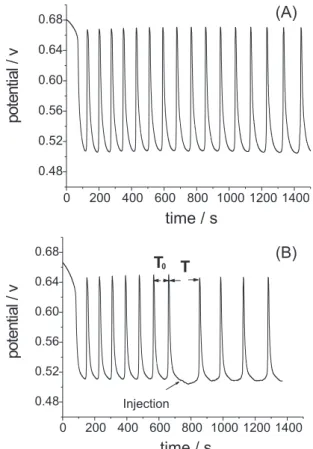
When indium ion was injected to the reaction medium, the period of the oscillating immediately increased. Figure 1 shows the typical potential oscillation profiles
for the oscillating chemical system both in the absence and presence of indium ion perturbation. Since the addition of indium ion changed the oscillating period significantly, a variational ratio of period (PR) was chosen as an analytical signal, which is defined as:
PR = ∆T / T0 = (T - T0) / T0
where T0 and T represent the periods of the oscillation before and after indium ion injection, respectively, and it was found that PR changed linearly to the concentration of indium ion under certain operating conditions. So, the perturbation of period can be applied to the indium ion determination.
In order to ensure the maximum possible sensitivity and accuracy in the determination of In(III), the effects of experimental variables on the determination were examined respectively.
Influences of experimental variables on indium determination
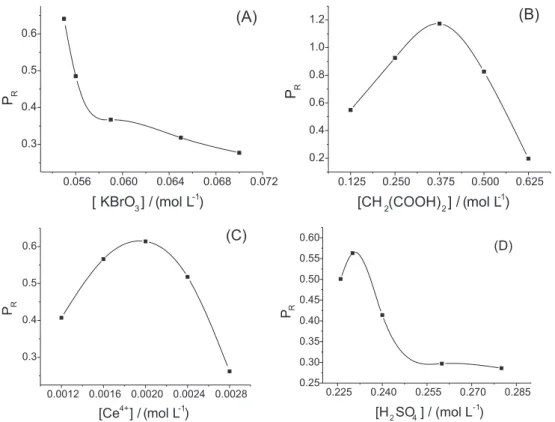
The effect of KBrO3 concentration was studied in the range of 0.055 - 0.07 mol L-1. With the increase of KBrO
3
Figure 1. Typical mixed potential oscillation profiles: (A) in the absence
of In(III); (B) in the presence of 1.96×10⁻⁶ mol L-1 In(III). Common con-ditions: KBrO3, 0.065 mol L-1; CH
2(COOH)2, 0.1625 mol L -1; Ce(IV), 0.002 mol L-1; H
concentration, the response of In(III) perturbation decreased (Figure 2A), with the amplitude, frequency increased and the induction period shortened. When the concentration of KBrO3 was less than 0.055 mol L-1, the
oscillation profiles became unstable. For the stable and sensitive purposes, the optimal choice of KBrO3 concentration was 0.055 mol L-1.
Figure 2B showed that higher concentration of malonic acid caused a higher PR value over the range from 0.125 -0.175 mol L-1, whereas decreased when the concentration
further increased. We adopted 0.375 mol L-1 as optimal
malonic acid concentration.
The concentration of Ce(IV), which was considered as a catalyst, was studied in the range of 0.0012-0.0028 mol L-1. The results showed that the sensitivity of In(III) got
maximum when Ce(IV) concentration was 0.002 mol L-1.
As can be seen in Figure 2D, PR increased and then decreased with the increase of acidity. 0.23 mol L-1 of
sulfuric acid was chosen as the optimum in this work. The influence of temperature was investigated over the range 293K-313K. In the absence of In(III), the oscillation period decreased with the increase in temperature. However, temperature scarcely affected the response of the oscillating system to the perturbation. 303K was chosen in order to work with a suitable oscillating period for the determination of In(III).
Determination of indium ion
Perturbation in the oscillating system by injecting a micro volume of sample containing a given amount of In(III) caused the change in the oscillation period that was quantitatively related to the analyte concentration in a certain range in the injected sample. Under the above described optimum conditions, with In(III) concentration in the range of 1.77×10⁻⁶ - 3.66×10⁻⁶ mol L-1, the P
R has
shown to obey the following equation:
PR = -0.09275 + 0.43523 [In(III)]
where the related coefficient is over 0.9984 (N=13) (in Figure 3). If the concentration of In(III) exceeds 3.66×10⁻⁶
mol L-1, the oscillation period changes as well, whereas
the PR value does not obey a linear relation with the In(III) concentration.
Interference study
In practice, the real water sample often contains a lot of other ions. Therefore, some inorganic ions for the determination of In(III) were investigated as the possible interferences concerning the system stability and PR value. Na+, K+, NO
3 –, PO
4 3-, SO
4
2- and Al3+ did not interfere with
Figure 2. Influence of concentration of (A) KBrO3; (B) CH2(COOH)2; (C) Ce(IV); (D) H2SO4 on the In(III) perturbed oscillating reaction. Common
the In(III) determination at the concentrations of 3000-fold that of In(III); Ca2+, Ba2+, Cu2+and Mn2+ did not interfere
with the In(III) determination at the concentrations of 1000-fold; F–, Ag+, Fe2+, Fe3+ did not interfere with the indium
determination at the concentrations of 200-fold. While Cl–
and I– have potential interference for indium determination
with the tolerance limits of 10-fold. Therefore, higher concentrations of Cl– and I– should be eliminated from the
solution. These findings showed that the BZ reaction system is a useful tool for indium determination.
Possible mechanism for indium ion determination
The FKN mechanism, which is referred to as bromide controlled, supplies a basic form of the chemistry for understanding and modeling the oscillatory phenomena. According to this theory, there are two states (reduced and oxidized) available to the B-Z reaction depending on the bromide concentration. A simplified interpretation of this system with many kinetic steps including several independent variables could involve three overall reactions.13
Process I:
BrO3– + 2Br– + 3CH
2(COOH)2 + 3H
+ → 3BrCH(COOH) 2
+ 3H2O
Process II:
BrO3– + 4Ce3+ + 5H+→ HOBr + 4Ce4+ + 2H 2O
Process III:
BrCH(COOH)2 + 4Ce4+ + HOBr + H
2O → 2Br – + 3CO
2↑
+ 4Ce3+ + 6H+
When the bromide level is high the reduced state (Process I) is dominant where the rate-controlling step is the medium reaction: Br– + BrO
3
– + 2H+→ HBrO
2 + HOBr.
The bromination of malonic acid causing removal of Br–
simultaneously, the reduced state becomes unstable when [Br–] becomes sufficiently low allowing the autocatalytic
reaction to take over and oxidize Ce3+ to Ce4+, in which the
reaction: HBrO2 + BrO3– + H+ → 2BrO
2 is the
rate-controlling step. Process II is characterized by high concentrations of HBrO2, Ce4+ and organic radicals. Then
the regeneration of bromide by Ce4+ oxidation of brominated
organic compounds grows up in Process III. When [Br–]
jumps to a high level and the concentration of HBrO2 reached the level in Process I, the cycle started again.
By the aid of bromide ion-selective electrode, we got the periodical changes of bromide concentration during the reaction. Figure 4 shows an apparent single oscillating cycle of [Br–]. The top value of [Br–] at point A first decreases
slightly down to point B and then decreases sharply until point C, and increases slowly to point D, and finally, increased abruptly to the level of point A, causing the start of another cycle. At the points A, B, C and D, there are some switches of main steps in the reaction.
In order to bring this problem to an understanding, we put the injection into the system at different points, and found that the maximum perturbation appeared when the injecting In3+ was in the period of C-D, during which
bromide concentration increased slightly. It appears that In3+ affect the system strongly in the period of bromide
regeneration. Introducing micro quantity of In3+ caused
the increasing of bromide concentration in the system, showing the lengthen oscillation period simultaneously.
Conclusions
Indium is widely used in the semiconductor industry. The high quality requires the high precise analytical techniques. At present, the most used method for indium determination is atom absorbance spectrometry. Of course,
Figure 4. Single oscillating cycle of [Br–].
Figure 3. Calibration curve of the PRversus concentrations of In(III) in
this method is very sensitive, however, the time-consuming and energy-consuming brought some troubles with operation. The proposed method in this work gives a potential to solve this problem. The results showed that the change in oscillating period is linearly proportional to the concentration of indium ion over the range of 4.98×10⁻⁷ to 3.85×10⁻⁶ mol L-1, with a correlation
coefficient of 0.9984.
Acknowledgments
This work was supported in part by the Project of International Cooperation between China and Ukraine (043-05), the National Natural Science Foundation (20475044) and the Invention Project of Science & Technology (KJCXGC-01, NWNU), China.
References
1. Field, R. J.; Schnieder, F. W.; J. Chem. Educ.1989, 66, 195. 2. Jimenez-Prieto, R.; Silva, M.; Pwewzi, D. B.; Analyst1998,
123, 1R.
3. Gao, J.Z.; Pak. J. Biolog. Sci.2005, 8, 512.
4. Gao, J.Z.; Yang, H; Liu, X.H.; Ren, J; Li, Q.Z.; Kang, J.W.;
Talanta2002, 57, 105.
5. Toledo, R.; Silva, M.; Khavrus, V.O.; Strizhak, P.E.; Talanta
2000,125, 2118.
6. Gao J.Z.; Ren, J.; Yang, W.; Liu X.H.; Yang, H.; Li, Q.Z.; Deng, H.L.; J. Electroanal. Chem.2002, 520, 157.
7. Raoof, J. B.; Ojani, R.; Kiani, A.; Khosravi, M.; Adnani, A.;
Bull. Chem. Soc. Jpn. 2005,78, 256.
8. Gao, J.Z.; Sou, N.; Yang, W.; Wang, L.; Zhao, G.H.; Sun, K.J.;
Chin. J. Anal. Lab. (Ch.) 2004,23, 5.
9. Gao, J.Z.; Yang, H.; Liu, X.H.; Ren, J.; Lu, X.Q.; Hou, J.G.; Kang, J.W.; Talanta2001, 55, 99.
10. Tikhonova, L.P.; Zakrevskaya, L.N.; Yasimirskii, K.B.; J. Anal. Chem.1978, 33, 1991.
11. Strizhak, P. E.; Didenko, O. Z.; Ivashchenko, T. S.; Anal. Chim.
Acta2000,428, 15.
12. Raoof, J.; Ojani, R.; Kiani, A.; Anal. Sci.2004,20, 883. 13. Nicholas, J.T.; George, K.; Victor F.A.L.; Lyons, J.; J. Am.
Chem. Soc. 1972, 94, 4.
Received: June 21, 2005
![Figure 4. Single oscillating cycle of [Br – ].](https://thumb-eu.123doks.com/thumbv2/123dok_br/18991202.460702/4.892.92.427.117.368/figure-single-oscillating-cycle-br.webp)
