THE AFRICAN HIND'S (Cephalopholis taeniops, SERRANIDAE) USE
OF ARTIFICIAL REEFS OFF SAL ISLAND (CAPE VERDE):
A PRELIMINARY STUDY BASED ON ACOUSTIC TELEMETRY*
Pedro G. Lino1**, Luís Bentes2, Miguel Tiago Oliveira3, Karim Erzini2 and Miguel Neves Santos1
1Instituto Nacional dos Recursos Biológicos (INRB I.P./L-IPIMAR)
(Av. 5 de Outubro s/n, 8700-305 Olhão, Portugal) 2Universidade do Algarve, Faculdade de Ciências e Tecnologia
Centro de Ciências do Mar (CCMAR) Campus de Gambelas, 8005-139 Faro, Portugal)
3Oceanário de Lisboa AS
(Esplanada D. Carlos I, 1990-005 Lisboa, Portugal) **Corresponding author: [email protected]
A
B S T R A C TThe African hind Cephalopholis taeniops (Valenciennes, 1828) is one of the most important commercial demersal species caught in the Cape Verde archipelago. The species is closely associated with hard substrate and is one of the main attractions for SCUBA divers. In January 2006 a former Soviet fishing vessel - the Kwarcit - was sunk off Santa Maria Bay (Sal Island). Young C. taeniops are commonly observed in this artificial reef (AR). In order to investigate the species' use of the AR, 4 specimens were captured and surgically implanted underwater with Vemco brand acoustic transmitters. The fish were monitored daily with an active telemetry receiver for one week after release. Simultaneously, an array of 3 passive VR2 / VR2W receivers was set for 63 days, registering data that allowed an analysis of spatial, daily and short term temporal activity patterns. The results showed site fidelity to the AR, with no migrations to the nearby natural reef. The method used allowed to register a consistent higher activity during daytime and a preference for the area opposite the dominant current.
R
E S U M OA garoupa-de-pintas Cephalopholis taeniops (Valenciennes, 1828) é uma das espécies demersais comerciais mais importantes no Arquipélago de Cabo Verde. Esta espécie está fortemente associada ao substrato rígido e constitui uma das principais atracções para os mergulhadores. Em Janeiro de 2006 um antigo navio de pesca soviético - Kwarcit - foi afundado ao largo da Baía de Santa Maria (Ilha do Sal). É comum observar juvenis de C. taeniops neste recife artificial (AR). Para investigar a utilização dos AR por esta espécie, foram capturados 4 exemplares nos quais foi implantado um transmissor acústico da marca Vemco, através de cirurgia realizada debaixo de água. Os peixes foram monitorizados através de um receptor de telemetria activo na semana após libertação. Simultaneamente foi instalada uma rede de 3 receptores passivos tipo VR2 / VR2W que registou dados durante 63 dias, permitindo analisar os padrões de actividade espaciais, diários e temporais de curto-prazo. Os resultados obtidos mostram que os peixes são fiéis ao habitat no AR, não realizando migrações para o recife natural próximo. O método utilizado permitiu registrar um padrão consistente de maior actividade diurna e uma preferência pela área do navio oposta à corrente dominante.
Descriptors: Cephalopholis taeniops, Vessel reef, Cape Verde, Activity pattern, Acoustic telemetry. Descritores: Cephalopholis taeniops, Recifes artificiais, Cabo Verde, Padrão de atividade, Telemetria acústica.
I
NTRODUCTIONThe African hind is a demersal serranid (Serranidae, Epinephelinae) whose native range __________
(*) Paper presented at the 9th CARAH – International Conference on
Artificial Reefs and Related Aquatic Habitats on 8-13 November, Curitiba, PR, Brazil.
(MEDINA et al., 2008). Nevertheless, this species is very important for local fisheries and is heavily exploited (STOBBERUP et al., 2005).
Sal Island in the Cape Verde archipelago has great potential as a tourist resort due to the favorable climate almost all theyear round. Although there are some natural diving site locations around the island, the southern coast, which is more protected from local currents and winds, has few natural underwater attractions. This was one of the reasons behind the "Rebuilding Nature" project - the creation of some artificial hard habitats that would add to the underwater attractions, as well as contribute to the restoration of the fishery resources that had been heavily exploited in the past, by providing additional protected habitats. Two ships were, therefore, sunk in Santa Maria Bay. One of them, a former Soviet fishing vessel named Kwarcit, was sunk in 2006 on a sandy bottom at around 28 m depth.
This new habitat has been monitored since 2008 in terms of colonization (unpublished data). The information gathered has shown that among the abundant fish community observed around and within the Kwarcit, there is a large number of juvenile African hind. Since there is very little biological information on this species, its behavior in terms of migratory and daily movement is particularly important for the assessment of the standing stock from two perspectives: asan attraction for underwater tourism and as a sustainable fishery resource for the local population (hand-lining and spear-fishing).
Acoustic tags have been used in fresh water for monitoring fish movement since the 70’s. However, the use of underwater acoustic monitoring in the marine environment has different limitations due to the increased conductivity (REINE, 2005). The increase in tag-battery capacity, which affects study duration and also the range of detection (by increasing power output), associated with a reduction of tag size and weight has, according to Reine (2005), led to the proliferation of electronic tag types, tracking equipment and expanded telemetry applications. Further, the use of automated receivers allows continuous tracking within the array’s range for extended periods of time on spatial scales ranging from meters to kilometers (VOEGELI et al., 2001).
Therefore, according to Zeller (1999), acoustic telemetry is the ideal tool to address questions
main objective of this study was to assess the use of the AR habitat by Cephalopholis taeniops and to investigate possible movements to and from the nearby natural reefs.
M
ATERIAL ANDM
ETHODSStudy Area and Sampling Procedure
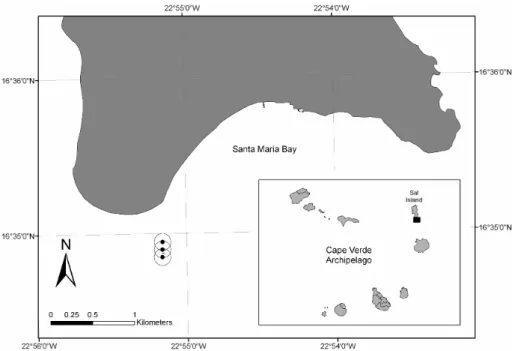
This study was carried out in the Cape Verde Archipelago, in the western part of the Santa Maria Bay off Sal Island (Fig. 1). The marine habitat in the study area has a fine grain sandy bottom, which includes a shallow natural reef (NR), known as the "Three Caves" with a few small caves (at 15 to 18 m depth) and the artificial reef (AR), a 28 m length vessel wreck, located on the deeper edge of the platform (30 m depth). Sampling of C. taeniops was carried out on the artificial reef, using SCUBA equipment and a hand line baited with chunks of fresh mackerel. After unhooking, each fish was examined to assess itsgeneral condition and placed for two days in a 1 m3 cage near the capture site, in order to guarantee that no damage was suffered during capture and handling.
Tagging
Fig. 1. Location of the study site. The black square in the inset image indicates the enlarged area. The circles in the Santa Maria Bay show the area covered by the passive acoustic receivers.
Experimental Design
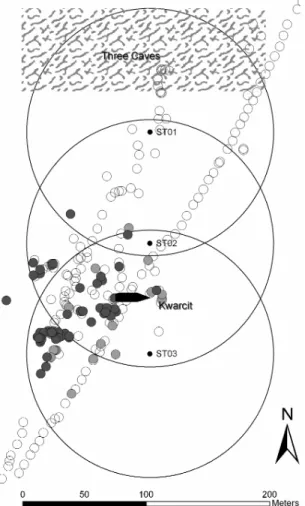
In order to design the final experimental layout, preliminary field work was carried out to assess the acoustic transmission conditions in situ. The preliminary study was carried out at the exact location where the main experiment was to be carried out. An acoustic transmitter was moored at about 1m from the bottom, on a cable connected to a surface buoy, and simultaneous measurements were registered with a VR2 passive receiver and a VH100 active receiver connected to an omnidirectional hydrophone. Based on the preliminary results a theoretical maximum acoustic range was set to 100 m. Two acoustic receivers (VR2 / VR2W) were set on the bottom 40 m to port and 40 m to starboard of the bow of the vessel reef. A third acoustic receiver (VR2) was set on the nearby natural reef, nearly 200 m from the AR, in order to monitor this area for possible migrations.
Active Telemetry
Active telemetry was carried out using a VR100 active acoustic receptor connected either to an omnidirectional or a directional hydrophone. After the tagged fished had been released, acoustic monitoring of the study area was carried out on a daily basis by performing transects covering the area from the "Three Caves" natural reef to the outer edge of the shelf, beyond the vessel reef’s position.
For each specimen the Residence Index (RI) was calculated. The RI is the ratio between the number of days the fish was detected and the total number of days the area was monitored. The relationship between the number of detections and water temperature was investigated using data recorded by a temperature sensor positioned on the AR.
R
ESULTSThe characteristics of the four fish captured using the underwater baited hand line are presented in Table 1. All four tagged specimens were young adults, in accordance with the size at first maturity of 18 cm TL described by Siau (1994).The fish had an average total length of 24.9 cm (±2.1cm, SD) and an estimated average weight of 219.5 g (±59.7 g, SD). Their weights were estimated using a weight-length relationship based on a sample of 310 specimens (unpublished data).
permanently within the study area. Fish ID915 was last detected in the study area 44 days after release, while fish ID911 was last detected 49 days after release. Fish ID913 was detected in the study area on the day before the receivers were recovered but had been absent for several intervals of a few days before then. This pattern can also be observed from the residence index (Table 1). Fish ID915 was present in the study area a little over half of the time (0.54), while fish ID911 and ID913 (0.76 and 0.73) were detected during nearly three-quarters of the study’s
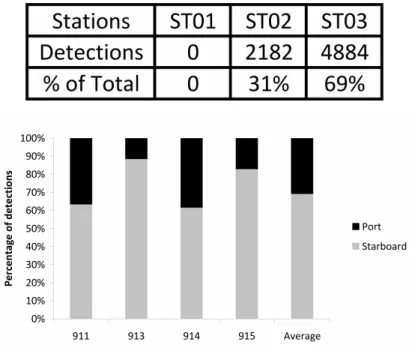
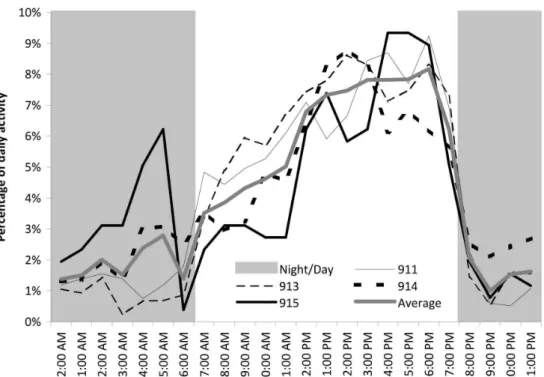
the ship) versus Station 3 (to the starboard side) show (Fig. 4) that, on average, the fish were detected more than 69% of the time by the starboard passive receiver. The passive monitoring revealed a clear daily pattern (Fig. 5), common to the 4 tagged specimens, with an increase in daily activity starting at daybreak and attaining a maximum a few hours before sunset. During the night, very little activity was detected, except for fish ID915 that had a peak of activity during the night of the third day of the experiment.
Fig. 3. Activity pattern. Dark grey squares represents high detection (>100 detections/day); mid grey represents moderate detection (25 to 100 detections/day); light grey represents low detection (<25 detections/day). White squares represent days where the fish was not detected. Fish ID is the number reported by the acoustic tag to the acoustic receiver.
Table 1. Characteristics of the tagged fish. Total Length in centimeters was measured to the nearest half centimeter and Total Weight was calculated from a Weight-Length relationship. Fish ID is the number reported by the acoustic tag to the acoustic receiver; RI is the Residence Index.
Table 2. Results from the passive telemetry. ST01, ST02 and ST03 are the station numbers.
Fig. 5. Detections of each fish by passive receivers. The grey area corresponds to the night time. The dark grey ribbon represents the average activity per hour.
D
ISCUSSIONThe results obtained from active telemetry were similar to those later recovered from the passive receivers. The same fish were detected in the same areas by both passive and active receivers, which proves that the experimental design was appropriate and in accordance with the existing knowledge of the study area. However, although fish ID913 was detected with active telemetry in the study area on the day before the receivers were recovered, no register of this fish was made by the passive receivers. This means that the position in which it was detected was out of the range of the passive receivers but still within the same general area. This probably indicates that there is an uncharted hard substrate nearby to which the fish move.
During the study period no movement to the shallow natural reef was detected. However, the data collected during a parallel study, based on visual censuses, showed that there was a size distribution overlap between the shallow "Farol Baixo" natural reef area (where total length ranged from 9-32 cm), which is adjacent to "Three Caves", and the deeper vessel reef site (where it ranged from 11-37 cm). Further, there is a statistically significant difference between the mean fish size at the two locations (16.82cm±2.32SD and 22.67cm±2.64SD at Farol Baixo and at the AR, respectively). This means that
there is a size gradient with depth and that although the fish living on the AR apparently do not migrate to shallow waters, it does not prove that large fish from the surrounding natural habitat do not visit the AR for feeding or reproduction. Daily migrations between the NR and the AR have been described for Diplodus sargus, a common demersal sparid (LINO et al, 2009). There might also be some migration of smaller specimens but current acoustic tagging limitations prevent their study using this methodology. Clearly, further investigation is required to determine the source and interchange of specimensbetween the two habitats.
All the fish remained in the study area for 44 days. In mid-July two fish were no longer detected and a third (ID913) was only detected randomly. Clearly the peak of activity within the study area, even ignoring the random activity registered on the first few days after release, which can be attributed to handling stress, occurred within the month of June, extending to mid-July. The posterior reduction in activity could be related to some reproductive migration since, according to Siau (1994) and Pastor (2002), the reproductive season occurs between June and September in nearby Senegal and between June and October in the Cape Verde islands of São Vicente and São Nicolau.
preferred the starboard side. This is to be expected from the lie of the boat which lists slightly to starboard with the bow facing the predominant easterly current. The vessel reef thus provides protection from the dominant current, creating a "shadow" area aft on the starboard side. This is corroborated by the active telemetry results, which showed that the most frequent detections were made near that position and by a parallel study on the AR fish assemblages (unpublished data). Stanley and Wilson (1997) have described a similar phenomenon by correlating the dominant current direction with higher counts of fish on the leeward side of a petroleum platform.
The fact that the vessel is leaning slightly to starboard means that the upper deck and super-structures are also protected from the dominant current. This not only increases the area protected but increases the number and complexity of available habitats as well as the abundance and diversity of benthic and demersal organisms available as food. These results seem to indicate that from a protection point of view it might be a better option, when deliberately sinking a vessel as an AR, to position it so as to list to one side, in such a way that the upper deck is to leeward of the dominant current. This will have both a positive effect on the fauna and create a protected area for recreational divers even in areas with bottom currents.
The fishes’ daily activity showed more intense activity during the day for all the specimens, except for fish ID915 that was not detected during the second day, but had a high number of detections during the night of the third day. Since little is known about the biology of this particular species, this data could be interpreted as indicating that C. taeniops is a visual predator, actively seeking for food during the daytime period. This behavior was observed in situ and allowed the authors to capture the fish with a hand line since they actively attacked the bait. Karlsen et al. (2009) also correlated greater activity of cod around shipwrecks with the diurnal activity of the major prey. However, the opposite behavior has been observed by Popple and Hunte (2005) for Cephalopholis cruentata using acoustic telemetry in a marine reserve on St. Lucia, West Indies. This species showed greater activity at night, which reinforces the need for species-specific study of habitat use.
The results obtained in this study call for further study of the movements of C. taeniops both in terms of area, using a larger array of receivers, and time, covering a whole year if possible to investigate seasonal patterns. Studies should also concentrate on other species, such as the island grouper Mycteroperca fusca, which is also quite abundant locally but listed as endangered by the IUCN. This continued study will clarify the role of vessel reefs in the life cycle of these
species but also ascertain the importance of ARs in the protection and restoration of local biodiversity.
A
CKNOWLEDGEMENTSThe authors would like to thank Nuno Marques da Silva, Manuel Lains and all the staff of the Manta Diving Center (Sal Island, Cape Verde) for all their help in setting up the experiment. Thanks are also due to all the colleagues who made this experiment possible and collaborated on it: Rute Portugal, João Cúrdia, Israel Ribeiro and Pedro Pousão-Ferreira. This study is a part of the "Creating Artificial Reefs - Rebuilding Nature" project funded by the Manta Diving Center, Banco Comercial do Atlântico, Soltrópico, Laranja Mecânica and Manta Diving Adventures.
R
EFERENCESABDALLAH, A. B.; SOUISSI, J. B.; MÉJRI, H.; CAPAPÉ, C.; GOLANI, D. First record of Cephalopholis taeniops (Valenciennes) in the Mediterranean Sea. J. Fish Biol., v. 71, n. 2, p. 610-614, 2007.
HEEMSTRA, P. C.; RANDALL, J. E. FAO species catalogue. Vol. 16. Groupers of the world (family Serranidae, subfamily Epinephelinae). An annotated and illustrated catalogue of the grouper, rockcod, hind, coral grouper and lyretail species known to date. FAO Fish. Synop., v. 125, n. 16, 382 p., 199
KARLSEN, J.; OLESEN, H. J.; ANDERSEN, N. G.; THYGESEN, U.H. Behaviour of large Atlantic cod at ship wrecks and similar rough bottom structures in the north-eastern part of the central North Sea. ICES CM 2009/B:09, 2009, 14 p.
LINO, P. G.; BENTES, L.; ABECASIS, D.; SANTOS, M. N. D.; ERZINI, K. Comparative behavior of wild and hatchery reared white sea bream (Diplodus sargus) released on artificial reefs off the Algarve (southern Portugal). In: NIELSEN, J. L.; ARRIZABALAGA, H.; FRAGOSO, N.; HOBDAY, A.; M. LUTCAVAGE , M.; SIBERT, J. (Ed.). Tagging and tracking of marine animals with electronic devices: Reviews: Methods and Technologies in Fish Biology and Fisheries v. 9, p. 23-34, 2009.
MEDINA, A.; BRÊTHES, J.; SÉVIGNY, J. Habitat fragmentation and body-shape variation of African hind Cephalopholis taeniops (Valenciennes) in an archipelago system (Cape Verde, eastern Atlantic Ocean). J. Fish Biol., v. 73, n. 4, p. 902-925, 2008.
MONTEIRO, P.; RIBEIRO, D.; SILVA, J.; BISPO, J.; GONCALVES, J.M.S. Ichthyofauna assemblages from two unexplored Atlantic seamounts: Northwest Bank and Joao Valente Bank (Cape Verde archipelago). Sci. Mar., v. 72, n. 1, p. 133-143, 2008.
Notes Collection, ERDC TN-DOER-E18).
SIAU, Y. Population structure, reproduction and sex-change in a tropical East Atlantic grouper. J. Fish Biol., v. 44,
n. 2, p. 205-211, 1994.
STANLEY, D. R.; WILSON, C. A. Seasonal and spatial variation in the abundance and size distribution of fishes associated with a petroleum platform in the northern Gulf of Mexico. Can. J. Fish. aquat. Sci., v. 54, p.
1166-1176, 1997.
STOBBERUP, K.; AMORIM, P.; PIRES, V.; MONTEIRO, V. Assessing the effects of fishing in Cape Verde and Guinea Bissau, northwest Africa. In: KRUSE, G.H.; GALLUCCi, V.F.; HAY, D.E.; PERRY, R.I.; PETERMAN, R.M.; SHIRLEY, T.C.; SPENCER, P.D.; WILSON, B.; WOODBY. D. (Ed.). Fisheries assessment and management in data-limited situations. Lowell Wakefield Fisheries Symposia Series, v. 21, p. 395-417, 2005.