Artigo Original
Débora Vidor-Souza1 Helena Bolli Mota2 Rosangela Marostega Santos3
Correspondence address:
Débora Vidor-Souza
Av. Borges de Medeiros, 356, Garibaldi (RS), Brasil, CEP: 95720-000. E-mail: [email protected]
Received: 12/20/2009
Accepted: 4/25/2011
Study conducted at the Graduate Program in Human Communication Disorders, Universidade Federal de Santa Maria – UFSM – Santa Maria (RS), Brazil.
(1) Graduate Program (Masters degree) in Human Communication, Universidade Federal de Santa Maria – UFSM – Santa Maria (RS), Brazil.
(2) Speech-Language Pathology and Audiology Department, Universidade Federal de Santa Maria – UFSM – Santa Maria (RS), Brazil.
(3) Faculdade Porto-Alegrense – FAPA – Porto Alegre (RS), Brazil.
relationship between perception and production of the
articulatory gesture
O desenvolvimento da consciência fonoarticulatória
e a relação entre a percepção e a produção do gesto
fonoarticulatório
ABSTRACT
Purpose: To investigate the articulatory awareness of children with normal phonological development accor-ding to the variables gender, age and schooling, as well as to analyze their performances in speech perception and production tasks. Methods: Participants were 90 Preschool and Elementary School students, with ages between 5 and 7 years, who were evaluated using the Articulatory Awareness Investigation Instrument (AAII). The test is subdivided into three articulatory gesture perception tasks (T1, T3 and T4) and two articulatory gesture production tasks (T2 and T5). Results: Girls showed better performances in T1, T2, T3, total score, and articulatory awareness perception tasks. Seven-year-old subjects presented better performances in T1, T4, T5, total score, articulatory awareness perception and production tasks, when compared to 5-year-olds. Seven-year-old children presented better performances than 6-year-olds in T4. Six-year-old subjects showed better performances than 5-year-olds in T5, total score, and articulatory awareness production tasks. Elemen-tary school students presented better performances than Preschool children in T1, T3, T4, T5, total score, and articulatory awareness perception and production tasks. There was correlation between articulatory awareness perception and production tasks, evidencing that the better the performance on perception tasks, the better the performance on the production tasks. Conclusion: Articulatory awareness improves with age and schooling. Female subjects show better performances than male subjects. The better the performance on articulatory awareness perception tasks, the better the performance on articulatory awareness production tasks.
RESUMO
Objetivos: Investigar a consciência fonoarticulatória de crianças com desenvolvimento fonológico normal de acordo com gênero, idade e escolaridade e analisar os desempenhos em tarefas de percepção e produção da fala. Métodos: Noventa crianças da Educação Infantil e primeira série do Ensino Fundamental, com idades entre 5 e 7 anos, foram avaliadas por meio do Instrumento de Investigação da Consciência Fonoarticulatória (ICFA). O instrumentoé subdividido em três tarefas de percepção (T1, T3 e T4) e duas de produção do gesto fonoarticulatório (T2 e T5). Resultados: Meninas apresentaram melhor desempenho em T1, T2, T3, escore total e tarefas de percepção da consciência fonoarticulatória. Crianças de 7 anos apresentaram desempenho superior em T1, T4, T5, escore total do teste, tarefas de percepção e produção da consciência fonoarticulatória quando comparadas às crianças de 5 anos. Crianças de 7 anos apresentaram melhor desempenho do que as de 6 anos em T4. Crianças de 6 anos apresentaram desempenho superior em relação às de 5 anos em T5, escore total e tarefas de produção da consciência fonoarticulatória. Escolares de ensino fundamental apresentam de-sempenho superior ao de escolares de educação infantil em T1, T3, T4, T5, escore total, tarefas de percepção e produção da consciência fonoarticulatória. Houve diferença na correlação entre tarefas de percepção e produção do gesto fonoarticulatório, evidenciando que quanto melhor for o desempenho nas tarefas de percepção, me-lhor será o desempenho nas tarefas de produção. Conclusão: A consciência fonoarticulatória aprimora-se de acordo com idade e escolaridade. Crianças do gênero feminino apresentam melhor desempenho do que as do gênero masculino. Quanto melhor o desempenho nas tarefas de percepção, melhor o desempenho nas tarefas de produção da consciência fonoarticulatória.
Descritores
Percepção da fala Testes de articulação da fala Distribuição por idade Fatores sexuais Escolaridade Keywords
INTRODUCTION
Speech perception is a bimodal phenomenon, in which both information modalities, auditory and visual, are integrated and uniied as one single stimulus. The visual and auditory inputs can inluence one another, and the status that allows better speech intelligibility is the audiovisual status(1).
The act of observing mouth movements profoundly in-luences speech perception. The McGurk-MacDonald effect is a demonstration of this inluence: when audiovisual stimuli are presented to the subjects, they relate having listened to a sound that is neither what they saw nor what they heard, but a fusion of both visual and auditory modalities(2).
Paying attention to the speaker’s mouth promotes a motor planning that will be used by the listener when he reproduces the observed movement(3). Audiovisual perception of speech activates a network of motor areas of the nervous system, inclu-ding the cerebellum and cortical motor areas that are involved in planning and executing speech production, as well as areas that assist in proprioception(3).
A model of audiovisual speech perception suggests that multisensory representations of speech, derived from sound patterns or from observed facial movements, can be interpreted as multisensory hypotheses – but not as a inal interpretation – over the sounds produced by the speaker. These hypotheses, which are extracted from sensory information, are mapped in the motor commands used in speech production. Such motor commands are associated to hypotheses based on past speech production experiences(3,4).
Speech motor perception theories defend the concept that this perception occurs through articulatory gesture by the speaker. The gestures are represented in the brain as invariable motor commands that program the movements of the speech articulators. Theories of motor perception of speech suggest that articulatory gestures are not only exclusive events for speech production, but also important for perception(5).
Articulatory gestures are movements produced in speech around a target on vocal tract. These movements have a time interval that allows them to slide over each other and superpose them partially or completelly(6).
Considering the bimodal phenomenon of speech perception, articulatory awareness is deined as the ability of perceiving that sound change according to where the articulators get in contact, being considered a sub-ability of phonological aware-ness(7). Phonological awareness is the ability that allows human beings to think and act about speech sounds(8-16). It is divides in different levels: of work, of syllabe, of intrasyllabic units and of phoneme(12,13,17-19).
The ability to relect on the phoneme as abstract repre-sentation of language is known as phonemic awareness. The articulatory awareness is the ability to relect on speech sounds, that are concrete, articulatory entities(7).
Articulatory awareness is the part of phonological aware-ness that allows to relect on the articulatory characteristics of phonemes, contributing to consolidate the phonemic knowled-ge(20). Children lean on articulatory clues as an initial strategy to target syllabes into smaller unities, i.e. phonemes(21).
A study performed with 90 children aged between 5 and 10 years old, whose aim was to relate articulatory awareness and written language, found that articulatory awareness is an ability that improves according to age and schooling. Results also showed that female children performance is higher than male children performance, and there is a relation between articulatory awareness and written language acquisition. The authors found that articulatory awareness is an ability that facili-tates the process of learning the alphabetic system of writing(22). It is believed that articulatory awareness has a vital im-portance in the process of acquiring and developing speech sounds(7). Therefore it is a widely used resource in speech therapy practice.
This study pursued to investigate the development of articu-latory awareness abilities in children with normal phonological development, according to gender, age and educational status, as well as to analize their performance in articulatory awareness perception and production tasks. Such investigation will bring beneits for phonology, clinical phonology and writing language acquisition, as well as for educational area.
METHODS
This study was approved by the Research Ethics Committee from Universidade Federal de Santa Maria (UFSM), numbered 0103/2007. Four institutions were contacted to obtain the Insti-tutional Consent (two public schools, one philanthropic school and one speech therapy service center). The adults responsible for the participating children signed the Statement of Consent.
Participants
Ninety children with normal phonological development and aged between ive and seven years old participated of this study. Fifty-seven of them (63,33%) are female and 33 (36,67%) are male. All the participants were at preschool or irst grade of elementary school, either at a public school or at a philanthropic school.
All children were submited to a speech screening (hearing, articulatory organs, speech and language). To be a part of the group studied, the children must present a good performance at the speech screening, not show obvious changes in the neu-rological, cognitive, psychological and/or emotional aspects, and not be or have been in speech therapy.
Instruments e proceedings
in Brazilian Portuguese language, namely: [p], [b] and [m]; [f] and [v]; [l]; [s] and [z]; [S] and [Z]; [k] and [g].
In each one of the tasks, two examples are presented so the examiner can be sure that the subject understood the activity. The IIAA used for this study consists in ive tasks: three of identiication (identiication of articulatory image from the sound – T1; identiication of articulatory image from the word – T3; and identiication of word from the articulatory gesture – T4) and two of production (production of sound from the articulatory image – T2; and production of word from the articulatory gesture – T5), total a 20 points score.
The irst task (T1), the child is supposed to relate the sound of a certain phoneme to the corresponding articulatory gesture in the photo. For example, hearing the sound of the phoneme /v/, the subject is supposed to select, among six photos of different mouths, the one that corresponds to the sound heard.
To perform task two (T2), the examiner presents a photo of a mouth reproducing one articulatory gesture, and the child is supposed to produce the corresponding sound. The third task (T3) consists in identifying the articulatory gesture that corresponds to the initial sound of a certain word, presented orally by the examiner. The child is supposed to name, for example, “car”, and identify, among six mouth photos, the one that corresponds to the irst sound of the evoked word.
The fourth task (T4), the subject is asked to identify, among four words presented in images, the one corresponding to the articulatory gesture in question. For the last task (T5), the child should, from a photo, evoke a word whose irst sound corres-ponds to the presented mouth image. For example, by seeing the mouth image corresponding to the sounds [p, b, m], the child is supposed to say words pato, bala e massa.
Data analysis
The sample proile was done by using descriptive statistics of continuous variables with mean values , standard deviation, minimum and maximum, median and quartiles. Comparisons of categorical variables between groups were made using Chi-square and Fisher’s Exact test, due to the presence of expected
values lower than ive in the tables. To compare the numeric variables between two groups, the Mann-Whitney test was made. The Kruskal-Wallis test was used to compare numeric variables between three or more groups, due to the absence of normal distribution.
The comparison of the scores of the ive tasks of the eva-luation instrument used in this study was performed using the Friedman test, followed by multiple comparisons using the Wilcoxon test for related samples. To examine the relationship between the scores of the tasks, a Spearman Correlation Coeficient was performed, due to lack of normal distribution. The signiicance level adopted for statistical tests was 5%, i.e. p≤0.05.
RESULTS
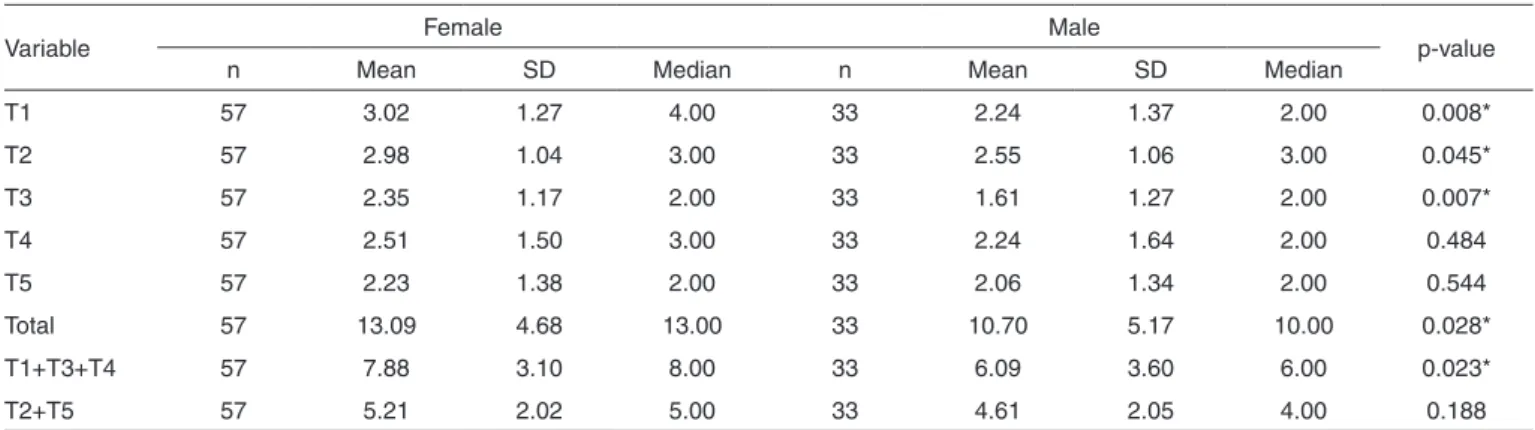
Concerning the results of the relation between articulatory awareness and gender, a difference to the variables was found: accuracy in identiication tasks (T1 and T3), production tasks (T2), articulatory gesture perception tasks and total test score, and the best performance was obtained by female subjects (Table 1).
Regarding the performance in articulatory awareness by age, difference was found for the following variables: accu-racy in identiication tasks (T1 and T4), production tasks (T5) articulatory gesture perception tasks, articulatory gesture pro-duction tasks and total test score. These results show that the test performance is enhanced in accordance with the advancing age of the children.
Differences were observed in sound identiication tasks (T1) and articulatory gesture perception tasks in children aged between 5 and 7 years old. Between children aged from 5 to 7 years old and from 6 to 7 years old, difference was found only in word identiication tasks (T4). Word production from image tasks (T5), articulatory gesture production tasks and total test score showed difference between children aged from 5 to 6 years old and from 5 to 7 years old (Table 2).
Based on the results of the relation between articulatory awareness and educational status, difference was observed
Table 1. Comparison of performances in articulatory awareness between genders
Variable Female Male p-value
n Mean SD Median n Mean SD Median
T1 57 3.02 1.27 4.00 33 2.24 1.37 2.00 0.008*
T2 57 2.98 1.04 3.00 33 2.55 1.06 3.00 0.045*
T3 57 2.35 1.17 2.00 33 1.61 1.27 2.00 0.007*
T4 57 2.51 1.50 3.00 33 2.24 1.64 2.00 0.484
T5 57 2.23 1.38 2.00 33 2.06 1.34 2.00 0.544
Total 57 13.09 4.68 13.00 33 10.70 5.17 10.00 0.028*
T1+T3+T4 57 7.88 3.10 8.00 33 6.09 3.60 6.00 0.023*
T2+T5 57 5.21 2.02 5.00 33 4.61 2.05 4.00 0.188
* Signiicant values (p≤0.05) – Mann-Whitney test
Note: SD = standard deviation; T1 = task 1 – identiication of articulatory image from the sound; T2 = task 2 – production of sound from the articulatory image; T3 =
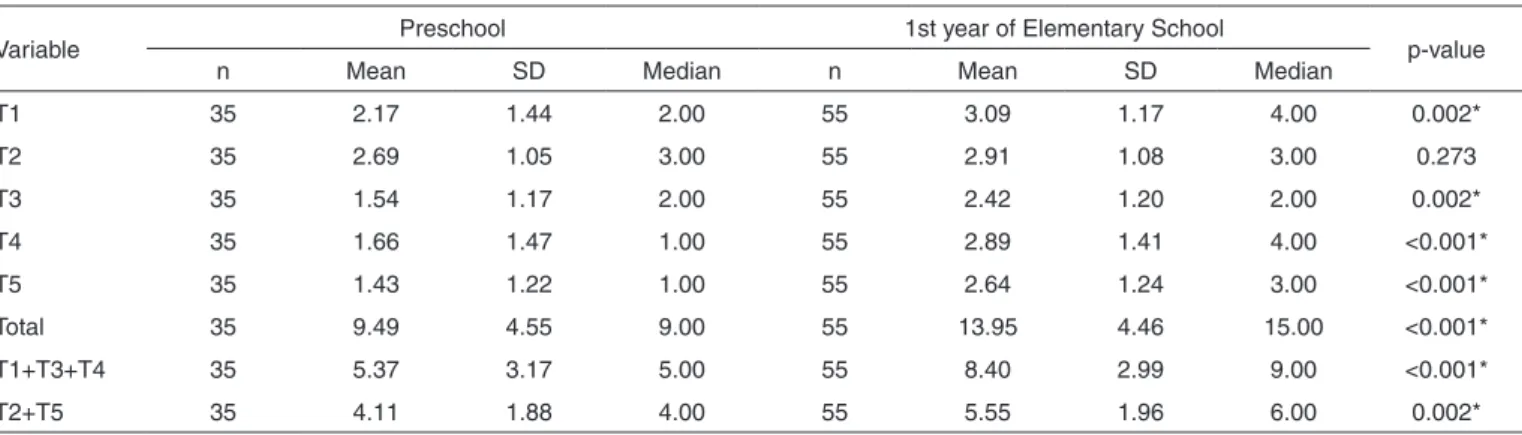
between grades for scores of identiication tasks (T1, T3 and T4) and production tasks (T5), articulatory gesture perception, articulatory gesture production and total test score. This shows superior performance of students in irst grade elementary scho-ol when compared to the Early Childhood Education (Table 3).
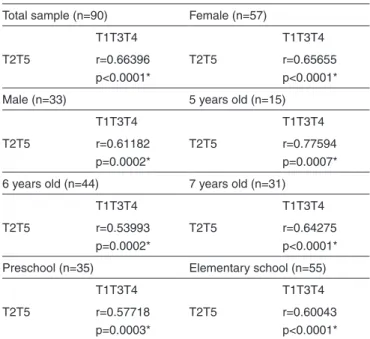
On the correlation between the scores of articulatory gesture perception and production tasks, the total sample and accor-ding to gender, age and grade, there was a difference between the scores of subtotals, both in the overall sample and in the comparison regarding gender, age and education.
A correlation was found between articulatory gesture perception and production tasks, ie the higher the score on articulatory gesture perception tasks, the higher the score on articulatory gesture production tasks (Table 4).
DISCUSSION
The results of this study show that female children have higher performance on articulatory awareness when compared to males, conirming the indings of a pilot study on articulatory awareness(22). Research involving phonological awareness also
found higher performance of girls compared to the boys(24-26). Girls seem to have better ability to analyze words into smal-ler units than boys(25,26). A study based on magnetic resonance imaging found that the female brain is better able to isolate the sounds of words and act upon each of them compared to male brain(27).
Some studies in phonological awareness disagree with the results for the articulatory awareness found in this work. However, these studies showed no difference between children male and female with regard to the levels of phonological awa-reness(16,28). Despite the broad reference on the subject, were not found, so far, studies in which the performance of male subjects was higher than in female subjects in metaphonological skills.
The indings on the relationship between articulatory aware-ness and age conirm the indings of a pilot study that evidences that this ability is enhanced according to the age advancement of the subjects(22). Overall, the results obtained conirm the indings that metaphonological skills are enhanced according with advancing age(18,29).
Another study also found that performance on phonologi-cal awareness increases with advancing age. Children 7 and Table 2. Comparison of performances in articulatory awareness between ages
Variable 5 years old 6 years old 7 years old p-value
n Mean SD Median n Mean SD Median n Mean SD Median
T1 15 1.87 1.60 2.00 44 2.75 1.30 3.00 31 3.13 1.15 4.00 0.025*
T2 15 2.67 1.11 3.00 44 2.77 1.10 3.00 31 2.97 1.02 3.00 0.641
T3 15 1.60 1.18 2.00 44 2.00 1.26 2.00 31 2.42 1.23 2.00 0.139
T4 15 1.33 1.11 1.00 44 2.20 1.62 2.00 31 3.23 1.20 4.00 <0.001*
T5 15 0.87 1.19 0.00 44 2.18 1.26 2.00 31 2.77 1.15 3.00 <0.001*
Total 15 8.33 4.45 10.00 44 11.91 4.87 12.00 31 14.52 4.12 16.00 <0.001*
T1+T3+T4 15 4.80 3.00 6.00 44 6.95 3.41 7.00 31 8.77 2.75 9.00 <0.001*
T2+T5 15 3.53 1.85 4.00 44 4.95 2.06 5.00 31 5.74 1.75 6.00 0.004*
* Signiicant values (p≤0.05) – Kruskal-Wallis test
Note: SD = standard deviation; T1 = task 1 – identiication of articulatory image from the sound; T2 = task 2 – production of sound from the articulatory image; T3 =
task 3 – identiication of articulatory image from the word; T4 = task 4 – identiication of word from the articulatory gesture; T5 = task 5 – production of word from the articulatory gesture
Table 3. Comparison of performances in articulatory awareness between school grades
Variable Preschool 1st year of Elementary School p-value
n Mean SD Median n Mean SD Median
T1 35 2.17 1.44 2.00 55 3.09 1.17 4.00 0.002*
T2 35 2.69 1.05 3.00 55 2.91 1.08 3.00 0.273
T3 35 1.54 1.17 2.00 55 2.42 1.20 2.00 0.002*
T4 35 1.66 1.47 1.00 55 2.89 1.41 4.00 <0.001*
T5 35 1.43 1.22 1.00 55 2.64 1.24 3.00 <0.001*
Total 35 9.49 4.55 9.00 55 13.95 4.46 15.00 <0.001*
T1+T3+T4 35 5.37 3.17 5.00 55 8.40 2.99 9.00 <0.001*
T2+T5 35 4.11 1.88 4.00 55 5.55 1.96 6.00 0.002*
* Signiicant values (p≤0.05) – Mann-Whitney test
Note: SD = standard deviation; T1 = task 1 – identiication of articulatory image from the sound; T2 = task 2 – production of sound from the articulatory image; T3 =
8 years old had higher scores than those 4, 5 and 6 years old. The author infers that this is due to the fact that older children have already been literate (10).
Similar results were obtained by a research(30) that pointed that the development of phonological awareness is inluenced by age and education. However, education was more inluential. For the authors, the instruction of reading seems to be essential for the development of phonological awareness(30).
Children of early childhood education have lower perfor-mance on articulatory awareness, possibly because they are not mature to handle tasks as abstract. The greatest degree of dispersion and self-centeredness (subjective thought, centered on their own experiences) are characteristic of preschool chil-dren, which may explain the inferior results(29). The inferior performance of preschool children can be attributed to the fact that they are not formally educated and pay more attention to the meaning of words than to their sound(28). The linguistic awareness, which allows children to be attentive to the sound information of words, separating them exclusively from their semantic value is a slow psycholinguistic process that sponta-neously develops and thrives on schooling(10).
This study reinforces the fact that the better the children’s performance in perception tasks, the better the performance in production tasks. These indings corroborate a study(1) that evidences that certain brain areas activated during speech production are also activated during audiovisual speech per-ception. The activation of cortical areas occurs primarily when the mouth movements are observed by the listener, suggesting the use of a shared system for audiovisual speech perception and production (1).
This study sought to correlate data from visual perception and speech production. However, further studies are needed, particularly with brain imaging to look for further evidence that perception and production can be interconnected in the skills of articulatory awareness.
CONCLUSION
Analysis of data suggests that the articulatory awareness is enhanced according with advancing age and schooling. Female children show a better performance in articulatory awareness when compared to males. There is also evidence that the better the performance in articulatory awareness perception tasks, the better the performance in articulatory awareness production.
REFERENCES
1. Skipper JI, van Wassenhove V, Nusbaum HC, Small SL. Hearing lips and seeing voices: how cortical areas supporting speech production mediate audiovisual speech perception. Cereb Cortex. 2007;17(10):2387-99. 2. McGurk H, MacDonald J. Hearing lips and seeing voices. Nature.
1976;264(5588):746-8.
3. Skipper JI, Nusbaum HC, Small SL. Listening to talking faces: motor cortical activation during speech perception. Neuroimage. 2005;25(1):76-89.
4. van Wassenhove V, Grant KW, Poeppel D. Visual speech speeds up the neural processing of auditory speech. Proc Natl Acad Sci U S A. 2005;102(4):1181-6.
5. Heilman KM, Voeller K, Alexander AW. Developmental dyslexia: a motor-articulatory feedback hypothesis. Ann Neurol. 1996;39(3):407-12. 6. Albano EC. O português brasileiro e as controvérsias da fonética atual: pelo aperfeiçoamento da fonologia articulatória. DELTA. 1999;15(Nº Espec):23-50.
7. Santos RM. Sobre consciência fonoarticulatória. In: Lamprecht R, Blanco-Dutra AP, Scherer AP, Barreto FM, Brisolara LB, Santos RM, et al. Consciência dos sons da língua: subsídios teóricos e práticos para alfabetizadores, fonoaudiólogos e professores de língua inglesa. Porto Alegre: EDIPUCRS; 2009. 352p.
8. Ball EW, Blachman BA. Does phoneme awareness training in kindergarten make a difference in early word recognition and developmental spelling? Read Res Q. 1991;26(1):49-66.
9. Cardoso-Martins CA. Sensibilidade fonológica e a aprendizagem inicial da leitura e da escrita. Cad Pesqui. 1991;76:41-9.
10. Cielo CA. Relação entre a sensibilidade fonológica e a fase inicial da aprendizagem da leitura. 1996 [dissertação]. Porto Alegre: Pontifícia Universidade Católica do Rio Grande do Sul; 1996.
11. Cielo CA. A sensibilidade fonológica e o início da aprendizagem da leitura. Letras de Hoje. 1998;33:21-60.
12. Cielo CA. Habilidades em consciência fonológica em crianças de 4 a 8 anos de idade. Pró-Fono. 2002;14(3):301-12.
13. Cielo CA. Avaliação de habilidades em consciência fonológica. J Bras Fonoaudiol. 2003;4(16):163-74.
14. Stackhouse J. Phonological awareness: connecting speech and literacy problems. In: Hodson BW, Edwards ML. Perspectives in applied phonology. Gaithesburg: Aspen Publication; 1997. p.157-96.
15. Cupples L, Iacono T. Phonological awareness and oral reading skill in children with Down syndrome. J Speech Lang Hear Res. 2000;43(3):595-608.
16. Moojen S, Santos RM. Avaliação metafonológica: resultados de uma pesquisa. Letras Hoje. 2001;125:751-8.
17. Treiman R. The internal structure of the syllable. In: Carlson GN, Tenenhaus MK, organizers. Linguistic structure in language processing. Netherlands: Reidel; 1989. p.27-52.
18. Freitas GC. Consciência fonológica: rimas e aliteração no português brasileiro. Letras de Hoje. 2003;38(2):155-70.
Table 4. Correlations between articulatory awareness tasks
Total sample (n=90) Female (n=57)
T1T3T4 T1T3T4
T2T5 r=0.66396
p<0.0001*
T2T5 r=0.65655
p<0.0001*
Male (n=33) 5 years old (n=15)
T1T3T4 T1T3T4
T2T5 r=0.61182
p=0.0002*
T2T5 r=0.77594
p=0.0007*
6 years old (n=44) 7 years old (n=31)
T1T3T4 T1T3T4
T2T5 r=0.53993
p=0.0002*
T2T5 r=0.64275
p<0.0001*
Preschool (n=35) Elementary school (n=55)
T1T3T4 T1T3T4
T2T5 r=0.57718
p=0.0003*
T2T5 r=0.60043
p<0.0001*
* Signiicant values (p≤0.05) – Spearman Correlation test
Note: r = Spearman correlation coeficient; T1 = task 1 – identiication of
19. Oliveira CM. A apropriação do princípio alfabético: compreensão do processo. Rev Virtual Estud Ling [Internet]. 2005 [citado 2006 Dez 22]; 3(5). Disponível em: http://132.248.9.1:8991/hevila/ Revistavirtualdeestudodalinguagem/2005/vol3/no5/1.pdf
20. Godard L. Troubles du langage écrit chez les enfants: dyslexie. Fréquences. 2007;18(4):12-6.
21. Valente F, Martins MA. Competências metalinguísticas e aprendizagem da leitura em duas turmas do 1º ano de escolaridade com métodos de ensino diferentes. Anál Psicol. 2004; 1 (22):193-212.
22. Vidor-Souza D, Santos RM. Relação entre consciência fonoarticulatória e linguagem escrita [CD-ROM]. In: 15º Congresso Brasileiro de Fonoaudiologia e 7º Congresso Internacional de Fonoaudiologia; 2007; Gramado. Anais. São Paulo: Sociedade Brasileira de Fonoaudiologia; 2007.
23. Santos RM, Vieira MJ, Vidor-Souza D. Consciência fonoarticulatória: instrumento de investigação (Casa do Psicólogo, São Paulo, 2012 - no prelo ).
24. Britto DB, Castro CD, Gouvêa FG, Silveira OS. A importância da consciência fonológica no processo de aquisição e desenvolvimento da linguagem escrita. Rev Soc Bras Fonoaudiol. 2006;11(3):142-50.
25. Andreazza-Balestrin C, Cielo CA, Lazzarotto C. Relação entre desempenho em consciência fonológica e a variável sexo: um estudo com crianças pré-escolares. Rev Soc Bras Fonoaudiol. 2008;13(2):154-60. 26. Moura SR, Mezzomo CL, Cielo CA. Estimulação em consciência
fonêmica e seus efeitos em relação à variável sexo. Pró-Fono. 2009;21(1):51- 6.
27. Shaywitz BA, Shaywitz SE, Pugh KR, Constable RT, Skudlarski P, Fulbright RK, et al. Sex differences in the functional organization of the brain for language. Nature. 1995;373(6515):607-9. Comment in: Nature. 1995;373(6515):561-2.
28. Maluf MR, Barrera SD. Consciência fonológica e linguagem escrita em pré-escolares. Psicol Relex Crít. 1997;10(1):125-45.
29. Alvarez A, Carvalho R, Caetano A. Peril de habilidades fonológicas. São Paulo: Via Lettera, 1998.