J. Braz. Chem. Soc., Vol. 14, No. 1, 16-19, 2003.
Printed in Brazil - ©2003 Sociedade Brasileira de Química 0103 - 5053 $6.00+0.00
A
r
ti
c
le
* e-mail: [email protected]
Macrocarpane, a New Sesquiterpene Skeleton from the Leaves of
Porcelia macrocarpa
Mariana H. Chavesa, João Henrique G. Lago*,b and Nídia F. Roqueb,c
a
Instituto de Química, Universidade Federal do Piauí, Campus Ininga, 64049-550 Teresina - PI, Brazil
b
Instituto de Química, Universidade de São Paulo, CP 26077, 05513-970 São Paulo - SP, Brazil
c
Instituto de Química, Universidade Federal da Bahia, 40170-290 Salvador - BA, Brazil
O óleo volátil e o extrato hexânico das folhas de Porcelia macrocarpa (Warm.) R.E. Fries, Annonaceae, foram submetidos a fracionamentos cromatográficos. Nove sesquiterpenos (α-cubebeno,
α-copaeno, germacreno-D, biciclogermacreno, γ-cadineno, δ-cadineno, espatulenol, globulol e
cis-cubenol) além de um diterpeno (fitol) foram identificados no óleo volátil, correspondendo a 83.1% (em massa) do total de constituintes. Dois sesquiterpenos (espatulenol e macrocarp-11(15)-en-8-ol), o último apresentando um novo esqueleto estrutural, um diterpeno (fitol), além de dois esteróides (sitosta-5,25-dien-3β-ol e sitosta-5,22,25-trien-3β-ol), foram isolados do extrato hexânico. As substâncias foram caracterizadas através de experimentos de RMN de 1H e 13C, incluindo análise
bidimensional, além de espectrometria de massas.
The volatile oil and the hexane extract from the leaves of Porcelia macrocarpa (Warm.) R.E. Fries, Annonaceae, were submitted to chromatographic separations. Nine sesquiterpenes (α-cubebene,
α-copaene, germacrene-D, bicyclogermacrene, γ-cadinene, δ-cadinene, spathulenol, globulol and
cis-cubenol) and one diterpene (phytol) were identified in the volatile oil (83.1 % in weight). Two sesquiterpenes (spathulenol and macrocarp-11(15)-en-8-ol), the latter with a novel skeleton, one diterpene (phytol) and two steroids (sistosta-5,25-dien-3β-ol and sitosta-5,22,25-trien-3β-ol) were isolated from the hexane extract. These compounds were characterized by 1H and 13C NMR
spectroscopy, including bidimensional analysis and mass spectrometry.
Keywords: macrocarpane, spathulenol, steroids, sesquiterpenes, Porcelia macrocarpa
Introduction
The chemical constitution of Porcelia macrocarpa was
described in four previous papers. In the first one,
acetogenins from seeds were reported.1 Two other papers
report the presence of amides, lignanamides and alkaloids
from the branches.2,3 The polar constituents, such as
aminoacids, trimethylamonium salts and glycosilated
flavonoids were also described.4 From our previous studies
with P. macrocarpa we describe herein the identification
of nine sesquiterpenes and one diterpene in the volatile oil and two sesquiterpenes, one diterpene and two steroids in the hexane extract, both from the leaves. The 1H and 13C
NMR data of 10, including bidimensional analysis,
showed a novel sesquiterpene skeleton, which was denominated macrocarpane.
Results and Discussion
The hexane extract of the leaves of P. macrocarpa was
submitted to chromatographic separations to give two sesquiterpenes: spathulenol (7) and macrocarp-11(15)-en-8-ol (10), one diterpene: phytol (11) and two steroids:
sistosta-5,25-dien-3β-ol (12) and sitosta-5,22,25-trien-3β -ol (13). The sesquiterpene 7, the diterpene 11 and the steroids 12 and 13 were identified by analysis of their 1H
and 13C NMR data and comparison with data described in
17 Macrocarpane, a New Sesquiterpene Skeleton from the Leaves of Porcelia macrocarpa
Vol. 14, No. 1, 2003
The EIMS spectrum of 10 showed the molecular ion
peak at m/z 220 Da. The 13C NMR spectra (BBD and DEPT
135°) displayed fifteen signals refering to three methyls, four methylenes, six methines, as well as two quaternary carbon atoms, suggesting the occurrence of an oxygenated sesquiterpene with molecular formula C15H24O. The signals at δ 146.0 (C) and δ 105.7 (CH2) were indicative of an exocyclic methylenic group, and the single signal at the
carbinolic region [δ 77.4 (CH)] confirms the presence of
one hydroxyl group in the molecule of 10.
The 1H NMR spectrum showed three methyl groups at
δ 0.79 (s), δ 0.93 (s) and δ 0.93 (d, J 3.0 Hz), the latter being linked to a methinic carbon atom. This spectrum also showed a signal at δ 0.51 (m), suggesting the presence
of a cyclopropane ring in the structure of 10. The
observation of a double-multiplete at δ 48.6, in the gated
13C NMR spectrum with J 163 Hz, characteristic of three
member ring,9 confirms the cyclopropane ring in the
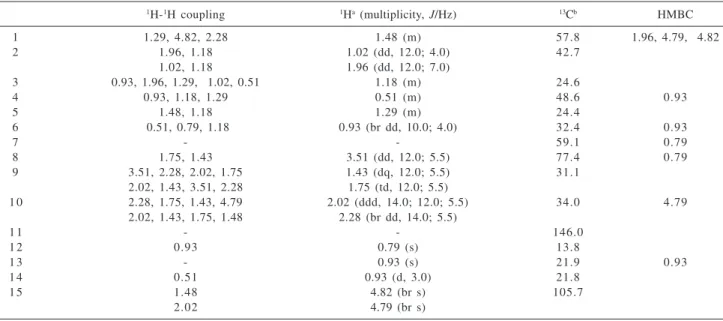
molecule. The HMQC spectrum showed long-range correlations between carbons and hydrogens (Table 1). These results associated with those showed in 1H-1H COSY
spectrum indicated the connectivities in the molecule, and suggested a decahydroazulene derivative with a cyclopropane ring. The mutual long range coupling between the signals at δ 1.48 (H-1) and δ 4.82 (H-15), δ
2.28 (H-10) and δ 1.29 (H-5), the latter being a W coupling,
corroborates the suggested structure and indicated the β
orientation to cyclopropane ring. This spectrum also showed the coupling between the hydrogens at C-9 and those at C-10 and C-8; thus, the two methyl groups should be at C-7. The presence of these groups interrupted the
1H-1H connectivities in the seven member ring. Therefore,
the cyclopropane group could only be at the five-carbon ring. The mutual coupling observed among the signals at
δ 0.51 (H-4) and δ 1.29 (H-5), and δ 1.18 (H-3) located the cyclopropane ring between C-3/C-5. This situation was corroborated by the correlations between 3/2 and
H-3/H-6, observed in the 1H-1H COSY spectrum. HMBC long
range correlations confirm the proposed structure. The small coupling constants of H-1 (W½ = 8 Hz) indicated a cis ring junction between the five and seven member rings. The
chemical shift of methyl group at C-4 (δ 21.8) suggested
the presence of this group at a position, free of δ
interactions. This sesquiterpenic skeleton has not been described in the literature yet, and was denominated
macrocarpane. Therefore, the structure of 10 was defined as macrocarp-11(15)-en-8-ol.
The biosynthetic pathway proposed to 10 should
involve a himachalane derivative which was not detected
in this study, but has been isolated from Ferula latipinna
(Umbelliferae),10 which could be formed by cyclization of
bicyclogermacrene (Figure 1). In the volatile oil, the
absence of 10 and the reduced amount of 7 (3.0%) could
be explained by the predominance of germacrene-D (37.8%) and bicyclogermacrene (27.5%). In the hexane extract, these sesquiterpenes were not detected, indicating that 7 and 10 should be formed from 4,11 corroborating the
proposed biosynthetic pathway.
The volatile oil from the leaves of P. macrocarpa was
submitted to chromatographic separationand the fractions
obtained were analysed by GC.12 The sesquiterpenes 3, 4,
7, 8 and 9 and the diterpene 11 were characterized as the
Table 1. 1H and 13C NMR data for sesquiterpene 10 (500 and 125 MHz, δ, CDCl 3)
1H-1H coupling 1Ha (multiplicity, J/Hz) 13Cb HMBC
1 1.29, 4.82, 2.28 1.48 (m) 57.8 1.96, 4.79, 4.82
2 1.96, 1.18 1.02 (dd, 12.0; 4.0) 42.7
1.02, 1.18 1.96 (dd, 12.0; 7.0)
3 0.93, 1.96, 1.29, 1.02, 0.51 1.18 (m) 24.6
4 0.93, 1.18, 1.29 0.51 (m) 48.6 0.93
5 1.48, 1.18 1.29 (m) 24.4
6 0.51, 0.79, 1.18 0.93 (br dd, 10.0; 4.0) 32.4 0.93
7 - - 59.1 0.79
8 1.75, 1.43 3.51 (dd, 12.0; 5.5) 77.4 0.79
9 3.51, 2.28, 2.02, 1.75 1.43 (dq, 12.0; 5.5) 31.1
2.02, 1.43, 3.51, 2.28 1.75 (td, 12.0; 5.5)
1 0 2.28, 1.75, 1.43, 4.79 2.02 (ddd, 14.0; 12.0; 5.5) 34.0 4.79
2.02, 1.43, 1.75, 1.48 2.28 (br dd, 14.0; 5.5)
1 1 - - 146.0
1 2 0.93 0.79 (s) 13.8
1 3 - 0.93 (s) 21.9 0.93
1 4 0.51 0.93 (d, 3.0) 21.8
1 5 1.48 4.82 (br s) 105.7
2.02 4.79 (br s)
18 Chaves et al. J. Braz. Chem. Soc.
main compounds in mixtures by analysis of their 1H and
13C NMR spectra. The comparison with the literature
values confirmed the proposed structures5,13-15.
Additionally, the crude volatile oil was submitted to analysis by GC/MS. The sesquiterpenes 1, 2, 5 and 6 were identified. This analysis confirms the identification of the sesquiterpenes 3, 4 and, 7, and the diterpene 11, which were characterized by NMR. Using this methodology, which is a combination of three spectrometric techniques (NMR, GC, GC/MS), nine sesquiterpenes, and one diterpene (83.1 % in weight) were identified in the volatile oil (Table 2).
Experimental
Plant material
All the leaves of P. macrocarpa (Warm.) R.E. Fries were collected from the same specimen, in March 1992 (hexane extract), and in December 2000 (volatile oil) at the Jardim Botânico of São Paulo State. A voucher specimen has been
deposited in the herbarium of the Instituto Botânico, São Paulo, Brazil under reference SP76791.
Extraction and isolation of the compounds
Dried powdered leaves (750 g) of P. macrocarpa were
extracted with hexane three times at room temperature. The concentrated hexane extract was partitioned between
MeOH/H2O (9:1, v/v) and hexane. The hexanic part (10 g)
was submitted to precipitation with MeOH from which were obtained the waxy material (9 g), and the MeOH
soluble material (1 g). The MeOH/H2O phase (6 g) and the
MeOH soluble material (1 g) were pooled together, chromatographed on silica gel column and eluted with increasing amounts of EtOAc in hexane, from which were obtained four groups (I-IV), after TLC on silica gel analyses. The group I (351 mg) was submitted to flash chromatography on silica gel and eluted with
hexane-EtOAc (6:4, v/v) yielding 7 (77 mg). Group II (720 mg)
was methylated with diazomethane, submitted to flash chromatography on silica gel and eluted with hexane-EtOAc (97:3, v/v) giving two mixtures A (359 mg), and B
(30 mg). The 1H NMR spectrum of A showed the occurrence
of fatty acid esters. Fraction B was applied to a Sephadex
LH-20 column and eluted with hexane-CH2Cl2 (1:4, v/v)
to yield 11 (10 mg). Group III (483 mg) was submitted to
flash chromatography on silica gel and eluted with hexane-[CH2Cl2-MeOH (98:2, v/v)] (6:4, v/v) to give two mixtures C (30 mg) and D (200 mg). Mixture C was comprised of
two steroids (12 and 13). Mixture D was applied to a
Sephadex LH-20 column and eluted with hexane-CH2Cl2
(1:4, v/v) to give a mixture of one sesquiterpene and steroidal material. The purification by prep. TLC on silica
gel with 15% of AgNO3 [hexane-EtOAc (6:4, v/v)] yielded
10 (15 mg).
The fresh plant material (2250 g) was hydrodistilled
Table 2. Chemical constituition of the crude volatile oil from leaves
of P. macrocarpa
component RRt RI percentage identification GC/MS NMR
α-cubebene (1) 562 1351 3.1 X
α-copaene (2) 581 1376 1.8 X germacrene-D (3) 712 1480 37.8 X X bicyclogermacrene (4) 734 1496 27.5 X X
γ-cadinene (5) 745 1513 1.4 X
δ-cadinene (6) 769 1524 2.0 X spathulenol (7) 849 1576 3.0 X X
globulol (8) 857 1592 1.6 X
cis-cubenol (9) 954 1668 1.9 X
phytol (11) 1518 2114 3.0 X X
19 Macrocarpane, a New Sesquiterpene Skeleton from the Leaves of Porcelia macrocarpa
Vol. 14, No. 1, 2003
using a Clevenger type apparatus to give the crude volatile oil (735 mg; yield 0.03%). Part of this material (500 mg) was submitted to flash chromatography on silica gel and
eluted with CH2Cl2 and CH2Cl2-MeOH (95:5 and 9:1)
affording mixtures containing 1 + 3 + 4 (fr 4, 137 mg), 3 +
4 (fr 6, 25 mg), 11 (fr 34, 16 mg), 7 (fr 38, 12 mg), 8 + 9 (fr 39, 52 mg). The remaining part of the crude volatile oil was subjected to analysis by GC/MS to identify the sesquiterpenes 1, 2, 5 and 6.
General
Silica gel 60 (Merck) was used for chromatography:
63-200 µm for CC, 40-63 µm for flash chromatography,
PF254 (5-45 µm) for preparative TLC. IR spectra were
obtained as KBr pellets in a Perkin-Elmer Infrared Spectrometer model 1750. Sephadex LH-20 (Sigma) was used for molecular exclusion chromatography. NMR
spectra were recorded at 300 and 500 MHz for 1H and 75
and 125 MHz for 13C on Brüker DPX-300 and DRX-500
spectrometers using CDCl3 as solvent and internal standard. The GC analysis was performed in a Hewlett-Packard 5890 series II (using helium as carrier gas) equipped with a FID detector and a capillary column HP-5, crosslinked 5% phenyl in 95% methyl silicone (30 m x 0.32 mm, film
thickness 0.25 µm) with a automatic injector (HP 7673)
and an electronic integrator (HP 3396A). The temperature programming was from isothermal 100 °C for 2 min,
100°-240 °C at 5°C.min-1, then isothermal at 240 °C for 5 min.
The (FID) injector and detector temperatures were 180 °C and 260 °C, respectively. The GC/MS analyses were carried out in an EIMS 70 eV Hewlett-Packard HP-5973 coupled with a Hewlett-Packard HP-6890 with a DB-50 column
(30 m x 0.25 mm, film thickness 0.25 µm) using the same
temperature programming conditions describe above. The identification of the compounds was done by comparing retention indices (determined relatively to the retention times of a series of n-alkanes) and mass spectra to those of authentic samples.
Macrocarp-11(15)-en-8-ol (10): colourless oil. IR (KBr)
νmax cm-1: 3402 (OH), 3108 (cyclopropane ring), 2945
(C-H), 1637 (>C=CH2), 919, 888. EIMS (70 eV) m/z (rel. int.)
220 [M]+(58), 202 [M-H
2O]
+(7), 187 [C 14H19]
+(17), 177
[C12H17O]+(22), 159 [C 12H15]
+(100), 145(24), 135(16),
133(27), 131(32), 121(16), 119(32), 117(30), 109(28),
107(23), 105(48), 95(14), 93(44), 91(55), 81(23), 79(32), 77(31), 69(13), 67(32), 65(14), 57(12), 55(36), 53(22). 1H
and 13C NMR: see table 1.
Acknowledgements
The authors are grateful to Dra. Maria Claudia Marx Young from Instituto de Botânica/SMS for the plant material provision. This work was supported by CAPES, CNPq and FAPESP.
References
1. Chaves, M.H.; Roque, N.F.; Phytochemistry 1997, 44, 523. 2. Chaves, M.H.; Roque, N.F.; Phytochemistry 1997, 46, 879. 3. Chaves, M.H.; Santos, L.A.; Lago, J.H.G.; Roque, N.F.; J. Nat.
Prod. 2001, 64, 240.
4. Chaves, M.H.; Freitas, A.; Roque, N.F.; Cavalheiro, A.J.; Quim. Nova2000, 23, 307.
5. Iwabuchi, H.; Yoshikura, M.; Kamisako, W.; Chem. Pharm.
Bull. 1989, 37, 509.
6. Rahman, A.; Ahmad, V.U.; 13C NMR of Natural Products,
Ple-num Press: New York, 1992.
7. Ahmad, V.U.; Aliya, R.; Perveen, S.; Shameel, M.;
Phytochem-istry 1992, 31, 1429.
8. Chaves, M.H.; PhD Thesis, Universidade de São Paulo, Brazil, 1996.
9. Gil, V.M.S.; Geraldes, C.F.G.C.; Ressonância Magnetica
Nuclear, Fundação Calouste Gulbenkian: Lisboa, 1987.
10. Gonzales, A.G.; Bermejo, J.; Diaz, J.G.; Arancibia, L.; De Paz, P.P.; J. Nat. Prod.1988, 51, 1140.
11. Toyota, M.; Koyama, H.; Mizutani, M.; Asakawa, Y;
Phy-tochemistry 1996, 5, 1347.
12. Brochini, C.B.; Núñez, C.V.; Moreira, I.C.; Roque, N.F.; Chaves, M.H.; Martins, D.; Quim. Nova1999, 1, 37. 13. Randriamiharisoa, R.; Gaydou, E.M.; Faure, R.; Bianchini,
J.P.; Mag. Res. Chem.1986, 24, 275.
14. Toyota, M.; Nagashima, F.; Fukuyama, Y.; Honda, S.; Asakawa,
Y.; Phytochemistry 1988, 27, 3317.
15. Faure, R.; Ramanoelina, A.R.P.; Rakotonirany. O.; Bianchini, J.P.; Gaydou, E.M.; Mag. Res. Chem.1991, 29, 969.
Received: November 1, 2001 Published on the web: October 29, 2002