Study of Bulk Properties of QCD Matter by the Relativistic Heavy Ion Collisions
Takeshi Kodama
Instituto de F´ısica, Universidade Federal do Rio de Janeiro C.P. 68528, Rio de Janeiro 21945-970, RJ, Brazil
Received on 24 October, 2006
We review the present understandings of the bulk properties of strong interacting matter obtained from Rela-tivistic Heavy Ion collision processes and the origin of collective flow. We discuss some open questions in the hydrodynamical approach to these processes.
Keywords: Relativistic hydrodynamics; QGP formation
I. INTRODUCTION
The existence of phase transitions of strongly interact-ing bulk matter predicted by the quantum chromodynamics (QCD) should relfects itself in variety of physical scenarios such as the evolution of inhomogeneities in the early universe, structure of compact stars, spectra of particles from nuclear collisions at ultra-relativistic energies, etc. In particular, the relativistic heavy ion collisions are the unique possibility of observing such phase transitions of the QCD bulk matter in laboratories, permitting us to extract the properties of the mat-ter at extremely high temperature and energy density.
It is now almost three decades since the basic idea of using ultra relativistic heavy ion collisions to achieve the new phase of the matter, quark-gluon plasma (QGP), was proposed[1]. By colliding two nuclei at relativistic energies, a huge amount of energy is expected to be concentrated in a small space-time region which would lead to this new phase. At first sight, one may think that a more simple system such as a single hadron-hadron collision rather than nucleus-nucleus collision could also achieve such a state and if so, it would be easier to study the QCD dynamics. In fact, heavy ion collisions are much more complicated and expensive than hadronic colli-sions for the same energy. Furthermore, the final states of the system become orders of magnitude more complex due to the corresponding large number of degrees of freedom involved. Therefore, methods of data storage and their analysis also be-come complex. However, when we want to investigate the thermodynamical signals of a system, we should first establish the thermodynamical equilibrium. This necessarily requires large interaction time and volume so that only in a macro-scopic system we can approach the thermal equilibrium. In hadron-hadron collisions, the system is too small to attain the thermal equilibrium. Thus the complexity of heavy ion col-lision is the price we have to pay to study the possible phase transition phenomena of the QCD bulk matter.
The relativistic heavy ion collision program started with the incident energy ∼1GeV per nucleon using the Bevalac, in Berkeley, just before the 80’s. Subsequently, in Brookhaven and Dubna, fixed target nuclear collisions at relativistic ener-gies have been studied. In the 90’s, a heavy ion program with fixed target started at the CERN SPS accelerator. The center of mass energy then was of the order of a few tens ofGeV per nucleon pairs. In the end of the year 2000, the Relativistic Heavy Ion Collider (RHIC) at BNL began to work, with
ener-gies of 100−200GeV at the center of mass, and in the next year (2007) the Large Hadron Collider (LHC) at CERN will be in operation for a heavy ion program in the energy range of a fewTeV s.
In early times, a clear-cut first order phase transition from hadronic matter to QGP was expected so that it was hoped that one might observe well-defined signals of phase transition such as the identification of latent heat by the construction of caloric curves (entropy density vs. temperature), but this was not so easy. During these two decades, especially from the experiments realized at SPS and RHIC, a lot of new data have been obtained and is still being accumulated. They revealed the extremely complex nature of the physical processes in-volved in heavy ion collisions. Instead of the initial naive QGP signals, necessities of more sophisticated observables have been recognized.
Although the nature of the transition from the hadronic phase to the QGP phase is still not well understood, the over-all “picture” of relativistic heavy ion collisions is now being configured. In addition to the experimental data, advances in theoretical studies also enriched understandings of the prop-erties of the strong interacting matter[2]. In particular, re-cent developments in the lattice-QCD calculations are very significant[3]. We now believe that there exists a tri-critical point in the (T,µ) phase diagram[4]. For (almost) baryon-antibaryon symmetric matter achieved in the central collisions of relativistic heavy ion reactions (or in the cosmological sce-nario) the phase transition from the color deconfined phase to confined phase will not be of the first order but higher order one or more smooth cross-over.
In this short review, we report the present status of the ultra-relativistic heavy ion collision physics, in particular, the col-lective flow phenomena which is considered as a robust signal of the formation of new state of hadronic matter. We also dis-cuss some of open problems of hydrodyanamical approach.
II. COLLECTIVE FLOW AS A SIGNAL OF FORMATION OF NEW STATE OF THE HADRONIC MATTER
not talking about a mere observation of the presence of quark-gluon degrees of freedom, but how they become deconfined and behave as the real carriers of the thermodynamical energy and momentum. That is, we are talking about dynamical mo-bilities of quarks and gluons.
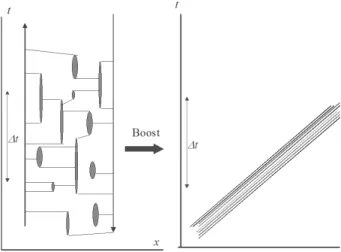
First, let us consider the structure of hadrons in terms of quarks and gluons. In the QCD picture, a hadron is a bound state of quarks which may be illustrated as in Fig.1.
FIG. 1: Many virtual quarks and gluons form dressed valence parti-cles in a hadron (left). These virtual partiparti-cles behaves as real partiparti-cles in a short time and distances (right).
In the left-hand side of this figure, a hadron (in this case, a meson) structure is illustrated in terms of two (valence) quark lines where the vertical direction represents the time and hor-izontal direction the space. Between the two lines many (infi-nite) virtual bubbles formed by quark-antiquark pairs are con-nected with gluon exchanges.
Suppose we need a certain minimum time interval ∆t to observe the structure of this hadron. All virtual lines which are shorter than this time interval are strongly correlated so that they are not observable as individual degrees of freedom. Only their average behavior reflects the observed hadron prop-erties. When the hadron is boosted near the speed of light (the right-hand side of the figure), then due to Lorentz dila-tion of time all these short-living bubbles elongate and the effect of correlation among them becomes irrelevant within the time interval∆t. In fact, all these virtual quarks and anti-quarks, together with gluons, can be regarded as independent particles within this short interaction time interval. There-fore, it is these “independent particles” that are responsible for the first interactions among high energy hadron collisions. They are called “partons”. Then we expect that the number of these partons will increase when the incident energy increases, since for higher energies we can “see” more uncorrelated vir-tual lines within a given interaction time∆t.How the number of partons increases as a function of the incident energy de-pends on the interaction which generates the virtual pairs in a hadron, i.e., depends on the ground state of the system. In practice, this energy (momentum) dependence of the number
of partons is observed as the structure functions of a hadron in deep inelastic collisions.
After the first instant of the collision in hadron-hadron col-lisions, these partons are shot out from their initial configu-rations and materialized. Several QCD based models (parton cascade, string fragmentation, Brigov-Regge theory, etc) have been constructed to simulate the high energy hadronic and nu-clear collisions[5]. Recently, the theory of color glass con-densate has been applied to calculate the initial energy den-sity distribution in the case of nucleus-nucleus collisions[6]. A huge number of partons is produced so that if interactions among them are sufficiently effective, thermalization of the partonic gas will be attained very quickly. This is the QGP and the most of partons are taken out from the vacuum which consitutes the hadron. In this sense, the QGP formed in high energy nucleus-nucleus collisions can be viewed as a conse-quence of “melting” nucleons at high energy density. Since these partons are nothing but the basic ingredients which con-stitute the background for the nucleon’s proper existence, i.e., the physical vacuum itself, we may also say that the QGP is a melted state of the physical vacuum.
Unfortunately, the melted vacuum cannot be observed di-rectly, since any observables are in the form of hadrons far af-ter their formation at the melting point. The QGP formed ex-pands rapidly in space and cooled down to hadron gas, again. Therefore, we have to find some way to deduce the properties of the melted matter as QGP using only after the observable hadronic final states. This is also exactly the case of the mod-ern observational cosmology, where we try to find out signals of the initial melted state of matter just after the Big-Bang in terms of the present-day signals.
exper-iments and despite the needs of several caveats which should be considered with care, a large amout of convincing facts that indicate the formation of the QGP phase in the early phase of nuclear collisions have been accumulating[7].
Among these signals, the one which brought a new insight is the emergence of collective flow in the final state of explod-ing particles. Suppose that a very high energy density domain has been created in the nuclear collision. If the mean-free path of partons are sufficiently short compared with the size of this domain, then the matter inside tends to create a collec-tive pressure which acts the system to expand. This is exactly the situation we expect in the hydrodynamical motion of a fluid. Since the acceleration of the expansion is proportional to the pressure gradient, the particles in the final state should have larger momentum in the direction in which initially the largest pressure gradient.
To make clear the meaning of the collective flow, let us here review the basic structure of the relativistic hydrodynamics. LetTµνbe the energy-momentum tensor of the matter. Then the dynamics of the system should obey the conservation law of this tensor,
∂µTµν=0. (1)
For the case of a perfect fluid in local equilibrium, we can write
Tµν= (ε+p)uµuν−pgµν,
whereε,panduµare, respectively, the proper energy density, pressure and four-velocity of the fluid element. Eq.(1) should be complemented by the continuity equations for conserved currents such as the baryon number,
∂µ(nuµ) =0,
and also the equation of state which describe the thermody-namical properties of the matter. The equation of state may be given by
ε=ε(n,s),
wheren ands are the baryon number and the entropy den-sities, respectively. For ideal fluid, the endropy is also con-served,
∂µ(suµ) =0.
These hydrodynamical equations can also be derived from the action principle[10]. They can be solved numerically to give the space-time development for the thermodynamical vari-ables and the fluid velocityuµ[11].
To analyze the physical observables in terms of the hydro-dynamical scenario, we have to construct the particle spectra from the hydro solution. As the hydrodynamical expansion proceedes, the fluid becomes cooled down and also becomes rarefied, occurring finally the decoupling of the constituent particles, that is, they don’t interact any more until their detec-tion (Long-lived resonances and other unstable particles may
decay on the way to the detector after this instant of decou-pling phase). In the standard hydrodynamical models, one in-troduces the concept of freeze-out, which assumes that parti-cle emission occurs on a sharp three-dimensional surface (de-fined for example by the local temperature,T(x,y,z,t) = con-stant). Before crossing it, particles have a hydrodynamical be-havior, and after they free-stream toward the detectors, keep-ing memory of the conditions (flow, temperature) of where and when they crossed the three dimensional surface. The Cooper-Frye formula [15] gives the invariant momentum dis-tribution in this case
Ed3N/d p3=
Z
σdσµp
µf(x,p). (2)
dσµis the surface element 4-vector of the freeze out surface σand f the thermal distribution function of the type of par-ticles considered. The space-time dependence comes from those of thermodynamical parameters, such as temperature and chemical potential. This is the formula implicitly used in all standard thermal and hydrodynamical model calculations (see [16] and the discussion in the next section for different approach of hadron production from the thermal gas). It is found that the hydrodynamical description can describe very well the many observables[9][19].
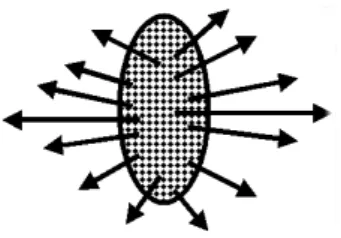
As menioned above, one of the most important observables in the hydrodynamical approach is the collective flow para-meter. For non-central collisions, anisotropic hot matter is created in between the colliding nucleus and this should lead to the anisotropic azimuthal distribution of particle momenta with respect to the reaction plane as illustrated below.
FIG. 2: Non central collision of two nuclei creates an anisotropic dis-tribution of hot and dense matter which expands hydrodynamcally.
FIG. 3: Due to the sharp pressure gradient, the final state particles attain the anisotropic momentum distrubution.
experimental data is not trivial since the reaction plane is not given a priori. In the hydro case, of course, the reaction plane is given from the beginning. We define the theoretical elliptic flow for a given transverse momentum window as
v(2)(pT) =
R
dφ£
d2N/d p2 Tdφ
¤
cos 2¡
φ−φ~b
¢®
R
dφ£
d2N/d p2
Tdφ
¤® ,
wherepT is the transverse momentum, andφandφ~bare, re-spectively, the azimuthal angles of the particle and of the im-pact parameter vector with respect to a some space-fixed co-ordinate system.
The finite positive value of this coefficientv2is referred to
as the elliptic flow and, from the point of view of hydrody-namics, it is sensitive to the initial pressure gradient of the system. In Figs.4 and 5, hydro calculations of the elliptic flow for different equation of states are shown together with the ex-perimental data. In these figures, we can see clearly that the elliptic flow reaches to the hydrodynamical limit for RHIC energies (Fig.5) whereas for lower energies (SPS - Fig.4) the flow is much less than that expected from the hydro model. This can be understood as, while the hadronic gas behaves as a viscous dissipasive matter, the QGP has much less dissipa-tive energy per unit entropy and offers a large initial pressure gradient, and the elliptic flow reaches to its ideal fluid dynam-ical limit, as seen from Fig.5.
FIG. 4: Elliptic flow at SPS energies as function of transverse mo-mentum, compared to the simple idela fluid hydrodynamical calcula-tion. The observed values of elliptic flow are below the hydro values. Figure adapted from the presentation of M. Gyulassy at International Symposium on Heavy Ion Collisions, Frankfurt, April, 2006.
These hydro calculations, together with the other observ-ables, such as pion interferometry (HBT[12]) measurements indicate that the thermal equilibrium of QGP is attained at a very early stage of the nucleus-nucleus collisions[13][23].
III. SOME OPEN PROBLEMS OF RELATIVISTIC HYDRODYNAMICS
We may summarize the present general picture for the formation of QGP in the relativistic heavy ion collisions at RHIC energies. I)-Hadronic abundances are well described
FIG. 5: Elliptic flow at RHIC energies as function of transverse mo-mentum, compared to the simple idela fluid hydrodynamical calcu-lation. Figure adapted from the presentation of M. Gyulassy at In-ternational Symposium on Heavy Ion Collisions, Frankfurt, April, 2006.
in terms of chemical equilibrium among hadronic resonances, which in turn indicate the temperature and chemical poten-tial of this stage. Temperatures as high as 170MeV in the chemical freeze-out are obtained in RHIC data, which indi-cate that the temperature achieved during the collision must have much exceeded the critical temperature predicted by the lattice QCD calculation. II)-Ideal hydrodynamical calcula-tions work basically well. This approach indicates the very early equilibration of the partonic gas. III)-In particular, the large elliptic flow observed at RHIC energies is consistent with the ideal fluid calculation, and when compared to the SPS cases, this fact strongly indicates that the new state of matter has been formed at the early stage of the collision at RHIC energies which flow as an ideal fluid. IV)-HBT mea-surements also indicate a short equilibration time. V)-Some indications of non-equilibrium processes reflecting in multi-strangeness enhancement.J/ψand heavy quark observations. IV)-Observations of jet-quenching, distribution of mono-jets, and their dependence on system size effect (jet tomography) are consistent with the emergence of hot and dense decon-fined quark and gluon domain. VII)- The nature of the QGP seems rather a strongly interacting fluid (sQGP) than a ideal parton gas, although the corresponding Reynold´s number is very large, close to the ideal fluid[18].
As shown above, although the evidences are yet circum-stancial, a lot of convincing indications are accumulating to believe that the QGP phase has been attaind in the RHIC ex-periments. However, we still do not know the precise nature of the QGP and its formation dynamics. In the coming LHC experiment (ALICE), observations of the hard components (jets), possible generation of shock waves and heavy quark production will be the central issue, in addition to other in-teresting possibilities such as the large extra dimension of the space-time.
in terms of the hydro model. These questions require careful examination to extract quantitative and precise information on the properties of QGP. For example, it has been pointed out that the effect of even-by-event fluctuations due to the dif-ferent initial conditions are crucial for quantitative studies of observables[17].
Furthermore, several very different physical scenarios within the hydro calculation (e.g. continuous emission, sud-den freeze-out, rQMD cascade, some drastically simple hydro models, etc) can give rise equally good results in reproduc-ing the observables with suitable choices of parameters. In a way, one may say that the hydro signature is “robust”, but on the other hand, this could be a synonym of “insensitive”, so that in order to extract some quantitative information on the properties of the quark-gluon plasma. For a better and quan-titative understanding of the mechanism of phase transition in the bulk QCD matter, we should clarify these points and refine the physical parameters used in these models.
With respect to this point, one should remind a important point of the collective flow. While we use the equation of state, hydrodynamical equations are meaningful only when the approximation of local thermal equilibrium is reasonable. On the other hand, as far as Eq.(1) is concerned, it is nothing but the local conservation of energy and momentum density. Therefore, it may be possible that a system which is com-pletely out of local thermal equilibrium can also manifest a flow pattern. For example, as a well-known example, we may recall that the Schr¨odinger equation
i~∂ψ
∂t =−
~2 2m∇
2ψ+Vψ
can also be written just as if the form of hydrodynamics, ∂
∂t~v+ (~v·∇)~v=− 1 m∇pq−
1 m∇V, ∂n
∂t +∇·(n~v) =0, where
~v= 1
m∇(argψ), n=|ψ|2 and
pq=− 1 2m
1 |ψ|∇
2|ψ|
serves as the pressure, but nothing to do with the thermal equi-librium. That is, a flow phenomena does not necessarily indi-cates the validity of the local thermodynamical equilibrium.
We may list several crucial points of the hydrodynamical approach to the relativistic heavy ion reactions.
1. How to establish the initial condition for the hydrodynamical motion in relativistic heavy ion reactions.
In particular, the process of thermalization of the par-tonic excitation, and understand how the early
thermaliza-tion can be attained. Several new concepts have been pro-posed. For example, as the mechanism of quick isotropiza-tion from the initial momentum distribuisotropiza-tion of partons (which is predominantly longitudinal), the so-called Weibel instabil-ities known in plasma physics is shown to be effective also in the case of QCD. However, the isotropization itself is not suffice for the thermal equilibrium. With respect to the mecha-nism of thermalization, another interesting notion, called pre-thermalization is recently developed. In a scalar field theoreti-cal model, it is shown that when the system is set to an excited state, the validity of equation of state (the functional relation between energy density and pressure) is attained well before the real thermal equilibrium is reached[21]. With respect to this point, we have discussed a possible relation between the mechanism of early thermalization to the non-extended sta-tistical mechanics[20]. Furthermore, the approach from the color glass condensate may provide an initial momentum dis-tribution easy to achieve a quick thermalized state of partons because of saturation mechanism. As mentioned, several in-vestigations based on the CGC approach to calculate the initial energy distribution have been carried out.
2. How to estimate the effects of finite size of the system and event-by-event fluctuations.
Even the mechanism of thermalization is fast enough, the initial condition attained by the nuclear collision must be far from smooth and fluctuates collision by collision. Further-more, strictly speaking, the hydrodynamics is the zero mean-free path approximation but for the nuclear collisions, this is not a trivial approximation. As we know that the nuclear ground state has finte surface thickness (of the order of 3 fm) but if we try to describe the density distribution in terms of zero mean free-path hydrodynamics, we would have zero sur-face thickness for the ground state mass distribution. The pa-rameter which characterizes the degree of approximation with respect to the finite size of the system would be
x= λMFP λHydro
whereλMFP is the tipical mean-free path of the constituent particles and λHydro is the hydrodynamical inhomogenity scale, which is tipically
λHydro≃
¯ ¯ ¯ ¯
1 ρ∇ρ
¯ ¯ ¯ ¯
−1
.
Such an effort is being done and recently that the effect of finite size of the system on the properties of chiral phase tran-sition has been estimated using the multiple reflextion expan-sion method within the frame work of Nambu-Jona-Lasinio model, showing explicitly the dependence of the equation of state (EoS) on the system size parameter. The basic idea is to introduce the density of state in the expression of the ther-modynamical potential within the mean-field approximation as
ω=m
2
4G−ν
Z ΛUV
0 dkρMRE(k,κ,R)
½
Ek+ 1 βln
h
1+e−β(Ek+µ)i h1+e−β(Ek−µ)i
¾
,
where
ρMRE= k
2
2π2
·
1+6π
2
kR fS
µ
k κ

+ 12π
2
(kR)2fC
µ
k κ
¶¸
,
is the density of state given by the multiple expansion method, and
fS(x) =−1 8π
µ
1−2 πarctanx

, (3)
fC(x) = 1 12π2
·
1−3 2x
³π
2−arctanx
´¸
. (4)
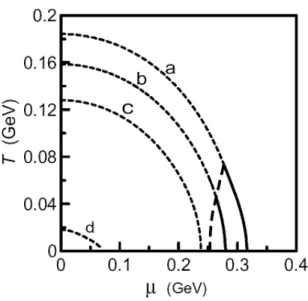
Randκare parameters related to the radius and surface thick-ness. In Fig.6, we show how the structure of the phase dia-gram is affected by the radius parameterR,withκ=0.The solid and dotted lines represents the critical lines of the first order and second order phase transitions, respectively. These lines represent the critical lines of (a)R=∞, (b) 20, (c) 10 and (d) 5.7 fm from the out-most one, respectively. One can see that the transition temperature of the chiral phase transi-tion is lowered as the system size is reduced. The reductransi-tion of the temperature is remarkable already atR=20 fm. The dashed line represents the trajectory of the tricritical point as a function ofR. One can easily see that the temperature and the chemical potential of the tricritical point are reduced as theR is decreased.
Although the example shown here is a very simplified es-timate, but the effect of inhomgenity on the equation of state can be very important for the hadronization mechanism of the QGP formed in the relativistic heavy ion collisions.
3. How to estimate the viscosity and its effect on collective flow phenomena for the QCD matter.
The comparison of flow phenomena to the ideal fluid calcu-lation indicates that the emergence of ideal-fluid type behavior at RHIC energies. This idea that the QGP behaves a real ideal fluid raised an interesting question which may have its orgin in supersymmetric gravity theory[24]. On the other hand, Hi-rano and Gyulassy argue that this is due to the the entropy density of the QGP which is much larger than the hadronic phase[6]. To be precise, a precise and consistent analysis of
FIG. 6: Change of phase diagram with respect to the size parameter of the system. Curves a, b, c and d correspond to the critical tempera-ture as function of the chemical potential for different size parameter R(see the text).
the viscosity has not yet been done. This is because the intro-duction of dissipative phenomena in relativistic hydrodynam-ics casts difficult problems, both conceptual and thechnical. It is known that the formalism of Landau[3] of relativistic vicous fluid leads to acausal wave propagation. To cure this problem, the second order thermodynamics was developed by Israel, Stewart and Miller[4]. However, this theory is too general and contains many unknown parameters which make difficult the application of the theory to practical problems. Several works have been done in this direction.
4. How to obtain the final hadron spectra from the hydrodynamical model.
temperature of the continuous emission scenario give equally good description of the observed spectra and flow.
IV. SUMMARY
The hydrodynamics is found to be a very successful tool for the description of the relativistic heavy ion collisions. A very simple, idealized form of this approach revealed that at the RHIC energies there emerges a new phase for the dense and hot matter which flows as if an ideal fluid. This may be identified as the QGP. On the other hand, from the quantitative
point of view, the present hydrodynamical approach still con-tains many uncertainties and also some conceptual problems. When these questions are clarified, we will have much more detailed knowledge about the dynamics and properties of the new states of strongly interacting matter.
The author expresses his thanks to T. Koide, M. Kiriyama, F. Grassi, Y. Hama, C.E. Aguiar, E. Fraga, Ph. Mota and G.S. Denicol for stimulating discussions and kind help. This work was partially supported by FAPERJ, CNPQ and CAPES.
[1] See for example, S. Nagamiya, and M. Gyulassy, Adv. Nucl. Phys.13, 201 (1984).
[2] See the recent text book by J. Letessier and J. Rafelski, “Hadrons and Quark Matter”, Cambridge Univ. Press 2002 and the collection of review papars on QGP, see R. Hwa and X.N. Wang, eds., “Quark Gluon Plasma 3”, World Scientific Pub, 2005
[3] F. Karsch, Nucl. Phys. A698, 199 (2002).
[4] Z. Fodor and S. D. Katz, Phys. Lett. B534, 87 (2002). [5] X.N. Wang and M. Gyulassy, Phys. Rev. D44, 3501 (1991);
K. Geiger and D. Srivastava, Phys. Rev. C56, 2718 (1997); T. Pierog, H. J. Drescher, F. Liu, S. Ostaptchenko, and K. Werner, Nucl. Phys. A715, 895 (2003).
[6] T. Hirano and Y. Nara, J. Phys. G30, S1139 (2004).
[7] S. S. Adler et al. ex/0306021; J. Adams et al. nucl-ex/0306024; B. B. Back et al. nucl-ex/0306025
[8] H. St¨ocker et al.,AIP Conference Proceedings631, 553 (2001). [9] L. V. Bravina et al. Phys. Rev. C60, 024904 (1999).
[10] H. T. Elze, Y. Hama, T. Kodama, M. Makler, and J. Rafelski, J. Phys. G25, 1935 (1999).
[11] C. E. Aguiar, T. Kodama, T. Osada, and Y. Hama, J. Phys. G 27, 75 (2001).
[12] see for example, U. A. Wiedermann and U. Heinz, nucl-th;9901094
[13] see for example, P. F. Kolb and U. Heinz, nucl-th/0305084.
[14] E. Shuryak, Prog. Part. Nucl. Phys.53, 273 (2004). [15] F. Cooper and G. Frye,Phys. Rev. D10. 186 (1976).
[16] F. Grassi, Y. Hama, and T. Kodama, Phys. Lett. B355, 9 (1955); Z. Phys. C73,153 (1966).
[17] C.E. Aguiar, Y. Hama, T. Kodama, and T. Osada, AIP Conf. Proc.631, 686 (2003).
[18] T. Hirano and M. Gyulassi, nucl-th/0506049.
[19] Y. Hama, T. Kodama, and O. Socolowski, Braz. J. Phys.35, 24 (2005).
[20] T. Kodama, H.-T. Elze, C.E. Aguiar, and T. Koide, EuroPhys. Lett.70, 439 (2005).
[21] J. Berges, S. Borsanyi, and C. Wetterich, Phys. Rev. Lett.93, 142002 (2004).
[22] P. Huovinen, Nucl. Phys. A761, 296 (2005).
[23] D. Teaney, J. Lauret, and E.V. Shuryak, nucl-th/0110037. [24] P. Kovtun, D.T. Son, and A. O. Starinets, Phys. Rev. Lett.94,
111601 (2005).
[25] H. Stoecker, Nucl. Phys. A750, 121 (2005).
[26] J. Randrup and S. Mrowczynski, Phys. Rev. C 68, 034909 (2003).
[27] P. Romatschke and M. Strickland, Phys. Rev. D70, 116006 (2004); A. Dumitru, Y. Nara, and M. Strickland, hep-ph/0604149.