Brazilian Journal of Physics, vol. 37, no. 1, March, 2007 23
Yang-Mills Effective Action from QCD at Finite Chemical Potential
C. Villavicencio and E. S. Fraga
Instituto de F´ısica, Universidade Federal do Rio de Janeiro, CP: 68528, Rio de Janeiro, RJ 21945-970, Brazil
Received on September 29, 2006
We present a construction of an effective Yang-Mills action for QCD, from the expansion of the fermionic determinant in terms of powers of the chemical potential at high temperature for the case of massless quarks. We analyze this expansion in the perturbative region and find that it gives extra spurious information. We pro-pose for the non-perturbative sector a simplified effective action which, in principle, contains only the relevant information.
Keywords: Effective Yang-Mills action; Perturbative QCD; Finite chemical potential
There has been an increasing interest in the last few years in thesign problemorphase problemin QCD. For finite chem-ical potential, the fermion determinant matrix is non-positive definite, so it is not possible to perform Monte-Carlo simula-tions [1, 2]. The Glasgow method [3] and sampling techniques [4] have made great advances in the description of phase tran-sitions on the lattice, considering a set of parameters near the transition line. However, the problem is still far from being solved.
There is special interest in the region of high temperature and low chemical potential, since it corresponds to the high-energy heavy-ion collision scenario. In this regime it is pos-sible to expand the fermion determinant in powers ofµ/T [5– 7]. This kind of expansion is what we are interested in in-vestigating. As one performs this expansion, some questions arise: what order is enough to cut the expansion? which is its range of validity? how to distinguish between real and com-plex terms? Differently from what is done in the previously mentioned papers, we keep the expanded series as a functional of the gauge fields, giving rise to an effective non-local Yang-Mills action.
I. BASIC IDEA OF THE EXPANSION
For simplicity, consider one-flavor massless quarks. The QCD generating functional at finite chemical potential in euclidean space is defined as
Z
=Z
D
Gdet(−iD/+iµγ4)e−SYM[G], (1) where G are the gluon fields, also present in the covariant derivativeD, andSYMis the Yang-Mills action. We can expandthe fermion determinant in powers of the chemical potential assuming thatµ<Λ∼T:
det(−iD/+iµγ4) =det(−iD/)exp (
− ∞
∑
s=1
(iµ)s
s
Z
Y1···Ys
Trγ4S(Y2,Y1)γ4S(Y3,Y2). . .γ4S(Y1,Yn) )
, (2)
whereS(Yb,Ya)is the dressed fermion propagator, which can be expressed as a series in powers of the gauge field and the
3 2 s
s-1
s-4 s-3 s-2
1
2
3
n-2 n
n-1
1
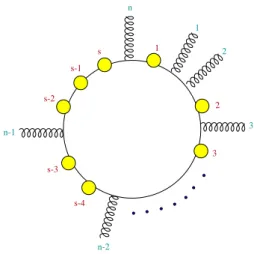
FIG. 1: General diagram for the construction of the effective vertices. The small circles correspond to chemical potential insertions.
free fermion propagator. The expansion, then, will contribute to additional terms in the Yang-Mills effective action
Seff
YM=SYM+
∞
∑
n=0 Z
X1···Xn
Γ(n)aµ11...µ...ann(Xi)G
a1
µ1(X1). . .G an
µn(Xn),
(3) where the verticesΓ(n) are series in powers of the chemical
potential: Γ(n)=∑
s≥1Γ(n,s), withΓ(n,s)∼µs. In this way we have a positive-definite fermion determinant and the contribu-tion from the chemical potential will be part of an effective Yang-Mills action. The problem now is to find criteria to cut this infinite series in terms of the chemical potential and gauge fields.
II. FEYNMAN DIAGRAMS
The Feynman rules to calculate the different effective ver-tices are almost the same as the usual ones in momentum space, except that all the operators between chemical poten-tial insertions must be transposed in order. Figure 1 shows a general diagram with chemical potential and gluon insertions. The rules are:
24 C. Villavicencio and E. S. Fraga
...
K...
...
P1 P2 Pr-1 Pr
K+P+...+P1 r
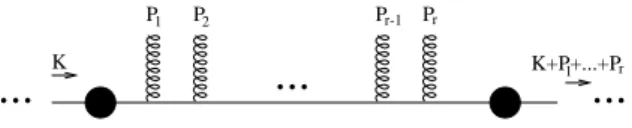
FIG. 2: Chemical potential insertions.
for any chemical potential insertion and divide by the symmetry factors, the number of chemical potential in-sertions shown in (2).
• Between chemical potential insertions, the order of the operator must be transposed considering momentum conservation. An example is shown in Fig. 2.
This piece of the effective vertex integrand must be written as
(−iµγ4)£S˜F(K)(−ta1γµ1)S˜F(K+P1). . .
. . .(−tarγµr)S˜F(K+P1+· · ·+Pr)
¤(t)
(−iµγ4),
where the exponent(t)in the brackets indicate to trans-pose the order of the operators: [
O
1O
2. . .O
j−1O
j](t)=O
jO
j−1. . .O
2O
1.• Take the trace over gamma matrices and color group representation, integrate over internal momentum and multiply by (2π)4δ(∑P
i) (momentum conservation). The summation of the internal Matsubara frequencies are over Fermi-Dirac modes.
The sum of all diagrams will produce the effective vertices Γ(n,s) which will be invariant under any cyclic change in the
set of indices µi, ai, Pi (or Xi in the case of configuration space). It is important that the effective vertices preserve ex-plicitly this cyclic feature at the moment of expanding in the HTL approximation, although some diagrams are the same when contracted with the gluon fields in the action because they are invariant under interchange of any set of indices as can be seen in (3).
III. PERTURBATIVE QCD
To test the expansion, we study it firstly in the perturbative sector. SettingG→gG, we find naturally the way to cut the gauge field series, which is given by the order of perturbative corrections. For one-loop corrections, we just need the effec-tive action up to orderg2, so
Seff
YM=SYM+Γ(
0)+g2Z
XYΓ
(2)ab
µν(X,Y)Gaµ(X)Gbν(Y). (4)
where this effective action is gauge invariant. If we calcu-late the pressure up to orderg2, considering the expansion on chemical potential up to orderµ4, we surprisingly obtain the same result as in the usual perturbative QCD calculation with the chemical potential included in the quark propagator [8].
However, the next terms in the chemical potential series are non-zero. In particular, the next vacuum contribution for the pressure is
P0(6)=−Γ
(0,6)
βV ≈0.9334Nc µ6
π2T2 , (5) which is negligible only forµ≪Λ. More than establishing the range of validity, this result shows that this kind of expansion contains some spurious information, at least for the massless case, and in principle the only indication on where to cut the series is the dimension of the desired observable.
IV. NON-PERTURBATIVE QCD
For the non-perturbative regime, we need another criterion to cut the series. The most appropriate is the Weinberg power counting [9], i.e. considering the external momentum as a small parameter, p<Λ, and also assuming that the chemi-cal potential and the expectation value of the fields are of the same order,µ∼G∼p. This gives a low-energy theory where the effective Lagrangian can be expanded in soft modes. In our case, we need that the chemical potential and the gluon field fluctuation be less than the external momentum. We are interested in not so low energies; if not, it is not possible to expand the fermion determinant. Since we want to see what will Weinberg criterion in this case is modified for not so low momentum asµ∼G<p<Λ.
In the case of Yang-Mills theories, this soft-mode expan-sions for high temperatures correspond to the Hard Thermal Loop (HTL) approximation [10, 11]. The minimal action must be of order p4. So, applying the power counting, the minimal effective action is
Smin
YM[G,µ] = SYM[G] +S
(0,2)[µ] +S(0,4)[µ]
+S(LO2,2)[G,µ] +S (3,1)
LO [G,µ], (6)
where the indices(n,s)denote powers ofnin the gauge field andsin the chemical potential, and LO means leading order in the HTL approximation. In this case, the appearance of imaginary terms will happen forSLO(3,1).
The whole series of gauge fields is gauge invariant in every order in theµexpansion, i.e. ∑nS(n,s) is gauge invariant for allsas can be seen directly from (2). The terms in the sum over chemical potential powers are traces containing dressed propagators, which are gauge invariant; so, every term in the sum is gauge invariant.
The minimal effective vertices we need satisfy the Ward identitiesp·Γ(2,2)=0 andp·Γ(3,1)=0. For the case ofΓ(2,2)
it was expected, since it basically reproduces the same result as that of performing radiative corrections to the gluon propa-gator with finite a density fermion propapropa-gator. For the case of Γ(3,1)it is not so obvious, since usually the contraction of the
three gluon vertex with the external momentum gives a com-bination of the self-energy in the HTL approximation. How-ever, there is noΓ(2,1), so necessarily, in a infinitesimal gauge
shiftδG=∂α+[G,α]onΓ(3,1), the contribution toΓ(2,1)
Brazilian Journal of Physics, vol. 37, no. 1, March, 2007 25
by changing derivatives on the vertex operators to covariant derivatives.
The minimal vertices we consider with the power counting used will be functions of p/p4in the HTL approximation at leading order. It is easy to see because there areΓ(2,2) µ2G2 andΓ(3,1)µG3, both of dimension 4, so the corresponding ef-fective vertices, without the chemical potential dependence, are dimensionless. The next-to-leading-order terms will be powers of p/T. This allows us to make another approxima-tion. Sincep4=2nπT, then
p/p4→ ½
∞ for n=0
0 for n6=0 (7)
We can separate the fields then from the zero order of the Mat-subara frequenciesG(X) =T G0(x) +T∑
n6=0ei2nπT x4Gn(x). giving an intermediate step before the Dimensional Reduction (DR) approximation [12–14]. .
This non-perturbative effective action is under construction and must be tested, but in principle it could provide rich
infor-mation on the confinement-deconfinement transition line. The low-energy effective action proposed here as compared to the one obtained by DR [15] is that it allows for an analysis of lower temperatures, above and under where the region where the phase transition is supposed to happen. DR considers tem-peratures higher than the expected critical temperature.
The fact that contributions up to orderg2in the expansion gives the same result for one-loop perturbative corrections to the pressure, and the next terms are non-zero, as can be seen in (5), indicates that next contributions are perturbations of the zero, and not necessarily will be negligible, so these ef-fective actions are necessary in order to exclude such spurious information.
Acknowledgment
We acknowledge financial support from CAPES, CLAF, CNPq, FAPERJ and FUJB-UFRJ.
[1] S. Hands, Nucl. Phys. Proc. Suppl.106, 142 (2002).
[2] E. Laermann and O. Philipsen, Ann. Rev. Nucl. Part. Sci.53, 163 (2003).
[3] I. M. Barbour and A. J. Bell, Nucl. Phys. B372, 385 (1992). [4] Z. Fodor and S. D. Katz, Phys. Lett. B534, 87 (2002). [5] S. A. Gottlieb, W. Liu, D. Toussaint, R. L. Renken, and R. L.
Sugar, Phys. Rev. Lett.59, 2247 (1987).
[6] C. R. Alltonet al., Phys. Rev. D68, 014507 (2003).
[7] C. R. Allton, W. Armour, D. Leinweber, A. Thomas, and R. Young, Phys. Rev. D71, 054508 (2005).
[8] J. I. Kapusta,Finite Temperature Field Theory, Cambridge
Uni-versity Press (1989).
[9] S. Weinberg, Physica A96, 327 (1979).
[10] E. Braaten and R. D. Pisarski, Phys. Rev. D45, 1827 (1992). [11] J. Frenkel and J. C. Taylor, Nucl. Phys. B374, 156 (1992). [12] S. Weinberg, Phys. Lett. B91, 51 (1980).
[13] P. H. Ginsparg, Nucl. Phys. B170, 388 (1980).
[14] T. Appelquist and R. D. Pisarski, Phys. Rev. D23, 2305 (1981). [15] A. Hart, M. Laine, and O. Philipsen, Nucl. Phys. B586, 443