Original Article
Artigo Original
Enunciative categories in the description of
language functioning of mothers and infants
aged 1-4 months
Categorias enunciativas na descrição do
funcionamento de linguagem de mães e bebês
de um a quatro meses
Cristina Saling Kruel1
Inaê Costa Rechia1
Luciéle Dias Oliveira1
Ana Paula Ramos de Souza1
Keywords
Language Development Child Development Maternal Behavior Language Assessment Early Detection
Descritores
Desenvolvimento da Linguagem Desenvolvimento Infantil Comportamento Materno Avaliação da Linguagem Detecção Precoce
Correspondence address:
Cristina Saling Kruel
Universidade Federal de Santa Maria – UFSM
Av. Roraima, 1000, Prédio 26, sala 1434, Santa Maria (RS), Brazil, CEP: 97105-900.
E-mail: [email protected]
Received: August 03, 2015
Study carried out at Universidade Federal de Santa Maria – UFSM - Santa Maria (RS), Brazil.
1Universidade Federal de Santa Maria – UFSM - Santa Maria (RS), Brazil.
Financial support: nothing to declare.
Conlict of interests: nothing to declare. ABSTRACT
Objective: To present categories which explain the language functioning between infants and their mothers from Benveniste’s concept of semiotic system, and verify whether such categories can be described numerically.
Method: Four mother-infant dyads were monitored in three stages. The irst study consisted of a qualitative
analysis of the transcribed video recordings conducted in each stage. We intended to identify the enunciative principles associated with the relationship between the semiotic system of the infant’s body and their mother’s language, namely, the principles of interpretancy and homology. The other study was conducted by means of a descriptive numerical analysis of the enunciative categories and the infant caregiver scale of behavior, using the ELAN software (EUDICO Linguistic Anotador). Results: Mutuality in mother-infant interactions was observed in most of the scenes analyzed. Productive enunciative categories demonstrated in the infant’s demand/
mother’s interpretation relation was identiied in homology and interpretancy. It was also possible to use these
categories to describe the mother-infant interactions numerically. In addition, other categories emerged because there are other subtypes of maternal productions not directly related to infant demand. This shows that infants are exposed to language of heterogeneous characteristics. Conclusion: The concept of semiotic system allowed
the proposition of language functioning categories identiiable in the mother-infant relationship. Such categories
were described numerically.
RESUMO
Objetivo: Apresentar categorias que expliquem o funcionamento de linguagem de um bebê com sua mãe
a partir do conceito de sistema semiótico benvenisteano e veriicar se tais categorias podem ser descritas
numericamente. Método: Quatro díades foram acompanhadas em três etapas. O primeiro estudo consistiu na
análise qualitativa das ilmagens transcritas, realizadas em cada uma das etapas. Pretendeu-se identiicar os princípios enunciativos atrelados à relação do sistema semiótico corporal do bebê à linguagem materna, a saber,
os princípios da interpretância e homologia. Outro estudo foi realizado por meio da análise numérica descritiva
das categorias enunciativas identiicadas e pela escala de comportamentos mãe-bebê, a partir da aplicação do
Software ELAN (EUDICO Linguistic Anotador). Resultados: Percebeu-se mutualidade mãe-bebê na maior parte
das cenas analisadas. Identiicaram-se, na homologia e na interpretância, categorias enunciativas produtivas que demonstram a relação demanda do bebê com a interpretação materna. Também foi possível utilizá-las para descrever numericamente as interações mãe-bebê. Além disso, outras categorias emergiram havendo mais subtipos de produções maternas que não estão diretamente relacionadas à demanda do bebê, demonstrando que este está exposto à linguagem de características heterogêneas. Conclusão: O conceito de sistema semiótico
permitiu propor categorias de funcionamento de linguagem identiicáveis na relação mãe-bebê. Tais categorias
INTRODUCTION
Several studies have demonstrated the importance of the relationship between infants and their caregivers, especially those who play the maternal role or provide maternal care, as a foundation for the infants’ psychic and linguistic constitution(1-3).
Speciically regarding the initial manifestations of infants and
the language addressed to them, there are many classical(4-6)
and some more recent studies emphasizing the importance of ‘motherese’, or infant-directed speech (IDS), as an early form of subjective and linguistic support(7-9).
This research considers and seeks to expand the study by Silva(10) on the irst enunciative mechanism in language
acquisition. The author(10) states that the entrance of the subject
in the symbolic of language emerges when the locutor becomes the subject of enunciation, constructing and recognizing the ‘other’ at the same time. The infants, as locutors, will point to the new (enunciative structures), to what has already been established (the language) and brought by their interlocutors, which will allow their instantiation as subjects of enunciative linguistics. Considering these principles, the author proposes
the irst enunciative mechanism characterized by the relations
of conjunction (I-you) and disjunction (I/you), which are
strategies evidenced in the transition from the illing of the
enunciative place, from the “other”, to the recognition of what this place provokes in the “other”. This is evidenced in infants aged 1-4 months. However, the author does not conduct a comprehensive study on the enunciative strategies relevant to this initial moment of development, because her research begins with a child over 1 year old.
The research herein reported aimed to analyze the enunciative strategies present in the early mother-infant protoconversations
during the irst four months of an infant’s life, based on the relection provided by Emile Benveniste’s ‘The Semiology
of Language’(11), from which it is possible to propose that the
manifestations of an infant’s body may function as a non-verbal
semiotic system that requires interpretancy through a relation of
homology with the maternal verbal system (or that of whoever performs this function), which would be the basic mechanism for the insertion of infants into language functioning and,
therefore, into the process of language acquisition. The analysis
provided by the present study seeks to offer categories that allow explanation of how infants access the relationship between form and meaning in language, through their insertion into meaningful language routines with their caregivers.
Considering the previously described theoretical assumptions, this article aimed to present language categories that explain the initial language functioning between infants and their mothers (or whoever exercises this type of care) based on the concept of semiotic system proposed by Benveniste(11), and to verify the
possibility of describing such categories numerically so that
further quantitative studies can be conducted.
METHOD
The study sample included four families with their newborns. The couples could have other children and different educational and socioeconomic levels, and their ages could vary; however, they had to share the same household and their infants had to be born at term, without complications during pregnancy, delivery and postpartum, and without syndromes or malformations. For the study, although the mothers and their infants were the main focus of analysis, all members of the families were considered as participants, because the video recording occurred in the families’ natural environment (usually at home) where all family members were present. The study sample comprised the total number of individuals that were available during data collection, met the inclusion criteria, and agreed to participate. This is, therefore, a collective case study(12).
Table 1 shows a summary of the demographic data of participants.
Regarding the data collection procedures, initially, the project was submitted to the research committee of a hospital located in a medium-sized municipality in Rio Grande do Sul state, where the infants’ families were invited to participate in the study, after being approved by the Research Ethics Committee (REC) of the university in which the graduate program responsible for the doctoral dissertation that originated this article was included. The research project was approved by the REC under license number CAAE 1154311.2.1.0000.5346. Data collection began between May 6 and 11, 2013 in the hospital obstetrics ward
where the families of ive newborns who met the inclusion
criteria signed the Informed Consent Form (ICF). Twenty days
after discharge, the ive mothers were irst reached by telephone.
On that occasion, one of them showed embarrassment to be
ilmed and declined the invitation. As planned, the withdrawal
was accepted and only four families remained in the study. Although it was a convenience sample, the participating families were not chosen, except for obedience to the criteria
previously deined. The survey comprised three stages of data collection: the irst, when infants were aged 20-30 days;
the second, when they were 80 to 90 days old; and the third, when they were aged 110-120 days (4 months old). Data were collected at home, during the day, at the most convenient time
for the family. In the irst meeting, an interview was conducted
with the infant’s mother about the experience of motherhood and breastfeeding. Also, at every stage of data collection, a
breastfeeding scene was video recorded, beginning at least ive minutes before and ending ive minutes after the breastfeeding
time period.
Table 1. Socioeconomic and educational information of study participants
Siblings Mother’s occupation Father’s occupation Family income Education
M1B1 - Housekeeper Mason 1 minimum wage Elementary School (incomplete)
M2B2 4 Housewife General services 2 and ½ minimum wages Primary
M3B3 1 Telemarketing operator Locksmith 3 minimum wages High School
Video recording was preceded by a rapport, i.e., an informal conversation with the family with the intention of familiarizing everyone with the camera and with the presence of the researcher.
The talk included questions about the infant’s development, the
family’s daily life, or any other topics introduced by family members. Video recording included scenes of family routine
and focused on the breastfeeding scene in the irst two stages
of collection. For this reason, the researcher sought to schedule the visits at a time that coincided with the breastfeeding.
During the rapport, the mothers were informed that any
activity with their infants could be ilmed and that, therefore,
they could do whatever they were accustomed to, not necessarily breastfeed. Moreover, although the study focused on the aspects of language, the mothers were not instructed to interact in any special way or to speak with their infants. The advantage of this type of proposal is that the family relationships show mother and infant in their natural environment and under conditions of
everyday life, consequently not hindering the analysis protocols
that allow for understanding the mother-infant interactions arranged for an analysis of family video recording, as proposed by Saint-Georges et al.(13). Nevertheless, the inevitable artiiciality
imposed by the camera and the presence of the researcher was not disregarded for purposes of analysis.
To accomplish this analysis, searching for evidence in the data of the referred principles, the video recordings were transcribed considering that the linguistic transcription occurs both in the enunciative instance, where the datum is produced (at the time of interview and videoing), and at the time of transcription, which is also a product of enunciation(14).
Two studies were designed for data analysis. The irst study consisted of the qualitative analysis of the transcripts to identify
the aspects concerning the enunciative principles associated with the relationship between the semiotic system of the infant’s body and the maternal language, namely the principles of interpretancy and homology, as well as categories associated with the maternal language addressed to the infants and their communicative manifestations, which emerged at the time of analysis. The second study was conducted by means of two procedures: a descriptive numerical analysis of the enunciative
categories identiied and the Infant Caregiver Scale of Behavior
(ICSB) proposed by Saint-Georges et al.(13). The latter was
used to analyze the infants in this study in comparison with the typical and autistic infants analyzed by those authors, who intended to verify whether their development was satisfactory and also to observe some behaviors regarding their evolution
in the irst semester of life, which is the focus of this research.
A summary of the ICSB by Saint-Georges et al.(13) is
presented ahead:
Caregiver’s behaviors:
• Regulation - modulates the child’s arousal and mood to
excite or calm, may be verbal or non-verbal;
• Touching - stimulates the child requesting attention by
touching them;
• Vocalization - stimulates the child requesting attention by
vocalizing or naming;
• Gesturing/showing - stimulates the child requesting attention
by gesturing or showing them an object.
Infant behaviors:
• Behavior with object - orienting toward object, direct their
gaze towards a source of new sensory stimulation coming from an object; gaze/follow the trajectory of an object; touch an object by hands, mouth or other sensory-motor actions to feel it; look at the object or around; intentionally smile at
object; ind pleasure and satisfaction experiencing a physical
or visual contact; seek object employing spontaneous and intentional movements to reach contact.
• Vocalizations - simple, produce sounds towards people or objects; crying, start crying after a speciic/non-speciic
event.
• Orientating toward people - direct their gaze towards a new
sensory stimulation coming from a person; shift gaze to
follow the trajectory of a person; touch a person to ind out
what it feels like (by hands, mouth or other sensory-motor actions).
• Receptivity to people - direct the eyes toward a human face; intentionally smile at a person; ind pleasure and satisfaction
experiencing a physical or visual contact with a person; sintony, present signs of congruous expressions to affective solicitations related to the other’s mood.
• Seeking people - seek contact with another person; display
a vocal or tactile action to attract the partner’s attention or to elicit another response.
• Inter-subjectivity - make anticipatory movements predicting
the other’s action; social communicative/social gestures; shift their gaze towards the caregiver to look for consultation in
a speciic situation; shift their gaze to follow the gaze of
another person; accept invitation, behavior is attuned to the person’s solicitation within three seconds; orienting to name prompt; imitation, repeat, after a short delay, another
person’s action; comprehensive/declarative/requestive
pointing, shift gaze towards the direction pointed by a person, point to share experience or obtain an object; maintaining social engagement, take active role to maintain two-way interaction; vocalize and maintain the turn taking; meaningful vocalization, produce sounds with stable semantic meaning.
These principles and behaviors were identiied in three minutes of footage of the four infants in the irst, second, and
third stages. These minutes were standardized to capture scenes in which the infant and mother were in face-to-face interaction, with the possible presence of siblings and other relatives in the scene, considering that the shooting of the scenes was not planned. Based on these elements, a descriptive statistical analysis was performed to verify the evolution of the infants and bring descriptive numerical evidence for the presence of
active principles in the irst enunciative mechanism proposed
Descriptive statistics was generated through the application of the software ELAN (EUDICO Linguistic Annotator)(15), an
annotation tool that enables the creation, editing, viewing, and search of annotations for video and audio data. Such behaviors were analyzed in the three study stages. Data analysis of the infants was performed by two speech therapists who studied the ICSB by Saint-Georges et al.(13), and that offered to identify the
categories listed in it, for three minutes, when it was possible to visualize a face-to-face interaction between mother and child in the four study cases. The three minutes were chosen by them in videos made by the researcher based on this criterion of interaction visualization.
Subsequently, the dissertation author, not only reviewed the
annotations made, but also examined the same three minutes of videotape with regard to the relationships of homology, interpretancy, and other language categories that emerged from the analysis described in the results. In case of doubt in the allocation of categories, the study adviser was consulted for conference. From this analysis, the total and median values per infant and per stage were calculated, and the STATISTICA 9.0 software was used to analyze whether the categories differed between stages.
RESULTS
In general, mother-infant mutuality was present in most scenes recorded and observed by the researcher, that is, the infants were not under psychological risk, which could also be observed in the behaviors analyzed using the ICSB by Saint-Georges et al.
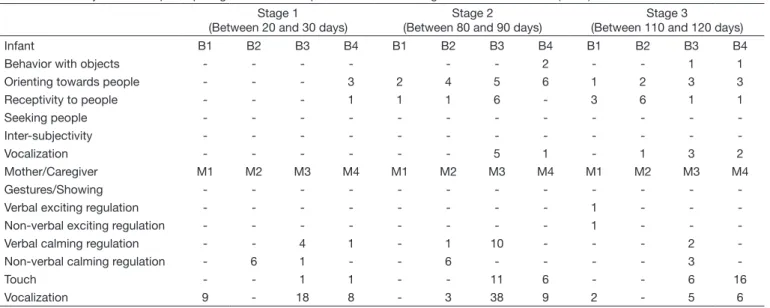
(13), shown in Table 2. It is possible to observe that the infants
paid attention and were receptive to people, which demonstrates a typical behavior for infants without risk of psychic evolution, and that the mothers guided the behavior of their children, played with them, and vocalized to them.
The language analysis categories found from enunciative analysis are summarized using examples of scenes of mother-infant
interactions in which they were identiied. A descriptive summary
of these categories for the three stages investigated is presented in Table 2, demonstrating that they can be evidenced numerically.
Mother-baby homology - Homology between maternal verbal semiotic system and infant non-verbal semiotic system (gesture, crying, nonsense vocalization). It occurs in situations in which the mother speaks with the infant or about the infant regarding one of their gesture or behavior, establishing a correlation between the parts of the semiotic system of the infant’s body and those of the verbal semiotic system of the mother. Example: the occasion when M4 notices that B4 has both hands in their mouth and she says: “Are you eating your
hands again? Whenever she sees her ingers she starts sucking
them!”. In this speech, the mother irst speaks with her baby
and then about her, and mother-infant homology is observed in both cases.
Interpretancy - The mother assigns meaning, through language, to the manifestations of her infant’s body. This occurs when the mother assigns a verbal meaning to her infant’s behavior, such as occurred in the scene where M1 observes B1’s interest in the researcher and she says: Are you looking at her? Are you looking
at this aunt?”. In theory, this is expected to occur in conjunction with homology, as the mother possibly assigns a behavior based on the infant’s manifestation. However, it is noteworthy that, in dyads where something is wrong, the mother may assign a meaning completely out of sync with the manifestation of the infant, which implies interpretancy without homology.
It is worth mentioning that the presence of interpretancy was considered only where there was a gesture or behavior of the infant being translated by the mother, and this excludes interpretancy from situations where there was a maternal narrative with homology and without demand from the infant. Of course, there is linguistic interpretation between what the mother does and says in a type of reinforcement between the mother’s verbal and non-verbal semiotic systems, but this analysis was allocated in the next category because it is considered to have another theoretical dimension, and mainly because the interpretancy proposed herein occurred only when directed synchronously with the infant’s demand.
Maternal narrative with homologous gesture - Homology between maternal verbal and non-verbal semiotic systems.
Table 2. Summary of the four participating infants with respect to the Infant Caregiver Scale of Behavior (ICBS)(15)
Stage 1 (Between 20 and 30 days)
Stage 2 (Between 80 and 90 days)
Stage 3
(Between 110 and 120 days)
Infant B1 B2 B3 B4 B1 B2 B3 B4 B1 B2 B3 B4
Behavior with objects - - - 2 - - 1 1
Orienting towards people - - - 3 2 4 5 6 1 2 3 3
Receptivity to people - - - 1 1 1 6 - 3 6 1 1
Seeking people - - -
-Inter-subjectivity - - -
-Vocalization - - - 5 1 - 1 3 2
Mother/Caregiver M1 M2 M3 M4 M1 M2 M3 M4 M1 M2 M3 M4
Gestures/Showing - - -
-Verbal exciting regulation - - - 1 - -
-Non-verbal exciting regulation - - - 1 - -
-Verbal calming regulation - - 4 1 - 1 10 - - - 2
-Non-verbal calming regulation - 6 1 - - 6 - - - - 3
-Touch - - 1 1 - - 11 6 - - 6 16
It occurs in situations where the mother acts in the relationship with her baby and tells what she is doing, establishing a correlation between a part of the semiotic system of the body and a part of the maternal verbal semiotic system, for example: “Let’s try a little of this breast, shall we”?, M3 says while holding the baby in her lap and offering the breast. “Here is your big elephant!”, M4 says while offering a stuffed elephant to B4. Therefore, these are moments when infants are exposed to language, and when the mother’s gestures and vocalizations are complemented; regarding homology, there are clues to the infants about the meaning of what is being said by the mothers. Yet, it is understood that there is a difference between the relationships of homology and interpretancy established about the infants’ demand, because they may or may not be aware of this speech. It is hypothesized that the chances of the infant understand what is directed to them about their demand, considering Winnicott’s theory, is greater in integrative terms, in other words, as the possibility of perceptual accommodation based on the proposition by Golse(16).
Speak with the baby - When a mother says something to her baby that is not accompanied by a reinforcing gesture, or an interpretancy of a manifestation of the infant (homology), which can be with or without the use of infant-directed speech (IDS). Differentiation between these two categories is considered not only because it is important to demonstrate that vocalization can occur in motherese or not, but also because the use of motherese may increase or decrease at different evolutionary stages of the infant. As an example, we can mention a breastfeeding scene
of the irst stage, in which M1 does not use motherese in her
speech: “Come over here my son, don’t touch it”. And in the same scene, seconds later, she speaks using motherese saying: “Don’t pull Mom’s booby my son”.
Speaks about the baby - The mother speaks about the baby with the interlocutor. Although the communication is not within the dyad, it is a time when the infant is exposed to language. M2, with B2 in her lap, demonstrates to recognize characteristics of her baby as in this example from the second stage: “He takes whatever you give him! He is always feeding,
right man?”. In this excerpt, M2 talks about the baby with the researcher, exposing them to language, and then she speaks with the baby without using motherese.
Non-verbal interpretation of infant’s demand - Situations where the mother interprets the infants’s behavior and replies
gesturally. This can be observed when the baby is being breastfed and releases the breast; noticing the baby’s behavior, the mother pulls them away from the breast and looks at them or blows towards their face; or when the baby wails and the mother offers them her breast, in silence.
Non-verbal contact - Situations where the mother interacts
with the baby gesturally without having been requested (affection,
ventilation). This is observed on occasions when the mother caresses the baby’s face, kisses them, removes the blanket that is close to their face, or shakes her hand near the baby’s face to increase ventilation without any demand for care or affection from the part of the infant.
Infant vocalization forms - Babbled utterances were
classiied for quality in three levels according to the work by
D’Odorico(17) as follows:
Level I: vocalization containing a vowel or a syllable containing a glottal stop or glide;
Level II: vocalizations containing one true consonant or a replicated true consonant ([ba], [dada]), or sounds that differ only in voicing ([data]);
Level III: vocalization containing two or more different consonants ([bati]).
This analysis of different infant vocalization levels was proposed because they demonstrate the progress towards the production of speech, which may have effects on adults regarding the recognition of the infant as a speaker, and perhaps this will lead to some change in the behavior of adults at older ages of the infant. They show a shift in complexity for the production of linguistic form. Possibly, an infant with increased production at level III has their speech recognized as closer to adult speech.
Infant gesture/crying - Infant gesture/crying demanding adult care. In this case, it is observed if the mother responds to the infant’s gestures or crying, and if the infant demands through these resources. In speech pathology clinic, hypoactive
infants are perceived either by deiciencies, or as a consequence of dificulties in the parents-infant bond, which underscores
the importance of identifying the existence of infant demand. These behaviors were analyzed in this study as described in the method: initially, these behaviors were analyzed in each dyad; later, an overview of the four dyads was offered.
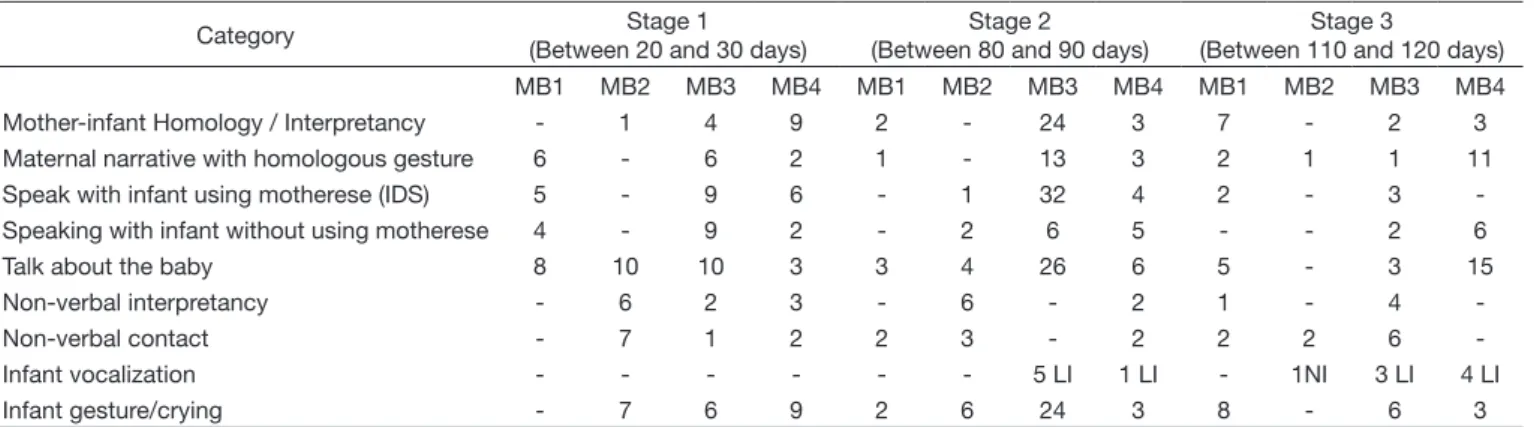
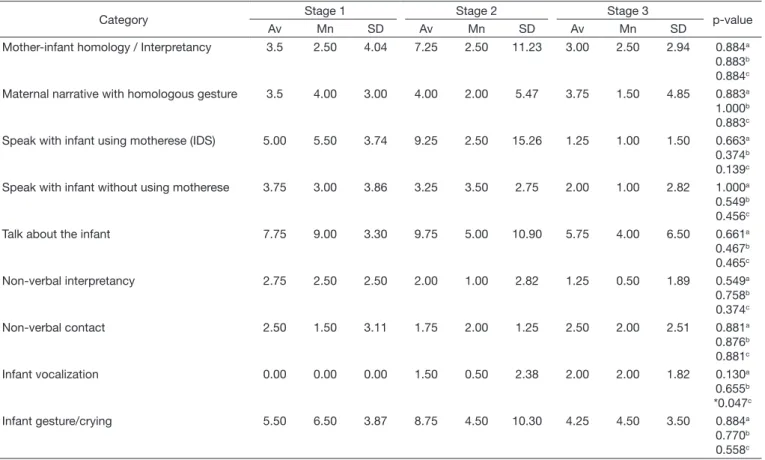
Table 3 shows the summarized results of analysis using the ELAN software for the proposed categories and Table 4 the statiscal analysis.
Table 3. Frequency summary of the proposed categories
Category Stage 1
(Between 20 and 30 days)
Stage 2 (Between 80 and 90 days)
Stage 3
(Between 110 and 120 days)
MB1 MB2 MB3 MB4 MB1 MB2 MB3 MB4 MB1 MB2 MB3 MB4
Mother-infant Homology / Interpretancy - 1 4 9 2 - 24 3 7 - 2 3
Maternal narrative with homologous gesture 6 - 6 2 1 - 13 3 2 1 1 11
Speak with infant using motherese (IDS) 5 - 9 6 - 1 32 4 2 - 3
-Speaking with infant without using motherese 4 - 9 2 - 2 6 5 - - 2 6
Talk about the baby 8 10 10 3 3 4 26 6 5 - 3 15
Non-verbal interpretancy - 6 2 3 - 6 - 2 1 - 4
-Non-verbal contact - 7 1 2 2 3 - 2 2 2 6
-Infant vocalization - - - 5 LI 1 LI - 1NI 3 LI 4 LI
Infant gesture/crying - 7 6 9 2 6 24 3 8 - 6 3
It is worth noting that the variation among mothers regarding the presence of language using IDS, as well as its higher
frequency in M3, occurs due to the fact that this mother has a
scene in stage 2 when her baby cries constantly and she tries to calm them by speaking motherese. Therefore, the numeric variation presents no standard per stage; rather, it seems more associated with this scene. Although preference has been given for scenes with more dialogues, they show distinct demands from the infants, which demonstrates that mothers actively adapt to their infants.
DISCUSSION
Considering the results in Table 2, based on the Infant Caregiver Behavior Scale (ICSB) by Saint-Georges et al.(13), it can
be stated that none of the four infants were at psychological risk, because they presented behaviors of orientation and receptivity to people as early as in the second stage of the research, with
B4 showing them in an analyzed scene of the irst stage.
These data suggests that they were infants with development without risk of progression to structuring of autism or any other severe psychopathology, based on studies on analysis of family videos(9,13,18).
It is also possible to observe that, although all mothers vocalize with their infants, there is a variation in the amount of vocalization among mothers. M3 and M4 vocalize more than M1 and M2, and this is accompanied by increased vocalization of their infants as well, considering that B1 has not vocalized
at any of the stages and B2 vocalized once in the last stage of
collection. These data allow us to afirm that the more silent the mothers, the quieter the infants. This does not mean that
the infant will not vocalize more before a talkative collocutor;
it only suggests that mothers who render quieter care to their
infants, such as M1 and M2, also have less “talkative” infants. Also with this regard, it is noteworthy that M1 and M2, the least talkative mothers, are also those with fewer years of study, which may be related to lower valuation of verbal interaction, as reported in several studies on maternal education and child language development(19).
However, this observation should not be mistaken for the possibility that the baby may not be inserted in language functioning, because by the analysis of the enunciative categories proposed in Table 3, which focuses on the semiotic relationship, it can be seen in greater detail how infants manifest in different ways through non-verbal semiotic, considering that gesture and crying are very common in infants as forms of communication that are interpreted by mothers from homology relationships established between the maternal verbal and non-verbal semiotic system and the non-verbal semiotic system of the infant. It is believed that the numeric expression of homology and interpretancy indicates that mechanisms can be productive in the construction of the form-meaning relationship by the infant, because when infants are interpreted in their gesturality they may accommodate what they feel(18), transforming it into perception from the offer of a
sign by the mother.
Table 4. Mean, median, and standard deviation analysis between the stages
Category Stage 1 Stage 2 Stage 3 p-value
Av Mn SD Av Mn SD Av Mn SD
Mother-infant homology / Interpretancy 3.5 2.50 4.04 7.25 2.50 11.23 3.00 2.50 2.94 0.884a
0.883b
0.884c
Maternal narrative with homologous gesture 3.5 4.00 3.00 4.00 2.00 5.47 3.75 1.50 4.85 0.883a
1.000b
0.883c
Speak with infant using motherese (IDS) 5.00 5.50 3.74 9.25 2.50 15.26 1.25 1.00 1.50 0.663a
0.374b
0.139c
Speak with infant without using motherese 3.75 3.00 3.86 3.25 3.50 2.75 2.00 1.00 2.82 1.000a
0.549b
0.456c
Talk about the infant 7.75 9.00 3.30 9.75 5.00 10.90 5.75 4.00 6.50 0.661a
0.467b
0.465c
Non-verbal interpretancy 2.75 2.50 2.50 2.00 1.00 2.82 1.25 0.50 1.89 0.549a
0.758b
0.374c
Non-verbal contact 2.50 1.50 3.11 1.75 2.00 1.25 2.50 2.00 2.51 0.881a
0.876b
0.881c
Infant vocalization 0.00 0.00 0.00 1.50 0.50 2.38 2.00 2.00 1.82 0.130a
0.655b
*0.047c
Infant gesture/crying 5.50 6.50 3.87 8.75 4.50 10.30 4.25 4.50 3.50 0.884a
0.770b
0.558c
Nevertheless, in addition to the categories designed by Benveniste(11), regarding homology and interpretancy, other
categories that transcend the relationship maternal demand-infant interpretation have emerged. This fact allows us to state that there are a number of subtle behaviors which can be described
qualitatively and numerically that show the language functioning
of infants. In the analysis by Saint-Georges et al.(13), as the goal
of her scale was to analyze more general behaviors on psychic structure and risk for psychopathology, no comprehensive
speciication can be found of how mothers conduct the verbal
regulation of infants - the most present in the sample - especially with the intention of calming, that is, respond to some demand of the infants while they are crying.
In contrast, the categories exposed in Table 3 allow observation of a number of other subtypes of maternal enunciations directed to infants besides homology and interpretancy, because mothers speak with their infants regardless of their demand; for instance, when they tell what they are doing with gestures homologous to their speech. These data, coupled with the fact that speaking using different amounts of IDS is present at similar proportions - except for the production of M3, who used motherese more often and longer - demonstrates that there is an exclusive production with motherese because, albeit important in recognizing the psychic
constitution and language acquisition(20), it should not be taken
constantly and solely for language insertion to infants. In the analyzed scenes, IDS emerged during mother-infant rapport and regulation to calming in the case of M3. It is important to note that infants are exposed to language by different verbal forms,
including speaking about them, which was quite frequently
observed in the four dyads.
When maternal non-verbal manifestations such as non-verbal interpretancy and contact are observed, it can be inferred that
such behaviors, although less frequent in this sample than verbal
manifestations, are also part of maternal care and are another form of mother-infant communication through which mothers
expressed mutuality and identiication with their infants.
Considering the statistical analysis that compared the medians for behavior, it is possible to noticed that the infants’
vocalizations showed signiicant difference between the stages,
especially in the transition from the second to the third stages, demonstrating that close to 120 days infants become more active in dialogue with the use of vocalization, which supports the increased maternal investment and the assumption of a
talkative mother. The lack of statistical signiicance in the other
categories shows that the type of language used by mothers is constant in the three stages, and it seems to have a trigger on the type of scene that is presented and in maternal demands, and not by the skills of infants in the age group studied.
Finally, it is worth emphasizing that this descriptive study indicates that future research, with distinct clinical samples (infants with and without developmental risk) and control of language outcome (with or without language disorder), may indicate the effectiveness of the categories found in distinguishing
the groups and bring relections that may allow an explanation
for language disorders. From these studies, it might be possible
to ind out if the categories proposed in the present study are
effective to identify whether the different maternal manifestations
lie in the mother’s style of communicating with her baby, or
poses a risk to language acquisition from the part of infants.
Previous studies(2-3) conducted by our research group suggest
that homology and interpretancy play a less active role in the dialogue between caregivers and infants at psychic risk, because
the irst do not seem to sustain the assumption of being talkative
subjects separately from homology and interpretancy for their
babies, and/or present dificulty establishing infant demand.
The basis for this process to occur seems to be supported by mother-infant mutuality(21), established through the identiication
of every mother, who was once an infant, with their infant.
CONCLUSION
Considering the main objective of proposing categories from the concept of semiotic system developed by Benveniste(11), this
work allowed us to identify, in homology and interpretancy, productive categories in the analysis, because they demonstrate that the relationship infant demand - maternal interpretancy is founded in mother-infant mutuality. It was also possible to use these categories to numerically describe mother-infant interactions, conferring them potential use in future clinical studies. Finally, it is worth mentioning that other categories have emerged, and that there are other subtypes of maternal productions not directly related to infant demand, demonstrating that infants are inserted in language of incongruous characteristics, as Benveniste himself
had already announced in his deinition of language.
REFERENCES
1. Carlesso JPP, Souza APR, Moraes AB. Análise da relação entre depressão materna e indicadores clínicos de risco para o desenvolvimento infantil. Rev CEFAC. 2014;16(2):500-10. http://dx.doi.org/10.1590/1982-0216201418812. 2. Flores MR, Ramos-Souza AP. Diálogo de pais e bebês em situação de
risco ao desenvolvimento. Rev CEFAC. 2014;16(3):840-52. http://dx.doi. org/10.1590/1982-0216201411412.
3. Oliveira LD, Ramos-Souza AP. O distúrbio de linguagem em dois sujeitos cm risco para o desenvolvimento em uma perspectiva enunciativa de funcionamento de linguagem. Rev CEFAC. 2014;16(5):1700-12. http:// dx.doi.org/10.1590/1982-0216201410713.
4. Trevarthen C. The psychobiology of speech development. In: Lenneberg EH, editor. Language and brain: developmental aspects. Boston: Neurosciences Research Program; 1974. p. 570-585. (Neurosciences Research Program Bulletin, 12).
5. Fernald A. Four-month-old infants prefer to listen to motherese. Infant Behav Dev. 1985;8(2):181-95. http://dx.doi.org/10.1016/S0163-6383(85)80005-9. 6. Fernald A, Kuhl P. Acoustic determinants of infant preference for
motherese speech. Infant Behav Dev. 1987;10(3):279-93. http://dx.doi. org/10.1016/0163-6383(87)90017-8.
7. Laznik MC, Parlato-Oliveira E. Interações sonoras. In: Laznik MC, editor.
A hora e a vez do bebê. 1. ed. São Paulo: Instituto Langage; 2013. p.
195-200.
8. Saint-Georges C, Chetouani M, Cassel R, Apicella F, Mahdhaoui A, Muratori F, et al. Motherese in interaction: at the cross-road of emotion and cognition? (a systematic review). PLoS One. 2013;8(10):e78103-78103. http://dx.doi.org/10.1371/journal.pone.0078103. PMid:24205112. 9. Mahdhaoui A, Chetouani M, Cassel RS, Saint-Georges C, Parlato E, Laznik
10. Silva CLC. A criança na linguagem: enunciação e aquisição. Campinas: Pontes Editores, 2009.
11. Benveniste E. Semiologia da língua. In: Benveniste E. Problemas de linguística geral II. Campinas: Pontes Editores; 2006. p. 43-67. 12. Alves-Mazzotti AJ. Usos e abusos dos estudos de caso. Cadernos Pesquisa.
2006;36(129):637-51. http://dx.doi.org/10.1590/S0100-15742006000300007. 13. Saint-Georges C, Mahdhaoui A, Chetouani M, Cassel RS, Laznik MC,
Apicella F, et al. Do parents recognize autistic deviant behavior long before diagnosis? Taking into account interaction using computational methods. PLoS One. 2011;6(7):e22393-22393. http://dx.doi.org/10.1371/journal. pone.0022393. PMid:21818320.
14. Surreaux LM, Deus VF. A especificidade da transcrição com base enunciativa na clínica fonoaudiológica. Verba Volant. 2010;1(1):110-20.
15. Max Planck Institute for Psycholinguistics. Elan Eudico Linguistic Anotador [Internet]. German; 2014 [citado em 2014 Nov 2]. Disponível em: http:// tla.mpi.nl/tools/tla-tools/elan/
16. Golse B. O autismo infantil, a intersubjetividade e a subjetivação entre as
neurociências e a psicanálise. In: Marin IK, Aragão RO, editores. Do que fala o corpo do bebê. São Paulo: Escuta; 2013. p. 263-278.
17. D’Odorico L, Majorano M, Fasolo M, Salerni N, Suttora C. Characteristics of phonological development as a risk factor for language development in Italian-speaking pre-term children: a longitudinal study. Clin Linguist
Phon. 2011;25(1):53-65. http://dx.doi.org/10.3109/02699206.2010.5117 59. PMid:21080829.
18. Cohen D, Cassel RS, Saint-Georges C, Mahdhaoui A, Laznik M-C, Apicella F, et al. Do parentese prosody and father’s involvement in interacting facilitate social interaction in infants who later develop autism? PLoS One. 2013;8(5):61409-61409. http://dx.doi.org/10.1371/journal.pone.0061402. 19. Escarce AG, Camargos TV, Souza VC, Mourão MP, Lemos SMA.
Escolaridade materna e desenvolvimento da linguagem em crianças de 2 meses a 2 anos. Rev CEFAC. 2012;14(6):1139-45. http://dx.doi.org/10.1590/ S1516-18462011005000144.
20. Flores MR, Beltrami L, Ramos-Souza AP. O manhês e suas implicações para a constituição do sujeito na linguagem. Distúrb Comun. 2011;23(2):143-52.
21. Winnicott DW. A experiência mãe-bebe de mutualidade. In: Winnicott D. Explorações psicanalíticas. Porto Alegre: Artes Médicas; 1994. p. 195-202.
Author contributions