Behavioral Neurology Group, Clinics Hospital of the Ribeirão Preto Faculty of Medicine:1Neurologist,2Psychiatrist,3Psychologist.
Dr. Francisco de Assis Carvalho Vale – Hospital das Clínicas da Faculdade de Medicina de Ribeirão Preto, Depto. de Neurologia, Psiquiatria e Psicologia Médica. Campus da USP, Bairro Monte Alegre - 14048-800 Ribeirão Preto SP - Brazil. E-mail: [email protected]
Reports by caregivers of behavioral and
psychological symptoms of dementia
Francisco de Assis Carvalho do Vale
1, Ricardo Guarnieri
2, Marcos Liboni
2,
Ari Pedro Balieiro Jr.
3, José Humberto Silva-Filho
3, Stênio José Correia de Miranda
1Abstract – Behavioral and Psychological Symptoms of Dementia (BPSD) are relevant since they are frequent and cause distress to caregivers. However, they may not be reported by physicians due to the priority usually attributed to cognitive symptoms.Objectives: To verify whether BPSD is being systematically investigated by physicians even in specialized settings and whether their records on medical files are accurate.Methods: Assessment of records on medical files of BPSD reported by caregivers to 182 patients (57.1% men, mean age 67.6±13.5 years) assisted in a tertiary-care behavioral neurology outpatient clinic (BNOC) who also had appointments in other clinics of the same hospital. Alzheimer’s disease (37.9%) and vascular disease (19.2%) were the most frequent causes of dementia.Results: Report/appointment ratios were 0.58 in BNOC, 0.43 in other neurological, 0.93 in psychiatric and 0.20 in non-neurological, non-psychiatric clinics. BPSD most fre-quently recorded in BNOC were insomnia, aggressiveness, agitation/hyperactivity, visual hallucinations, apathy, inadequate behavior and ease of crying. Sorted by psychiatrists, categories associated to more BPSD were affect/mood, thought and personality/behavior. affect/mood and sensoperception symptoms were the most fre-quently reported. Sorted according to Neuropsychiatric Inventory (NPI), categories associated to more BPSD were depression/dysphoria, delusion and apathy/indifference. depression/dysphoria and agitation/ aggression symptoms were the most frequently reported.Conclusions: BPSD reported by caregivers were very diverse and were not systematically investigated by physicians. Notes in medical files often contained non-technical terms.
Key words:BPSD, behavioral symptoms, psychotic disorders, mood disorders, personality disorders, dementia, caregiver.
Relatos de cuidadores sobre sintomas psicológicos e comportamentais de demência
Resumo – Sintomas Comportamentais e Psicológicos de Demência (SCPD) são relevantes, pois são freqüentes e causam estresse aos cuidadores. Contudo, podem não ser relatados pelos médicos devido à prioridade usual-mente atribuída aos sintomas cognitivos.Objetivos: Verificar que SCPD podem não ser sistematicamente inves-tigados pelos médicos mesmo em ambientes especializados e que seus registros nos prontuários podem ser imprecisos.Métodos: Avaliação dos registros nos prontuários médicos dos SCPD de relatos de cuidadores de 182 pacientes (57,1% homens, idade média 67,6±13,5 anos) assistidos em um ambulatório de neurologia comporta-mental (ANCP), que também tiveram consultas em outras clínicas neurológicas, psiquiátricas, não-neurológicas e não-psiquiátricas do mesmo hospital. Doença de Alzheimer (37,9%) e doença vascular (19,2%) foram as causas mais freqüentes de demência.Resultados: As razões relato/consulta foram 0,58 no ANCP, 0,43 em outros ambulatórios neurológicos, 0,93 em ambulatórios psiquiátricos e 0,20 em outros ambulatórios não-neurológi-cos e não-psiquiátrinão-neurológi-cos. SCPD mais freqüentemente anotados no ANCP foram insônia, agressividade, agi-tação/hiperatividade, alucinações visuais, apatia, comportamento inadequado e choro fácil. Classificados por psiquiatras, as categorias reunindo mais SCPD foram afeto/humor, pensamento e personalidade/comportamen-to. sintomas de afeto/humor e sensopercepção foram os mais freqüentemente relatados. Classificados de acordo com o Inventário Neuropsiquiátrico (INP), as categorias reunindo mais SCPD foram depressão/disforia, delírio e apatia/indiferença. sintomas de depressão/disforia e agitação/agressão foram os mais freqüentemente
relata-dos.Conclusões: SCPD relatados pelos cuidadores eram muito diversos e não eram sistematicamente
investiga-dos pelos médicos. Anotações nos prontuários eram freqüentemente feitas com termos não técnicos.
Non-cognitive symptoms occurring in dementia patients constitute a major problem for family members and caregivers. As symptoms are frequent and diverse, the term behavioral and psychological symptoms in demen-tia (BPSD) was proposed by the International Psycho-geriatric Association1It serves to designate a variety of
symptoms which includes agitation, aggressiveness, apa-thy, delusions, hallucinations, depression among many others. This heterogeneity reflects different pathophysio-logic states of cerebral regions and different underlying psychopathological mechanisms2. Despite their
interrela-tionship, behavioral and cognitive symptoms are different and independent to some extent3,4.
BPSD are very frequent in dementia patients in both developed and developing countries5-7. Although
behav-ioral and psychological symptoms are ubiquitous in all dementias, their frequency and distribution may vary according to type8 severity of dementia9-11 and ethnic
group12.
These symptoms have crucial relevance since they are the most important cause of distress to caregivers and family members, usually leading to institutionalization of patients. The magnitude of burden caused to caregivers and its consequent distress depends on symptom severity, type and also ethnicity9,13-17. The occurrence of BPSD
considerably increases the economic and social costs of dementia management7,16,18.
Despite their high occurrence and importance, behav-ioral and psychological symptoms may not be reported by physicians due to the priority usually attributed to the investigation of the cognitive symptoms in dementia. In this study, we reviewed the reports of BPSD by caregivers in tertiary care outpatient clinics of a teaching hospital according to the physicians' annotations.
The objective of this study was to verify whether BPSD is being systematically investigated by physicians even in specialized settings and check whether their records on medical files are accurate and adequate.
Methods
We reviewed the medical files of all dementia patients assisted in the Behavioral Neurology Outpatient Clinic (BNOC) during a 3-year period of follow up (1997-1999). BNOC, which has been described elsewhere, is a tertiary care facility of a teaching hospital, the Clinics Hospital of the Ribeirão Preto Faculty of Medicine (CHFMRP)19. In the BNOC, diagnoses of Alzheimer’s
disease, vascular dementias, Lewy body dementia and frontotemporal dementias are made in accordance with internationally accepted criteria20-23. In this outpatient
clinic, dementia severity is rated using the Clinical De-mentia Rating (CDR)24-27. The study was approved by
CHFMRP Ethics Committee through its branch Section of Medical Files. Due to the nature of the study, it was not necessary seek Informed Consent.
We actively looked up physicians’ annotations in reports on BPSD by their informant caregivers at ap-pointments made in the BNOC. All appointment records of each patient were reviewed. By informant caregivers we assumed those who were present in the appointment and routinely involved with patient care, comprising mostly family members.
Additionally, we sought physicians’ annotations on reports of BPSD by those BNOC patients´ informant care-givers during appointments made in other neurological outpatient clinics, psychiatric outpatient clinics and other non-neurological, non-psychiatric outpatient clinics (e.g., general clinic, cardiology, pneumology) of the same hos-pital. As all patients were BNOC patients, we performed searches in other clinic appointments in the same way they were done in BNOC appointment annotations.
Initially, we took the literal annotation by the physi-cians in the reports on behavioral and psychological dis-orders given by the caregivers. Subsequently, these literal terms were transposed by three of the authors (FACV, RG, ML) to a more technical, closer to the psychopatho-logical terminology. In this manner, some 60 reported
Table 1.Records of appointments reviewed in the search for BPSD* reported by caregivers.
Outpatient clinic (OC)
Number of patients attended in OC
N (%)
Total of appointments
in OC
Appointments with reports
of BPSD
Report/ appointment
ratio
BNOC† 182 (100.0) 803 469 0.58
Other neurological 92 (50.5) 257 111 0.43
Psychiatric OC 36 (19.8) 248 231 0.93
Other non-neurological, non-psychiatric OC 90 (49.4) 487 96 0.20
Table 2.BPSD* reported by caregivers sorted into categories according to psychiatrists and to NPI†.
BPSD Categories by psychiatrists NPI
Adynamia Affect and mood disturbances Apathy/indifference
Agitation, hyperactivity, restlessness Personality and behavior disturbances Agitation/aggression
Alcohol abuse Personality and behavior disturbances N/A
Anhedonia Affect and mood disturbances Depression/dysphoria
Anxiety Affect and mood disturbances Anxiety
Apathy/lack of initiative Affect and mood disturbances Apathy/indifference
Arrogance Personality and behavior disturbances Irritability/lability
Auditory hallucination Sensoperception disturbances Hallucination
Avolition Affect and mood disturbances Apathy/indifference
Childish behavior Personality and behavior disturbances Disinhibition
Confabulation Thought disturbances Delusion
Decreased appetite Affect and mood disturbances Appetite/eating change
Decreased libido Affect and mood disturbances Depression/dysphoria
Delusion of guilt Thought disturbances Delusion
Delusion of jealousy Thought disturbances Delusion
Delusion of ruin Thought disturbances Delusion
Delusion of theft Thought disturbances Delusion
Depression Affect and mood disturbances Depression/dysphoria
Ease of crying Affect and mood disturbances Depression/dysphoria
Emotional lability Affect and mood disturbances Irritability/lability
Euphoria Affect and mood disturbances Euphoria/elation
Fear Affect and mood disturbances Anxiety
Hipersomnia Affect and mood disturbances Night-time behavior
Hopelessness Affect and mood disturbances Depression/dysphoria
Idea rumination Affect and mood disturbances Depression/dysphoria
Ideas of abandonment Affect and mood disturbances Depression/dysphoria
Ideas of death Affect and mood disturbances Depression/dysphoria
Ideoaffective dissociation Affect and mood disturbances Depression/dysphoria
Illusion Sensoperception disturbances Hallucination
Impatience Affect and mood disturbances Anxiety
Inadequate behavior Personality and behavior disturbances Disinhibition
Increased appetite Affect and mood disturbances Appetite/eating change
Increased libido, sexual disinhibition Affect and mood disturbances Disinhibition
Indifference Affect and mood disturbances Apathy/indifference
Insomnia Affect and mood disturbances Night-time behavior
Irritability Affect and mood disturbances Irritability/lability
Jocosity (improper laughs and jokes) Affect and mood disturbances Disinhibition
Lack of interest (daily activities, hobbies, job, etc) Affect and mood disturbances Apathy/indifference Leave home aimlessly Other behavior not sorted into previous categories Aberrant motor behavior
Multiple complaints Affect and mood disturbances N/A
Nervousness Affect and mood disturbances Irritability/lability
Other (tactile, gustatory, olfactory) hallucinations Sensoperception disturbances Hallucination Other delusional thoughts ("this is not home, I want to go home") Thought disturbances Delusion
Persecutory delusion Thought disturbances Delusion
Pessimism Affect and mood disturbances Depression/dysphoria
Physical aggressiveness Personality and behavior disturbances Agitation/aggression
Psychomotor slowness/bradyphrenia Thought disturbances Apathy/indifference
Rummage Other behavior not sorted into previous categories Aberrant motor behavior
Sadness Affect and mood disturbances Depression/dysphoria
Shouting, calling Other behavior not sorted into previous categories N/A
Soliloquy Thought disturbances Delusion
Solitude Affect and mood disturbances Depression/dysphoria
Suicidal attempt Affect and mood disturbances Depression/dysphoria
Suicidal ideation Affect and mood disturbances Depression/dysphoria
Sundowning Other behavior not sorted into previous categories Agitation/aggression
Tachylalia/verbosity Thought disturbances Disinhibition
Verbal aggressiveness Personality and behavior disturbances Agitation/aggression
Visual hallucination Sensoperception disturbances Hallucination
Wandering Other behavior not sorted into previous categories Aberrant motor behavior
symptoms were listed. Next, they asked 22 psychiatrists of CHFMRP to sort those symptoms into five categories of disturbances: affect and mood, thought, sensoperception, personality and behavior and other behaviors that did not fit under in any of these categories. Finally, three of the authors (FACV, APBJ, JHSF) managed to sort those symptoms according to the categories of the Neuro-psychiatric Inventory (NPI), although this instrument had not been applied to these patients28,29.
We present a descriptive analysis of the reports on BPSD by informant caregivers which were annotated by the physicians during the appointments in the BNOC and in other outpatient clinics of a tertiary care, teaching hospital.
Results
We studied 182 patients (57.1% of male gender), age range 29-93 years (mean age 67.6±13.5 years). The age of onset of dementia symptoms ranged from 26 to 91 years (mean age of 64.7±14.0 years). Alzheimer's disease (AD) was the most frequent cause, accounting for 37.9% of cases (6.0% of those constituting AD associated with vas-cular dementia). Vasvas-cular dementia (VaD) accounted for 19.2% of cases, other non degenerative dementias for 19.1% (6.0% of those were dementia associated with alcoholism), other degenerative dementia for 9.2% (3.3% were dementia with Lewy bodies and 1.6% were fron-totemporal dementia), mixed dementias except AD asso-ciated with VaD represented 5.8%. The etiology was not clear in 8.8% of cases. Dementia severity was staged as mild in 23.1% of cases, moderate in 34.1% and severe in 42.8%.
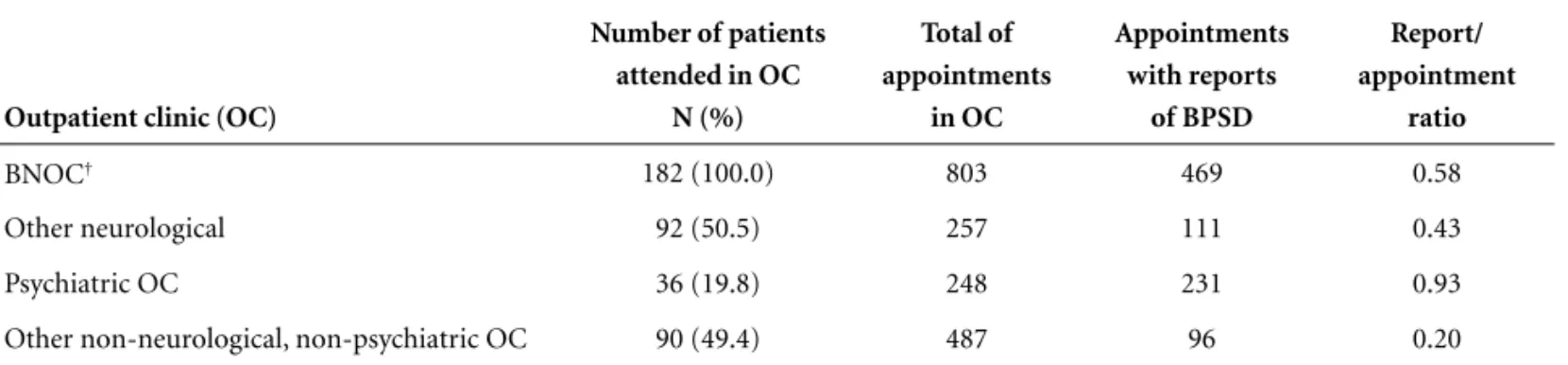
Table 1 shows the numbers of appointment records reviewed, the numbers of appointments with reports of BPSD and report/appointment ratios. The frequency of
reports on BPSD by caregivers in the appointments, as taken from the annotations by the physicians, varied among the outpatient clinics.
Table 2 lists all sixty BPSD reported by the informant caregivers, sorted into categories according to the psychi-atrists and according to NPI.
Table 3 shows the number of symptoms sorted into each of five categories by the psychiatrists, the overall number of reports of symptoms in each category and the number of patients with reports of symptoms in each category.
Table 4 shows the number of symptoms sorted into each of twelve categories of NPI, the overall number of reports of symptoms in each category and the number of patients with reports of symptoms in each category.
On the whole, we observed that these symptoms were not systematically investigated by the physicians in the course of various appointments. Also, annotations were often inaccurate and frequently written in non-technical, lay terms.
BPSD reported by the informant caregivers most fre-quently annotated by physicians in BNOC appointments were insomnia (8.38%), physical aggressiveness (8.30%), agitation/hyperactivity (7.71%), visual hallucinations (6.69%), apathy (6.35%), inadequate behavior (5.42%) and ease of crying (4.83%). These percentage figures rep-resent report frequencies of each symptom in relation to the overall number of reports. BPSD least annotated by physicians were: ideoaffective dissociation, increased libido, multiple complaints, illusion, arrogance, leave home aimlessly, rummaging and sundowning (0.08% each); hopelessness, ideas of abandonment, pessimism, rumination of ideas, other (tactile, gustatory, olfactory) hallucinations and childish behavior (0.17% each); anhe-donia, lack of interest (daily activities, hobbies, job, etc.),
Table 3.BPSD* reported by caregivers, sorted by psychiatrists into categories.
Categories
Types of BPSD N (%)
Reports of BPSD N (%)
Patients presenting BPSD N (%a)
Affect/mood disturbances 33 (55.0) 1,434 (50.0) 150 (82.4)
Thought disturbances 10 (16.7) 271 (9.5) 80 (44.0)
Personality/behavior disturbances 8 (13.3) 294 (10.3) 67 (36.8)
Sensoperception disturbances 4 (6.7) 796 (27.8) 134 (73.6)
Other behavioral disturbances not sorted into previous categories
5 (8.3) 72 (2.5) 29 (15.9)
Total 60 (100.0) 2,867 (100.0) ––
solitude, delusion of jealousy and delusion of theft (0.25% each); euphoria and tachylalia/verbosity (0.34% each); indifference, jocosity (improper laughs and jokes) and suicidal attempt (0.42% each).
Discussion
The percentage distribution of the etiology does not reflect that of populational studies, since this is a casuist-ry taken from tertiacasuist-ry care outpatient clinics of a teaching hospital. In this setting, the frequency of cases are mostly made up of referrals by primary and secondary care physicians and by physicians from other specialty outpa-tient clinics in the hospital, as was described elsewhere for the BNOC19. A possible bias in the discussion of our data
is that it lacks the level of education of the informant caregivers, and education may be a factor influencing the perception and report of behavioral and psychological symptoms. In a previous paper, mean schooling of the BNOC dementia patients was 2.96±3.17 years (19) and hence it might also be inferred that the level of education of caregivers was also low.
Concerning the frequency of reports of BPSD by care-givers in the appointments, as taken from the physicians annotations in the medical files, the report/appointment ratios varied among different clinics. The highest report/ appointment ratio (0.93) occurred in psychiatric
outpa-tient clinics probably due to the nature of symptoms. However, even in this context, 7.0% of appointments lacked annotation of BPSD, possibly because they went uninvestigated by the physicians. By taking 0.93 as a “gold standard” in this casuistry, the report/appointment ratio in BNOC (0.58) might be considered low since it is a spe-cialized neurological clinic attending dementia patients. The ratio was even lower in other neurological clinics (0.43) but that could be accounted for the occurrence of other relevant neurological symptoms to be reported in their appointments. The lowest ratio occurred in other non-neurological, non-psychiatric outpatient clinics, as one might expect. All these outpatient clinics are prac-tices with medical residences, and trainee physicians may not be aware of the importance of investigating BPSD even in neurological settings.
The most generally reported BPSD by informant care-givers in the BNOC annotated by the physicians were insomnia, physical aggressiveness and agitation/hyperac-tivity. Rates of BPSD vary according to setting and ascer-tainment6, studies highlighting different symptoms as
being the most frequently reported, namely depres-sion5,11, aberrant motor behavior13and apathy4,14.
The least reported symptoms, all with less than 0.50% of occurrence each, were ideoaffective dissociation, in-creased libido, multiple complaints, illusion, arrogance,
Table 4.BPSD reported by caregivers, sorted by the authors into categories of the neuropsychiatric inventory.
Categories Types of BPSD N (%)
Reports of BPSD N (%)
Patients presenting BPSD N (%a)
Depression/dysphoria 15 (25.0) 467 (26.3) 80 (44.0)
Delusions 8 (13.3) 241 (8.4) 62 (34.1)
Apathy/indifference 6 (10.0) 258 (9.0) 79 (43.4)
Disinhibition 5 (8.3) 149 (5.2) 59 (32.4)
Agitation/aggression 4 (6.7) 523 (18.2) 111 (61.0)
Hallucination 4 (6.7) 294 (10.3) 67 (36.8)
Irritability/lability 4 (6.7) 199 (6.9) 58 (31.9)
Aberrant motor behavior 3 (5.0) 12 (0.4) 8 (4.4)
Anxiety 3 (5.0) 132 (4.6) 33 (18.1)
Appetite/eating change 2 (3.3) 126 (4.4) 43 (23.6)
Night-time behavior 2 (3.3) 307 (10.7) 80 (44.0)
Euphoria/elation 1 (1.7) 9 (0.3) 4 (2.2)
N/A (not applicable) 3 (5.0) 150 (5.2) 34 (18.7)
Total 60 (100.0) 2,867 (100.0) –
leave home aimlessly, rummage, sundowning, hopeless-ness, ideas of abandonment, pessimism, rumination of ideas, other (tactile, gustatory, olfactory) hallucinations, childish behavior, anhedonia, lack of interest (daily activ-ities, hobbies, job, etc.), solitude, delusion of jealousy, delusion of theft, euphoria, tachylalia/verbosity, indiffer-ence, jocosity (improper laughs and jokes) and suicidal attempt. Rates of the least reported behavioral and psy-chological symptoms vary due to the same reasons as for the most reported ones, studies have indicated
eupho-ria10,13,14 hallucinations and disinhibition14 as being
amongst the least reported.
According to the sorting of BPSD by psychiatrists, the category under which most symptoms were assigned was affect/mood disturbances (55.0 of symptoms), followed by thought disturbances (16.7%) and personality/behav-ior disturbances (13.3%). Affect/mood disturbance symp-toms were also the most frequently reported (50.0% of the overall number of reports) but here the second-placed category is sensoperception disturbances (27.8%).
In reference to the sorting of BPSD reported by informant caregivers according to NPI categories, one must stress that it was merely an attempt to add informa-tion and enrich the discussion because this instrument was not applied to the patients of this casuistry. Presently, the BNOC dementia patients have been assessed using the NPI, to be reported in a coming paper. Several BPSD reported could be sorted into more than one category; however the authors chose the most suitable categories by taking into consideration the structure and the set of questions of the NPI. Also, some BPSD reported did not fit under any NPI category (alcohol abuse, multiple com-plaints, shouting/calling). The categories assigned most symptoms were depression/dysphoria (25.0% BPSD re-ported), delusions (13.3%) and apathy/indifference (10.0%). with regard to the frequency of reports of symp-toms, the most important categories were depression/ dysphoria (26.3% of the overall number of reports) and agitation/aggression (18.2%).
In this casuistry, BPSD reported by informant care-givers were more diverse. They were not systematically investigated by the physicians. Despite being an impor-tant cause of distress for family members and caregivers, such symptoms were not always properly described in the medical files whereas the annotations were also inaccu-rate and written with the use of non-technical terms. On the other hand, this highlights the need for systematically looking out for behavioral and psychological symptoms when examining patients with cognitive disorders and dementias, perhaps possible with the aid of appropriate questionnaires and inventories4,5,16.
References
1. International Psychogeriatric Association. Behavioral and Psychological Symptoms of Dementia (BPSD). Educational Pack; 1998.
2. Sultzer DL, Brown CV, Mandelkern MA, et al. Delusional thoughts and regional frontal/temporal cortex metabolism in Alzheimer's disease. Am J Psychiatry 2003;160:341-349. 3. Spalletta G, Baldinetti F, Buccione I, et al. Cognition and
behaviour are independent and heterogeneous dimensions in Alzheimer's disease. J Neurol 2004;251:688-695.
4. Derouesne C, Piquard A, Thibault S, Baudouin-Madec V, Lacomblez L. Noncognitive symptoms in Alzheimer's dis-ease. A study of 150 community-dwelling patients using a questionnaire completed by the caregiver. Rev Neurol (Paris) 2001;157:162-177.
5. Ferri CP, Ames D, Prince M. Dementia Research Group. Behavioral and psychological symptoms of dementia in developing countries. Int Psychogeriatr 2004;16:441-459. 6. Brodaty H, Draper BM, Low LF. Behavioural and
psycho-logical symptoms of dementia: a seven-tiered model of service delivery. Med J Aust 2003;178:231-234.
7. Hemels MEH, Lanctôt KL, Iskedjian M, Einarson TR. Clinical and economic factors in the treatment of behav-ioural and psychological symptoms of dementia. Drugs Aging 2001;18:527-550.
8. Pinto C, Seethalakshmi R. Behavioral and psychological symptoms of dementia in an Indian population: compari-son between Alzheimer’s disease and vascular dementia. Int Psychogeriatr 2006:1-7.
9. Piccininni M, Carlo AD, Baldereschi M, Zaccara G, Inzitari D. Behavioral and psychological symptoms in Alzheimer's disease: Frequency and relationship with duration and severity of the disease. Dement Geriatr Cogn Disord 2005; 19:276-281.
10. Shimabukuro J, Awata S, Matsuoka H. Behavioral and psycho-logical symptoms of dementia characteristic of mild Al-zheimer patients. Psychiatry Clin Neurosci 2005;59:274-279. 11. Hart DJ, Craig D, Compton SA, et al. A retrospective study
of the behavioural and psychological symptoms of mid and late phase Alzheimer's disease. Int J Geriatr Psychiatry 2003; 18:1037-1042.
12. Chow TW, Liu CK, Fuh JL, et al. Neuropsychiatric symp-toms of Alzheimer´s disease differ in Chinese and American patients. Int J Geriatr Psychiatry 2002;17:22-28.
13. Fuh JL, Liu CK, Mega MS, Wang SJ, Cummings JL. Behav-ioral disorders and caregivers' reaction in Taiwanese patients with Alzheimer's disease. Int Psychogeriatr 2001;13: 121-128.
15. Pang FC, Chow TW, Cummings JL, et al. Effect of neuropsy-chiatric symptoms of Alzheimer´s disease on Chinese and American caregivers. Int J Geriatr Psychiatry 2002;17:29-34. 16. Aguglia E, Onor ML, Trevisiol M, Negro C, Saina M, Maso E. Stress in the caregivers of Alzheimer's patients: an experi-mental investigation in Italy. Am J Alzheimers Dis Other Demen 2004;19:248-252.
17. Rymer S, Salloway S, Norton L, Malloy P, Correia S, Monast D. Impaired awareness, behavior disturbance, and caregiver burden in Alzheimer disease. Alzheimer Dis Assoc Disord 2002;16:248-253.
18. Murman DL, Chen Q, Powell MC, Kuo SB, Bradley CJ, Colenda CC. The incremental direct costs associated with behavioral symptoms in AD. Neurology 2002;59:1721-1729. 19. Vale FAC, Miranda SJC. Clinical and demographic features of patients with dementia attended in a tertiary outpatient clinic. Arq Neuropsiquiatr 2002;60:548-552.
20. McKeith IG, Galasko D, Kosaka K, et al. Consensus guide-lines for the clinical and pathologic diagnosis of dementia with Lewy bodies (DLB): report of the consortium on DLB international workshop. Neurology 1996;47:1113-924. 21. McKhann G, Drachman D, Folstein M, Katzman R, Price D,
Stadlan EM. Clinical diagnosis of Alzheimer's disease: report of the NINCDS-ADRDA Work Group under the aus-pices of Department of Health and Human Services Task
Force on Alzheimer's Disease. Neurology 1984;34:939-44. 22. Roman GC, Tatemichi TK, Erkinjuntti T, et al. Vascular
dementia: diagnostic criteria for research studies. Report of the NINDS-AIREN International Workshop. Neurology 1993;43:250-260.
23. Clinical and neuropathological criteria for frontotemporal dementia. The Lund and Manchester Groups. J Neurol Neurosurg Psychiatry 1994;57:416-418.
24. Hughes CP, Berg L, Danziger WL, Coben LA, Martin RL. A new clinical scale for the staging of dementia. Br J Psy-chiatry 1982;140:566-572.
25. Morris JC. The Clinical Dementia Rating (CDR): current version and scoring rules. Neurology 1993;43:2412-2414. 26. Maia AL, Godinho C, Ferreira ED, et al. [Application of the
Brazilian version of the CDR scale in samples of dementia patients]. Arq Neuropsiquiatr 2006;64:485-4899.
27. Montano MB, Ramos LR. [Validity of the Portuguese ver-sion of Clinical Dementia Rating]. Rev Saude Publica 2005; 39:912-917.
28. Cummings JL. The Neuropsychiatric Inventory: assessing psychopathogy in dementia patients. Neurology 1997;44 (Suppl 6):S10-S16.