Abstract—Human face detection plays an important role in many application areas such as video surveillance, human computer interface, face recognition and face image database management. In the human face detection applications, face region usually form an inconsequential part of the images. Consequently, preliminary segmentation of images into regions that contain "non-face" objects and regions that may contain "face" candidates can greatly accelerate the process of human face detection. Most existing face detection methods [1]-[4] process the image under some assumptions, which make them applicable only under some specifically conditions. Existing techniques for face detection in color images are plagued by poor performance in the presence of variation in illumination, scale variation, variation in skin light, complex backgrounds etc. In this research work, we have made a color
barycenter hexagon (CBH) model to thresholding the full color image at the presence of varying lighting conditions, for varied skin colors as well as with complex backgrounds and offer idea binary image for face detection. The experimental results show the successful detected face over a wide range of facial variations in color, position, scale, varying lighting conditions, orientation and expression in images from several photo collections and database.
Index Terms—Face detection, Thresholding segmentation, and Color barycenter hexagon (CBH) model.
I. INTRODUCTION
Nowadays, many applications are developed to secure access control and financial transactions are based on biometrics recognition such as fingerprints, iris pattern and face recognition. Along with the development of those technologies, computer controller plays an important role to making the biometrics recognition more economically feasible in such developments.
One of the most common and intuitionistic biometrics recognition is face recognition. In the recent years, the face recognition become popular research direction more and more, and has many applications such as mug shot matching, credit card verification, ATM access, personal PC access, video surveillance etc. [5] for status identification.
The first step of automated face recognition is the face detection, an efficiently algorithm of face detection is propitious to the follows recognition. For recent surveys on face detection, [6]-[10] can be referred to. These approaches use some techniques such as principal component analysis, neural networks, machine learning, support vector machines (SVM), Hough transform, geometrical template matching,
Manuscript received December 30, 2007.
Authors are with the Graduate School of Information, Production and Systems, Waseda University, Japan (E-mail: [email protected],
[email protected] and [email protected]).
color analysis etc.
The neural network based [11][12] methods require a large number of face and non-face images to training respectively to get the network model [8]. SVM is a linear classifier and can classify goal region in hyper plane. Geometrical facial templates and Hough transform were incorporated to detect gray faces in real time applications [13]. Categorizing face detection methods based on the representation used reveals that detection algorithms using holistic representations have the advantage of finding small faces or faces in low quality images, while those using the geometrical facial features provide a good solution for detecting faces in different poses. A combination of holistic and feature-based approaches is a promising approach to face detection as well as face recognition. Color transform methods [14]-[19], are useful cues for face detection. However the color based approaches face difficulties in robustly detecting skin colors [20][21] in the presence of complex background and different lighting conditions [22][23].
We proposed a face detection algorithm based on CBH model and it is able to handle a wide range of variations in static color images, various skin tones and with complicated background can be detected effetely.
II. CBHMODEL
A. Model construction
Usually the image’ color can be described in different color space; usually we use RGB, YCbCr, HSV and HSI color space etc. In practice, we choice one suitably color space and use 3 channels to reflect it, so the color information must use 3D coordinate to describe. In RGB color space, use 3D coordinate to describe the color characteristic is easy, but use 2D coordinate reflect it and find the relation of colors is not easy. To solve this problem, the color triangle of Fig. 1 is proposed, it use three vectors from origin and alternation
o
120 reciprocally in one plan, every vector’s rang is same as the gray value from 0 to 255. Passing this way, RGB values can be reflected in 2D space. For describe this, we choice polar coordinate system and the formulas describe it:
⎪
⎩
⎪
⎨
⎧
≤
≤
=
=
≤
≤
=
=
≤
≤
=
=
)
255
0
330
(
,
)
(
:
)
255
0
210
(
)
(
:
)
255
0
90
(
,
)
(
:
,
B B
B B
G G
G G
R R
R R
r
and
r
r
B
r
and
r
r
G
r
and
r
r
R
o o o
ϕ
ϕ
ϕ
ϕ
ϕ
ϕ
(1)
Connect the three peak of RGB vectors, it can compose a triangle, observing the triangle of Fig. 1, we find that when only change the values of RGB respectively, it can create different shape’s triangle and color. The barycenter’s position of every triangle can be reflected the characteristic
Face Detection Method Based on Color
Barycenter Hexagon Model
Qieshi Zhang,Jun Zhang and Sei-ichiro Kamata
Proceedings of the International MultiConference of Engineers and Computer Scientists 2008 Vol I IMECS 2008, 19-21 March, 2008, Hong Kong
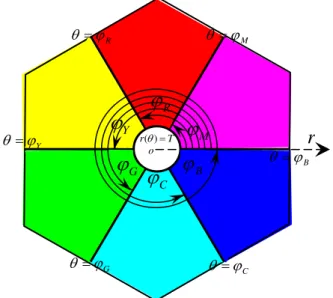
of correspond color. Based on those analyses, it can be find that the aggregate of all barycenter show as hexagon, so the model of Fig. 2 is created. In this color barycenter model, passing segmentation the region of barycenters, the RGB color space’s color can be clustering to 7 regions: RGB (Red, Green and Blue), CMY (Cyan, Magenta and Yellow) and W (luminance) regions. In practice application, the proposed model can clusting the image to 2 ~ 7 color regions.
To use this method, it needs 7 thresholds to calculate the threshold carves and then use those carves to clustering. The following section will introduce the thresholds’ range and how to get them.
B. Threshold selection
Section A introduces how to create the CBH model and the strongpoint; this section will introduce how to get the thresholds and how to use the model.
From Fig. 2 we can see it divided 7 parts, the center part of this model is a circular region, if the RGB values are close, no matter dark or light; it has little color information and only reflects the luminance. So the barycenters of those colors’ triangle will in this circular region. Usually those regions are not the goal region and belong to noise, so let T
as the threshold, the curve’s function is:
)
85
0
(
,
)
(
=
T
≤
T
≤
r
θ
(2) If the color has weak color information it will in this region,so threshold T cans thresholding the none-color (weak color) region. Around this circular region it has 6 color blocks can reflect 6 clusters. The follows formulas show the 6 regions:
⎪
⎪
⎪
⎪
⎩
⎪⎪
⎪
⎪
⎨
⎧
<
≤
≤
=
<
≤
≤
=
<
≤
≤
=
<
≤
≤
=
<
≤
≤
=
<
≤
≤
=
)
,
(
,
)
(
:
)
,
(
,
)
(
:
)
,
(
,
)
(
:
)
,
(
,
)
(
:
)
,
(
,
)
(
:
)
,
(
,
)
(
:
B B C B C C G C G G Y G Y Y R Y R R M R M M B Mr
T
r
r
B
r
T
r
r
C
r
T
r
r
G
r
T
r
r
Y
r
T
r
r
R
r
T
r
r
M
ϕ
θ
ϕ
θ
ϕ
θ
ϕ
θ
ϕ
θ
ϕ
θ
ϕ
θ
ϕ
θ
ϕ
θ
ϕ
θ
ϕ
θ
ϕ
θ
(3)in formula (2) and (3), T, ϕM, ϕR, ϕY, ϕG, ϕC and ϕBare the thresholds, and the initial value of them is 5, o
60 , o 120 , o
180 , o 240 , o
300 and o 360 .
Based on those threshold curves, the key point is how to get the thresholds. For different images and goals, the threshold is different; this paper is using this model for face detection. So it only needs three thresholds to detect skin region, then do farther process.
Despite the face skin in different image is different, but usually the color is nearly, it only has the different of luminance. To get the thresholds, we select 50 face regions by hand, then calculate the barycenter of those colors’ triangles and print on the CBH model show in Fig. 3. After observing those barycenters distributing, the values can be decided.
III. FACE DETECTION BASED ON CBHMODEL
A. Thresholding
1. Nonlinear thresholding
Considering the frequency of gray values can more exactly reflect it’s distributing, so do the nonlinear transform with original image, then quantize to 2 clusters; lastly do inverse transform to get the binary image. The Fig. 4(a)(b) is the original image and binary image, the formula is as follows:
]
255
1
ln[
)]
,
(
255
1
ln[
)
,
(
+
+
=
k
y
x
f
y
x
f
binary original (4)Fig. 2 Color Barycenter Hexagon Model
r
Mϕ
Rϕ
Gϕ
Cϕ
ϕBY
ϕ
T r(θ)=
o B
ϕ
M ϕ θ = R ϕ θ = Y ϕ θ = G ϕ θ = C ϕ θ= B ϕ θ =Fig. 3 Threshold Selection
GR
k
RG
k
Fig.1 Color Triangle
R
ϕ
ϕ
G Bϕ
Br
Gr
Rr
r
o
Proceedings of the International MultiConference of Engineers and Computer Scientists 2008 Vol I IMECS 2008, 19-21 March, 2008, Hong Kong
k is the number of cluster, here let k=2.
From Fig. 4(b) it can be seeing that though the nonlinear thresholding, the binary image’s background with white color has been clustering to same value as the face region, so it hard to separate the face region with background. This method only fit to separate the image which foreground and background have obvious different.
2. CBH model thresholding
Use the CBH model can solve the shortage above, because the judgment rule is calculating the direction of color not the brightness, so it can let the darkly and lightly region comes to one cluster and ignore some noise.
Using the thresholds selection way as section 2, it only need select 3 thresholds to get the threshold curves for thresholding. Passing mass experiments and calculate the face region’s barycenter distributing in CBH model, the thresholds can be fixed. For face detection, it only needs passing the thresholds of T, ϕM and ϕR to calculate the threshold curves, other thresholds keep the initial value and without calculate. By this way, the binary image can be got as Fig. 4(c). From the result we can see that the white background region and white collapsible are clustering to black and only the goal region clustering to white. By this way it can ignore many noise regions; especially the excessive bright or dark region and different color region, Fig. 5(b)(c) reflect the effect again.
3. CBH model correct
Some times, the bright region also can reflects some color and it’s barycenter in the goal region, but in fact it is noise. For example, the hair region in Fig. 4(c), so it need use some way to denoise. Passing research, we find that for denoise the noise region and hold the goal region, it can use the binary image which thresholding by nonlinear thresholding to correct the binary image which thresholding by CBH model by "and operation" as follows:
)
,
(
)
,
(
)
,
(
x
y
f
x
y
f
x
y
f
Final=
Nonliner∧
CBH (5)Fig. 4(d) is the corrected result.
B. Face detection
After get the idea binary image, the face detection is easy to achieve. In this paper, we use region grow method to get the face. Find the seed for region grow is the first step, passing median filter and open/close operation, the dispersedly noise can be denoised.
Before calculate the seed, we need judgment which region include face. For judgment the region use the corresponding region at gray image then search the eyes [8][24] to judgment if the region include face.
After fixed the regions, let the midpoints of eyes as the seeds for grow, then the face can be detected as Fig. 4(e).
IV. RESULT AND ANALYZE
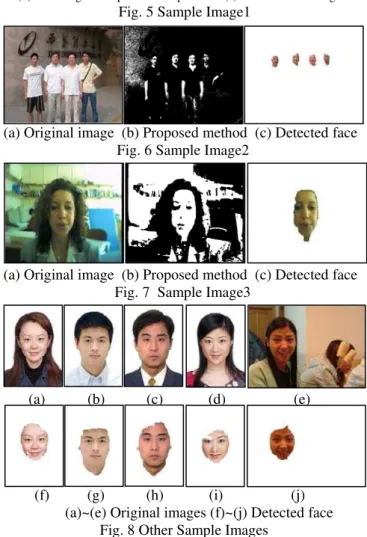
The Fig. 5 compares the 3 thresholding result in complex background with 3 people. Fig. 5(b) is by nonlinear thresholding and the effect is good for vision, but not fit to detection the face; Fig. 5(c) is the result of CBH model and Fig. 5(d) is corrected CBH method. For detection the face, we do the median filter and open/close operation then get Fig. 5(e) and passing some judgment Fig. 5(f) is got. Fig. 6 and Fig. 7 are the sample images and the results. Passing observe the images, is hard thresholding it by existing method, the cupboard of background of Fig. 7 has the same as face region’s color direction, so it hard thresholding. But by proposed method can ignore the noise of brightly and outlying color. Fig. 8 is one group detected face result and the result effect is good for do ROI compress and face recognize.
(a) Original image (b) Proposed method (c) Detected face Fig. 7 Sample Image3
(a) (b) (c) (d) (e)
(a) Original image (b) Nonlinear thresholding (c) CBH model thresholding (d) Corrected CBH thresholding (e) Detected face
Fig. 4 Thresholding Result and Detected Face
(a) Original image (b) Nonlinear thresholding in RGB color space (c) CBH model thresholding (d) Corrected CBH thresholding (e) Filtering and open/close operation (f) Detected face region
Fig. 5 Sample Image1
(a) (b) (c)
(d) (e) (f)
(a) Original image (b) Proposed method (c) Detected face Fig. 6 Sample Image2
(a) (b) (c) (d) (e)
(f) (g) (h) (i) (j) (a)~(e) Original images (f)~(j) Detected face
Fig. 8 Other Sample Images
Proceedings of the International MultiConference of Engineers and Computer Scientists 2008 Vol I IMECS 2008, 19-21 March, 2008, Hong Kong
V. CONCLUSION AND FUTURE WORK
Through result image with the proposed method, it can detect faces under varied conditions effective. Our detection algorithm takes the color image and applies CBH model to detect the valid skin regions. Then use the binary image which quantized by nonlinear thresholding to correct the binary image which thresholding by CBH model. Then use the eyes detection in the region of corrected CBH model to judgment if the face exist and use region grow method to detect the whole goal face region.
In some instance the proposed method can not get idea result, for example if the image include some regions and those region have closely color and shape of face, so is hard to distinguish it. So to conquer this kinks problem, it need combine other method to get effective result.
REFERENCES
[1] P.T. Bao; J.Y. Kim and S.Y. Na, "Fast multi-face detection in color images using fuzzy logic", Proc. of 2005 Int’l Symposium on Intelligent Signal Processing and Communication Systems, (ISPACS 2005), Dec. 2005, pp. 777-780.
[2] X.F. Nie, J. Guo and Z. Yang, "Face Detection Based on Wavelet Transform", Journal of Beijing University of Posts and Telecommunications, Jun. 2006, vol. 29, No. 3, 114-117.
[3] X.M. Xu and D. Xu, "Study of Appearance-based Subspace Face Recognition Algorithms", Application Research of Computers, May 2007, vol. 24, No. 5, 10-12.
[4] L.H. Zhao, J.H. Liu, Y.G. Sun and X.H. Xu, "Appearance-based Face Detection Methods", Application Research of Computers, 2006, 246-249.
[5] A. Girgensohn, J. Adcok and L. Wilcox, "Leveraging Face Recognition Technology to Find and Organize Photos", 6th ACM SIGMM International Workshop on Multimedia Information Retrieval (MIR 2004), New York, USA, Oct 2004, pp. 99-106. [6] M.H. Yang, D. Kriegman and N. Ahuja, "Detecting Faces in Images:
A Survey", IEEE Trans Pattern Analysis And Machine Intelligence, Jan 2001, vol. 24, no 1, pp 34-58,
[7] E. Bakry, H.M and Q. Zhao, "Fast Neural Implementation of PCA for Face Detection", InternationalJointConferenceon Neural Networks,
(IJCNN 2006), Jul. 2006, pp.806–811.
[8] H. Jee, K. Lee and S. Pan, "Eye and face detection using SVM", Proc. of the 2004 Int’l Sensor Networks and Information Processing Conference (ISN・IPC 2004), Dec. 2004 pp. 577-580.
[9] Y. Gao, "Efficiently Comparing Face Images Using a Modified Hausdorff Distance", IEEE Proc. on Vision, Image and Signal Processing (VISP 2003), Dec. 2003, vol. 150, pp. 346-350.
[10] J. Chen, L. Zhou, H.G. Shi and D.W. Su, "An Approach of Face Detection In Color Images Based on Haar Wavelet", Control & Automation, 2005, Vol. 28.
[11] K.Yang, H. Zhu and Y.J. Pan, "Human Face Detection Based on SOFM Neural Network", IEEE Proc. of 2006 Int’l Conf. on Information Acquisition, Weihai, China, August 2006, pp. 1253-1257. [12] S.H. Lin, S.Y. Kung and L.J. Lin, "Face recognition/detection by
probabilistic decision-based neural network", IEEE Trans. On Neural Networks, Jan. 1997, Vol. 8, pp. 114-132.
[13] Z. Xing, Y. Qu and S. Wang, "Face Detection on Gray-Scale Static Image with Complex Background", Journal of Computer-Aided Design & Computer Graphics, May 2005, vol. 5.
[14] W. Chen, Y. Q. Shi and G. Xuan, "Identifying Computer Graphics Using HSV Color Model and Statistical Moments of Characteristic Functions", 2007 IEEE Int’l Conf. on Multimedia and Expo (ICME 2007), Jul. 2007, pp. 1123-1126.
[15] H. Stokman and T. Gevers, "Selection and Fusion of Color Models for Image Feature Detection", IEEE Trans. On Pattern Analysis and Machine Intelligence, Mar. 2007, vol. 29, pp. 371-381.
[16] H. Stokman and T. Gevers, "Selection and fusion of color models for feature detection", IEEE Computer Society Conf. on Computer Vision and Pattern Recognition (CVPR 2005), Jun. 2005, vol. 1, pp. 560-565. [17] A. Chikando and J. Kinser, "Optimizing Image Segmentation Using Color Model Mixtures", Proc. 34th Applied Imagery and Pattern Recognition Workshop (AIPR 2005), Oct. 2005.
[18] S. Jayaram, S. Schmugge, M.C. Shin, and L.V. Tsap, "Effect of Colorspace Transformation the Illuminance Component, and Color Modeling on Skin Detection", Proc. of Computer Society Conf. on Computer Vision and Pattern Recognition (CVPR 2004), Jun. 2004, vol. 2, pp. 813-818.
[19] T. Gevers and A.W.M. Smeulders, "Combining Color and Shape Invariant Features for Image Retrieval", IEEE Trans. On Image Processing, Jan. 2000, vol. 9, pp. 102-119.
[20] C.N. R. Kumar and A. Bindu, "An Efficient Skin Illumination Compensation Model for Efficient Face Detection", 32nd Annual Conf, on IEEE Industrial Electronics (IECON 2006), Nov. 2006, pp. 3444-3449.
[21] L. P. Son, A. Bouzerdoum and D. Chai, "A Novel Skin Color Model in YCbCr Color Space and Its Application to Human Face Detection",
Proc. 2002 Int’l Conf. on Image Processing (ICIP 2002), Sept. 2002, vol. 1, pp. 289-292.
[22] R.L. Hsu, A.M. Mohamed and K. J. Anil, "Face Detection in Color Images", IEEE Trans. on Pattern Analysis and Machine Intelligence, vol. 24, No.5, May 2002, pp. 696-706.
[23] Y. T. Pai, S. J. Ruan, M. C. Shie and Y.C. Liu, "A Simple and Accurate Color Face Detection Algorithm in Complex Background",
IEEE 2006 Int’l Conf. on Multimedia and Expo (ICME 2006), Jul. 2006, pp.1545-1548.
[24] X.W. Wang and Y.Q. Shi, "A Method of Face Detection Based on Eyes Feature", Application Research of Computers, 2005, 239-240.
Proceedings of the International MultiConference of Engineers and Computer Scientists 2008 Vol I IMECS 2008, 19-21 March, 2008, Hong Kong