Comparison of the RIFLE, AKIN and KDIGO
criteria to predict mortality in critically ill patients
INTRODUCTION
Advances in healthcare technologies and greater life expectancy have resulted in more patients with multiple and complex conditions requiring treatment in an intensive care setting. he occurrence of acute kidney injury (AKI) is common in such patients. AKI is a serious complication in the context of severe disease, especially when associated with sepsis and multiple organ dysfunction syndrome. In the literature, AKI is responsible for signiicant morbidity and mortality, ranging from 20 to 80%.(1-6)
In an attempt to standardize the deinition and classiication of AKI, the Risk, Injury, Failure, Loss, End-Stage (RIFLE) and Acute Kidney Injury Network (AKIN) criteria were created. Currently, these are the criteria used for classifying AKI based on serum creatinine and urine output.
Talita Machado Levi1,2, Sérgio Pinto de Souza3, Janine Garcia de Magalhães3, Márcia Sampaio de Carvalho3, André Luiz Barreto Cunha3, João Gabriel Athayde de Oliveira Dantas4, Marília Galvão Cruz5, Yasmin Laryssa Moura Guimarães5, Constança Margarida Sampaio Cruz6,7
1. Department of Clinical Medicine, Universidade Estadual de Santa Cruz -UESC - Itabuna (BA), Brazil.
2. Department of Clinical Medicine, Faculdade do Sul - Itabuna (BA), Brazil.
3. Residency Program in Clinical Medicine, Hospital Santo Antonio, Obras Assistenciais Irmã Dulce - Salvador (BA), Brazil. 4. Undergraduate Program, Faculdade de Tecnologia e Ciências - FTC - Salvador (BA), Brazil.
5. Undergraduate Program, Escola Bahiana de Medicina e Saúde Pública - Salvador (BA), Brazil. 6. Postgraduate Program in Medicine and Human Health, Escola Bahiana de Medicina e Saúde Pública - Salvador (BA), Brazil.
7. Coordination for Multidisciplinary Research, Hospital Santo Antônio, Obras Sociais Irmã Dulce - Salvador (BA), Brazil.
Objective: Acute kidney injury is a common complication in critically ill patients, and the RIFLE, AKIN and KDIGO criteria are used to classify these patients. he present study's aim was to compare these criteria as predictors of mortality in critically ill patients.
Methods: Prospective cohort study using medical records as the source of data. All patients admitted to the intensive care unit were included. he exclusion criteria were hospitalization for less than 24 hours and death. Patients were followed until discharge or death. Student's t test, chi-squared analysis, a multivariate logistic regression and ROC curves were used for the data analysis.
Results: he mean patient age was 64 years old, and the majority of patients were women of African descent. According to RIFLE, the mortality rates
Conflicts of Interest: None.
Submitted on September 11, 2013 Accepted on December 13, 2013
Corresponding Author:
Constança Margarida Sampaio Cruz Avenida Dom João VI, 275 - Brotas Zip code: 40296-000 - Salvador (BA), Brazil E-mail: [email protected]
Comparação dos critérios RIFLE, AKIN e KDIGO quanto à
capacidade de predição de mortalidade em pacientes graves
ABSTRACT
Keywords: Acute kidney injury; Incidence; Mortality; Prognosis; Intensive care units
were 17.74%, 22.58%, 24.19% and 35.48% for patients without acute kidney injury (AKI) in stages of Risk, Injury and Failure, respectively. For AKIN, the mortality rates were 17.74%, 29.03%, 12.90% and 40.32% for patients without AKI and at stage I, stage II and stage III, respectively. For KDIGO 2012, the mortality rates were 17.74%, 29.03%, 11.29% and 41.94% for patients without AKI and at stage I, stage II and stage III, respectively. All three classiication systems showed similar ROC curves for mortality.
Conclusion: he RIFLE, AKIN
and KDIGO criteria were good tools for predicting mortality in critically ill patients with no signiicant diference between them.
he RIFLE criteria are based on the deinition of three stages of AKI (Risk, Injury and Failure), which are based on changes in serum creatinine values along with urinary output to determine the stage of renal dysfunction. hese criteria are also based on two other stages, deined as clinical outcomes, that correspond to more severe disease and a worse prognosis (Loss and End-Stage). he RIFLE criteria have been extensively evaluated for application in the monitoring of critically ill patients. As a result, some studies have shown that these criteria have great relevance for diagnosing, classifying and evaluating the progression of renal disease and for predicting death in this group of patients.(3,7,8)
he AKIN criteria emerged from the joint work of nephrologists and intensivists to make the RIFLE criteria more sensitive and reliable.(7) Several pieces of evidence suggested that even small changes in serum creatinine may be associated with increased mortality.(6) he AKIN criteria proposed a new deinition by taking into account these minor changes in serum creatinine values and establishing a period of 48 hours to determine the change in creatinine with no need to irst correlate with a baseline value. Additionally, the need for renal replacement therapy (RRT) was taken into account. A major advantage of the AKIN criteria is not using the individual's baseline creatinine. To compare the values of this biomarker according to AKIN, two measurements are needed: an initial (which corresponds to the baseline used by RIFLE) and another obtained after 48 hours. Patients with a primary alteration in serum creatinine >0.3mg/dL or an increase ≥150-199% over the irst measurement are classiied as having stage 1 injury (which corresponds to the Risk stage of RIFLE). When the increase in serum creatinine is 200-299% compared with the irst measurement, the patient is classiied as stage 2 (corresponding to the Injury stage of RIFLE). Finally, patients with ≥300% increase over the initial creatinine or a serum creatinine ≥4.0mg/dL with an abrupt rise of at least 0.5mg/dL or the onset of TSR are grouped together (which corresponds to the Failure stage of RIFLE).(7,9) he classiication proposed by RIFLE had two major shortcomings. he irst was that it depended directly on obtaining the baseline creatinine for each patient, which did not necessarily relect the state of renal involvement. Secondly, there was no deinition of which speciic stage indicated patients
who required RRT.(10) In this sense, the modiications adopted to generate AKIN were relevant.
Due to the high incidence of AKI in large intensive care units (ICUs) and its signiicant contribution to high mortality rates in such centers,(4) a comparative study of the RIFLE and AKIN criteria as predictors of mortality in critically ill patients is of great importance. It should be noted that similar studies have been conducted in some regions such as Europe, North America and Australia where the populations analyzed were predominantly Caucasian.(3,4,8) However, those studies were retrospective in design, while the present study had a prospective design and thus higher quality data.
More recently, the Kidney Disease: Improving Global Outcomes (KDIGO) Acute Kidney Injury Work Group(11) proposed changes to the staging for AKI. his new classiication was important and novel for medical practice, especially with regard to the criterion of time. KDIGO covers both the AKIN and RIFLE criteria, taking into account changes in creatinine within 48 hours or a decline in the glomerular iltration rate (GFR) over 7 days. Moreover, patients under 18 with a GFR <35mL/min and patients with a serum creatinine >4.0mg/dL (absolute value) were added to AKIN stage 3. Our objective was to prospectively evaluate these three criteria for AKI classiication as predictors of death.
METHODS
his was a prospective cohort study using a systematic sample that included cases consecutively admitted to the ICU between January 1 and December 31, 2011. he medical records of patients admitted to the ICU of a general hospital located in northeastern Brazil were used as the data source. his study was approved by the Research Ethics Committee of the Hospital Santo Antônio - Obras Sociais Irmã Dulce, under protocol number 49.342. An informed consent form was signed by all of the patients or their guardians. he study was conducted following the recommendations of Resolution 196/96 of the National Health Council.
he dependent variables were AKI and death from any cause. he following independent variables were analyzed: age; gender; ethnicity; origin; serum creatinine; serum potassium; need for elective surgery or emergency surgery; APACHE II score; volume of crystalloid administered within 24 hours; urine volume every 6 hours; use of vasoactive drugs; mean arterial pressure (MAP) measured by any method; need for dialysis; and the presence or absence of diabetes mellitus, hypertension, multiple trauma, heart failure/cardiogenic shock, infection and sepsis/septic shock.
he data were analyzed using the statistical program Statistical Package for Social Sciences (SPSS) version 14.0. Descriptive statistics were performed for frequency estimates, measures of central tendency and dispersion. Student's t-test was performed to compare means, and the chi-squared test was used to compare proportions. ROC (receiver operating characteristic) curves were used to evaluate the power of the AKIN, RIFLE and KDIGO criteria to predict death. Finally, a multivariate logistic regression was performed to determine the association between these criteria and mortality.
RESULTS
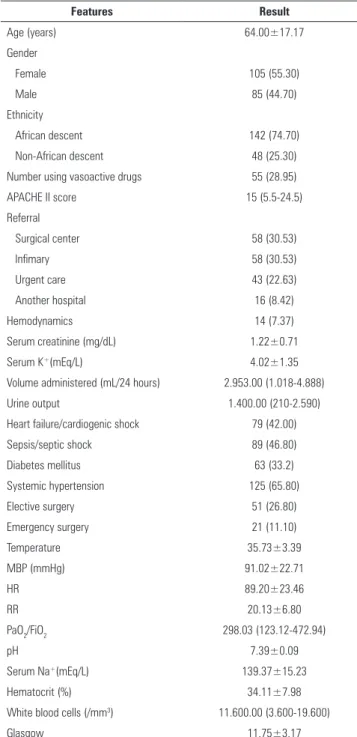
One hundred ninety patients were studied, and the mean age was 64.00±17.17. he predominant sex was female: 105 patients (55.30%) were women and 85 patients (44.70%) were men. In the present study, African descent was the most prevalent ethnic group, corresponding to 142 (74.70%) patients. Forty-eight patients (25.30%) were not of African descent. Fifty-ive patients (28.95%) used vasoactive drugs. he median APACHE score was 15 (9.5). In terms of pathology, of the 190 patients analyzed, 125 patients (65.80%) were hypertensive, 89 patients (46.80%) had heart failure/cardiogenic shock, 79 patients (42.00%) had sepsis/septic shock, and 63 patients (33.2%) had diabetes mellitus. hese and other data are displayed in table 1.
Table 2 shows a cross-tabulation of the agreement between the RIFLE and AKIN criteria at diferent stages: 34.74% for patients without AKI; 29.47% for AKIN stage I and RIFLE Risk classiication; 6.31% for AKIN stage II and RIFLE Injury classiication; and 14.21% for AKIN stage III and RIFLE Failure classiication.
According to the RIFLE criteria, the mortality rates were 11 (17.74%), 14 (22.58%), 15 (24.19%) and 22
Table 1 - Demographic features and clinical-laboratory baselines for critically ill patients (N=190)
Features Result
Age (years) 64.00±17.17
Gender
Female 105 (55.30)
Male 85 (44.70)
Ethnicity
African descent 142 (74.70)
Non-African descent 48 (25.30)
Number using vasoactive drugs 55 (28.95)
APACHE II score 15 (5.5-24.5)
Referral
Surgical center 58 (30.53)
Infimary 58 (30.53)
Urgent care 43 (22.63)
Another hospital 16 (8.42)
Hemodynamics 14 (7.37)
Serum creatinine (mg/dL) 1.22±0.71
Serum K+(mEq/L) 4.02±1.35
Volume administered (mL/24 hours) 2.953.00 (1.018-4.888)
Urine output 1.400.00 (210-2.590)
Heart failure/cardiogenic shock 79 (42.00)
Sepsis/septic shock 89 (46.80)
Diabetes mellitus 63 (33.2)
Systemic hypertension 125 (65.80)
Elective surgery 51 (26.80)
Emergency surgery 21 (11.10)
Temperature 35.73±3.39
MBP (mmHg) 91.02±22.71
HR 89.20±23.46
RR 20.13±6.80
PaO2/FiO2 298.03 (123.12-472.94)
pH 7.39±0.09
Serum Na+(mEq/L) 139.37±15.23
Hematocrit (%) 34.11±7.98
White blood cells (/mm3) 11.600.00 (3.600-19.600)
Glasgow 11.75±3.17
Serum K+ - serum potassium; MBP - mean blood pressure; HR - heart rate; RR - respiratory rate; PaO2/FiO2 - arterial oxygen pressure/fraction of inspired oxygen; Serum Na+ - serum sodium. The results are expressed as number (%), mean±standard deviation or median (interquartile interval).
Table 2 - Cross-tabulation of patients classified by RIFLE versus AKIN criteria
AKIN RIFLE
Without AKI Risk Injury Failure Total (AKIN)
Without AKI 66 (34.74) 0 2 (1.05) 2 (1.05) 70(36.84)
Stage 1 4 (2.10) 56 (29.47) 10 (5.26) 1 (0.53) 71 (37.37)
Stage 2 0 0 12 (6.31) 3 (1.58) 15 (7.89)
Stage 3 1 (0.53) 2 (1.05) 4 (2.10) 27 (14.21) 34 (17.89)
Total (RIFLE) 71 (37.37) 58 (30.53) 28 (17.74) 33 (17.37) 190 (100) AKI - acute kidney injury. Number of patients classified in the indicated AKI stages by the AKIN or RIFLE criteria are cross-tabulated. The results are expressed as numbers and percentages. Grey cells indicate patients that were assigned to the same AKI degree by both classification systems.
Considering the amendments suggested by KDIGO 2012, the mortality rates were 17.74%, 29.03%, 11.29% and 41.94% for patients without AKI and at stage I, stage II and stage III, respectively (Table 3).
Table 3 - Mortality rate stratified according to the RIFLE and AKIN criteria
Total (N=190) Death (N=62) No death (N=128)
RIFLE
Without AKI 71 (37.4) 11 (17.74) 60 (46.87)
Risk 58 (30.5) 14 (22.58) 44 (34.37)
Injury 28 (14.7) 15 (24.19) 13 (10.16)
Failure 33 (17.4) 22 (35.48) 11 (8.59)
AKIN
Without AKI 70 (36.8) 11 (17.74) 59 (46.09)
Stage 1 71 (37.4) 18 (29.03) 53 (41.40)
Stage 2 15 (7.9) 8 (12.90) 7 (5.47)
Stage 3 34 (17.9) 25 (40.32) 9 (7.03)
KDIGO
Without AKI 70 (36.8) 11 (17.74) 59 (46.09)
Stage 1 71 (37.4) 18 (29.03) 53 (41.40)
Stage 2 14 (7.36) 7 (11.29) 7 (5.47)
Stage 3 35 (18.42) 26 (41.94) 9 (7.03)
Results expressed as absolute n (valid percent).
3.83 to 20.83 for stage 3. For the KDIGO criteria, the results were as follows: an OR of 0.58 with a 95%CI of 0.30 to 1.11 for stage 1; an OR of 2.2 with a 95%CI of 0.74 to 6.58 for stage 2; and an OR of 9.55 with a 95%CI of 4.10 to 22.22 for stage 3 (Table 4).
Table 4 - Association between mortality and the RIFLE, AKIN and KDIGO criteria
Odds ratio (95%CI) Odds ratio (95%CI) corrected for age and APACHE II score
RIFLE criteria
Risk 0.56 (0.27-1.12) 0.48 (0.19-1.21)
Injury 2.82 (1.25-6.39) 1.19 (0.40-3.47)
Failure 5.85 (2.61-13.12) 4.12 (1.45-11.72)
AKIN criteria
Stage 1 0.58 (0.30-1.11) 0.56 (0.24-1.30)
Stage 2 2.56 (0.88-7.42) 2.60 (0.64-10.52)
Stage 3 8.93 (3.83-20.83) 4.40 (1.47-13.16)
KDIGO criteria
Stage 1 0.58 (0.30-1.11) 0.56 (0.24-1.30)
Stage 2 2.2 (0.74-6.58) 2.30 (0.54-9.76)
Stage 3 9.55 (4.10-22.22) 4.74(1.60-14.03)
* Values for odds ratio with 95% confidence interval (95%CI) for the RIFLE and AKIN criteria based on univariate and multivariate logistic regression analyses.
We next tested the association between mortality and the RIFLE, AKIN and KDIGO criteria. he results for the RIFLE criteria were as follows: an odds ratio (OR) of 0.56 and a 95% conidence interval (95%CI) of 0.27 to 1.12 for the Risk stage; an OR of 2.82 with a 95%CI of 1.25 to 6.39 for the Injury stage; and an OR of 5.85 with a 95%CI of 2.61 to 13.12 for the Failure stage. he results for the AKIN criteria were and follows: an OR of 0.58 with a 95%CI of 0.30 to 1.11 for stage 1; an OR of 2.56 with a 95%CI of 0.88 to 7.42 for stage 2; and an OR of 8.93 with a 95%CI of
he area under the ROC curve (AUROC) was calculated as 0.735 for the RIFLE criteria, 0.74 for the AKIN criteria and 0.733 for the KDIGO criteria, with p<0.001 for all three criteria (Figure 1).
DISCUSSION
he present study was developed from a cohort of patients with a high median age. his inding corroborates other studies conducted in the ICU setting that have also evaluated parameters related to the development of kidney disorders.(5,7,8)
An important characteristic of the sample in the present study was that most patients were of African descent, relecting the reality of the population served by the clinic where this study was conducted.(12) his aspect could lead to an overestimation of the incidence of AKI because such patients have a higher propensity to develop systemic hypertension, which is a disease known to be associated with kidney disorders.(13-16)
It should be noted that the RIFLE, AKIN and KDIGO criteria all operate using the same laboratory parameters and urine output measurements to stratify pre-established renal injury stages. herefore, any bias that may compromise the accuracy of the values will afect all of the indices, thus reducing any particular inluence on the outcome.(7)
A literature review conducted by searching medical-scientiic databases analyzed several relevant studies published from January 2000 to June 2011 to arrive at a consensus deinition of the parameters for AKI. Among the important conclusions expressed by the review, there was no clear superiority between the RIFLE and AKIN criteria for the establishment of AKI; the results for mortality were similar regardless of the classiication used.(6) hese indings were consistent with the results of the present study. However, experts prefer the AKIN index because it can detect AKI earlier by taking into account lower biomarker values.(6)
he irst study to compare the RIFLE and AKIN criteria and relate them to AKI in an ICU setting was published in 2008 by Bagshaw et al. his large study involved more than 120,000 patients and concluded that the establishment of the AKIN criteria, which were derived from the renowned RIFLE criteria, was not signiicant in bringing substantial beneits.(7) Although the sample size was large and it was a multicenter study, that study had limitations related to being retrospective and because there were no data on the need for dialysis or urinary output every 6 hours, which may have led to misclassiication of the diferent stages of AKI.
According to the data presented in the results of this work, it was evident that there was essentially no signiicant diference between the rates of AKI and mortality as determined by the RIFLE and AKIN criteria. his inding was consistent with similar studies in the medical-scientiic literature.(5-7,17,18) However, some studies have shown small diferences in the ability to diagnose AKI between the RIFLE and AKIN criteria. Some of those studies referred to the RIFLE as a more sensitive predictor,(10,19) while others indicated the AKIN as a better classiication tool,(20,21) although both yield very similar results regarding the prediction of death.
As demonstrated in the literature by studies on the same topic using similar methodologies, mortality rates are expected to grow as the AKI progresses from initial to subsequent stages according to the RIFLE and AKIN classiications.(6) However, due to a small sample size, the present study was unable to show a statistically signiicant relationship between the severity of AKI and progression of mortality rates between the diferent stages. However, we found higher mortality rates associated with the KDIGO and AKIN stages III and the Failure classiication in RIFLE. Moreover, both the KDIGO and AKIN stages III and the Failure classiication in RIFLE were signiicantly associated with a higher likelihood of death in univariate and multivariate analyses corrected for age and APACHE II score (Tables 3 and 4).
Analyzing the layout of the ROC curves corroborated the indings of the present study. As explained in the results above, the AUROCs for the RIFLE, AKIN and KDIGO criteria were 0.735, 0.74 and 0.733, respectively, with p<0.001 for all three criteria. In this context, these values were similar to results found in the literature in studies addressing the same main topic.(5,7,22-24)
potential sources of classiication bias. In addition, the recent amendments proposed by KDIGO(11) were also compared with the RIFLE and AKIN criteria as predictors of mortality. Additional limitations of the present study were the single center focus and the number of patients included.
CONCLUSION
he RIFLE, AKIN and KDIGO scores were all good predictors of mortality in critically ill patients, and there were no diferences among them in terms of predicting death. hese scores are good predictors of death.
Objetivo: A lesão renal aguda é uma complicação comum em pacientes gravemente enfermos, sendo os critérios RIFLE, AKIN e KDIGO utilizados para sua classiicação. Esse trabalho teve como objetivo a comparação dos critérios citados quanto à capacidade de predição de mortalidade em pacientes gravemente enfermos.
Métodos: Estudo de coorte prospectiva, utilizando como fonte de dados prontuários médicos. Foram incluídos todos os pacientes admitidos na unidade de terapia intensiva. Os critérios de exclusão foram tempo de internamento menor que 24 horas e doença renal crônica dialítica. Os pacientes foram acompanhados até a alta ou óbito Para análise dos dados, foram utilizados os testes t de Student, qui-quadrado, regressão logística multivariada e curva ROC.
Resultados: A média de idade foi de 64 anos, com mulheres e afrodescendentes representando maioria. Segundo o RIFLE, a
taxa de mortalidade foi de 17,74%, 22,58%, 24,19% e 35,48% para pacientes sem lesão renal aguda e em estágios Risk, Injury e
Failure, respectivamente. Quanto ao AKIN, a taxa de mortalidade
foi de 17,74%, 29,03%, 12,90% e 40,32% para pacientes sem lesão renal aguda, estágio I, estágio II e estágio III, respectivamente. Considerando o KDIGO 2012, a taxa de mortalidade foi de 17,74%, 29,03%, 11,29% e 41,94% para pacientes sem lesão renal aguda, estágio I, estágio II e estágio III, respectivamente. As três classiicações apresentaram resultados de curvas ROC para mortalidade semelhantes.
Conclusão: Os critérios RIFLE, AKIN e KDIGO
apresentaram-se como boas ferramentas para predição de mortalidade em pacientes graves, não havendo diferença relevante entre os mesmos.
RESUMO
Descritores: Lesão renal aguda; Incidência; Mortalidade; Prognóstico; Unidades de terapia intensiva
REFERENCES
1. Metnitz PG, Krenn CG, Steltzer H, Lang T, Ploder J, Lenz K, et al. Effect of acute renal failure requiring renal replacement therapy on outcome in critically ill patients. Crit Care Med. 2002;30(9):2051-8.
2. Thadhani R, Pascual M, Bonventre JV. Acute renal failure. N Engl J Med.1996;334(22):1448-60.
3. Hoste EA, Clermont G, Kersten A, Venkataraman R, Angus DC, De Bacquer D, et al. RIFLE criteria for acute kidney injury are associated with hospital mortality in critically ill patients: a cohort analysis. Crit Care. 2006;10(3):R73.
4. Mehta RL, Pascual MT, Soroko S, Savage BR, Himmelfarb J, Ikizler TA, Paganini EP, Chertow GM;Program to Improve Care in Acute Renal Disease. Spectrum of acute renal failure in the intensive care unit: the PICARD experience. Kidney Int. 2004;66(4):1613-21.
5. Chang CH, Lin CY, Tian YC, Jenq CC, Chang MY, Chen YC, et al. Acute kidney injury classification: comparison of AKIN and RIFLE criteria. Shock. 2010;33(3):247-52.
6. Valette X, du Cheyron D. A critical appraisal of the accuracy of the RIFLE and AKINclassifications in defining "acute kidney insufficiency" in critically ill patients. J CritCare. 2013;28(2):116-25.
7. Bagshaw SM, George C, Bellomo R; ANZICS Database Management Committe. A comparison of the RIFLE and AKIN criteria for acute kidney injury in critically ill patients. Nephrol Dial Transplant. 2008;23(5):1569-74. 8. Uchino S, Kellum JA, Bellomo R, Doig GS, Morimatsu H, Morgera S,
Schetz M, Tan I, Bouman C, Macedo E, Gibney N, Tolwani A, Ronco C; Beginning and Ending Supportive Therapy for the Kidney (BEST Kidney) Investigators. Acute renal failure in critically ill patients: a multinational,
9. Mehta RL, Kellum JA, Shah SV, Molitoris BA, Ronco C, Warnock DG, Levin A; Acute Kidney InjuryNetwork. Acute Kidney Injury Network: report of an initiative to improve outcomes in acute kidney injury. Crit Care. 2007;11(2):R31.
10. Joannidis M, Metnitz B, Bauer P, Schusterschitz N, Moreno R, Druml W, et al. Acute kidney injury in critically ill patients classified by AKIN versus RIFLE using the SAPS 3 database. Intensive Care Med. 2009;35(10):1692-702. 11. Kidney Disease: Improving Global Outcomes (KDIGO). Acute Kidney Injury
Work Group. KDIGO Clinical Practice Guideline for Acute Kidney Injury. Kidney Int Suppl. 2012;2(Suppl 1):1-138.
12. Instituto Brasileiro de Geografia e Estatística - IBGE. Cidades. Informações sobre os municípios brasileiros. Bahia. Salvador [Internet].[citado 2013 Dec4]. Disponível em: http://cidades.ibge.gov.br/xtras/perfil.php?lang=& codmun=292740&search=bahia|salvador
13. Rose DE, Farmer MM, Yano EM, Washington DL. Racial/ethnic differences in cardiovascular risk factors among woman veterans. J Gen Intern Med. 2013; Suppl2:S524-8.
14. Sarafidis PA, Georgianos P, Bakris GL. Resistant hypertension--its identification and epidemiology. Nat Rev Nephrol. 2013;9(1):51-8. Review. Erratum in: Nat Rev Nephrol. 2013;9(9):492. Review. Erratum in: Nat Rev Nephrol. 2013;9(9):492.
15. Hunte HE, Mentz G, House JS, Schulz AJ, Williams DR, Elliott MR, et al. Variations in hypertension-related outcomes among Blacks, Whites and Hispanics in two large urban areas and in the United States. Ethn Dis. 2012;22(4):391-7.
17. Tülübas EK, Demir G, Duman E, Altun D, ÇetingökH, Hergünsel O, et al. Monitoring of renal function in patients with RIFLE and AKIN scores to compare the effects on mortality and morbidity in ICU. MedJ Bakirköy. 2013;9(2):69-72.
18. Englberger L, Suri RM, Li Z, Casey ET, Daly RC, Dearani JA, et al. Clinical accuracy of RIFLE and Acute Kidney Injury Network (AKIN) criteria for acute kidney injury in patients undergoing cardiac surgery. Crit Care. 2011;15(1):R16.
19. Kompoti M, Paridou A, Stefanatou E, Koutsodimitropoulos I, Iordanidou O, Markou N, et al. Acute kidney injury predicts mortality in critically ill patients: a comparison of RIFLE and AKIN classifications. Intensive Care Med. 2010;36(2 Suppl):S175.
20. Ratanarat R, Skulratanasak P, Tangkawattanakul N, Hantaweepant C. Clinical accuracy of RIFLE and Acute Kidney Injury Network (AKIN) criteria for predicting hospital mortality in critically ill patients with multi-organ dysfunction syndrome. J Med Assoc Thai. 2013;96Suppl2:S224-31.
21. Jiang F, Chen YH, Liang XL, Xu LX, Ma GP, Hu PH, et al. [The sensitivity and accuracy of RIFLE and AKIN criteria for acute kidney injury diagnosis in intensive care unit patients[. Zhongguo Wei Zhong Bing JiJiu Yi Xue. 2011;23(12):759-62. Chinese.
22. Yan X, Jia S, Meng X, Dong P, Jia M, Wan J, et al. Acute kidney injury in adult postcardiotomy patients with extracorporeal membrane oxygenation:evaluation of the RIFLE classification and the Acute Kidney Injury Network criteria. Eur J Cardiothorac Surg. 2010;37(2):334-8. 23. Robert AM, Kramer RS, Dacey LJ, Charlesworth DC, Leavitt BJ, Helm
RE, Hernandez F, Sardella GL, Frumiento C, Likosky DS, Brown JR; Northern New England Cardiovascular Disease Study Group. Cardiac surgery-associated acute kidney injury: a comparison of two consensus criteria. Ann Thorac Surg. 2010;90(6):1939-43.