(1) Department of Audiology and Speech-Language Therapy
of the Bauru School of Dentistry/University of São Paulo - FOB/USP, Bauru, São Paulo, Brazil.
(2) Department of Audiology and Speech-Language Therapy of the Bauru School of Dentistry/University of São Paulo - FOB/USP, Bauru, São Paulo, Brazil.
(3) Department of Audiology and Speech-Language Therapy
of the Bauru School of Dentistry/University of São Paulo - FOB/USP, Bauru, São Paulo, Brazil.
(4) Department of Audiology and Speech-Language Therapy
of the Bauru School of Dentistry/University of São Paulo - FOB/USP, Bauru, São Paulo, Brazil.
(5) Department of Audiology and Speech-Language Therapy
of the Bauru School of Dentistry/University of São Paulo - FOB/USP, Bauru, São Paulo, Brazil.
(6) Department of Audiology and Speech-Language Therapy
of the Bauru School of Dentistry/University of São Paulo - FOB/USP, Bauru, São Paulo, Brazil.
Financial aid: scholarships for scientiic initiation – PIBIC - CNPq Conlict of interest: non-existent
millions of people affected around the world, regardless of the level of development of the nations, transform it into a public healthcare problem1.
The environmental exposure to this metal has
become a worrisome issue, as the results of the studies developed in this area showed neurophysi-ologic and neurocognitive alterations on children and adults, even in low contamination levels2.
In this regard, the Center for Disease Control3
described adverse effects that blood lead levels considered low (10mg/dL) may cause. Since then, the normative regulations referring to lead environ-mental control were reviewed, and lead level in blood commended to determine an intervention was reduced from 25 mg/dL to 10 mg/dL3,4.
Research has pointed out that lead levels in the blood between 10 and 20 mg/dL are not considered safe, as there is the possibility of occurrence of central nervous system dysfunction, especially in children, causing alterations in reasoning, concen-tration, and learning abilities; attention and vigil
deicits; cognitive losses; psychomotor function,
short term memory, and visuospatial abilities altera-tions; language dysfunction; and also headaches, INTRODUCTION
Lead, one of the most common environment
contaminants, is a well known neurotoxic agent,
which vast range of associated effects and the
AUDIOLOGICAL EVALUATION IN CHILDREN WITH
CUMULATIVE LOW-LEVEL OF LEAD EXPOSURE
Avaliação audiológica em crianças com baixo nível
de exposição cumulativa ao chumbo
Kátia de Freitas Alvarenga(1), Daniela de Oliveira Manoel(2), Fernanda Zucki(3),
Lilian Cássia Bórnia Jacob-Corteletti(4), Andrea Cintra Lopes(5), Mariza Ribeiro Feniman(6)
ABSTRACT
Purpose: to verify the occurrence of sensorineural hearing loss in children with low level of cumulative
lead exposure. Methods: 156 lead-poisoned children, 94 males and 62 females, ranging in age from 18 months old to 14 years and 5 months old were subjected to analysis of longitudinal lead level in blood as well as pure tone audiometry and transient evoked otoacoustic emissions. Results: the population studied had a mean estimated blood lead level of 12,2±5,7mg/dL (range between 2,4 and 33mg/dL); all children had a normal response in pure tone audiometry at 20 dBHL in the frequencies tested, 0.5, 1, 2 and 4 kHz, in both ears; the transient evoked otoacoustic emissions were presented
for all frequencies bilaterally in 79 children surveyed. Conclusion: there has been no hearing loss in
children with a history of low cumulative lead exposure, as there was no injury of cochlear outer hair
cells, even if subclinical.
by poisoning, regardless of the concentration rate of this substance in blood.
Therefore, the occurrence of hearing loss as a
consequence of contamination by this metal has been questioned. Studies aimed at the action of
lead in the auditory system began in the 70’s. Figure 1 shows a compilation of the studies presented in
the ield literature, which performed an auditory
assessment of children and adults through behav-ioral methods. Another important aspect to be emphasized about this compilation is that only two studies demonstrated the absence of cochlear lesion10,11.
seizures, IQ decrease, hearing loss, aggressive
behavior, and mental retardation5-7.
However, cognition, attention and behavior
dysfunctions have been veriied on children whose
blood lead level are found in levels as low as 3 to 5mg/dL. This demonstrates that these levels can be considered inducers of behavioral alterations, being, in this aspect, also harmful to health8,9.
Considering speciically the auditory system, liter
-ature presents clinical and experimental studies with
contradictory results. So far, there is no consensus regarding the effect of lead in the auditory system, and about possible structures that could be altered
Figure 1 – Effects of lead on the auditory system of adults and children
Author Sample Evaluation Results
Repko and Corum (1979)
Workers with blood lead level > 70 µg/dl
Behavioral (tonal threshold
audiometry)
Hearing thresholds correlated with the lead blood level.
Schwartz and
Otto (1987) 4519 children
Behavioral (tonal threshold
audiometry)
Thresholds changed at 0,5, 1, 2 and 4
kHz related to lead exposure
Schwartz and Otto (1991)
3545 children and teenagers evaluated during
the Hispanic Health and
Nutrition Examination
Survey (HHANES)
Behavioral (tonal threshold
audiometry)
Thresholds increase at frequencies 0,5, 1, 2 and 4 kHz with signiicant
correlation with blood lead level. The pathologic nature of the contamination
was not clear.
Forst et al. (1997)
183 workers with blood lead level between 1-18µg/
dl
Behavioral (tonal threshold
audiometry)
Thresholds increase at frequency 4 kHz. The level of exposure to noise
was not considered.
Farahat et al.
(1997)
90 workers, 45 exposed
to Pb (36,94±4,36 µg/dl) and 45 workers without
exposure (11,51±1,22µg/dl)
Behavioral (tonal threshold
audiometry)
Auditory threshold increase at
frequencies 1 and 8 kHz, with signiicant difference in the control
group, with association with blood lead
level at frequency 8 kHz.
Trong-Neng et al.
(2000)
220 workers exposed to Pb
and noise
Behavioral (tonal threshold
audiometry)
There was no correlation between the auditory threshold, and the blood lead level and noise. The variability of the
auditory threshold was explained by the long term exposure to lead index.
Hwang et al.
(2009)
412 workers exposed to
chemical agents and noise
Behavioral (tonal threshold
audiometry)
Signiicant association found between
low lead levels and induced hearing
loss by noise in different frequencies.
There is higher impact on high
frequencies, especially 6000 Hz. Exposure to lead may contribute to
a value ≥ 50%, and a relationship signal/noise ≥ 3
dB. A click-type stimulus was applied, non-linear, with intensity at about 80 dB. The probe stability was
always superior to 80% and calibration was done on
a daily basis.
The present study was undertaken at the Speech-Language Pathology and Audiology Clinic of the Bauru School of Dentistry and Audiological Research Center of the Hospital for Rehabilitation of Craniofacial Anomalies, both belonging to the
University of São Paulo. It was approved by the
Research Ethics Committee of the Bauru School of Dentistry through process number 133/2003.
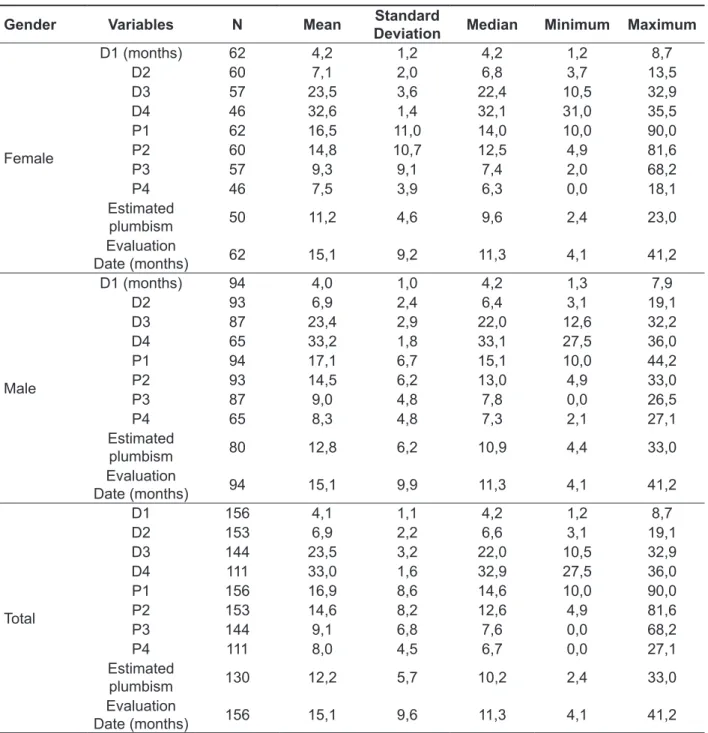
Next, the descriptive statistics analysis done will
be presented (mean, standard deviation, median,
minimum and maximum), regarding plumbism,
estimated plumbism considering males and females, as well as the data obtained from monitoring the hearing system evaluation using tonal threshold audiometry and evoked otoacoustic emissions through transient stimulus.
RESULTS
Table 1 presents the descriptive statistics analysis (mean, standard deviation, median, minimum and
maximum) considering the date of collection of each
plumbism; the plumbism values obtained and the date of the audiological assessment, considering all the 156 children evaluated.
Tonal threshold audiometry was conducted in
125 children (80%). Normal response at 20 dBNA was found in all of them, for the frequencies of 0,5; 1; 2 e 4 kHz, for both ears. In the same way, the
evoked otoacoustic emissions through transient
stimulus were present in 31 children (20%), with amplitude >3dB and reproducibility >75% in the frequency bands from 1 to 5 kHz.
Considering the fact that there is no clarity about the cumulative effect of lead on the auditory system,
that is, its long term inluence, the authors decided
to calculate the value of estimated plumbism at the date of the audiological evaluation. To do so,
the date on which the irst collection was done in
the population was considered as the reference. Also on table 1, it is possible to observe that the estimated plumbism was calculated for 130 children.
26 children were excluded from the total, due to the
fact that their audiological evaluation took place later than date of last collection, thus not allowing the proposed calculation. The estimated plumbism value was 12,2±5,7mg/dL
Due to the lack of consensus in the literature in terms of the action of lead on the auditory system, the objective of this study is to verify the occur-rence of sensorineural hearing loss in children with
cumulative low-level lead exposure.
METHODS
Subjects and locations
The sample consisted of 156 children poisoned by lead, 94 males and 62 females, aged from 18 months to 14 years and 5 months (6a8m±3a2m). These children were residents of a battery factory neighborhood in the city of Bauru, state of São
Paulo. In 2002, it caused an environmental accident,
contaminating the soil and rivers of the region with lead.
Plumbism monitoring
Plumbism monitoring was performed longitudi-nally through periodic blood collection, where all the
children had a minimum of two and a maximum of
four collections. The sample collection was under the responsibility of the Municipal Health Department
and Regional Health Division (DIR) of Bauru/SP,
and the analyses were under the responsibility of the
Adolfo Lutz/SP Laboratory. The analytical technique
to measure the blood lead level was the Atomic Absorption Spectrometry with a Graphite Furnace.
Audiological Evaluation
Initially, the children had their hearing veriied
using tonal threshold audiometry (TTA) in the
frequencies of 0,5; 1; 2 and 4 kHz. The presence of response on the 20 dBNA intensity, level that deter -mines regular social hearing, was checked. To this end, the pure tone was presented with intensities of
40 and 20 dB. In case a response is not obtained
in 20 dB, a research would be done on the hearing threshold. The TTA was done in an acoustic booth, using a Madsen audiometer (model MD622), with
standard TDH-39 earphones itted with the MX-41 cushion, calibrated to the ISO 8253/ IEC 645/ ISO
389 standards.
In children under the age of 2 and ½ years, with
the objective of evaluating the cochlea, the function-ality of outer hair cells was studied, using evoked otoacoustic emissions through transient stimulus
research, at a frequency range between 1 to 5 kHz, using Otodynamics Ltda ILO92 Research OAE
Regarding the auditory system, in fact, there
is still no clarity about the toxic effect of lead. In
a careful analysis of the methodology used in the various studies reviewed here, some points seem to
suggest a certain discrepancy of the indings, which
will be discussed below.
Initially, it appears that there is no consensus as to the index to be used to determine the degree
of contamination of the various populations which DISCUSSION
The concern with the effect of lead on health
has allowed the realization of several experimental
and clinical studies with industry workers, adults and children with a history of contamination by this metal, even at levels close to 10mg/dL, previously believed to be safe 3.
Table 1 – Descriptive statistics analysis (mean, standard deviation, median, minimum and maximum) considering the date of collection of each plumbism; the plumbism values obtained, estimated plumbism and the date of the hearing assessment, considering males and females
Gender Variables N Mean Standard
Deviation Median Minimum Maximum
Female
D1 (months) 62 4,2 1,2 4,2 1,2 8,7
D2 60 7,1 2,0 6,8 3,7 13,5
D3 57 23,5 3,6 22,4 10,5 32,9
D4 46 32,6 1,4 32,1 31,0 35,5
P1 62 16,5 11,0 14,0 10,0 90,0
P2 60 14,8 10,7 12,5 4,9 81,6
P3 57 9,3 9,1 7,4 2,0 68,2
P4 46 7,5 3,9 6,3 0,0 18,1
Estimated
plumbism 50 11,2 4,6 9,6 2,4 23,0
Evaluation
Date (months) 62 15,1 9,2 11,3 4,1 41,2
Male
D1 (months) 94 4,0 1,0 4,2 1,3 7,9
D2 93 6,9 2,4 6,4 3,1 19,1
D3 87 23,4 2,9 22,0 12,6 32,2
D4 65 33,2 1,8 33,1 27,5 36,0
P1 94 17,1 6,7 15,1 10,0 44,2
P2 93 14,5 6,2 13,0 4,9 33,0
P3 87 9,0 4,8 7,8 0,0 26,5
P4 65 8,3 4,8 7,3 2,1 27,1
Estimated
plumbism 80 12,8 6,2 10,9 4,4 33,0
Evaluation
Date (months) 94 15,1 9,9 11,3 4,1 41,2
Total
D1 156 4,1 1,1 4,2 1,2 8,7
D2 153 6,9 2,2 6,6 3,1 19,1
D3 144 23,5 3,2 22,0 10,5 32,9
D4 111 33,0 1,6 32,9 27,5 36,0
P1 156 16,9 8,6 14,6 10,0 90,0
P2 153 14,6 8,2 12,6 4,9 81,6
P3 144 9,1 6,8 7,6 0,0 68,2
P4 111 8,0 4,5 6,7 0,0 27,1
Estimated
plumbism 130 12,2 5,7 10,2 2,4 33,0
Evaluation
In the tonal audiometry threshold, response to 20dBNA, the minimum intensity studied, was found
in all the children. Considering that the children presented, at some point, blood lead level > 10 mg/
dL, with maximum value of 90 mg/dL in the irst
collection, even though the estimated plumbism value was considered low (12,2±5,7mg/dL, range between 2,4-33mg/dL), the occurrence of senso-rioneural hearing loss could be assumed if the lead
really had ototoxic effect.
Nevertheless, all the children assessed by tonal
threshold audiometry presented normal response, demonstrating that, regardless of the lead level
found, hearing loss was not veriied, inding that
supports some studies in the literature10,18.
It is important to critically analyze the studies
that found an increase of the hearing threshold with
signiicant correlation with the blood lead level, as it
is possible to verify some methodological fragilities that are noteworthy12,13,19-21,.
In the studies involving exposure to lead and
workers, it is observed that control groups are not adopted in their methodologies, nor are presented
information about concomitant exposure to noise
and its intensity, aspects which are considerably relevant to the true understanding of the effects of lead on the hearing function. This argumentation is based on a study11 in which a control group
with equivalence on the factors age and level of exposure to noise is used. It found hearing
alterations, however there was no difference in the amplitude of the evoked otoacoustic emissions, a
product of the distortion between the lead-exposed group associated to noise and the group exposed
solely to noise
With reference to research done with children, various authors have discussed small changes on
the thresholds found on intensities £10dBNA, that
is, hearing thresholds that do not clinically represent
hearing loss19,20. On the other hand, this inding allows questioning whether this threshold variation would not be relecting initial alterations on the auditory system, as for example on the outer hair cells, irst structure which is usually injured on ototoxicity. In this study, the children subjected to
evoked otoacoustic emissions through transient stimulus research presented normal result, bilat-erally, demonstrating that there was no of outer hair cells in the cochlea, even sub-clinical. Considering the sensitivity of the procedure to detect this type of alteration, it is possible to assume that the lead did not cause cochlear alteration on the structure that
was speciically analyzed, inding that corroborates
with what is described in the literature10,11.
were studied; in other words, what would be the lead level to be taken into account in the analyses: the blood lead level at the time of the evaluation, the cumulative level, or another proposal for calculation?
Considering the studies that used the blood lead levels at the time of the evaluation, there was
no agreement as to whether there is signiicant
association with the parameters used on the evalu-ation of the auditory function. Some studies have shown that the increase in the auditory threshold was correlated with the levels of lead in blood12,13-15
while others did not conirm this inding16,17.
Only a single study considered the cumulative
lead level, given by the index calculation of the long term exposure to the metal, similar to that proposed
in this study. As a result, the authors found no correlation with the auditory thresholds observed in
workers exposed to lead and noise12.
In the present work, two to four collections
in the children were done for Plumbism control. The values obtained were between 16,9±8,6mg/ dL (range between 10-90mg/dL); 14,6±8,2mg/dL (range between 4,9-81,6mg/dL); 9,1± 6,8mg/dL (range between 0-68,2mg/dL); 8,0±4,5mg/dL (range between 0- 27,1mg/dlL (table 1).
It was possible to verify, therefore, that there was
a decrease on the lead blood level, and in the last two collections, the mean value was already below
10mg/dL, considered as the limit for deinition for intervention. This fact is justiied by the measures
assumed by the municipal government and the company responsible for the ecological accident near the community of the area around the factory, such as: drug treatment of the child when necessary; asphalt in the houses and streets; orientation of the population for the non-consumption of food produced in the region, awareness regarding care for children, among others.
It is important to emphasize that, even though
the present study obtained a rigid monitoring of the blood lead level, it was not possible to carry out the audiological assessment in the same week of the blood collection for all the individuals. Thus, there was a difference of 15,1±9,6 months between the blood collection and audiological evaluation. For this reason, the estimated Plumbism was
calcu-lated. This fact raises dificulties on the compar -ative analysis between the studies, since there is no direction on the lead parameter to be used. Therefore, in this study, the authors opted for using the estimated Plumbism value, because it considers
the variable time of exposure and, consequently, the
ACKNOWLEDGEMENTS
National Council for Scientiic and Technological Development – CNPq.
CONCLUSION
No sensorineural hearing loss was veriied in
children with a history of cumulative low-level lead
exposure. Also, no injury of cochlear outer hair cells
was found, not even subclinical ones.
REFERENCES
1. Olympio KPK, Oliveira PV, Naozuka J, Cardoso MRA, Gunther WMR, Bechara EJH. Surface dental enamel lead levels and antisocial behavior in
Brazilian adolescents. The Toxicologist (Supplement to Toxicological Sciences). 2009;108(1):76-7.
2. Dascanio D, Valle TGM. A associação entre
variáveis sócio-demográicas e plumbemia em
crianças. Paidéia. 2008;18(41):541-53.
3. CDC. Preventing lead poisoning in young children. Atlanta: US Department of Health and Human Services, Public Health Service, 1991. 4. OMS - Human exposure to lead. In. Human
Exposure Assessurent Series, WHO, 1992.
5. Mostafa GA, El-Shahawi HH, Mokhtar A. Blood lead levels in Egyptian children from high and low lead-polluted areas: impact on cognitive function.
Acta Neurol Scand. 2009;120:30-7.
6. Min MO, Singer LT, Kirchner HL, Minnes S, Short E, Hussain Z. et al. Cognitive development
and low-level lead exposure in poly-drug exposed children. Neurotoxicology and Teratology.
2009;31:225-31.
7. Bellinger D. Very low lead exposures and children’s neurodevelopment. Curr Opin Pediatr. 2008;20:172-7.
8. Chiodo LM, Jacobson SW, Jacobson JL.
Neurodevelopmental effects of postnatal lead exposure at very low levels. Neurotoxicol.
2004;26:359-71.
9. Chiodo LM, Covington C, Sokol RJ, Hannigan JH, Jannise J, Ager J, Greennwald M,
Delaney-Black V. Blood lead levels and speciic attention effects in young children. Neurotoxicol Teratol.
2007;29:538-46.
10. Buchanan LH, Counter SA, Ortega F, Goran L. Distortion product oto-acoustic emissions in Andean
children and adults with chronic lead intoxication.
Acta Otolaryngol (Stockh). 1999;119:652-8.
11. Alvarenga KF, Jacob LCB, Martins CHF, Costa
Filho AO, Coube CZV, Marques JM. Emissões
otoacústicas - produto de distorção em indivíduos
expostos ao chumbo e ao ruído. Rev Bras
Otorrinolaringol. 2003;69(5):681-9.
12. Farahat TM, Abdel-Rasoul GM, El-Assy AR, Kandil SH, Kabil MK. Hearing thresholds of workers in a printing facility. Environ Res.1997;73:189-92. 13. Hwang YH, Chiang HY, Yen-Jean MC, Wang JD. The association between low levels of lead in blood and occupational noise-induced hearing loss in steel workers. Science of the Total Environment
408. 2009:43–9.
RESUMO
Objetivo: veriicar a ocorrência de perda auditiva sensorioneural em crianças com baixo nível de
exposição cumulativa ao chumbo. Métodos: 156 crianças intoxicadas por chumbo, 94 do sexo mas
-culino e 62 do sexo feminino, na faixa etária entre 18 meses a 14 anos e 5 meses, foram submetidas a análise longitudinal do nível de Plumbemia em sangue, bem como audiometria tonal liminar e
emis-sões otoacústicas evocadas por estímulo transiente.Resultados: a população pesquisada apresen -tou um valor médio de Plumbemia estimada de 12,2±5,7mg/dL (faixa entre 2,4-33mg/dL); todas as
crianças apresentaram resposta normal na audiometria tonal liminar em 20 dBNA nas frequências testadas, 0,5; 1; 2 e 4 kHz, para ambas as orelhas; as emissões otoacústicas evocadas por estímulo transiente estiveram presentes para todas as frequências bilateralmente, nas 79 crianças pesqui -sadas. Conclusão: não foi constatada perda auditiva sensorioneural em crianças com histórico de
baixo nível de exposição cumulativa por chumbo, assim como não foi encontrada lesão de células ciliadas externas na cóclea, mesmo que subclínicas.
18. Trong-Neng W, Chen-Yang S, Jim-Shoung
L, Chain-Fun G, Kquei-Nu K, Hsueh-Yun C, et al. Effects of lead and noise exposure on hearing
ability. Arch Env Health. 2000;55(2):109-18.
19. Schwartz J, Otto D. Blood lead, hearing thresholds, and neurobehabioral development in children and youth. Arch Environ Health. 1987;42(3):153-60.
20. Schwartz J, Otto D. Lead and minor hearing impairment. Arch Environ Health. 1991;46(5):300-5. 21. Forst LS, Freels S, Persky V. Occupational lead
exposure and hearing loss. J Occup Environm Med.
1997;39(7):658-60. 14. Counter SA, Buchanan LH. Neuro-ototoxicity in
andean adults with chronic lead and noise exposure.
J Occup Environ Med. 2002;44(1):30-8.
15. Bernard SM. Should the Center for Disease Control and Prevention’s childhood lead poisoning intervention level be lowered? Am J Public Health. 2003; 93:1253-60.
16. Zou C, Zhao Z, Tang L, Chen Z, Du L. The effect of lead on brainstem auditory evoked potentials in children. Chin Med J (England) 2003;116(4):565-8. 17. Hirata M, Kosaka H. Effects of lead exposure on neurophysiological parameters. Environ Res. 1993;63:60-9.
Received on: October 18, 2011 Accepted on: February 05, 2012
Mailing address:
Kátia de Freitas Alvarenga
Faculdade de Odontologia de Bauru
Departamento de Fonoaudiologia (in care of Professora Doutora Kátia de Freitas Alvarenga)
Alameda Doutor Otávio Pinheiro Brizola, Nº 9-75 -
Vila Universitária Bauru - SP CEP: 17043-101