Nicolas Tabareau1,2*, Jean-Jacques Slotine3, Quang-Cuong Pham1
1LPPA, Colle`ge de France, Paris, France,2INRIA, E´cole des mines de Nantes, France,3Nonlinear Systems Laboratory, Massachusetts Institute of Technology, Cambridge, Massachusetts, United States of America
Abstract
The functional role of synchronization has attracted much interest and debate: in particular, synchronization may allow distant sites in the brain to communicate and cooperate with each other, and therefore may play a role in temporal binding, in attention or in sensory-motor integration mechanisms. In this article, we study another role for synchronization: the so-called ‘‘collective enhancement of precision’’. We argue, in a full nonlinear dynamical context, that synchronization may help protect interconnected neurons from the influence of random perturbations—intrinsic neuronal noise—which affect all neurons in the nervous system. More precisely, our main contribution is a mathematical proof that, under specific, quantified conditions, the impact of noise on individual interconnected systems and on their spatial mean can essentially be cancelled through synchronization. This property then allows reliable computations to be carried out even in the presence of significant noise (as experimentally found e.g., in retinal ganglion cells in primates). This in turn is key to obtaining meaningful downstream signals, whether in terms of precisely-timed interaction (temporal coding), population coding, or frequency coding. Similar concepts may be applicable to questions of noise and variability in systems biology.
Citation:Tabareau N, Slotine J-J, Pham Q-C (2010) How Synchronization Protects from Noise. PLoS Comput Biol 6(1): e1000637. doi:10.1371/journal.pcbi.1000637
Editor:Michael Breakspear, The University of New South Wales, Australia
ReceivedJune 18, 2009;AcceptedDecember 8, 2009;PublishedJanuary 15, 2010
Copyright:ß2010 Tabareau et al. This is an open-access article distributed under the terms of the Creative Commons Attribution License, which permits unrestricted use, distribution, and reproduction in any medium, provided the original author and source are credited.
Funding:This work was supported in part by EC—contract number FP6-IST-027140, action line: Cognitive Systems. The funders had no role in study design, data collection and analysis, decision to publish, or preparation of the manuscript.
Competing Interests:The authors have declared that no competing interests exist. * E-mail: [email protected]
Introduction
Synchronization phenomena are pervasive in biology. In neuronal networks [1–3], a large number of studies have sought to unveil the mechanisms of synchronization, from both physiological [4,5] and computational viewpoints (see for instance [6] and references therein). In addition, the functional role of synchronization has also attracted considerable interest and debates. In particular, synchronization may allow distant sites in the brain to communicate and cooperate with each other [7–9] and therefore may play a role in temporal binding [10,11] and in attention and sensory-motor integration mechanisms [12–14].
In this article, we study another role for synchronization: the so-calledcollective enhancement of precision(see e.g. [15–17]), an intuitive and often quoted phenomenon with comparatively little formal analysis [18]. We explain mathematically why synchronization may helpprotect interconnected nonlinear dynamic systems from the influence of random perturbations. In the case of neurons, these perturbations would correspond to so-called ‘‘intrinsic neuronal noise’’ [19], which affect all of the neurons in the nervous system. In the presence of significant noise intensities (as experimentally found in e.g. retinal ganglion cells in primates [20]), this property would be required for meaningful and reliable computations to be carried out.
It should be noted that ‘‘protection of systems from noise’’ and ‘‘robustness of synchronization to noise’’ are two different concepts. The latter concept means that the synchronized systems remain so in presence of noise, whereas the former concept means that, thanks to synchronization, the behaviors of the coupled systems are close to the noise-free behaviors. This difference is further addressed in the Discussion.
The influence of noise on the behaviors of nonlinear systems is very diverse. In chaotic systems, a small amount of noise can yield dramatic effects. At the other end of the spectrum, the effect of noise on nonlinear contracting systems is bounded by
s2=lwhere s is the noise intensity – which can be arbitrarily large – andlis the contraction rate of the system [21]. Between these two extremes, it has been shown analytically that some limit-cycle oscillators commonly used as simplified neuron models, such as FitzHugh-Nagumo (FN) oscillators, are basically unperturbed when they are subject to a small amount of white noise [22]. Yet, a larger amount of noise breaks this ‘‘resistance’’, both in the state space and in the frequency space [Figures 1(A)–(D)]. This suggests that both temporal coding and frequency coding may be unusable in the context of large neuronal noise.
One might argue that it could be possible to recover some information from the noisy FN oscillators by considering the activities of a large number of oscillators simultaneously [19,23]. Figure 2(A) shows that the spatial mean of the noisy oscillators still carries very little information when the noise intensities are large, making the population coding hypothesis also unlikely in this context. In other words, if the underlying dynamics are fundamentallynonlinear, as in the case of our FN oscillators, the spatial mean of the signals is ‘‘clean,’’ but contains very little information: the nonlinear nature of the systems dynamics prevents the familiar ‘‘averaging out’’ of noise through multiple measurements, and getting rid of the noise also gets rid of the signal.
[Figure 1(F)] or ‘‘populational’’ aspects [Figure 2(B)]. Thus, in some sense, the linear effect of averaging noise while preserving signal [24] can be achieved for these highly nonlinear dynamic components through the process of synchronization. Our aim in this article is to give mathematical elements of explanation for this phenomenon, in a full nonlinear setting. It is also to suggest elements of response to a more general question, namely: what is the precisemeaningof ensemble measurements or population codes, and what information do they convey about the underlying dynamics and signals?
Results
General analytical result
Consider a diffusive network ofd-dimensional noisy non-linear dynamical systems
dxi~ f(xi,t)zX j=i
Kji(xj{xi) !
dtzsdWi,i~1. . .n ð1Þ
wheref~(f1,. . .,fd)T is aRd?Rd function. Note that the noise intensitysis intrinsic to the dynamical system (i.e. independent of the inputs), which is consistent with experimental findings [20]. For simplicity, we setsto be a constant in this article, although the case of time- and state-dependent noise intensities can be easily adapted from [21].
We consider four mathematical assumptions that will enable us to relate the trajectory of any noisy element of the networkxito the trajectory of the noise-free system xnoise{free driven by equation
dxnoise{free~f(xnoise{free,t)dt:
(A1) is an assumption on the form of the network. (A2) gives a bound on the nonlinearity of the dynamicsf. (A3) states that the system trajectories are resistant to small perturbations. Finally, (A4) requires that the dynamical systems in the network are synchronized.
(A1). The network is balanced, that is, for any element of the network, the sum of the incoming connection weights equals the
sum of the outgoing connection weights
Vi X
j
Kji~X j
Kij:
Remark that any symmetric network is balanced.
A particular kind of balanced network consists of an all-to-all network with identical couplings, i.e.Kij~k=nfor alliandj. In general, assuming all-to-all coupling needs not be unduly restrictive, since such coupling can be implemented through mechanisms such asquorum sensing[25–27]. Indeed, assuming that the mean value of thexi’s can be provided by the environment as
x.~1 n
X
ixi,then the all-to-all network (1) can be written as a
star network where damping is added locally and each cellxiis only connected to the common signal
dxi~f(xi,t)zk(x. {xi)
ð ÞdtzsdWi:
Quorum sensing, and more generally the measurement of a common mean signal, can thus be seen as a practical (and biologically plausible) way to implement all-to-all coupling with2n
connections instead ofn2.
(A2). LetHjdenote the Hessian matrix of the functionfjand
letlmax(Hj)denote its largest eigenvalue. For allj, we assume that lmax(Hj)is uniformly upper-bounded by a constant
1 ffiffiffi d
p Hbd. This
implies in particular that
Vx,j,t xTHjxƒHbd ffiffiffi d p ExE2:
This assumption gives us a bound on the nonlinearity off, the extreme case beingHbd~0for a linear system.
(A3). The dynamicsfis resistant to small perturbations. More
precisely, consider two systems starting from the same initial conditions but driven by slightly different dynamics
_
x
xnoise{free~f(xnoise{free,t)
and
_
x
xperturbed~f(xperturbed,t)zP,
(wherePis a real time stochastic process) then (EPE)?0implies
Exnoise{free{xperturbedE?0.
In particular, such a property has been demonstrated in the case of FN oscillators, withPrepresenting a white noise process [22]. (A4). After exponential transients, the expected sum of the squared distances between the states of the elements of the network is bounded by a constantr
X
ivj
Exi{xjE2
! ƒr:
This is where synchronization will come into play, because synchronization is an effective way to reduce the boundr. Some precise conditions for this will be given later.
We show inMethodsthat under these assumptions and when
n?? and r=n2?0, the distance between the trajectory of any
noisy elementxiof the network and that of the noise-free system
xnoise{free tends to zero, with the impact of noise on the mean Author Summary
Synchronization phenomena are pervasive in biology, creating collective behavior out of local interactions between neurons, cells, or animals. On the other hand, many of these systems function in the presence of large amounts of noise or disturbances, making one wonder how meaningful behavior can arise in these highly perturbed conditions. In this paper we show mathemat-ically, in a general context, that synchronization is actually a means toprotectinterconnected systems from effects of noise and disturbances. One possible mechanism for synchronization is that the systems jointly create and then share a common signal, such as a mean electrical field or a global chemical concentration, which in turn makes each system directly connected to all others. Conversely, extracting meaningful information from average measure-ments over populations of cells (as commonly used for instance in electro-encephalography, or more recently in brain-machine interfaces) may require the presence of synchronization mechanisms similar to those we describe.
trajectory evolving as
rHbd
2n2 z
s ffiffiffi n p :
In particular, whenf is a time-varying linear system of the form
f(x,t)~A(t)xzb(t), we recover the known result [28] that the impact of noise evolves as the inverse square root of n. More generally, linear components of the system dynamics (including, in particular, the input signals) do not contribute to the first term of the above upper bound.
Figure 1. Simulations of a network of FN oscillators using the Euler-Maruyama algorithm[47].The dynamics of coupled FN oscillators are given by equation (2). The parameters used in all simulations area~0:3,b~0:2,c~30. (A) shows the trajectory of the ‘‘membrane potential’’ of a noise-free oscillator and (B) depicts the frequency spectrum of this trajectory computed by Fast Fourier Transformation. (C) and (D) present the trajectory (respectively the frequency spectrum) of anoisy uncoupledoscillator (s~10). (E) and (F) show the trajectory (respectively the frequency spectrum) of anoisy synchronizedoscillator within an all-to-all network (s~10,kij~5,n~200). Note the temporal and frequential similarities between a noise-free oscillator and a noisy synchronized one. For instance, the main frequency and the first harmonics are very similar in the two frequency spectra. In contrast, the frequency spectrum of a noisy uncoupled oscillator shows no clear harmonics.
Synchronization in networks of noisy FN oscillators
We now give conditions to guarantee assumption (A4) for all-to-all networks of FN oscillators with identical couplings. The dynamics ofnnoisy FN oscillators coupled by (gap-junction-like) diffusive connections is given by
dvi ~ cf(vi,wi,I)zP j
k n(vj{vi)
!
dtzsdWi
dwi ~ {1
c(vi{azbwi)dt 8
> > > <
> > > :
ð2Þ
where f(v,w,I)~v{1 3v
3zwzI. We show inMethods that,
after exponential transients of ratek,
X
ivj (vi{vj)2
!
ƒn(n{1)s
2
k : ð3Þ
Thus, (A4) is verified with
r~n(n{1)s
2
k : ð4Þ
For large n, we have r=n2*s2=k, which converges to 0 when
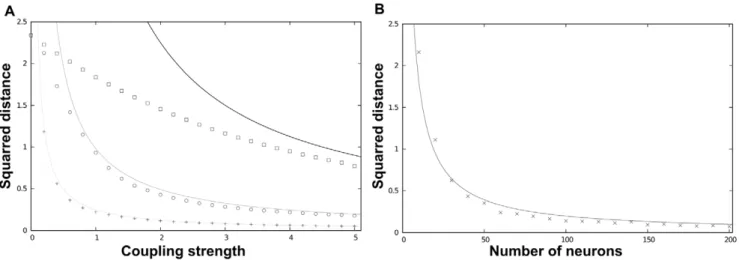
k??. Figure 3(A) provides a comparison of this theoretical
bound with simulations.
Assumption (A1) is also verified because an all-to-all network with identical couplings is symmetric, therefore balanced. Since the(vi,wi)Tare oscillators with stable limit cycles, it can be shown that the trajectories of theviare bounded by a common constant
M. Thus (A2) is verified withHbd~2cM. Finally, (A3) may be adapted from [22]. Indeed, we believe that the arguments of [22] can be extended to the case of non-white noise. Making this point precise is the subject of ongoing work.
Using now the ‘‘general analytical result’’, we obtain that, given any (non necessarily small) noise intensitys, in the limits fork??and
n??and after exponential transients, the behavior of any oscillator will be arbitrary close to that of a noise-free oscillator (Figure 1).
This statement can be further tested by constructing a model-based nonlinear state estimator (observer) [29]. Let(vi,wi)T be a noisy synchronized oscillator and consider the observer
vobs ~ cf(vobs,wobs,I)zkobs(vi{vobs)
wobs ~ { 1
c(vobs{azbwobs): 8
<
:
ð5Þ
Ifvihas the same trajectory as a noise-free FN oscillator, then it can be shown that(vobs,wobs)T tends exponentially to(vi,wi)T, independently of the observer’s initial conditions [29]. Thus the squared distance(vobs{vi)2indicates how closeviis from a noise-free oscillator [see Figure 3(B) for a comparison this theoretical result with simulations].
Simulations of more generic networks
We provide in this section simulation results which show that similar observations can be made even for more general network classes that are not yet covered by the theory. We believe that this simulations show the genericity of the concepts presented above.
Probabilistic networks. In practice, all-to-all neuronal networks of large size are rare. Rather, the mechanisms of neuronal connections in the brain are believed to be probabilisitic in nature (see [30] for a review). Here, we consider a probabilistic symmetric network ofnoscillators, where any pair of oscillators has probabilitypto be symmetrically connected and probability 1{p to be unconnected. Figure 4 shows simulation results for randomly chosen network withp~0:1. Concretely, we have built a network by randomly deciding for any pair of connections if the connection exists or not.
Hindmarsh-Rose oscillators. Hindmarsh-Rose oscillators are three-dimensional dynamical systems that are also often used as neuron models
dV ~ (I{n{m{V3zgVVzEVV2)dtzsdW
dn ~ (GNazENaV2{n)dt
dm ~ (gCa(ECa(VzVconst){m))dt 8
> <
> :
Figure 2. ‘‘Spatial mean’’ of FN oscillators.Note that the same set of random initial conditions was used in the two plots. (A) shows the average ‘‘membrane potential’’ computed overn~200noisy uncoupledoscillators (s~10). (B) shows the average ‘‘membrane potential’’ computed overn~200 noisy synchronizedoscillators within an all-to-all network (s~10,kij~5). Observe that, in the first plot, the average trajectory of uncoupled oscillators carries essentially no information, while in the second plot, the average trajectory of synchronized oscillators is very similar to a noise-free one. doi:10.1371/journal.pcbi.1000637.g002
withgV~0:5;EV~2:8;GNa~0;ENa~4:4;gCa~0:001;ECa~9;
Vconst~7=ECa. These oscillators can exhibit more complex behaviors (including spiking and bursting regimes [31]) than FitzHugh-Nagumo oscillators. The proofs of (A3) and (A4) for Hindmarsh-Rose oscillators are the object of ongoing research.
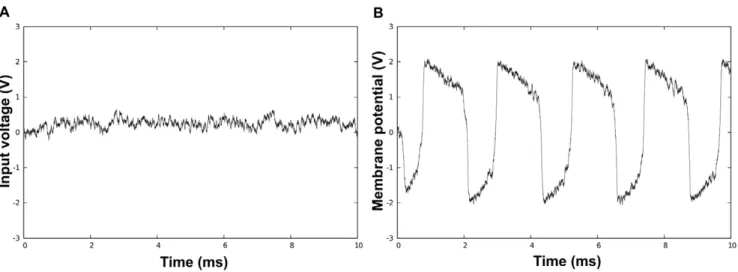
We made the inputs time-varying in this simulation. In fact, all the previous calculations can be straightforwardly extended to the case of time-varying inputs, as long as those inputs are the same for all the oscillators [6].
One can observe from the simulations (see Figure 5) that the synchronized oscillators preserve the input signal, while the uncoupled oscillators completely blur it out.
Discussion
We have argued that synchronization may represent a fundamental mechanism to protect neuronal assemblies from noise, and have quantified this hypothesis using a simple nonlinear neuron model. This may further strengthen our understanding of synchronization in the brain as playing a key functional role, rather than as being mostly an epiphenomenon.
It should be noted that the causal relationship studied here – effect of synchronization on noise – is converse to one usually investigated formally in the literature – effect of noise on synchronization: under certain conditions, adding noise can de-synchronize already de-synchronized oscillators (destructive effect)
Figure 3. Asymptotic appraisal of the theoretical bounds.Note that the experimental expectations were computed assuming the ergodic hypothesis. (A) Expectation of the average squared distance between thevi’s andv.
(given by1 n
X
i(vi{v
.
)2) as a function of the coupling
strengthkij(s~10). Theoretical bound(n{1)s
2
n2kij (cf equations (7) and (4)) forn~10(bold line), forn~50(plain line), forn~200(dashed line);
simulation results for n~10 (squares), forn~50(triangles), for n~200(crosses). (B) Expected squared distance between a noisy synchronized oscillator and its observer (given by(vobs{vi)2) as a function ofn(s~10,kij~5). The bound
(n{1)s2
n2kij was plotted in plain line and the simulation
results were represented by crosses. doi:10.1371/journal.pcbi.1000637.g003
Figure 4. Simulation for a probabilistic symmetric network (n~200,p~0:1,s~10,kij~5).(A) shows the trajectory of the ‘‘membrane potential’’ of an oscillator in the network. (B) shows its frequency spectrum. Compare these two plots with those in Figure 1.
[32]; under other conditions, adding noise can, on the contrary, synchronize oscillators that were not synchronized (constructive effect) [33,34]; for a review, see [35]. Also, previous papers have studied a similar phenomenon of improvement in precision by synchronization. Enright [28] shows ffiffiffi
n p
improvement in a model of coupled relaxation oscillators, all interacting through a common accumulator variable (possibly being the pineal gland). This pffiffiffin
improvement has been experimentally shown in real heart cells [36]. More recently, [37] shows a way to get better than ffiffiffi n p
improvement. However, their studies primarily focused on the case of phase oscillators, which are linear dynamical systems. In contrast, we concentrate here on the more general case of nonlinear oscillators, and quantify in particular the effect of the oscillators’ nonlinearities. The assumptions we consider are also different: while most existing approaches (including [37]) assume weak couplings and small noise intensities, we consider here strong couplings and arbitrary noise intensities.
The mechanisms highlighted in the paper may also underly other types of ‘‘redundant’’ calculations in the presence of noise and variability. In otoliths for instance, ten of thousands of hair cells jointly compute the three components of acceleration [38,39]. In muscles, thousands of individual fibers participate in the control of one single degree of freedom. Similar questions may also arise in systems biology, e.g., in cell mechanisms of quorum sensing where individual cells measure global chemical concentrations in their environment in a fashion functionally similar to all-to-all coupling
[25–27], in mechanical coupling of motor proteins [40], in the context of transcription-regulation networks [41,42], and in differentiation dynamics [43].
Finally, the results point to the general question: what is the precise meaning of ensemble measurements or population codes, what information do they convey about the underlying signals, and is the presence of synchronization mechanisms (gap-junction mediated or other) implicit in this interpretation? As such, they may also shed light on a somewhat ‘‘dual’’ and highly controversial current issue. Ensemble measurements from the brain can correlate to behavior, and they have been suggested e.g. as inputs to brain-machine interfaces. Are these ensemble signals actually available to the brain [44], perhaps through some process akin to quorum sensing, and therefore functionally similar to (local) all-to-all coupling? Are local field potentials [45] plausible candidates for a role in this picture?
Methods
Proof of the general analytical result
In the noise-free case (s~0), it can be shown that, for strong enough coupling strengths, the elements of the network synchro-nize completely, that is, after exponential transients, we haver~0 in (A4) [6]. Thus, all thexitend to a common trajectory, which is
in fact a nominal trajectory of the noise-free system _
x
xnoise{free~f(xnoise{free,t), because all the couplings vanish on the synchronization subspace.
Figure 5. Simulation of Hindmarsh-Rose oscillators with time varying inputs.(A) The time-varying input voltage. (B) Trajectory of the ‘‘membrane potential’’ of a noise-free oscillator. (C) Trajectory of anoisy uncoupledoscillator. (D) Trajectory of anoisy synchronizedoscillator (n~200,
s~10,kij~5).
doi:10.1371/journal.pcbi.1000637.g005
In the presence of noise, it is not clear how to relate the trajectory of each xi to a nominal trajectory of the noise-free
system. Nevertheless, we still know that the xi live ‘‘in a small neighborhood’’ of each other, as quantified by (A4). Thus, if the center of this small neighborhood follows a trajectory similar to a nominal trajectory of the noise-free system, then one may gain some information on the trajectories of thexi.
To be more precise, letx.
be the center of mass of thexi, that is
x. ~1
n X
i
xi: ð6Þ
Observe that, after expansion and rearrangement, the sum
P
ivjExi{xjE2can be rewritten in terms of the distances of the xifromx.
X
ivj
Exi{xjE2~nX i
Exi{x. E2:
Using (A4) then leads to
X
i
Exi{x. E2
!
ƒr
n: ð7Þ
Summing over i the equations followed by the xi and using assumption (A1), we have
dx. ~1
n X
i f(xi,t)
! dtz1
n X
i
sdWi: ð8Þ
We now make the dynamics explicit with respect tox.
by letting
e~1 n
Xn
i~1
f(xi,t) !
{f(x.,t) ð9Þ
so that Equation (8) can be rewritten as
dx.~ðf(x.,t){eÞdtz1 n
X
i
sdWi: ð10Þ
Using the Taylor formula with integral remainder, we have
fj(xi,t){fj(x.,t){Fj(x.,t)T(xi{x.)
~ Ð1
0(1{s)(xi{x .)TH
j((1{s)xizsx.)(xi{x.)ds ð11Þ
whereFjis the gradient offjor, equivalently, thejthvector of the Jacobian matrix of f. Summing Equation (11) over iand using assumption (A2), we get
jX i
(fj(xi,t){fj(x.,t))jƒ Hbd
2 ffiffiffi d
p X
i
Exi{x.E2: ð12Þ
Summing now inequality (12) overjand using inequality (7), we get
(EeE)ƒr Hbd
2n2 ð13Þ
which implies that (EeE)?0whenr=n2?0.
Turning now to the noise term1
n X
isdWiin Equation (10), we
have
1 n
X
i
sdWi% s ffiffiffi n
p dW ð14Þ
since the intrinsic noises of the elements of the network are mutually independent.
Thus, for a given (even large) noise intensitys, the difference between thedynamicsfollowed byx.
and the noise-free dynamicsf
tends to zero when n?? and r=n2?0. Assumption (A3) then
implies thatEx.{x
noise{freeE?0. More precisely, the impact of
noise on the mean trajectory (quantified by (Ex.
{xnoise{freeE)) evolves as
rHbd
2n2 z
s ffiffiffi n
p : ð15Þ
Finally, Equation (7) and the triangle inequality
Exnoise{free{xiEƒExnoise{free{x .
EzEx.{xiE ð16Þ
imply that thetrajectoryof any synchronized element of the network
xi and that of the noise-free systemxnoise{free are also similar [compare Figure 1(A) and Figure 1(E)].
FN oscillators in an all-to-all network
Two FN oscillators. Consider first the case of two coupled FN oscillators driven by Equation (2). Construct the following auxiliary system (or virtual system, in the sense of [46]), wherev1 andv2are considered asexternal inputs
dx1 ~ (c{(v12zv1v2zv22){k)x1zcx2)dtz
ffiffiffi 2 p
sdW
dx2 ~ { 1 cx1{
b cx2
dt: 8 > < > :
ð17Þ
Remark that (x1,x2)T~(v1{v2,w1{w2)T is a particular trajectory of this system.
Letl1~kz(v21zv1v2zv22){c andl2~b=c. Assume that the coupling strength is significantly larger than the system’s parameters, i.e. k&c, k&1=c and k&b=c. Since v21zv1v2zv22 is nonnegative for anyv1andv2, we have eitherl1§korl1^k, depending on the actual value of v2
1zv1v2zv22. This implies in particular thatl1&c,l1&1=candl1&l2~b=c.
Given these asymptotes, the evolution matrix of system (17) is diagonalizable with eigenvalues{l1’and{l2’ and eigenvectors respectively(l001,1=c)T and(c,l0001)T. Furthermore, it is not difficult to see that all thosel’s are asymptotically close to each other, that isli^l
0
i^l
00
i^l
000
i (i~1,2). We now define
y1~l 00 1x1z
1 cx2 y2~cx1zl
000 1x2
8 <
:
ð18Þ
leading to
dy1~{l 0 1y1dtz
ffiffiffi 2 p
sl001dW dy2~{l
0 2y2dtz
ffiffiffi 2 p
scdW: (
(corollary 1 of [21]) and the approximations li^l
0
i^l
00
i, this
yields
(y2
1)ƒs2l1, after transients of ratel1 (y2
2)ƒ
c2s2
l2
, after transients of ratel2:
8 <
:
These bounds can be translated back in terms of the xi by inverting (18)
x1^ 1 l1
y1{
c l21y2
x2^{ 1 cl21y1z
1 l1
y2:
8 > > > < > > > :
Thus, after transients of ratel1,
(x21)ƒ
s2
l1
(x22)ƒ
s2c2
l21l2
:
Since (v1{v2,w1{w2)T is a particular trajectory of system (17) as we remarked earlier, one finally obtains that, after transients of rate k,
((v1{v2)2)ƒ
s2
k ((w1{w2)
2)ƒs2c3
bk2: ð19Þ
General case. Consider now an all-to-all network with identical couplings as in Equation (2). Construct as above the following n(n{1) auxiliary systems indexed by (i,j)[½1. . .n2,
where theviare considered as external inputs
dvij ~ (c{(v2
izvivjzv2j){k)vijzcwij)
dt
zpffiffiffi2sdW dwij ~ {1
cvij{ b cwij dt: 8 > > > > < > > > > :
Remark that, similarly to the case of two oscillators, (vij,wij)T
i,j~ (vi{vj,wi{wj) T
i,j is a particular solution of
these equations. Remark also that each pair (vij,wij) is in fact uncoupled with respect to other pairs. This allows us to use (19) to obtain that, after transients of ratek,
Vi,j,i=j, ((vi{vj)2)ƒs
2
k :
Summing over thei,jyields
X
ivj
(vi{vj)2 !
ƒn(n{1)s
2
k :
Thus, (A4) is verified with
r~n(n{1)s
2
k :
For largen, we have r=n2*s2=k, which converges to 0 when
k??[see Figure 3(A)].
Assumption (A1) is also verified because an all-to-all network with identical couplings is symmetric, therefore balanced. As for (A2), observe thatHw~0and
Hv~ 2cv 0
0 0
:
Since the(vi,wi)T are oscillators with stable limit cycles, it can be shown that the trajectories of thevi are bounded by a common constantM. Thus (A2) is verified withHbd~2cM.
Acknowledgments
The authors would like to thank the anonymous reviewers for their helpful comments. JJS is grateful to Uri Alon for stimulating discussions on possible relevance of the results to cell biology.
This publication reflects only the authors’ views. The European Community is not liable for any use that may be made of the information contained therein.
Author Contributions
Performed the experiments: NT. Contributed reagents/materials/analysis tools: NT JJS QCP. Wrote the paper: NT JJS QCP.
References
1. Singer W (1993) Synchronization of cortical activity and its putative role in information processing and learning. Annu Rev Physiol 55: 349–74. 2. Buzsaki G (2006) Rhythms of the Brain Oxford University Press.
3. Tiesinga P, Fellous J, Sejnowski T (2008) Regulation of spike timing in visual cortical circuits. Nature Reviews Neuroscience 9: 97.
4. Hestrin S, Galarreta M (2005) Electrical synapses define networks of neocortical gabaergic neurons. Trends Neurosci 28: 304–9.
5. Fukuda T, Kosaka T, Singer W, Galuske RAW (2006) Gap junctions among dendrites of cortical gabaergic neurons establish a dense and widespread intercolumnar network. J Neurosci 26: 3434–43.
6. Pham QC, Slotine JJ (2007) Stable concurrent synchronization in dynamic system networks. Neural Netw 20: 62–77.
7. Crick FC, Koch C (2005) What is the function of the claustrum? Philos Trans R Soc Lond B Biol Sci 360: 1271–9.
8. Canolty RT, Edwards E, Dalal SS, Soltani M, Nagarajan SS, et al. (2006) High gamma power is phase-locked to theta oscillations in human neocortex. Science 313: 1626–8.
9. Womelsdorf T, Schoffelen JM, Oostenveld R, Singer W, Desimone R, et al. (2007) Modulation of neuronal interactions through neuronal synchronization. Science 316: 1609–12.
10. Grossberg S (2000) The complementary brain: unifying brain dynamics and modularity. Trends Cogn Sci 4: 233–246.
11. Engel A, Singer W (2001) Temporal binding and the neural correlates of sensory awareness. Trends Cogn Sci 5: 16–25.
12. Womelsdorf T, Fries P (2007) The role of neuronal synchronization in selective attention. Curr Opin Neurobiol 17: 154–60.
13. Palva S, Palva JM (2007) New vistas for alpha-frequency band oscillations. Trends Neurosci 30: 150–8.
14. Gregoriou GG, Gotts SJ, Zhou H, Desimone R (2009) High-frequency, long-range coupling between prefrontal and visual cortex during attention. science 324: 1207–1210.
15. Sherman A, Rinzel J, Keizer J (1988) Emergence of organized bursting in clusters of pancreatic beta-cells by channel sharing. Biophysical journal 54: 411–425.
16. Sherman A, Rinzel J (1991) Model for synchronization of pancreatic beta-cells by gap junction coupling. Biophysical journal 59: 547–559.
17. Kinard T, De Vries G, Sherman A, Satin L (1999) Modulation of the bursting properties of single mouse pancreatic b-cells by artificial conductances. Biophysical journal 76: 1423–1435.
18. Winfree A (2001) The geometry of biological time Springer.
19. Faisal AA, Selen LPJ, Wolpert DM (2008) Noise in the nervous system. Nat Rev Neurosci 9: 292–303.
20. Croner L, Purpura K, Kaplan E (1993) Response Variability in Retinal Ganglion Cells of Primates. Proc Natl Acad Sci U S A 90: 8128–8130.
21. Pham QC, Tabareau N, Slotine JJ (2009) A contraction theory approach to stochastic incremental stability. IEEE Trans Automatic Control 54: 816– 820.
22. Tuckwell HC, Rodriguez R (1998) Analytical and simulation results for stochastic fitzhugh-nagumo neurons and neural networks. J Comput Neurosci 5: 91–113.
23. Dayan P, Abbott L (2001) Theoretical neuroscience: computational and mathematical modeling of neural systems MIT Press.
24. Gelb A (1974) Applied Optimal Estimation MIT Press.
25. Garcia-Ojalvo J, Elowitz MB, Strogatz SH (2004) Modeling a synthetic multicellular clock: repressilators coupled by quorum sensing. Proc Natl Acad Sci U S A 101: 10955–60.
26. Waters C, Bassler B (2005) Quorum Sensing: Cell-to-Cell Communication in Bacteria. Annu Rev Cell Dev Biol 21: 319–346.
27. Taylor A, Tinsley M, Wang F, Huang Z, Showalter K (2009) Dynamical Quorum Sensing and Synchronization in Large Populations of Chemical Oscillators. Science 323: 614.
28. Enright J (1980) Temporal precision in circadian systems: a reliable neuronal clock from unreliable components? Science 209: 1542–1545.
29. Lohmiller W, Slotine J (1998) On Contraction Analysis for Non-linear Systems. Automatica 34: 683–696.
30. Strogatz SH (2001) Exploring complex networks. Nature 410: 268–76. 31. Izhikevich EM (2004) Which model to use for cortical spiking neurons? IEEE
Trans Neural Netw 15: 1063–70.
32. Teramae J, Kuramoto Y (2001) Strong desynchronizing effects of weak noise in globally coupled systems. Physical Review E 63: 36210.
33. Mainen Z, Sejnowski T (1995) Reliability of spike timing in neocortical neurons. Science 268: 1503–1506.
34. Teramae J, Tanaka D (2004) Robustness of the Noise-Induced Phase Synchronization in a General Class of Limit Cycle Oscillators. Physical Review Letters 93: 204103.
35. Ermentrout GB, Gala´n RF, Urban NN (2008) Reliability, synchrony and noise. Trends Neurosci.
36. Clay J, DeHaan R (1979) Fluctuations in interbeat interval in rhythmic heart-cell clusters. Role of membrane voltage noise. Biophysical Journal 28: 377–389. 37. Needleman D, Tiesinga P, Sejnowski T (2001) Collective enhancement of
precision in networks of coupled oscillators. Physica D: Nonlinear Phenomena 155: 324–336.
38. Kandel E, Schwartz J, Jessell T (2000) Principles of Neural Science McGraw-Hill.
39. Eliasmith C, Anderson C (2004) Neural Engineering: Computation, Represen-tation, and Dynamics in Neurobiological Systems MIT Press.
40. Hendricks A, Epureanu B, Meyho¨fer E (2009) Collective dynamics of kinesin. Phys Rev E 79: 031929.
41. Alon U (2007) An Introduction to Systems Biology: Design Principles of Biological Circuits Chapman & Hall/CRC.
42. Barkai N, Shilo B (2007) Variability and robustness in biomolecular systems. Molecular Cell 28: 755–760.
43. Suel G, Kulkarni R, Dworkin J, Garcia-Ojalvo J, Elowitz M (2007) Tunability and noise dependence in differentiation dynamics. Science 315: 1716. 44. El Boustani S, Marre O, Be´huret S, Baudot P, Yger P, et al. (2009)
Network-state modulation of power-law frequency-scaling in visual cortical neurons. PLoS Computational Biology 5: e1000519.
45. Pesaran B, Pezaris J, Sahani M, Mitra P, Andersen R (2002) Temporal structure in neuronal activity during working memory in macaque parietal cortex. Nature Neuroscience 5: 805–811.
46. Wang W, Slotine JJE (2005) On partial contraction analysis for coupled nonlinear oscillators. Biol Cybern 92: 38–53.
![Figure 1. Simulations of a network of FN oscillators using the Euler-Maruyama algorithm [47]](https://thumb-eu.123doks.com/thumbv2/123dok_br/18205315.333998/3.918.90.828.91.863/figure-simulations-network-oscillators-using-euler-maruyama-algorithm.webp)