ABSTRACT
Objective: To evaluate and compare subjective sleep quality in medical students across the various phases of the medical course. Methods: This was a cross-sectional study involving medical undergraduates at one medical school in the city of Botucatu, Brazil. All irst- to sixth-year students were invited to complete the Pittsburgh Sleep Quality Index, which has been validated for use in Brazil. Participants were divided into three groups according to the phase of the medical course: group A (irst- and second-years); group B (third- and fourth-years); and group C (ifth- and sixth-years). The results obtained for the instrument components were analyzed for the total sample and for the groups. Results: Of the 540 students invited to participate, 372 completed the instrument fully. Of those, 147 (39.5%) reported their sleep quality to be either very or fairly bad; 110 (29.5%) reported taking more than 30 min to fall asleep; 253 (68.0%) reported sleeping 6-7 h per night; 327 (87.9%) reported adequate sleep eficiency; 315 (84.6%) reported no sleep disturbances; 32 (8.6%) reported using sleeping medication; and 137 (36.9%) reported dificulty staying awake during the day at least once a week. Group comparison revealed that students in group A had worse subjective sleep quality and greater daytime dysfunction than did those in groups B and C. Conclusions: Medical students seem to be more exposed to sleep disturbance than other university students, and irst- and second-years are more affected than those in other class years because they have worse subjective sleep quality. Active interventions should be implemented to improve sleep hygiene in medical students.
Keywords: Students, medical; Quality of life; Sleep.
Sleep quality in medical students: a
comparison across the various phases of
the medical course
Camila de Castro Corrêa1, Felipe Kazan de Oliveira1, Diego Scherlon Pizzamiglio1, Erika Veruska Paiva Ortolan2, Silke Anna Theresa Weber1
Correspondence to:
Silke Anna Theresa Weber. Faculdade de Medicina de Botucatu, Universidade Estadual Paulista Júlio de Mesquita Filho, Distrito de Rubião Júnior, s/n, CEP 18618-970, Botucatu, SP; Brasil.
Tel.: 55 14 3811-6256. E-mail: [email protected] Financial support: None.
INTRODUCTION
Sleep quality has been studied among university students.(1-4) Such studies have shown impairments in sleep quality, which are even greater when it comes to medical undergraduates,(5) who have a heavy academic schedule and responsibilities in various activities, all of
which signiicantly impact sleep quality.(6-9)
University students experience disturbances in their circadian cycle because of the stress of the academic environment,(1) which is increased by habits such as
suring the Internet, watching television,(2) and using alcohol and tobacco,(3) habits that are common in this
population. Improved sleep quality is associated with
engaging in sports and extracurricular activities.(8) Since impairment in sleep quality directly affects academic performance(4) and also emotional aspects,(6) we emphasize the importance of measuring sleep quality in medical students and monitoring it across the various phases of the medical course. To that end, there are instruments for self-assessment of sleep quality in the
literature, such as the Pittsburgh Sleep Quality Index (PSQI),(10) which has been validated for use in Brazil(11)
and which, because of its high eficacy (high speciicity
and high sensitivity), is recommended for use in clinical
practice and research. The PSQI contains 19 items, which
address sleep latency, usual bedtime and wake time, and sleep and nap quality.(10) Therefore, the objective of the present study was to evaluate and compare subjective sleep quality in medical students across the various phases
of the medical course, by using the PSQI.
METHODS
This was a cross-sectional study involving medical undergraduates at the Botucatu School of Medicine,
located in the city of Botucatu, Brazil. All irst- to sixth-year
students (N = 540) were invited to participate. Data were collected over two months. The study was approved by the local human research ethics committee (Protocol no. 400/08). All participants gave written informed consent.
All students who completed the PSQI fully within the speciied period were included in the study. The students
who declined the invitation to participate in the study or who did not complete the entire questionnaire were excluded.
The research instrument selected was the PSQI(11) because this is an analysis instrument that is used 1. Departamento de Oftalmologia,
Otorrinolaringologia e Cirurgia de Cabeça e Pescoço, Faculdade de Medicina de Botucatu, Universidade Estadual Paulista Júlio de Mesquita Filho – FM-UNESP – Botucatu (SP) Brasil.
2. Departamento de Pediatria, Faculdade de Medicina de Botucatu, Universidade Estadual Paulista Júlio de Mesquita Filho – FM-UNESP – Botucatu (SP) Brasil.
Submitted: 22 June 2016. Accepted: 14 April 2017.
worldwide and is validated for assessing sleep disturbances, as well as allowing assessment of
questions in isolation or the overall result. Its seven
components—subjective sleep quality; sleep latency; sleep duration; habitual sleep efficiency; sleep disturbances; use of sleeping medication; and daytime dysfunction—were analyzed separately. The range of
this instrument is from 0 to 21 points, and scores ≥
5 signify poor sleep quality, indicating possible sleep disturbance. The sum of the seven component scores produces a global score.
Statistical analysis
The data from the completed questionnaires were entered into tables using Microsoft Excel, one of which showing the results for the total sample and the others showing the results for each undergraduate class year. The class years were then grouped according to the traditional phases of the medical course (initial phase, pathophysiology phase, and clinical clerkship phase) and participants were divided into three groups:
group A, with irst- and second-year students; group
B, with third- and fourth-year students; and group C,
with ifth- and sixth-year students. The results were
described for the total sample and for the groups, and among- and between-group comparisons were conducted.
Analysis was performed using the proportions of different responses as a function of each component.
In the inductive analysis, the chi-square test was used
for among-group comparisons of the seven components
of the PSQI, whereas the Wilcoxon test was used for
between-group comparisons of the components and the Student’s t-test was used for between-group comparisons of the global score. Values of p < 0.05
were considered signiicant.
RESULTS
Of the total of 540 students who were invited to participate in the study, 372 (68.9%) completed the
PSQI, being distributed by class year as follows: 72, irst-years; 53, second-years; 86, third-years; 67, fourth-years; 30, ifth-years; and 64, sixth-years. As
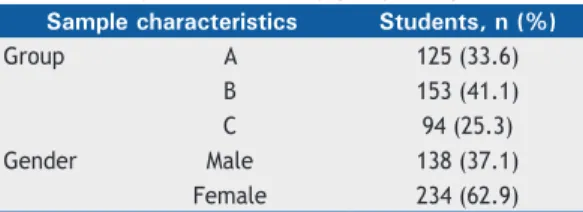
for gender distribution, there was a larger proportion of females (Table 1).
The results for the seven components of the PSQI
were analyzed for the total sample and for the three study groups (Table 2). Of the total sample, 39.5%
of the participants classiied their sleep quality as
either very or fairly bad, and 29.5% reported taking more than 30 min to fall asleep two or more times a week. The average number of hours slept per night
ranged from 6 h and 14 min among ifth-years to 6h and 34 min among second-years. Inductive statistical results showed no signiicant differences among the
three groups regarding subjective sleep quality, sleep latency, or sleep duration.
A more thorough analysis of subjective sleep quality,
by using the classiication of this quality as “very good”
as a reference, revealed that only students in group
A were statistically signiicantly likely to have “very bad” subjective sleep quality (Figure 1). Habitual sleep eficiency was considered adequate in 87.9% of the
total sample, and the frequency of sleep disturbances was considered low in 84.6% of the total sample.
In the group analysis, neither component showed signiicant differences.
Of the total sample, 8.6% of the participants reported using sleeping medication at least once a week, and
87.4% reported having dificulty staying awake during the day at least once a week. In addition, 50.4%
reported having trouble engaging in daily activities at least once a week, and 70.6% reported dozing; of the latter, 47.7% did not intend to doze and 44.0%
regarded dozing as necessary. In the group analysis,
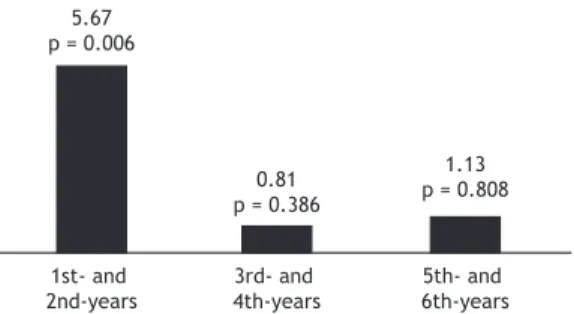
p values = 0.72 were obtained for use of sleeping medication, whereas, for daily dysfunction, group A
showed a signiicant difference (p = 0.006; Figure 2). The mean global PSQI scores for groups A, B, and
C were, respectively, 6.62 ± 2.55, 6.20 ± 2.65, and 6.66 ± 2.64, and 12.9% of the total sample had scores < 5 (Table 3). Analysis by undergraduate class year
revealed scores < 5 in 5.5% of irst-years, 7.6% of
second-years, 15.9% of third-years, 10.1% of
fourth-years, 10.0% of ifth-fourth-years, and 9.4% of sixth-years.
Logistic regression, considering results > 5 (1) and
≤ 5 (0) for assessing group inluence, revealed no signiicant intergroup inluence (p = 0.24).
In addition, the mean scores on the seven components of the PSQI were compared between groups, and no signiicant differences were found between any of the
groups (Table 4).
DISCUSSION
Sleep quality among medical students is a subject that has been studied worldwide because of its repercussions on the academic routine and personal life of this population. Therefore, investigating sleep quality by means of an instrument that has been validated
for use in Brazil and allows quantiication, such as the PSQI,(11) is extremely important for the monitoring of sleep health in such students, aiding in the planning of interventions aimed at raising awareness of this problem. By this means, we found that aspects of sleep quality were altered in our sample, with 12.9% of the participants having scores < 5, which indicate
signiicant impairment in sleep quality.
Table 1. Sample distribution by group and gender. Sample characteristics Students, n (%)
Group A 125 (33.6)
B 153 (41.1)
C 94 (25.3)
Gender Male 138 (37.1)
Female 234 (62.9)
Adherence in this study was nearly 70%, which is
consistent with literature indings on the rate of return
of this type of questionnaire (73.3%).(7) In terms of participation by gender, we found a female predominance in effective participation in the study, which is not true for other studies that used this instrument with medical students, in which there was a predominance of males—73%(8) and 54.7%.(9)
Nearly 40% of the students in our sample classiied
their sleep quality as either very or fairly bad, a proportion that is lower than that reported in the
literature, with indings of poor sleep quality in 61.5%(12) and 61.9%,(7) speciically among medical students. The poor sleep quality observed in group A is consistent with reports from other studies, which also observed
these indings in incoming students, emphasizing the
correlation between poor sleep quality and irst-year
undergraduates, in whom poor sleep hygiene habits,
such as Internet suring at night, poor social life, and
bad eating habits, are found to be aggravating factors.(13) Poor sleep quality is associated with excessive daytime sleepiness.(7,9) In the present study, daytime dysfunction was reported by 36.9% of the participants, who had
dificulty staying awake during the day at least once a
week. This is consistent with the literature, although there are variations across studies in the proportion of medical students reporting daytime sleepiness: 31%(7); 42.1%(12); and 63%.(6) Therefore, students in group A experienced greater deleterious effects on subjective sleep quality and daytime dysfunction than did those in the other groups, with daytime
dysfunction showing a trend toward a signiicant
Table 2. Results for the Pittsburgh Sleep Quality Index components as a function of the number (considering each of the three study groups) and proportion (considering the total sample) of students who selected each response option.
Component Group A
n = 125 (33.6)
Group B n = 153 (41.1)
Group C n = 94 (25.3)
Students, n (%) p*
Subjective sleep quality
Very good 10 15 10 35 (9.4) <
0.0001
Fairly good 65 68 57 190 (51.1)
Fairly bad 43 67 24 134 (36.0)
Very bad 7 3 3 13 (3.5)
Sleep latency
≤ 15 min 32 52 20 104 (28.0) 0.07
16 to 30 min 63 47 48 158 (42.5)
31 to 60 min 25 40 11 76 (20.4)
> 60 min 5 14 15 34 (9.1)
Sleep duration
> 7 h 24 17 18 59 (15.9) 0.10
6 to 7 h 78 110 65 253 (68.0)
5 to 6 h 19 16 10 45 (12.1)
< 5 h 4 10 1 15 (4.0)
Habitual sleep eficiency
> 85 108 132 87 327 (87.9) 0.58
75 to 84 14 19 7 40 (10.8)
65 to 74 2 2 0 4 (1.1)
< 65 1 0 0 1 (0.3)
Sleep disturbances
0 8 6 4 18 (4.8) 0.29
1 to 9 104 122 71 297 (79.8)
10 to 18 13 25 19 57 (15.3)
19 to 27 0 0 0 0 (0)
Use of sleeping medication
Not during the past month 115 142 83 340 (91.4) 0.72
Less than once a week 5 7 4 16 (4.3)
Once or twice a week 2 1 3 6 (1.6)
Three or more times a week 3 3 4 10 (2.7)
Daytime dysfunction
1 to 2 10 34 3 47 (12.6) <
0.0001
3 to 4 46 55 30 131 (35.2)
5 to 6 32 53 54 139 (37.4)
Every day 37 11 7 55 (14.8)
difference when comparing groups A and C (p = 0.05). This can be explained by the fact that incoming students go through a transitional period of change from attending preparatory courses for college entrance examinations and/or attending high school to attending an undergraduate course, which is characterized by too many academic activities and irregular daily routines, which vary too much because of the class
load, shifts, breaks, and free study periods. It should
also be emphasized that attending a medical course
requires a high level of dedication and sellessness,
signifying harmful lifestyle changes,(14-16) such as sleep deprivation and poor sleep hygiene habits. (16,17) After the second year of the undergraduate course, there may be accommodation and better adaptation to the routine of studies and visits.
The results for the sleep latency component showed that sleep latency was slightly altered in 29.9% of the participants, whereas the results for the sleep duration component revealed that 68.0% of the participants reported sleeping 6-7 h per night, which is similar to the variation from 6 h and 55 min to 7 h and 25 min found in one study(18) and the average of 6.48 h reported by students at the Universidad Adventista del Plata,(19) but different from the average of 5.8 h of sleep per night reported by students at the Saudi Medical School.(20)
Frequent use of sleeping medication was identiied
in 8.6% of the participants in the present study, but this proportion is lower than that found in a study involving medical students in Saudi Arabia, which
identiied that 17% of those students used drugs for
sleep induction; this fact indicates the need for early intervention programs targeting poor lifestyle habits.(21)
Global PSQI scores > 5 were observed in 87.1% of the our total sample, surpassing the literature indings
of 59.4%(5) and 20.7%.(22)
When we analyzed mean global PSQI scores, we
found results between 6 and 7 in the different groups, values that are lower than those reported in another study (8.1).(23)
In summary, we investigated sleep quality in
medical students at one medical school in the city of
Botucatu, Brazil, and found impairments in certain PSQI
components, which suggests that investigations should continue in different regions of the country and the
world, in order to monitor the proile of such students and encourage the translation of indings into health
promotion practices. Our results are in agreement
with literature indings of a high frequency of altered
aspects in sleep quality, a high frequency that is not regarded as a problem or disorder, which may have harmful effects on health.
Since the most substantial results were obtained for the sleep quality and daily dysfunction components, a limitation of the present study was that we did not use other instruments, such as the Epworth Sleepiness Scale, which could provide details on daytime sleep
dysfunction. In addition, speciic protocols for assessing
sleep habits could have been used to better compare student behaviors across the various phases of the medical course, given that students in group A had greater problems regarding subjective sleep quality and daytime dysfunction than did those in groups B and C.
Table 4. Values of p* for between-group comparisons of the seven components and the global score of the Pittsburgh Sleep Quality Index.
Groups COMPONENTS Global
score
1st 2nd 3rd 4th 5th 6th 7th
A vs. B 0.59 0.19 0.70 0.21 0.68 0.78 0.10 0.37
A vs. C 0.40 0.90 0.53 0.65 0.19 0.37 0.05 0.10
B vs. C 0.19 0.26 0.73 0.09 0.37 0.22 0.74 0.37
A: irst- and second-year students; B: third- and fourth-year students; and C: ifth- and sixth-year students. *Wilcoxon test for the components and Student’s t-test for the global score.
Figure 1. Inductive statistics for the subjective sleep quality component and corresponding p values. Chi-square test.
Figure 2. Inductive statistics for the daytime dysfunction component and corresponding p values. Chi-square test.
Table 3. Global Pittsburgh Sleep Quality Index (PSQI) scores as a function of the number of students (total sample).
Global PSQI scores Students, n (%) p*
≤ 4 48 (12.9)
0.27
5-8 207 (55.6)
9-16 117 (31.5)
*Chi-square test. 0,17 p = 0,019
0,54
p = 0,187 0,40 p = 0,121
*Reference: very good
C
h
a
n
ce
d
e
s
e
r
m
u
it
o
r
u
im
*
1st- and 2nd-years
3rd- and 4th-years
5th- and 6th-years
5.67 p = 0.006
0.81 p = 0.386
1.13 p = 0.808
1st- and 2nd-years
3rd- and 4th-years
There is a need for health promotion measures, such as proposals of changes in adopted health behaviors
speciically related to good sleep hygiene, among the
population of higher education students. Such proposals are found in the literature and are targeted at the general population,(24,25) but they are also applicable to and indispensable for populations such as that of the present study.
We therefore conclude that poor subjective sleep
quality was high for students in all class years of the undergraduate medical course. The comparison across
the various phases of the course showed that irst- and
second-years (group A) reported worse sleep quality and greater daytime dysfunction than did those in other class years (groups B and C).
REFERENCES
1. Benavente SB, Silva RM, Higashi AB, Guido Lde A, Costa AL. Inluence of stress factors and socio-demographic characteristics on the sleep quality of nursing students [Article in Portuguese]. Rev Esc Enferm USP. 2014;48 (3):514-20. https://doi.org/10.1590/S0080-623420140000300018
2. Mesquita G, Reimão R. Quality of sleep among university students: effects of nighttime computer and television use. Arq Neuropsiquiatr. 2010;68(5):720-5. https://doi.org/10.1590/S0004-282X2010000500009
3. Araújo MF, Feritas RW, Lima AC, Pereira DC, Zanetti ML,
Damasceno MM. Health indicators associated with poor sleep quality among university students [Article in Portuguese]. Rev Esc Enferm USP. 2014;48(6):1085-92. https://doi.org/10.1590/S0080-623420140000700017
4. Lemma S, Berhane Y, Worku A, Gelaye B, Williams MA. Good quality sleep is associated with better academic performance among university students in Ethiopia. Sleep Breath. 2014;18(2):257-63. https://doi.org/10.1007/s11325-013-0874-8
5. Preišegolavičiūtė E, Leskauskas D, Adomaitienė V. Associations of
quality of sleep with lifestyle factors and proile of studies among Lithuanian students. Medicina (Kaunas). 2010;46(7):482-9.
6. Pagnin D, de Queiroz V, Carvalho YT, Dutra AS, Amaral MB, Queiroz TT. The relation between burnout and sleep disorders in medical students. Acad Psychiatry. 2014;38(4):438-44. https://doi. org/10.1007/s40596-014-0093-z
7. Ribeiro CR, Oliveira SM, Silva YM. The impact of sleep quality in
medical education [Article in Portuguese]. Rev Soc Bras Clin Med. 2014;12(1):8-14.
8. Del Pielago Meoño AF, Failoc Rojas VE, Plasencia Dueñas EA, Díaz Vélez C Calidad de sueño y estilo de aprendizaje en estudiantes de Medicina Humana de la Universidad Nacional Pedro Ruiz Gallo. Act Méd Per. 2013;30(4):63-8.
9. Cardoso HC, Bueno FC, Mata JC, Alves AP, Jochims I, Vaz Filho IH, et al. Assessing quality of sleep in medical students [Article in Portuguese]. Rev Bras Educ Med. 2009;33(3):349-55. https://doi. org/10.1590/S0100-55022009000300005
10. Buysse DJ, Reynolds CF 3rd, Monk TH, Berman SR, Kupfer DJ. The Pittsburgh Sleep Quality Index: a new instrument for psychiatric practice and research. Psychiatry Res. 1989;28(2):193-213. https:// doi.org/10.1016/0165-1781(89)90047-4
11. Bertolazi AN, Fagondes SC, Hoff LS, Dartora EG, Miozzo IC, de Barba ME, et al. Validation of the Brazilian Portuguese version of the Pittsburgh Sleep Quality Index. Sleep Med. 2011;12(1):70-5. https:// doi.org/10.1016/j.sleep.2010.04.020
12. Rique GL, Fernandes Filho GM, Ferreira AD, de Sousa-Muñoz RL.
Relationship between chronotype and quality of sleep in medical students at the Federal University of Paraiba, Brazil. Sleep Sci. 2014;7(2):96-102. https://doi.org/10.1016/j.slsci.2014.09.004
13. Cheng SH, Shih CC, Lee IH, Hou YW, Chen KC, Chen KT, et al. A study
on the sleep quality of incoming university students. Psychiatry Res. 2012;197(3):270-4. https://doi.org/10.1016/j.psychres.2011.08.011
14. Mirghani HO, Mohammed OS, Almurtadha YM, Ahmed MS. Good sleep quality is associated with better academic performance among Sudanese medical students. BMC Res Notes. 2015;8:706. https:// doi.org/10.1186/s13104-015-1712-9
15. Mota MC, De-Souza DA, Mello MT, Tuik S, Crispim CA. Lifestyle
and medical education: impact on the nutritional proile [Article in Portuguese]. Rev Bras Educ Med. 2012;36(3):358-68. https://doi. org/10.1590/S0100-55022012000500010
16. Azad MC, Fraser K, Rumana N, Abdullah AF, Shahana N, Hanly PJ, et al. Sleep disturbances among medical students: a global perspective. J Clin Sleep Med 2015;11(1):69-74. https://doi.org/10.5664/ jcsm.4370
17. Pérez-Olmos I, Ibáñez-Pinilla M. Night shifts, sleep deprivation,
and attention performance in medical students. Int J Med Educ. 2014;5:56-62. https://doi.org/10.5116/ijme.531a.f2c9
18. Lima PF, Medeiros AL, Araujo JF. Sleep-wake pattern of medical students: early versus late class starting time. Braz J Med Biol Res. 2002;35(11):1373-7. https://doi.org/10.1590/S0100-879X2002001100016
19. Fontana SA, Raimondi W, Rizzo ML. Quality of sleep and selective
attention in university students: descriptive cross-sectional study [Article in Spanish]. Medwave. 2014;14(8):e6015. https://doi. org/10.5867/medwave.2014.08.6015
20. Alsaggaf MA, Wali SO, Merdad RA, Merdad LA. Sleep quantity, quality, and insomnia symptoms of medical students during clinical years. Relationship with stress and academic performance. Saudi Med J. 2016;37(2):173-82. https://doi.org/10.15537/ smj.2016.2.14288
21. Al-Sayed AA, Al-Rashoudi AH, Al-Eisa AA, Addar AM, Al-Hargan AH, Al-Jerian AA, et al. Sedative Drug Use among King Saud University Medical Students: A Cross-Sectional Sampling Study. Depress Res Treat. 2014;2014:378738. https://doi.org/10.1155/2014/378738
22. Machado-Duque ME, Echeverri Chabur JE, Machado-Alba JE. Excessive Daytime Sleepiness, Poor Quality Sleep, and Low Academic Performance in Medical Students [Article in Spanish]. Rev Colomb Psiquiatr. 2015;44(3):137-42. https://doi.org/10.1016/j. rcp.2015.04.002
23. Waqas A, Khan S, Sharif W, Khalid U, Ali A. Association of academic stress with sleeping dificulties in medical students of a Pakistani medical school: a cross sectional survey. Peer J. 2015;3:e840. https://doi.org/10.7717/peerj.840
24. Corrêa Cde C, Blasca WQ, Berretin-Felix G. Health promotion in
obstructive sleep apnea syndrome. Int Arch Otorhinolaryngol. 2015;19(2):166-70. https://doi.org/10.1055/s-0034-1390327