This study evaluated the effects of indirect restorative materials, curing conditions and time on the degree of conversion (DC) of a dual-cured resin cement using infrared spectroscopy. The resin cement (RelyX Unicem 2, 3M ESPE) was applied to the diamond surface of a horizontal attenuated-total-reflectance unit and activated using one of following conditions: self-cure, direct light exposure, light exposure through indirect restorative materials (resin nano-ceramic: Lava Ultimate, 3M ESPE or feldspathic ceramic: Vita Blocks Mark II, Vita Zahnfabrik). Four thicknesses (0.5, 1.0, 1.5 or 2.0 mm) of each indirect material were analyzed, and the light-activation was performed using a blue LED light. Data (n=5) were analyzed by three-way ANOVA, Tukey’s post hoc and Dunnett’s tests (=5%). No significant differences in DC were observed between indirect materials of similar thickness. All groups exhibited higher DC after 10 min than after 5 min. At both times points, the self-cure group exhibited significantly lower DC than all the light exposure groups. Only when the overlying indirect restoration had a thickness of 2 mm did DC decrease significantly. The presence of a thick, indirect restoration can decrease the DC of resin cement. DC after 10 min was higher than after 5 min. The self-cure mode yielded lower DC than the light-activating one.
Indirect Restoration Thickness and
Time after Light-Activation Effects on
Degree of Conversion of Resin Cement
Ana Paula Almeida Ayres1, Carolina Bosso Andre1, Rafael Rocha Pacheco1, Adriana Oliveira Carvalho1, Renata Cantanhede Bacelar-Sá1, Frederick Allen Rueggeberg2, Marcelo Giannini1
1Department of Restorative
Dentistry, Piracicaba Dental School, UNICAMP – Universidade Estadual Paulista, Piracicaba, SP, Brazil
2Department of Oral Rehabilitation,
College of Dental Medicine, Georgia Regents University, Augusta, GA, USA
Correspondence: Dr. Marcelo Giannini, Av. Limeira, 901, 13414-903 Piracicaba, SP, Brasil. Tel: +55 19 2106-5340. e-mail: [email protected]
Key Words: resin cement, ceramic, composite, degree of conversion, light-activation.
Introduction
Some clinical scenarios do not allow adequate polymerization of resin-based materials due to strong light attenuation caused by the distance from the light source and absorbing characteristics of restorative materials (1-4). Curing light attenuation compromises the mechanical and adhesive properties of the resin cement because the low light intensity that reaches the resin cement is not sufficient to produce a high degree of conversion (DC) (5-8). The light-absorbing characteristics of indirect restorative materials are related to their thickness, shade and opacity. The composition also influences light transmission through the material. Thus, composite resins, feldspathic and zirconia ceramics present different optical and light absorption properties that may influence light attenuation during photocuring of an underlying dual-cured resin cement (9-13).
The fabrication of indirect dental restorations by computer-aided design/computer-aided manufacturing (CAD/CAM) uses new digital impression technology. Three classes of CAD/CAM restorations have been produced: glass-, oxide-ceramics and resin composites. Oxide and glass ceramic materials have superior mechanical and esthetic properties, respectively, however indirect resin nano-ceramic offer advantages related to their finish-ability/ polish-ability, fast fabrication, intraoral reparability (10).
Thus, the use of millable materials for CAD-CAM increases the interest of dentists and clinical instructors to have more information about the light passing through these types of indirect esthetic restorations and their influence on the DC of resin cements (14,15).
Dual-cured resin materials are used to overcome the effects of curing light attenuation. These resin cements contain self-curing components that do not depend only on light activation to polymerize them. The conventional dual-cured cementing systems have been used in combination with dual-cured adhesive systems, which contain co-initiators, such as sulfinic acid salts (5,7,16). The co-initiators produce free radicals that contribute to the polymerization reaction of the dual-cured resin cements when light from the curing unit is not available (1). The new dual-cured, self-adhesive resin cements do not require a previous bonding agent application; therefore, no co-initiator is necessary. Their self-curing reaction must be sufficiently efficient to ensure high monomeric conversion levels in the absence of light.
364
M. Giannini et al.
than the one measured 5 min after polymerization initiation and (III) the self-cure mode would yield lower DC than dual-cure mode (light-activation and self-curing).
Material and Methods
Specimen Preparation and Fourier Transform Infrared Analysis
This study measured the DC of commercial dual-cured, self-adhesive resin cement (lot # 439796) (RelyX Unicem 2, 3M ESPE, Seefeld, Germany) when light activated through indirect restorations with different thicknesses. One millable resin nano-ceramic (shade A2, lot # N340017) (Lava Ultimate, 3M ESPE, St. Paul, MN, USA) and feldspathic ceramic blocks (shade 2M2C, lot # 11850) (Vita Blocks Mark II, Vita Zahnfabrik, Bad Säckingen, Germany) for using with CAD/CAM systems were prepared to simulate overlying restorations. Five samples of each thickness for both materials were made.
An automix dispenser was used to apply the resin cement to a horizontal diamond ATR element (Golden Gate; Specac, Woodstock, GA, USA) in the optical bench of a Fourier transform infrared spectrometer (FTS-40; Digilab/ BioRad, Cambridge, MA, USA). Adhesive tape (3M, St. Paul, MN, USA) was placed around the diamond surface to act as a spacer, ensuring a standard thickness for all specimens (100–120 µm). The deposited material was covered with a Mylar strip and polymerized using one of the following curing modes: light activation (Elipar S10; 3M ESPE, St. Paul, MN, USA) through a glass slide (2 mm thick) (direct light exposure); light activation through resin ,nano-ceramic or feldspathic ceramic discs (0.5 1.0, 1.5 or 2.0 mm thick); or they were allowed to self-cure under a Mylar strip and glass slide, with no curing light exposure (n=5). In the light-activated groups, light exposure was provided after placing the resin cement and the resin nano-ceramic discs, feldspathic ceramic discs or the glass slide on the diamond ATR element (9).
Monomer Conversion
Infrared spectra were collected between 1680 and 1500 cm-1 at a rate of 1 s-1 at 2 cm-1 resolution, from the moment when the resin cement was applied to the ATR surface, immediately after light activation and for the next 10 min at 30 °C. Five replications were made for each test condition. Adequate light condition was provided to not interfere in DC measurements.
Monomer conversion was calculated by standard methods of using changes in the ratios of aliphatic-to-aromatic C=C absorption peaks in the uncured and cured states obtained from the infrared spectra (17). The DC of all curing modes was compared within each product at 5 and 10 min from the time that the resin cement was
light-activated, as well as between the two time periods. All polymerized specimens were carefully removed from the ATR plate and measured for thickness to the nearest 0.01 mm using a digital micrometer (Series 406; Mitutoyo America Corp., Aurora, IL, USA) to ensure that pressure applied to either of the microscope slides of the prepolymerized resin disc provided similar thickness for all specimens.
Curing Light Irradiance
The irradiance (mW/cm2) of the curing unit (a blue only LED Elipar S10) was determined using a laboratory-grade spectral radiometer system: a 7.62 cm diameter integrating sphere (DAS 2100; Labsphere, N. Sutton, NH, USA) and a spectroradiometer (USB-2000; Ocean Optics, Dunedin, FL, USA). Five measurements were obtained when the glass slide was placed between the integrating sphere aperture and the light guide tips. Irradiance values were obtained between 350 and 490 nm by dividing the total emitted power (mW) by the optical area of the light guide end.
Experimental Design and Statistical Analyses
The factors under study were: indirect restorative materials at two levels (nano-ceramic resin and feldspathic ceramic), curing conditions at five levels (direct exposure, 0.5 mm, 1.0 mm, 1.5 mm and 2 mm thick restorative material) and evaluation times at two levels (5 min and 10 min). Additional groups comprised self-curing reaction (without light-activation) for 5 and 10 min. DC data were analyzed by three-way analysis of variance, Tukey’s post-hoc and Dunnett’s tests. All of the statistical tests were performed at a pre-set alpha of 0.05.
Results
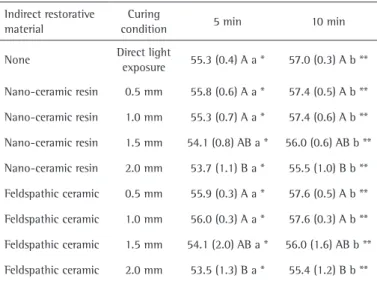
The irradiance values measured for Elipar S10 by integrating sphere and spectroradiometer was 1,008 ± 1 mW/cm2. DC results are shown in Table 1. No significant difference in DC was observed between nano-ceramic resin and feldspathic ceramic (p=0.6481) using the same thickness, neither after 5 or 10 min. The RelyX Unicem 2 resin cement exhibited lower DC at 5 min than at 10 min in all curing conditions (p<0.05). Light attenuation caused by 2.0-mm thick millable materials for CAD-CAM system resulted in significantly lower DC (p<0.05) than those obtained with thin materials (0.5 and 1.0 mm thick), which did not differ from the “direct light exposure” (p>0.05) (Table 1).
Degree of conversion of resin cement
Discussion
When RelyX Unicem 2 resin cement was used in the self-curing mode it showed lower DC than it did following light activation, even when an indirect restoration had been positioned between the light tip and the resin cement. After 5 and 10 min post-mixing, the DC was lower than the light exposure groups and reached only 23.6 and 33.2%, respectively (Fig. 1). This self-adhesive resin cement showed the same behavior of traditional dual-cured cementing systems, as the self-curing mode was less effective when compared to the dual-cured. The concerns related to low DC values for self-curing mode are associated with the increase of water sorption and solubility, which may compromise the mechanical properties of the resin cements and the longevity of indirect restoration (18,19).
Light activation is important as well as the amount irradiant energy that reaches the resin cement in order to obtain high DC, since poor polymerization affects the quality of cementing procedure (14,15,20,21). The methodology to obtain the DC values used in this study may increase the cure mode effects, because self-adhesive resin-based luting agents contain acidic functional methacrylates. When bonded to dentin/enamel, buffering of acidic monomers is expected to increase the amount of C=C, because of the increased pH of the reaction environment. However, when testing materials are not bonded to acid-sensitive materials, such as the horizontal diamond ATR element of a Fourier transform infrared spectrometer, the absence of pH buffering tends to reduce the C=C conversion (20,22).
It has been reported that ceramic thickness has a more profound effect on resin polymerization compared to the ceramic shade (2). In that study, an overlying ceramic thickness of 3 mm or more significantly decreased the microhardness of resin cements. In the present study, the thickest tested materials were 2 mm, which was enough to reduce the DC of resin cement (13). Flury et al. (23) showed that the irradiances from two curing units decreased by >80% through IPS Empress CAD and IPS e.max CAD (Ivoclar Vivadent) 1.5-mm discs. However, the DC for the RelyX Unicem 2 was not reduced, which corroborates the results of this study. After 5 and 10 min, 1.5 mm of nano-ceramic resin and feldspatic ceramic reduced the DC approximately 2%, which was not significantly different compared to direct light exposure. The attenuation of light and irradiant energy was significant at the 2.0 mm thickness. Thus, the concern related to the low DC of resin cement should begin by the 2.0-mm-thick indirect restoration.
Lava Ultimate and Vita Blocks Mark II are restorative materials with different composition; however, when they were tested using the Elipar S10, they resulted in similar DC of the resin cement. Vita Blocks Mark II is made from fine structure feldspar ceramics and the composition is based on different types of oxides, such as (by weight): silicon dioxide (56-64%), alumina (20-23%), sodium oxide (6-9%), potassium oxide (6-8%), calcium oxide (0.3-0.6%) and titanium dioxide (0.0-0.1%).
According to the manufacturer information, Lava Ultimate contains silica (20 nm diameter) and zirconia (4 to 11 nm diameter). The addition of small particles to formulations containing nanoclusters reduces the interstitial spacing among the filler particles, leading to a higher nano-ceramic particles content. This restorative material was formulated with approximately 80%
nano-Table 1. Comparison between the groups at the initial, post-irrigation and final samples (mean and standard deviation of CFU mL-1 log)
Indirect restorative material
Curing
condition 5 min 10 min
None Direct light
exposure 55.3 (0.4) A a * 57.0 (0.3) A b **
Nano-ceramic resin 0.5 mm 55.8 (0.6) A a * 57.4 (0.5) A b **
Nano-ceramic resin 1.0 mm 55.3 (0.7) A a * 57.4 (0.6) A b **
Nano-ceramic resin 1.5 mm 54.1 (0.8) AB a * 56.0 (0.6) AB b **
Nano-ceramic resin 2.0 mm 53.7 (1.1) B a * 55.5 (1.0) B b **
Feldspathic ceramic 0.5 mm 55.9 (0.3) A a * 57.6 (0.5) A b **
Feldspathic ceramic 1.0 mm 56.0 (0.3) A a * 57.6 (0.3) A b **
Feldspathic ceramic 1.5 mm 54.1 (2.0) AB a * 56.0 (1.6) AB b **
Feldspathic ceramic 2.0 mm 53.5 (1.3) B a * 55.4 (1.2) B b **
Self-cure: 23.6 (2.1) and 33.2 (2.0) for 5 min and 10 min, respectively. * Differ from self-cure mode at 5 min, and ** differ from self-cure mode at 10 min (by Dunnett’s test). Means followed by different uppercase letters (column/within time) and lowercase letters (row/within material) are different by Tukey’s post-hoc test (p<0.05).
366
M. Giannini et al.
ceramic material by weight (or 60% by volume) and this high filler concentration may be responsible for blocking the light emitted by curing units when used in thick layers. Also, the smaller the filler size, the greater is the light scattering (21,24).
Studies have reported that the light activation of dual-cured resin cement through the indirect restorations resulted in lower bond strength to dentin, even when used in combination with dual-cured adhesive systems (1,5,7,9). These bond strength reductions are due to the light attenuation caused by indirect restorations, which significantly affect the DC and hardness of the resin cements (1,2,6,8,11,12). Although resin cements are dual-cure materials, the self-curing components have not been able to compensate the low light irradiance and produce the same monomer conversion as the light-activated groups (9).
All the research hypotheses were confirmed. The attenuation of light delivered to the resin cement and passed through millable 2-mm-thick materials resulted in lower DC, when compared to the light that passes through the glass slide. The DC after 10 min was higher than the one measured after 5 min of polymerization initiation, because the polymerization reaction continued after light activation. Although there is relative immobility of radicals to migrate and continue the polymerization reaction, due to the change in resin viscosity after light activation, the increase of DC observed over time was also due to the autopolymerization reaction (1,7,9,20,22). Regarding the third hypothesis, when the resin cement was allowed to self-cure the lowest DC was obtained.
Elipar S10 generated 1,008 ± 1 mW/cm2 of irradiance, which is higher than that produced by most curing units (25). It would be interesting to test in further studies whether even higher irradiance would compensate the light attenuation promoted by thick indirect restorations cemented with dual-cured resin cements. In conclusion, the presence of a thick (2 mm) indirect restoration resulted in lower DC of resin cement, which was higher at 10 min than after 5 min. The self-curing mode produced lower DC than light-activation, independent of the restorative material thickness.
Resumo
Este estudo avaliou os efeitos do tipo de material restaurador indireto, da condição de ativação e do tempo no grau de conversão de um cimento resinoso de dupla ativação, utilizando espectroscopia de luz infravermelha. O cemento resinoso (RelyX Unicem 2, 3M ESPE) foi aplicado à superfície do diamante da unidade de reflectância atenuada e ativado segundo as seguintes condições: ativação química, exposição direta da luz e aplicação da luz através de dois materiais protéticos: resina nano-cerâmica (Lava Ultimate, 3M ESPE) ou cerâmica feldspática (Vita Blocks Mark II, Vita Zahnfabrik). Quatro espessuras de cada um desses materiais (0,5; 1,0; 1,5 e 2,0 mm) foram analisadas e a ativação realizada com luz LED. Os dados (n=5) foram analisados pela ANOVA três fatores, testes de Tukey e Dunnett
(5%). Nenhuma diferença do grau de conversão foi observada entre os materiais. Todos os grupos mostraram maior grau de conversão após 10 min que após 5 min. Em ambos os tempos, o grupo ativado quimicamente teve menor grau de conversão que todos os grupos fotoativados. O grau de conversão foi reduzido somente quando foi utilizada a peça protética de 2 mm. Espessas peças protéticas podem reduzir o grau de conversão do cemento resinoso. A grau de conversão após 10 min é maior que após 5 min da cimentação. A ativação química produz menor grau de conversão que a fotoativação.
Acknowledgements
This study was supported by grants from Capes (#3110/2010 and #840/2010) and FAEPEX (#15/12) from Brazil, as well as The Georgia Regents University, Augusta, GA, USA.
References
1. Arrais CA, Giannini M, Rueggeberg FA. Effect of sodium sulfinate salts on the polymerization characteristics of dual-cured resin cement systems exposed to attenuated light-activation. J Dent 2009;37:219-227.
2. Kilinc E, Antonson SA, Hardigan PC, Kesercioglu A. The effect of ceramic restoration shade and thickness on the polymerization of light- and dual-cure resin cements. Oper Dent 2011;36:661-669.
3. Gregor L, Bouillaguet S, Onisor I, Ardu S, Krejci I, Rocca GT. Microhardness of light- and dual-polymerizable luting resins polymerized through 7.5-mm-thick endocrowns. J Prosthet Dent 2014;112:942-948.
4. Paula AB, Tango RN, Sinhoreti MAC, Alves MC, Puppin-Rontani RM. Effect of thickness of indirect restoration and distance from the light-curing unit tip on the hardness of a dual-cured resin cement. Braz Dent J 2010;21:117-122.
5. Arrais CAG, Giannini M, Rueggeberg FA, Pashley DH. Microtensile bond strength of dual-polymerizing cementing systems to dentin using different polymerizing modes. J Prosthet Dent 2007;97:99-106. 6. Watanabe H, Kazama R, Asai T, Kanaya F, Ishizaki H, Fukushima M, et
al.. Efficiency of dual-cured resin cement polymerization induced by high-intensity led curing units through ceramic material. Oper Dent 2015;40:153-162.
7. Cavalcanti SC, Oliveira MT, Arrais CA, Giannini M. The effect of the presence and presentation mode of co-initiators on the microtensile bond strength of dual-cured adhesive systems used in indirect restorations. Oper Dent 2008;33:682-689.
8. Arrais CA, Chagas CL, Munhoz A, Oliveira M, Reis AF, Rodrigues JA. Effect of simulated tooth temperature on the degree of conversion of self-adhesive resin cements exposed to different curing conditions. Oper Dent 2014;39:204-212.
9. Arrais CAG, Rueggeberg FA, Waller JL, de Goes MF, Giannini M. Effect of curing mode on the polymerization characteristics of dual-cured resin cement systems. J Dent 2008;36:418-426.
10. Ruse ND, Sadoun MJ. Resin-composite blocks for dental CAD/CAM applications. J Dent Res 2014;93:1232-1234.
11. Tango RN, Sinhoreti MA, Correr AB, Correr-Sobrinho L, Consani RL. Effect of veneering materials and curing methods on resin cement Knoop hardness. Braz Dent J 2007;18:235-239.
12. Turp V, Sen D, Poyrazoglu E, Tuncelli B, Goller G. Influence of zirconia base and shade difference on polymerization efficiency of dual-cure resin cement. J Prosthodont 2011;20:361-365.
13. Runnacles P, Correr GM, Baratto Filho F, Gonzaga CC, Furuse AY. Degree of conversion of a resin cement light-cured through ceramic veneers of different thicknesses and types. Braz Dent J 2014;25:38-42. 14. Lührs AK, Pongprueksa P, De Munck J, Geurtsen W, Van Meerbeek B.
Curing mode affects bond strength of adhesively luted composite CAD/ CAM restorations to dentin. Dent Mater 2014;30:281-291.
Degree of conversion of resin cement
16. Ikemura K, Endo T. Effect of adhesion of new polymerization initiator systems comprising 5- monosubstituted barbituric acids, sulfinate amides, and terbutyl peroxymaleic acid in dental adhesive resin. J Appl Polym Sci 1999;72:1655-1668.
17. Rueggeberg FA, Hashinger DT, Fairhurst CW. Calibration of FTIR conversion analysis of contemporary dental resin composites. Dent Mater 1990;6:241-249.
18. Gerdolle DA, Mortier E, Jacquot B, Panighi MM. Water sorption and water solubility of current luting cement: An in vitro study. Quintessence Inter 2008;39:e107-e114.
19. Kilinc E, Antonson SA, Hardigan PC, Kesercioglu A. The effect of ceramic restoration shade and thickness on the polymerization of light- and dual-cure resin cements. Oper Dent 2011;36:661-669.
20. Moraes RR, Faria-e-Silva AL, Ogliari FA, Correr-Sobrinho L, Demarco FF, Piva E. Impact of immediate and delayed light activation on self-polymerization of dual-cured dental resin luting agents. Acta Biomater 2009;5:2095-2100.
21. Malhotra N, Mala K. Light-curing considerations for resin-based composite materials: a review. Part II. Compend Contin Educ Dent
2010;31:584-588.
22. Pereira SG, Fulgêncio R, Nunes TG, Toledano M, Osorio R, Carvalho RM. Effect of curing protocol on the polymerization of dual-cured resin cements. Dent Mater 2010;26:710-718.
23. Flury S, Lussi A, Hickel R, Ilie N. Light curing through glass ceramics with a second- and a third-generation LED curing unit: effect of curing mode on the degree of conversion of dual-curing resin cements. Clin Oral Investig 2013;17:2127-2137.
24. Mousavinasab SM. Effects of filler content on mechanical and optical properties of dental composite resin. In: Cuppoletti J, ed. Metal, Ceramic and Polymeric Composites for Various Uses. 1st ed. Rijeka, Croatia: In Tech; 2011:421-428.
25. Price RBT, Rueggeberg FA, Labrie D, Feliz CM. Irradiance uniformity and distribution from dental light curing units. J Esthet Restor Dent 2010;22:86-103.