Hearing and quality of life in musicians of a symphony
orchestra
Audição e qualidade de vida de músicos de uma orquestra
sinfônica brasileira
Débora Lüders1, Cláudia Giglio de Oliveira Gonçalves1, Adriana Bender Moreira de Lacerda1, Sônia Regina
Lazarotto Schettini1, Luciana Santos Gerosino da Silva1, Evelyn Joyce Albizu2, Jair Mendes Marques1
ABSTRACT
Purpose: To analyze the impact of exposure to music in the hearing process and quality of life in musicians of a symphony orchestra.
Methods: This is a descriptive, cross-cut, quantitative study on the aspects of hearing health in 30 musicians of the symphony orchestra of Paraná, ages between 33 and 54 years. The sound pressure levels that musicians are exposed to were measured during the orchestra rehearsal, and participants answered a questionnaire about the musical practice as well as the SF-36 questionnaire, which investigates the quality of life. Conventional audiometry and high-frequency audiometry were applied.
Results: During the orchestra rehearsal, hazardous sound pressure
levels to musicians’ hearing health were observed. The commonest symptoms reported were tinnitus and intolerance to intense sounds. In the conventional audiometry test, more than half of the musicians featured sensorineural hearing loss, and the worst results were found in high frequencies. In the high -frequency audiometry test, higher auditory thresholds were also found in higher frequencies. As for quality of life, there was significant correlation for musicians with hearing loss in the domain “limitation due to emotional aspects”. Conclusion: the sound
pressure levels that musicians are exposed to are excessive and represent a risk to hearing health. Hearing loss and other auditory symptoms can interfere in their quality of life, once hearing is essential to this professional category.
Keywords: Music; Occupational exposure; Hearing; Hearing loss;
Quality of life
RESUMO
Objetivo: Analisar o impacto da exposição à música na audição e na qualidade de vida de músicos de uma orquestra sinfônica brasileira.
Métodos: Trata-se de um estudo quantitativo transversal, descritivo, sobre os aspectos da saúde auditiva de 30 músicos da orquestra sinfôni-ca do Paraná, com idade entre 33 e 54 anos. Foram medidos os níveis de pressão sonora a que os músicos estão expostos durante um ensaio da orquestra e os participantes responderam a um questionário sobre a prática musical e o questionário SF-36, que investiga a qualidade de vida. Foi realizada audiometria convencional e de altas frequências.
Resultados: Durante o ensaio da orquestra, foram observados níveis
de pressão sonora que colocam a audição dos músicos em risco. Os sintomas auditivos mais relatados foram zumbido e intolerância a sons intensos. Na audiometria convencional, mais da metade dos músicos apresentou perda auditiva neurossensorial, com piores resultados nas frequências mais altas. Na audiometria de altas frequências, também foram encontrados limiares auditivos mais elevados nas frequências mais altas. Quanto à qualidade de vida, houve correlação significativa para os músicos com perda auditiva no domínio “limitação por aspectos emocionais”. Conclusão: Os níveis de pressão sonora a que os músicos estão expostos são excessivos, colocando em risco a sua audição. A per-da auditiva, juntamente com outros sintomas auditivos, pode interferir na qualidade de vida, uma vez que a audição é fundamental para essa categoria profissional.
Descritores: Música; Exposição ocupacional; Audição; Perda auditiva; Qualidade de vida
Manuscript held in the Post-Graduation Program of Communication Disorders, Universidade Tuiuti do Paraná – UTP – Curitiba (PR), Brazil. (1) Post-Graduation Program of Communication Disorders, Universidade Tuiuti do Paraná – UTP – Curitiba (PR), Brazil.
(2) Ministry of Labor and Employment, Fundação Jorge Duprat e Figueiredo – FUNDACENTRO – Curitiba (PR), Brazil.
Conflict of interests: No
Authors’ contribution: DL study conception and design, data analysis and interpretation, drafting, final approval of the version to be published; CGOG study conception and design, data collection, article revision, approval of the final version to be published; ABML data collection, analysis and interpretation; SRLS
data collection, analysis and interpretation; LSGS data collection, analysis and interpretation, drafting; EJA data collection, analysis and interpretation, drafting;
JMM study design, variable selection, data analysis and interpretation, and drafting.
Corresponding author: Débora Lüders. E-mail: [email protected]
INTRODUCTION
Music celebrates and preserves people’s cultural herita-ge, while it allows to explore the domains of expression and imagination. It is an important cultural and cognitive aspect and must be stimulated in all educational levels, being part of human beings’ growth and development(1).
However, whenever people refer to music, disregarding their musical preferences, they generally recognize it as harmonious, pleasant sounds, not considered a deleterious source of sound to hearing. Nevertheless, systematic exposure to high levels of sound pressure, even music, may cause permanent hearing impairment(2).
In the past decades, studies have reported damages to hearing health of orchestra musicians, caused by high sound levels that they are exposed to in their professional practice, as well as musculoskeletal and emotional problems, which may altogether interfere in their career and quality of life(3,4).
Hearing impairments stem from the exposure to intense sound for long periods of time, such as frequent rehearsals and performances. Among the several hazardous factors for hearing in this professional practice, can be mentioned the length of ex-posure, music intensity, the acoustics of the orchestra rehearsal setting, proximity of sound sources (placement of the musician in the orchestra and in the family of instruments that his/her instrument belongs to), choice of the repertoire and repetition of specific musical passages(5).
Even though mild hearing losses hardly hinder commu-nication, they may impair timbre recognition and instrument tuning, thus they should be identified early(2,6,7). The difficulty in
identifying timbres and variations in sound intensity may lead the musicians to misleading perceptions, that is, by determining whether intensity or frequency has changed, they may assume that what they have heard is a high-pitched sound (frequency), while it actually is a crescendo(8) (increase in sound intensity).
Such problems may affect musicians’ quality of life, and they are scarcely investigated in this professional category. According to a study(9), one of the reasons for that is that many
researchers wrongly believe that music, for being associated with leisure and pleasure, is not an occupational activity. Moreover, there is not specific legislation in Brazil that prevent musicians from related impairments to loud music(7).
The amount and quality of studies published up to date in the area of musician medicine show how this research field has lagged behind the other occupational sectors(10).
Therefore, the current study objectified to analyze the impact of music exposure to hearing and quality of life of musicians of a Brazilian symphony orchestra.
METHODS
It is a cross-cut quantitative study, which analyzed the he-aring health and quality of life of 30 musicians of a symphony
orchestra in Paraná State, Brazil. This research study was appro-ved by the Research Ethics Board of the Sociedade Evangélica Beneficente de Curitiba, under opinion n. 697.598/2014, and all
participants signed the Free Informed Consent Form, after being informed about the objectives, justification and methodology of the proposed study.
The established inclusion criterion was to be a professio-nal musician, member of the symphony orchestra. Musicians featuring tympanometric curves due to medium-ear disorder were excluded from the research.
Initially, sound pressure levels were measured during two rehearsals in order to investigate musicians’ sound ex-posure, according to methodology and procedures establi-shed in the Occupational Hygiene Regulation (NHO-1) by FUNDACENTRO(11) and the Standardizing Regulation NR
15(12), both from the Ministry of Labor and Employment.
Integrated Bruel and Kjaer® 2230 sound level meter (duly calibrated with calibrator from the same brand) was used. Measurements were carried out by the researcher with the equipment positioned in the hearing area (site delimited by a maximum radius of 150 mm from the entry of the ear canal) of musicians who played the following instruments: transverse flute, oboe, piccolo, French horn, harp, cello, violin and per-cussion. The meter was adjusted for Leq readings, which is the average level from the measured period of time based on the sound energy equivalence. Measurements for each instrument were taken down during two rehearsals of the same repertoire. Assessment length of time for each musical instrument was five minutes. FUNDACENTRO/Paraná State owns the equipment used for noise assessment, and measurements were made by an engineer, institution researcher.
After the measurement of sound pressure levels, the musi-cians were invited to undergo a previously scheduled audiolo-gical test at a teaching-clinic.
On the scheduled date, visual screening of the outer acoustic meatus was carried out in order to verify any obs-tructions which would prevent the audiological test, followed by the immittance testing by using a Madsen®, Otoflex 100 immittance meter. At that moment, musicians, who featured tympanometric curves due to medium-ear disorder, were excluded from the study. After the testing, participants answered a questionnaire on musical practice, knowledge of intense music hazards for hearing and preventive measures for hearing disorders.
Subsequently, air-conduction tone threshold audiometry, frequencies from 250 to 8000 Hz, and bone-conduction tone threshold audiometry, frequencies from 500 to 4000 Hz, were carried out when airway thresholds were above 25dBHL (Madsen® audiometer, Itera II with TDH-39 headphones), and high-frequency audiometry was also held, 9000 to 16000 Hz, with the same equipment but HDA 200 headphones.
life (Medical Outcomes Study 36 – Short Form Health Survey).
The instrument was elaborated as a generic questionnaire to assess quality of life, thus it is not specific for a certain age, disease or treatment group. Once it is generic, it contemplates not only related aspects to the presence or absence of disease symptoms, but also related aspects to impairments that may hinder individuals’ well-being or their daily-life activities. It was translated and validated for the Portuguese language(13) ,
and consists of 36 items of eight domains, taking up the most frequently concepts measured in health inquiries. They are, as follows: 1. functional capacity, which assesses the presence and range of limitations due to the functional capacity; 2. li-mitation due to physical aspects, which assesses lili-mitations in the kind and amount of work and in the activities of the daily living due to physical problems; 3. pain, which assesses the range of pain and its interference in the activities of the daily living; 4. general health status, which assesses general health-status perceptions; 5. vitality, which considers energy and fatigue levels; 6. limitation due to social aspects, which assesses individuals’ limitation to social activities due to he-alth problems; 7. limitation due to emotional aspects, which assesses the limitations in the kind and amount of work as well as in the activities of the daily living due to emotional problems; 8. mental health, which assesses the perceptions in relation to anxiety, depression, behavioral disorders and psychological well-being. For each domain, there is a different type of scoring, ranging from 0 to 100, being zero the worst general health status, and 100 for the best general health sta-tus, with each domain being separately analyzed. The result is called Raw Scale because the final scoring does not present any measurement units.
For data analysis, Student’s t-test was used, significance level of 0.05, for comparison of conventional tonal auditory thresholds between right and left ears. The domains of the SF-36 questionnaire were related to the mean values of conventional tonal auditory thresholds and musicians’ high frequencies, by means of Spearman’s Correlation Test, significance level of 0.05.
RESULTS
Thirty (30) orchestra musicians participated in this study, being 6 (20%) females and 24 (80%) males, ages ranging be-tween 33 and 54 years (mean age of 48.3 years).
Regarding musical practice, 30 musicians participated in the orchestra for an average of 24 years. Among them, 9 (30%) performed professionally only in the orchestra, while 21 (70%) also performed in other orchestras and bands, apart from tu-toring and teaching at music graduation courses, among other related activities to musical practice. None of the musicians reported to have been exposed to occupational noise before.
Length of daily exposure of rehearsal was three hours. Results from measurement of sound pressure levels which the musicians were exposed to, carried out during two rehearsing sessions, are shown in Table 1.
The highest sound pressure levels were measured near the French horns and violins (104 dB LAeq), followed by the piccolo (103,3 dB LAeq).
Among the most reported hearing symptoms by the mu-sicians were: tinnitus for 53.34%, hearing impairment for 43.34%, and intolerance to intense sounds for 33.34%. among the 16 musicians who reported tinnitus, 4 mentioned to be permanent. Apart from those, 7 (23.4%) musicians reported dizziness, 4 (13.4%) reported headache, and 3 (10%) reported earache.
Regarding the musicians’ perception on sound intensity produced by the orchestra most of the time, 18 (60%) reported high intensity, 10 (33.34%) reported medium intensity and 2 stated that such data is very relative. In the whole, 19 (63.34%), believed that high-intensity music may impair hearing, 24 (80%) knew how to prevent hearing loss, among those, 21 re-ferred to the possibility of wearing hearing protectors. However, among those 21 musicians, only 1 used hearing protectors for considering orchestra sound as deafening. The others reported that they did not wear hearing protectors, even specific ones for musicians because they hinder performance, such as loss of tuning and timbre change.
Table 1. Musicians’ sound exposure for three hours of daily orchestra rehearsal, according to the musical instrument
Instrument
dB (LAeq) dB (C)
1st rehearsal 2nd rehearsal 1st rehearsal 2nd rehearsal
French horn 104 103.8
Piccolo 103.3 102
Violin 103.3 104
Oboe 98 98.2
Harp 93.7 90.6
Violoncello 93.4 93.7
Transverse Flute 89.95 90
Percussion 107 to 113.9 107 to 113.9
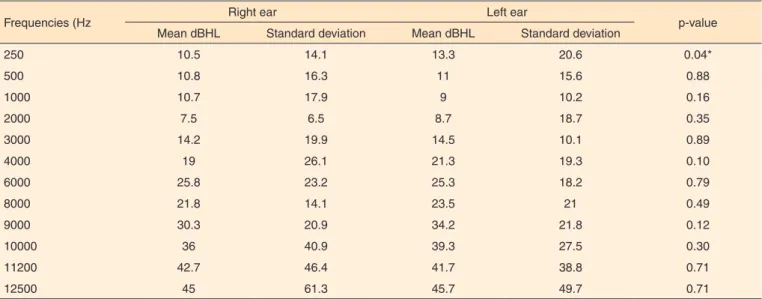
The results of the conventional audiometry and high- frequency audiometry are shown in Table 2.
The thresholds between 14000 Hz and 16000 Hz are not shown in Table 2, once there was no response to the maximum intensity of the equipment during assessment of 23 (76.7%) out of 30 musicians, in one or in both frequencies, and in one or both ears.
As for the conventional audiometry, there was significant difference only in the frequency of 250 Hz between right and left ears, with the worse result in the left ear. However, the worst mean value was found bilaterally at the frequency of 6000 Hz. Among the 30 musicians, 16 (53.33%) had hearing thresholds higher than 25 dBHL in one or more frequencies for one or both ears with the worst results in 3000 Hz, 4000 Hz and 6000 Hz. Among the 16 musicians with hearing impairments, 9 (56.2%) played instruments from the string family, and 7 (43.8%) played instruments from the brass family. Regarding high-frequency audiometry, all of them had hearing thresholds higher than 25 dBHL, higher occurrence at frequencies of 14000 Hz and 16000 Hz, except for 2 musicians (a 52-year-old viola player and a 56-year-old violinist).
As for musicians’ quality of life, scoring in the different studied domains according to SF-36 questionnaire, is shown in Table 3.
The lowest scored domains were “vitality” (65.3 points), which considers level of energy and fatigue; “general health status” (65.8 points), which assesses how patients feel in rela-tion to their general health, and “mental health” (65.9 points), which includes questions on anxiety, depression, behavioral disorders or emotional dysfunction and psychological well--being. The other domains had higher scoring than 70, with the best scoring in the “functional capacity” domain (92.3 points), which assesses the presence and range of limitations on physical capacity.
When the average of frequency thresholds for 3000, 4000 and 6000 Hz of 14 musicians with normal hearing was corre-lated with the domains of SF-36 questionnaire, no significant correlation was found.
The mean values of the frequency thresholds for 3000, 4000 and 6000 Hz of the 16 musicians suffering from hearing loss was correlated with the domains of the SF-36 questionnaire, by means of the Spearman’s correlation test, and significant
Table 2. Mean conventional tone thresholds and high-frequency thresholds in musicians’ right and left ears (n=30)
Frequencies (Hz Right ear Left ear p-value
Mean dBHL Standard deviation Mean dBHL Standard deviation
250 10.5 14.1 13.3 20.6 0.04*
500 10.8 16.3 11 15.6 0.88
1000 10.7 17.9 9 10.2 0.16
2000 7.5 6.5 8.7 18.7 0.35
3000 14.2 19.9 14.5 10.1 0.89
4000 19 26.1 21.3 19.3 0.10
6000 25.8 23.2 25.3 18.2 0.79
8000 21.8 14.1 23.5 21 0.49
9000 30.3 20.9 34.2 21.8 0.12
10000 36 40.9 39.3 27.5 0.30
11200 42.7 46.4 41.7 38.8 0.71
12500 45 61.3 45.7 49.7 0.71
*Significant values (p<0.05) – Student’s t-Test
Table 3. Display of the mean, median scoring and standard deviation in the different domains of the SF-36 questionnaire
Domain Scoring Standard deviation
Mean Median
Functional capacity 92.3 95 7.3
Limitation due to physical aspects 82.5 100 30.9
Pain 70.6 74 24.7
General health status 65.8 67 13.9
Vitality 65.3 65 8.4
Limitation due to social aspects 77.9 75 19.1
Limitation due to emotional aspects 78.9 100 34.4
correlation was found in the domain “limitation due to emotio-nal aspects”, regarding occupatioemotio-nal problems due to emotioemotio-nal disorders such as anxiety and depression, evidencing that the worse the mean thresholds, the worse the perception on such aspects. The results are shown in Table 4.
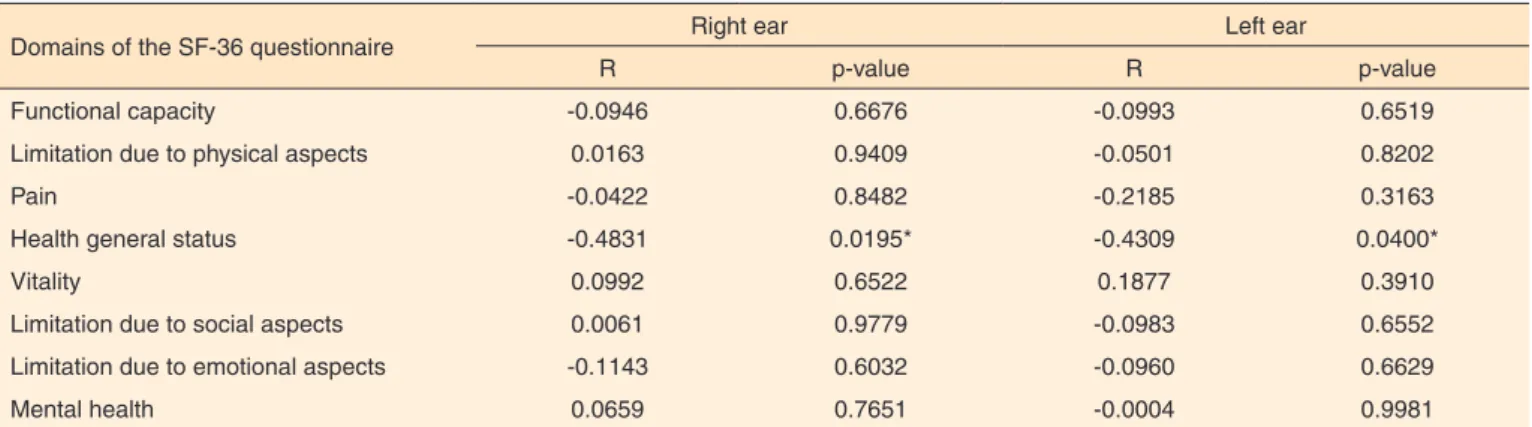
The comparison between the mean values of high frequency thresholds and the domains of SF-36 questionnaire was held by dividing the musicians in two groups: one with mean to-nal thresholds up to 25 dBHL, and another with mean toto-nal thresholds superior to 25 dBHL. By means of the Spearman’s Correlation test, it was verified that there was significant cor-relation only between the group of musicians with mean tonal thresholds superior to 25 dBHL and the “general health status” domain, which assesses the perceptions on the general health status, evidencing that the lower the hearing thresholds, the worse the perception on the general health status. The results are shown in Table 5.
DISCUSSION
In relation to the sound pressure levels that the musicians were exposed to, although the highest levels were found next to the French horns and violins (104 dB LAeq), all of them, except
the ones found next to the transverse flutes, evidenced hazar-dous intensities for musicians’ hearing, since the safest level would be 92 dB, according to the Brazilian labor legislation(12),
after three consecutive hours of rehearsal.
Several national and international studies have assessed sound pressure levels that orchestra musicians are exposed to. However, the methodology used has not always brought enough information for comparing the obtained results among the studies. A literature review(14) on the risk of hearing loss
among orchestra musicians reported that the published studies did not clarify such aspects properly, for example, whether the measurement technique obtained the equivalent levels (LAeq) or
the peak levels (instantaneous measurement). Raw data were not frequently provided, calculations were not explained, and some conclusions were based on inconsistent data analysis.
A study(15), whose objective was to analyze symphony
orchestra musicians’ sound exposure in eight rehearsal with different repertoires, evidenced lower sound levels than the ones found in the current study. The authors reported varied levels, according to the family of instruments: 78.9 to 89.7 dB (A) for strings, 84.9 to 96.8 dB (A) for wind instruments, 87.0 to 97.4 dB (A) for brass instruments, 85.9 to 95.4 dB (A) for percussion and timpani, and 77.2 to 86.3 dB (A) for conductors.
Table 4. Correlation between mean auditory thresholds at frequencies of 3000, 4000 and 6000 Hz and the domains of the SF-36 questionnaire – Group of the musicians with altered audiometry (n=16)
Domains of the SF-36 questionnaire Right ear Left ear
R p-value R p-value
Functional capacity -0.0479 0.8601 -0.0231 0.9323
Limitation due to physical aspects -0.2057 0.4447 -0.4924 0.0527
Pain -0.1752 0.5163 -0.2222 0.4081
General health status 0.0223 0.9346 -0.2289 0.3938
Vitality -0.4011 0.1236 -0.2498 0.3508
Limitation due to social aspects -0.2344 0.3821 -0.3040 0.2524
Limitation due to emotional aspects -0.8166 0.0001* -0.6395 0.0076*
Mental health -0.0327 0.9043 0.0752 0.7818
*Significant values (p<0.05) – Spearman’s Correlation
Table 5. Correlation between mean auditory thresholds at frequencies of 9000 to 16000 Hz and the domains of the SF-36 Questionnaire – Group of the musicians with mean thresholds superior to 25 dBHL (n=23)
Domains of the SF-36 questionnaire Right ear Left ear
R p-value R p-value
Functional capacity -0.0946 0.6676 -0.0993 0.6519
Limitation due to physical aspects 0.0163 0.9409 -0.0501 0.8202
Pain -0.0422 0.8482 -0.2185 0.3163
Health general status -0.4831 0.0195* -0.4309 0.0400*
Vitality 0.0992 0.6522 0.1877 0.3910
Limitation due to social aspects 0.0061 0.9779 -0.0983 0.6552
Limitation due to emotional aspects -0.1143 0.6032 -0.0960 0.6629
Mental health 0.0659 0.7651 -0.0004 0.9981
In general, musicians that played instruments from the brass family were exposed to sound levels consistently higher than the other musicians (92.7 ± 2.77), in accordance with the findings in this study, although in lower levels, followed by the musicians who played woodwind instruments (90.5 ± 3.45), similar data to the present study, and the musicians who played percussion and timpani (90.0 ± 2.93). Lower sound levels were measured among the musicians who played string instruments (85.4 ± 3.40) and conductors (82.1 ± 2.56).
Another study(16) analyzed sound exposure during individual
practice of 35 orchestra musicians, evidencing sound levels from 60 to 107 dB LAeq, with peak levels from 101 to 130 dB LC. Considering that the average length of individual practice reported by musicians was 2.1 hours a day, five days a week, 53% would exceed the maximum safe level for daily exposure.
A study(17) assessed sound pressure levels during a
perfor-mance of the Limburg Symphony Orchestra in the Netherlands, and found similar Leq values to the ones in this study, rang-ing from 84.4 dB LAeq and 96.1 dB LAeq, finding 88.2 dB LAeq
among the violins.
Another study(8) evidenced sound pressure levels during
rehearsals, considering all the assessed repertoire ranging from 75 dB LAeq to 100 dB LAeq, that is, values close to the ones
found in this study.
Although other studies mentioned in the literature re-view(5,18,19,20) also measured sound pressure levels in symphony
orchestras, the assessment methodology was scarcely defined or different from the one used in this study, however, they also show enough high intensities to impair musicians’ hearing.
In relation to musicians’ hearing symptoms, the present study found the occurrence of tinnitus in 53.34% of them, and intolerance to intense sounds in 33.34%. Among the 16 musi-cians who reported tinnitus, four stated that it was permanent. Some studies have shown the presence of such symptoms in orchestra musicians. Among them, a study(21) with 23
orches-tra musicians found 52.1% of the musicians suffering from intolerance to intense sounds, and 43.4% of them from tin-nitus. Another study(22) evidenced that among 241 orchestra
musicians, 17% reported tinnitus, mainly in their left ear. Other studies have shown the presence of those symptoms in different musical groups, such as an instrumental band(7), which
had tinnitus reported by 47% of the musicians, and intolerance to intense sounds by 58.8%, as well as a military band(2), which
had tinnitus reported by 76% of its members.
The presence of tinnitus and intolerance to intense sounds were reported by several studies, and by this study as well. These symptoms can be associated to musicians’ occupational exposure, whether they are professionals or students, and can be followed by hearing loss due to high sound pressure levels.
In relation to hearing impairments caused by the exposure to intense sound pressure levels in orchestra musicians, stu-dies(18,19,21,22,23) showed results which feature music-induced
hearing loss.
In a study(24) which assessed 182 musicians’ hearing, authors
concluded that musicians feature better hearing, in average, than the general population, but classical musicians with higher level of sound exposure would have yearly sound levels equivalent to 90 dBA during their professional career. Comparing them to their less exposed peers, they would have an additional he-aring loss of 6.3 dB at 3000 Hz, 4000 Hz and 6000 Hz, which characterizes the risk that musicians are exposed to during their professional practice.
Another study(6) carried out with 30 musicians between 18
and 37 years, found 24% audiograms suggesting music-induced hearing loss, significantly lower rate than the one found in the current study (33 to 54 years). This fact may have occurred due to a younger age group and, consequently, shorter length of musical practice and sound exposure.
As for the high-frequency assessment, there was a notch in the frequency of 12500 Hz bilaterally, and in the frequency of 14000 Hz in the right ear, although mean thresholds were 11 dBHL maximum. By analyzing hearing from 50 musicians of a military band in Brazil, a study(25) also found higher auditory
thresholds than 25 dBHL, at 3000 Hz, and/or 4000 Hz, and/or 6000 Hz in 32% of the musicians.
By comparing the tonal thresholds, using high-frequency audiometry, between the group of musicians and a control group, it was observed that the musicians evidenced worse au-ditory thresholds than the non-exposed group to intense sounds for the frequencies of 14000 and 16000 Hz in both ears, and 9000 Hz in the right ear, which differs from the current study.
Research carried out among music students have also reported hearing losses in this population. In a study(26) with
329 students, the prevalence of music-induced hearing loss was 45%, with 78% of the notches occurring at 6000 Hz, a very high rate considering they are students, therefore from a younger age group.
In Brazil, a study(27) compared 42 music students’ hearing
to a control group and found the worst results for the frequency of 6000 Hz among the students’ group. In relation to high fre-quencies, only the mean threshold of the frequency at 9000 Hz in the right ear was worse in the studied group when compared to the control group, similarly to a formerly mentioned study(25).
From what has been mentioned, it is perceived that hearing loss due to loud music exposure has been occurring in musi-cians and music students, musimusi-cians from orchestras and other musical groups at different age groups.
Research on musicians’ quality of life has not been found in literature by means of the SF-36 questionnaire, used in this study. In general, the “quality of life” theme has been scarcely studied in this cohort. However, some publications address the quality of life of this professional group by means of other data collection instruments, thus, most of them focus on pain as one of the determinants of quality of life.
According to the results from a study(28) with symphony
a “silent” one. The reason for that could be the culture of the pain considered necessary to an instrument player or the “ver-tical and military” structure of a symphony orchestra, which intimidates musicians to remain silent due to the competition and fear of losing their jobs. Another study(4) warns for the fact
that musicians may not search for specialized professionals due to the competitive nature of their occupation, fearing that treatment demands as well as an injury becoming public may cost their job positions.
Researchers(29) investigated the loss of sleep quality in 71%
of the musicians from a symphony orchestra. According to the study, low rates of sleep quality showed the association between decreased capacity to perform activities of daily living and work. The perception of pain and discomfort also evidenced a strong association with sleep quality, confirming that that is an important ergonomic aspect in musicians’ occupation.
A study(30) among 16 instrument players of viola and violin,
males and females, of a Brazilian orchestra, aimed to assess the occupational outcomes over health and quality of life of these professionals. In general, the most negative perceptions were related to physical problems, such as pain and allergies.
Even though there are no studies in literature correlating hearing loss to musicians’ quality of life, even mild hearing impairments may put their professional careers to an end, and considering that an occupation is an important factor to maintain the quality of life, the results in this study, correlating hearing loss at frequencies of 3000 Hz, 4000 Hz and 6000 Hz, and one of the domains in SF-36 questionnaire, which takes occupational problems in consideration, evidence the impact that hearing may also pose to musicians’ career.
The correlation found between high-frequency thresholds superior to 25 dBHL and the “general health status” domain can be associated with the fact that the studied group of musicians is from an older age group (mean age of 49.3 years) than the musicians featuring thresholds inferior to 25 dBHL (mean age of 45.4 years). Thus, the correlation would be justified by the age, not by the auditory thresholds found, once older age may generate a higher impact over the quality of life, concerning the general health status. However, as the difference in the mean age among the studied groups was only 3.9 years, maybe the correlation between the two variables has occurred due to the increase in the high-frequency thresholds. Nevertheless, in literature, there have not been analyses about the impact of the professional exposure to music on high-frequency hearing, and how that impact influences professional performance, and consequently, quality of life. Therefore, the considerations stated here are mere hypotheses.
CONCLUSION
Among the musicians of an orchestra, 53,33% of the orches-tra musicians suffer from hearing loss, mainly at the frequen-cies of 3000 Hz, 4000 Hz e 6000 Hz, with high occurrence of
tinnitus and intolerance to intense sound levels. It was observed impairment in the quality of life in some researched domains with significant correlation between hearing loss and the “limi-tation due to emotional aspects” domain, and thresholds higher than 25 dB and the “general health status” domain. The sound pressure levels that the musicians are exposed to are excessi-ve, putting their hearing at risk. Hearing loss as well as other hearing disorders may impair musicians’ quality of life, once hearing is essential to this professional category.
REFERENCES
1. Chesky K. Schools of music and conservatories and hearing loss prevention. Int J Audiol. 2011;50(Suppl 1):S32-7. http://dx.doi.org/ 10.3109/14992027.2010.540583
2. Gonçalves CGO, Lacerda ABM, Zocolli AMF, Oliva FC, Almeida SB, Iantas MR. Percepção e o impacto da música na audição de integrantes de banda militar. Rev Soc Bras Fonoaudiol. 2009;14(4):515-20. http://dx.doi.org/10.1590/S1516-80342009000400015
3. Kähäri KR, Axelsson A, Hellström PA, Zachau G. Hearing assessment of classical orchestral musicians. Scand Audiol. 2001;30(1):13-23. http://dx.doi.org/10.1080/010503901750069536 4. Raymond DM 3rd, Romeo JH, Kumke KV. A pilot study
of occupational injury and illness experienced by classical musicians. Workplace Health Saf. 2012;60(1):19-24. http://dx.doi. org/10.3928/21650799-20111227-01
5. Schmidt JH, Pedersen ER, Juhl PM, Christensen-Dalsgaard J, Andersen TD, Poulsen T et al. Sound exposure of symphony orchestra musicians. Ann Occup Hyg. 2011;55(8):893-905. http:// dx.doi.org/10.1093/annhyg/mer055
6. Amorim RB, Lopes AC, Santos KTP, Melo ADP, Lauris JRP. Alterações auditivas da exposição ocupacional em músicos. Arq Int Otorrinolaringol. 2008;12(3):377-83.
7. Mendes MH, Morata TC, Marques JM. Aceitação de protetores auditivos pelos componentes de banda instrumental e vocal. Rev Bras Otorrinolaringol. 2007;73(6):785-92. http://dx.doi.org/10.1590/ S0034-72992007000600010
8. Reid AW, Holland MW. A sound ear II: the control of noise at work regulations 2005 and their impact on orchestras. London: Association of British Orchestras; 2008.
9. Fragelli TBO, Günther IA. Relação entre dor e antecedentes de adoecimento físico ocupacional: um estudo entre músicos instrumentistas. Per Musi. 2009;19:18-23. http://dx.doi.org/10.1590/ S1517-75992009000100003
10. Frank A, Mühlen CA. Queixas musculoesqueléticas em músicos: prevalência e fatores de risco. Rev Bras Reumatol. 2007;47(3):188-96. http://dx.doi.org/10.1590/S0482-50042007000300008
www.fundacentro.gov.br/biblioteca/normas-de-higiene-ocupacional/ publicacao/detalhe/2012/9/nho-01-procedimento-tecnico-avaliacao-da-exposicao-ocupacional-ao-ruido
12. Ministério do Trabalho e Emprego (BR). Norma regulamentadora de segurança e saúde do trabalho – NR 15. Atividades e operações insalubres. Brasília, DF Ministério do Trabalho e Emprego; 1998 [citado 20 ago 2014]. Disponível em: http://www.tem.gov.br/ legislacao/normas_regulamentadoras/nr_15.pdf
13. Ciconelli RM, Ferraz MB, Santos W, Meinão I, Quaresma MR. Tradução para a língua portuguesa e validação do questionário genérico de avaliação de qualidade de vida SF-36 (Brasil SF-36). Rev Bras Reumatol. 1999;39(3):143-50.
14. Behar A, Wong W, Kunov H. Risk of hearing loss in orchestra musicians: review of the literature. Med Probl Perform Art. 2006;21(4):164-8.
15. Rodrigues MA, Freitas MA, Neves MP, Silva MV. Evaluation of the noise exposure of symphonic orchestra musicians. Noise Heath. 2014;16(68):40-6. http://dx.doi.org/10.4103/1463-1741.127854 16. O’Brien I, Driscoll T, Achermann B. Sound exposure of professional
orchestral musicians during solitary practice. J Acoust Soc Am. 2013;134(4):2748-54. http://dx.doi.org/10.1121/1.4820900 17. Zijl AV. Hearing damage in classical musicians: the orchestration of
a problem [thesis]. Maastricht: Faculty of Arts and Social Sciences, Maastricht University; 2007.
18. Maia AA, Gonçalves DU, Menezes LN, Barbosa BMF, Almeida PS, Resende LM. Análise do perfil audiológico dos músicos da Orquestra Sinfônica de Minas Gerais (OSMG). Per Musi. 2007;15:67-71. 19. Laitinen HM, Topila EM, Olkinuora PS, Kuisma K. Sound exposure
among the Finnish National Opera personnel. Appl Occup Environ Hyg. 2003;18(3):177-82. http://dx.doi.org/10.1080/10473220301356 20. Lee J, Behar A, Kunov H, Wong W. Musicians noise exposure
in orchestra pit. Appl Acoust. 2005;66(8):919-31. http://dx.doi. org/10.1016/j.apacoust.2004.11.009
21. Marchiori LLM, Melo JJ. Comparação das queixas auditivas com relação à exposição ao ruído em componentes de orquestra sinfônica. Pro Fono. 2001;13(1):9-12.
22. Jansen EJ, Helleman HW, Dreschler WA, Laat JA. Noise induced hearing loss and other hearing complaints among musicians of symphony orchestras. Int Arch Occup Environ Health. 2009;82(2):153-64. http://dx.doi.org/10.1007/s00420-008-0317-1. 23. Russo FA, Behar A, Chasin M, Mosher S. Noise exposure and
hearing loss in classical orchestra musicians. Int J Ind Ergon. 2013;43(6):474-8. http://dx.doi.org/10.1016/j.ergon.2012.11.001 24. Schmidt JH, Pedersen ER, Paarup HM, Christensen-Dalsgaard
J, Andersen T, Poulsen T et al. Hearing loss in relation to sound exposure of professional symphony orchestra musicians. Ear Hear. 2014;35(4):448-60. http://dx.doi.org/10.1097/ AUD.0000000000000029
25. Gonçalves CGO, Lacerda ABM, Zeigelboim BS, Marques JM, Luders D. Limiares auditivos em músicos militares: convencionais e altas frequências. CoDAS. 2013;25(2):181-7. http://dx.doi. org/10.1590/S2317-17822013000200015
26. Phillips SL, Henrich VC, Mace ST. Prevalence of noise-induced hearing loss in student musicians. Int J Audiol. 2010;49(4):309-16. http://dx.doi.org/10.3109/14992020903470809
27. Lüders D, Gonçalves CGO, Lacerda ABM, Ângela Ribas A, De Conto J. Music students: conventional hearing thresholds and at high frequencies. Braz J Otorhinolaryngol. 2014;80(4):296-304. http:// dx.doi.org/10.1016/j.bjorl.2014.05.010
28. Costa CP, Abrahão JI. Quando tocar dói: um olhar ergonômico sobre o fazer musical. Per Musi. 2004;10:60-79.
29. Pereira EF, Teixeira CS, Kothe F, Merino EAD, Daronco LSE. Percepção de qualidade do sono e da qualidade de vida de músicos de orquestra. Rev Psiq Clin. 2010;37(2):48-51. http://dx.doi. org/10.1590/S0101-60832010000200003