WEEDING AND DISPOSAL IN ACADEMIC LIBRARIES:
MAPPING OF SCIENTIFIC PRODUCTION
Márcia Regina Silva Cláudio Marcondes Castro Filho Paula Oliveira Quirino
Departamento de Educação, Informação e Comunicação Universidade de São Paulo (USP/Ribeirão Preto) Brazil
ABSTRACT
The aim of this study is to raise and discuss the literature on weeding and disposal in academic libraries. A survey of documents in databases of national and international scientific articles that address this issue. Items recovered on disposal and weeding were filtered and separated into four categories, namely: physical space, the current collection, collection development and other aspects. The results indicate that the process of weeding and disposal is not much explored in the literature, both nationally and internationally, in addition, there are indications that not all libraries that care to follow training policies and collection development statements.
Keywords: Collections Development; Collection Weeding; Collection Disposal;
Academic Library.
1 INTRODUCTION
Vergueiro (1989) believes that activities related to the development of collections “[…] should be as daily activities as the cataloguing, classification and indexation of items”. However, according to the author, it is not what happens in the Brazilian libraries in general. As Weitzel emphasizes (2006, p.7), although this process is present mainly in the activities of selection and acquisition of items, it is rare to find a library which adopts a formal policy and all its technical resources to guarantee the balanced development of collections, given the institutional and collective goals.
There are no doubts that the policy of development of collections is an important instrument to initiate the process of formation and growth of collections. It is also important to highlight, according to Vergueiro (1989, 1993), that this policy has a strategic function to manage conflicts of interests and to obtain consensus, improve the communication channel with the community and be a mechanism for institutional achievements.
Although the literature seems saturated when it comes to policies, collection development, there is still much to discuss. That's because everything indicates that the theory and practice are in opposite sides about this thematic. Even though the courses of Librarianship and Information Science offer disciplines about these policies, it is not all the libraries that have a policy of formation and development of collection consolidated, in addition it is noted that the discussion in the literature surrounds always among the same works.
The main steps for the development of collections were highlighted by Vergueiro (1989), Maciel and Mendonça (2006), they are: community study, collection development policy, selection, acquisition, evaluation and; weeding. However, in this study we will address only on the step related to weeding, given its importance for the harmonious growth of the collections of libraries.
Many times the weeding is done without the aid of a collection development policy well defined. The activities of the reassignment and disposal of the collection are carried out as the need arises, without following guidelines previously planned.
not had a significant impact in these environments. This statement is verified by the observation that the majority of university libraries are found in the limit for the provision of the collections. In addition the issue of physical space, is the premise that the library is a living organism, i.e. it cannot be regarded as a deposit, where the works are statics, without care and mainly unused.
The weeding process involves the commitment of the professional who, after an assessment of the work, will decide whether or not it should remain in the collection. Complicated decision? If we consider the implications arising from these practices yes, the relocation can compromise access, if the works removed from the circulating collection are not disclosed they are in danger of being completely forgotten. In the case of disposal, if the evaluation is miss performed, a rare work, or a depleted work, but with a large influx of loan, can be discarded. Furthermore, if there is no interest from another library in the discarded works, the professional should make the decision to send them for recycling, which can generate commotion to the population by the disposal for institutionalized works. Even though involving commitment is a difficult task to execute it should not be avoided. All the decisions must follow previously approved policies.
This work aims to accomplish a documentary survey of information sources in national and international articles, theses and dissertations that address weeding in university libraries. Although we know that discussions about the incorporation of digital books in libraries bring perspectives of dematerialization of the collections, it is still necessary to know the scientific production about practical issues that still affect directly the decision taking of librarians in information units.
2 METHODOLOGICAL WAYS
About the choice of research method, Lopes (2003, p.11) points out that the clever combination of theory and methodology allows to perform the magic of the metamorphosis of a ‘subject’ into a ‘theme’ strictly scientific and, consequently, the accomplishment of the research and the formulation of a new explanation, or improvement of any known explanation.
Thus, it is concluded that all research work should have the demonstration and the development of logical reasoning. According to Alves-Mazzotti and Gewandsznajder (2001), the social sciences have developed their own models of research and proposed criteria that serve to guide the development of research, as well as evaluating the rigor of their procedures and the reliability of their conclusions. The methodological steps indicate the path that must be traveled, presenting several parts, such as the methods used and techniques applied, readings and discussions on the topic chosen, seeking a theoretical framework in which, Demo (2004), builds up the explanatory ability of the author, in order to deal with the causes, origins, reasons of the problem into focus.
For the recovery of the scientific production about weeding in university libraries, surveys were conducted in 4 (four) sources of relevant information to the field of Applied Social Sciences, the Library and Information Science Abstracts (LISA) and EBSCO Information Services, in The Scientific Electronic Library Online (SciELO) and the Digital Library of Theses and Dissertations (BDTD), University of São Paulo (USP). The records retrieved with this theme were subsequently filtered and placed into categories, only the researches directly related to weeding and activities of diverting and disposal of bibliographic materials were prioritized.
3 NATIONAL AND INTERNATIONAL SCIENTIFIC PRODUCTION ON WEEDING
According to Vergueiro (1989) weeding is the routine of relocation of some items of the collection, which did not have many queries in recent times, to an inactive collection, which may return or not to the active collection, depending on demand by users. On the other side the Disposal is considered a bit more complex routine, because many collections are tumbled and heritage as the case of library collections of public institutions, which makes the act of disposal difficult. For Alonso (1988, p.192), the definition of a discard policy should have as its main objective the maintenance of the library collection, with the level of adjustments required for the best service to customers, covering all fields of subjects defined as relevant, inside the political guidelines and activities of the institution to which it binds.
In this sense, we highlight some guidelines for a program of disposal, as Alonso (1988, p.193):
a) that the ones involved in the task have professional experience and are confident that to discard is an intellectual and operational activity determinant of the collection development;
b) knowledge of the area being assessed;
c) the need to detect who uses the materials, how they are used, and mainly the reason they are no longer used;
d) the most suitable occasion for disposal is apparently during the collection inventory.
The relocation and disposal contribute to renew the spaces of the library collection, to the storage and improvements in user access to existing material in the library (WEITZEL, 2006).
For Puerta, Amaral and Lovely (2010) "[...] the collections need weeding so that they can develop harmoniously, without having some of their parts developed randomly, making themselves strange to the others".
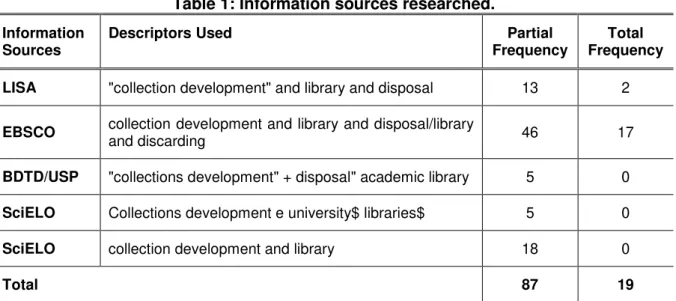
On Table 1there are the keywords used for the information retrieval. The partial frequency refers to the number of articles retrieved using the descriptors related and the total frequency is the number of articles that specifically address the theme 'weeding' in libraries.
Table 1: Information sources researched.
Information Sources
Descriptors Used Partial
Frequency
Total Frequency
LISA "collection development" and library and disposal 13 2
EBSCO collection development and library and disposal/library and discarding 46 17
BDTD/USP "collections development" + disposal" academic library 5 0
SciELO Collections development e university$ libraries$ 5 0
SciELO collection development and library 18 0
Total 87 19
It is observed that in some sources of information the descriptor 'Academic library' was not used, this because, when restricting the search with this descriptor any records were recovered.
It is highlighted that in the survey conducted in BDTD/USP, the only wholly national foundation consulted with the descriptors used, only five records were recovered, however, after analysis, it was noted that none of them was really relevant to the study for not addressing weeding (relocation and/or disposal). This result may reflect the lack of interest of scholars in exploring this theme. We can ask ourselves if the students of Library and Information Science are not paying attention to these issues, or are actually unaware of the importance of this process.
About the year of publication of the articles, in Figure 1 we observe that the oldest article is from 1976, after this date only in 1984 another article on the same topic is available in the information sources surveyed. It is observed a higher concentration of articles in the 2000s, more specifically from 2002 on. In 2008, 4 (four) articles were available.
This quantitative demonstrates that the scientific production on the weeding is still incipient. The few studies found are international. This fact indicates a gap in national studies of this nature.
Figure 1: Year of publication of articles.
During the survey accomplished in the information sources a total of 87 (eighty seven) articles that address the theme of the collection development in academic libraries was found, however, it was found that out of these 87 (eighty seven) articles, only 19 (nineteen) really deal with the weeding in libraries as a central theme.
3.1 Weeding: Physical Space
About weeding, Evans (1979) defines it as being a practice of disposal or transfer of the collection for excess of copies, rarely used books and materials not used for a long time. In addition, Evans (1979, p.219) reports that there are three important aspects for weeding: "a) save space, improves access and reduces costs" and that some frequent excuses by the librarians for not weeding are: "[…] lack of time, fear of failure, putting off the collection and reluctance to throw a book away" (EVANS, 1979, p.222).
The article Crosetto, Kinner and Duhon (2008), highlights the ease of evaluation of the collection, through the available data, to the performing of the disposal, in order to get more space for a renovation project of the Library of the University of Toledo collection. The article of Higuchi (2002) also deals with a case study of the Academic library Asahi in Japan, which established rules for disposal of books in 1985. These rules had to be reviewed in 1998 due to growing pressure on the physical space. Library staff is empowered to remove the duplicates and old editions, however, for the disposal of other materials it is required consultation with academics.
And article IDEAS for an operación de expurgo in public libraries (2009) focuses on several methods to dispose old books and also some methods used to promote the growth and progress of public libraries. It also examines how to improve the updating of the collection, accessibility and overcome the limitation of space. With this it shows the importance of having a process for evaluating collections and storage areas to maintain the viability of the library.
3.2 Weeding: Updating of the collection
The records classified in the category update the collection represent those articles that discuss the importance of this stage of development of collections to keep the collection updated. The update of the collection is of great importance for libraries once that the user needs sources of updated information, either of specific or collective nature, or, by its function, utility and use.
Burgett (2006) describes a program of dispose that helped a library of Kentucky to keep its collection updated and assisted in meeting the needs of its users. Mary and Sankar (2003) assert the importance of the development of collections in libraries, emphasizing the need for disposal, replacement of materials that are consistent with the needs of users and that are current. They also stress the importance of listening to the needs of users through questionnaires, and really know what you have in fact in the collection through inventory.
Booth (2009) presents a case study in libraries in the healthcare field, focusing on the disposal of materials considered outdated, he also discusses the importance of collection development and communication with its users. We see in the authors mentioned above that besides the concern with the issue of weeding, they also focused on the issue of communication with library users, auxiliary process of the development collections.
In the article of Lampasone (2008), the author offers suggestions for disposing of the collection of printed references, the author suggests to keep only the most current items and also to use the resources of the internet, when available.
On the other hand, Smith (2004) focuses on the disposal from the fiction collections of libraries in, deals with the importance of a policy for the development of the collection, of the attractiveness of the collection by removing unnecessary items and leaving the collection more centralized. Kerby (2002a) provides information on the assessment, continuous review and disposal, processes carried out in order to keep the collection of books updated. Shows the common excuses not to discard, the importance of these processes and how they are performed. Rogers (2007) analyzes the disposal as a useful function, yet neglected in libraries. The disposal or the relocation refer to the removal of outdated, obsolete and worn materials, these activities are as important as the acquisition. The library's collection becomes updated and renewed when the relocation is done.
It is possible to realize by the dialogues of the authors cited, how important it is for the library to keep its collection updated. To do so, one must not dismiss efforts with the evaluation of the collection. The relocation and disposal can only be made after obtaining the results of the collection evaluation.
3.3 Weeding: Collection Development
On this category the authors dealing with the weeding within the process of the collection development were grouped. It is noteworthy that the weeding step within the process of collection development is not as exploited as the stages of selection and acquisition.
It is interesting to note in the above quotations, how the authors equate the importance of preparation and execution of all the stages of the process of the collection development, including the process in a cyclic and continuous way.
3.4 Weeding: Several Aspects Covered
On this category we found the authors dealing with the weeding in a more comprehensive way, without necessarily focusing on a specific category, however, they show the importance of this step for a smooth running of the library services
In the article of Krabbe (1987) suggestions on disposal of books, journals and other library collection materials are offered. Collie (2010) attributes to the reluctance of American librarians to perform disposal for being afraid to discard something that someone might want later, for not knowing where to start this venture, or for having the misconception that when purchasing works, the same shall remain in the library as heritage.
On the article Vintage feedback (2008), the authors present opinions about the document life on the shelves of a library, and the decision associated with the disposal of the book or other resource. According to the authors, the provision of a book is based on the relevance and use condition. The editors assume that the books are discarded based on its value, on the other side in the libraries the basis for the disposal is the collection development policy.
Finally, Intner (2006) reflects on disposal, relocation, treatment and preservation of materials for librarians. He believes that the disposal should receive more attention, and notes the difficulty that librarians have to perform this process. He presents an analysis of the activity of disposal as necessary and positive emphasizing its importance for the improvement of the services offered in libraries.
4 FINAL CONSIDERATIONS
The idealization of this work came after the observation of the lack of national publications on issues related to collection development, particularly with respect to weeding. In this sense, one of the great difficulties in carrying out this study was precisely the lack of national bibliography on the subject, being used almost only the book by Vergueiro (1989), because the books after this quoted the same. This work is one of the few references when it comes to collection development, it is noted that the theme has not been updated, either for lack of interest of scholars in the field of Library and Information Science or because it has already attained a degree of saturation.
Analyzing and reflecting on the questions regarding the disposal, it is clear how necessary it is for libraries to have a collection development policy, and not only to have but follow it. As raised in the theoretical, the deployment and use of all stages of collection development can contribute effectively to the improvement of the services offered by libraries, and mainly keep them with alive, active and updated collections.
Although we know about the existence of steps to follow to the development of policies for the formation and development of collections, some issues are latent: Why do institutions do not strive for the implementation of such policies? Is the process of collection development lagging? Is it required a redesign of the steps for appropriateness and updating? Is the attitude of librarians towards their collections correct?
The answer of these questions would require a more prepared study, but what can be seen through this research is that the collection development needs more attention from librarians.
relocate and dispose the right materials, gaining shelf space to allocate new acquisitions that have been carefully selected - through the study of the community and / or user to whom the library serves - and subsequently acquired.
It is extremely necessary that university libraries invest in the implementation of collection development policies, so that they could save financial and human resources, besides meeting the expectations of its users better.
REFERENCES
ALONSO, M. D. L. Descarte. Revista Biblioteconomia de Brasília, Brasília, v.16,
n.2, p.191-206, jul./dez. 1988.
ALVES-MAZZOTTI, A. J.; GEWAMDSZNAJDER, F. O método nas ciências sociais: pesquisa quantitativa e qualitativa. São Paulo: Pioneira, 2001. BOOTH, A. Fahrenheit 451?: a ‘burning question’ on the evidence for book
withdrawal. Health Information & Libraries Journal, Oxford, v.26, n.2, p.161-165,
Jun. 2009.
BOSTIC, M. J. Serials deselection. Serials Librarian, New York, v.9, n.3, p.85-101,
1985.
BURGETT, S. W. A comprehensive weeding project for a community college library collection or bye bye books. Kentucky Libraries, Kentucky, v.70, n.4, p.17-21, 2006.
COLLIE, G. The reluctant weeder. Children & Libraries: The Journal of the
Association for Library Service to Children, De Pere, v.8, n.2, p.51-53, 2010.
CROSETTO, A.; KINNER, L.; DUHON, L. Assessment in a tight time frame: using readily available data to evaluate your collection. Collection Management, New
York, v.33, n.1-2, p.29-50, 2008.
DEMO, P. Pesquisa e construção de conhecimento. Rio de Janeiro: Tempo
brasileiro, 2004. 125p.
EVANS, G. E. Developing library collections. Colorado: Libraries Unlimited, 1979.
IDEAS para una operación de expurgo en las bibliotecas públicas. Boletín de la Asociación Andaluza de Bibliotecarios, Málaga, v.24, n.96-97, p.187-193, Jun.
2009.
INTNER, S. S. Weeding, collection development, and preservation. Technicalities,
Phoenix, v.26, n.3, p.1-18, May/Jun. 2006.
KERBY, R. Weeding your collection. School Library Media Activities Monthly,
Lincoln, v.18, n.6, p.22, Feb. 2002a.
KERBY, R. What practicing school library media specialists say about collection development. School Library Media Activities Monthly, Lincoln, v.18, n.9, p.26,
May 2002b.
KRABBE, N. It’s weeding time again. School Library Journal, New York, v.33, n.42,
May 1987.
LAMPASONE, L. A time to weed. Library Journal, New York, v.133, n.8, p.100, Jan.
2008.
LOPES, M. I. V. de. Pesquisa em comunicação. São Paulo: Loyola, 2003. 171p.
MACIEL, A. C.; MENDONÇA, M. A. R. Bibliotecas como organizações. Rio de
Janeiro: Interciência, 2006.
OLIVEIRA, S. L. de. Tratado de metodologia científica: projetos de pesquisa, TGI,
TCC, monografias, dissertações e teses. São Paulo: Pioneira Thomson Learning, 2002.
MARY, A. L.; SANKAR, A. Collection evaluation of PSN College of Engineering and Technology Library and PET Engineering College Library in Tirunelaveli District.
Herald of Library Science, New Jersey, v.42, n.3-4, p.223-231, Jul./Oct. 2003.
MILLER, J. W. Throwing out belles letters with the bathwater. American Libraries,
Chicago, v.15, n.6, p.384, Jun. 1984.
VINTAGE Feedback. One-Person Library, v.25, n.7, p.12, Nov. 2008.
PUERTA, A. A.; AMARAL, R. M.; GRACIOSO, L. S. Uso de tecnologias da informação e comunicação para participação de usuários de formação em desenvolvimentos de coleções. In: SEMINÁRIO NACIONAL DE BIBLIOTECAS UNIVERSITÁRIAS, 16., Rio de Janeiro. Anais... Rio de Janeiro, 2010.
REID, C. Collection development in a small library. Christian Librarian, Ohio, v.51,
ROGERS, T. Weeding: bringing a great practice to light. PNLA Quarterly, Burnaby,
v.71, n.2, p.8-9, 2007.
SINHA, B. K; CLELLAND, R. C. Modeling for the management of library collections.
Management Science, Hanover, v.22, n.5, p.547-57, Jan. 1976.
SMITH, S. The clean sweep. Access, Toronto, v.10, n.4, p.46-47, 2004.
VERGUEIRO, W. de C. S. Desenvolvimento de coleções. São Paulo: Polis/APB,
1989.
VERGUEIRO, W. de C. S. Desenvolvimento de coleções: uma nova visão para o planejamento de recursos informacionais. Ciência da Informação, Brasília, v.22,
n.1, p.13-21, jan./abr. 1993.
WEITZEL, S. da R. Elaboração de uma política de desenvolvimento de coleções em bibliotecas universitárias. Rio de Janeiro: Interciência, 2006.
Márcia Regina Silva
Departamento de Educação, Informação e Comunicação Universidade de São Paulo (USP/Ribeirão Preto)
E-Mail: [email protected] Brazil
Cláudio Marcondes Castro Filho
Departamento de Educação, Informação e Comunicação Universidade de São Paulo (USP/Ribeirão Preto)
E-Mail: [email protected] Brazil
Paula Oliveira Quirino
Universidade de São Paulo (USP/Ribeirão Preto) E-Mail: [email protected]