8 1
Arq Bras Oftalmol. 2014;77(2):81-3
Original Article
Metallic corneal foreign bodies: an occupational health hazard
Corpos estranhos metálicos na córnea: um problema de saúde ocupacional
Zeynep Gursel OZkurt1, Harun yuksel1, Gunay saka1, Hande Guclu2, sina evsen2, selaHattin Balsak2
INTRODUCTION
A supericial corneal foreign body (FB) is the most common and preventable eye injury(1). Metallic corneal FBs resulting from occupa
tional accidents are often seen in construction and metal industry workers(2). FBs can decrease the quality of vision by causing scars on
the visual axis and secondary infections ranging from keratitis to en dophthalmitis(3,4). The health care costs for these injuries are another
problem as they create an economic burden(5).
Prevention of FB accidents and their potentially serious conse quences are certainly possible, and the investment in their preven tion is easily justiied. Wearing appropriate protective goggles pre vents about twothirds of these accidents(6). In addition to the use of
personal protective measures, it is important to improve workplace standards and provide appropriate training for supervisors(7).
Approximately 36% workers in Turkey are unregistered(8). Unre
gistered workers do not qualify for governmentfunded health care
Submitted for publication: November 22, 2013 Accepted for publication: December 6, 2013
Study conducted at Dicle University Faculty of Medicine, Diyarbakir, Turkey.
1 Department of Ophthalmology, Dicle University of Medicine, Diyarbakir, Turkey. 2 Diyarbakir Education and Research Hospital, Diyarbakır, Turkey.
Funding: No specific financial support was available for this study.
Disclosure of potential conflicts of interest: None of the authors have any potential conflicts of interest to disclose.
Corresponding author: Zeynep Gursel Ozkurt. Dicle University Medical. Faculty Ophthalmology Department Diyarbakir, Diyarbakir 21280 - Turkey - E-mail: [email protected] This study was approved by Dicle University Medical Faculty Ethics Committee Hospital.
ABSTRACT
Purpose: To analyze the risk factors, outcomes, demographic characteristics, and attitudes of workers with metallic corneal foreign body (FB) injury.
Methods: One hundred consecutive patients who presented with a metallic cor neal FB to the eye clinic at Diyarbakir Training and Research Hospital were eva luated. The patients completed a questionnaire and were examined to determine features of the injury.
Results: All patients were male. The mean age was 32.46 ± 1.03 years. Fiftyfive percent of the patients were unregistered workers, 59% were working in the metal industry sector, and 65% injuries resulted from metal cutting. Protective goggles were available in the workplace of 64% patients. However, 57% patients were not wearing goggles when the accident occurred, and 43% were injured despite goggle use. Most patients (52%) attempted to remove FBs by themselves. FBs were located in the central zone of the cornea in 16% patients. Rust marks remained after FB removal in 26% patients. Corneal scars from previous FB injuries were present in 58% patients. Only 8% workplaces provided compensation for physician visits for occupationrelated illnesses.
Conclusions: Workplaces with a high risk for eye injuries should increase their protective measures, and educational programs should be implemented for both workers and occupational physicians. The government should enforce laws regarding unregistered workers in a better manner.
Keywords: Corneal injuries; Ocular foreign bodies; Eye injuries; Occupational health; Accidents, occupational
RESUMO
Objetivo: Analisar os fatores de risco, resultados, características demográficas dos
trabalhadores e atitudes em relação à lesão por corpo estranho metálico na córnea. Métodos: Foram avaliados cem pacientes consecutivos que se apresentaram com
corpo estranho metálico na córnea à clínica oftalmológica do Diyarbakir Training and Research Hospital. Um questionário foi respondido e as características da lesão foram anotadas.
Resultados: Todos os pacientes eram do sexo masculino. A idade média foi de
32,46 ± 1,03 anos. Cinquenta e cinco por cento dos pacientes eram trabalhadores não registrados. Cinquenta e nove por cento dos pacientes estavam trabalhando no setor da indústria metal, 65% das lesões resultaram de corte de metal. A presença de óculos de proteção no local de trabalho foi de 64%. Cinquenta e sete por cento dos pacientes não estavam usando óculos de proteção no momento do acidente, e 43% sofreram a lesão, apesar do uso óculos de proteção. Cinquenta e dois por cento dos pacientes tentaram remover o corpo estranho por si só. Dezesseis por cento dos corpos estranhos foram na zona central da córnea. Um depósito de ferrugem permaneceu após a remoção do corpo estranho em 26% dos pacientes. Cinquenta e oito por cento dos pacientes tinham cicatrizes na córnea por causa de lesões por corpo estranho anteriores. Os locais de trabalho que proporcionaram remuneração por visita médica relacionada à ocupação foram de apenas 8%.
Conclusões: Locais de trabalho de alto risco devem ser detectados e medidas de
pro-teção devem ser aumentadas. Os programas educacionais devem ser implementados para os trabalhadores e médicos do trabalho. As leis sobre trabalhadores sem carteira assinada deve ser melhor fiscalizadas pelo governo.
Descritores: Córnea/lesões; Corpos estranhos oculares; Lesões oculares; Saúde ocu-pacional; Acidentes de trabalho
after an occupational accident nor do they take advantage of their legal rights. In this study, we investigated the demographic characte ristics, eye protection measures, approaches to FBs, and the level of knowledge about corneal FBs in a working population in Turkey.
METHODS
This study was approved by the hospital’s institutional review board and adhered to the tenets of the Declaration of Helsinki. This prospective study evaluated 100 consecutive patients who presen ted with metallic corneal FBs to the eye clinic at Diyarbakir Training and Research Hospital between December 2012 and May 2013. Ver bal consent was obtained from the patients before they completed the questionnaire.
Patients were evaluated with a siltlamp biomicroscope. FBs and rust rings were removed using a 26gauge needle under topical anes thesia. A topical antibiotic treatment (Tobramycin, four times
Metallic corneal foreign bodies: an occupational health hazard
8 2 Arq Bras Oftalmol. 2014;77(2):81-3
a day) was prescribed after FBs were removed. The locations of the removed FB, rust marks, and any existing corneal scars from previous FBs were noted.
We recorded demographic information for each patient, which included age, gender, education, and type of social insurance. The following data also were obtained through our questionnaire: busi ness sector and occupation at the time of incident, number of years of work in the present sector, time between the incident and irst visit to an ophthalmologist, number of previous similar eye injuries, availa bility of protective goggles at work, protective goggle use during the incident, attempted FB removal by the patient, technique used if selfremoval was attempted, the number of workers in the workplace, and presence of an occupational physician. To determine a worker’s level of knowledge about corneal FB injuries, we asked whether they understood that repetitive FB injuries can cause serious visual impair ment and FB removal by themselves can cause serious and infection. Statistical analyses were performed with Statistical Program for Social Science (SPSS) version 15 (SPSS, Chicago, Illinois, USA). The sta tistical calculations included descriptive statistics, chisquare test, and SpearmanBrown correlation. The data are presented as the mean ± standard deviation.
RESULTS
We examined 100 patients who were diagnosed with a metallic corneal FB. All patients were male and had a mean age of 32.46 ± 1.03 years (age range: 1457 years; Table 1). Six percent of patients had not received formal education, 56% had completed primary school, 23% had completed secondary school, 15% had graduated from high school or an equivalent institution. Fortyeight percent of the pa tients had a green card (a document given to lowincome individuals without social insurance to allow them to use the public health care service in Turkey) and 7% had no social insurance; thus, 55% patients were unregistered workers, whereas only 45% were registered.
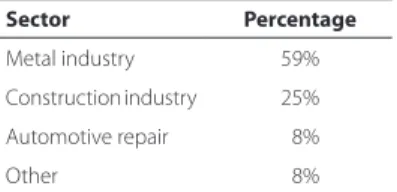
Most patients (59%) were working in the metal industry sector, 25% were working in the construction sector, and 8% were working in automotive repair sector (Table 2). Most injuries (65%) occurred when the patient was cutting metal (65%), 22% occurred with welding, and 13% had an unknown origin (Table 3). The number of FB injuries increa sed signiicantly with number of years at work in the metal industry and construction sectors (p<0.001, p=0.005). Sixtyfour per cent of the patients reported that protective goggles were available in their workplace; however, 57% were not wearing goggles at the time the accident occurred, and 43% were injured despite goggle use. There was no signiicant correlation between the education level and goggle use (p=0.470).
We examined the patient’s knowledge about corneal FBs and his approach to treatment. The mean duration between the injury and the irst visit to an ophthalmologist was 2.16 (±0.26) days and ranged between 0 and 21 days. We found that 52% patients attempted FB removal by themselves. The materials used for the removal were currency notes (31%), napkins (7%), a cloth (4%), and miscellaneous items (10%) such as a needle or toothpick, which can cause further in jury (Table 4). One patient presented with a deep central corneal scar that caused a secondary infection after he had removed the FB by himself. There was no signiicant correlation between the education level and whether patients attempted to remove FBs by themselves, or between understanding the potential harm in selfremoval and understanding repetitive FB injuries can harm visual acuity (p=0.079, p=0.435, p=0.329).
Only 8% workplaces provided an occupational physician service; however, the presence of an occupational physician in the workplace did not afect the availability of protective goggles (p=0.580), the workers’ attitudes about wearing goggles (p=0.341), whether workers attempted to remove FBs by themselves (p=0.284), or understanding the harm of selfremoval of FBs p=0.764).
The locations of the FBs were central (16%), paracentral (61%), and peripheral (23%). Rust marks were present in 26% patients after FBs were removed. Corneal scars due to previous FB injuries were pre sent in 58% patients and were located in the central (5%), paracentral (42%), and peripheral (11%) regions.
DISCUSSION
Corneal injury due to a metallic FB is a common occupational health injury in Turkey and worldwide. Occupational injury by corneal FB comprises 35%58% of all ocular trauma(9,10), and more frequently
afects young men(11). These preventable injuries cause additional
bur den on the national economy, adjustment problems, and psycho logical morbidity(5,12).
In a study conducted in Turkey, metal fragments caused 37% of all supericial corneal FB injuries, but the occupational injury ratio and the causes of injury were not deined in that study(13). In our
study, occupational injuries occurred during metal cutting (65%) or welding (22%), whereas 13% had an unknown origin. Metal cutting and welding are frequent tasks in the metal industry; hence, most FB eye injuries occurred in this sector (59%), which was followed by the construction sector. In a similar study, 70% corneal FB injuries occur red in the metal cutting industry(14). In a Canadian study, 21%
eye injuries occurred during welding(15). Thus, the people working in
these sectors comprise the largest risk group.
In our patient population, 52% patients attempted to remove the FBs themselves using materials that can damage and infect the
Table 4. Materials used for self-removal
Material Percentage
Paper money 31%
Napkins 07%
A piece of cloth 04%
Other 10%
Table 1. Distribution of patients by age group in 15-year age intervals
Age group (years) Percentage
1429 42%
3044 42%
4560 16%
Table 2. Occupation sectors
Sector Percentage
Metal industry 59%
Construction industry 25%
Automotive repair 08%
Other 08%
Table 3. İnjury mechanisms
İnjury mechanism Percentage
Metal cutting 65%
Welding 22%
Ozkurt ZG, et al.
8 3
Arq Bras Oftalmol. 2014;77(2):81-3 cornea. In a study conducted by Filho et al., several microorganisms
apart from the normal conjunctival lora were isolated from 20% conjunctival swabs of patients with corneal FBs(4). In a similar study,
14% positive bacteria cultures were obtained from patients with corneal FBs(5). Corneal FBs themselves can spread infections, and
selfremoval of an FB with contaminated and potentially traumatic materials can increase the risk of corneal infections. These secondary corneal infections afect the quality of vision and can cause corneal scarring. In one of our patients, a deep corneal scar caused vision loss that resulted from a corneal abscess that formed after selfremoval of an FB. In an Australian study that included 100 patients with metallic corneal FBs, one patient presented with bacterial keratitis, although it was not indicated whether the patient attempted FB removal(11).
Metallic FBs usually leaves a rust ring in the cornea often causes a white scar to form that can decrease visual quality. The appearance of a rust ring indicates an FB was embedded in the cornea for >1224 h(16).
Therefore, visiting an ophthalmologist after an injury as soon as possi ble is crucial. Among our patients, the mean duration between the injury and their irst visit to an ophthalmologist was 2.16 (±0.26) days after the injury. A rust ring remained in 26% patients and a corneal white scar attributed to a previous FB was observed in 58% patients. The high frequency of scarring observed in our patients likely resul ted from the delay in seeking treatment from an ophthalmologist and the attempt of removing the FB with traumatic materials.
Using protective goggles, especially those with top and side shields, may have prevented twothirds of these FB injuries(6). Despite
wearing goggles, 43% patients sustained injuries. In a similar study, 45% patients sustained an eye injury while wearing some form of eye protection(11). In this context, new designs should be implemented
and workplace standards should be adjusted to increase the protecti ve capabilities of goggles(7).
According to the current occupational health and safety board re gulations in Turkey, an occupational physician is necessary in sectors that employ at least 50 workers. The workplaces of only 8% patients in the present study had an occupational physician. The dominance of smallscale workplaces and 55% workers being unregistered might explain this low ratio. Unfortunately, the presence of an occupational physician has not been efective for the procurement of protective goggles at workplaces or the attitudes of workers toward goggle use. In addition, the presence of an occupational physician has not increa sed the workers’ level of knowledge about ocular safety. In addition, no correlation was found between education and the knowledge of the subject. According to these data, occupational physicians should be informed about the importance of preventative measures against eye injuries, and they should inform workers about the subject without considering the workers education status.
In Turkey, approximately 36% employees are unregistered(8). In
the present study, this percentage was even higher at 55%. These
unregistered workers are unable to take advantage of legal rights for accidents occurring at work. In addition, workers do not have social insurance and are ineligible for free health care. This situation can force workers to remove the FBs by themselves rather than seek care from an ophthalmologist.
CONCLUSION
Workplaces with a high risk for corneal injury should be identiied, occupational physicians and workers should be educated about such eye injuries, and eye protective measures should be increased. Furthermore, the necessary legal arrangements should be made to decrease the number of unregistered workers.
ACKNOWLEDGMENT
We are grateful to Dicle University DUBAP for their sponsorship of the English editing of this manuscript.
REFERENCES
1. Woo JH, Sundar G. Eye injuries in SingaporeDon’t risk it. Do more. A prospective study. Ann Acad Med Singapore. 2006;35(10):70618.
2. Welch LS, Hunting KL, Mawudeku A. Injury surveillance in construction: eye injuries. Appl Occup Environ Hyg.2001;16(7):75562.
3. DeBrof BM, Donahue SP, Caputo BJ, Azar MJ, Kowalski RP, Karenchak LM. Clinical cha racteristics of corneal foreign bodies and their associated culture results. CLAO J.1994; 20(2):12830.
4. Macedo Filho ET, Lago A, Duarte K, Liang SJ, Lima AL, Freitas D. Supericial corneal foreign body: laboratory and epidemiologic aspects. Arq Bras Oftalmol. 2005;68(6):8213. 5. Fong LP. Eye injuries in Victoria, Australia. Med J Aust. 1995;162(2):648.
6. Gumus K, Karakucuk S, Mirza E. Corneal ınjury from a metallic foreign body: an occu pational hazard. Eye Contact Lens. 2007;33(5):25960.
7. Lipscomb HJ, Dement JM, McDougall V, Kalat J. Workrelated eye injuries among union carpenters. Appl Occup Environ Hyg. 1999;14(10):66576.
8. Turkiey Istatistik Kurumu. [cited 2013 Sep 6]. Available from: http://www.tuik.gov.tr/ PreHaberBultenleri.do?id=13483
9. Nicaeus T, Erb C, Rohrbach M, Thiel HJ. [An analysis of 148 outpatient treated occupa tional accidents]. Klin Monatsbl Augenheilkd. 1996;209(4):A711. German.
10. Voon LW, See J, Wong TY. The epidemiology of ocular trauma in Singapore: perspective from the emergency service. Eye (Lond). 2001;15(Pt 1):7581.
11. Ramakrishnan T, Constantinou M, Jhanji V, Vajpayee RB. Corneal metallic foreign body injuries due to suboptimal ocular protection. Arch Environ Occup Health. 2012;67(1):4850. 12. Alexander DA, Kemp RV, Klein S, Forrester JV. Psychiatric sequelae and psychosocial
adjustment following ocular trauma: a retrospective pilot study. Br J Ophthalmol. 2001; 85(5):5602.
13. Yiğit O, Yürüktümen A, Arslan S.Foreign body traumas of the eye managed in an emer gency department of a singleinstitution. Ulus Travma Acil Cerrahi Derg. 2012;18(1):759. 14. Nepp J, Rainer G, Krepler K, Stolba U, Wedrich A. [Etiology of nonpenetrating corneal
injuries]. Klin Monatsbl Augenheilkd. 1999;215(6):3347. German
15. Reesal MR, Dufresne RM, Suggett D, Alleyne BC. Welder eye injuries. J Occup Med. 1989;31(12):10036.