Original article
Examining the validity of the Athlete Engagement
Questionnaire (AEQ) in a Portuguese sport setting
Paulo Martins António Rosado
Vítor Ferreira Rui Biscaia
University of Lisbon, Portugal
Abstract—Sport psychology literature suggests that understanding engagement levels is pivotal to promote positive sporting experiences among athletes. The purpose of this study was to examine the psychometric properties of the Athlete Engagement Questionnaire among Portuguese sport athletes. Two distinct samples of Portuguese athletes from
diffe-rent competitive levels were collected, and the results of a conirmatory factor analysis demonstrated a good it of the
model to the data. A review of the psychometric properties indicated that all factors showed good composite reliability, convergent validity, and discriminant validity. In addition, a multi-groups analysis showed the invariance of the model in two independent samples providing evidence of cross validity. Implications of these results for scholars and coaches are discussed and guidelines for future studies are suggested.
Keywords: engagement, athletes, Athlete Engagement Questionnaire, psychometric properties
Resumo—“Análise da validade do Athlete Engagement Questionnaire (AEQ) no contexto desportivo português.” A literatura em psicologia de desporto sugere que a compreensão dos níveis de engajamento é primordial para promover experiências desportivas positivas entre os atletas. O objetivo deste estudo foi examinar as propriedades psicométricas do Athlete Engagement Questionnaire entre os desportistas portugueses. Duas amostras distintas de atletas portugueses
com diferentes níveis de prática competitiva foram recolhidas e os resultados de uma análise fatorial conirmatória de -mostraram boa qualidade de ajustamento do modelo. A análise das qualidades psicométricas indicou que todos os fatores
mostraram iabilidade compósita, validade convergente e validade discriminante. Adicionalmente, uma análise multigrupos
mostrou a invariância do modelo nas duas amostras independentes, indicando validade cruzada. As implicações destes resultados para treinadores e académicos foram discutidas, sendo também apontadas sugestões para futuros estudos. Palavras-chave: engajamento, atletas, Questionário de Engajamento no Desporto, propriedades psicométricas
Resumen—“Análisis de la validad del Athlete Engagement Questionnaire (AEQ) en un contexto deportivo portugués.” La literatura en psicología del deporte sugiere que la comprensión de los niveles de compromiso en la actividad deportiva es importante para la promoción de entornos deportivos positivos entre los atletas. El objetivo del estudio consiste en
veriicar las propiedades psicométricas del Athlete Engagement Questionnaire entre los atletas portugueses. Trabajamos dos muestras distintas de los atletas portugueses con niveles competitivos diferentes, los resultados del análisis factorial
conirmatorio han demostrado un buen ajuste del modelo a los datos. El análisis de las propiedades psicométricas ha
indicado que todos los factores tienen una buena consistencia interna, así como buena validez convergente y validez discriminante. Además, el análisis multi-grupos muestra que el modelo es estable en dos muestras independientes, pro-porcionando evidencia de la validez cruzada. Las implicaciones de estos resultados para los académicos y entrenadores fueron discutidas, siendo igualmente planteadas propuestas para estudios futuros.
Palabras clave: compromiso, atleta, Cuestionario de Compromiso del Atleta, propiedades psicométricas
Introduction
There is a growing body of literature focusing on engagement in different research settings (Hodge, Lonsdale, & Jackson, 2009; Martin, 2008; Maslach & Leiter, 1997). Engagement is a psychological construct that describes ‘energy in action’ in the form of a link between a person and an activity (Russel, Ainley, & Freydenberg, 2005). Previous studies suggest that
In sport settings, studying athlete engagement (AE) assu-mes a pivotal importance due to its relationship with the level of performance (Russell et al., 2005). The concept of AE is often described as a result of an enduring, relatively stable sport experience, which refers to generalized positive affects and cognitions about the individuals’ involvement in the prac-tice of a sport (Lonsdale, Hodge, & Jackson, 2007; Lonsdale, Hodge, & Raedeke, 2007). However, with few exceptions, little
empirical research has been conducted in the sports ield to
understand the role of athletes’ engagement in a sport environ-ment. Of the few studies about this topic, Hodge et al. (2009)
focused on an elite sport context and identiied the antecedents
(basic psychological needs) and consequences (dispositional
low) of athlete engagement. Notwithstanding, it is important
to further explore the applicability of the engagement concept with athletes involved in different levels of competition. Prior studies highlighted that expert performance results from a long-term systematic engagement in a deliberate practice in a domain (Ericsson, Krampe, & Tesch-Römer, 1993; Martin, 2008). In this sense, examining the role of engagement of athletes in different competitive levels may prove to be vital to understand how they are driven to master skills, and continue to practice their sports (Liem & Martin, 2012; Martin, 2008) The majority of previous studies has focused on the more observable indicators of engagement levels (e.g. Furrer, Skinner, Marchand, & Kindermann, 2006; Zyngier, 2008). The measure-ment of engagemeasure-ment through athletes’ behavior is a highly de-ductive method, and this procedure does provide precision in the
deinition of the engagement construct (Reschly & Christenson,
2006). In this sense, a focus on a more inductive approach (e.g. self-reported measures of athletes’ cognitive engagement) may be important to better understand the multidimensional nature of engagement in sport environments (Appleton et al., 2006). Consequently, in order to improve previous theoretical concep-tualizations, it is necessary to rely on empirical measurements of engagement according to the athletes’ sense of experience
and its meaning within a speciic sport context (Appleton, et
al., 2006; Connell, Halpern-Felsher, Clifford, Crichlow, & Usinger, 1995). In line with this concept, recent studies have increasingly focused on the development of measurement tools to assess athletes’ perceived engagement with sports activities (Lonsdale, Hodge, & Jackson, 2007; Lonsdale, Hodge, & Ra-edeke, 2007). For example, Lonsdale et al. (2007) conducted
an exploratory study using New Zealand elite athletes, and
developed the Athlete Engagement Questionnaire (AEQ)
consisting of four dimensions: conidence, dedication, vigor,
and enthusiasm. In the subsequent study, Lonsdale, Hodge, and Raedeke (2007) examined the proposed factor structure
using a larger sample of New Zealand and Canadian elite
athletes. The AEQ revealed good psychometric properties proving to be a reliable tool to assess engagement in sport competitive environments, as well as to understand the relationship between burnout and engagement in athletes.
Notwithstanding, the authors suggested that future research
using the AEQ should be applied in different contexts in order to further validate the instrument, given that cultural differences may limit item interpretation and factor content.
A focus on reliable psychological instruments analyzing athletes’ mental skills is a pre-requisite in the sport-related lite-rature (Chartrand, Jowdy, & Danish, 1992; Salmela, Monfared, Mosayebi, & Durand-Bush, 2008). Thus, considering previous research (Lonsdale et al., 2007; Lonsdale, Hodge, & Raedeke, 2007), the current study uses the AEQ to examine athletes’
engagement in a different sport environment. Speciically, the
purpose of this study was to test the AEQ in a Portuguese athle-tes’ sport setting. Therefore, we intend to further validate the AEQ instrument to the Portuguese language, given that every new application of the AEQ is a contribution to its validity con-summation, and offers an important theoretical value (Baric & Horga, 2006). Additionally, it may aid sport psychologists and coaches in offering more positive sporting experiences (Hod-ge et al., 2009; Vecina, & Chacón, 2013), and skillfully guide athletes in a safer and more effective manner (Erikson, 2007).
Method
Participants and data collection
The research sample consisted of two convenience groups and the participants were selected from different competitive levels (i.e. elite, national and regional levels), sports and regions of Portugal. All participants accepted voluntarily to participate in the study under the guarantee of anonymity of their respon-ses. The total number of participants was 771 athletes, and all participants (and their parents when appropriate) were instructed
about the purpose and procedures of the study before to ill an
informed consent. Questionnaires were distributed in two se-parate moments. In each moment, a total of 500 questionnaires were distributed to the athletes before their training sessions. The questionnaires were self-administered and completion
took approximately 12 minutes. After data screening, in a irst
moment, a total of 357 were deemed usable for data analyses.
The mean age of the irst sample was 20.2 years old (SD=6.28),
and little more of two third were males (79.6%). Regarding the second moment, a total of 414 questionnaires were deemed usable for data analysis, with participants mean age of 17.2
years old (SD=4.63), and a great majority (i.e., about two thirds)
were males (81.2.6%). It is important to note that in both data collections, samples sizes exceeded the minimum (n=200) re -commended for structural equation modelling with maximum likelihood estimation (Hair, Black, Babin, & Anderson, 2009).
Measures
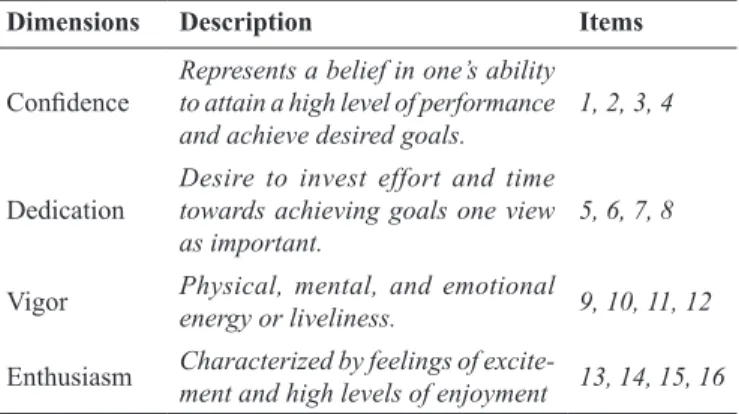
The original Athlete Engagement Questionnaire (AEQ) comprises sixteen items distributed in four dimensions, namely:
conidence, dedication, enthusiasm, and vigor (see Table 1).
Respondents are asked to indicate how they felt in the past three months through a 5-point Likert-type scale ranging from 1 (strongly disagree) to 5 (strongly agree). Sample items include, for example: ‘I believe I am capable of accomplishing my goals
in sport’ (conidence); ‘I am determined to achieve my goals in
and ‘I feel really alive when I participate in my sport’ (vigor). The AEQ scale was translated to Portuguese and then back-trans-lated to English to minimize discrepancies between the original and the translated version (Banville, Desrosiers, & Genet-Volet,
2000). Speciically, the AEQ instrument was irst translated
into Portuguese by two of the researchers in cooperation with
an experienced Portuguese sport psychologist. Next, to test the
equivalence of the items, back-translation into English was carried
out by two natives of Portugal that are luent in English. To verify
the accuracy of the items, a bilingual expert was asked to assess differences in meaning between the original items and the
back-translated items. The comparison of the two forms leaded to the conclusion that the two instruments were conceptually equivalent.
Data analysis
Data were analyzed using AMOS 21.0, and a conirmatory
factor analysis (CFA) was performed to assess the psychome-tric properties of the AEQ instrument. Internal consistency of the constructs was assessed through composite reliability (Hair, et al., 2009). Convergent validity was evaluated through the average variance extracted (AVE), while discriminant va-lidity was established when AVE for each construct exceeded the squared correlations between that construct and any other (Fornell & Larcker, 1981). The appropriateness of the model
was tested using a variety of indices. Speciically, the mea -surement model was assessed with chi-square (χ²) statistical test, the ratio of χ² to its degrees of freedom, comparative
-of-it-index (CFI), goodness-of-it index (GFI), parsimony comparative-of-it-index (PCFI), parsimony goodness-of-it
index (PGFI), and root mean square error of approximation
(RMSEA). The statistical signiicance was assumed at a .05
level. Additionally, a multi-group analysis was conducted to
compare the irst sample with a second sample in order to
assess cross validity. The model’s invariance in both sam-ples was tested by comparing the unconstrained model with
constrained models (factor loadings ixed and variances/co-variances ixed). Factorial invariance was accepted when the models did not differ signiicantly (p>0.05), according to the
χ² statistic (Loehlin, 2003; Marôco, 2010).
Dimensions Description Items
Conidence Represents a belief in one’s ability to attain a high level of performance and achieve desired goals.
1, 2, 3, 4
Dedication
Desire to invest effort and time towards achieving goals one view as important.
5, 6, 7, 8
Vigor Physical, mental, and emotional
energy or liveliness. 9, 10, 11, 12
Enthusiasm Characterized by feelings of
excite-ment and high levels of enjoyexcite-ment 13, 14, 15, 16
Table 1. Dimensions, description and corresponding items of the original version of the Athlete Engagement Questionnaire (Lonsdale, Hodge, & Jackson , 2007, p.472).
Constructs/items Loadings Z-value CR AVE
Conidence .88 .66
I believe I am capable of accomplishing my goals in sport .67 13.74
I feel capable of success in my sport .87 20.04
I believe I have the skills/technique to be successful in my sport .86 19.42
I am conident in my abilities .77 16.55
Dedication .88 .65
I am dedicated to achieving my goals in sport .77 16.46
I am determined to achieve my goals in sport .83 18.40
I am devoted to my sport .75 15.89
I want to work hard to achieve my goals in sport .80 17.50
Vigor .86 .60
I feel energized when I participate in my sport .80 17.41
I feel energetic when I participate in my sport .77 16.75
I feel really alive when I participate in my sport .88 20.20
I feel mentally alert when I participate in my sport .73 15.51
Enthusiasm .85 .58
I feel excited about my sport .79 17.08
I am enthusiastic about my sport .76 15.97
I enjoy my sport .75 15.80
I have fun in my sport .82 17.99
Multi-group models χ² df ∆χ² ∆df p PCFI PGFI GFI CFI RMSEA
Model 1 514.81 196 --- --- --- .78 .66 .92 .95 .05
Model 2 533.87 212 19.06 16 .266 .84 .72 .95 .92 .05
Model 3 542.19 218 27.38 22 .197 .87 .74 .92 .95 .04
Table 4. Results of the multi-group CFA models across the irst and second application of the Portuguese Athletic Engagement Questionnaire.
Note. First sample: n=357; Second sample: n=441.
Results
AEQ model
The results of the conirmatory analysis for each enga -gement factor are reported in Table 2. All estimated factor loadings exceed the cut-off point of .50 (Hair et al., 2009), ranging from 0.67 to 0.88. Also, the Z-values ranged from 13.74 to 20.20. These results indicate that each item did load
signiicantly on its construct. All composite reliability values
exceeded the recommended minimum of 0.60 (Bagozzi & Kimmel, 1995) ranging from 0.85 to 0.88. Convergent va-lidity was accepted for all constructs given the AVE values of each construct showed accepted levels and ranged from .58 to 0.66, with a mean of .62 (Fornell & Larcker, 1981). In addition, the results obtained for the measurement model
demonstrated an acceptable it to the data [χ²=319.38, p<0.01;
χ²/df=3.26, PCFI=0.77, PGFI=0.66, CFI=0.95, GFI=0.91, RMSEA=0.074]. Although the χ² was signiicant, this statistic
result is sensitive to sample size, and the study was conducted with a large sample (n=771). However, both PCFI and PGFI
were above the cut-off point of 0.60, while the CFI and GFI were higher than 0.90 (Hair et al. 2009). In addition, the
RM-SEA value indicated an acceptable it (Byrne, 2000).
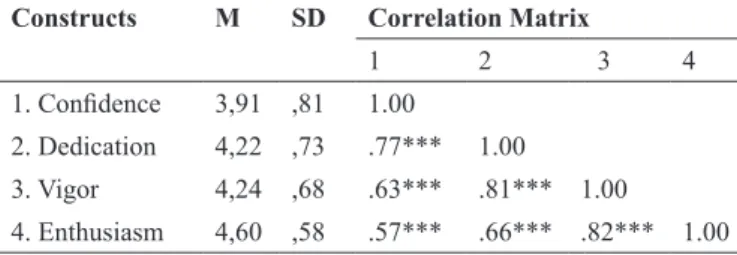
Descriptive statistics for each constructs and its correlations are presented in Table 3. ‘Enthusiasm’ was the construct with
the highest mean score (M=4.60, SD=0.58) while ‘Conidence’ had the lowest mean score (M=3.91, SD=0.81). Evidence of
discriminant validity was accepted since none of the squared cor-relations exceeded the AVE values for each associated construct.
Cross validity
A multi-group analysis was conducted with the irst moment
of data collection sample (n=357) and a second validation sample
(n=441) collected two months after irst data set. Athletes from
the second sample showed similar demographic characteristics.
As shown in Table 4, the it of the unconstrained model [Model
1: χ²(196)=514.81 (p<.001), PCFI=0.78, PGFI=0.66, CFI=0.96,
GFI=0.92, RMSEA=0.046] was acceptable, and this model was compared with this baseline conigural-invarience model (Marsh, 1993). The models with constrained factor loadings [Model 2: χ²(212)=533.87 (p<.001), PCFI=0.84, PGFI=0.72, CFI=0.95,
GFI=0.92, RMSEA=0.046] and constrained variances/co-varian
-ces [Model 3: χ²(218)=542.19 (p<.001), PCFI=0.87, PGFI=0.74,
CFI=0.95, GFI=0.92, RMSEA=0.044] showed a satisfactory it. The χ² statistic did not show signiicant differences between
Model 1 and Model 2 (χ²dif (16)=19.06; p=0.266) or Model 1
and Model 3 (χ²dif (22)=3427.38; p=0.197). Thus, the results
demonstrated the model’s invariance in both samples indicating that the factorial structure of AEQ was stable in two independent samples (Loehin, 2003; Marôco, 2010) indicating cross validity.
Discussion
The main goal of the current study was to extend previous research on athletes’ engagement to the validation of the AEQ to the Portuguese sport competitive environment. Given the fact that every new application of a measurement instrument represents a contribution to improve the theoretical value of the research domain
(Barić & Horga, 2006), this study extends the body of knowledge by conirming the validity of the AEQ instrument in a different re -search setting, as well as by improving the knowledge of how to aid sport psychologists and coaches to manage athletes’ engagement. The results of the CFA revealed that the four-factor structure
proposed to assess athletes’ engagement, including Conidence, Dedication, Vigor and Enthusiasm, showed a good it to the data.
In addition, all constructs showed good psychometric properties.
These indings are consistent with previous research using the AEQ
(Lonsdale et al., 2007, Lonsdale, Hodge, & Raedeke, 2007), and
they conirm the importance of each of the four constructs in the
understanding of the engagement levels of athletes. Also, there is
another important inding to highlight about the AEQ that repre
-sents a contribution to the sports-related literature. Speciically, the
model’s invariance in two independent samples was supported, indicating cross validity. This is a pivotal step when evaluating psychometric properties of a measurement scale (Marôco, 2010), and this procedure has been reported when validating scales in recent studies conducted in the sports scenario (e.g., Alvarado, San-dín, Valdez-Medina, González-Arratia, & Rivera, 2012; Biscaia, Correia, Ross, Rosado, & Mâroco, 2013; Cabrita, Rosado, Leite, & Sousa, 2013; Theodorakis, Dimmock, Wann, & Barlas, 2010).
Constructs M SD Correlation Matrix
1 2 3 4
1. Conidence 3,91 ,81 1.00
2. Dedication 4,22 ,73 .77*** 1.00
3. Vigor 4,24 ,68 .63*** .81*** 1.00
4. Enthusiasm 4,60 ,58 .57*** .66*** .82*** 1.00
Table 3. Mean (M), standard deviation (SD) and Squared Correlations between the irst order constructs or among constructs.
Note. No correlations failed the AVE test of discriminant validity.
population to better understand engagement among athletes. Additional samples with athletes from other countries could also be collected to compare the validity of the scale in different cultural contexts. Consistent with this view, Bollen (1989) refers
that it is important to compare the it of the model with the it of prior research models, and the it indices produced in the current study are comparable to the previously established it indices
(e.g. Lonsdale et al., 2007). Thus, the analysis of the AEQ in longitudinal studies using samples from different countries may constitute a step forward to aid scholars improving their understanding of the role of engagement in sports.
Second, the athletes’ engagement construct was assessed
with four dimensions, namely, conidence, dedication, vigor,
enthusiasm. However, previous literature suggests that the existence of other important dimensions, such as enjoyment and preoccupation (Lonsdale et al., 2007a). As such, the insertion of these dimensions in futures empirical studies using the AEQ might be an important contribution to better understand the concept of athletes’ engagement.
Third, while the current study focused on measuring the di-mensions of engagement in sports settings, the antecedents and consequences of athletes’ engagement were not systematically examined. According to Vallerand, Mageau, Elliot, Dumais, De-mers, and Rousseau (2008), high levels of motivation are believed to be central at improving engagement. Also, Hodge et al. (2009) and Londsdale, Hodge, and Raedeke (2007) observed that bur-nout can be a consequence of low levels of engagement within a sport. In addition, the engagement levels have been suggested to be linked to the climate perceptions namely the quality of human relations (Busseri, Constain, Campbell, Rose-Krasnor, & Evans, 2011). In this sense, examining the relationship between engage-ment and athletic identity may also represent an important topic for future studies. Thusly, the simultaneous analysis of athletes’ engagement, previous factors, and consequences could represent an important step in the pursuit of how sport participation and performance of athletes can be enhanced.
References
Allender, S., Cowburn, G., & Foster, C. (2006). Understanding parti-cipation in sport and physical activity among children and adults: a review of qualitative studies. Health Education Research, 21(6), 826-835. doi: Doi 10.1093/Her/Cyl063
Alvarado, B.G., Sandín, B., Valdez-Medina, J.L., González-Arratia, N., & Rivera, S. (2012). Análisis factorial conirmatorio del Cuestiona -rio SA-45 en una muestra mexicana. Anales de Psicología, 28(2), 426-433. doi: http://dx.doi.org/10.6018/analesps.28.2.148851 Appleton, J., Christenson, S., Kim, D., & Reschly, A. (2006).
Mea-suring cognitive and psychological engagement: Validation of the Student Engagement Instrument. Journal of School Psychology, 44:427–445.
Bagozzi, R.P. & Kimmel, S.K. (1995). A comparison of leading theories for the prediction of goal-directed behaviours. British Journal of Social Psychology, 34, 437-461.
Banville, D., Desrosiers, P., & Genet-Volet, Y. (2000). Translating questionnaires and inventories using a cross-cultural transla-tion technique. Journal of Teaching in Physical Education for Information, 19(3), 374-387.
Engagement plays an important role for desirable outcomes that require emotional adjustments when the issue is to achieve high levels of performance by both elite athletes and beginners (Liem & Martin, 2012; Martin, 2008; Oliver, Hardy, & Mardland, 2010).
Thus, indings from this study provide scholars and coaches with a
tool to aid them in managing their athletes’ levels of engagement. Previous studies suggest that expert performance in sport is the result of long-term engagement in a highly specialized form of training named deliberate practice (Maehr & Meyer, 1997; Wall & Coté, 2007). Furthermore, when an athlete’s primary goal is to
master his or her sport, it is more likely that his/her motivations
will increase (Martin, 2007, 2010). Thus, from the scholars’ point of view, the results of the current study may represent an impor-tant basis for the development of studies with a multidimensional framework including both motivations and engagement, in order
to better understand an individual’s energy and his/her drive to
learn (Liem, & Martin, 2012; Martin, 2008). From the coaches’ standpoint, this study provides a tool to assess engagement with
practical implications in the improvement levels of conidence,
dedication, enthusiasm, and vigor of athletes. Additionally, there
is a research line suggesting that a large amount of sport-speciic
practice at a young age could lead to high levels of burnout among athletes in different stages of their sport careers (Hodge et al., 2009; Lonsdale et al., 2007, Lonsdale, Hodge, & Raedeke, 2007; Schau-feli, Salanova, González-Roma, & Bakker, 2002). Furthermore, studying AE could also be important for the understanding of how to avoid low levels of performance, enhanced pressure to win, and even dropout from sports (Liem & Martin, 2012).
According to the literature about AE, the study of engage-ment experiences among athletes at sub-elite levels may also be crucial to understand sport participation (Allender, Cowburn, & Foster, 2006; Ullrich-French & Smith, 2009). That is, studying
the feelings of conidence in one’s ability to perform at a high level (conidence), how much dedicated athletes are to sacriice
themselves to keep doing hard training (dedication), the phy-sical, mental, and emotional energy of the athletes (vigor), and their high levels of enjoyment (enthusiasm) may contribute to extend the sport career of sub-elite athletes up to the elite level of participation (Coté, Horton, MacDonald, & Wilkes, 2009; Fraser-Thomas, Côté, & Deakin, 2008; Wall, & Côté, 2007). Given the importance of enhancing athletic performance and athletes’ involvement since early ages, this measurement ins-trument examined in the current study would also be of pivotal interest to potentiate the transition from the sub-elite levels to elite levels of participation (Lonsdale et al., 2009; Salmela et al., 2008). Thus, the study of AE levels may contribute to draw a measurement of the athletes’ risk of developing maladaptive emotions related to the sport setting (Hodge et al., 2009; Oliver et al., 2010; Trew, Kremer, Gallagher, Scully, & Ogle, 1997).
Limitations and future research
As with any study, this research has limitations that should be considered for future research. First, the study sample was not representative of the Portuguese athletes’ population, and as such the results may lack generalizability. Thus, future
Barić, R. & Horga, S. (2006). Psychometric properties of the croatian version of task and ego orientation in sport questionnaire (CTE-OSQ). Kinesiology, 38(2), 135-142.
Biscaia, R., Correia, A., Ross, S., Rosado, A., & Marôco, J. (2013). Spectator-based brand equity in professional soccer. Sport Marke-ting Quarterly, 22(13).
Bollen, K.A. (1989). Structural equations with latent variables. New
York: Wiley.
Busseri, M.A., Costain, K.A., Campbell, K.M., Rose-Krasnor, L., & Evans, J. (2011). Brief report: Engagement in sport and identity status. Journal of adolescence, 34(5), 1087-1091. doi: 10.1016/j.
adolescence.2010.06.004
Byrne, B.M. (2000). Structural Equation Modeling with AMOS: Basic Concepts, Applications, and Programing. Mahwah, NJ: Lawrence
Erlbaum Associates.
Cabrita, C., Rosado, A., Leite, T., & Sousa, L. (2013). Adaptation of the Athletic Identity Scale (AIMS-Plus) for the Portuguese Population.
Psicologia Relexão e Crítica, 27(1), in press.
Chartrand, J.M., Jowdy, D.P., & Danish, S.J. (1992). The Psychological Skills Inventory for Sports: Psychometric Characteristics and Applied Implications. Journal of Sport & Exercise Psychology, 14, 405-413. Connell, J.P., Halpern-Felsher, B.L., Clifford, E., Crichlow, W., & Usin-ger, P. (1995). Hanging in there: Behavioral, psychological, and contextual factors affecting whether African American adolescents stay in high school. Journal of Adolescent Research, 10(1), 41-63. Coté, J., Horton, S., MacDonald, D., & Wilkes, S. (2009). The Beneits of Sampling Sports During Childhood. Physical & Health Educa-tion Journal, 74(4), 6.
Ericsson, K.A. (2007). Deliberate practice and the modiiability of body and mind: toward a science of the structure and acquisition of expert and elite performance. International Journal of Sport Psychology, 38(1), 4-34.
Ericsson, K.A., Krampe, R.T., & Tesch-Römer, C. (1993). The role of deliberate practice in the acquisition of expert performance.
Psychological Review, 100(3), 363-406. doi:
10.1037/0033-295X.100.3.363
Furrer, C.J., Skinner, E., Marchand, G., & Kindermann, T.A. (2006, Mar-ch). Engagement vs. disaffection as central constructs in the dynamics of motivational development. Paper presented at the Annual Meeting of the Society for Research on Adolescence, San Francisco, CA. Fornell, C., & Larcker, D.F. (1981). Structural equation models with
unobserved variables and measurement error: Algebra and statis-tics. Journal of Marketing Research, 18(3), 382-388.
Fraser-Thomas, J., Côté, J., & Deakin, J. (2008). Examining Adolescent Sport Dropout and Prolonged Engagement from a Developmental Perspective. Journal of Applied Sport Psychology, 30, 318-333. doi: 10.1080/10413200802163549
Fredricks, J.A., Blumenfeld, P.C., & Paris, A.H. (2004). School engagement: Potential of the concept, state of the evidence. Review of Educational Research, 74(1), 59-109. doi: Doi 10.3102/00346543074001059
Hair, J.F., Black, W.C., Babin, B., & Anderson, R.E. (2009). Multiva-riate data analyses (7th ed.). New York: Prentice Hall.
Hodge, K., Lonsdale, C., & Jackson, S.A. (2009). Athlete Engagement in Elite Sport: An Exploratory Investigation of Antecedents and Consequences. Sport Psychologist, 23(2), 186-202.
Liem, G.A.D., & Martin, A.J. (2012). The Motivation and Engage-ment Scale: Theoretical Framework, Psychometric Properties, and Applied Yields. Australian Psychologist, 47(1), 3-13. doi: 10.1111/j.1742-9544.2011.00049.x
Loehlin, J.C. (2003). Latent variable models: An introduction to factor, path, and structural equation analysis (4th ed.). Mahwah, NJ:
Lawrence Erlbaum Associates.
Lonsdale, C., Hodge, K., & Jackson, S.A. (2007). Athlete engagement: II. Development and initial validation of the Athlete Engagement Ques-tionnaire. International Journal of Sport Psychology, 38(4), 471-492. Lonsdale, C., Hodge, K., & Raedeke, T.D. (2007). Athlete engagement:
I. A qualitative investigation of relevance and dimensions. Inter-national Journal of Sport Psychology, 38(4), 451-470.
Maehr, M.L., & Meyer, H.A. (1997). Understanding motivation and schooling: Where we’ve been, where we are, and where we need to go. Educational Psychology Review, 9(4), 371-408.
Marôco, J. (2010). Análise de equações estruturais: fundamentos teóricos, software & aplicações. Lisboa: Report Number.
Martin, A.J. (2007). Examining a multidimensional model of student motivation and engagement using a construct validation approach.
British Journal of Educational Psychology, 77, 413-440. Martin, A.J. (2008). Motivation and engagement in music and sport:
Testing a multidimensional framework in diverse performance settings. Journal of Personality, 76(1), 135-170. doi: 10.1111/j.
1467-6494.2007.00482.x
Martin, A.J. (2010). Physical Activity Motivation in Late Adolescen-ce: Reinement of a Recent Multidimensional Model. Research Quarterly for Exercise and Sport, 81(3), 278-289.
Maslach, C., & Leiter, M. (1997). The truth about burnout: How or-ganizations cause personal stress and what to do about it (1 ed.). San Francisco: Jossey-Bass.
Oliver, E.J., Hardy, J., & Marldand, D. (2010). Identifying important practice behaviors for the development of high-level youth athletes: Exploring the perspectives of elite coaches. Psychology of Sport and Exercise, 11(6), 433-443.
Reschly, A., & Christenson, S.L. (2006). Prediction of dropout among students with mild disabilities. Remedial and Special Education, 27(5), 276-292.
Russell, V.J., Ainley, M., & Frydenberg, E. (2005). Schooling issues digest: Student motivation and engagement. Retrieved on Mars 1, 2013 from: http://www.dest.gov.au/sectors/school_education/ publications_resources/schooling_issues_digest/schooling_is-sues_digest_motivation_engagement.htm
Salmela, J.H., Monfared, S.S., Mosayebi, F., & Durand-Bush, N. (2008). Mental skill proiles and expertise levels of elite Iranian athletes. International Journal of Sport Psychology, 40(3), 361-373. Schaufeli, W.B., Salanova, M., González-Roma, V., & Bakker, A.B. (2002). The measurement of engagement and burnout: a two sam-ple conirmatory factor analytic approach. Journal of Happiness Studies, 3(1), 71-92.
Teodorakis, N., Dimmock, J., Wann, D., & Barlas, A. (2010). Psycho -metric Evaluation of the team identiication scale among Greek sport fans: a cross-validation aprroach. European Sport Manage-ment Quarterly, 10(3), 289-305. doi: 10.1080/1618471003770180
Trew, K., Kremer, J., Gallagher, A.M., Scully, D., & Ogle, S. (1997). Young people’s participation in sport in northern ireland. Interna-tional Review for the Sociology of Sport, 32(4), 419-431. Ullrich-French, S., & Smith, A.L. (2009). Social and motivational
predictors of continued youth sport participation. Psychology of Sport and Exercise, 10(1), 87-95. doi: http://dx.doi.org/10.1016/j. psychsport.2008.06.007
Vallerand, R.J., Mageau, G.A., Elliot, A.J., Dumais, A., Demers, M.A., & Rousseau, F. (2008). Passion and performance attainment in sport. Psychology of Sport and Exercise, 9(3), 373-392. doi: 10.1016/j.psychsport.2007.05.003
Wall, M., & Côté, J. (2007). Developmental activities that lead to drop out and investment in sport. Physical Education and Sport Pedagogy, 12, 77-87.
Zyngier, D. (2008). (Re)conceptualising student engagement: Doing education not doing time. Teaching and Teacher Education, 24(7), 1765-1776. doi: 10.1016/j.tate.2007.09.004
Authors’ note
António Rosado ([email protected]) is a member of the Centro Interdisciplinar do Estudo da Performance Humana (CIPER), Facul-dade de MotriciFacul-dade Humana.
Rui Biscaia ([email protected] / [email protected]) is a member of the Centro Interdisciplinar do Estudo da Performance Humana (CIPER), Faculdade de Motricidade Humana, Universidade de Lisboa, and Escola de Turismo, Desporto e Hospitalidade, Univer-sidade Europeia, Lisboa, Portugal
Vítor Ferreira ([email protected]) and Paulo Martins ([email protected]) are with the Faculdade de Motricidade Humana, Universidade de Lisboa
Corresponding author:
Paulo Martins
Faculdade de Motricidade Humana, Universidade de Lisboa, Portugal Email: [email protected]
Acknowledgements:
This research is based on the doctoral project of the irst author and was supported by a grant (SFRH/BD/45885/2008) from the Foundation for Science and Technology (Portugal).