BGD
12, 7577–7598, 2015Isotopically enriched ammonium shows
high nitrogen turnover
K. Maeda et al.
Title Page
Abstract Introduction
Conclusions References
Tables Figures
◭ ◮
◭ ◮
Back Close
Full Screen / Esc
Printer-friendly Version
Interactive Discussion
Discussion
P
a
per
|
Discussion
P
a
per
|
Discussion
P
a
per
|
Discussion
P
a
per
|
Biogeosciences Discuss., 12, 7577–7598, 2015 www.biogeosciences-discuss.net/12/7577/2015/ doi:10.5194/bgd-12-7577-2015
© Author(s) 2015. CC Attribution 3.0 License.
This discussion paper is/has been under review for the journal Biogeosciences (BG). Please refer to the corresponding final paper in BG if available.
Isotopically enriched ammonium shows
high nitrogen turnover in the pile top zone
of dairy manure compost
K. Maeda1,2, S. Toyoda2, M. Yano2, S. Hattori3, M. Fukasawa2, K. Nakajima1, and N. Yoshida3,4
1
NARO, Hokkaido Agricultural Research Center, Dairy Research Division, 1 Hitsujigaoka, Sapporo 062-8555, Japan
2
Department of Environmental Science and Technology, Tokyo Institute of Technology, 4259 Nagatsuta, Midori-ku, Yokohama 226-8502, Japan
3
Department of Environmental Chemistry and Engineering, Tokyo Institute of Technology, 4259 Nagatsuta, Midori-ku, Yokohama 226-8502, Japan
4
Earth-Life Science Institute, Tokyo Institute of Technology, 2-12-1 Ookayama, Meguro-ku, Tokyo 152-8550, Japan
Received: 13 April 2015 – Accepted: 4 May 2015 – Published: 20 May 2015
Correspondence to: K. Maeda ([email protected])
BGD
12, 7577–7598, 2015Isotopically enriched ammonium shows
high nitrogen turnover
K. Maeda et al.
Title Page
Abstract Introduction
Conclusions References
Tables Figures
◭ ◮
◭ ◮
Back Close
Full Screen / Esc
Printer-friendly Version
Interactive Discussion
Discussion
P
a
per
|
Discussion
P
a
per
|
Discussion
P
a
per
|
Discussion
P
a
per
|
Abstract
δ15N-NH+4 of dairy manure compost piles with and without bulking agent (10 %w/w) were compared to understand the significant mitigation of N2O emission by the use of
bulking agent.δ15N-NH+4 of each locations of the pile (top, side and core) were also compared. Piles with bulking agent showed significantly higher δ15N values (17.7±
5
1.3 ‰) than that of the piles without bulking agent (11.8±0.9 ‰) at the end of the process, reflecting significant higher nitrogen conversion and NH3loss occurred in the pile with bulking agent. The pile top samples, especially in the piles with bulking agent, showed very high NH+4 concentrations with significant high 15N (δ15N: 12.7–29.8 ‰) values, indicating extremely high nitrogen conversion, nitrification-denitrification activity
10
of the microbes and NH3volatilization occurred in this zone.
1 Introduction
Nitrogen is one of the most abundant major elements in the Earth’s atmosphere. There are two major anthropogenic activities on global nitrogen cycle; energy production and food production (Galloway et al., 2004). Because nitrogen is one of the most important
15
elements for plant nutrition, modern agriculture uses huge amount of industrially fixed nitrogen as the fertilizer to improve the crop productivity (Tilman et al., 2002). Current anthropogenic nitrogen input to the environment (160 Tg year−1) is already more than that of natural biological fixation (110 Tg) on land or in the ocean (140 Tg) (Gruber and Galloway, 2008), and the significance of agricultural nitrogen input on global nitrogen
20
cycle is expected to be increased to feed the growing population. In livestock production industry, livestock intake organic nitrogen from their feedings, and they produce huge amount of organic nitrogen as manure, which should be treated appropriately to protect the environment (Sharpley et al., 1998). Most of them are used as the organic fertilizer for the efficient nutrient cycling, therefore the understanding on nitrogen flow in livestock
25
BGD
12, 7577–7598, 2015Isotopically enriched ammonium shows
high nitrogen turnover
K. Maeda et al.
Title Page
Abstract Introduction
Conclusions References
Tables Figures
◭ ◮
◭ ◮
Back Close
Full Screen / Esc
Printer-friendly Version
Interactive Discussion
Discussion
P
a
per
|
Discussion
P
a
per
|
Discussion
P
a
per
|
Discussion
P
a
per
|
Nitrogen contained in dairy manure exists mostly as organic nitrogen or NH+4. Through the composting process, the heat production by degradation of organic matter leads to significant loss of nitrogen into the atmosphere as gaseous ammonia (NH3) (Dämmgen and Hutchings, 2008). Some microorganism groups such as nitrifier in the manure also convert this nitrogen as nitrite (NO−2) or nitrate (NO−3), and both nitrifier
5
and denitrifiers can use them as electron acceptor. They reduce these nitrogen oxides into dinitrogen (N2) and make them be back to the atmosphere, so called
denitrifica-tion (Zumft, 1997). Through the nitrogen conversion in the composting process, green-house gas nitrous oxide (N2O) is known to be emitted (Sommer et al., 2009). Because it is known that N2O have very strong greenhouse effects (298-fold greater than the 10
greenhouse effects of CO2 over a 100 year time horizon; (IPCC, 2007), and N2O is
also known to contribute to ozone layer destruction (Ravishankara et al., 2009), these gas emissions must be mitigated.
For this N2O emission, our previous studies clarified that nitrification occurs in the
compost surface, and compost turning (mixing by machines) and subsequent
denitri-15
fication can be the major source of N2O (Maeda et al., 2013b, 2010b). Also, we have showed that appropriate use of bulking agent can reduce the N2O emission significantly
(Maeda et al., 2013a). However, the mechanism of this N2O mitigation is largely
un-known. Because the bulking agent is used to increase the oxygen supply into the com-post piles (Jolanun and Towprayoon, 2010), the nitrification expected to be increased
20
and subsequent N2O production should be increased.
To solve this contradiction, we compared the abundance ofδ15N-NH+4 of these com-posts, because this can be used to track the amount of reaction on NH+4 in the environ-ment (Brooks et al., 1989; Garten Jr., 1992; Yeatman et al., 2001). So far, it is known that the NO−x accumulation and the bacterial communities are different between the
25
BGD
12, 7577–7598, 2015Isotopically enriched ammonium shows
high nitrogen turnover
K. Maeda et al.
Title Page
Abstract Introduction
Conclusions References
Tables Figures
◭ ◮
◭ ◮
Back Close
Full Screen / Esc
Printer-friendly Version
Interactive Discussion
Discussion
P
a
per
|
Discussion
P
a
per
|
Discussion
P
a
per
|
Discussion
P
a
per
|
2 Materials and methods
2.1 Composting experiment
The composting experiment was performed three times at the Hokkaido Agricultural Research Center (Sapporo City, Hokkaido): once from 27 May through 21 July in 2010 (Run 1), once from 15 September through 10 November in 2010 (Run 2) and once
5
from 19 May through 14 July in 2011 (Run 3). The cows were fed orchard grass silage and corn silage, oat hay, alfalfa hay, beet pulp and two types of concentrate mixtures to meet their digestible energy requirements, as recommended by the Japanese Feeding Standard for Dairy Cattle. Lactating Holstein cow excrement and dried grass (Orchard grass;Dactylis glomerata) were used in this study to make the compost.
10
About 4 t of dairy cow excrement and 400 kg of dried grass were mixed to form the treatment piles (pile 1), while the control piles (pile 2) consisted of dairy cow excrement alone. The compost was piled up on a waterproof concrete floor, and turned once ev-ery two weeks with a front loader and manure spreader. Each pile had a volume of 7.5 m3 with pile dimensions of 4 m in diameter and 1.8 m in height at the start of the
15
experiment. The temperatures of the compost piles and the ambient air were mea-sured hourly using a Thermo Recorder RTW-30S (Espec, Japan). Fresh samples were taken from each zone (the pile top, surface, and core) at the start and end of the three composting experiments and just before each turning.
2.2 Chemical analysis of the compost
20
About 1 kg of fresh compost samples was collected at the start and end of the three composting experiments and just before each turning. Samples were homogenized and fresh subsamples were used to measure total solids, volatile solids, inorganic-N, pH and electrical conductivity, or stored at−20◦C for total nitrogen determination. Total solids (TS) were measured after drying the samples overnight at 105◦
C, and
25
dried samples were powdered and used for C/N ratio determination. Volatile solids
BGD
12, 7577–7598, 2015Isotopically enriched ammonium shows
high nitrogen turnover
K. Maeda et al.
Title Page
Abstract Introduction
Conclusions References
Tables Figures
◭ ◮
◭ ◮
Back Close
Full Screen / Esc
Printer-friendly Version
Interactive Discussion
Discussion
P
a
per
|
Discussion
P
a
per
|
Discussion
P
a
per
|
Discussion
P
a
per
|
(VS) were measured after the samples were processed at 600◦
C for 1 h. Total N was measured using raw samples by the Kjeldahl method. The C/N ratio was determined using a C/N analyzer (vario MAX CNS; Elementar, Germany).
To measure inorganic-N, pH and electrical conductivity, 5 g of fresh compost was placed into a 50 mL polypropylene tube with 40 mL of deionized water, then shaken
5
(200 rpm, 30 min) and centrifuged (3000 g, 20 min). The supernatant was collected and NH+4, NO−
2-N and NO −
3-N were measured using ion chromatography (ICS-1600;
Dionex, USA); pH and electrical conductivity (EC) were determined with calibrated electrodes (Horiba, Japan).
2.3 Determination ofδ15N-NH+
4 and Rayleigh plot analysis
10
δ15N-NH+4 abundance of the extracted samples or trapped NH3 samples was
deter-mined with diffusion method (Holmes et al., 1998).
One cm diameter GF/D filters (Whatman, UK) were cut into four pieces, acidified with 20 µL H3PO4 (0.02 mM) and sandwiched between 2.5 cm diameter 10 mm
pore-size Teflon membranes (Millipore, USA). These filter packs were used for ammonium
15
trap in the samples. Ten ml of NH+4-N samples (50 µg-N) were put into 15 mL tubes and 0.5 g of NaCl (ashed at 450◦C for 8 h) was added. Put one filter pack into the 15 mL bottle, and 0.03 g MgO (ashed at 450◦C for 8 h) was added to put NH+4 in the samples into NH3. The 15 mL bottles were incubated at 40◦
C for 2 weeks with 200 rpm. After incubation, filter pack was removed from the bottles and dried in the desiccators
20
for 2 days. After drying, filters were recovered and put into tin cups. These tin cups with filters were analyzed by an elemental analyzer (EA1110, CE instruments Ltd., Wigan, UK) coupled with an isotope ratio mass spectrometer (MAT252, ThermoFisher Scientific KK, Yokohama, Japan) to determineδ15N-NH+4 in the samples. Calibration was conducted with IAEA-N1 and IAEA-N2 (NH4SO4), and precision (1σ) was better
25
BGD
12, 7577–7598, 2015Isotopically enriched ammonium shows
high nitrogen turnover
K. Maeda et al.
Title Page
Abstract Introduction
Conclusions References
Tables Figures
◭ ◮
◭ ◮
Back Close
Full Screen / Esc
Printer-friendly Version
Interactive Discussion
Discussion
P
a
per
|
Discussion
P
a
per
|
Discussion
P
a
per
|
Discussion
P
a
per
|
from the atmospheric N2as defined by the following equation:
δ15N(‰)=((Rsample/Rstandard)−1)×1000 (1)
whereRsampleandRstandardare the 15
N/14N ratios of samples and the atmospheric N2,
respectively. Isotopic fractionation factorα is expressed as
α=RB/RA, (2)
5
whereRAandRBare isotopic ratio of phase A and B, respectively.
Isotopic fractionation can also be described by the enrichmentε, which describes the enrichment of the product relative to that of the substrate, and which is also expressed per mil (‰).
ε=(α−1)×1000 (3)
10
The evolution of the isotopic composition is described by a Rayleigh equation with fractionation factor as follows for15N,
R/R0= 1+10 −3δ15
N
/ 1+10−3δ15
N0
=
NH+4 /
NH+4 0
α−1
(4)
whereR andR0 are the isotope ratio of samples just before the turning and the sam-ples just after the previous turning. Since the piles were homogenized at every turning
15
events, the samples just after previous turning events were used as “initial ammonium”.
δ15N andδ15N0are the respectiveδvalues of the each NH+4. [NH+4]0and [NH+4] are the ammonium concentration of the samples just after previous turning events and sam-ples just before the each turning events. Using the approximation of ln(1+x)∼=x with
x≪1, the relationship between the difference of δ15N values between pile turnings
20
and the reaction rate of the substrate is obtained from Eqs. (3) and (4) as follows,
δ15N−δ15N0=εln(1−f) (5)
wheref is the reacted ammonium between the turning events, (1−[NH+
4]/[NH+4]0).
BGD
12, 7577–7598, 2015Isotopically enriched ammonium shows
high nitrogen turnover
K. Maeda et al.
Title Page
Abstract Introduction
Conclusions References
Tables Figures
◭ ◮
◭ ◮
Back Close
Full Screen / Esc
Printer-friendly Version
Interactive Discussion
Discussion
P
a
per
|
Discussion
P
a
per
|
Discussion
P
a
per
|
Discussion
P
a
per
|
2.4 Keeling plot analysis
The basis of the Keeling plot method is conservation of mass. The ammonium concen-tration of each location of the pile before the pile turnings can be expressed as,
cb=ca+cs (6)
wherecb,ca, and cs are the ammonium concentration measured in each location of 5
the pile just before the turning, the ammonium concentration just after the previous pile turning, and the additional concentration component produced by the source, respec-tively. Given conservation of mass,
δ15Nbcb=δ15Naca+δ15Nscs (7)
whereδ15N represents the nitrogen isotope ratio of each ammonium. By combining
10
Eqs. (6) and (7), we used
δ15Nb=ca δ15Na−δ15Ns
(1/cb)+δ15Ns (8)
2.5 Statistical analysis
The chemical component data were analyzed by ANOVA using the general linear model procedure described by SAS (SAS Institute, 2001). Tukey’s multiple range comparison
15
tests were used to separate the means. A value ofP <0.05 was considered statistically significant.
3 Results
3.1 Composting experiments
The temperature of the piles with bulking agent (10 % w/w) exceeded 60◦C
dur-20
BGD
12, 7577–7598, 2015Isotopically enriched ammonium shows
high nitrogen turnover
K. Maeda et al.
Title Page
Abstract Introduction
Conclusions References
Tables Figures
◭ ◮
◭ ◮
Back Close
Full Screen / Esc
Printer-friendly Version
Interactive Discussion
Discussion
P
a
per
|
Discussion
P
a
per
|
Discussion
P
a
per
|
Discussion
P
a
per
|
showed significantly lower temperature (below 50◦
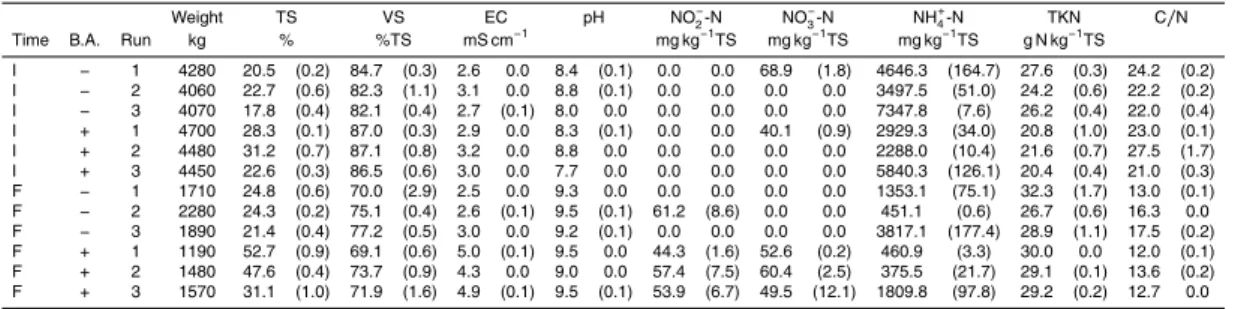
C). Initial weight were 4543±137 kg in the piles with bulking agent and 4136±124 kg without bulking agent, and these val-ues dropped significantly to 1413±99 kg and 1960±291 kg for with and without the bulking agent, respectively (Table 1). Total solids of the piles with and without bulking agent after the composting process were 43.8±11.3 % and 23.5±1.8 %, respectively.
5
C/N ratio of with and without bulking agent significantly dropped from 23.8±3.3 to 12.8±0.8 and from 22.8±1.2 to 15.6±2.6, respectively. These parameters all indi-cate that the organic matter degradation rate was much higher in the piles with bulking agent.
Pile top samples (2.8–7.4 mg N g−1
TS; pile 1) and core samples (1.0–14.6 mg N g−1 10
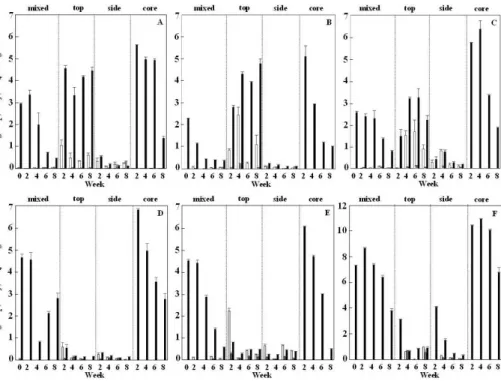
TS; pile 1) contained high ammonium concentration compared to pile side samples (0.1–1.8 mg N g−1 TS; pile 1) (Fig. 1a–c). High NO−2 accumulation were also observed in pile top samples (0.03–3.8 mg N g−1TS; pile 1), but not from pile core samples. NO−3 was also detected from pile top and side samples, but the concentrations were low (0–0.29 mg N g−1 TS; pile 1). Although this tendency was same in pile 2 (Fig. 1d–f),
15
the NH+4 in pile top were generally lower (0.15–2.2 mg N g−1 TS) than that of pile 1. Accumulation of NO−
2 (0.08–2.2 mg N g −1
TS) and NO−
3 (0.02–0.7 mg N g −1
TS) were also detected from both pile top and pile side samples of pile 2.
3.2 δ15N of NH+
4 in mixed samples
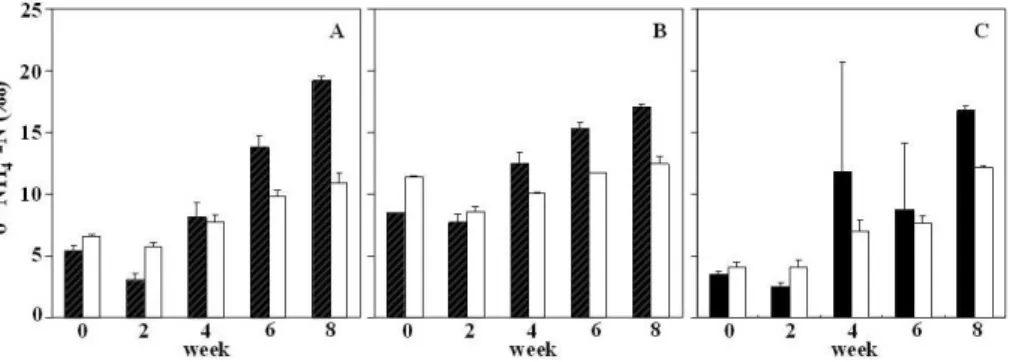
δ15N-NH+4 values of the mixed samples just after the pile turning events were shown in
20
Fig. 2. All compost runs showed similar tendency. Initialδ15N-NH+4 values were 5.8± 2.5 ‰ and 7.4±3.8 ‰ for the piles with and without bulking agent, respectively. These values slightly dropped from weeks 0–2 to 4.4±2.8 ‰ and 6.1±2.3 ‰ for both piles with and without bulking agent in all runs. This decrease between weeks 0 and 2 were not statistically significant. After week 4, these values showed significant increase, and
25
reached 17.7±1.3 ‰ and 11.8±0.9 ‰ for with and without bulking agent, respectively, at the end of the experiments. Also, the piles with bulking agent showed higher value
BGD
12, 7577–7598, 2015Isotopically enriched ammonium shows
high nitrogen turnover
K. Maeda et al.
Title Page
Abstract Introduction
Conclusions References
Tables Figures
◭ ◮
◭ ◮
Back Close
Full Screen / Esc
Printer-friendly Version
Interactive Discussion
Discussion
P
a
per
|
Discussion
P
a
per
|
Discussion
P
a
per
|
Discussion
P
a
per
|
than that of the piles without the bulking agent, and this difference was statistically significant.
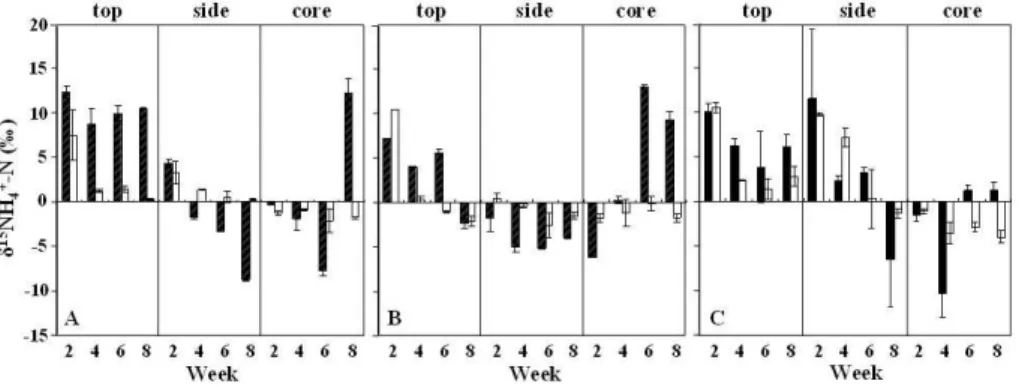
δ15N-NH+4 values were also determined for pile top, side and core samples, which are shown in Fig. 3. The data were expressed as the difference from the mixed samples taken after the pile homogenization. The pile top samples showed higher value (9.6–
5
22.5 ‰) than the side samples (9.2–11.3 ‰) in both composts with and without bulking agent. The core samples showed low values in week 2 (1.7±1.0 ‰ and 4.7±2.0 ‰ for the piles with and without bulking agent, respectively), reflecting the newly formed “light” NH+4-N which were supplied by the degradation of organic-N in the manure. On the other hand, the heaviest NH+4 (25.4±6.8 ‰) were also observed from pile core
10
samples at the end of experimental period. This phenomenon was observed only from the piles with bulking agent.
4 Discussion
Stable isotopeδ15N value of NH+4 in dairy manure compost with and without bulking agent was studied to understand the mechanism of significant N2O mitigation by use 15
of bulking agent. Temporal decrease ofδ15N value of NH+4 were observed in both piles, which were not obtained in other work (Kim et al., 2008). This can be explained by the supply of newly formed “light” NH+4 by the ammonification of organic N, which has low value (α=∼1.000) of isotopic fractionation (Högberg, 1997). Theδ15N value of NH+
4
were significantly higher in the piles with bulking agent 17.7±1.3 ‰ than that of the piles
20
without bulking agent (11.8±0.9 ‰) (Fig. 2), indicating that the nitrogen transformation rate was much higher in these piles with bulking agent. Since the bulking agent is used to promote the organic matter degradation by introducing oxygen into the pile, which enhance microbial activity, significant higher organic matter degradation seems likely contributed the higher δ15N value of NH+4 in the pile with bulking agent. Previously
25
BGD
12, 7577–7598, 2015Isotopically enriched ammonium shows
high nitrogen turnover
K. Maeda et al.
Title Page
Abstract Introduction
Conclusions References
Tables Figures
◭ ◮
◭ ◮
Back Close
Full Screen / Esc
Printer-friendly Version
Interactive Discussion
Discussion
P
a
per
|
Discussion
P
a
per
|
Discussion
P
a
per
|
Discussion
P
a
per
|
manure composting (Maeda et al., 2013a). However the present study did not show the comprehensive reason why this could be achieved. Our first hypothesis on low N2O
emission by use of bulking agent, nitrogen transformation by nitrification- denitrification process is much lower, was not supported.
Because significantly different concentrations for not only NH+4 but also NO−2 and
5
NO−3 can be achieved every two weeks (Fig. 1), independent phenomenon seems likely occurring in these different location of the piles. Therefore we collected the samples from each location (pile top, side and core), and it was confirmed that pile top samples just before turning events shows clearly higher NH+4 concentration than that of mixed samples of the last turning events (Fig. 1). This can be possibly explained by high
tem-10
perature of pile core, especially in the piles with bulking agent (>60◦
C). The high tem-perature cause the internal convective airflow even if the piles were not aerated (Bar-rington et al., 2003; Lynch and Cherry, 1996; Yu et al., 2005), and the air flow can cause the transportation of NH3-N from the specific zone where significant ammonification of organic-N occurs.δ15NH+4 were also determined for these samples, and we found that
15
significantly enriched15N value of NH+4 were detected in pile top samples (Fig. 3). This data indicates that nitrogen turnover rate is very high in pile top zone, where significant high NH+4 and NO−2 concentrations can be obtained. The high NH+4 concentrations in pile top can only be explained by the transformation from pile core as stated above, however the NH+4 in pile core generally showed depleted δ15NH+4 (Fig. 3). We
there-20
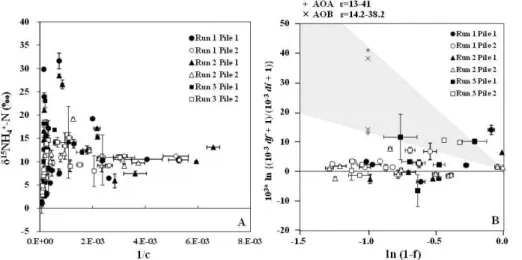
fore performed Keeling plot analysis to explain the phenomenon (Fig. 4a). If there was single “heavy” 15NH+4 source, we will have significant regression line between15NH+4 values and inverse ammonium concentration. However, we could not see it, indicating that nitrogen turnover and isotope fractionation occurs independently in each locations. That mean in turn, the nitrogen turnover rate is extremely high in pile top samples,
25
which shows high NH+4 concentration with highly enriched δ15N values. Possible ex-planation on these highly enriched δ15NH+4 can be done by two points. One is due to extremely high nitrification-denitrification activity in these samples, and the other is high nitrogen loss as gaseous NH3state.
BGD
12, 7577–7598, 2015Isotopically enriched ammonium shows
high nitrogen turnover
K. Maeda et al.
Title Page
Abstract Introduction
Conclusions References
Tables Figures
◭ ◮
◭ ◮
Back Close
Full Screen / Esc
Printer-friendly Version
Interactive Discussion
Discussion
P
a
per
|
Discussion
P
a
per
|
Discussion
P
a
per
|
Discussion
P
a
per
|
Previously Casciotti et al. (2003) reported that biological ammonium oxidation by beta-proteobacterial ammonium oxidizing bacteria (AOB; fourNitrosomonas and one
Nitrosospira species) have isotopic effect and it ranges from 14.2–38.2 ‰. Another ammonium oxidizer, ammonium oxidizing archaea (AOA), also shows isotopic fraction-ation during their activity and it ranges from 13–41 ‰ (Santoro and Casciotti, 2011).
5
Because the pH and availability of ammonia is one of the critical driver partitioning these two ammonium oxidizer (Hatzenpichler, 2012), and manure compost shows high pH values and contains very high NH+4 concentration in general, AOB rather than AOA seems to be the main oxidizer in the compost (Yamamoto et al., 2012). Because sig-nificant amount of bacterial amoA gene, which required for ammonium oxidation by
10
AOB can be detected from both pile top and side, but not from pile core (Maeda et al., 2010b), their contribution can be the possible explanation on these “heavy”15NH+4 es-pecially in pile top samples. Therefore we performed the Raleigh plot on our15NH+4data and tried to explain these enriched value with nitrification by the microbes (Fig. 4b). However, only some plot were included in the area which can be explained by
nitrifica-15
tion, thus the nitrification alone cannot be the driving factor for these “heavy”15NH+4-N. The isotope fractionation for NH3volatilization and nitrification are similar, 1.029 and 1.015–1.035 (Högberg, 1997), respectively. It is also known that high NH3
volatiliza-tion certainly contribute the enrichedδ15NH+4 during cattle manure storage (Lee et al., 2011). Another study reported that NH+4 can be gaseous state easily at high pH
envi-20
ronment, and the temperature can also influence the fractionation (Li et al., 2012). The
δ15N data of volatilized NH3 from same scale of the compost piles showed very low
values (−17.9∼ −13.5 ‰, unpublished data), thus NH
3volatilization could seems likely
partly contributed on these “heavy” NH+4 in the pile top.
On the other hand, the significant increase inδ15NH+4 in the latter stage of the
pro-25
cess cannot be explained by NH3 volatilization, because most of this occurs during initial stage of the process, as we showed previously (Maeda et al., 2013a). The rel-ative contribution of NH3volatilization and nitrification/denitrification on these δ
15
lat-BGD
12, 7577–7598, 2015Isotopically enriched ammonium shows
high nitrogen turnover
K. Maeda et al.
Title Page
Abstract Introduction
Conclusions References
Tables Figures
◭ ◮
◭ ◮
Back Close
Full Screen / Esc
Printer-friendly Version
Interactive Discussion
Discussion
P
a
per
|
Discussion
P
a
per
|
Discussion
P
a
per
|
Discussion
P
a
per
|
ter stage of the process (Sanchez-Monedero et al., 2001), the nitrification seems to contribute this increase significantly. Interestingly, highly enriched δ15NH+4 could be observed from pile core zone at the end of the experiment in runs 1 and 2. This phe-nomenon cannot be explained by NH3volatilization because of its location in the piles, thus it could be achieved solely by nitrification-denitrification process. It is well known
5
that high nitrification can occur in the latter stage of the composting process (Bernal et al., 2009; Parkinson et al., 2004), andamoAgene could be detected from the com-post core even in the latter stage of the comcom-posting process, high nitrogen conversion by microbes seems likely occurred in the compost core, and this could contribute on the sharp increase of theδ15NH+4 of the mixed samples.
10
5 Conclusions
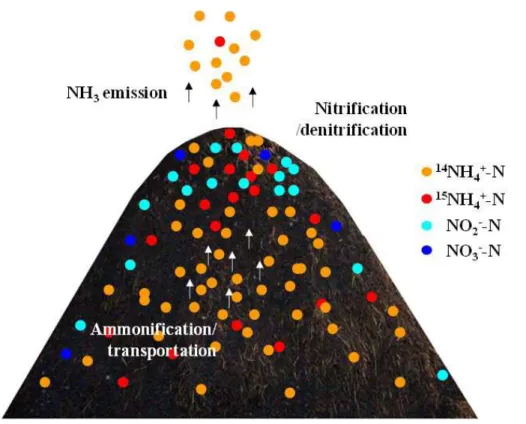
The δ15NH+4 measurement of the samples collected from each location of the pile enabled the explanation about what occurs between the turnings. The plausible story between the pile turnings (Fig. 5) is,
i. Ammonification of organic N supplies large amount of “light” ammonium in
com-15
post core, where high organic matter degradation activity can be achieved.
ii. These “light” ammonium will be transported to pile top zone by the upstream airflow generated by heat in compost core zone.
iii. Significant nitrification, denitrification and NH3 volatilization occurs especially in
the pile top zone, which leads to highly enrichedδ15NH+4 in the pile top, but this
20
seems not likely occurring in pile side significantly.
iv. Nitrification rate exceeds denitrification rate, which can lead to accumulation of NO−
2 in pile top and side, and this can contribute the significant denitrification and
N2O emission just after the turning events.
BGD
12, 7577–7598, 2015Isotopically enriched ammonium shows
high nitrogen turnover
K. Maeda et al.
Title Page
Abstract Introduction
Conclusions References
Tables Figures
◭ ◮
◭ ◮
Back Close
Full Screen / Esc
Printer-friendly Version
Interactive Discussion
Discussion
P
a
per
|
Discussion
P
a
per
|
Discussion
P
a
per
|
Discussion
P
a
per
|
On the other hand, theδ15NH+4 measurement of piles with and without bulking agent did not explain why N2O emission can be mitigated by using of bulking agent, thus
further studies are needed.
The Supplement related to this article is available online at doi:10.5194/bgd-12-7577-2015-supplement.
5
Author contributions. K. Maeda, S. Toyoda designed the experiments. K. Maeda, M. Yano and
M. Fukasawa carried out the experiments. K. Maeda, S. Toyoda and S. Hattori analyzed the results, K. Maeda, K. Nakajima and N. Yoshida wrote the paper.
Acknowledgements. We would like to thank Ms. Atsuko Kobayashi and Kazuha Azumaya for
providing the laboratory-based technical assistance. This work was supported by a grant for 10
the “Development of Mitigation and Adaptation Techniques to Global Warming in the Sectors of Agriculture, Forestry, and Fisheries” from the Ministry of Agriculture, Forestry and Fisheries (MAFF), Japan. This work was also supported by Grant-in-Aid for Young Scientists (B) to K. Maeda and a grant from the Global Environment Research Fund (B-094) of the Ministry of the Environment, Japan to N. Y.
15
References
Barrington, S., Choinière, D., Trigui, M., Knight, W.: Compost convective airflow under passive aeration, Bioresource Technol., 86, 259–266, 2003.
Bernal, M., Alburquerque, J., and Moral, R.: Composting of animal manures and chemical cri-teria for compost maturity assessment. A review, Bioresource Technol., 100, 5444–5453, 20
2009.
Brooks, P., Stark, J. M., McInteer, B., and Preston, T.: Diffusion method to prepare soil extracts for automated nitrogen-15 analysis, Soil Sci. Soc. Am. J., 53, 1707–1711, 1989.
Casciotti, K., Sigman, D., and Ward, B.: Linking diversity and stable isotope fractionation in ammonia-oxidizing bacteria, Geomicrobiol. J., 20, 335–353, 2003.
BGD
12, 7577–7598, 2015Isotopically enriched ammonium shows
high nitrogen turnover
K. Maeda et al.
Title Page
Abstract Introduction
Conclusions References
Tables Figures
◭ ◮
◭ ◮
Back Close
Full Screen / Esc
Printer-friendly Version
Interactive Discussion
Discussion
P
a
per
|
Discussion
P
a
per
|
Discussion
P
a
per
|
Discussion
P
a
per
|
Dämmgen, U. and Hutchings, N. J.: Emissions of gaseous nitrogen species from manure man-agement: a new approach, Environ. Pollut., 154, 488–497, 2008.
Galloway, J. N., Dentener, F. J., Capone, D. G., Boyer, E. W., Howarth, R. W., Seitzinger, S. P., Asner, G. P., Cleveland, C. C., Green, P. A., and Holland, E. A.: Nitrogen cycles: past, present, and future, Biogeochemistry, 70, 153–226, 2004.
5
Garten Jr., C. T.: Nitrogen isotope composition of ammonium and nitrate in bulk precipitation and forest throughfall, Int. J. Environ. An. Ch., 47, 33–45, 1992.
Gruber, N. and Galloway, J. N.: An Earth-system perspective of the global nitrogen cycle, Na-ture, 451, 293–296, 2008.
Hatzenpichler, R.: Diversity, physiology, and niche differentiation of ammonia-oxidizing archaea, 10
Appl. Environ. Microb., 78, 7501–7510, 2012.
Holmes, R. M., McClelland, J. W., Sigman, D. M., Fry, B., and Peterson, B. J.: Measuring15N– NH+4 in marine, estuarine and fresh waters: an adaptation of the ammonia diffusion method for samples with low ammonium concentrations, Mar. Chem., 60, 235–243, 1998.
Högberg, P.:15N natural abundance in soil–plant systems, New Phytol., 137, 179–203, 1997. 15
IPCC: Synthesis Report. Contribution of Working Groups I. in: II and III to the Fourth Assess-ment Report of the IntergovernAssess-mental Panel on Climate Change, Core Writing Team, edited by: Pachauri and Reisinger, IPCC, Geneva, Switzerland, 2007.
Jolanun, B. and Towprayoon, S.: Novel bulking agent from clay residue for food waste compost-ing, Bioresource Technol., 101, 4484–4490, 2010.
20
Kim, Y.-J., Choi, W.-J., Lim, S.-S., Kwak, J.-H., Chang, S. X., Kim, Y., Yoon, K.-S., and Ro, H.-M.: Changes in nitrogen isotopic compositions during composting of cattle feedlot manure: effects of bedding material type, Bioresource Technol., 99, 5452–5458, 2008.
Lee, C., Hristov, A. N., Cassidy, T., and Heyler, K.: Nitrogen isotope fractionation and origin of ammonia nitrogen volatilized from cattle manure in simulated storage, Atmosphere, 2, 25
256–270, 2011.
Li, L., Lollar, B. S., Li, H., Wortmann, U. G., and Lacrampe-Couloume, G.: Ammonium stability and nitrogen isotope fractionations for –NH3 (aq)–NH3 (gas) systems at 20–70◦
C and pH of 2–13: Applications to habitability and nitrogen cycling in low-temperature hydrothermal systems, Geochim. Cosmochim. Ac., 84, 280–296, 2012.
30
Lynch, N. J. and Cherry, R. S.: Design of passively aerated compost piles: vertical air velocities between the pipes, Biotechnol. Progr., 12, 624–629, 1996.
BGD
12, 7577–7598, 2015Isotopically enriched ammonium shows
high nitrogen turnover
K. Maeda et al.
Title Page
Abstract Introduction
Conclusions References
Tables Figures
◭ ◮
◭ ◮
Back Close
Full Screen / Esc
Printer-friendly Version
Interactive Discussion
Discussion
P
a
per
|
Discussion
P
a
per
|
Discussion
P
a
per
|
Discussion
P
a
per
|
Maeda, K., Hanajima, D., Morioka, R., and Osada, T.: Characterization and spatial distribution of bacterial communities within passively aerated cattle manure composting piles, Biore-source Technol., 101, 9631–9637, 2010a.
Maeda, K., Toyoda, S., Shimojima, R., Osada, T., Hanajima, D., Morioka, R., and Yoshida, N.: Source of nitrous oxide emissions during the cow manure composting process as revealed 5
by isotopomer analysis of and amoA abundance in betaproteobacterial ammonia-oxidizing bacteria, Appl. Environ. Microb., 76, 1555–1562, 2010b.
Maeda, K., Hanajima, D., Morioka, R., Toyoda, S., Yoshida, N., and Osada, T.: Mitigation of greenhouse gas emission from the cattle manure composting process by use of a bulking agent, Soil Sci. Plant Nutr., 59, 96–106, 2013a.
10
Maeda, K., Toyoda, S., Hanajima, D., and Yoshida, N.: Denitrifiers in the surface zone are primarily responsible for the nitrous oxide emission of dairy manure compost, J. Hazard. Mater., 248–249, 329–336, 2013b.
Parkinson, R., Gibbs, P., Burchett, S., and Misselbrook, T.: Effect of turning regime and seasonal weather conditions on nitrogen and phosphorus losses during aerobic composting of cattle 15
manure, Bioresource Technol., 91, 171–178, 2004.
Ravishankara, A., Daniel, J., and Portmann, R.: Nitrous oxide (N2O): the dominant ozone-depleting substance emitted in the 21st century, Science, 326, 123–125, 2009.
Sanchez-Monedero, M. A., Roig, A., Paredes, C., and Bernal, M. P.: Nitrogen transformation during organic waste composting by the Rutgers system and its effects on pH, EC and ma-20
turity of the composting mixtures, Bioresource Technol., 78, 301–308, 2001.
Santoro, A. E. and Casciotti, K. L.: Enrichment and characterization of ammonia-oxidizing ar-chaea from the open ocean: phylogeny, physiology and stable isotope fractionation, ISME J., 5, 1796–1808, 2011.
SAS Institute: I. SAS/STAT user’s guide, SAS Institute, Cary, NC, 2001. 25
Sharpley, A., Meisinger, J. J., Breeuwsma, A., Sims, J. T., Daniel, T. C., and Schepers, J. S.: Im-pacts of Animal Manure Management on Ground and Surface Water Quality. Animal Waste Utilization: Effective Use of Manure as a Soil Resource, edited by: Hatfield, J. L., and Stew-art, B. A., CRC Press, Boca Raton, FL, 173–242, 1998.
Sommer, S., Olesen, J., Petersen, S., Weisbjerg, M., Valli, L., Rodhe, L., and Beline, F.: Re-30
BGD
12, 7577–7598, 2015Isotopically enriched ammonium shows
high nitrogen turnover
K. Maeda et al.
Title Page
Abstract Introduction
Conclusions References
Tables Figures
◭ ◮
◭ ◮
Back Close
Full Screen / Esc
Printer-friendly Version
Interactive Discussion
Discussion
P
a
per
|
Discussion
P
a
per
|
Discussion
P
a
per
|
Discussion
P
a
per
|
Tilman, D., Cassman, K. G., Matson, P. A., Naylor, R., and Polasky, S.: Agricultural sustainability and intensive production practices, Nature, 418, 671–677, 2002.
Yamamoto, N., Oishi, R., Suyama, Y., Tada, C., and Nakai, Y.: Ammonia-oxidizing bacteria rather than ammonia-oxidizing archaea were widely distributed in animal manure composts from field-scale facilities, Microbes Environ., 27, 519–524, 2012.
5
Yeatman, S., Spokes, L., Dennis, P., and Jickells, T.: Can the study of nitrogen isotopic compo-sition in size-segregated aerosol nitrate and ammonium be used to investigate atmospheric processing mechanisms?, Atmos. Environ., 35, 1337–1345, 2001.
Yu, S., Clark, O., and Leonard, J.: Airflow measurement in passively aerated compost, Canad. Biosyst. Eng., 47, 39–45, 2005.
10
Zumft, W. G.: Cell biology and molecular basis of denitrification, Microbiol. Mol. Biol. R., 61, 533–616, 1997.
BGD
12, 7577–7598, 2015Isotopically enriched ammonium shows
high nitrogen turnover
K. Maeda et al.
Title Page
Abstract Introduction
Conclusions References
Tables Figures
◭ ◮
◭ ◮
Back Close
Full Screen / Esc
Printer-friendly Version
Interactive Discussion
Discussion
P
a
per
|
Discussion
P
a
per
|
Discussion
P
a
per
|
Discussion
P
a
per
|
Table 1.Chemical components of compost samples.
Weight TS VS EC pH NO−
2-N NO −
3-N NH
+
4-N TKN C/N Time B.A. Run kg % %TS mS cm−1 mg kg−1TS mg kg−1TS mg kg−1TS g N kg−1TS
I − 1 4280 20.5 (0.2) 84.7 (0.3) 2.6 0.0 8.4 (0.1) 0.0 0.0 68.9 (1.8) 4646.3 (164.7) 27.6 (0.3) 24.2 (0.2) I − 2 4060 22.7 (0.6) 82.3 (1.1) 3.1 0.0 8.8 (0.1) 0.0 0.0 0.0 0.0 3497.5 (51.0) 24.2 (0.6) 22.2 (0.2) I − 3 4070 17.8 (0.4) 82.1 (0.4) 2.7 (0.1) 8.0 0.0 0.0 0.0 0.0 0.0 7347.8 (7.6) 26.2 (0.4) 22.0 (0.4) I + 1 4700 28.3 (0.1) 87.0 (0.3) 2.9 0.0 8.3 (0.1) 0.0 0.0 40.1 (0.9) 2929.3 (34.0) 20.8 (1.0) 23.0 (0.1) I + 2 4480 31.2 (0.7) 87.1 (0.8) 3.2 0.0 8.8 0.0 0.0 0.0 0.0 0.0 2288.0 (10.4) 21.6 (0.7) 27.5 (1.7) I + 3 4450 22.6 (0.3) 86.5 (0.6) 3.0 0.0 7.7 0.0 0.0 0.0 0.0 0.0 5840.3 (126.1) 20.4 (0.4) 21.0 (0.3) F − 1 1710 24.8 (0.6) 70.0 (2.9) 2.5 0.0 9.3 0.0 0.0 0.0 0.0 0.0 1353.1 (75.1) 32.3 (1.7) 13.0 (0.1) F − 2 2280 24.3 (0.2) 75.1 (0.4) 2.6 (0.1) 9.5 (0.1) 61.2 (8.6) 0.0 0.0 451.1 (0.6) 26.7 (0.6) 16.3 0.0 F − 3 1890 21.4 (0.4) 77.2 (0.5) 3.0 0.0 9.2 (0.1) 0.0 0.0 0.0 0.0 3817.1 (177.4) 28.9 (1.1) 17.5 (0.2) F + 1 1190 52.7 (0.9) 69.1 (0.6) 5.0 (0.1) 9.5 0.0 44.3 (1.6) 52.6 (0.2) 460.9 (3.3) 30.0 0.0 12.0 (0.1) F + 2 1480 47.6 (0.4) 73.7 (0.9) 4.3 0.0 9.0 0.0 57.4 (7.5) 60.4 (2.5) 375.5 (21.7) 29.1 (0.1) 13.6 (0.2) F + 3 1570 31.1 (1.0) 71.9 (1.6) 4.9 (0.1) 9.5 (0.1) 53.9 (6.7) 49.5 (12.1) 1809.8 (97.8) 29.2 (0.2) 12.7 0.0
B.A., bulking agent; I, initial; F, final; C, control; T, treatment; TS, total solids; VS, volatile solids; EC, electrical conductivity; NO−
2-N, nitrite-nitrogen; NO
−
3-N,
nitrate-nitrogen; NH+
4-N, ammonium-nitrogen; TKN, total Kjeldahl nitrogen; C/N, carbon/nitrogen ratio. The values represent the average (SD). Values followed by
BGD
12, 7577–7598, 2015Isotopically enriched ammonium shows
high nitrogen turnover
K. Maeda et al.
Title Page
Abstract Introduction
Conclusions References
Tables Figures
◭ ◮
◭ ◮
Back Close
Full Screen / Esc
Printer-friendly Version
Interactive Discussion
Discussion
P
a
per
|
Discussion
P
a
per
|
Discussion
P
a
per
|
Discussion
P
a
per
|
Figure 1.NO−2 (white), NO−3 (grey) and NH+4-N (black) content of the compost samples from each location (top, side and core) of the pile and the sample just after the turnings (mixed). These content were determined every two weeks, just before/after the turning events.(a–c)
indicate the pile 1 of the compost runs 1–3, and(d–f)indicate the pile 2 of the compost runs 1–3, respectively. The error bars indicate the SD (n=3).
BGD
12, 7577–7598, 2015Isotopically enriched ammonium shows
high nitrogen turnover
K. Maeda et al.
Title Page
Abstract Introduction
Conclusions References
Tables Figures
◭ ◮
◭ ◮
Back Close
Full Screen / Esc
Printer-friendly Version
Interactive Discussion
Discussion
P
a
per
|
Discussion
P
a
per
|
Discussion
P
a
per
|
Discussion
P
a
per
|
BGD
12, 7577–7598, 2015Isotopically enriched ammonium shows
high nitrogen turnover
K. Maeda et al.
Title Page
Abstract Introduction
Conclusions References
Tables Figures
◭ ◮
◭ ◮
Back Close
Full Screen / Esc
Printer-friendly Version
Interactive Discussion
Discussion
P
a
per
|
Discussion
P
a
per
|
Discussion
P
a
per
|
Discussion
P
a
per
|
Figure 3.δ15N of NH+4-N of the samples from each compost location (pile top, side and core). The values were expressed as the difference from the mixed samples just after the turning events. Black bars indicate the compost with bulking agent (10 %w/w), and the white bars indicate the compost without bulking agent. (a–c)indicate the compost runs 1–3. The error bars indicate the SD (n=3).
BGD
12, 7577–7598, 2015Isotopically enriched ammonium shows
high nitrogen turnover
K. Maeda et al.
Title Page
Abstract Introduction
Conclusions References
Tables Figures
◭ ◮
◭ ◮
Back Close
Full Screen / Esc
Printer-friendly Version
Interactive Discussion
Discussion
P
a
per
|
Discussion
P
a
per
|
Discussion
P
a
per
|
Discussion
P
a
per
|
BGD
12, 7577–7598, 2015Isotopically enriched ammonium shows
high nitrogen turnover
K. Maeda et al.
Title Page
Abstract Introduction
Conclusions References
Tables Figures
◭ ◮
◭ ◮
Back Close
Full Screen / Esc
Printer-friendly Version
Interactive Discussion
Discussion
P
a
per
|
Discussion
P
a
per
|
Discussion
P
a
per
|
Discussion
P
a
per
|
Figure 5.Summary of the events between the pile turnings.