Motor learning through virtual reality in elderly - a
systematic review
Denise Cardoso Ribeiro-PapaI, Thais MassettiII, Tânia Brusque CrocettaII, Lilian Del Ciello de MenezesII, Thaiany
Pedrozo Campos AntunesII, Ítalla Maria Pinheiro BezerraIII, Carlos Bandeira de Mello MonteiroI,III
DOI: 10.5935/MedicalExpress.2016.02.01
I Universidade de São Paulo, Faculdade de Medicina, Programa de pós-graduação em Ciências da Reabilitação, São Paulo, SP, Brazil. II Faculdade de Medicina do ABC, Departmento de Escrita Cientíica, São Paulo, SP, Brazil.
III Universidade de São Paulo, Escola de Artes, Ciências e Humanidades, São Paulo, SP, Brazil.
INTRODUCTION: Decline in physical function is a common feature of older age and has important outcomes in terms of physical health as it relates to quality of life. Our capacity for motor learning allows us to lexibly adapt movements to an ever-changing environment. The term Virtual Reality refers to a wide variety of methods used to simulate an alternative or virtual world.
OBJECTIVE: To analyze the results shown in previous studies on motor learning with Virtual Reality use in elderly participants.
METHOD: To select the articles, three steps were followed. A systematic literature review was performed without time limitation. The research was carried out using PubMed, BVS and Web of science; considering the keywords, we included articles that showed the following three terms: elderly, virtual reality and motor learning.
RESULTS: The initial search yielded 49 articles. After duplicates were removed, two of the authors independently evaluated the title and abstract of each article against the study inclusion criteria. From these, 45 articles were excluded based on title and abstract. Finally, four articles met the inclusion criteria.
CONCLUSION: Although few studies were conducted on motor learning in elderly people through virtual reality and, even fewer were of good quality, it was shown that elderly people, with or without a speciic disease, can beneit from interventions based on virtual reality to improve motor learning skills.
KEYWORDS: Elderly, Aged, Virtual reality, Motor learning.
Ribeiro-Papa DC, Massetti T, Crocetta TB, Menezes LDC, Antunes TPC, Bezerra IMP, Monteiro CBM. Motor Learning Through Virtual Reality in Elderly – a Systematic Review. MedicalExpress (São Paulo, online). 3(2):M160201
Received for Publication on October 27, 2015; First review on November, 22, 2015; Accepted for publication on January 21, 2016; Online on February 17, 2016
E-mail: [email protected]
■
INTRODUCTIONInternationally, as the number of older adults increases different types of care settings are involved to address the care needs of this group.1 Decline in physical function is a common feature of older age and has important outcomes in terms of physical health related quality of life, falls, health care use, admission to residential care and mortality.2
There are several interrelated factors that can challenge the independence of older adults: primarily
functional and cognitive impairment, chronic diseases, a diminishing social network, and a low level of physical activity.3,4 Moreover, with aging, the capacity to continue to learn new motor skills is of the utmost importance for maximizing quality of life, as older people need to practice and learn new skills and to relearn motor skills that were practiced in the past.5 Our capacity for motor
learning allows us to flexibly adapt movements to an
ever-changing environment.6
guidelines.15 The use of guidelines, such as those provided by PRISMA, are likely to improve the reporting quality of a systematic review and provide substantial transparency in the selection process of papers in a systematic review.16,17
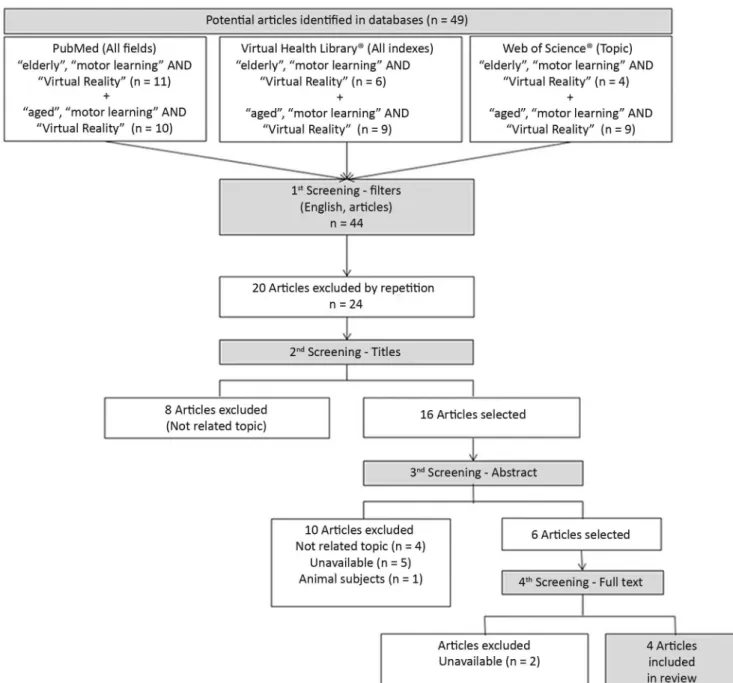
To select the articles we used three steps (figure 1): first, we looked for articles in databases, reading the
titles and abstracts; second, we excluded works by title or abstract based upon our selection criteria; the third and
final step was to analyze the eligible works.18,19
As previously described and performed,18,20 we used the search strategy based on PICOs strategy for the construction of the research, to locate and compare different works. Studies published in English were deemed eligible if they met the PICOs criteria. The following PICOs parameters were used:
Population: Elderly, aged 60 years or older.
Intervention: Any motor learning therapy with virtual reality, including immersive, nonimmersive, and off-the-shelf gaming system technologies
Comparator (control): Any motor learning therapy without virtual reality.
Outcome: Any score of motor learning therapy.
Study design(s): clinical trials, case-control, cross-sectional, case reports and case series.
The bibliographic review was performed without time limitation. The research was carried out using PubMed, Virtual Health Library, and Web of Science. As keywords, we included articles that showed the terms “elderly” or “aged”, “virtual reality” and “motor learning”.
Figure 1 illustrates the complete procedure. Abstracts
of identified articles were then screened for the following
inclusion criteria: (1) population included older adults (aged 60 years, or older); (2) motor learning intervention; and (3) virtual reality as material or instrumentation. There were no restrictions on minimum sample size. Articles were excluded if they (1) were not original research (e.g., books, theoretical papers, or secondary reviews), (2) were not published in English,16 (3) examined populations not
explicitly identified as elderly, (4) did not include virtual
reality and motor learning as intervention or (5) reviews, trial protocols, and retrospective studies.21
Study Quality Assessment: In the next phase, all potentially relevant articles were obtained and evaluated
in order to determine whether or not they fulfilled the
inclusion criteria. The Physiotherapy Evidence Database (PEDro) scale was employed to assess the quality of the studies that met the inclusion criteria.22 To increase
confidence in the selection of articles, all potentially relevant
articles were reviewed independently by two researchers: when a positive consensus was obtained, articles were
deemed to have fulfilled the inclusion criteria.18,21,23
Once accepted for inclusion, each article was independently reviewed for quality by two reviewers using the PEDro scale; any variations were resolved by implications for the lives of older adults. According to Maas
et al.,7 motor learning refers to a set of processes associated with practice and experience, leading to relatively per-manent changes in performance, arising from systematic practice and feedback. Technology might provide a solution for some of these challenges. In the last decade in particu-lar, much effort has been invested in the development of technology.8
It is essential to ensure that technologies tailored to individual needs are made available and that they are reliable and effective over the long-term. Technological innovations that can deliver exercise programs have the potential to increase adherence by providing regular feedback to and motivation for older adults. Acceptance of technologies that are electronic or digital may be more
difficult for the current generation of seniors, which did not
grow up with these types of technologies.8,9
The term Virtual Reality Environment in Rehabilitation refers to a wide variety of methods used to simulate an alter-native or virtual world. Virtual Reality Environment can be ca-tegorized into two basic forms based on viewing perspective: immersive or nonimmersive. In immersive virtual reality, the
person retains the first-person viewing perspective as if in the
real world. In contrast, nonimmersive Virtual Reality Environ-ment uses an avatar, which can take any form, to represent the user in the virtual world, creating a third-person perspective.10 Virtual reality (VR) has been proposed as a potentially useful tool for motor assessment and rehabilitation.11
One of the main barriers to the successful use of these technologies is lack of adoption/adherence to their use. Intrinsic factors related to the attitudes of older adults related to control, independence and perceived need/ requirements for safety are important for motivation to use (and continue to use) such technologies. Extrinsic factors such as usability, feedback gained and cost are also important in supporting attitudes and perceptions.12
Given the difficulties imposed regarding motor
learning in older adults, the purpose of this study was to
analyze the results and benefits shown in previous studies
on motor learning with VR use in this population.
■
METHODSystematic reviews have become increasingly important in health care.13,14 The tools of evidence-based science are of great importance,14 especially, the systematic
review, which is a literature review that poses a well-defined and specific research question, uses systematic and explicit
methods to identify, select and appraise research, and analyze data from selected studies.
Figure 1. Flowchart illustrating the search and selection procedures used in this study.
consensus.24 In order to demonstrate the methodological quality of the studies, an article with a good level of evidence was considered to be one with a score equal to or higher than 6 according to the PEDro evaluation scale. This criterion was based on previous reports18,20 which rated studies scoring 9-10 on the PEDro scale to be methodologically ‘Excellent’, 6-8 ‘Good’, 4-5 ‘Fair’ and below 4 ‘Poor’.
■
RESULTSForty nine titles and abstracts were reviewed for applicability. After eliminating duplicates, two authors independently evaluated the title and abstract and 45 articles
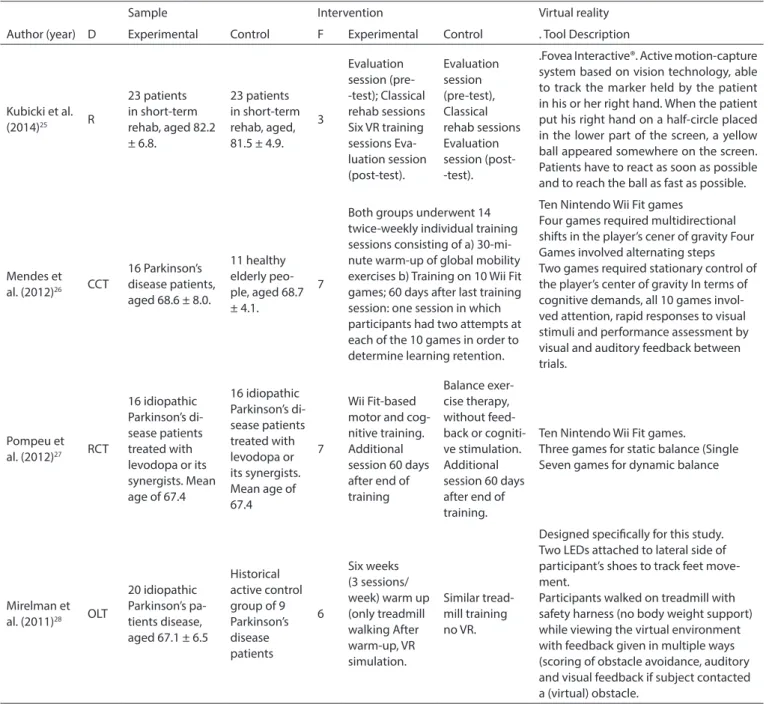
were excluded. Four papers met the inclusion criteria and were accepted for review. They are summarized in Tables 1 and 2.
Table 1. Characteristics of the four selected studies for motor learning with VR use in elderly participants
Sample Intervention Virtual reality
Author (year) D Experimental Control F Experimental Control . Tool Description
Kubicki et al.
(2014)25 R
23 patients in short-term rehab, aged 82.2 ± 6.8.
23 patients in short-term rehab, aged, 81.5 ± 4.9.
3
Evaluation session (pre--test); Classical rehab sessions Six VR training sessions Eva-luation session (post-test). Evaluation session (pre-test), Classical rehab sessions Evaluation session (post--test).
.Fovea Interactive®. Active motion-capture system based on vision technology, able to track the marker held by the patient in his or her right hand. When the patient put his right hand on a half-circle placed in the lower part of the screen, a yellow ball appeared somewhere on the screen. Patients have to react as soon as possible and to reach the ball as fast as possible.
Mendes et al. (2012)26 CCT
16 Parkinson’s disease patients, aged 68.6 ± 8.0.
11 healthy elderly peo-ple, aged 68.7 ± 4.1.
7
Both groups underwent 14 twice-weekly individual training sessions consisting of a) 30-mi-nute warm-up of global mobility exercises b) Training on 10 Wii Fit games; 60 days after last training session: one session in which participants had two attempts at each of the 10 games in order to determine learning retention.
Ten Nintendo Wii Fit games
Four games required multidirectional shifts in the player’s cener of gravity Four Games involved alternating steps Two games required stationary control of the player’s center of gravity In terms of cognitive demands, all 10 games invol-ved attention, rapid responses to visual stimuli and performance assessment by visual and auditory feedback between trials.
Pompeu et al. (2012)27 RCT
16 idiopathic Parkinson’s di-sease patients treated with levodopa or its synergists. Mean age of 67.4
16 idiopathic Parkinson’s di-sease patients treated with levodopa or its synergists. Mean age of 67.4
7
Wii Fit-based motor and cog-nitive training. Additional session 60 days after end of training
Balance exer-cise therapy, without feed-back or cogniti-ve stimulation. Additional session 60 days after end of training.
Ten Nintendo Wii Fit games.
Three games for static balance (Single Seven games for dynamic balance
Mirelman et al. (2011)28 OLT
20 idiopathic Parkinson’s pa-tients disease, aged 67.1 ± 6.5
Historical active control group of 9 Parkinson’s disease patients 6 Six weeks (3 sessions/ week) warm up (only treadmill walking After warm-up, VR simulation. Similar tread-mill training no VR.
Designed speciically for this study. Two LEDs attached to lateral side of participant’s shoes to track feet move-ment.
Participants walked on treadmill with safety harness (no body weight support) while viewing the virtual environment with feedback given in multiple ways (scoring of obstacle avoidance, auditory and visual feedback if subject contacted a (virtual) obstacle.
Note: D: Design; R: Randomized; F: Follow up (in weeks); CCT: Controlled clinical trial; RCT: Randomized controlled trials; OLT: Open-label trial; VR: Virtual reality.
As shown in Table 2, based on the PEDro scale, and according to criteria adopted by Snider, Majnemer and Darsaklis,20 two of the selected studies were rated 6 and 7 (good) two as 4 (fair).
■
DISCUSSIONIn order to locate (through a search in scientific
databases) studies that report on motor learning with the use of Virtual Reality (VR) in the elderly population, we found that most of the studies found elderly people with
some disorder or disease, and most had a control group of healthy older adults. As far as we saw, no reliable studies focused on healthy elderly alone.
It should be noted that the available studies show great variability in the number of surveyed individuals and frequency of sessions. The study with the largest group (N =
46) only covers older adults without specific diseases;25 the
Table 2. Outcomes summarized for motor learning with virtual reality use in elderly participants in selected studies. Main diferences in results between groups
Experimental Control Main outcomes Quality assessment
of selected studies
Kubicki et al. (2014)2
Both hand and CoP kine-matics were improved.
Hand kinematics: hand
mo-vement time and reaction time decreased between
pre and post-test; mean velocities were increased between pre and post-test;
CoP kinematics: mean
velocity increased between pre and post-test.
Only mean velocity of hand kinematics
impro-ved.
Hand kinematics: hand
movement time decre-ased between pre and post-test; mean velocities
and reaction time incre-ased between pre and
post-test;
CoP kinematics: mean
ve-locity decreased between pre and post-test.
VR had a positive efect on motor
learning in elderly. 6/10
Mendes et al. (2012)26
Lower scores;similar learning and retention on seven games; worse performance on ive games;unable to improve their performance on three
games following training.
Higher scores; similar learning and retention on seven games; better performance on ive ga-mes; good learning and retention on three games
following training.
VR had a positive efect on motor learning in both PD and healthy elderly. The ability of patients with
PD to learn, retain and transfer performance improvements after VR based training depends
particu-larly on the cognitive demands of the games involved, reiterating the
importance of gameselection for rehabilitation purposes.
4/10
Pompeu et al. (2012)27 No diferences were found No diferences were found
Both groups (VR training and usual balance therapy) showed improved performance in activities of daily living after 14 sessions of balance training, with no additional advan-tages associated with the VR-based
motor and cognitive training.
7/10
Mirelman et al. (2011)28
Decrease of errors in obs-tacles; During dual task, there was an increase in gait speed, stride time,
stride length and gait variability, all maintained
at follow-up.
Gains under the dual task condition in both gait spe-ed and stride length were signiicantly lower after training treadmill alone.
The gains in gait speed and stride length during usual walking were similar in both groups. Treadmill training + virtual reality in PD may
signiicantly improve physical performance, gait during complex challenging conditions and
cogniti-ve function.
4/10
Design of a randomized controlled trial (RCT), the ‘gold standard’ interventions,29 that could give
more strength to conclusions concerning the efficacy of
interventions in VR to improve motor learning functioning in older people, was evaluated only in one study.27
Although in the study of Mendes et al.,26 patients with Parkinson’s Disease had lower scores on Nitendo Wii Fit games compared to healthy older adults, both groups were able to transfer motor ability trained in the games to a similar untrained task; there was similar learning and retention between groups on seven out of ten games. Patients had a
worse performance on five of the games and were unable to
improve their performance on three of the games. The ability of these patients to learn, retain and transfer performance
improvements after training on the Nintendo Wii Fit depended largely on the demands (particularly cognitive demands) of the games involved, reiterating the importance of game selection for rehabilitation purposes.
Pompeu et al.27 reported four key findings: (1) Parkinson’s Disease patients were able to improve their performance in three groups of games; (2) Wii-based motor and cognitive training improved the participants’ independent performance of activities of daily life, balance and cognition, and this was maintained for 60 days after the end of training; (3) the improvement was similar to that obtained by the participants who performed balance
exercise therapy; and (4) no training led to significant
Pompeu et al.27 showed that both types of training promoted similar improvement in the performance of activities of daily life, balance and cognition among patients with Parkinson’s disease, thus supporting the possibility of therapeutic use of either balance exercise therapy or Wii-based motor and cognitive training. Due to the chronic and degenerative nature of Parkinson’s Disease, physical therapy guidelines suggest that treatment should occur on a long-term basis, which could have an adverse effect on patients’ adherence to treatment, because the repetitive nature of the exercises could become monotonous; consequently, VR training can be a useful alternate.
In turn, the results of the study by Mirelman et al.28 indicate that VR training in addition to usual training
(walking on treadmill), may significantly improve phy
-sical performance and gait during complex challenging conditions, and even certain aspects of cognitive function
in people with Parkinson’s Disease. These findings have
important implications for understanding motor learning in the presence of Parkinson and for treating fall risk in this condition, aging, and others patient groups who share a heightened risk of falls.
Postural control associated with self-paced move-ment is critical for balance in frail older adults. Kubicki et al.25 aimed to investigate the effects of a 2D virtual reality--based program on postural control associated with rapid arm movement in this population. Participants in an upright standing position performed rapid arm-raising movements towards a target. Practice-related changes were assessed by pre- and post-test comparisons of hand kinematics and centre-of-pressure displacement parameters measured in the training and the control group.25
The results of the Kubicki et al.25 study suggest that some level of motor (re)-learning is maintained in frail patients with low functional reserves. The study also suggest that re-learning of anticipatory postural control (i.e., motor prediction) is less robust than the explicit motor learning involved in arm reaching. In order to automate anticipatory postural activities, this last point should encourage clinicians to extend the training course duration, even if reaching movement improvements seem to have been acquired. However, other studies are required to measure the retention of these two types of learning over a longer period of time.
Systematic searches identified 21 studies that
used behavioral techniques with assistive technology to enhance the performance of functional motor activities; such studies showed positive effects on basic skills such as object manipulation, posture, and walking in people with multiple disabilities, such as intellectual, motor, and often also sensory disabilities.29 Individuals with Down syndrome respond positively and effectively, improving their sensory motor control, when stimulated with different and
complementary tasks to conventional therapy, especially therapy involving VR.30
Advancing age is associated with declines in several domains of motor function, and these changes can lead to functional limitations and increased risk of disability, falls, and loss of independence.31 Likewise, individuals with limited motor skills and a limited capacity to move have less opportunity to learn from movement experience and exploration and this is likely to interfere with the acquisition of other developmental skills and with overall function.29 Studies with other populations may show motor skill improvements through the use of VR, and this can be extended to the elderly population.
Current medical and technological achievements enable the prevention and cure of diseases that were once considered fatal, with reduced mortality, increased life expectancy and, consequently, an increase in the number of elderlies. This now occurs in developing countries, where access to medical services remains restricted.32 When planning new policies for the care of older adults based on quality of life, there is an assumption of the fundamental importance of the concept of functional capacity, i.e., the ability to maintain physical and mental skills necessary for autonomous and independent living.33
Under certain conditions and with specific tasks, a higher
degree of learning has been demonstrated with training in virtual reality, as compared to that performed in physical environments.34
In addition, the resources of Information and Communication Technology may be of great interest because they enable the patients’ performances and actions to be captured and accurately evaluated in real time and in real life situations;35 thus virtual reality has
important ramifications for use in motor rehabilitation
programs.36
Virtual reality using immersion and interaction may provide new approaches to the treatment of memory
deficits in elderly individuals,36 as well as be seen as useful
tools for the evaluation of functional balance, mobility and reaction time.35
■
CONCLUSIONAlthough few virtual reality studies were conducted on motor learning in older adults and, even fewer were of good quality, the results of the present study indicate that
older people, with or without a specific disease, can benefit
from interventions based on virtual reality to improve motor learning skills.
■
DECLARATION OF CONFLICT■
AUTHOR PARTICIPATIONRibeiro-PapaI DC: setting up of Introduction, objecti-ves discussion and conclusions; Massetti T: elaboration of the search strategy, structuring of method and analysis of results; Crocetta TB: elaboration of the search strategy, structuring of method and analysis of results; Menezes LDC: analysis of seletected articles and discussion of results; Thaiany Pedrozo Campos Antunes TPC: revision and organization of manuscript; Bezerra IMP: search and selection of articles, introductory text Monteiro CBM: writing of introduction, method and discussion, orientation of research project.
APRENDIZADO MOTOR ATRAVÉS DE REALIDADE VIRTUAL EM IDOSOS
INTRODUÇÃO: O Declínio da função física é uma
característica comum de idade avançada e tem consequências
importantes em termos de saúde física e qualidade de vida.
Nossa capacidade de aprendizagem motora nos permite adaptar movimentos a um ambiente em constante mudança. A expressão Realidade Virtual refere-se a uma ampla variedade de
métodos usados para simular uma alternativa ao mundo virtual.
OBJETIVO: Analisar os resultados apresentados em
estudos anteriores sobre aprendizagem motora com o uso de Realidade Virtual em participantes idosos.
MÉTODO: Para selecionar os artigos, três etapas foram
seguidas. Uma revisão sistemática da literatura foi realizada sem limitação de tempo. A pesquisa foi realizada utilizando PubMed, BVS e Web os Science; considerando-se as palavras-chave, incluímos artigos que apresentaram os três seguintes termos:, realidade virtual idosos e aprendizagem motora.
RESULTADOS: A busca inicial rendeu 49 artigos.
Depois da remoção de duplicações, dois dos autores avaliaram independentemente o título e o resumo de cada artigo em
relação aos critérios de inclusão do estudo. Destes, 45 artigos
foram excluídos com base no título e resumo. Finalmente,
quatro artigos preencheram os critérios de inclusão.
CONCLUSÃO: Embora poucos estudos foram
encontrados sobre a aprendizagem motora em pessoas
idosas através da realidade virtual e, menos ainda eram
de boa qualidade, foi mostrado que as pessoas idosas, com
ou sem uma doença específica, podem se beneficiar de
intervenções com base na realidade virtual para melhorar a habilidades de aprendizagem motora.
PALAVRAS-CHAVE:, envelhecimento, realidade
virtual, idosos, e aprendizagem motora.
■
REFERENCES1. Resnick B, Galik E. Impact of care settings on residents’ functional and psychosocial status, physical activity and adverse events. Int J Older People Nurs. 2015; 10(4):273-83. http://dx.doi.org/10.1111/ opn.12086
2. Freedman VA, Martin LG, Schoeni RF. Recent trends in disability and functioning among older adults in the United States: a systematic review. JAMA. 2002;288(24):3137-46. http://dx.doi.org/10.1001/ jama.288.24.3137.
3. Perissinotto CM, Stijacic Cenzer I, Covinsky KE. Loneliness in older persons: a predictor of functional decline and death. Arch Intern Med. 2012;172(14):1078-84. http://dx.doi.org/10.1001/ archinternmed.2012.1993.
4. Stuck AE, Walthert JM, Nikolaus T, Bula CJ, Hohmann C, Beck JC. Risk factors for functional status decline in community-living elderly people: a systematic literature review. Soc Sci Med. 1999;48(4):445-69. http://dx.doi.org/10.1016/S0277-9536(98)00370-0
5. Nunes ME, Souza MG, Basso L, Monteiro CBM, Correa UC, Santos S. Frequency of provision of knowledge of performance on skill acquisition in older persons. Front Psychol. 2014;5:1454. http://dx.doi. org/10.3389/fpsyg.2014.01454
6. Mongeon D, Blanchet P, Messier J. Impact of Parkinson’s disease and dopaminergic medication on adaptation to explicit and implicit visuomotor perturbations. Brain Cogn. 2013;81(2):271-82. http:// dx.doi.org/10.1016/j.bandc.2012.12.001.
7. Maas E, Robin DA, Austermann Hula SN, Freedman SE, Wulf G, Ballard KJ, et al. Principles of motor learning in treatment of motor speech disorders. Am J Speech Lang Pathol. 2008;17(3):277-98. http://dx.doi. org/10.1044/1058-0360(2008/025).
8. Peek ST, Wouters EJ, van Hoof J, Luijkx KG, Boeije HR, Vrijhoef HJ.
Factors influencing acceptance of technology for aging in place: a
systematic review. Int J Med Inform. 2014;83(4):235-48. http://dx.doi. org/10.1016/j.ijmedinf.2014.01.004.
9. Fozard J, Wahl H. Age and cohort effects in gerontechnology: A reconsideration. Gerontechnology. 2012;11(1):10-21. http://dx.doi. org/10.4017/gt.2012.11.01.003.00
10. Resnik L, Etter K, Klinger SL, Kambe C. Using virtual reality environment to facilitate training with advanced upper-limb prosthesis. J Rehabil Res Dev. 2011;48(6):707-18. http://dx.doi. org/10.1682/JRRD.2010.07.0127
11. Leocani L, Comi E, Annovazzi P, Rovaris M, Rossi P, Cursi M, et al. Impaired short-term motor learning in multiple sclerosis: evidence from virtual reality. Neurorehabil Neural Repair. 2007;21(3):273-8. http://dx.doi.org/10.1177/1545968306294913
12. Hawley-Hague H, Boulton E, Hall A, Pfeiffer K, Todd C. Older adults’ perceptions of technologies aimed at falls prevention, detection or monitoring: a systematic review. Int J Med Inform. 2014;83(6):416-26. http://dx.doi.org/10.1016/j.ijmedinf.2014.03.002
13. Sheehan MC, Lam J. Use of Systematic Review and Meta-Analysis in Environmental Health Epidemiology: a Systematic Review and Comparison with Guidelines. Curr Environ Health Rep. 2015;2(3):272-83. http://dx.doi.org/10.1007/s40572-0100062-z
14. Moher D, Liberati A, Tetzlaff J, Altman DG. Preferred reporting items for systematic reviews and meta-analyses: the PRISMA statement. Int J Surg. 2010;8(5):336-41. http://dx.doi.org/10.1016/j.ijsu.2010.02.007. 15. Hutton B, Salanti G, Caldwell DM, Chaimani A, Schmid CH, Cameron
C, et al. The PRISMA Extension Statement for Reporting of Systematic Reviews Incorporating Network Meta-analyses of Health Care Interventions: Checklist and Explanations. Ann Intern Med. 2015;162(11):777-84. http://dx.doi.org/10.7326/M14-2385. 16. Knobloch K, Yoon U, Vogt PM. Preferred reporting items for systematic
reviews and meta-analyses (PRISMA) statement and publication bias. J Craniomaxillofac Surg. 2011;39(2):91-2. http://dx.doi.org/10.1016/j. jcms.2010.11.001.
17. Panic N, Leoncini E, de Belvis G, Ricciardi W, Boccia S. Evaluation of the endorsement of the preferred reporting items for systematic reviews and meta-analysis (PRISMA) statement on the quality of published systematic review and meta-analyses. PLoS One. 2013;8(12):e83138. http://dx.doi.org/10.1371/journal.pone.0083138.
19. Menezes LDC, Massetti T, Oliveira FR, Abreu LC, Herrero D, Malheiros SRP, et al. Motor Learning and Virtual Reality in Down Syndrome; a Literature Review. Int Arch Med. 2015;8:119.
20. S n i d e r L , M a j n e m e r A , D a r s a k l i s V. V i r t u a l r e a l i t y as a therapeutic modality for children with cerebral pal-sy. D ev N e u ro re h a b i l . 2 0 1 0 ; 1 3 ( 2 ) : 1 2 0 - 8 . h t t p : / / d x . d o i . org/10.3109/17518420903357753
21. Launonen AP, Lepola V, Flinkkila T, Laitinen M, Paavola M, Malmivaara A. Treatment of proximal humerus fractures in the elderly A systematic review of 409 patients. Acta Orthopaedica. 2015;86(3):280-5. http:// dx.doi.org/10.3109/17453674.2014.999299
22. Maher CG, Sherrington C, Herbert RD, Moseley AM, Elkins M. Reliability of the PEDro scale for rating quality of randomized controlled trials. Phys Ther. 2003;83(8):713-21.
23. Sampaio RF, Mancini MC. Estudos de revisão sistemática: um guia
para síntese criteriosa da evidência científica. Braz J Phys Ther(Impr). 2007;11(1):83-9.
24. Wilhelm M, Roskovensky G, Emery K, Manno C, Valek K, Cook C. Effect of Resistance Exercises on Function in Older Adults with Osteoporosis or Osteopenia: A Systematic Review. Physiotherapy Canada. 2012;64(4):386-94. http://dx.doi.org/10.3138/ptc.2011-31BH 25. Kubicki A, Bonnetblanc F, Petrement G, Mourey F. Motor-prediction
improvements after virtual rehabilitation in geriatrics: frail patients reveal different learning curves for movement and postural control. Neurophysiol Clin. 2014;44(1):109-18. http://dx.doi.org/10.1016/j. neucli.2013.10.128.
26. Mendes FAS, Pompeu JE, Modenesi Lobo A, Guedes da Silva K, Oliveira Tde P, Peterson Zomignani A, et al. Motor learning, retention and transfer after virtual-reality-based training in Parkinson’s disease--effect of motor and cognitive demands of games: a longitudinal, controlled clinical study. Physiotherapy. 2012 Sep;98(3):217-23. http://dx.doi.org/10.1016/j.physio.2012.06.001.
27. Pompeu JE, Mendes FAdS, Silva KGd, Lobo AM, Oliveira TdP, Zomignani AP, et al. Effect of Nintendo Wii™-based motor and cognitive training on activities of daily living in patients with Parkinson’s disease: A randomised clinical trial. Physiotherapy. 2012;98(3):196-204. http:// dx.doi.org/10.1016/j.physio.2012.06.004.
28. Mirelman A, Maidan I, Herman T, Deutsch JE, Giladi N, Hausdorff JM. Virtual reality for gait training: can it induce motor learning to enhance complex walking and reduce fall risk in patients with Parkinson’s disease? J Gerontol A Biol Sci Med Sci. 2011 Feb;66(2):234-40. http:// dx.doi.org/10.1093/gerona/glq201.
29. Houwen S, van der Putten A, Vlaskamp C. A systematic review of the effects of motor interventions to improve motor, cognitive, and/ or social functioning in people with severe or profound intellectual disabilities. Research in Developmental Disabilities. 2014;35(9):2093-116. http://dx.doi.org/10.1016/j.ridd.2014.05.006
30. Justice JN, Johnson LC, DeVan AE, Cruickshank-Quinn C, Reisdorph N, Bassett CJ, et al. Improved motor and cognitive performance with sodium nitrite supplementation is related to small metabolite signatures: a pilot trial in middle-aged and older adults. Aging (Albany NY). 2015;7(11):1004-21. 31. Souza JNd, Chaves EC. The effect of memory stimulation practices
as a therapeutic method on healthy elders. Revista da Escola de Enfermagem da USP. 2005;39(1):13-9. http://dx.doi.org/10.1590/ S0080-62342005000100002
32. Veras R. Population aging today: demands, challenges and innovations. Revista de saúde pública. 2009;43(3):548-54. http://dx.doi. org/10.1590/S0034-89102009005000025.
33. Todorov E, Shadmehr R, Bizzi E. Augmented Feedback Presented
in a Virtual Environment Accelerates Learning of a Difficult
Motor Task. J Mot Behav. 1997;29(2):147-58. http://dx.doi. org/10.1080/00222899709600829
34. Robert PH, Konig A, Andrieu S, Bremond F, Chemin I, Chung PC, et al. Recommendations for ICT use in Alzheimer’s disease assessment: Monaco CTAD expert meeting. Journal of Nutrition Health & Aging. 2013;17(8):653-60. http://dx.doi.org/10.1007/s12603-013-0046-3. 35. Monteiro CBM, Massetti T, da Silva TD, van der Kamp J, de Abreu