INVOLUNTARY HAND LEVITATION
ASSOCIATED WITH PARIETAL DAMAGE
Another alien hand syndrome
Paulo E.M. Carrilho
1, Paulo Caramelli
1, Francisco Cardoso
2,
Egberto Reis Barbosa
1, Carlos A. Buchpiguel
3, Ricardo Nitrini
1ABSTRACT The alien hand syndrome (AHS) usually consists of an autonomous motor activity perceived as an involuntary and purposeful movement, with a feeling of foreignness of the involved limb, commonly associated with a failure to recognise ownership of the limb in the absence of visual clues. It has been described in association to lesions of the frontal lobes and corpus callosum. However, parietal damage can promote an involuntary, but purposeless, hand levitation, which, sometimes, resembles AHS. In the present study, four patients (cortico-basal ganglionic degeneration n=2; Alzheimers disease n=1 and parietal stroke n=1) who developed alien hand motor behaviour and whose CT, MRI and/or SPECT have disclosed a major contralateral parietal damage or dysfunction are described. These results reinforce the idea that parietal lobe lesions may also play a role in some patients with purposeless involuntary limb levitation, which is different from the classic forms of AHS.
KEY WORDS: alien hand syndrome, parietal lobe, Alzheimers disease, cortico-basal ganglionic degeneration.
Movimento involuntário de levitação da mão associado a lesão parietal: uma variante da síndrome da mão alienígena
RESUMO A síndrome da mão alienígena (SMA) geralmente consiste de uma atividade motora autônoma involuntária e aparentemente proposital, acompanhada de uma sensação de estranheza em relação ao membro afetado, muitas vezes associada a uma dificuldade em reconhecê-lo na ausência de pistas visuais. Tal síndrome vem sendo descrita em associação a lesões dos lobos frontais e corpo caloso. No entanto, lesões parietais podem promover um quadro de movimento involuntário de levitação da mão, aparentemente desproposital, mas que por vezes lembra uma SMA. No presente estudo, quatro pacientes (degeneração ganglionar córtico-basal n=2; doença de Alzheimer n=1 e infarto parietal n=1) que desenvolveram tal quadro clínico e cujos estudos de TC, RM e SPECT revelaram um maior dano parietal contralateral, são descritos. Os dados encontrados reforçam a teoria que lesões parietais podem representar algum papel na gênese da levitação involuntária e desproposital da mão, a qual deve ser diferenciada das formas clássicas da SMA.
PALAVRAS-CHAVE: síndrome da mão alienígena, lobo parietal, doença de Alzheimer, degeneração ganglionar córtico-basal.
Departments of Neurology1 and Radiology (Nuclear Medicine)3, University of São Paulo School of Medicine, São Paulo SP, Brazil; Depart-ment of Neurology2, Federal University of Minas Gerais School of Medicine, Belo Horizonte MG, Brazil
Received 29 October 2000, received in final form 1 March 2001. Accepted 10 March 2001.
Dr. Paulo Eduardo Mestrinelli Carrilho - Rua Santa Catarina 925 85806-040 Cascavel PR Brasil. FAX: 55-45 225 1030. E-mail: [email protected]
The motor phenomenon of the alien hand syn-drome (AHS) was probably first reported by Goldstein in 19081, although Brion and Jedynak were those
who clearly defined this neurological entity in 19722.
It has been commonly associated with frontal lobe damage, lesions of the anterior corpus callosum, or a combination of both. Two forms of AHS may exist according to Feinberg3, a frontal and a callosal one.
Frontal AHS is characterised by a compulsive ma-nipulation of tools by the dominant hand, and is usually associated with frontal release signs
(grasp-ing and grop(grasp-ing). The supplementary motor area (SMA), anterior cingulate gyrus, medial prefrontal cortex are implicated in this type of AHS. The sec-ond form, callosal AHS, is characterised by the pres-ence of intermanual conflict and abspres-ence of frontal release signs. This type of AHS occurs in the non-dominant limb and a single lesion in the corpus cal-losum is the main finding.
According to Doody and Jankovic4, the classical
522 Arq Neuropsiquiatr 2001;59(3-A)
recognise ownership of it when visual clues are re-moved; c) Autonomous motor activities that are per-ceived as involuntary and are different from other identifiable movement disorders; d) Personification of the affected body part.
Furthermore, some patients with parietal dam-age may also feel a strangeness of the contralateral limb in association with an involuntary abnormal pos-ture when the attention is distracted from it, resem-bling a levitation phenomenon5. Such clinical
condi-tion has been already reported and discussed by oth-ers6-9.
The present study enrolled four patients who had a syndrome of purposeless involuntary hand levita-tion and, at least, three of the four hallmarks listed above, whose neuroimaging findings are suggestive of parietal lobe involvement.
CASES
Patient 1 A 70 year-old woman was seen with a three-year history of gait disorder and parkinsonism, mainly af-fecting her left side, which was unresponsive to high-doses of L-DOPA. After one year, she started to rise involuntarily her left hand, when she was distracted or when she moved the right side. She also complained that the left hand did not belong to her, when visual clues were removed. Gradu-ally, all the left side of the body became more rigid and dystonic. Rare myoclonic jerks appeared in this limb asso-ciated with a grasp reflex. Vertical upside gaze palsy and an important postural instability were also noticed. She obtained 17 out of 30 points at the Mini-Mental State Examination (MMSE)10, with a poor performance on ver-bal memory tasks. Estereoagnosia with morphoagnosia and bilateral apraxia were also noticed. The EEG disclosed slow waves in right temporal lobe, and the MRI showed a
right temporo-parietal atrophy (Fig 1). SPECT revealed a marked hypoperfusion in the same region (Fig 2). Clinical diagnosis was cortico-basal ganglionic degeneration (CBGD).
Patient 2 A 75 year-old woman was admitted with a three-year history of progressive left hand incoordination and difficulty in dressing. No memory complaints were
Fig 1 (patient 1). Right temporo-parietal atrophy disclosed by MRI.
recorded and she scored 26 points at the MMSE, with a poor performance on motor tasks because of ideomotor and constructive apraxias. Left side parkinsonism was present and the AHS appeared one year later. It was cha-racterised by a purposeless left hand levitation, with this hand being considered uncooperative by the patient, who denied its ownership. MRI disclosed a right temporo-parietal atrophy (Fig 3). Clinical diagnosis was CBGD.
Patient 3 A 63 year-old man was seen with a three-year history of progressive memory loss. By the time of the first evaluation, he scored 14 points at the MMSE. Right hemi-neglect, estereoagnosia, simultanagnosia and optic ataxia were observed. The right side was also mildly rigid with sporadic myoclonic jerks. Erratically, the right hand was raised without purpose, mainly when his eyes were closed. He also did not recognise it as his own limb. EEG showed slow irregular waves in left temporal region. MRI disclosed a global atrophy, mainly in the left parietal lobe (Figs 4 and 5). SPECT showed bilateral posterior hypoperfusion, most evident in left temporo-parietal re-gion (Fig 6). Laboratory tests were unremarkable. Clinical diagnosis was AD.
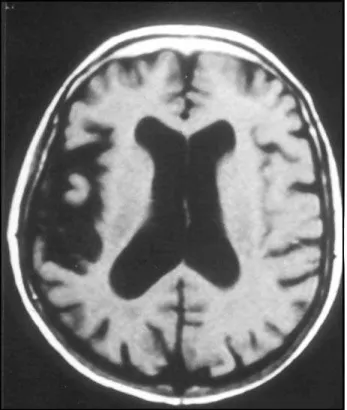
Patient 4 A 60 year-old woman suddenly developed numbness in the left hand. Neurological examination dis-closed a mild left hemiparesis with Babinski sign and left hand dystonia. Severe impairment of graphestesia and stereognosia in the left limb were seen. The AHS was cha-racterised by erratic, slow and irregular levitation of the left hand, increased by closure of the eyes. Frequently she complained that her limb did not belong to her and it had its own life. MRI showed a hypointense area in the right
Fig 3 (patient 2). Right temporo-parietal atrophy disclosed by MRI.
Fig 4 (patient 3). Left parietal atrophy.
524 Arq Neuropsiquiatr 2001;59(3-A)
superior parietal lobule on T1-weighted scans, consistent with an old watershed infarct in the area between the posterior and middle cerebral arteries territories.
The Table summarises the clinical and neuroimaging features of patients reported herein.
DISCUSSION
The motor behaviour of AHS varies according to the topography of the responsible lesion. Fronto-medial and callosal damage are the most frequent findings in the majority of the reported patients 2-4,8,11. This feature is easy to explain since these areas
are clearly well related to motor planning and to its final pathways. Besides, electrical stimulation of fron-tal SMA is able to generate coordinated motor ac-tivity of the contralateral limb12,13.
In the present study, however, an evidence of contralateral parietal damage or dysfunction, as dis-closed by MRI and SPECT, was observed in four pa-tients who experienced a feeling of absence or
for-eignness of the contralateral limb with hand levita-tion when attenlevita-tion was distracted from it and they denied the ownership of the hand. In spite of being a purposeless movement, all the other manifesta-tions are essentially clinical hallmarks of a true, but not classic, AHS.
Three of our patients were affected by degen-erative diseases, what does not allow us to rule out possible associated involvement of the frontal lobes in these cases. Notwithstanding, our patient 4 had an ischaemic parietal damage, with no evidence of a frontal lobe lesion, what gives a strong support to the hypothesis of the participation of the parietal lobe lesion in the pathophysiology of such kind of AHS.
The unusual association of involuntary movemen-ts with parietal dysfunction has been already re-ported before6-9 and Ventura et al.15 reported a 58
year-old right-handed woman who developed a left AHS after a right capsulothalamic haemorrhage. No
Fig 6 (patient 3). Left temporo-pari-etal hypoperfusion disclosed by SPECT.
Table. Summary of clinical data from the four patients with AHS
Patient Main clinical feature CT / MRI SPECT AHS Probable Diagnosis 1 Parkinsonism RTP atrophy LP in RTP Left hand levitation CBGD
2 Parkinsonism RTP atrophy - Left hand levitation CBGD
3 Dementia Global atrophy LP in RTP/LTP, Right hand levitation AD (+ left parietal lobe) but marked in RTP
4 Mild left Right parietal - Left hand levitation Stroke
hemiparesis T1 hypointensity
lesion was detected in the corpus callosum and a PET scan showed a diffuse right cortical hypometabo-lism, mainly in the sensorimotor area. Two other groups9,14 have recently described isolated cases of
AHS associated with posterior cerebral artery occlu-sion, which promoted a parietal lesion. In agreement to our hypothesis, Ay et al.9 claimed that a
sen-sory or posterior form of AHS has to be distingui-shed from the motor or anterior form described more commonly in current clinical practice.
The pathophysiology of AHS associated with pa-rietal lobe lesion is not well understood. Dolado et al.7 described a right-handed patient, with a right
parietal infarct, who developed a left AHS when vi-sual clues were removed. The authors hypothesised that dorsal parieto-occipital lesions may interfere with peristriate outflow pathways toward parietal zones, where visual somato-sensory interactions are likely to occur, and this interference may explain the emergence of the alien hand behaviour. Leiguarda et al.8 also described two groups of patients with a
paroxysmal form of the AHS. One group had fronto-medial and the other, parietal damage. The former group had brief episodes of abnormal motor beha-viour of the contralateral arm. In the other group, a paroxysmal feeling of unawareness of the location of the contralateral arm and purposeless hand move-ments, generally limb levitation, were observed. The-se last features reThe-semble all caThe-ses of our study. TheThe-se authors haveproposed an epileptogenic basis to ex-plain the paroxysmal nature of the AHS: an epileptic focus may release learned motor engrams from SMA and cingulate gyrus. Based on this hypothesis, these authors8 argued that limb, axial and eye movements
may also be evoked by epileptic activity in the pari-etal lobe. This occurs especially if the epileptic focus is within Brodmann areas 5 and 7.
This epileptogenic theory is very interesting, but it has to be confirmed8. Recently, however, Feinberg
et al.16 described a 61 year-old woman with a right
hemisphere glioblastoma who developed AHS in the left hand. Simultaneous EEG documented
continu-ous spikes in the right fronto-temporal region and diazepam IV reversed the movements and EEG. Our cases did not have any evidence of epilepsy nor of epileptogenic activity on EEG.
In conclusion, the present study reinforces the idea that the clinical spectrum of AHS should include not only the classical frontomedial or callosal AHS, but also a parietal form, characterised by stereotyped simple hand levitation. This form of AHS probably arises as a consequence of a major parietal lesion or dysfunction secondary to different diseases.
REFERENCES
1. Goldstein K. Zur lebre der motorischen apraxia. Z Physiol Neurol 1908;11:169-187.
2. Brion S, Jedynak CP. Troubles du transfert interhemisphérique (cal-losal disconnection). A propos de trois observations de tumeurs du corps calleux. Le signe de la main étrangère. Revue Neurol 1972;126:257-266.
3. Feinberg TE, Schindler RJ, Flanagam NG, Haber LD. Two alien hand syndromes. Neurology 1992;42:19-24.
4. Doody RS, Jankovic J. The alien hand and related signs. J Neurol Neurosurg Psychiatry 1992;55:806-810.
5. Denny-Brown D, Meyer JS, Horenstein S. The significance of percep-tual rivalry resulting from parietal lesion. Brain 1952;75:433-471. 6. Kumar R, Bergeron C, Pollanen MS, Lang AE. Cortico-basal
Gangli-onic Degeneration. In Jankovic J; Tolosa E (eds). Parkinson’s disease and movement disorders 3.Ed. Baltimore: Lippincott Willians & Wilkins, 1998:300.
7. Dolado AM, Castrillo C, Varela de Seijas E. Alien hand sign or alien hand syndrome ? J Neurol Neurosurg Psychiatry 1995;59:100-101. 8. Leiguarda R, Starkstein S, Nogués M, Berthier M, Arbelaiz R. Paroxysmal
alien hand syndrome. J Neurol Neurosurg Psychiatry 1993;56:788-792. 9. Ay H, Buonanno FS, Price BH, Le DA, Koroshetz WJ. Sensory alien
hand syndrome : case report and review of the literature. J Neurol Neurosurg Psychiatry 1998;65:366-369.
10. Folstein MF, Folstein ME, McHugh PR. “Mini-mental state”: a practi-cal method for grading the cognitive state of patients for the clinician. J Psychiatr Res 1975;12:189-198.
11. Goldberg K, Mayer NH, Togli JV. Medial frontal cortex infarction and the alien hand sign. Arch Neurol 1981;36:683-686.
12. Geschwind DH, Iacobini M, Mege MS, Zaidel DN, Cloughesy T, Zardel E. Alien hand syndrome: interhemispheric motor disconnection due to a lesion in the midbody of the corpus callosum. Neurology 1995; 45:802-808.
13. Penfield W, Welsh K. The supplementary motor area of the cerebral cortex. Arch Neurol Psychiatry 1951;66:289-317.
14. Groom KN, Ng WK, Kevorkian CG, Levy JK. Egosyntonic alien hand syndrome after right posterior cerebral artery stroke. Arch Phys Med Rehabil 1999;80:162-165.
15. Ventura MG, Goldman S, Hildebrand J. Alien hand syndrome without a corpus callosum lesion. J. Neurol Neurosurg Psychiatry 1995;58:735-737. 16. Feinberg TE, Roane DM, Cohen J. Partial status epilepticus associated