Lanara Alves Pereira
I, Manuella Carvalho Feitosa
II, Grazielle Roberta Freitas da Silva
III,
Illoma Rossany Lima Leite
III, Maria Esther Silva
IV, Rômulo Diego Monte Soares
VI Albert Einstein Israelite Hospital, Multiprofi ssional Residency in Intensive Therapy. Teresina, Piauí, Brazil.
II Universidade Federal de Roraima, Nursing Department. Boa Vista, Roraima, Brazil.
III Universidade Federal do Piauí, Center for Health Sciences. Teresina, Piauí, Brazil.
IV Emergency Hospital of Teresina, Healthcare Clinic. Teresina, Piauí, Brazil.
V Hospital São Paulo. Teresina, Piauí, Brazil.
How to cite this article:
Pereira LA, Feitosa MC, Silva GRF, Leite IRL, Silva ME, Soares RDM. Patients with HIV/Aids and ulcer risk: nursing care demands. Rev Bras Enferm [Internet]. 2016;69(3):538-44. DOI: http://dx.doi.org/10.1590/0034-7167.2016690322i
Submission: 04-10-2015 Approval: 01-30-2016
ABSTRACT
Objective: to analyze the demand for nursing care and the risk of pressure ulcers (PU) of patients with HIV/Aids. Method:
quantitative survey, carried out from December 2012 to March 2013 in a public hospital of Teresina, state of Piauí, Brazil.
Results: the sample of 31 patients was predominantly male, mean age 36.6 years, average care demand 49.4%, most showing some risk of developing PU. The variables correlated with PU risk were care demand and clinical outcome (death). Those associated with care demand were age and clinical outcome (death). Conclusion: the results showed that patients require moderate nursing care needs and most of them present risk of developing PU.
Descriptors: Nursing; Nursing care; Pressure Ulcer; Intensive Care Units; Acquired Immunodefi ciency Syndrome.
RESUMO
Objetivo: analisar a demanda de cuidados de enfermagem e o risco para desenvolvimento de úlcera por pressão (UP) em pacientes com HIV/Aids. Método: pesquisa quantitativa, realizada de dezembro de 2012 a março de 2013 em hospital público de Teresina-PI. Resultados: a amostra de 31 pacientes foi majoritariamente do sexo masculino, média de 36,6 anos de idade, média da demanda de cuidados de 49,4% e a maioria apresentou algum risco para desenvolver UP. As variáveis correlacionadas com o risco para o desenvolvimento de UP foram: demanda de cuidados e desfecho clínico (óbito). Já as que se associaram com a demanda de cuidados foram: idade e desfecho clínico (óbito). Conclusão: Os resultados obtidos demonstram que os pacientes demandam moderada necessidade de cuidados de enfermagem e maior parte deles apresenta risco para desenvolvimento de UP.
Descritores: Enfermagem; Cuidados de Enfermagem; Úlcera por Pressão; Unidades de Terapia Intensiva; Síndrome da Imunodefi ciência Adquirida.
RESUMEN
Objetivo: analizar la demanda de atención de enfermería y el riesgo de desarrollar úlceras por presión (UP) en pacientes con HIV/SIDA. Método: estudio cuantitativo realizado desde diciembre 2012 hasta marzo 2013 en un hospital público de Teresina-PI. Resultados: la muestra de 31 pacientes, en su mayoría hombres, edad media de 36,6 años, la demanda de atención media de 49,4% y la mayoría mostró un cierto riesgo de desarrollar UP. Las variables correlacionadas con el riesgo de desarrollar UP fueran: demanda de atención y el resultado clínico (muerte). Las variables asociadas con la demanda de atención fueron la edad y el resultado clínico (muerte). Conclusión: Los resultados mostraron que los pacientes demandan moderada necesidad de cuidados de enfermería y la mayoría presenta riesgo para el desarrollo de UP.
Descriptores: Enfermería; Cuidados de Enfermería; Úlcera por Presión; Unidades de Cuidados Intensivos; Síndrome da Inmunodefi ciencia Adquirida.
Patients with HIV/Aids and ulcer risk: nursing care demands
Pacientes com HIV/Aids e risco de úlcera: demandas de enfermagem
Pacientes con HIV/Sida y el riesgo de úlcera: demandas de enfermería
Lanara Alves Pereira E-mail: [email protected]
INTRODUCTION
Nursing care is established according to patients’ needs, as well as their clinical characteristics, and should be based on humanized, contextualized and integrated health care. Re-garding the care of patients with HIV/AIDS, it is worth not-ing that nursnot-ing work is provided in all stages of infection, contributing to improve the quality of life of patients and the provision of quality care services.
There is need for better description and quantification of nursing care provided to these patients during hospitaliza-tion periods, so that this knowledge may be used to plan care services with professionals and resources that are appropriate in both quantity and quality. In its scope, this premise also allows institutions to meet patients’ rights to risk-free health care, and can also avoid the exposure of failures related to work overload and deficient care quality(1), especially the oc-currence of pressure ulcer (PU), which subjects patients to longer hospitalization periods and is a major problem in the search for quality in health services.
HIV/Aids patients present, particularly when hospitalized, a widespread impairment of bodily functions, which results in weakness and emaciation. This leads to loss of adipose tissue and increased exposure of bony prominences, in ad-dition to a highly deficient nutritional conad-dition. Thus, these patients become more susceptible to the development of PU. According to the National Pressure Ulcer Advisory Panel (NPUAP), this is a type of injury located in the skin or un-derlying tissue, usually found in areas of bony prominences, and is the result of prolonged external pressure(2).
Nursing care directed towards patients with HIV/Aids is challenging, since all organ systems are potential targets of infections or cancer. In addition, this disease is compli-cated by many emotional, social and ethical issues. There-fore, care plans and interventions for patients with HIV/Aids must be individualized in order to meet the patients’ needs, help them face the reactions to antiretroviral therapy, and reinforce social and emotional support and adherence to treatment. Furthermore, they must be directed towards more complex and continuous interventions in the event of a pos-sible hospitalization. These are some of the care measures that can provide people with HIV with the prospect of a long, good quality life(3).
A recent instrument used both in the Intensive Care Unit (ICU) and in other hospital units, and which affords the pos-sibility of systematizing and managing nursing care with better quality, is the Nursing Activities Score (NAS). This in-strument consists of 23 items and is subdivided into seven major categories, ranging from basic activities to more com-plex care procedures. Each item is assigned a score ranging from 1.2 to 32.0, and the total score resulting from the added scores of each item may vary from 0 to 176.8%, which cov-ers, on the whole, 80.8% of the time spent by nursing profes-sionals in caring for patients, and corresponds to the direct and indirect care needs required by patients over 24 hours(4). High NAS scores mean high dependence of individual pa-tients on nursing care. However, there are no cutoff points
for the categorization and ordinal classification of this de-mand based on the score.
Depending on the patient’s clinical situation, the demand for specialized care with or without the use of complex technology may be high, given the need and concern of the health team to prioritize the stabilization of the patient’s situ-ation. Therefore, those body health maintenance procedures which include skin integrity, emotional integrity, and family ties can become jeopardized or hampered(5).
In this context, it is observed that the nursing staff’s work-load increases about 50% when the patient develops PU. Thus, prevention in patient care is extremely important, since it also brings benefits to the health system(6).
Predicting PU risk is the first measure adopted to prevent the injury. The more extensively tested and used risk evalu-ation tool is the Braden Scale. This scale has been translat-ed into several languages, including Portuguese, Chinese, Japanese, French, German and Italian, and is used in health institutions from various countries. The scale evaluates six risk factors (subscales): sensory perception, moisture, physi-cal activity, nutrition, mobility, and friction and shear. All subscales score from 1 to 4, except friction and shear, which scores from 1 to 3. Total scores range from 6 to 23, with a low score on the Braden Scale indicating low functional abil-ity and, therefore, high risk of the patient developing PU(5).
Within this perspective, the main objective of the study was to analyze the demand for nursing care and the risk of PU in hospitalized patients with HIV/Aids, and the specific objectives were to verify the correlation of care demand and PU risk to age, length of stay and clinical outcome, and as-sess the association between care demand and PU risk.
METHOD
Ethical Aspects
The study was preceded by the approval of the Research Eth-ics Committee of the Federal University of Piauí, and the signing of the free and informed consent according to Resolution No. 466/12 of the Brazilian National Health Council (MEC).
Study Design and Location
This cross-sectional study was carried out in three adult inpa-tient units, two of which were wards and one an ICU, in a medi-um-sized state public hospital in the city of Teresina, state of Piauí, Brazil. This is a benchmark hospital for the diagnosis and treat-ment of infectious diseases. Nursing care of patients with HIV/ AIDS is carried out in a systematic way, following all the steps of the Nursing Care Systematization (NCS). There are no risk assess-ment protocols of these patients in said hospital, but the Braden Scale is used to classify patients regarding PU risk. It should also be noted that no instrument to check the demand for nursing care is used in the hospital, so the study opted to administer the NAS.
Population/Sample and Period
were patients aged 18 or over, undergoing clinical treatment, and who were hospitalized for at least 24 hours in the selected units. Readmissions were excluded.
Study Protocol
Data were collected by means of a form divided into three parts: the first with the patients’ demographics, such as sex and age; the second with the NAS score; and the third one containing the Braden Scale. The sample consisted of 31 medical records, calculated from a sampling error of 5% and a confidence level of 95%, based on the average number of patients admitted to the hospital chosen for the study.
For standardization purposes, NAS was administered ret-rospectively, on a daily basis, throughout the patients’ whole length of stay, to establish a care demand average for each individual. The Braden Scale scores were also collected daily, albeit prospectively, and the following strata were considered: ≤ 9 = very high risk, 10-12 = high risk, 13-14 = moderate risk, 15-18 = low risk, 19-23 = no risk(5).
Analysis of results and statistics
The data were stored in a Microsoft Office Excel 2007 electronic database and analyzed using the software package Statistical Package for the Social Sciences version 18.0. The results were organized in tables and figures for better visual-ization and comprehension of results.
The statistical analyses considered mean NAS and Braden Scale values. The correlations between “Care Demand - Mean NAS” (dependent variable), “Age” and “Length of Stay” (inde-pendent variables) were executed by using the nonparametric Spearman test, since the variables showed no adherence to the normal distribution curve. The same test was used in the corre-lations between “PU Risk - Mean Braden” (dependent variable), “Age” and “Length of Stay” (independent variables), and the correlation between “Care Demand - Mean NAS” (independent variable) and “PU Risk (mean Braden)” (dependent variable). Results with p-values lower than 0.05 and with a 95% confi-dence interval were considered statistically significant.
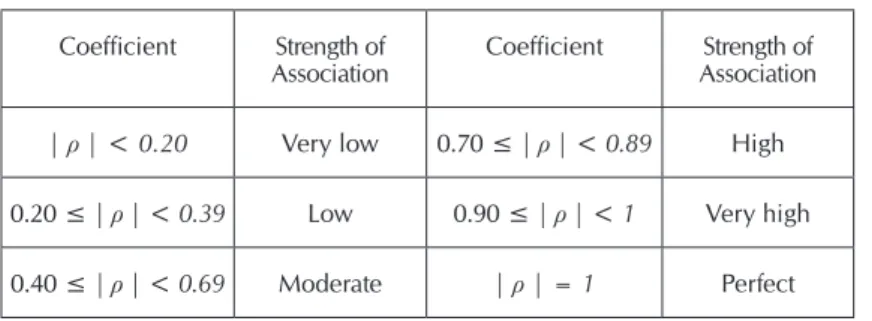
Besides the p-values, Spearman’s correlation coefficient values (ρ) were also analyzed, regarding strength of associa-tion, based on Pestana and Gageiro’s table(7) , as follows:
The coefficient of determination (R²) was calculated manu-ally by calculating the square of the correlation coefficient,
demonstrating to what extent the variation of the dependent vari-able is explained by the variation of the independent varivari-able.
To assess whether mean NAS and Braden Scale scores were significantly different between patients who survived and those who progressed to death (clinical outcome), the nonparametric Mann-Whitney test was also used, since these variables also did not present a normal distribution.
All ethical standards were met, according to Resolution No. 466/12 of the Brazilian National Health Council (MEC): the project originating this study was submitted to the Ethics Committee of the Federal University of Piauí and approved with CAAE (Certificate of Presentation for Ethical Assessment) No. 02750012.0.0000.5214; the subjects were instructed and asked to sign the Informed Consent Form if they agreed to par-ticipate in the study; a confidentiality agreement and a request for authorization to use medical records were also drawn up.
RESULTS
The sample consisted of 31 patients, 64.5% (20) of them men. The mean age was 36.6 years (SD = 10.4 years), ranging from 21 to 64 years.
Regarding inpatient units, 21 patients (54.8%) were in the hospital wards and only 10 patients (32.3%) were admitted to the ICU. Furthermore, there were situations in which, owing to deteriorated clinical conditions or stability of vital functions, pa-tients were transferred from the wards to the ICU or vice versa; 12.9% (4) of patients were involved in these changes. The aver-age length of stay was 26.6 days (SD = 16.4 days), ranging from 6 to 63 days. As for clinical outcome, the mortality rate was 38.7%, with 12 patients progressing to death. A total of 459 NAS measures was carried out, with an average percentage of 49.4% (SD = 22.8%) and variation of 22.4% to 149.2%.
As shown in Table 1, we observed that 16 of the 31 patients (51.6%) showed some risk of developing PU, with 9 (29.0%) of these patients classified as very high risk, while 15 (48.4%) individuals showed no PU risk.
Correlation of care demand with patients’ age (Figure 1) was statistically significant (p=0.010), positive, and of mod-erate magnitude (ρ=0.43). The coefficient of determination found was 0.18 (18%).
Figure 2 shows a significant difference in mean NAS scores between surviving patients and those progressing to death (p≤0.01).
There was also a significant difference (p<0.01) in mean Braden scores between surviving patients and those progressing to death (Figure 3).
As to the correlation between mean NAS and Braden scores (Figure 4), we observed that it was statistically significant (p<0.01), negative, of high magnitude (ρ=-0.81), and that 66% of mean Braden variation (PU risk) can be explained by mean NAS variation (patients’ care demand).
There was no statistically significant cor-relation between the variables mean NAS and length of stay (p = 0.488), nor between mean Braden and length of stay (p = 0.144) and age (p = 0.084).
Box 1 – Spearman (ρ) correlation coefficients
Coefficient Strength of
Association Coefficient AssociationStrength of
| ρ | < 0.20 Very low 0.70 ≤ | ρ | < 0.89 High
0.20 ≤ | ρ | < 0.39 Low 0.90 ≤ | ρ | < 1 Very high
Table 1 – Distribution of patients by PU risk, according to the Braden Scale, Teresina, Piauí, Brazil, 2013 (N=31)
n %
Very high risk 9 29.0
High risk 6 19.4
Moderate risk 1 3.2
Low risk -
-No risk 15 48.4
Total 31 100
DISCUSSION
The findings show that the patients in the study have a sig-nificant need for care, which means a high workload for nurs-ing professionals. This, in turn, can affect PU risk, since the clinical conditions of patients requiring longer nursing care is usually more severe.
A predominance of male patients was observed (64.5%) in this study. This fact is consistent with the findings of the latest Epidemiological Bulletin of the Brazilian Ministry of Health (MS), in which out of 608,230 AIDS cases recorded, 397,662 (65.4%) were male individuals(8). The mean age was 36.6 Age (years)
120.0%
100.0%
80.0%
60.0%
40.0%
20.0%
p=0.010 ρ=0.43** R2=0.18
20 30 40 50 60 70
Mean N
AS
Notes: **Spearman Test; Moderate strength of association 0.40 ≤ |ρ| <0.69.
Figure 1 – Diagram of association dispersion between mean NAS and patients’ age, Teresina, Piauí, Brazil, 2013 (N = 31)
Mean N
AS
Survivor Death
p=0.000**
120.0%
100.0%
80.0%
60.0%
40.0%
20.0%
0%
Clinical Outcome
Note: **Mann-Whitney Test.
Figure 2 – Comparative Box Plot of mean NAS according to patients’ clinical outcome, Teresina, Piauí, Brazil, 2013 (N= 31)
Mean Br
aden
p=0.000** 25
20
15
10
5
0
Clinical Outcome Survivor Death
Note: **Mann-Whitney Test.
Figure 3 – Comparative Box Plot of mean Braden according to patients’ clinical outcome, Teresina, Piauí, Bra-zil, 2013 (N= 31)
Mean NAS 20
15
10
p=0.000 ρ=0.81** R2=0.66
20.0% 40.0% 60.0% 80.0% 100.0% 120.0%
Mean Br
aden
Note: **Spearman Test; High strength of association 0.70 ≤ |ρ| < 0.89.
years in 2010 and the age group that showed Brazil’s largest incidence rate was 35 to 39 years old (38.1 cases/100,000 inhabitants)(8). The study’s sample therefore presented socio-demographic characteristics consistent with national epide-miological trends.
These data on age and sex are worrying, given the predom-inance of young people in the prime of their productive and sexual lives, affording a greater chance of perpetuating and transmitting the infection. In addition, the increasing number of cases in women in reproductive age may contribute to the increase of cases of vertical transmission.
As for the admission units, most patients (54.8%) were in the hospital wards, which may suggest less severe clini-cal states and more stable conditions, while only 10 patients (32.3%) were in the ICU, in conditions of greater dependence and weakness. However, some subjects (12.9%) were admit-ted to both inpatient units (ICU and wards); one possible ex-planation for this fact is the clinical susceptibility and need for continuous monitoring of these patients.
The average length of stay was 25.5 days. In this sense, two national studies that analyzed clinical-epidemiological and so-cio-demographic variables obtained an average length of stay of 11.6 and 37.4 days(9-10). This indicates that HIV-positive patients may have immunological impairment ranging from mild to se-vere and progressive, often depending on the characteristics of comorbidities, mostly opportunistic. This factor is used to define from short lengths of stay to extended hospitalizations.
The 38.7% mortality rate was similar to the results of other studies(10-11). It should be reaffirmed that only one ward patient died, while eight ICU patients (of ten) and three ward patients (of four) who were admitted to both sectors did not leave the hospital alive. This high mortality rate can be attributed to sever-al factors, ranging from the specific characteristics of the patients treated in these units, who may present prior poor health condi-tions that contributed to the greater severity and grim prognosis of their state, to the very issue of service infrastructure. It should be emphasized that the hospital where the study was carried out has only seven ICU beds. On this topic, a study shows that in institutions where ICU beds are scarce, these are seldom offered to less severe patients, and, consequently, more patients with few chances of survival are admitted(10).
The average score of nursing workload obtained (49.4%) was compatible with the findings of other studies, which ranged from 52.7% to 66.5%(12-14). Therefore, there are high levels when considering care requirements and, consequent-ly, the nursing workload.
The small difference between the abovementioned values is probably associated with the fact that the study’s overall mean NAS was calculated based on values gauged for both ICU pa-tients and ward papa-tients, the latter of whom are more indepen-dent regarding self-care, and therefore require less time from the nursing staff. In the other studies, on the other hand, NAS was administered only to ICU patients, which, in turn, are patients who need more care time, due to continuous monitoring and also the severity of their condition. In the absence of studies us-ing NAS and the Braden Scale in patients with HIV/AIDS, it is difficult to analyze the results in light of other realities. Thus, the
characteristics of patients treated in the wards may have contrib-uted to a reduction in the overall mean NAS.
Regarding PU risk, most of the subjects presented some risk of this condition, which allows us to assume that most of the studied population had some of the PU risk factors of the Braden Scale, namely: sensory perception, moisture, physical activity, mobility, nutrition, and friction and shear. Many patients admit-ted to the wards had no mobility/physical activity deficit, which is a determining factor in the disruption of skin surface.
A noteworthy figure is that 29.0% of subjects are in the very high risk category, most of them undergoing intensive treatment, in a state of inactivity and subject to an inappropri-ate diet, among other factors that strongly predispose them to developing PU. The result of the study by Oliveira(15), which also examined associations between nursing workload and occurrence of PU, corroborates this finding, inasmuch as it showed a 27.1% percentage of very high PU risk. However, this figure differs from that found in another national study(5), in which the group classified as having very high risk amount-ed to only 10.8% of the total. This significant number of pa-tients who were classified as having very high PU risk is repre-sented by patients with high vulnerability to factors that affect skin integrity, mainly caused by their medical condition, thus requiring continuous and intensive care from the nursing staff.
Patients at more advanced ages required longer care time from the nursing staff, according to NAS items and sub-items and confirmed by the statistical association found (p=0.010). It is therefore observed that older patients with higher de-pendence on nursing care (which may be related to loss of functional capacity) greatly contributed to increase the nurs-ing workload. In contrast, Cyrino and Dell’Acqua(1) and Leite, Silva and Padilla(16) found no statistical correlation between mean NAS and age of investigated patients. Therefore, age is not always an indicator of high care demand.
Regarding the relationship between clinical outcome and workload, we observed that patients who progressed to death presented a significantly higher mean NAS than patients who survived (p <0.001), indicating that severe patients require more time for therapeutic interventions throughout their stay in the inpatient unit, especially due to their clinical instability, reaching high NAS values. This result is confirmed by other studies (16-17).
Moreover, it can be observed that the demand for nurs-ing care by patients who died ranged more than the demand by patients who survived. The latter showed more homoge-neous values, close to the group average, rendering a flatter appearance of the Box Plot representing their distribution. Still regarding mortality, subjects with an unfavorable clinical outcome showed a significantly lower average on the Braden Scale compared to patients who did not die, i.e., higher PU risk. Analysis of this correlation did not differ from the results obtained in other national studies(15,18).
suggested in the national and international literature. In this con-text, we found, through significant association, that the greater the demand for patient care (mean NAS), the greater the risk of developing PU, demonstrated by the low scores on the Braden Scale (p=0.000). This finding contradicts a study carried out in three ICUs of a tertiary-level university hospital located in São Paulo, Brazil(5), in which the presence of PU and the workload measured by NAS showed no association (p = 0.702) . On the other hand, in verifying the correlation between total NAS and Braden scores (Spearman test), Oliveira(14) also found a sig-nificant negative correlation between the two (p <0.01), which supports the findings of this study.
The statistically significant result (p<0.01) of the correla-tion between mean NAS and Braden scores is related to the importance of quality care and the importance of the appro-priate allocation of nursing resources, especially in the ICU, considering, in this case, the impact of workload on service quality, patient safety, and the occurrence of adverse hospi-talization events, such as PU. As one of the main measures for PU prevention, position change is essential and should be carried out considering the circumstances of individual pa-tients, including: level of activity and mobility, skin condition, general treatment goals and comfort (19).
As for age and length of stay, similar to another national study(19), there was no statistically significant association indi-cating that these variables influenced the development of PU (p=0.084 and p=0.144, respectively). However, the above-mentioned study revealed an association between length of stay and occurrence of PU (p=0.015).
Regarding the variables length of stay and NAS, no statisti-cally significant association was found (p=0.976), but these are variables that currently provoke controversy in the litera-ture. A study analyzing nursing care demand(20) corroborates this finding by showing a similar result regarding the signifi-cant relationship between these variables. In contrast, in the study of Panunto and Guirardello(13), which evaluated nurs-ing workload in an ICU for adults, this correlation showed a significant statistical difference (p=0.003), suggesting thereby that length of stay has an influence on mean NAS values.
The findings indicate that the number of nursing staff should be based on the institution’s characteristics, the ser-vices provided by nurses and the patients cared for, since the adequate provision of personnel will result in excellence of staff services, increased productivity, safe and satisfactory hos-pitalization, and decreased spending on preventable compli-cations, such PU.
The high complexity of the studied population justifies the use of tools to assist in adjusting the quantity of professionals to ensure safe quality care, as the scales used allow the strati-fication of the risks to which patients are exposed, as well as their actual care needs, therefore assisting in the unit’s man-agement decision-making processes, such as staff sizing and care allocation.
It is important to point out, as a limitation of this study, that the data were collected retrospectively from patients’ medical records, and that a need was identified to improve nursing records regarding activities carried out with patients over 24 hours, to produce a more accurate picture so that the nursing workload is not underestimated in studies such as this one.
Thus, adjustment of nursing staff and assessment of their workload and respective effect on health care results are the focus of interest of nurses, since, to ensure quality care, it is essential that the number of staff is commensurate with the care demands of individual patients.
CONCLUSION
The specific population composing this study presents a high need for health care, thus imposing high demands on the nursing staff. A significant statistical relationship was found between NAS and Braden Scale ratings, demonstrating that scores achieved in the former reflect on the latter. A statisti-cally positive relationship was obtained between nursing care demand and patient age, similar to the correlation between mean NAS and Braden Scale scores. In contrast, no statistical-ly significant correlation was found between the variables of mean NAS and length of stay, neither between mean Braden scores and length of stay and patient age.
REFERENCES
1. Cyrino CMS, Dell’acqua MCQ. [Assistance sites in the intensive care unit and the relation from nursing activi-ties score with the hospital infection]. Esc Anna Nery Rev Enferm [Internet]. 2012[cited 2015 Dec 16];16(4):712-8. Available from: http://www.scielo.br/pdf/ean/v16n4/10.pdf Portuguese.
2. National Pressure Ulcer Advisory Panel, European Pressure Ulcer Advisory Panel and Pan Pacific Pressure Injury Al-liance. Prevention and treatment of pressure ulcers: quick reference guide. Emily Haesler (Ed.). Cambridge Media: Os-borne Park, Australia; 2014.
3. Smeltzer SC, Bare BG, Hinkle JL, Cheever KH. Tratado de enfermagem médico-cirúrgica.11ª Ed. Rio de Janeiro:
Guanabara Koogan, 2009.
4. Queijo AF, Padilha KG. NURSING ACTIVITIES SCORE (NAS): cross-cultural adaptation and validation to Portu-guese language. Rev Esc Enferm USP [Internet]. 2009[cit-ed 2015 Dec 16];43(n esp):1001-8. Available from: http:// www.scielo.br/pdf/reeusp/v43nspe/en_a04v43ns.pdf 5. Cremasco MF, Wenzel F, Sardinha FM, Zanei SSV,
Whita-ker IY. Pressure ulcer: patient risk, patient acuity, and nursing workload. Acta Paul Enferm [Internet]. 2009[cited 2015 Dec 16];22(n esp): 897-902. Available from: http:// www.scielo.br/pdf/ape/v22nspe/en_11.pdf
cited 2015 Dec 16];24(6):772-7. Available from: http://www. scielo.br/pdf/ape/v24n6/en_a07v24n6.pdf
7. Pestana MH, Gageiro JN. Análise de dados para ciências sociais: a complementariedade do SPSS. 3ªed. Lisboa: Sí-labo; 2003.
8. Brasil. Ministério da Saúde, Secretaria de Vigilância em Saúde, Departamento de DST, Aids e Hepatites Virais. Boletim epidemiológico - Aids e DST: versão preliminar. Ano VIII, n. 1. Brasília (DF): MS; 2011.
9. Nunes AA, Vergara MLS, Melo IM, Silva ALA, Rezende LSA, Guimarães PB. Perfil clínico- epidemiológico de pa-cientes com HIV/Aids internados em um hospital de en-sino do Brasil. Rev Panam Infectol. 2008 Jun; 10(3):26-31. 10. Antunes CM. Predictors of the short- and long-term sur-vival of HIV-infected patients admitted to a Brazilian in-tensive care unit. Int J STD AIDS [Internet]. 2012[cited 2015 Dec 16];23(10):692-7. Available from: http://std. sagepub.com/content/23/10/692.abstract
11. Ultramari L, Moretto PB, Gir E, Canini SRMS, Teles SA, Gas-par J, et al. Perfil clínico e epidemiológico da infecção pelo HIV/Aids em idosos. Rev Eletrônica Enferm [Internet]. 2011 [cited 2015 Dec 16];13(3):405-12. Available from: http://re-vistas.ufg.emnuvens.com.br/fen/article/view/11816 12. Ducci AJ, Padilha KG, Telles SCR, Gutierrez BAO.
Gravi-dade de pacientes e demanda de trabalho de enferma-gem em unidade de terapia intensiva: análise evolutiva segundo TISS-28. Rev Bras Terap Intens. 2004;16(1):22-7. 13. Panunto MR, Guirardello EB. Nursing workload in an in-tensive care unit of a teaching hospital. Acta Paul Enferm [Internet]. 2012[cited 2015 Dec 16];25(1):96-101. Available from: http://www.scielo.br/pdf/ape/v25n1/en_v25n1a17.pdf 14. Gonçalves LA, Garcia PC, Toffoleto MC, Telles SCR, Padil-ha KG. [The need for nursing care in Intensive Care Units:
daily patient assessment according to the Nursing Activi-ties Score (NAS)]. Rev Bras Enferm [Internet]. 2006[cited 2015 Dec 16];59(1):56-60. Available from: http://www. scielo.br/pdf/reben/v59n1/a11v59n1.pdf Portuguese. 15. Oliveira CR. Associações entre carga de trabalho de
en-fermagem e ocorrência de úlceras por pressão em pacien-tes internados em unidade de terapia intensiva. [Disserta-ção]. Escola de Enfermagem da Universidade Federal de Minas Gerais. Belo Horizonte, 2012.
16. Leite IRL, Silva GRF, Padilha KG. Nursing Activities Score and demand of nursing work in intensive care. Acta Paul Enferm [Internet]. 2012[cited 2015 Dec 16];25(6):837-43. Available from: http://www.scielo.br/pdf/ape/v25n6/ en_v25n6a03.pdf
17. Lima MKF, Tsukamoto R, Fugulin FMT. [Application of the nursing activities score in patients with high depen-dency on nursing care]. Texto Contexto Enferm [Internet]. 2008[cited 2015 Dec 16];17(4):638-46. Available from: http://www.scielo.br/pdf/tce/v17n4/03.pdf Portuguese. 18. Sousa CA, Santos I, Silva LD. [Applying recommendations of
the Braden’s Scale and preventing pressure ulcers: evidenc-es for nursing care]. Rev Bras Enferm [Internet]. 2006[cited 2015 Dec 16];59(3):279-84. Available from: http://www. scielo.br/pdf/reben/v59n3/a06v59n3.pdf Portuguese. 19. Fernandes LM, Caliri MHL. Using the Braden and Glasgow
scales to predict pressure ulcer risk in patients hospitalized at intensive care units. Rev Latino-Am Enfermagem [Inter-net]. 2008 [cited 2015 Dec 16];16(6):973-8. Available from: http://www.scielo.br/pdf/rlae/v16n6/06.pdf