79 Cerâmica 53 (2007) 79-82
INTRODUCTION
Mixed oxides, particularly those of general formula ABO3 (A and B are d and f transition metals), which crystallize in the perovskite structure have been studied for a range of new applications. These materials are usually stable at high temperatures and depict a series of interesting electric, magnetic, catalytic and optical properties [1, 2]. Inorganic pigments, traditionally obtained from naturally occurring minerals or by ceramic processing [3, 4], have been produced using different approaches such as combustion synthesis [5], polymeric precursor method [6] and precipitation [7]. Alternative synthesis routes have been tested aiming at improved powder characteristics, especially particle size, which enhances the coloring effect of the pigment as it is used in ceramic glazes [8]. In general, light
scattering improves with reduced particle size, producing glazes with superior optical performance [9]. In this context, ceramic pigments based on iron oxide (Fe2O3) doped with lanthanum or yttrium, were synthesized from polymeric precursors using Pechini´s method. The resulting powders were characterized and the effect of rare earth addition on
the inal color of the pigment was studied b� UV-visible and
colorimetric analyses.
EXPERIMENTAL PROCEDURE
RE-FeO3 (RE = Y, Fe) mixed oxides were synthesized from polymeric precursors using the method proposed by Pechini [10]. Lanthanum nitrate La(NO3)3.X�2O and Yttrium nitrate Y(NO3)3.X�2O were obtained from the reaction of La2O3 or Y2O3 with citric acid (�NO3, Aldrich Steinhein, Abstract
Iron oxide has been doped with rare earth ions (yttrium or lanthanum) aiming at producing ceramic pigments with hues that vary from orange to brown. The powders were synthesized from polymeric precursors using the Pechini method and subsequently calcined between 900 and 1100 ºC. The resulting pigments were characterized by BET, X ray diffraction, colorimetric analysis, UV-visible, infrared (FTIR), particle size distribution and thermal analysis. The color depicted by La/Fe powders changed as the calcination temperature increased from 900 ºC to 1100 ºC, as established by the corresponding changes in the values of the colorimetric coordinates from L* a* b* = 49.003, 10.541, 12.609 to L* a* b* = 31.279, 6.096, 6.877. On the other hand, Y/Fe powders were little affected by similar changes in the calcination temperature, revealing the effect of yttrium on the color stability of the powder. The values of the colorimetric coordinates in this case varied from L* a* b* = 45.230, 17.315, 28.750 to L* a* b* =51.631, 15.726, 25.825. Structural changes were also noticed as a function of the size of the rare earth ion added to the structure. Upon calcination at 900°C, lanthanum stabilized the ABO3-type perovskite structure whereas the presence of yttrium resulted in a mixture of oxides.
Keywords: rare earths, ceramic pigments, colorimetry.
Resumo
Óxido de ferro foi dopado com íons de terras raras (ítrio e lantânio) para a produção de pigmentos cerâmicos com colorações que variaram de laranja a marrom. Os pigmentos foram produzidos na forma de pós sintetizados pelo método Pechini a partir de precursores poliméricos e calcinados entre 900 ºC e 1100 ºC. Os materiais resultantes foram caracterizados por BET, difração de raios X, colorimetria, UV-visível, espectroscopia no infravermelho (FTIR), análise granulométrica e térmica. A cor dos pós de La/Fe foi alterada a medida que a temperatura de calcinação aumentou de 900 ºC a 1100 ºC. As correspondentes coordenadas colorimétricas L* a* b* mudaram de 49,003; 10,541; 12,609 para 31,279; 6,096; 6,877. Por outro lado pós do sistema Y/Fe demonstraram maior estabilidade colorimétrica com a mudança da temperatura de calcinação. Nesse caso, as coordenadas colorimétricas L* a* b* mudaram de 45,230; 17,315; 28,750 para 51,631; 15,726; 25,825. O tamanho do íon de terra rara usado na dopagem também afetou a estrutura do material. A presença de lantânio estabilizou a estrutura perovisquita ABO3 após calcinação a 900 °C, enquanto a adição de ítrio resultou em uma mistura de óxidos calcinados.
Palavras-chave: terras raras, pigmentos cerâmicos, colorimetria.
Synthesis and characterization of lanthanum- and
yttrium-doped Fe
2O
3pigments
(Síntese e caracterização de pigmentos de Fe
2O
3dopados com lantânio e ítrio)
D. M. A. Melo, M. A .F. Melo, A. E. Martinelli, Z. R. Silva, J. D. Cunha, A. C. Lima
80 D. M. A. Melo et al. / Cerâmica 53 (2007) 79-82
Germany). The concentrations of metallic íons La3+ and Y3+
were established by complexiometric titration using EDTA. Fe3+ citrate solution was prepared f at 60 °C under constant
stirring from Fe(Cl3)3(aq.) setting the molar ratio to 1:3 with respect to citric acid. La(NO3)3(aq.) or Y(NO3)3(aq.) were then mixed to the Fe3+ citrate solution and hated up to 90 ºC.
Subsequently, ethyleneglycol was added at a ratio of 60:40 (citric acid to ethyleneglycol). This solution was stirred and heated up to the point where a transparent gel was formed. The gel was then calcined at 300 ºC for 2 h at a heating rate of 5 ºC/min. A sponge-like powder was formed and comminuted in a Pulverisete 2000 planetary mill.
The calcination temperature of the pigments was established by thermogravimetric analyses carried out under air in a Perkin Elmer system. The heating rate was 10 ºC/min. Infrared patterns were used to evaluate whether organic residues remained in the material after calcination at 500, 700 or 900 ºC. A Perkin Elmer FTIR-16 PC set-up was used to that end. KBr samples (1 wt.% pigment) were previously dried at 100 ºC for 4 h and pressed under 4 ton during 5 min. The presence of crystalline phases was established by X ray diffraction using a Shimadzu XRD-6000 diffractometer. The angular range 5°≤ 2θ≤ 100° was scanned using CuKα radiation (λ = 1.5418 Å). The speciic surface area of the pigments was estimated by BET N2 adsorption in a Quantachrome NOVA 2000 system. For these analyses, 0.3 g powder samples were prepared at 300 ºC under vacuum. Particle size distributions were obtained using a CILAS 1064 particle size analyzer. The morphology of the powders (previously coated
with an Au ilm) was observed b� scanning electron microscop� using a Philips XL 30 ESEM s�stem. The diffuse relectance
of calcined powders was measured in the 300 to 800 nm range using a Gretac Macbeth 2180-2180 UV spectrophotometer using D65 lighting.
Finally, the color of the pigment was established from L*a*b* colorimetric coordinates according to CIE standards using
∆E2 = L2 + a2 + b2 (A)
where L* varies from black (0) to white (100), a* from green (-) to red (+)], and b* from blue (-) to yellow (+).
RESULTS
The stages of thermal decomposition of the polymeric precursor to form RE-Fe2O3, (RE: La or Y) can be visualized in Figs. 1 and 2. The onset of decomposition took place at 50 ºC with the decomposition of the citric acid present in the polymeric solution. Water decomposed up to 150 ºC and organic material between 150 and 650 ºC.
Absorption infrared spectra of the precursor powders (Fig. 3) revealed the presence of wide bands between 1500 and 1750 cm-1 corresponding to the stretching of carboxylate
groups (COO-) of the organic material. Wide rounded bands
corresponding to the stretching of (O-�) bonds, present in citric acid, and coordinated water were also observed at 3275 cm-1. At 900º, the stretching of carboxylate groups (COO-)
were no longer observed. Instead, a band at 550 cm-1 was
Figure 2: Thermogravimetric curve of the Y-Fe2O3 precursor resin calcined at 300 ºC.
[Figura 2: Curva termogravimétrica da resina precursora de Y-Fe2O3 calcinada a 300 °C.]
Figure 1: Thermogravimetric curve of the La-Fe2O3 precursor resin calcined at 300 ºC.
[Figura 1: Curva termogravimétrica da resina precursora de La-Fe2O3 calcinada a 300 °C.]
Figure 3: Infrared spectroscopy of RE-Fe2O3, (RE: La and Y) precursor resin calcined at 300 ºC .
[Figura 3: Espectroscopia no infravermelho das resinas precursoras de TR-Fe2O3 (TR: La e Y) calcinadas a 300 °C.]
Wavenumber / cm-1
3500 3000 2500 2000 1500 1000 500
%(Y / Fe2O3)
81 D. M. A. Melo et al. / Cerâmica 53 (2007) 79-82
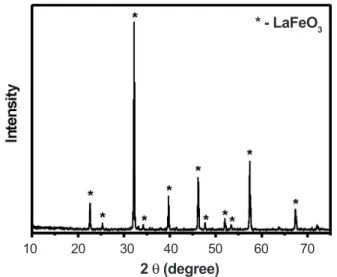
formed and could be attributed to oxide phases (Fig. 4). X ray diffraction patterns of samples calcined at 900 ºC (Fig. 5) suggested the formation of LaFeO3 depicting the perovskite structure and a polyphasic material consisting of Y2O3 and Fe2O3 (Fig. 6). Although the properties of lanthanum and yttrium are similar, their atomic radii are different, which affected the mechanisms that determine their occupancy in the host lattice. As a result, the corresponding powders were characterized by different colors determined
Figure 4: Infrared spectroscopy of RE-Fe2O3, (RE: La and Y) calcined at 900 ºC
[Figura �: Espectroscopia no infravermelho das resinas precursoras de TR-Fe2O3 (TR: La e Y) calcinadas a 900 °C.]
Figure 5: X-ray diffraction pattern of La-Fe2O3 calcined at 900 ºC. [Figura 5: Difratograma de raios X do La-Fe2O3 calcinado a 900 °C.]
Figure 6: X-ray diffraction pattern of Y-Fe2O3 calcined at 900 ºC. [Figura 6: Difratograma de raios X do Y-Fe2O3 calcinado a 900 °C.]
Figure 7: UV-Visible pattern of RE-Fe2O3, (RE: La and Y) calcined at 900 °C and 1100 ºC.
[Figura �: Padrão de UV-visível de TR-Fe2O3 (TR: La e Y) calcinados a 900 °C e 1100 °C.]
R
el
ec
ta
n
ce
wavelength / nm Wavenumber / cm-1
Table I - Colorimetric coordinates of calcined powders.
[Tabela I - Coordenadas colorimétricas dos pós calcinados.]
a samples calcined at 900 ºC - b samples calcined at 1100 ºC Sample Powder Pigments
∆E L* a* b*
LaFe a (900) 51.685 49.003 10.541 12.609
LaFe b (1100) 32.601 31.279 6.096 6.877
YFe a (900) 56.321 45.230 17.315 28.750
YFe b (1100) 59.833 51.631 15.726 25.825
* - Rare Earth (La , Y)
a samples annealed at 900 ºC - b samples annealed at 1100 ºC
Table II - Effect of temperature on the surface area of pigemnts calcined at 900 ºC and 1100 ºC.
[Tabela II - Efeito da temperatura na área de superfície
dos pigmentos calcinados em 900 ºC e 1100 ºC.]
Sample TR*:Fe S
BET Average
(ratio) (m2g-1) Diameter (µm)
LaFe a (900) 1:1 5.105.10 16.5716.5716.57
LaFe b (1100) 1:1 3.203.20 19.2519.2519.25
YFe a (900) 1:1 4.15 25.20
Yfe b (1100) 1:1 2.20 28.08
3500 3000 2500 2000 1500 1000 500
10
2 θ (degree)
20 30 40 50 60 70
20 30 40 50 60 70 80 90 100
2 θ (degree)
300 400 500 600 700 800
%(Y / Fe2O3) %(La / Fe2O3)
* - LaFeO3
82 D. M. A. Melo et al. / Cerâmica 53 (2007) 79-82
by the homogeneity of phase distribution.
UV-visible plots of La-Fe2O3 and Y-Fe2O3 (Fig. 7) included a band between 600 and 700 nm, characteristic of the emission of iron compounds. The colorimetric coordinates of the pigments were calculated (Table I). The positive values of a* indicated the reddish hue of both pigment systems. �owever, the La-Fe2O3 powder was darker, as suggested by smaller values of L*(49,003) to (31,279).
BET and particle size analyses (Table II) indicated that
the speciic surface area decreased and the average particle
size increased as the calcination temperature increased from 900 ºC to 1100 ºC for both RE-Fe2O3 systems. The increase in particle size resulting from the increase in calcination temperature contributed to particle agglomeration as it could be seen from the SEM images of LaFeO3 (Figs 8A and B) and Y2O3-Fe2O3 powders (Figs. 8C and D).
CONCLUSIONS
The addition of La3+ or Y3+ to Fe
2O3 resulted in pigments
of different colors. The La/Fe2O3 system depicted the perovskite structure whereas the addition of yttrium resulted in a polyphasic material consisting of Y2O3 and Fe2O3. The color of La/Fe powders changed with the calcination
Figure 8: SEM images of LaFeO3 powders calcined at (A) 900 ºC, (B) 1100 ºC and Y-Fe2O3 calcined at (C) 900 ºC and (D) 1100 ºC. [Figura 8: Imagens de MEV de pós de LaFeO3 calcinados a (A) 900 ºC, (B) 1100 ºC e Y-Fe2O3 calcinados a (C) 900 ºC e (D) 1100 ºC.]
(A) (B)
(C) (D)
temperature whereas Y/Fe powders were little affected. SEM analyses revealed that both powders consisted of agglomeration of particles.
REFERENCES
[1] S. Fujihara, G. Murakami, T. Kimura, J. Alloys & Comp. 243, 1-2 (1996) 70.
[2] A. Martinez-Juárez, L. Sánchez, E. Chinarro, P. Recio, C. Pascual, J. R. Jurado, Solid State Ionics 135 (2000) 525. [3] T. Leskela, M. Leskel, L. Niinisto, Thermochimica Acta 72 (1984) 229.
[4] D. M. A. Melo, J. D. Cunha, J. D. G. Fernandes, M. I. Bernardi, M. A. F. Melo, A. E. Martinelli, Mater. Res. Bull.Res. Bull. 38 (2003) 1559.
[5] Weidong Li, Jiazhi Li, Jingkun Guo, Ceram. Soc. 13 (2003) 2289.
[6] S. T. Aruna, S. Ghosh, K. C. Patil, Int. J. Inorganic Mater. 3 (2001) 387.
[7] T. Leskela, M. Lesuela, Thermochimica Acta 77 (1984) 177. [8] M. Laczka, K. Cholewa, J. Alloys & Comp. 218 (1995) 77. [9] W. E. Vargas, P. Greenwood, J. E. Otterstedt, G. A. Nilklasson, Solar Energy 6 (2000) 553.
[10] P. A. Lessing, Am. Ceram. Soc. Bull.Ceram. Soc. Bull. 68, 5 (1989) 1002.