Contribution of di- and trivalent oxides to crystal phase formations
and properties of yttrium aluminosilicate glass-ceramics
Saad M. Salman
,Samia N. Salama
,Ebrahim A. Mahdy
∗Glass Research Department, National Research Centre, Dokki, Cairo, Egypt
Received 9 June 2015; Received in revised form 8 September 2015; Accepted 25 September 2015
Abstract
The crystallization behaviour, phase composition, microhardness and chemical durability of some silicate glasses and glass-ceramics based on LiAlSi2O6-YAlSiO5 system were investigated. The effects of partial re-placements of LiAlSi2O6mostly with LiFeSi2O6and complete replacement of YAlSiO5with CaMgSi2O6 were considered. In some cases small amount of Cr2O3was introduced as nucleating agent or Fe2O3was partially replaced with chromium or indium oxides. The main crystalline phases formed after controlled heat-treatments of the glasses were yttrium-containingβ-spodumene solid solution (ss) - Li(Al,Y)Si2O6, together with varieties of pyroxene-ss including lithium iron pyroxene-ss - LiFeSi2O6-CaMgSi2O6, augite - Ca(Mg,Fe)Si2O6, chromo-augitess, Li-aegirine - LiFeSi2O6, diopside - CaMgSi2O6and lithium indium silicate - LiInSi2O6 phases. The Vickers’ microhardness values of the studied glasses (ranged from 4610 to 6185 MPa) were greatly affected by the modifications of the glass compositions. On the other hand, the glass-ceramics’ microhardness (7245– 8175 MPa) was markedly improved depending on the microstructure and the nature of crystalline phases formed. The glass-ceramics have chemical stability better than those for the corresponding glasses.
Keywords: crystallization, glass-ceramics, pyroxeness, microstructure, hardness
I. Introduction
Glass-ceramics are forward looking materials for modern technology that has many technical applications [1]. These applications depend on the complex inter-relationship of structural, compositional and process-ing variables [2]. It is well known that the properties of glass-ceramics are strongly dependent on the rela-tive amounts and types of the various crystalline phases formed. The crystalline phases in the final product de-pend on the composition, type of nucleating agent, and the heat-treatment regime of the corresponding glass [2,3]. It is possible to obtain new glass-ceramic materi-als with better, and sometimes unique properties in com-parison with their parent glasses, especially when the chemical composition of the basic glass and the crystal-lization process are properly programmed [4].
Aluminosilicate glasses containing yttria (YAS) have interesting physical properties. These glasses have high glass transition temperatures [5], interesting mechan-ical properties, high hardness [6] and great chemmechan-ical
∗
Corresponding author: tel:+201068704325, fax:+20233370931, e-mail:[email protected]
durability [7]. The structures of yttrium aluminosilicate glasses are also of great interest in glass science to elu-cidate the principle of glass formation and structure [8]. Y2O3was recently added to silicate and aluminosilicate glasses, allowing to improve the mechanical and ther-modynamic properties [9,10] and to obtain high refrac-tive indices, very low electrical conductivity and mod-erate thermal expansion coefficients. These properties make them a good alternative to borosilicate glasses cur-rently used as sealing glass for tungsten and molybde-num [11]. Kolitschet al. [12] found metastable phases for the Y2O3-Al2O3-SiO2 system in their work for es-tablishing the phase equilibrium of this system. Later, Lichvár et al. [13] also found unknown phase during their work for this system, but they did not character-ize it.
glass-ceramics with high chemical resistance and good mechanical properties [15]. As a result these glass-ceramics have found extensive application in heat ex-changers; cookware or telescope mirror supports [16].
Glass-ceramics based on pyroxene group have at-tracted interest due to the excellent controllability of their properties. Pyroxenes are capable of a wide range of isomorphous substitution in their crystal structure and have the necessary physical and chemical characteris-tics, and may form the basis for production of many crystalline and glass-ceramic materials [17]. The chain silicate structure of pyroxenes enables incorporation of various cations in their structure resulting in minerals found in abundance in the nature [18].
The present work, aims to study the crystalliza-tion behaviour, and the extent of solid solucrystalliza-tion phases formed due to the heat-treatment of some glasses based on Li2O-Al2O3-Y2O3-SiO2system with partial replace-ment of LiAlSi2O6 by CaMgSi2O6 and/or LiFeSi2O6 or CaMgSi2O6 instead of YAlSiO5. The effect of intro-ducing In2O3 or Cr2O3 at the expense of Fe2O3 on the phase relation and solid solution formed were also in-vestigated. Some physico-chemical properties of the ob-tained materials including chemical durability and hard-ness were also determined.
II. Materials and methods
2.1. Preparation of glasses
The glass batches were calculated to give different proportions of stoichiometric composition LiFeSi2O6 -YAlSiO5 in which LiAlSi2O6 was partially replaced by CaMgSi2O6 and/or LiFeSi2O6, while YAlSiO5 was completely replaced by CaMgSi2O6. In addition, in some cases small amount of Cr2O3 was introduced as nucleating agent (0.5 g of Cr2O3 was added in 100 g glass oxides) or Fe2O3was partially replaced with In2O3 or Cr2O3. Details of the glass compositions are given in Table 1. The parent glasses were prepared by the conventional melt technique. Starting materials of high purity powders in the form of oxides and carbonates were taken as Li2CO3, CaCO3, MgCO3, Al2O3, Y2O3, Fe2O3, In2O3, Cr2O3 and SiO2 (Fluka, ≥99.9% pure). Powders were accurately weighed and then thoroughly mixed in a ball agate mortar for about 15 minutes to
en-sure complete homogeneity. After mixing, batches were melted in platinum crucibles at 1350–1450 °C for 3 h with continuous stirring at intervals to achieve homo-geneity. The melt batches were cast in warm stainless steel molds in the required dimensions. The prepared samples were immediately transferred to an annealing muffle furnace regulated at 500 °C, and cooled down to room temperature to minimize thermal stresses.
The progress of crystallization in the glasses was fol-lowed using double stage heat-treatment regimes. Crys-tallization was carried out at temperatures in the region of the main DTA exothermic peak determined for each glass. The glasses were first heated according to the DTA results at the endothermic peak temperature for 5 h, which was followed by another thermal treatment at the exothermic peak temperature for 10 h.
2.2. Sample characterization
Differential thermal analysis (DTA) was carried out using a differential thermal analyser (SETARAM Lab-sys™ TG-DSC16) to detect the glass transition and crystallization temperatures and determine the opti-mum conditions for heat treatment. The cast glass was crushed and sieved between 90 and 125µm to produce glass powder suitable for DTA. About 20 mg of powder sample was placed in platinum crucible and subjected to a heating rate of 10 °C/min from ambient temperature to 1200 °C in a flowing high purity nitrogen environment.
Identification of the formed crystalline phases was conducted by X-ray diffraction (XRD) analysis of the powdered samples. XRD experiments were performed by X-ray diffractometer (PW1080, PANalytics, Nether-lands) using Ni filtered Cu-Kαradiation with scanning speed of 2° (2θ) per minute. Diffraction pattern was recorded and the phases were identified by JCPDS num-bers (ICDD-PDF2 database).
The microstructure of the heat treated samples was investigated by SEM (JEOL type JXA-840A Electron Probe Microanalyzer operated at 30 kV). The samples were fractured and the fracture positions were immersed in (1% HF+1% HNO3) solution for 60 s. The fracture surfaces were coated with a thin layer of gold by sput-tering method. SEM was carried out to analyse the mor-phology of crystals in the final glass-ceramic materials. Microhardness measurements were performed on
Table 1. Chemical composition of the glass batches
Samples LiAlSi2O6 YAlSiO5 LiFeSi2O6 CaMgSi2O6 Nucleating agent
(LAS) (YAS) (LFS) (CMS)
G1 80 20 - -
-G2 50 20 30 -
-G3 50 - 30 20
G3na 50 - 30 20 Cr2O3
G3In 50 - 30 (In2O3/Fe2O3) 20
-G3Cr 50 - 30 (Cr2O3/Fe2O3) 20
-G4 40 - 30 30
-an - indicate that 0.5 g of Cr
Table 2. Crystalline phases developed in the studied glasses
Samples Heat-treatment Crystalline phases formed [°C/h]
G1 940/5–1090/10 β-spodumene-ss
G2 885/5–1030/10 β-spodumene-ss+Li-aegirine (LiFeSi2O6)
G3 655/5–860/10 β-spodumene+Pyroxene-ss (Li,Mg,Ca)FeSi2O6
G3n 670/5–830/10 β-spodumene+Pyroxene-ss (Li,Mg,Ca)FeSi2O6
G3In 675/5–880/10 β-spodumene+LiInSi2O6+Augite
G3Cr 690/5–905/10 β-spodumene+Augite-ss
G4 640/5–850/10 β-spodumene+Diopside+Li-aegirine
Figure 1. DTA data of the investigated glasses
Figure 2. DTA data of the investigated glasses
mirror polished glass and glass-ceramic samples by using Vickers’ microhardness tester (Shimadzu, Type-HMV, Japan). Grinding and thorough polishing were necessary to obtain polished, smooth and flat paral-lel surfaces of the glass and glass-ceramic samples
be-fore indentation testing. At least six indentation read-ings were made and measured to minimize the experi-mental errors and the average of values of each sample was considered. Testing was made by 100 g load and the loading time was fixed for all samples (15 s). The mea-surements were carried out under normal atmospheric conditions. The Vickers’ microhardness value was cal-culated withHv = A(P/d2) [19], whereAis a constant equal to 1.8545 which takes into account the geome-try of squared based diamond indenter with an angle of 136° between the opposing faces,Pis the applied load anddis the average diagonal length.
The powdered method was applied to assess the chemical durability of the glass and glass-ceramic ma-terials. The samples were crushed in an agate mortar and then sieved to obtain particles with diameter ranging between 0.63 and 0.32 mm. Then the grains were then washed by decantation in ethyl alcohol three times and dried. The dried sample was accurately weighed (1 g) in a G4-sintered glass crucible, which was then placed in a 300 ml polyethylene beaker [20]. The samples were tested for their chemical durability in 200 ml of 0.1 N HCl solution introduced into the polyethylene beaker. The polyethylene beaker with its content was covered by polyethylene cover to reduce evaporation. The exper-iments were carried out at 95 °C for 1 hour. The sintered glass crucible was then transferred and kept in an oven at 120 °C for 1 hour, and then transferred in a desiccator to cool down. After cooling, the total weight loss of the samples was calculated. To obtain reproducible results and minimize the experimental errors each experiment was repeated at least twice and the weight loss (in wt.%) was taken as a measure of the relative magnitude of the acid resistivity.
III. Results
3.1. Crystallization characteristics
of YAlSiO5 (the samples G1-G4) led to the shifting of
the endothermic dips and the onset of the crystallization exotherms to lower temperature values (Fig. 1). How-ever, the addition of Cr2O3 as a nucleating agent (the glass sample G3n) shifts the endothermic dip
temper-atures to higher values (Fig. 1). Also, the partial re-placement of Fe2O3 with In2O3or Cr2O3in the Fe2O3 -containing glass (i.e. the samples G3Inand G3Cr,
respec-tively) shifts the endothermic dip temperatures to higher values (Fig. 2).
X-ray diffraction analysis indicated that the base glass G1 crystallized after heat treatment at 940 °C/5 h
and 1090 °C/10 h, and only crystalline phase β -spodumene-ss (card no.74-1095) was formed. More-over, the presence of yttrium phase could not be iden-tified (Fig. 3, pattern I, Table 2). The partial replace-ment of LiAlSi2O6with LiFeSi2O6in the base glass (the sample G2), heat-treated at 885 °C/5 h and 1030 °C/10 h
led to the development of pyroxene phase of Li-aegirine - [LiFeSi2O6] type (card no.89-0225) together withβ -spodumene-ss as the major phase (Fig. 3, Pattern II).
The addition of CaMgSi2O6 instead of YAlSiO5 in the Fe-containing glass (the sample G3) heated
at 655 °C/5 h and 860 °C/10 h, led to the forma-tion of pyroxene-ss of lithium iron silicate-diopside [LiFeSi2O6-CaMgSi2O6] with d-spacing lines close to lithium iron silicate, together with the major β -spodumene phase. However, no other phases could be detected as proved by the X-ray diffraction analysis (Fig. 3, pattern III). Figure 3 (pattern IV) indicates that for G4 glass-ceramic sample, heat-treated at 640 °C/5 h
and 850 °C/10 h, the increasing of CaMgSi2O6-content at the expense of LiAlSi2O6 led to the development of pyroxene members including diopside - CaMgSi2O6 (card no. 19-239) and Li-aegirine phases together with β-spodumene as the main crystalline phase (Table 2).
The XRD analysis of the glass-ceramic specimen G3In, thermally treated at 675 °C/5 h and 880 °C/10 h
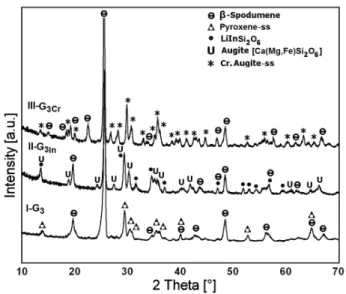
re-vealed that the partial replacement of Fe2O3with In2O3 led to the formation of new pyroxene-like phases as lithium indium silicate - LiInSi2O6 (card no. 33-799) and augite - Ca(Fe,Mg)Si2O6(card no. 24-201) together with β-spodumene phase (Fig.4, pattern II). However, the partial exchange of Fe2O3 with Cr2O3 led to the crystallization of pyroxene solid solution of augite -Ca(Mg,Fe)Si2O6 type (card no.76-544) together with the major β-spodumene phase as indicated by the X-ray diffraction analysis of the glass G3Cr, heat-treated at
690 °C/5 h and 905 °C/10 h (Fig. 4, pattern III, Table 2). The addition of small amount of Cr2O3 (0.5 wt.%), as nucleating agents, greatly improved the crystalliza-tion of the glass. Thus, the X-ray diffraction analysis showed that amount of iron-containing pyroxene phase was significantly increased by introducing small amount of Cr2O3 to the glass (the sample G3n) heat-treated at
670 °C/5 h and 830 °C/10 h (Fig. 5, Table 2).
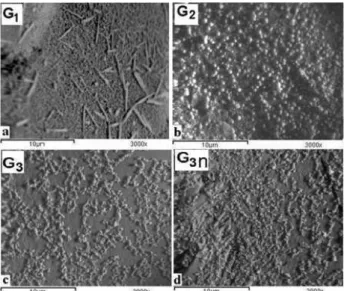
SEM micrographs of the fractured surfaces of the crystallized glasses are presented in Figs. 6 and 7. They
Figure 3. X-ray diffraction analysis of the crystallized glasses G1-G4
Figure 4. X-ray diffraction analysis of the crystallized glasses G3, G3Inand G3Cr
Figure 5. X-ray diffraction analysis of the crystallized glasses G3and G3n
clearly show that volume crystallization of fine fibrous with needle-like crystals was developed for the crys-talline base glass (the sample G1) (Fig. 6a). The
Figure 6. SEM micrograph of fracture surface of heat treated glass-ceramics: a) G1, b) G2, c) G3and d) G3n
sample G2) led to volume crystallization and formation
of very small spherulite-like units (Fig. 6b). However, the complete substitution of YAlSiO5with CaMgSi2O6 in the Fe-containing glass (the sample G3) led to the
for-mation of numerous tiny aggregates-like units (Fig. 6c). The addition of minor amount of Cr2O3, as nucleating
Figure 7. SEM micrograph of fracture surface of heat treated glass-ceramics: a) G3Inand b) G3Cr
agent (the sample G3n), led to bulky crystallization and
formation of very tiny aggregates (Fig. 6d). The partial replacement of Fe2O3with In2O3(the sample G3In)
en-able development of fine fibrous crystals with tiny ag-gregates (Fig. 7a). However, the involvement of Cr2O3 at the expense of Fe2O3(the sample G3Cr) led to volume
crystallization and formation of dense fine microstruc-ture (Fig. 7b).
3.2. Microhardness
The microhardness properties of the resulting glass and glass-ceramics were determined by Vickers’ micro-hardness. The obtained data for the microhardness of the investigated glass and glass-ceramic materials are graphically represented in Fig. 8. The Vickers’ micro-hardness values of the investigated glass samples are ranging from 4610 to 6185 MPa. The data revealed that the partial replacements of LiFeSi2O6/LiAlSi2O6and/or CaMgSi2O6/LiAlSi2O6 or adding CaMgSi2O6 instead of YAlSiO5led to the decrease in the microhardness val-ues, while the partial replacements of Fe2O3with In2O3 or Cr2O3 caused the increase in the microhardness val-ues of the investigated glasses (Fig. 8). However, in crystalline state the microhardness values for the glass-ceramics were found to be in the ranged from 7245 to 8175 MPa. From the obtained data, it was noticed that all modification processes in the glass-ceramic compo-sitions led to the increase in the microhardness values of the resultant crystalline materials (Fig. 8).
Entering of small amount of the Cr3+ ions, as nucle-ating agent, in the glass sample G3nalso gave rise to the
increasing of microhardness values for the investigated glass and its glass-ceramic sample (Fig. 8).
3.3. Chemical durability
The chemical durability characterization of the glasses and corresponding glass-ceramics was con-ducted in order to evaluate the chemical resistance in hot acidic media. Figure 9 shows the chemical stabil-ity of the examined samples tested in 0.1 N HCl so-lution at 95 °C. The results of weight loss of glass samples showed that the base glass sample (G1) was
more durable than all other glass samples. There-fore, the replacements of LiFeSi2O6/LiAlSi2O6 and/or CaMgSi2O6/LiAlSi2O6 or the addition of CaMgSi2O6 instead of YAlSiO5 led to the decrease in the chemical resistance of the resultant glasses. While the partial re-placements of In2O3/Fe2O3 or Cr2O3/Fe2O3 led to the increase in the durability of the obtained glasses by acid solution (Fig. 9).
Figure 8. Microhardness of the investigated glasses and their glass-ceramics
Figure 9. The chemical durability of the investigated glasses and their glass-ceramics
The addition of minor amount of Cr2O3 (0.5 wt.%), as nucleating agent, in the examined sample G3n led to
the decrease in the weight loss by the acidic solution for the studied glass and its corresponding glass-ceramic sample (Fig. 9).
IV. Discussion
4.1. DTA Study
The structure of multicomponent silicate glasses is based on a polymeric network with coexisting cations, which may act as modifier or as charge compensating cations needed for balancing the charge deficit of oxy-gen neighbours. This situation occurs when trivalent cations are substituted to silicon in the polymeric net-work. Glass properties may be strongly affected
depend-ing whether cations are network modifiers or charge compensators [21].
The results of DTA curves show well-defined glass transition ranges and exothermic peaks corresponding to the crystallization of possible crystalline phases. The locations of the main endothermic and exothermic peaks of the base glass, G1, were detected at higher
tempera-tures than in other glasses (Figs. 1 and 2).
The replacement of LiFeSi2O6 with LiAlSi2O6 in the base glass, G1, clearly indicates that the
endother-mic and the onset of crystallization exotherendother-mic peaks are shifted toward the lower temperature values with increasing of Fe2O3 contents (present in LiFeSi2O6 molecule) instead of Al2O3 (present in LiAlSi2O6 molecule). This drop of temperature could be attributed to the fact that the addition of Fe2O3 in the glasses greatly favours the formation of non-bridging oxygen atoms [22]. Therefore, the increase of Fe2O3content led to the decrease in the coherency of the glass network compared to that arising by the presence of Al2O3. The decreasing of SiO2 content and increasing of Li2O also may contribute to this drop. Agarwalet al.[23] stated that the decreasing of SiO2content led to the decrease in density of cross-linking of the silicate units in the glass structure which decreases the cohesiveness of the net-work and hence the glass transition temperature. On the other hand, Li2O can contribute to form non-bridging oxygen atoms, therefore, a drop of temperature could be expected.
The addition of CaMgSi2O6 at the expense of YAlSiO5 or LiAlSi2O6 in the iron-containing glasses led to the shift of the endothermic peak temperatures toward lower values. This can be explained on the basis that the glass transition temperature decreased with di-valent modifier cations (CaO and MgO) present in the glasses instead of trivalent former cations Al2O3 and Y2O3. In other words, the presence of trivalent oxides Al2O3 and Y2O3in the glasses led to the obtaining of a stronger structure, therefore, a higher transition temper-ature could be expected [24].
The addition of trivalent In2O3 or Cr2O3 at the ex-pense of Fe2O3 in the glasses remarkably changed the glass transition temperatures as well as crystallization temperatures. This may be attributed to the ionic field strength of the two trivalent element added which pos-sess a higher field strength than that of iron. This may account for the increase of the coherency of glass struc-ture [25]. Therefore, the endothermic peak temperastruc-tures of the investigated glasses were shifted towards higher temperatures by the addition of different trivalent ions instead of Fe2O3.
The addition of small amount of Cr2O3, as nucleat-ing agent, in glass sample G3nincrease the coherency of
4.2. X-ray diffraction for the crystallization study The X-ray diffraction analysis (Fig. 3, pattern I) revealed that the base glass, G1, crystallized to β
-spodumene-ss phase. The presence of Y2O3 in the glass enhanced the development ofβ-spodumene, as the main crystalline phase, which was formed directly with-out the transformation fromβ-quartz intoβ-spodumene [26]. The present data is in agreement with the previ-ous studies by Zheng et al. [27]. They found thatβ -spodumene (Li2O·Al2O3·4 SiO2) was observed directly without transformation fromβ-quartz toβ-spodumene. As the temperature increases from 820 to 970 °C, the content ofβ-spodumene increases gradually.
The present result revealed that there is a great affi n-ity of β-spodumene-LiAlSi2O6 to accommodate Y2O3 in its structure and to form solid solution. The dis-placement of the major characteristic d-spacing lines may support the suggestion that Y3+ was incorporated in the β-spodumene structure giving rise to the prob-able formula; Li(Al0.79Y0.21)Si2O6. However, no other phases containing yttrium could be detected (Fig. 3, pat-tern I). Ahmad et al. [28] suggested that yttrium ion is substituted with an aluminium ion and oxygen con-tent remains constant. But the main contradiction to this suggestion is that the ionic radii of Y3+(0.1 nm) differ greatly from the ionic radii of Al3+(0.06 nm). Further-more, despite the difference in radius, the substitution is permitted by the crystal chemistry. Singhet al.[29] re-ported that the addition of Y2O3 in any glass composi-tion increase the stability of the glasses without forming any detrimental phase during the heat treatment.
The obtained results indicated also that the partial replacement of LiAlSi2O6 with LiFeSi2O6 in the base glass (the sample G2) led to the development of
pyrox-ene phase of Li-aegirine - LiFeSi2O6type together with β-spodumene-ss as the major phase (Fig. 3, pattern II). Lithium iron pyroxene was described by Salman [30] who showed that iron oxide tends to be accommodated in the lithium silicate structure rather than lithium bo-rate to form a Li-aegirine phase LiFeSi2O6. Lithium iron pyroxene has great theoretical and technological impor-tance in glass-ceramic technology.
The addition of CaMgSi2O6 instead of YAlSiO5 in the iron-containing glasses (the sample G3) does not
lead to the formation of different phases than those ob-tained from the crystallized glass G2 (CaMgSi2O6-free
sample). However, the amount of Li-aegirine phase was increased as indicated from the increase of the inten-sities of their d-spacing lines of the XRD analysis to-gether withβ-spodumeness phase (Fig. 3, pattern III). The displacement of the major characteristicd-spacing lines of the pyroxene variety towards higher 2θ val-ues (Fig. 3, pattern III) may support the suggestion that diopside molecules (CaMgSi2O6) were accommodated in the lithium iron pyroxene (Li-aegirine) host structure giving rise to the formation of the probable pyroxene solid solution formula (Li0.52Ca0.24Mg0.24)FeSi2O6.
Salman and Salama [31] confirmed that a great
ex-tent of solid solution phase could be formed between two pyroxenes - diopside and LiFeSi2O6. Simultane-ously, at higher CaMgSi2O6 content at the expense of LiAlSi2O6 (the sample G4) no complete solid
solu-tion between diopside and Li-aegirine could be formed and the diopside-CaMgSi2O6 phase is exsolved, i.e. the two phases diopside - CaMgSi2O6 and Li-aegirine - LiFeSi2O6 are detected together with the major β -spodumene phase as confirmed by the X-ray diffraction analysis of the glass G4 (Fig. 3, Pattern IV).
The state of iron, its coordination and concentra-tion in the glasses mainly determined the nature of the phases formed especially at high Li2O + Fe2O3 con-tent. Iron oxide can be present in the glass as ferrous (Fe2+) and ferric (Fe3+) ions, and their ratio depends on the glass composition and melting conditions [31]. In silicate glasses, the ferric cations may occupy octa-hedral FeO6 and tetrahedral FeO4 sites [32], while the ferrous cations occupy only octahedral sites which de-crease by increasing the iron content [33]. The presence of appreciable amounts of Li2O together with Fe2O3 in the present glasses, greatly favour the formation of bridging oxygen atoms. The high concentrations of non-bridging oxygen atoms in silicate glass will favours Fe2+ in the network-forming position as Fe2+O4.
The partial replacements of Fe2O3with In2O3in glass composition (the sample G3In) led to crystallization of
the lithium indium silicate - LiInSi2O6 phase together with β-spodumene (major) phase and iron-containing pyroxene phase of augite type (Fig. 4, pattern II). The structure of augite is similar to that of diopside. In this case a limited partial replacement of silica by Fe3+ions seemed to be taking place in the tetrahedral position, which was accompanied by introducing Li+ions to pre-serve electrical neutrality, leading to the pyroxene for-mation of augite phase having the probable formula Ca(Mg0.49Li0.51)(Fe0.34Si0.66)2O6.
The partial swap of Fe2O3 by Cr2O3 (the sample G3Cr) led to the formation ofβ-spodumene as the
ma-jor phase together with pyroxene solid solution phase of chromo-augite type having the following probable formula Ca(Mg0.33Li0.67)(Fe0.17Cr0.17Si0.66)2O6. A wide variety of ionic substitutions occur in the members of the pyroxene group. The complexity of this group is exhibited by the wide isomorphism of the various ele-ments in the expandable pyroxene formula [18] result-ing in minerals found in abundance in the nature, such as diopside (CaMgSi2O6), aegirine (NaFeSi2O6), and augite (Ca,Na)(Mg,Fe,Al,Ti)(Si,Al)2O6.
From the XRD patterns (Fig. 4, pattern III), it has to be noted that participation of Cr3+ ions in Fe2O3 -containing glass (the sample G3Cr) did not affect type
of the phases but it induced change of the relative in-tensities of the pyroxene phase. This may indicate that the crystallization rate of the iron-containing pyroxene-ss was increased by the involvement of Cr2O3. Rezvani
et al. [34] summarized the role of chromium oxide as
sepa-ration or directly precipitate from molten glass during cooling stage as some form of chromium spinel crystal-lites; it greatly assisted the formation of final pyroxene or diopside-like phases. Chromium oxide is character-ized by a low solubility in silicate glass melts, resulting in the direct formation of Cr-based spinels, which then appear as nuclei for pyroxene glass-ceramics formation [35].
The results showed also that the introduction of mi-nor amount of Cr2O3, as nucleating agent, into the glass sample G3nfavours pyroxene crystallization of the glass
as indicated by the development of the intensities of their d-spacing lines in the XRD (Fig. 5). Karamanov
et al. [36] stated that Cr2O3 is very effective
nucleat-ing agent in high iron content glasses. They proved that a small percentage of Cr2O3 strongly affects the spinel formation and enhances the degree of crystallization of iron containing silicate glasses.
SEM micrographs (Figs. 6 and 7) showed that the re-placement processes led to the volume crystallization and formation of fine grained microstructures. Salman
et al.[37] observed that the presence of iron oxide
in-creases the number of crystallization centres and stimu-lates the crystallization of the glass during the reheating process giving rise to the volume crystallization of fine grained microstructures. Karamanovet al.[36] claimed also that addition of 0.7% Cr2O3 enhances the spinel formation and consequently nucleation rate causing a higher degree of crystallization and finer structures in these glass-ceramics with the major crystalline phase of pyroxene.
4.3. Microhardness
The hardness value is usually defined as the ratio of the indentation load and either the surface or projected area of residual indents. The standard hardness tests are vital in nearly all areas of materials science and engi-neering. On the other hand, a good understanding of the relationship between the hardness and tensile properties of materials is very important [38].
From the Vickers’ microhardness values of the glass samples, the obtained data shows that the base glass sample (G1) has the highest value among all glass
samples (Fig. 8). The microhardness values, on the other hand, were decreased with low Y2O3 and Al2O3 -contents in the glass batches. However, the introduc-tion of trivalent oxides In2O3 or Cr2O3 at the expense of Fe2O3 in the glass sample led to the increase of the microhardness values. The microhardness, therefore, is a bond sensitive property [39], which provides an in-sight on the nature of the chemical bonding in a mate-rial. So the strong network forming role of Al2O3in alu-minosilicate glasses increases with the Al2O3-content in the glasses. Therefore, high Al2O3 containing glasses display high hardness values [40]. Varshneya [41] re-vealed that the addition of alkalis to the silicate glasses decreased their hardness [42] presumably because the connectivity of the glass structure decreased.
Sohn et al. [43] revealed that the hardness of
sili-cate glass-ceramics increased due to the formation of fine grained microstructure by which the crystal size plays an important role in preventing the propagation of the cracks in the whole structure. The microhardness of crystallized glasses depends not only on the type of pre-cipitating phases but also on their size, shape, and natu-ral wetting as well on the emergence or absence of inter-nal cracks. However, the degree of crystallinity should be also taken into consideration [44].
Dependence of microhardness on the replacement processing for different glass samples is shown in Fig. 8. The microhardness value for the base crystalline sample G1 is 7245 MPa, which increases slowly after
replace-ment with LiFeSi2O6and/or CaMgSi2O6molecules (the samples G2-G4). This may be due to that, the presence
of iron oxide led to more nucleation sites [37] during the first stage of heat treatment, and thus achieving a very fine microstructure as compared with that of Fe2O3-free crystalline sample, G1 (Fig. 6a). The development of
high mechanical strength pyroxene-like crystals as Li-aegirine, diopside, iron-containing pyroxenes and their solid solutions are also considered. The microhardness of glass-ceramics generally increased with the increase of crystallinity, smaller crystalline aggregates as well as formation of fine microstructure [45]. The microstruc-ture mostly represents the major influence on the me-chanical properties of the glass ceramic materials [46].
The data also indicate that the glass-ceramic samples containing In2O3 or Cr2O3 instead of iron oxide (the samples G3Inand G3Cr, respectively) had higher
micro-hardness values than that for the sample G3 - free of
In2O3or Cr2O3(Fig. 8). This may be due to the forma-tion of high mechanical pyroxene member phases to-gether with β-spodumene phase. Glass-ceramics based on pyroxenes have attracted interest due to the excel-lent controllability of their properties. Pyroxenes are ca-pable of a wide range of isomorphous substitutions in their crystal structure and having a distinct physical and chemical characteristic [47].
The results also showed that, the introduction of mi-nor amount of Cr2O3, as nucleating agent, in the sample G3n led to the increase of the crystallization tendency
of the glasses, and strongly enhanced volume crystal-lization with the formation of very fine grained mi-crostructure (Fig. 6d), this was followed by an increase in the microhardness values of the glass and its crys-talline sample as compared with that of the Cr2O3-free sample, i.e. G3, (Fig. 8). Enriqueet al. [48] stated that
the presence of Cr2O3 supported earlier crystallization of pyroxene-like crystals and the formation of a more homogeneous glass-ceramic material characterized with relatively high mechanical strength.
4.4. Chemical durability
replace-ment (the samples G2-G4). While, the partial
replace-ments of In2O3/Fe2O3 or Cr2O3/Fe2O3 (the samples G3In and G3Cr, respectively) led to the increase of the
chemical durability of the obtained glasses (Fig. 9). In yttrium aluminosilicate glasses, the rare earth ions in these glasses had similar structural function as that of the aluminium ions [23]. While, conventional ternary yttrium aluminosilicate glasses that incorporate of di-valent cation modifiers (e.g. Ca and Mg), is usually at-tributed to stronger bonding of the Y3+cations, and to the lower contrast in bond strengths between bridging and non-bridging oxygen [24]. Bunkeret al.[49] stated that, in the glass dissolution, the divalent cations are leached from the glass surface by exchange with pro-tons in the solution in the early stage of the reaction.
The chemical durability of glass-ceramics is quite different from that of glasses. It must be viewed as a multiphase system with each phase having individual corrosion characteristic and possible unique reactions at the phase boundary [50]. The greater mobility of alkali metal ions in the glass phase as compared with that of similar ions incorporated in crystal phases will lead to greater reactivity of the glass phase and hence to inferior resistance to chemical attack. The achievement of high chemical durability in glass-ceramics indicates that, the chemical composition of the crystalline phases obtained favour good stability. McMillan [1] had indicated that, the glass ceramic, in general, possess good chemical sta-bility and that they compare favourably in this respect with other ceramic type materials.
All modifications in the glass compositions by re-placement processes led to great improvements in the chemical durability of the resultant glass-ceramics (Fig. 9). This may be attributed to that the replacement pro-cesses led to support the development of the highly durable low reactive pyroxene member [18] with for-mation of fine microstructure e.g., Li-aegirine, diop-side, lithium indium silicate, iron-containing pyroxenes and their solid solutions, together with the presence of low reactive lithium aluminosilicate crystals [51], e.g.β -spodumene, which had been formed as dominant crys-talline phase. MacMillan [1] pointed out that lithium aluminosilicate glass-ceramics of medium thermal ex-pansion are quietly unaffected by exposure of chlorine or hydrogen chloride gases for a period of 6 h at 800 °C. Varieties of pyroxene phases and their solid solution containing Fe3+, Mg2+and/or Ca2+show variable resis-tance towards the acid attack. The solubility of both the formed crystals and the residual glass phase in leach-ing solution has almost an equally important influence on the chemical stability of glass ceramics [1]. Varieties of pyroxene phases and their solid solution containing Fe3+, Mg2+ and/or Ca2+ show variable resistance to-wards the acid attack. The solubility of both the formed crystals and the residual glass phase in leaching solution has almost an equally important influence on the chem-ical stability of glass ceramics [1].
The presence of Cr2O3, as nucleating agent, in
the Fe2O3-containing sample (G3n) improved also the
chemical stability of the both glass and crystalline sam-ple (Fig. 9). This may be attributed to the formation of a coherent glass structure. This led to the decrease of the leachability of the nucleant glasses. Other explana-tion was also due to the crystallizaexplana-tion of better chem-ical stability materials with dense nonporous very fine microstructure [1] of the pyroxene-like phase.
V. Conclusions
Glass-ceramic materials of high chemical resistance and good mechanical properties were successfully pre-pared by introducing LiFeSi2O6 and/or CaMgSi2O6 molecules at the expense of LiAlSi2O6 or CaMgSi2O6 instead of YAlSiO5in the glasses based on Li2O-Al2O3 -Y2O3-SiO2 system. The same trends of the properties were also obtained in the presence of In2O3 or Cr2O3. The main crystalline phases, formed after control-ling heat-treatment are yttria-containingβ -spodumene-ss - [Li(Al,Y)Si2O6] together with varieties of pyrox-ene phases including Li-aegirine, diopside, lithium in-dium silicate and iron-containing pyroxene solid so-lution including lithium iron silicate-ss - LiFeSi2O6 -CaMgSi2O6, augite - Ca(Mg,Fe)Si2O6 and chromo-augite-ss. The replacement processes greatly change the microhardness values and chemical durability data of the glasses. However, in the case of crystalline state the microhardness and chemical durability of the glass-ceramics were greatly improved due to the development of varieties of pyroxene phases and their solid solu-tions with the formation of fine grained microstructure. The addition of Cr2O3, as nucleating agent in the se-lected glass, was also improved the properties of the glass and its corresponding glass-ceramic. The present results provided valuable information about the role of glass oxide constituents and heat treatment applied in determining the crystalline phase formations, the nature of the solid solution formed as well the chemical and mechanical properties of the resultant materials.
Acknowledgements:The authors are grateful to SAIF,
Kochi for providing the instrumental data, UGC and to the Principal, CMS College, Kottayam, Kerala for pro-viding the necessary facilities.
References
1. P.W. McMillan, Glass-ceramics, Academic Press, New York, 1979.
2. W. Holand, G.H. Beall,Glass-Ceramic Technology, The American Ceramics Society, Westerville, OH, USA, 2002.
3. P. James, “Glass-ceramic: New compositions and uses”,J. Non-Cryst. Solids,181(1995) 1–15. 4. L. Karolina, C.K. Katarzyna, B.L. Maria, “Thermal
and spectroscopic characterization of glasses and glass-ceramics of Li2O-Al2O3-SiO2(LAS) system”,
5. I.H. Arita, DS. Wilkinson, GR. Purdy, “Crystalliza-tion of yttria-alumina-silica glasses”,J. Am. Ceram. Soc.,75(1992) 3315–3320.
6. I. Pozdnyakova, N. Sadiki, L. Hennet, V. Cristiglio, A. Bytchkov, G.J. Cuello, J.P. Coutures, D.L. Price, “Structures of lanthanum and yttrium aluminosil-icate glasses determined by X-ray and neutron diffraction”,J. Non-Cryst. Solids,354(2008) 2038– 2044.
7. N. Sadiki, J.P. Coutures, C. Fillet, J.L. Dussossoy, “Crystallization of lanthanum and yttrium alumino-silicate glasses”,J. Nucl. Mater.,348(2006) 70–78. 8. D. Jincheng, “Molecular dynamics simulations of
the structure and properties of low silica yttrium alu-minosilicate glasses”,J. Am. Ceram. Soc.,92(2009) 87–95.
9. Y. Zhang, A. Navrotsky, “Thermochemistry of glasses in the Y2O3-Al2O3-SiO2system”,J. Am.
Ce-ram. Soc.,86(2003) 1727–1732.
10. A. Makimishima, T. Shimoira, “Alkaline durabil-ity of high elastic modulus alumino-silicate glasses containing Y2O3, La2O3 and TiO2”, J. Non-Cryst.
Solids,38-39(1980) 661.
11. J.E. Shelby, S.M. Minton, C.E. Lord, M.R. Tuzzolo, “Formation and properties of yttrium aluminosilicate glasses”,Phys. Chem. Glasses,33(1992) 93. 12. U. Kolitsch, H.J. Seifert, T. Ludwig, F. Aldinger,
“Phase equilibria and crystal chemistry in the Y2O3 -Al2O3-SiO2system”,J. Mater. Res.,14(1999) 447– 555.
13. P. Lichvár, P. Sajgalík, M. Liska, D. Galusek, “CaO-SiO2-Al2O3-Y2O3 glasses as model grain boundary phases for Si3N4 ceramics”,J. Eur. Ceram. Soc.,27
(2007) 429–436.
14. F. Luo, D.M. Zhu, W.C. Zhou, “A two-layer dielec-tric absorber covering a wide frequency range”,
Ce-ram. Int.,33(2007) 197–200.
15. A.M. Hu, M. Li, D.L. Mao, “Growth behavior, morphology and properties of lithium aluminum silicateglass-ceramic with different amounts of CaO, MgO and TiO2 additives”, Ceram. Int., 34 (2008) 1393–1397.
16. Y.M. Sung, S.A. Dunn, J.A. Koutsky, “The effect of boria and titania addition on the crystallization and sintering behavior of Li2O-Al2O3-4 SiO2 glass”, J.
Eur. Ceram. Soc.,14(1994) 455–462.
17. R.M. Thompson, R.T. Downs, “Model pyroxenes II: Structural variation as a function of tetrahedral rota-tion”,Am. Mineral.,89(2004) 614–628.
18. W.A. Deer, R.A. Howie, J. Zussman, “An intro-duction to the rock-forming minerals”,Third ELBS
impression, Hong Kong, Common Wealth, Printing
Press Ltd., 1992.
19. R.L. Smith, G.E. Sandland, “An accurate method of determining the hardness of metals, with Particular reference to those of a high degree of hardness”,
Pro-ceedings of the Institution of Mechanical Engineers,
1(1922) 623–641.
20. L. Wu, Y. Li, Y. Teng, G. Meng, “Preparation and characterization of borosilicate glass-ceramics con-taining zirconolite and titanite crystalline phases”,J.
Non-Cryst. Solids,380(2013) 123–127.
21. G. Calas, L. Cormier, L. Galoisy, P. Jollivet, “Structure-property relationships in multi-component oxide glasses”, Comptes Rendus
Chim.,5(2002) 831–843.
22. T.J. Kiczenski, C. Ma, E. Hammarsten, D. Wilker-son, M. Affatigato, S. Feller, “A study of selected physical properties of alkali germinate glasses over wide ranges of composition”, J. Non-Cryst. Solids,
272(2000) 57–66.
23. A. Agarwal, S. Sanghi, R. Bala, S. Khasa, “Influence of SiO2on the structural and dielectric properties of ZnO·Bi2O3·SiO2 glasses”,J. Integr. Sci. Technol.,
3(2015) 6–13.
24. T. Schaller, J.F. Stebbins, “The structural role of lan-thanum and yttrium in aluminosilicate glasses: Al27 and O17 MAS NMR study”,J. Phys. Chem. B,102
(1998) 10690–10697.
25. R.H. Doremus, Glass Science, 2nd ed., John Wiley and Sons Inc., New York, 1994.
26. M. Guedes, A.C. Ferro, J.M.F. Ferreira, “Nucleation and crystal growth in commercial LAS composi-tions”,J. Eur. Ceram. Soc.,21(2001) 1187–1194. 27. W. Zheng, J. Cheng, L. Tang, J. Quan, X. Cao,
“Ef-fect of Y2O3addition on viscosity and crystallization of the lithium aluminosilicate glasses”,Thermochim. Acta,456(2007) 69–74.
28. S. Ahmad, T. Ludwig, M. Herrmann, M.M. Mah-moud, W. Lippmann, H.J. Seifert, “Phase evaluation during high temperature long heat-treatments in the Y2O3-Al2O3-SiO2 system”,J. Eur. Ceram. Soc.,34
(2014) 3835–3840.
29. K. Singh, N. Gupta, O.P. Pandey, “Effect of Y2O3 on the crystallization of SiO2-MgO-B2O3-Al2O3 glasses”,J. Mater. Sci.,42(2007) 6426–6432. 30. S.M. Salman, “Crystallization of alkali iron
pyrox-ene LiFeSi2O6 in Li2O-SiO2 glasses containing iron oxide”,Interceram.,30(1981) 48–51.
31. S.M. Salman, S.N. Salama, “Pyroxene solid so-lutions crystallized from CaO-MgO(Li2O, Fe2O3 )-SiO2glasses”,Ceram. Int.,12(1986) 221–228. 32. C.R. Kurkjian, E.A. Sigety, “Coordination of Fe3+in
glass”,Phys. Chem. Glasses,9(1968) 73–83. 33. S.M. Salman, “Thermal expansion characteristics of
some iron containing glasses and their corresponding crystalline materials”,Thermochim. Acta,81(1984) 125–137.
34. M. Rezvani, B. Eftekhari-Yekta, M. Solati-Hashjin, V.K. Marghussian, “Effect of Cr2O3, Fe2O3 and TiO2 nucleants on the crystallization behaviour of SiO2-Al2O3-CaO-MgO (R2O) glass-ceramics”,
Ce-ram. Int.,31(2005) 75–80.
35. G. Müller,Low Thermal Expansion Glass Ceramics, Springer-Verlag, Ed. H. Bach, Berlin, 1995.
of Cr2O3 as a nucleating agent in iron-rich glass-ceramics”, J. Eur. Ceram. Soc., 19 (1999) 2641– 2645.
37. S.M. Salman, F. Mostafa, “Crystallization of alkali-iron-borosilicate glasses”, Sprechsaal, 118 (1985) 622–676.
38. I. Brooks, P. Lin, G. Palumbo, G.D. Hibbard, U. Erb, “Analysis of hardness-tensile strength relationships for electroformed nanocrystalline materials”,Mater.
Sci. Eng. A,491(2008) 412–419.
39. J. Zarzycki, Glass and Vitreous State, Cambridge Univ. Press, New York, Port Chester, USA, 1991. 40. J.F. MacDowell, Alumina in Glasses and
Glass-ceramics, Reprinted from Alumina Chemicals
Sci-ence and Technology Handbook, Am. Ceram. Soc.
Inc., USA, 1990.
41. A.K. Varshneya, Fundamentals of Inorganic
Glasses, Academic Press, London, UK, 1994.
42. H. Scholze,Glass-nature Structure, and Properties, Springer-Verlag, New York, 1990.
43. S.B Sohn, S.Y. Choi, Y.K. Lee, “Controlled crys-tallization and characterization of cordierite glass-ceramics for magnetic memory disk substrate”, J.
Mater. Sci.,35(2000) 4815–4821.
44. H.A. Miska,Ceramics and Glasses, Engineered Ma-terials Handbook, 4ASM Int. 4, 1991.
45. F.J. Torres, J. Alarcon, “Effect of additives on the
crystallization of cordierite-based glass-ceramics as glazes for floortiles”,J. Eur. Ceram. Soc.,23(2003) 817–826.
46. J. Henry, R.G. Hill, “The influence of lithia content on the properties of fluorphlogopite glass-ceramics, II-Microstructure hardness and machineability”, J.
Non-Cryst. Solids,319(2003) 13–30.
47. R.M. Thompson, R.T. Downs, G.J. Redhammer, “Model pyroxenes III: Volume of C2/c pyroxenes at mantle P, T, and X”,Am. Mineral.,90(2005) 1840– 1851.
48. M. Enrique, G. Alexander, I. Jose, “Crystalliza-tion behavior of glasses in the system of Na2 O-CaO-MgO-Fe2O3-Al2O3-SiO2with high contents of nickel oxide”,J. Non-Cryst. Solids,353(2007) 366– 373.
49. B.C. Bunker, “Molecular mechanism for corrosion of silica and silicate glasses”, J. Non-Cryst.Solids,
179(1994) 300–308.
50. W.J. McCracken, “Corrosion of glass-ceramics”, in Corrosion of Glass, Ceramics and Ceramic Super
Conductors, Ed. by D.E. Clark & B. Zoitos, Noyes
Publications, Park Ridge, New Jersey, USA, 1992. 51. D.C. Boyd, P.S. Danielson, D.A. Thompson,Glass
Kirk-Othmer Encyclopedia of Chemical Technology,
4thEd., John Wiley, and Sons Inc, New York, USA,