INTRODUCTION
Corresponding author: Dr. Rodrigo de Carvalho Santana. e-mail: [email protected]
Received 29 February 2016 Accepted 28 April 2016
Secular trends in Klebsiella pneumoniae isolated
in a tertiary-care hospital: increasing prevalence
and accelerated decline in antimicrobial susceptibility
Rodrigo de Carvalho Santana
[1], Gilberto Gambero Gaspar
[1], Fernando Crivelenti Vilar
[1],
Fernando Bellissimo-Rodrigues
[2]and Roberto Martinez
[1][1]. Departamento de Clínica Médica, Faculdade de Medicina de Ribeir̃o Preto, Universidade de S̃o Paulo, Ribeir̃o Preto, S̃o Paulo, Brasil. [2]. Departamento de Medicina Social, Faculdade de Medicina de Ribeir̃o Preto, Universidade de S̃o Paulo, Ribeir̃o Preto, S̃o Paulo, Brasil.
ABSTRACT
Introduction:Klebsiella pneumoniae has become an increasingly important etiologic agent of nosocomial infections in recent years. This is mainly due to the expression of virulence factors and development of resistance to several antimicrobial drugs.
Methods: This retrospective study examines data obtained from the microbiology laboratory of a Brazilian tertiary-care hospital. To assess temporal trends in prevalence and antimicrobial susceptibility, K. pneumoniae isolates were analyzed from 2000 to 2013. The relative frequencies of K. pneumoniae isolation were calculated among all Gram-negative bacilli isolated in each period analyzed. Susceptibility tests were performed using automated systems. Results: From 2000-2006, K. pneumonia isolates comprised 10.7% of isolated Gram-negative bacilli (455/4260). From 2007-2013, this percentage was 18.1% (965/5331). Strictly considering isolates from bloodstream infections, the relative annual prevalence of K. pneumoniae increasedfrom 14-17% to 27-32% during the same periods. A progressive decrease in K. pneumoniae susceptibility to all antimicrobial agents assessed was detected. Partial resistance was also observed to antimicrobial drugs that have been used more recently, such as colistin and tigecycline. Conclusions: Our study indicates that K. pneumoniae has become a major pathogen among hospitalized patients and
conirms its recent trend of increasing antimicrobial resistance.
Keywords: Klebsiella pneumonia.Antimicrobial resistance. Carbapenem. Amikacin. Secular trends.
In recent decades, Klebsiella pneumoniae has become an increasingly important nosocomial infectious agent, which is partly attributed to its increased expression of virulence factors that promote intra-hospital transmission and challenge infection control practices(1). Additionally, strains with progressive
reductions in antibacterial drug susceptibilityhave been isolated in different countries(2) (3). Since the end of the 20th century,
strains have been disseminated with simultaneous resistance to various antimicrobial classes mediated by the production of extended spectrum beta-lactamases (ESBL), loss of porins, and later also by the production of carbapenemases and metallo-beta-lactamases(4) (5). Development of resistances to alternative drugs
used to treat hospital-acquired K. pneumoniae infections, such as polymixins and tigecycline, is currently being observed(6).
Simultaneous and long-term analysis of K. pneumoniae
susceptibility to different antimicrobials allows us to better
understand current and future perspectives for the therapeutic use of these drugs. This study aimed to describe secular trends of antimicrobial susceptibility among K. pneumoniae isolates over a 14-year period in a Brazilian tertiary-care hospital.
METHODS
This is a retrospective study based on data obtained from the Microbiology Laboratory of the Ribeir̃o Preto Medical School Hospital at the University of S̃o Paulo in Ribeir̃o Preto, Brazil.
This is a public university-afiliated facility with approximately
800 active beds that provides tertiary acute care in many medical specialties for a reference population of around 3,000,000 persons. The study was performed from January 1, 2000 to December 31, 2013. During the entire study period, there was an antibiotic stewardship program actively promoted by the local Infection Control Service. This program includes weekly rounds performed by infectious disease specialists in critical areas, like intensive care units, and requires that all in-hospital antibiotic prescriptions have justification by the assistant physician of the patient, which is also audited by infectious
diseases physicians. Those audits are speciically focused on the use of cephalosporins, carbapenems, β-lactamase inhibitor
RESULTS
DISCUSSION
is available for the prescribers in the hospital intranet. The Infection Control Service also promotes educational measures on the rational use of antibiotics and prevention of healthcare-associated infections.
We included all strains of K. pneumoniae isolated during the study period from any clinical specimens. To avoid the inclusion of duplicate strains, we considered only one isolate per patient in the same year. If a patient had a second infection
episode apart from the irst one, then, the second isolate counted
as a new specimen. We did not differentiate between colonizing strains and truly infectious strains. We also did not examine if they were hospital-acquired or not. Although the vast majority of isolates included were considered hospital-acquired, a small portion of isolates was probably from community-acquired severe infections that led to the patient’s admission.
We evaluated the relative frequency of K. pneumoniae
isolation among all Gram-negative bacilli isolated in each
analyzed period for all clinical specimens and speciically for
blood cultures. The relative frequencies of Escherichia coli
and Pseudomonas aeruginosa isolates in clinical samples were also estimated.
Antimicrobial susceptibility tests
These tests were performed using the automated MicroscanTM
system (Siemens, USA) between 2000 and 2005 and by the automated VitekTM system (Biomerieux, France) between 2006
and 2013.
Susceptibility tests were interpreted according to the recommendations of the Clinical Laboratory Standards Institute (CLSI, USA) over the study period(7). The percentage of isolates
susceptible to the assessed antibiotics was reported as a weighted
mean for deined intervals.
Aminoglycoside minimum inhibitory concentration
The minimum inhibitory concentrations (MICs) of amikacin and gentamicin were determined using the Vitek2TM system
(Biomerieux) for K. pneumoniae isolated between January and June 2013. We selected 105 bacterial isolates obtained from blood, venous catheters, urine, surgical wounds, and deep abscesses. MIC distribution was compared between three bacterial phenotypes: a) carbapenem-resistant isolates, b) ESBL-producing carbapenem-susceptible isolates, and c) isolates with multiple susceptibilities.
Ethical considerations
This study protocol was submitted to and approved by the institutional ethics review committee (number 8718/2015).
During the period between 2000 and 2006, the mean number of Gram-negative bacilli isolated from hospitalized patients was 4,260 (range, 4,020-4,564). The mean number of
K. pneumoniae isolates was 455 (range, 395-498), corresponding to 10.7% of the total Gram-negative bacilli isolated. During the period between 2007 and 2013, the annual mean numbers
of Gram-negative bacilli and of K. pneumoniae were 5,331 (range, 4,002-5,967) and 965 (range, 581-1,208), respectively, representing a relative frequency of 18.1% for K. pneumoniae
during that period. Figure 1 shows a gradual increase in
K. pneumoniae isolation in relation to the total Gram-negative bacilli, particularly starting from 2006-2007. Comparatively, the relative percentage of Escherichia coli and Pseudomonas aeruginosa isolates remained stable. The relative frequency of
K. pneumoniae compared to other Gram-negative bacillicausing bloodstream infections also increased from 14-17% between 2000 and 2003 to 27-32% between 2010 and 2013 (Figure 1).
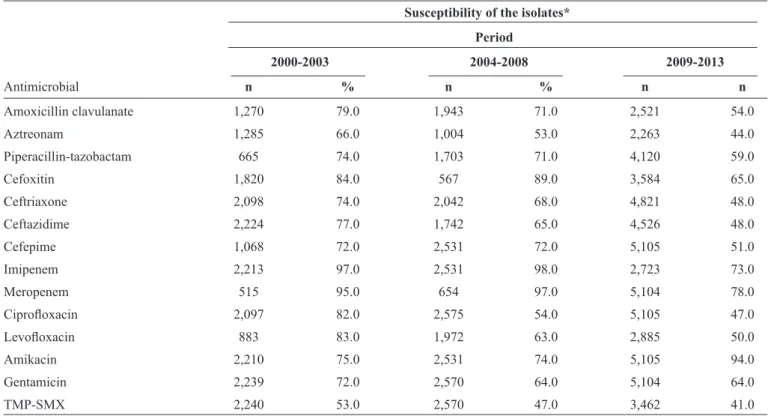
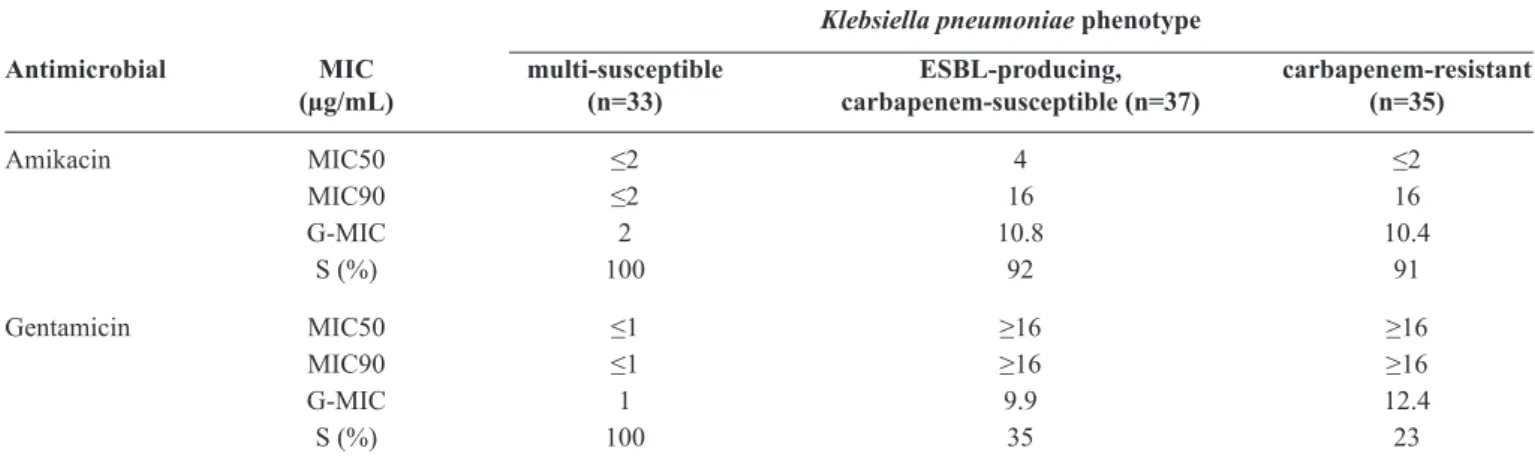
Weighted mean K. pneumoniae rates of susceptibility to various classes of antimicrobials between 2000 and 2013 are presented in Table 1. Decreases in susceptibility to practically all antibiotics assessed were observed. Susceptibility to amikacin was maintained and even slightly increased from 2007 to 2013, exactly when a marked reduction in susceptibility to imipenem and ceftazidime occurred. Drugs that were more recently used in clinic, such as polymyxin and tigecycline, exhibited reduced in vitro activities against K. pneumoniae (Figure 2). Susceptibilities of 90% and 55% were observed to colistin and tigecycline, respectively, in 2013. The MIC for amikacin was similar between carbapenem-resistant and ESBL-producing
K. pneumoniae isolates, but both were higher than that for multi-susceptible phenotypes (Table 2).
The results of this study indicate a recent increase in K. pneumoniae colonization and infection of hospitalized patients, as well as a progressive reduction in the in vitrosusceptibility of this Enterobacteriaceae to several antimicrobials(8). The greater
involvement of multidrug-resistant K. pneumoniae strains in hospital-acquired infectious has been simultaneously observed in Europe(9) and Asia(10) (11). The expansion of K. pneumoniae
as a colonizing and infectious agent in hospitals suggests a marked capacity of this bacterium to acquire resistance and survive in environments where antimicrobials are extensively used. A study conducted in the same hospital reported that
K. pneumoniae strains expressed genes that increase resistance
to carbapenems and luoroquinolones as well as genes related to
virulence factors(12). Carbapenemase-producing K. pneumoniae that expresses genes related to capsule, imbriae, siderophores
and other virulence factors has been isolated in distinct geographic areas(1) (13). There is evidence that K. pneumoniae
has developed clones with multiple simultaneous resistance
to antimicrobials and suficient virulence to provide adaptive
advantages to the hospital environment and facilitate patient colonization or infection(4).
In the study institution, many antibiotics were introduced in the 1980s or 1990s. Since then, a continuous and variable reduction in K. pneumoniae susceptibility to these drugs has occurred. Long-term susceptibility studies have detected increasing antimicrobial drug resistance in hospitals in various countries(3) (14). This is especially true for carbapenems. Few
0
2000-2001 2002-200 3
2004-200 5
2006-2007 2008-200 9
2010-201 1
2012-201 3
5 10 15 20 25 30 35 40 45
Relative frequency (%
)
Biennial period
Klebsiella pneumoniae
Pseudomonas aeruginosa
Klebsiella pneumoniae (bloodstream infections)
Escherichia coli
FIGURE 1 - Relative frequency of Gram-negative bacilli isolates for all specimens analyzed from 2000-2013. The dotted line represents the relative
frequency speciically for bloodstream isolates.
up to 2007. Since 2008, carbapenem-resistant K. pneumoniae
has spread to various wards of the hospital, and in 2012-2013, about 35% of the isolates had this phenotype. Between 2008 and 2013, a rapid reduction in susceptibility to carbapenems occurred together with an accelerated decrease in susceptibility to other beta-lactam antibiotics. Carbapenemase-producing
K. pneumoniae have been noted in several regions in the world. In the USA, the isolation of carbapenem-resistant K. pneumoniae has increased from <0.1% in 2002 to 4.5% in 2010, while resistance to ceftazidime has increased from 5.3% in 1999 to 11.5% in 2010(15). Data from the SENTRY study of intensive
care units in Europe revealed a reduction in susceptibility to imipenem from 100% in 2009 to 89.7% in 2011(16). A multicenter
study showed that resistance to imipenem increased in Brazil in 2008-2010 (8.6%) compared to 2003-2005 (1.7%) and 1997-1999 (0.5%)(17). A rapid increase in the rate of
carbapenemase-producing K. pneumoniae isolation has been observed in Italian hospitals during a period similar to that in this study(18).
Currently, imipenem resistance rates may exceed 50%(2).
The change made by CLSI in the carbapenem breakpoints for Enterobacteriaceae(7) may have additionally reduced the
rate of isolate susceptibility to these drugs, particularly for ertapenem(19) (20). However, the major reason for the increase
in K. pneumoniae resistance to carbapenems is probably the international dissemination of bacterial clones, such as the CC11 clonal complex, which express genes that regulate the carbapenemases, including Klebsiella pneumoniae
carbapenemase (KPC), oxacillinase 48 (OXA-48), and New Delhi
metallo-β-lactamase (NDM)(21) (22).
Amikacin was outstanding among antimicrobials because of its high and stable rates of K. pneumoniae susceptibility, which has allowed clinical use of this drug in infections caused by carbapenemase-producing isolates. High in vitro eficacy of
amikacin has been observed in other studies(13) (16) and has been
attributed to the limited clinical use of aminoglycosides over the last decades(23). However, its higher MIC for
carbapenem-resistant isolates suggests that these isolates are intermediately resistant to amikacin(24).
Polymixins and tigecycline are the major therapeutic options for treatment of infections caused by carbapenemase-producing
K. pneumoniae(6). Although polymixins were reintroduced
TABLE 1 - In vitro susceptibility of Klebsiella pneumoniae isolates to selected antimicrobials.
Susceptibility of the isolates*
Period
2000-2003 2004-2008 2009-2013
Antimicrobial n % n % n n
Amoxicillin clavulanate 1,270 79.0 1,943 71.0 2,521 54.0
Aztreonam 1,285 66.0 1,004 53.0 2,263 44.0
Piperacillin-tazobactam 665 74.0 1,703 71.0 4,120 59.0
Cefoxitin 1,820 84.0 567 89.0 3,584 65.0
Ceftriaxone 2,098 74.0 2,042 68.0 4,821 48.0
Ceftazidime 2,224 77.0 1,742 65.0 4,526 48.0
Cefepime 1,068 72.0 2,531 72.0 5,105 51.0
Imipenem 2,213 97.0 2,531 98.0 2,723 73.0
Meropenem 515 95.0 654 97.0 5,104 78.0
Ciproloxacin 2,097 82.0 2,575 54.0 5,105 47.0
Levoloxacin 883 83.0 1,972 63.0 2,885 50.0
Amikacin 2,210 75.0 2,531 74.0 5,105 94.0
Gentamicin 2,239 72.0 2,570 64.0 5,104 64.0
TMP-SMX 2,240 53.0 2,570 47.0 3,462 41.0
TMP-SMX: trimethoprim-sulfamethoxazole. *Weighted mean for the period.
0 20 40 60 80 100
2004 2005 2006 2007 2008 2009 2010 2011 2012 2013
Susceptibility (%
)
Year
Ciprofloxacin
Amikacin
Ceftazidime
Imipenem
Polymyxin
Tigecyclin
TABLE 2 - Minimum inhibitory concentrations of amikacin and gentamicin for Klebsiellapneumoniae isolates from nosocomial infection cases in 2013, according to ESBL or carbapenemase production.
Klebsiella pneumoniae phenotype
Antimicrobial MIC multi-susceptible ESBL-producing, carbapenem-resistant
(µg/mL) (n=33) carbapenem-susceptible (n=37) (n=35)
Amikacin MIC50 ≤2 4 ≤2
MIC90 ≤2 16 16
G-MIC 2 10.8 10.4
S (%) 100 92 91
Gentamicin MIC50 ≤1 ≥16 ≥16
MIC90 ≤1 ≥16 ≥16
G-MIC 1 9.9 12.4
S (%) 100 35 23
ESBL: extended-spectrum β-lactamase; MIC: minimal inhibitory concentration; G-MIC: geometric mean minimal inhibitory concentration; S: susceptibility
rate according to CLSI breakpoints; CLSI: Clinical and Laboratory Standards Institute.
Gram-negative bacilli, they have shown a slow and progressive reduction in activity against carbapenemase-producing K. pneumoniae, which in some studies has reached resistance rates that exceed 20%(25) (26). Hetero-resistance to colistin, which is
used more extensively, as well as the long-term therapy with polymixins are factors favoring the selection of strains resistant to these drugs(27). The reduction in susceptibility to tigecycline
occurred rapidly considering the short time for which this drug
was in clinical use. This inding has also been observed in other
countries(25) (28).
This study is limited by its retrospective nature. Thus, the
inluence of speciic events, such as outbreaks, on antibiotic susceptibility could not be precisely deined. Otherwise, the long assessment period could dilute the inluence of eventual
outbreaks when taking into account the long-term antimicrobial susceptibility tendencies at the institution in this study. The same idea should be considered with regard to the different methods used to assess antibiotic susceptibility. In the last eight years, the automated VitekTM system became the only method used,
and the current trend in antibiotic susceptibility is evident. Moreover, throughout the period of analysis, susceptibility results followed CLSI recommendations. Additionally, over the last 10 years, medical cases that are more complex have been admitted to the hospital, which results in an increased need for microbiological cultures and antimicrobial prescriptions. This may have contributed to the selection of resistant
microorganisms, but it does not explain the speciic increase
in the relative frequency of K. pneumoniae isolation. Although the institution has made efforts to promote the rational use of antibiotics and prevent bacterial dissemination, these measures proved to be not effective enough. The limited number of experts in antimicrobial use hampers the audit of prescriptions. We also suspect that non-compliance with the guide for antimicrobial use is a factor that contributes to bacterial resistance.
In conclusion, our study indicates that K. pneumoniae has become a major pathogen among hospitalized patients and
conirms its recent increase in antimicrobial resistance, a fact
that will further complicate the clinical management of infected patients.
REFERENCES
The authors declare that there is no conlict of interest. CONFLICT OF INTEREST
1. Broberg CA, Palacios M, Miller VL. Klebsiella: a long way to go towards understanding this enigmatic jet-setter. F1000 Prime Rep
2014; 6:64.
2. Saleem AF, Qamar FN, Shahzad H, Qadir M, Zaidi AK. Trends in antibiotic susceptibility and incidence of late-onset Klebsiella pneumoniae neonatal sepsis over a six-year period in a neonatal intensive
care unit in Karachi, Pakistan. Int J Infect Dis 2013; 17:e961-e965.
3. Sanchez GV, Master RN, Clark RB, Fyyaz M, Duvvuri P, Ekta G, et al. Klebsiella pneumoniae antimicrobial drug resistance, United
States, 1998-2010. Emerg Infect Dis 2013; 19:133-136.
4. Carvalhaes CG, Cayo R, Gales AC. Klebsiella pneumoniae carbapenemase-producing Klebsiella pneumoniae in the intensive
care unit: a real challenge to physicians, scientiic community, and society. Shock 2013; 39:32-37.
5. Patel G, Bonomo RA. "Stormy waters ahead": global emergence of
carbapenemases. Front Microbiol 2013; 4:48.
6. Petrosillo N, Giannella M, Lewis R, Viale P. Treatment of carbapenem-resistant Klebsiella pneumoniae: the state of the art.
Expert Rev Anti Infect Ther 2013; 11:159-177.
7. Clinical and Laboratory Standards Institute (CLSI). Performance Standards for antimicrobial susceptibility testing. Twentieth
Informational Supplement M100-S20. Wayne, PA, USA: CLSI; 2010.
8. Bellissimo-Rodrigues F, Gomes ACF, Passos ADC, Achcar JA, Perdoná GSC, Martinez R. Clinical outcome and risk factors related to extended-spectrum beta-lactamase-producing Klebsiella spp. infection among hospitalized patients. Mem Inst Oswaldo
9. Orsi GB, Giuliano S, Franchi C, Ciorba V, Protano C, Giordano A, et al. Changed epidemiology of ICU acquired bloodstream infections over 12 years in an Italian teaching hospital. Minerva
Anestesiol 2015; 81:980-988.
10. Gupta A, Sharma S, Arora A, Gupta A. Changing trends of in vitro antimicrobial resistance patterns in blood isolates in a tertiary care
hospital over a period of 4 years. Indian J Med Sci 2010;
64:485-492.
11. Yoon BI, Kim HS, Kim SD, Cho KJ, Kim SW, Ha US, et al. Changes in bacterial species and antibiotic sensitivity in intensive care unit: acquired urinary tract infection during 10 years interval
(2001-2011). Urol J 2014; 11:1478-1484.
12. Andrade LN, Vitali L, Gaspar GG, Bellissimo-Rodrigues F, Martinez R, Darini AL. Expansion and evolution of a virulent, extensively drug-resistant (polymyxin B-resistant), QnrS1-, CTX-M-2-, and KPC-2-producing Klebsiella pneumoniae ST11
international high-risk clone. J Clin Microbiol 2014; 52:2530-2535.
13. de Cassia Andrade Melo R, de Barros EM, Loureiro NG, de Melo
HR, Maciel MA, Souza Lopes AC. Presence of imH, mrkD, and
irp2 virulence genes in KPC-2-producing Klebsiella pneumoniae
isolates in Recife-PE, Brazil. Curr Microbiol 2014; 69:824-831.
14. Sedlakova MH, Urbanek K, Vojtova V, Suchankova H, Imwensi P,
Kolar M. Antibiotic consumption and its inluence on the resistance in Enterobacteriaceae. BMC Res Notes 2014; 7:454.
15. Braykov NP, Eber MR, Klein EY, Morgan DJ, Laxminarayan R. Trends in resistance to carbapenems and third-generation cephalosporins among clinical isolates of Klebsiella pneumoniae in the United States, 1999-2010. Infect Control Hosp Epidemiol
2013; 34:259-268.
16. Sader HS, Farrell DJ, Flamm RK, Jones RN. Antimicrobial susceptibility of Gram-negative organisms isolated from patients hospitalized in intensive care units in United States and European
hospitals (2009-2011). Diagn Microbiol Infect Dis 2014;
78:443-448.
17. Gales AC, Castanheira M, Jones RN, Sader HS. Antimicrobial resistance among Gram-negative bacilli isolated from Latin America: results from SENTRY Antimicrobial Surveillance Program (Latin America, 2008-2010). Diagn Microbiol Infect Dis
2012; 73:354-360.
18. Sisto A, D'Ancona F, Meledandri M, Pantosti A, Rossolini GM, Raglio A, et al. Carbapenem non-susceptible Klebsiella pneumoniae from Micronet network hospitals, Italy, 2009 to 2012.
Euro Surveill. 2012; 17:20247.
19. Huang CC, Chen YS, Toh HS, Lee YL, Liu YM, Ho CM, et al. Impact of revised CLSI breakpoints for susceptibility to third-generation cephalosporins and carbapenems among
Enterobacteriaceae isolates in the Asia-Paciic region: results
from the Study for Monitoring Antimicrobial Resistance Trends
(SMART), 2002-2010. Int J Antimicrob Agents 2012; 40:S4-S10.
20. Liu PY, Shi ZY, Tung KC, Shyu CL, Chan KW, Liu JW, et al. Antimicrobial resistance to cefotaxime and ertapenem in Enterobacteriaceae: the effects of altering clinical breakpoints.
J Infect Dev Ctries 2014; 8:289-296.
21. Nordmann P, Poirel L. The dificult-to-control spread of carbapenemase producers among Enterobacteriaceae worldwide.
Clin Microbiol Infect 2014; 20:821-830.
22. Pereira PS, de Araujo CF, Seki LM, Zahner V, Carvalho-Assef AP, Asensi MD. Update of the molecular epidemiology of KPC-2-producing Klebsiella pneumoniae in Brazil: spread of clonal complex 11 (ST11, ST437 and ST340). J Antimicrob Chemother
2013; 68:312-316.
23. Bosso JA, Haines ML, Gomez J. Stable susceptibility to aminoglycosides in an age of low level, institutional use. Infec Dis
Ther 2013; 2:209-215.
24. Bremmer DN, Clancy CJ, Press EG, Almaghrabi R, Chen L, Doi Y, et al. KPC-producing Klebsiella pneumoniae strains that harbor AAC(6')-Ib exhibit intermediate resistance to amikacin.
Antimicrob Agents Chemother 2014; 58:7597-7600.
25. Papadimitriou-Olivgeris M, Christoidou M, Fligou F, Bartzavali C, Vrettos T, Filos KS, et al. The role of colonization pressure in the dissemination of colistin or tigecycline resistant KPC-producing Klebsiella pneumoniae in critically ill patients. Infection 2014; 42:883-890.
26. Pereira GH, Garcia DO, Mostardeiro M, Fanti KS, Levin AS. Outbreak of carbapenem-resistant Klebsiella pneumoniae: two-year epidemiologic follow-up in a tertiary hospital. Mem Inst
Oswaldo Cruz 2013; 108:113-115.
27. Lee J, Patel G, Huprikar S, Calfee DP, Jenkins SG. Decreased susceptibility to polymyxin B during treatment for carbapenem-resistant Klebsiella pneumoniae infection. J Clin Microbiol 2009; 47:1611-1612.
28. Hawser SP, Bouchillon SK, Hackel M, Chen M, Kim EC. Trending 7 years of in vitro activity of tigecycline and comparators against Gram-positive and Gram-negative pathogens from the