resumo
Objeivou-se descrever o peril sócio-de-mográico e clínico-epidemiológico de por-tadores de Tuberculose Mulirresistente (TBMR), matriculados em Centro de Refe-rência para Tuberculose (TB) do Estado de São Paulo. Estudo quanitaivo, descriivo, retrospecivo e seccional. Levantaram-se dados de ichas de noiicação e de prontu-ários de sujeitos matriculados de agosto de 2002 a dezembro de 2009. Os dados foram coletados de fevereiro a junho de 2010, com instrumento estruturado, e sistemai-zados no Excel e Epi Info. Ideniicaram -se
188 sujeitos, 74,2% do Município de São Paulo; 93,1% na faixa etária produiva; 61,6% desempregados; 64,4% homens; 34,6% com 4 a 7 anos de escolaridade; 98,9% com tratamentos anteriores para TB; 98,4% com TBMR pulmonar; 71,4% com lesão bilateral cavitária e todos reali-zaram teste de sensibilidade aos animicro-bianos. Os achados evidenciam pistas de que os sujeitos desenvolveram TBMR prin-cipalmente devido às condições de vida e acesso aos serviços de saúde. A limitação dos dados de ichas de noiicação e pron-tuários limitou abordagem ampla como re-quer a TB, enfermidade consagradamente socialmente determinada.
descritores
Tuberculose resistente a múliplos medicamentos
Vigilância da população Vigilância epidemiológica
Patients with multidrug-resistant tuberculosis
in a reference center: sociodemographic and
clinical-epidemiological profile*
,**
O
riginal
a
r
ticle
AbstrAct
The objecive of this is quanitaive, de-scripive, retrospecive and secional study was to describe the sociodemographic and clinical-epidemiological proile of the pa-ients with Mulidrug-Resistant Tuberculo-sis (MRTB) enrolled in the State of São Pau-lo Reference Center for TubercuPau-losis (TB). Data was collected from noiicaion forms and medical records of subjects registered between August 2002 and December 2009. Data collecion was performed February to June 2010, using a structured instrument, and then systemaized using Excel and Epi Info. It was ideniied 188 people, 74.2%
from the municipality of São Paulo; 93.1% in the producive age group; 61.6% were unemployed; 64.4% men; 34.6% had 4 to 7 years of educaion; 98.9% with prior TB treatment; 98.4% with pulmonary MRTB; 71.4% with bilateral lesion cavity and all tested for animicrobial sensiivity. The findings evidenced that subjects devel-oped MRTB mainly due to living condi-tions and accessibility to health services. Insufficient data from notification forms and files limited an extensive approach as required by TB, a disease proven to be socially determined.
descriptors
Tuberculosis mulidrug-resistant Populaion surveillance Epidemiologic surveillance
resumen
Se objeivó describir el peril sociodemográ-ico y clínsociodemográ-ico-epidemiológsociodemográ-ico de portadores de Tuberculosis Mulirresistente (TBMR), matriculados en Centro de Referencia para Tuberculosis (TB) del Estado de São Paulo. Estudio cuanitaivo, descripivo, retrospec-ivo, seccional. Se recabaron datos de ichas de noiicación e historias clínicas de sujetos matriculados entre agosto 2002 y diciembre 2009. Datos recolectados entre febrero y junio 2010, con instrumento estructurado, sistemaizados en Excel y Epi Info. Se
iden-iicaron 188 sujetos, 74,2% del Municipio de São Paulo, 93,1% en faja etaria produc-iva, 61,6% desempleados, 64,4% hombres, 34,6% con 4-7 años de escolaridad, 98,9% tratados anteriormente por TB, 98,4% con TBRM pulmonar, 71,4% con lesión bilateral cavitaria; todos realizaron test de sensibili-dad a anibióicos. Los hallazgos evidencian que los sujetos desarrollaron TBMR princi-palmente por condiciones de vida y acceso a servicios sanitarios. La limitación de ichas e historias impidió un abordaje tan amplio como el requerido por TB, enfermedad socialmente determinante.
descriptores
Tuberculosis resistente a múliples medicamentos
Vigilancia de la población Vigilancia epidemiológica
Kuitéria ribeiro Ferreira1, edilma Gomes rocha cavalcante2, mónica cecilia
de-La-torre-ugarte-Guanilo3, rosalinda Asenjo Lopez berti4, maria rita bertolozzi5
Portadores de tuberculose multirresistente em um centro de referência: Perfil sócio-demográfico e clínico-ePidemiológico
Portadores de tuberculosis multirresistente en un centro de referencia: Perfil sociodemográfico y clínico-ePidemiológico
* study awarded a prize at the Poster session, 2º simpósio internacional de Políticas e Práticas em saúde coletiva na Perspectiva da enfermagem – sinPesc, school of nursing, university of são Paulo. são Paulo, oct. 9th-11th, 2011. ** extracted from the dissertation “tuberculose multirresistente em um
1686
Rev Esc Enferm USP 2011; 45(Esp. 2):1685-9 www.ee.usp.br/reeusp/Patients with multidrug-resistant tuberculosis in a reference center: sociodemographic and clinical-epidemiological proile
Ferreira KR, Cavalcante EGR, De-La-Torre-Ugarte-Guanilo MC, Berti RAL, Bertolozzi MR
introduction
The tuberculosis (TB) panorama in the world and in Brazil is criical in view of the growing Muli-drug Resis-tant Tuberculosis (MDR-TB) problem, as it is a threat to TB control because it increases the death rates, and makes the treatment longer, more expensive and diicult, in ad-diion to reducing the expectaion of cure(1). According to the World Health Organizaion (WHO), in 2008, there were 440,000 esimated TB cases in the world(2). In 2009, 411 new TMTB cases were reported in Brazil(3).
Considering that TB, as well as MDR-TB, are related to social inequaliies, it is important that intervenions be founded not only on the clinical- epidemiological proile of the populaion, but also on the sociodemographic pro-ile, in order to make the intervenions perinent and ef-fecive. With the purpose of contribuing with the knowl-edge regarding MDR-TB and improving the disease control measures, this aricles presents the results of a study performed with the objecive to describe the sociodemo-graphic and clinical-epidemiological proile of individuals with MDR-TB, enrolled at Insituto Clemente Ferreira – a Reference Center for TB control in the State of São Paulo, between August 2002 and December 2009.
metHod
This is a quanitaive, descripive, retrospecive and sec-ional study developed at a Reference Center for TB Control in the State of São Paulo, which is also a reference for the care for individuals with MDR-TB. The data used were ob-tained from computerized forms for disease noiicaion of the Naional MDR-TB Informaion System and the medical records of the subjects, who were older than 18 years and had a irst diagnosis for MDR-TB noiied at the insituion between August 2002 and December 2009.
The MDR-TB concept used in Brazil unil the year 2009 was adopted in this study, which considers MDR-TB con-irmed as: every TB case with a concon-irmed diagnosis by cul-ture and ideniicaion of Mycobacterium tuberculosis, and a sensiivity test, showing resistance to Rifampicin, Isonia-zid and one addiional drug(4).
Data were collected between February and June 2010, using a structured instrument that permited to obtain informaion regarding the sociodemographic and clini-cal- epidemiological proile of the subjects. The instru-ment was irst submited to a pre-test. The data were stored and systemized using Microsot Oice Excel 2007 and Epi Info 2.000. All the data on the Excel were carefully reviewed by one of the researchers before exporing to Epi Info 2.000, in order to avoid any possible laws when feeding the database.
The study was approved by the Research Ethics Com-mitee at the University of São Paulo School of Nursing
(Process number 797/2009), as well as by the Administra-ion Department of the InsituAdministra-ion were the study was held.
resuLts
An analysis was performed of the noiicaion forms and paient records of 188 subjects. Regarding their so-ciodemographic proile, it was found that most were: male (64.4%); 93.1% belonged to economically acive age group (18-55 years), with a greater number of subjects between 36-40 years; 34.6% had between four and seven years of educaion, though some subjects has twelve or more years of educaion (9.6%), and others had none or one year of educaion (1.1%).
Regarding their employment situaion, a signiicant rate (61.6%) of unemployment was ideniied, of which 41.5% did not have any other individual source of income, e.g. support from Social Security (Insituto Nacional do Se-guro Social - INSS).
As to the subjects’ city of residence, regarding the irst diagnosis for MDR-TB, most were originally from São Pau-lo (74.2%) and had been referred from municipal health care services (72.6%), mostly (40.9%) from Basic Health Units (BHUs)
Regarding the clinical-epidemiological proile of the subjects, in terms of the year of the irst MDR-TB noiica-ion, Table 1 shows there was a higher rate of cases in the years of 2005 and 2009.
Year of the 1st MDR-TB
notiication Number %
2002* 7 3,7
2003 26 13,8
2004 24 12,8
2005 33 17,6
2006 25 13,3
2007 23 12,2
2008 20 10,6
2009 30 16,0
Total 188 100,0
* data regarding the period from august to december 2002.
Table 1 - Distribution of subjects according to the year of the irst MDR
--TB notiication - São Paulo, 2010
Of these subjects, 98.9% has a history of TB treatment before the irst noiicaion for MDR-TB, with two (37.6%) and three (31.2%) treatments, and two subjects had nine and ten treatments, respecively. Nearly all (98.9%) present-ed secondary MDR-TB; however, there was only one register of 79.2%(a) of secondary MDR-TB on the noiicaion forms.
(a)the under-reporting of secondary mdr-tb occurred due to possible
failures when feeding the mdr-tb system, which contain the computerized
Regarding the outcomes of the treatments performed before the MDR-TB, abandonment was ideniied in the following schemes: I (23.0%), IR (21.4%), III (8.7%) an in the modality others (38.9%). Failure was ideniied in the schemes: I (45.1%), IR (61.1%), III (88.5%) and others (50.0%).
Regarding the co-morbidiies, before the noiica-ion and/or at the ime of the irst MDR-TB noiicanoiica-ion, most subjects (59.0%) presented some form of TB-asso-ciated disease, including smoking (28.2%) and alcoholism (22.9%).
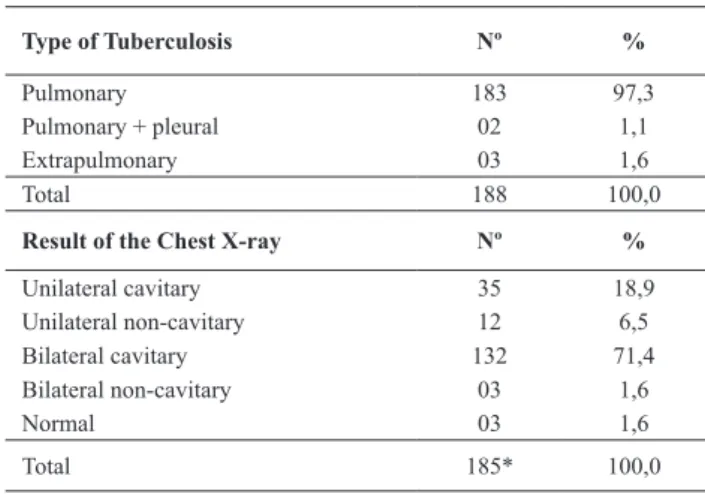
In Table 2, it is observed that most subjects presented pulmonary MDR-TB and bilateral cavitary lesion.
Regarding the modality of the MDR-TB treatment, 94.7% iniiated the Cooperated Observed Treatment(b) soon ater the irst diagnosis, whereas 85.4% of the sub-jects performed the Directly Observed Treatment (DOT) in cooperaion with the BHU.
Of all subjects, 41 (21.8%) did not have an outcome for the MDR-TB treatment in the studied period: 83.0% were following the treatment and 17.0% were transferred to other insituions. On the other hand, 147 (78.2%) achieved an outcome in the studied period, 66.0% of which were cured and discharged, 17.7% abandoned the treatment, 9.5% died, and 6.8% failed. Of the 14 regis-tered deaths, 50% were due to TB. The other cases did not specify the cause of death on the data sources.
(b)because of the particular characteristic of the studied location, i.e., a
reference center, the dot is performed in cooperation with other health institutions. the clemente ferreira institute is a pioneer in the use of the cooperated dot for tb in brazil.
discussion
The data extracted from the noiicaion forms and medical records permit to recognize the most afected populaion segment regarding the subjects’ age, gender, educaion, employment situaion, and place of residence. The sociodemographic proile found in the present study is similar to those of other invesigaions, which point out to the predominance of TB and MDR-TB among male subjects in the producive age-group, with low educaion level, with a precarious or no job, and afected by poverty(5,6-7).
Most subjects lived in the same city where the Refer-ence Center and BHU were located, which made easier their referral, diagnosis, and MDR-TB care. It was found that the subjects used the Primary Care system as their entrance to health care, as recommended in the decen-tralizaion policies for TB control(3).
The results found regarding the subjects’ clinical-epi-demiological proile reveal that, in the addressed histori-cal series, the number of new noiied cases per year was always between 26 and 30, which implies there the TB and MDR-TB prevenion measures were deicient, because most did not reach cure ater more than two treatments before MDR-TB. Failure and abandonment are intrinsically related to the treatments being unsuccessful.
Studies have pointed the following causes for TB treat-ment failure and abandontreat-ment: inappropriate prescrip-ion, alcoholism, socioeconomic issues and adverse ef-fects to drugs(8-9). Therefore, treatment irregulariies and non-adherence are key elements for the development of MDR-TB(3,7).
The present study found there were irregulariies in the use of medicaion in treatments before TMBR. Treat-ment adherence is key for TB control, paricularly in terms of muli-drug resistance(7).
The high rates of failure and abandonment ideniied in the study reveal the need to further address the causes. They also reveal the need to take care of the subjects un-der treatment, so they do not reach the extreme situaion that is MDR-TB and/or so there is an early ideniicaion of MDR-TB cases, thus avoiding paient sufering and reduc-ing the epidemiological chain of transmission, reducreduc-ing unnecessary costs.
With the purpose of reducing the rates of treatment failure and, consequently, increasing cure rates, The Na-ional Program for TB Control established, as of 2009, the early diagnosis of MDR-TB through a sensiivity test all the animicrobial drugs in every case of TB tracking(3).
Smoking and alcoholism, which are co-morbidiies ideniied in the studied populaion, are pointed out as ele-ments associated to the occurrence of MDR-TB(10-11). In this sense, once they also express an important social determi-naion, once again it is highlighted that it is necessary to use
Type of Tuberculosis Nº %
Pulmonary 183 97,3
Pulmonary + pleural 02 1,1
Extrapulmonary 03 1,6
Total 188 100,0
Result of the Chest X-ray Nº %
Unilateral cavitary 35 18,9
Unilateral non-cavitary 12 6,5
Bilateral cavitary 132 71,4
Bilateral non-cavitary 03 1,6
Normal 03 1,6
Total 185* 100,0
* The three subjects with extrapulmonary MDR-TB did not perform the Chest
X-ray.
Table 2 -Distribution of subjects, according to the clinical and radiologic
1688
Rev Esc Enferm USP 2011; 45(Esp. 2):1685-9 www.ee.usp.br/reeusp/Patients with multidrug-resistant tuberculosis in a reference center: sociodemographic and clinical-epidemiological proile
Ferreira KR, Cavalcante EGR, De-La-Torre-Ugarte-Guanilo MC, Berti RAL, Bertolozzi MR
the moment the subject atends the health service as an opportunity to talk and learn about their needs.
Clinical data, such as the type of TB and lesion, are im-portant informaion included in the sources. This informa-ion is relevant for the clinical proile because they permit health care professionals to be more careful regarding individuals with large pulmonary caviies and/or bilateral lesion revealed in the chest X-ray, because resistance is a phenomenon fundamentally associated with large bacte-ria populaions, because, the bigger the lesion, the great-er the amount of bacilli and the highgreat-er the chances of becoming resistant, even before beginning the treatment (natural resistance-gene mutaion)(6).
The present study permited to verify that the informa-ion about irregulariies in the treatment is registered on the noiicaion form and on the medical records. Howev-er, the other key elements regarding the triggers for iden-ifying TB and the Social Determinants of Health (SDH) are not registered on these instruments, although some (very few, actually) health care professionals described some related aspects. Knowing these elements permits to un-derstand the subjects’ vulnerability and needs, and allows health care professionals to work comprehensively. It is worth staing that treatment adherence is not limited to one’s will,
(...) disconnected from the reality of the patient, but de-pendent on a series of intermediations that involve the in-dividual, the organization of working processes in health, and the accessibility in a broader sense, regarding the processes that lead (or not) to the development of a de-cent life(5).
In fact, adherence surpasses the limits regarding the subjects’ aitudes or behaviors and extends towards their social inclusion(5,7). Studies highlight the importance of considering social issues to guarantee treatment adher-ence, because they surely have an efect on treatment coninuity. It is emphasized that, in this domain, knowing hot treatment support works, either from the family, or other possibiliies, such as social networks, besides know-ing other aspects, such as the availability of food, autho-rizaion to leave work for the ST, sigma, accessibility to informaion about the disease and health services, all of which are considered essenial(7,12).
It is worth emphasizing that the DOT is a strategy rec-ognized due to its importance in strengthening treatment
adherence among subjects with TB and MDR-TB(3). In this study, most individuals with MDR-TB were following TS. However, among those who completed the treatment, only 51.6% were cured and discharged, which reveals certain limitaions that are not objecively ideniied when extracted from the source data, as those used in the present study.
Back to the SDH issue, according to the WHO, they refer to the social condiions of life and work that relate with the health condiion(13). Because of their importance, today, there is a global movement in course, iniiated by the WHO in 2005, that aims at promoing, in the inter-naional level, awareness about the importance of social determinants in the health situaion of individuals and the populaion(13). Understanding the MDR-TB as an eminently social disease means that it is also associated to the forms of life and work of those afected.
The DSH are important to direct disease control and prevenion measures that permit to improve the rates of cure, abandonment, and death due to MDR-TB, highlight-ing that the rates at the studied insituion are far from adequate.
concLusion
The surveyed data permited to idenify the sociode-mographic and clinical- epidemiological proiles of the subjects, but with some limitaions. It is necessary that any informaion regarding the SDH be registered so as to provide a beter understanding of the sociodemographic and clinical-epidemiological proile, and support studies that clarify the life and work condiions with MDR-TB, to improve and expand the public policies, challenging health surveillance services to review the implemented pracices, expanding and diversifying informaion tech-niques and intervenions about the determinants of health-disease.
The SDH appear as potenial aspects to improve TB and MDR-TB prevenion and control measures. Therefore, health care professionals must be encouraged to idenify and register them with the purpose to improve the knowl-edge about the sociodemographic and clinical-epidemi-ological proile of subjects with MDR-TB, as well as their needs, from the perspecive of social determinaion.
reFerences
1. Araújo Filho JA, VasconcelosJúnior AC, Sousa EM, Silveira C,
Sousa PTP, Severo KA, et al. Mulidrug-resistant tuberculosis: case reports study in a central state of Brazil. Braz J Infect. 2008;12(1):94-8.
2. World Health Organizaion (WHO). Mulidrug and extensively drug-resistant TB (M/XDR TB): global report on surveillance and response. WHO Report 2010. Geneva; 2010.
Acknowledgement
the authors thank the state of são Paulo research foundation (Fundação de Amparo à Pesquisa do
Estado de São Paulo - FAPESP), process number º 2009/04766-2, for the inancial support.
4. Brasil. Ministério da Saúde; Secretaria de Vigilância em Saúde; Centro de Referência Professor Hélio Fraga. Tuberculose mul-irresistente: guia de vigilância epidemiológica [Internet]. Rio de Janeiro; 2007 [citado 2009 jul. 3]. Disponível em: htp:// www4.ensp.iocruz.br/biblioteca/dados/txt_670024370.pdf 5. Bertolozzi MR. Adesão ao tratamento da tuberculose na
per-speciva da estratégia do tratamento diretamente observado (“DOTS”) no município de São Paulo-SP [tese livre-docência]. São Paulo: Escola de Enfermagem, Universidade de São Paulo; 2005.
6. Coelho AGV. Peril da tuberculose mulidroga resistente no município de Santos, 2000-2004 [dissertação]. São Paulo: Co-ordenadoria de Controle de Doenças, Secretaria de Saúde do Estado de São Paulo; 2007.
7. Queiroz EM, Bertolozzi MR. Tuberculosis: supervised treat-ment in North, West and East Health Departtreat-ments of São Paulo. Rev Esc Enfer USP. 2010; 44(2):449-45.
8. Albuquerque MFM, Leitão CCS, Campelo ARL, Souza WV, Salusiano A. Fatores prognósicos para o desfecho do trata-mento da tuberculose pulmonar em Recife, Pernambuco, Bra-sil. Rev. Panam Salud Publica. 2001;9(6):368-74.
9. Sá LD, Souza KMJ, Nunes MG, Palha PF, Nogueira JA, Villa TCS. Tratamento da tuberculose em unidades de saúde da família: histórias de abandono. Texto Contexto Enferm. 2007;16(4):712-18.
10. Melo FAF, Afuine JB, Ide-Neto J, Almeida EA, Spada DTA, An-telmo ANL, et al. Aspectos epidemiológicos da tuberculose mulirresistente em Serviço de Referência na cidade de São Paulo. Rev Soc Bras Med Trop. 2003;36(1):27-34.
11. Suarez GI, Rodrigues BA, Vidal PJL, Garcia VMA, Jaras HMJ, Lopes O, et al. Risk factores for mulidrug-resistant tubercu-losis in a tubercutubercu-losis unit Madri, Spain. Eur J Clin Microbiol Infect Dis. 2009;28(4):325-30.
12. Ferreira KR. Tuberculose mulirresistente em um Centro de Referência do Estado de São Paulo: peril e trajetória de pacientes [dissertação]. São Paulo: Escola de Enfermagem, Universidade de São Paulo; 2011.