Validation of nursing interventions in
people with diabetes mellitus
VALIDAÇÃO DE INTERVENÇÕES DE ENFERMAGEM EM PESSOAS COM DIABETES MELLITUS
VALIDACIÓN DE INTERVENCIONES DE ENFERMERÍA EN PERSONAS CON DIABETES MELLITUS
1 PhD Professor, University of São Paulo at Ribeirão Preto, General and Specialized Nursing Department. Ribeirão Preto, SP, Brazil. [email protected] 2 RN. Master Student, University of São Paulo at Ribeirão Preto, Fundamental Nursing Program. Ribeirão Preto, SP, Brazil. [email protected] 3 RN. Master Student, University of São Paulo at Ribeirão Preto, Fundamental Nursing Program. Ribeirão Preto, SP, Brazil. [email protected] 4 RN. Associate Professor, University of São Paulo at Ribeirão Preto, General and Specialized Nursing Department. Ribeirão Preto, SP, Brazil. [email protected] 5 RN. Doctoral Student,
O
RIGINAL
A
R
TICLE
RESUMO
Estudo descritivo e exploratório que obje-tivou validar as intervenções de enferma-gem propostas pela Nursing Interven-tions Classification para os diagnósticos de enfer-magem: Integridade da pele prejudicada, Conhecimento deficiente e Controle inefi-caz do regime terapêutico predominantes em pessoas com diabetes. Participaram 21 enfermeiros especialistas em diabetes mellitus no Brasil, em 2007. As intervenções de enfermagem que obtiveram a maior média ponderada foram cuidado com le-sões: drenagem fechada, precauções circu-latórias para o diagnóstico de enfermagem Integridade da pele prejudicada, ensino: processo de doença, ensino: medicação prescrita para o Conhecimento deficiente e ensino: processo de doença e ensino: die-ta prescridie-ta para Controle ineficaz do regi-me terapêutico. Dentre as 1005 atividades de enfermagem, 51% foram validadas como muitíssimo características pelos especialis-tas. Acredita-se que outros estudos devam ser conduzidos para ampliar a validação das intervenções de enfermagem em pessoas com diabetes mellitus no Brasil, buscando evidências científicas para o cuidado dessa clientela.
DESCRITORES
Diabetes mellitus.
Diagnóstico de enfermagem. Cuidados de enfermagem.
Carla Regina de Souza Teixeira1,Tânia Alves Canata Becker2, Rachel Citro3, Maria Lúcia Zanetti4
Camila Aparecida Pinheiro Landim5
ABSTRACT
This descriptive, exploratory study aimed to validate nursing interventions proposed by the Nursing Interventions Classification for impaired skin integrity, deficient knowl-edge, ineffective therapeutic regimen man-agement for predominant nursing diag-noses in people with diabetes. Participants were 21 specialist nurses in diabetes melli-tus in Brazil, in 2007. Interventions were analyzed according to Fehring's evaluation model. The nursing interventions with the highest weighted average were care to in-juries: closed drainage and circulatory pre-cautions for the impaired skin integrity nursing diagnosis, teaching: disease process
and teaching: prescribed medication for deficient knowledge and teaching: disease process and teaching: prescribed diet for ineffective therapeutic regimen manage-ment. Among the 1005 activities of nurs-ing, 51% were validated as very character-istic by experts. Other studies should be carried out to expand the validation of the nursing interventions to people with dia-betes mellitus in Brazil, searching for scien-tific evidences for care to these clients
KEY WORDS
Diabetes mellitus. Nursing diagnosis. Nursing care.
RESUMEN
Estudio descriptivo exploratorio que objetivó validar las intervenciones de en-fermería propuestas por la Nursing Interventions Classification para los diag-nósticos de enfermería: Integridad de la piel perjudicada, Conocimiento deficiente y Control ineficaz del régimen terapéutico, predominantes en personas con diabetes. Participaron 21 enfermeros especialistas en diabetes mellitus en Brasil, en 2007. Las intervenciones de enfermería que obtuvie-ron la mayor media ponderada fueobtuvie-ron cui-dado con lesiones: drenaje cerrado, precau-ciones circulatorias para el diagnóstico de enfermería Integridad de la piel perjudica-da, enseñanza: proceso de la enfermedad y
enseñanza: medicación prescripta para el Conocimiento deficiente, y enseñanza: pro-ceso de la enfermedad y enseñanza: dieta prescripta para Control ineficaz del régimen terapéutico. Entre las 1005 actividades de enfermería, el 51% fueron validadas como muy características por los especialistas. Se cree que deben ser efectuados otros estu-dios para ampliar la validación de las inter-venciones de enfermería a personas con diabetes mellitus en Brasil, buscando evi-dencias científicas para el cuidado de dichos pacientes.
DESCRIPTORES
INTRODUCTION
Diabetes mellitus is currently considered an important health problem in terms of its prevalence, incidence and relationship to premature mortality, as well as due to the costs involved to control and treat its complications. Better understanding of the causes and reasons that lead to DM complications has enabled professionals to provide a more appropriate treatment and consequently lead to increased life expectancy and a higher rate of survival for people with diabetes mellitus(1).
Additionally, the complexity of the treatment of diabe-tes in a daily routine seeks to achieve normal levels of blood glucose in order to avoid acute complications and to have a satisfactory adaptation of lifestyle, which requires the multi-professional health team to be qualified in order to meet the nursing goal of implementing an integrated ap-proach to all the body systems(2).
Therefore, the nursing process is a varia-tion of the scientific ravaria-tionale that helps nurses to organize, systematize and concep-tualize nursing practice. Organization is a se-quence of stages or components necessary to achieve this objective. The nursing process currently includes, in its most familiar form, five interrelated stages: data collection, nurs-ing diagnosis, plannnurs-ing, implementation, and evaluation(3). Through this method, nurses are
encouraged to continually assess care deliv-ery, reviewing their practices and reflecting on the best way to implement them(4).
The nursing diagnosis is a result of critical thinking because it encompasses decisions about nursing situations, seeking results for which nurses are responsible. We stress the importance of accuracy in data collection as
an essential step for establishing the nursing diagnosis(3). In
Brazil, some authors identified various nursing diagnoses in people with diabetes mellitus(5-7); however, in this study, we
opted for the following: Impaired skin integrity, Knowledge deficit, and Ineffective management of therapeutic regimen, in line with the majority of studies on diabetes mellitus.
With the expansion of nursing diagnoses and classifica-tion systems, the need to recover and also classify nursing interventions emerges in order to establish a channel of communication between the nurse and the other mem-bers of the health team or within the nursing team itself(8).
In this context, the Nursing Interventions Classification (NIC) is a taxonomy that includes actions recommended in nursing care. It is designed to improve clinical documenta-tion, communication of care, integration of data in computer systems, use of data by nurses from various outpatient clin-ics and health facilities, data sources for research, indicators of productivity, evaluation of competence, payment for ser-vices, and curricular structure. The recommendation to
implement studies using this taxonomy will contribute to the generation of new knowledge and hypotheses, contributing to the advancement of Brazilian nursing(9).
OBJECTIVE
This study proposes to validate nursing interventions according to NIC for the following nursing diagnoses: Im-paired skin integrity, Knowledge deficit, and Ineffective management of therapeutic regimen, which are predomi-nant in people with diabetes mellitus.
METHOD
This is a descriptive and exploratory study. The popula-tion was composed of 21 nurse-experts in diabetes mellitus in Brazil. Aiming to homogenize the sample, the following inclusion criteria were used: being a nurse and working with individuals with diabetes for at least three years and having clinical experience of at least one year, and reading and signing a consent form to partici-pate in the study.
Two questionnaires were developed, one containing socio-demographic data (age, gen-der, profession, time of work in the institu-tion) and data from the institution (whether it is a public or private facility, number of con-sultations delivered to people with diabetes per month, service flow), and another con-taining the scale of nursing interventions pro-posed by NIC for the diagnoses under study(9).
The second questionnaire had a five-point Likert scale. A numerical value was attributed to each variation of points: (0) not, (0.25) little, (0.5) somewhat, (0.75) very, and (1) very much characteristic. The number corresponds to the degree of importance of each action and the possibility of suggesting new actions and/or relevant observations(10).
Four experts with knowledge in diabetes mellitus as-sessed the instrument. For data collection, a letter of invi-tation containing the study’s objectives and nature, the data collection instrument and a free and informed consent form, were sent by mail in sealed and stamped envelopes to facilitate participants returning the documents.
Data collection was carried out between August 2007 and June 2008 through three strategies. First, a letter was sent to 38 institutions registered in the Brazilian Society of Diabetes asking their authorization to carry out the survey. After various telephone contacts with the 38 institutions, 12 directors agreed to participate in the study but only six nurses returned the data collection instruments.
Secondly, authorization to collect data was obtained from a Program of Hypertension and Diabetes of the City Health Department; five nurses from primary health care and four
Better understanding of the causes and reasons that lead to DM complications has enabled professionals
to provide a more appropriate treatment and consequently lead
to increased life expectancy and a higher rate of survival
from hospital care returned the instrument. Finally, given the difficulty of obtaining answered instruments, the Lattes Plat-form from the National Council for Scientific and Technologi-cal Development (CNpQ) was searched using the descriptors: nursing diagnosis and diabetes mellitus. A total of 28 experts were identified. Of these, six returned the instrument. The fi-nal sample was composed of 21 nurse-experts in diabetes.
Most (83%) of the 21 nurses were women, aged from 30 to 39 years (50%); 27% had attended postgraduate educa-tion programs and 27% specializaeduca-tion courses. Time since graduation of 10 years or more (66%) predominated and 55% of the nurses worked in public institutions, in outpatient clin-ics. The participants were not able to report the number of patients with diabetes cared for in the facilities for which they worked. In terms of offering education in DM, 67% re-ported they do not organize educational groups in DM.
For each answer option in the second data collection instrument, a weighted average was computed for each nursing activity. Then, the sum of weighted averages was divided by the number of nursing activities in each nursing intervention and the number of participants. Interventions with weight > 0.80 were considered essential nursing inter-ventions. Nursing activities with weight between 0.50 and 0.79 were considered complementary.
Data were analyzed and processed through the Statisti-cal Package for Social Sciences for Windows version 14.0. The project was approved by the Research Ethics Commit-tee at the University of São Paulo at Ribeirão Paulo, Col-lege of Nursing (protocol nº 0607/2005).
RESULTS
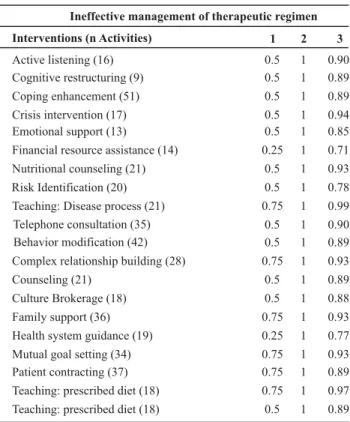
Tables 1, 2 and 3 presents the distribution of weighted av-erages of answers of individuals for each nursing intervention of the nursing diagnoses: Impaired skin integrity, Knowledge deficit, and Ineffective management of therapeutic regimen. Table 1 - Distribution of nursing interventions for the nursing diagnoses
Impaired skin integrity, according to the weighted average of answers for each nursing activity - Ribeirão Preto, SP, Brazil - 2008
NURSING DIAGNOSIS Impaired skin integrity
1 2 3
Amputation care (28) Circulatory precautions (11) Exercise promotion (17) Foot care (20)
Medication management (28)
Pressure management: minimize pressure to body parts (18)
Pressure ulcer prevention (25) Skin care: Topical treatments (28) Wound care: closed drainage (10) Skin surveillance (15)
Medication administration: subcutaneous (13) 0 -0.5 0.75 0 0 0 0 0.75 0.75 0.75 1 1 1 1 1 1 1 1 1 1 1 0.78 1.00 0.78 0.84 0.75 0.81 0.85 0.86 1.00 0.99 0.95
Interventions (n Activities)
1 = Minimum values 2 = Maximum values 3 = Weighted average
Table 2 - Distribution of nursing interventions for the nursing
diagnoses Knowledge deficit, according to the weighted average of answers for each nursing activity - Ribeirão Preto, SP, Brazil - 2008
NURSING DIAGNOSIS Knowledge deficit (specify)
1 2 3
Interventions (n Activities)
Health system guidance (19) Learning Facilitation (40)
Teaching: disease process (21) Teaching: procedure/treatment (28)
Health Education (35)
Learning Readiness Enhancement (28) Patient rights protection (17)
Teaching: individual (27)
Teaching: prescribed activity/exercise (23) Teaching: prescribed medication (32) Teaching: psychomotor skill (12)
Teaching: sexuality (25)
0.25 0.25 0.25 0 0.5 0.25 0 0.75 0.5 0.25 0.75 0.25 1 1 1 1 1 1 1 1 1 1 1 1 0.78 0.91 0.96 0.92 0.77 0.83 0.77 0.92 0.91 0.96 0.92 0.89
Table 3 - Distribution of nursing interventions for the nursing
diagnoses Ineffective management of therapeutic regimen, according to the weighted average of answers for each nursing activity - Ribei-rão Preto, SP, Brazil - 2008
1 = Minimum values 2 = Maximum values 3 = Weighted average 1 = Minimum values 2 = Maximum values 3 = Weighted average
Active listening (16) Cognitive restructuring (9) Coping enhancement (51)
Crisis intervention (17) Emotional support (13)
Financial resource assistance (14)
Nutritional counseling (21)
Risk Identification (20) Teaching: Disease process (21)
Telephone consultation (35) Behavior modification (42)
Complex relationship building (28)
Counseling (21)
Culture Brokerage (18) Family support (36)
Health system guidance (19)
Mutual goal setting (34) Patient contracting (37)
Teaching: prescribed diet (18)
Teaching: prescribed diet (18)
0.5 0.5 0.5 0.5 0.5 0.25 0.5 0.5 0.75 0.5 0.5 0.75 0.5 0.5 0.75 0.25 0.75 0.75 0.75 0.5 1 1 1 1 1 1 1 1 1 1 1 1 1 1 1 1 1 1 1 1 0.90 0.89 0.89 0.94 0.85 0.71 0.93 0.78 0.99 0.90 0.89 0.93 0.89 0.88 0.93 0.77 0.93 0.89 0.97 0.89 NURSING DIAGNOSIS
Ineffective management of therapeutic regimen
1 2 3
Interventions (n Activities)
weighted averages and were considered essential: wound care: closed drainage and circulatory precautions, and three interventions that obtained weighted averages between 0.50 and 0.79 were considered complementary: amputa-tion care, exercise promotion and medication management. A total of 12 nursing interventions and 307 nursing ac-tivities are listed for the nursing diagnosis Knowledge defi-cit. The interventions that obtained the highest weighted averages and thus were considered essential were: teach-ing: disease process and teaching: prescribed medication. The three complementary interventions, that is, those that obtained weighted averages between 0.50 and 0.79 were: health system guidance, health education, and patient rights protection.
Finally, 20 nursing interventions and 485 nursing activi-ties are listed under the nursing diagnosis Ineffective man-agement of therapeutic regimen. The two interventions that obtained the highest weighted averages were: teaching: dis-ease process and teaching: prescribed diet. Those that ob-tained weighted averages between 0.50 and 0.79 were the following complementary interventions: financial resource assistance, risk identification and health system guidance.
Hence, 1,005 nursing activities were analyzed by the 21 individuals who participated in the study, totaling 21,105 answers. Of these answers, 10,763 (51%) were considered as very much characteristic, 7,598 (36%) as very character-istic, 1,900 (9%) somewhat charactercharacter-istic, 633 (3%) as little characteristic, and 211 (1%) not characteristic. No nursing activities were added by the participants in the three ana-lyzed nursing diagnoses.
DISCUSSION
The Nursing Classification Interventions (NIC) is more recent than the NANDA-I International System of Nursing Diagnosis. Therefore, the methods used to validate nurs-ing diagnoses have also been used to validate nursnurs-ing in-terventions.
One study proposed a model to validate nursing diag-noses called Differential Diagnostic Validation (DDV), in addition to having significantly changed the two existent models(10) Diagnostic Content Validation (DCV) and Clinical
Diagnostic Validation (CDV)(11).
In the Diagnostic Content Validation (DCV) model, the characteristics with averages equal to or higher than 0.80 are considered leading provisory indicators and those with an average between 0.50 and 0.79 are considered second-ary provisory indicators. Finally, the total DCV score is ob-tained summing up the individual scores and dividing them by the total number of the diagnosis defining characteris-tics, discarding those characteristics with averages equal to or below 0.50(10-11).
The nursing activities with averages equal to or higher than 0.80 were considered in this study as essential or
rel-evant interventions for the studied diagnoses and there-fore should be implemented for people with diabetes; in-terventions with averages between 0.50 and 0.79 were con-sidered complementary. Those with averages equal to or below 0.50 were considered not essential for the studied diagnoses. This study revealed that 51% of the nurses con-sidered most of the interventions essential for caring for individuals with diabetes mellitus.
We stress that the individual needs of each patient should be taken into account in nursing care and that nursing inter-ventions can be implemented according to the nurses’ as-sessment. Hence, it is expected that this study’s results will aid in the analysis of activities performed in DM care.
Two essential interventions were identified for the nurs-ing diagnosis Impaired skin integrity, wound care: closed drainage and circulatory precautions.
A study was carried out to identify the characteristics of ulcers in people with peripheral vasculopathy with the diagnosis Impaired skin integrity related to the interrup-tion of arterial and/or venous blood flow, hospitalized in the vascular ward of the Dante Pazzanese Institute of Car-diology of São Paulo, Brazil. This study found that ulcers present particular and distinct characteristics because they are either arterial, venous, diabetic or hypertensive, hence, nurses should recognize them to reach an accurate diagno-sis and adopt an appropriate regimen for healing the wounds(12). This study raises the importance of the nursing
intervention circulatory precautions for individuals with diabetes, because these are individuals who need rapid di-agnosis and appropriate treatment so that chronic compli-cations, occasionally severe or even fatal, are avoided.
Another study investigated 403 individuals with diabe-tes (31% with type 1 diabediabe-tes mellitus and 69% type 2 dia-betes mellitus) cared for in the outpatient facility of a uni-versity hospital and found that detection of skin wounds was high among people with diabetes. The results show that 81% of the studied individuals presented various types of derma-toses, and 1,198 skin disorders were found corresponding to three to four skin manifestations per individual. The study concluded that careful skin assessment should be associated with outpatient follow-up of people with diabetes in order to provide appropriate treatment of the diagnosed derma-toses(13). Hence, we emphasize that the actions of the health
team should be integrated and maintain multi-professional consensus while skin assessment of people with diabetes should be carefully carried out by nurses.
The complementary intervention amputation care was also found for the nursing diagnosis Impaired skin integ-rity, in which people with diabetes present a 15 times in-creased risk of being subject to amputation of lower limbs than those who do not have diabetes(14), due to Diabetic
Foot, one of the most severe and prevalent chronic com-plications of diabetes mellitus.
Nurses, as members of the multi-disciplinary team, have a special role, which is to educate people. Patient understand-ing the amputation process is essential for health profes-sionals to perform their activities more effectively, which enables care to be focused on the patients’ individuality and particularities concerning their lives’ experiences(15).
A descriptive study carried out in two primary health care units in Ribeirão Preto, SP, Brazil characterized 101 people with type 2 diabetes mellitus to identify factors that triggered the condition of diabetic foot. In the feet assess-ment, 73% presented poor hygiene and inappropriate nail cutting, 63% had dry and scaly skin, 52% altered nails, 49% calluses and/or cracks, and 33% flat feet. The risk classifica-tion identified that 7.9% presented plantar insensitivity and 6.9% presented plantar insensitivity and foot deformity. The study concluded that such disorders could be prevented through basic education and interventions for foot care, in which external factors identified in this study could be re-solved and monitored with actions of low complexity(16).
Nurses should take the responsibility to track and moni-tor risk facmoni-tors for Diabetic Foot during the care process and instruct people with DM concerning the risks and, with the involvement of the entire health team, determine the basic interventions and plan educational activities for self-care and maintenance of a good metabolic control in order to avoid severe complications(16). Hence, this intervention
is closely related to the nursing intervention of the diagno-sis Ineffective management of therapeutic regimen, con-sidered complementary for identification of risk.
An essential step in identifying risk factors for Diabetic Foot is podiatric assessment, which consists of inspecting the skin, its structural and circulatory aspects, and tactile pressure sensitivity, in addition to hygienic conditions and characteristics of shoes. These actions, when performed by professionals at the primary care health level, contribute to reducing the risk of morbidities and complications in the feet of people with diabetics(17).
In relation to interventions for the nursing diagnoses
Knowledge deficit and Ineffective management of thera-peutic regimen, the following essential interventions were identified: teaching: disease process, teaching: prescribed diet and teaching: prescribed medication focused on pro-viding guidance concerning the disease, medication and diet. Hence, there is a predominance of interventions in the literature related to dietary planning, physical exercise and the appropriate use of medication(18).
We stress that the nursing intervention teaching: dis-ease process was identified as essential for both nursing diagnoses previously reported. It acknowledges education as a fundamental strategy in DM treatment, aiming to im-prove the knowledge of people with diabetes and to en-able them to intervene, themselves, in order to achieve the desired metabolic control. Therefore, the metabolic con-trol of individuals with diabetes is obtained through edu-cation, glucose monitoring, nutritional therapy, regular
ex-ercise, pharmacological therapeutic schemes, information on the prevention and treatment of chronic and acute com-plications, and the reinforcement of treatment objectives(18).
Due to the chronic nature of diabetes and the impor-tance of glycemic control to preventing complications and subsequent problems, knowledge acquired through edu-cation is a relevant aspect in the treatment(18).
A study developed in an educational center in the interior of São Paulo, Brazil to verify the implementation of a program to care for individuals with diabetes used the Staged Diabetes Management (SDM) protocol and to characterize the activi-ties developed by the multi-professional health team verified that the use of the protocol contributed to improve the meta-bolic control of people with diabetes, which consequently im-proved medication coverage for diabetes mellitus, hyperten-sion, and knowledge concerning the disease and also reduced the signs and symptoms reported by people with DM(19).
Relating the essential nursing intervention teaching: pre-scribed diet with the results reported earlier, the study re-vealed that the objective of nutritional care for people with diabetes is to evaluate the nutritional state and define needs, establishing attainable goals in the diet plan and metabolic control and also adjust eating based on the response and metabolic control of the individual with diabetes(19).
Another study conducted in the interior of São Paulo evalu-ated the impact of an educational program that showed that people improved their knowledge concerning their disease with a significant increase regarding general subjects of dia-betes mellitus such as: concept, physiopathology and treat-ment; other subjects that stood out were exercise and diet(20).
It is noteworthy that 67% of the individuals in this study do not organize educational groups in the studied facility. In contrast, the literature indicates that group intervention is a valuable strategy for achieving educational objectives, promoting greater interaction and group cohesion(21).
Finally, for the nursing diagnoses Knowledge deficit, and Ineffective management of therapeutic regimen, comple-mentary interventions were identified in relation to health system guidance, patient rights protection, and financial resources assistance, while the nursing intervention health system guidance was found in both nursing diagnoses pre-viously reported.
There is a science currently used as a field of action in health, in which human beings are considered subjects, not only objects. This science is known as bioethics, ethics ap-plied to life, and it is presented as a search for responsible behavior of people who should decide upon types of treat-ment, research or positions in relation to humanity(22).
when the person who seeks the health care service is not considered a subject, a holder of rights and life options(22).
Nursing, as part of the health system, should ensure that people who seek out the health system have a guar-antee of care under its responsibility in a equitable way, since everyone has the right to information, regardless of his/her condition(22).
Health professionals should have the competence to en-able people who seek health services to know increasingly more about their bodies, diseases and relationship with their social environment, enabling people to play an active role in the face of their problems. This would imply the development of a more effective health care and more suc-cessful treatment(22).
CONCLUSION
This study revealed that most of the nursing interven-tions for the nursing diagnoses Impaired skin integrity, Knowledge deficit and Ineffective management of thera-peutic regimen were considered essential by 51% of the studied nurses. Thus, they should be implemented for indi-viduals with diabetes mellitus.
Two nursing interventions obtained the highest weighted averages and were considered essential for the diagnosis Impaired skin integrity: wound care: closed drain-age and circulatory precautions; three interventions ob-tained weighted averages between 0.50 and 0.79 and thus were considered complementary: amputation care, exer-cise promotion, and medication management.
In relation to the nursing diagnosis Knowledge deficit, the interventions that obtained the highest averages and
thus were considered essential were: teaching: disease pro-cess and teaching: prescribed medication. The tree comple-mentary interventions, that is, those whose weighted av-erages were between 0.50 and 0.79, were: health system guidance, health education, and patient rights protection. Finally, for the nursing diagnosis Ineffective manage-ment of therapeutic regimen the two essential interven-tions were: teaching: disease process and teaching: pre-scribed diet and the complementary interventions: finan-cial resource assistance, risk identification, and health sys-tem guidance.
The nursing interventions evidenced by this study indi-cate the need for health education. The professional prac-tice of nurses included in the multi-professional team, when centered on the scope of education to enable people with diabetes mellitus to efficaciously practice self-care, can minimize the onset of chronic complications.
Some difficulties such as: length of the data collection instrument, identification of nurse-experts in diabetes mel-litus coupled with the need to contact participants through mail, by telephone or e-mail, and also the delayed return of instruments, represented limitations to this study.
We consider the fact that for one to deliver nursing care to people with diabetes mellitus, the activities included in the interventions of the three studied nursing diagnoses are interrelated and need further studies to identify them in clinical practice, verifying their applicability, especially in the nurses’ educational actions.
We believe that other studies should be conducted to expand the validation of nursing interventions to people with diabetes mellitus in Brazil in the search of scientific evidence to provide integral care to this clientele.
REFERENCES
1. Franco LJ, Rocha JSY. O aumento das hospitalizações por dia-betes mellitus na região de Ribeirão Preto, no período 1988-97. Diabetes Clínica. 2002;6(2):108.
2. Mancini MC. Obstáculos diagnósticos e desafios terapêuticos no paciente obeso. Arq Bras Endocrinol Metabol. 2001;45 (6):584-608.
3. Alfaro-Lefevre R. Aplicação do processo de enfermagem: um guia passo a passo. 4ª ed. Porto Alegre: Artes Médicas Sul; 2000. 4. Pellison F, Nagumo MM, Cunha ES, Melo LL. Aplicação prática do processo de enfermagem a uma adolescente portadora de doença crônica. Rev Esc Enferm USP. 2007;41(3):513-7. 5. Doenges ME, Moorhouse MF. Application of nursing process
and nursing diagnosis: an interactive text for diagnostic reasoning. 5th ed. Philadelphia: Davis; 2003.
6. Becker TAC, Teixeira CRS, Zanetti ML. Diagnósticos de enfer-magem em pacientes diabéticos em uso de insulina. Rev Bras Enferm. 2008;61(6):847-52.
7. Volpato MP, Cruz DALM. Diagnósticos de enfermagem de paci-entes internadas em unidade médico-cirúrgica. Acta Paul Enferm. 2007;20(2):119-24.
8. Barreto PL, Oliveira FM, Silva RCP. Utilização do processo de enfermagem em diabéticos nas Unidades de Saúde de Coronel Fabriciano, Minas Gerais. RBPS Rev Bras Promo-ção Saúde. 2007;20(1): 53-9.
9. Mccloskey JC, Bulechek GM. Classificação das Intervenções de Enfermagem (NIC). 4ª ed. Porto Alegre: Artes Médicas; 2008. 10. Fehring RJ. Validating diagnostic labels: standardized
11. Creason NS. Clinical validation of nursing diagnoses. Int J Nurs Terminol Classif. 2004;15(4):123-32.
12. Bersusa AAS, Lages JS. Integridade da pele prejudicada: iden-tificando e diferenciando uma úlcera arterial e uma venosa. Ciênc Cuidado Saúde. 2004;3(1):81-92.
13. Foss NT, Polon DP, Takada MH, Foss-Freitas MC, Foss MC. Dermatoses em pacientes com diabetes mellitus. Rev Saúde Pública. 2005;39(4):677-82.
14. Most RS, Sinnock P. The epidemiology of lower extremity amputation in diabetic individuals. Diabetes Care. 1983;6 (1):87-91.
15. Chini GCO, Boemer MR. A amputação na percepção de quem a vivencia: um estudo sob a ótica fenomenológica. Rev Lat Am Enferm. 2007;15(2):330-6.
16. Ochoa-Vigo K, Torquato MTCG, Silvério IAS, Queiroz FA, De La Torre Ugarte-Guanilo MC, Pace AE. Caracterização de pes-soas com diabetes em unidades de atenção primária e se-cundária em relação a fatores desencadeantes do pé diabéti-co. Acta Paul Enferm. 2006;19(3):296-303.
17. Milman MHSA, Leme CBM, Borelli DT, Kater FR, Baccili ECDC, Rocha RCM, et al. Pé diabético: avaliação da evolução e custo hospitalar de pacientes internados no Conjunto Hospitalar de Sorocaba. Arq Bras Endocrinol Metabol. 2001;45(5):447-51. 18. American Diabetes Association. Recomendações para os
porta-dores de diabetes mellitus. Diabetes Clínica. 2001;5(4):258-62. 19. Zanetti ML, Otero LM, Freitas MCF, Santos MA, Guimarães FPM,
Couri CEB, et al. Atendimento ao paciente diabético utilizando o protocolo Staged Diabetes Management: relato de experi-ência. RBPS Rev Bras Promoção Saúde. 2006;19 (4):253-60. 20. Otero LM, Zanetti ML, Ogrizio MD. Knowledge of diabetic patients
about their disease before and after implementing a diabetes education program. Rev Lat Am Enferm. 2008; 16 (2):231-7. 21. Santos MA, Péres DS, Zanetti ML, Otero LM. Grupo operativo
como estratégia para a atenção integral ao diabético. Rev Enferm UERJ. 2007;15(2):242-7.