Estela M L AquinoI Maria Jenny AraujoI
Maria da Conceição C AlmeidaII Patrícia ConceiçãoI
Célia Regina de AndradeIII Nágela Valadão CadeIV Marilia Sá CarvalhoV
Roberta Carvalho de FigueiredoVI Maria de Jesus M da FonsecaIII Luana GiattiVII
Greice Maria de Souza MenezesI Maria Angélica NunesVIII
Angelita Gomes de SouzaIX Paulo R Vasconcellos-SilvaII,X,XI Alvaro VigoXII
I MUSA Programa Integrado em Gênero
e Saúde. Instituto de Saúde Coletiva. Universidade Federal da Bahia. Salvador, BA, Brasil
II Centro de Pesquisa Gonçalo Moniz.
Fundação Oswaldo Cruz. Salvador, BA, Brasil
III Escola Nacional de Saúde Pública. Fundação
Oswaldo Cruz. Rio de Janeiro, RJ, Brasil
IV Departamento de Enfermagem e Programa
de Pós-Graduação em Saúde Coletiva. Universidade Federal do Espírito Santo. Vitória, ES, Brasil
V Programa de Computação Científi ca.
Fundação Oswaldo Cruz. Rio de Janeiro, RJ, Brasil
VI Programa de Pós-Graduação em Saúde
Pública. Faculdade de Medicina. Universidade Federal de Minas Gerais. Belo Horizonte, MG, Brasil
VII Departamento de Nutrição Clínica e Social.
Universidade Federal de Ouro Preto. Ouro Preto, MG, Brasil
VIII Programa de Pós-Graduação em
Epidemiologia. Faculdade de Medicina. Universidade Federal do Rio Grande do Sul. Porto Alegre, RS, Brasil
IX Hospital Universitário. Universidade de São
Paulo. São Paulo, SP, Brasil
X Pós-Graduação em Ensino em Biociências
e Saúde. Instituto Oswaldo Cruz. Fundação Oswaldo Cruz. Rio de Janeiro, RJ, Brasil
XI Departamento de Medicina Especializada.
Escola de Medicina e Cirurgia.
Universidade Federal do Rio de Janeiro. Rio de Janeiro, RJ, Brasil
XII Departamento de Estatística. Instituto de
Matemática. Universidade Federal do Rio Grande do Sul. Porto Alegre, RS, Brasil
Correspondence:
Estela Maria Motta Lima Leão de Aquino Campus do Canela - UFB
R. Basílio da Gama, s/n 2º andar 40110-040 Salvador, BA, Brasil E-mail: [email protected] Received: 11/13/2011 Approved: 7/7/2012
Article available from: www.scielo.br/rsp
Participants recruitment in
ELSA-Brasil (Brazilian Longitudinal Study
for Adult Health)
ABSTRACT
OBJECTIVE: To present the recruitment and communication strategies of the ELSA-Brasil (Estudo Longitudinal de Saúde do Adulto – Brazilian Longitudinal Study for Adult Health)
METHODS:The strategies were directed at dissemination, institutionalization and recruitment. The communication actions intended to promote the strengthening of a positive institutional image for the study, knowledge management and an effective dialogue with its target audience. An offi cial website was created in order to communicate with different audiences, to disseminate scientifi c knowledge, and to contribute to consolidate the image of the study within society.
RESULTS: We recruited 16,435 men and women, active employees and retirees of six public institutions of education and research, to constitute the cohort of 15,105 participants. The recruitment goals were fully achieved in the six centers, with a slight predominance of women and of younger adults, and slightly fewer employees with lower level of schooling.
CONCLUSIONS: The strategies used were adequate and essential to the successful inclusion and participation of the employees.
Epidemiological studies with large samples require effective and effi cient strategies to recruit participants. In longitudinal studies, the selection and recruitment of adequate population are crucial,1 as differential losses
in the follow-up may compromise the validity of the results.15,17 Due to this, the strategies for attracting and
recruiting should concentrate on the broad adherence of an adequate amount of participants, without losing sight of their permanence over the years.2 Therefore, the
communication strategies should strive to expand the adherence and to mitigate the decrease in participation rates – an issue that is extremely relevant in studies of this type.12
In the international literature, barriers and diffi culties to reach minority or more resistant groups have been discussed in different contexts,2,7,10,11,13,14,18 and the
importance of adopting a “cultural sensitivity”14 to
achieve broader adherence has been emphasized. The majority of the papers have described procedures, mainly in experimental studies, without evaluating their effectiveness,10,14,18 but there are evidences that
higher participation rates result from the combination of different recruitment strategies.10,13-15
In Brazil, although there are ongoing cohort studies, there are no papers describing the challenges to partici-pant recruitment and retention, and the few papers that were identifi ed involve hard-to-reach populations.5,16
This paper describes the communication and recruit-ment strategies in the Estudo Longitudinal de Saúde do Adulto (ELSA-Brasil - Brazilian Longitudinal Study for Adult Health) and discusses the results achieved in the constitution of the cohort, as well as aspects that contributed to its effectuation.
METHODS
It is a cohort study of women and men aged 35 to 74 years, civil servants of six teaching and research insti-tutions located in the Northeast, Southeast and South regions of Brazil. In the baseline, data production included interviews, measurements, tests and storage of biological material. Annually, the participants are contacted by telephone and invited every three years to be submitted to new interviews, measurements and tests in face-to-face contacts to follow up their health status and monitor outcomes.3
The constitution of the cohort during the baseline study occurred at two moments: Stage 1 – pre-enrollment – it included the recruitment (confi rmation of interest in participating, of the person’s eligibility and of the identifi cation data), the signature of the Termo de Consentimento Livre e Esclarecido (TCLE – Informed
INTRODUCTION
Consent Document) and the fi rst part of the interview, at workplaces or at the headquarters of the Investigation Center (IC); Stage 2 – enrollment – it involved the second part of the interview, measurements and tests, always at the IC. In some centers (Bahia, Rio de Janeiro and São Paulo), image tests were complemented in a third or even fourth visit.
The exclusion criteria were: the intention of leaving the institution, being pregnant or having been pregnant less than four months before, having severe cognitive or communication diffi culty and, if retired, living outside the corresponding metropolitan region. A category of temporary ineligibility was created due to possible changes in eligibility during recruitment – concerning minimum age or the status of pregnancy – or due to licenses for sabbaticals or medium-duration academic trips. The sample is constituted of volunteers and people who were actively recruited from lists of employees provided by the institutions. Sample size was calculated at approximately 6,400 participants, based on estima-tions of incidence of type 2 diabetes and myocardial infarction for the Brazilian population.3 To
compen-sate for gender differences and possible losses in the follow-up, the size of the sample was increased to 15 thousand participants, distributed across the six centers, proportionally to the respective population of eligible employees. For a better distribution, recruitment goals were defi ned by sex (50% each), age (15% aged 35-44, 30% aged 45-54, 40% aged 55-64 and 15% aged 65-74 years) and occupational category (35% of support level, with incomplete elementary school; 35% with high school and 30% with higher education/teaching level).
The participants recruitment included general strate-gies – for standardization across centers – and local strategies – to meet the specifi cities of the institutional contexts and of the population of each center. They were grouped into seven items, in a typology that was adapted from other authors.15
Awareness-raising and involvement of the academic community
Fieldwork was preceded by institutional contacts, with visits to teaching units and other units, which aimed to raise the managers’ awareness of the study, with initial distribution of promotional material. Information on the functioning and structure of the unit was collected, as well as facilitating and limiting aspects to fi eldwork and indication of people to support the operational team.
Countless meetings were held with leaders and employees in institutional spaces. Other awareness-raising strategies included billboards, banners and posters at the campuses; inclusion of articles in local informative leafl ets, departments’ bulletins, and in newspapers of institutions, university hospitals, asso-ciations of teachers and of employees; news and reports on the radio and TV; inclusion of virtual banners in the intranet of units and of news in institutional and associations portals.
Creation of the study’s visual identity
The study’s visual identity was constructed, with the design of an easy-to-remember fi gurative logo that expressed fundamental concepts associated with the ELSA-Brasil. The following elements were prioritized: health (and not illness), represented by moving bodies; ethnic, age and gender diversity; the longitudinal nature of the research; process, temporality.
The logo, which represents people who are visually differentiated walking in the same direction, was applied to all the promotional materials, including stationery, stickers, envelopes and leafl ets, as well as to the material used by the team (clothes, bags and backpacks) and by participants during the tests. Thus, the aim was to grant unity to the initiatives, contributing to the team’s feeling of belonging and fi xing a positive image of the study among eligible people, participants and the public in general.
Dissemination of information about the study
Since the beginning, efforts were invested in communi-cation actions and strategies, especially by the Ethics, Recruitment and Social Communication Committee, under the coordination of the IC of the State of Bahia (Northeastern Brazil), where the Communication Center was organized for specialized support and education in scientifi c journalism.
The offi cial website of the ELSA-Brasila was created
with the purpose of dialoging with different audi-ences, functioning as a scientifi c disseminator and contributing to the formation and consolidation of the study’s image within society. Based on the divi-sion in sections – General Interest, Participants and Researchers –, the website has enabled the dissemina-tion of informadissemina-tion about the study and of scientifi c knowledge to the population.
The institutional means and spaces were mapped for transmission of information about the study and promo-tional products were developed.
The poster with the logo summoned people to partici-pate in the study and strengthened potential benefi ts,
like free access to health control tests and the contribu-tion to disease prevencontribu-tion and control in Brazil through the generation of scientifi c knowledge.
The awareness-raising folder was the main printed material that was used and it included information on the ELSA-Brasil and its importance, participation criteria and enrollment instructions. In a detachable form, the volunteers registered data that enabled to locate them for recruitment. Two pullouts included in this folder were targeted at health professionals, who have specialized knowledge about the object of the study; and at the retirees, due to their age and employ-ment situation.
The reading of the TCLE before the Stage 1 interview enabled the volunteer to understand his/her rights and commitments when entering the study. Many pre-tests were carried out with outsourced employees whose profi le was similar to that of the eligible employees, until the comprehension problems were overcome.
After performing the fi rst part of the interview, the person received the Guide for Participation in the ELSA-Brasil, with instructions to perform tests and to the visit to the IC, when he/she could solve doubts and complement information.
All the centers, at distinct moments, conducted personal-ized dissemination, or dissemination for specifi c groups, like teachers and retirees, by sending folders or invitation letters attached to paychecks, placed in personal pigeon-holes, sent by mail or electronic message.
A folder for international dissemination contains information about the study in Portuguese, Spanish and English.
Study’s team
The selection of the team to perform the recruitment focused on relevant skills to obtain the participants’ adherence, such as communication capacity, assertive and reliable attitude, responsibility, persistence and fl exibility. The training for the recruitment lasted 12 hours within a broader program of interviewers’ quali-fi cation. In the speciquali-fi c module, forms, materials and promotional means were presented, as well as general and local recruitment strategies, such as approaching eligible people at the workplace and dealing with situ-ations of limited availability of time, evasive attitudes and explicit refusals, the interest of ineligible people, the scheduling of the interview, and special situations (people with special needs, pregnant women, retirees).
Supervision mechanisms were defi ned so as to support the interviewers in order to take maximum advantage of the recruitment opportunities, besides enforcing strict
quality assurance. These included weekly face-to-face meetings between supervisors and the local team, and the supervisor network, through face-to-face meetings or audio-conference.
Contact and scheduling methods
Since the initial contact, the researchers attempted to ensure that the volunteers learned about all the stages of the study, received correct and reliable information, and that the commitment to the ethical conduction of the study was transmitted to them.
An element that facilitated adherence was the possi-bility of choosing the time for the Stage 1 interview, even in the evenings, and its performance at workplaces, where spaces with privacy were selected. The Stage 1 interviews also took place at the IC headquarters, in the case of retired interviewees, or when the location of the headquarters facilitated the participant’s access or provided greater privacy. Exceptionally at this stage, retirees were interviewed at their own homes.
The subjects were offered the option of scheduling the visit to the IC during recruitment or after the Stage 1 interview, on a date and at a time chosen by the partici-pant according to different fl ows. A maximum of three re-schedulings was allowed. With antecedence of 24 to 48 hours, the participants received a call from “ELSA calls” to confi rm the date and time of the visit to the IC and to revise instructions for measurements and tests.
Characteristics of the interaction for data production
Recruitment included interviewers’ visits to the units. They approached employees, distributed promotional material and, if possible, performed the immediate recruitment. Stands were installed at the campuses as bases to support the team and to collect the contact forms that had been fi lled in. Boxes were also placed at strategic places, like bank branches (which concentrate the employees’ payment), medical service, restaurants, employees’ unions, and at the assistance center of human resources units.
The contact with active and retired volunteers was made predominantly by telephone. After the eligibility criteria were confi rmed, the Stage 1 interview was scheduled and, at some centers, also the visit to the IC. Volunteers who did not confi rm the initial interest were no longer contacted, but they were informed that they could parti-cipate in the study if they changed their minds.
The recruitment of retirees required special care, as they no longer attend the workplaces and have less access to the information about the research, especially because older generations use electronic communica-tion resources less frequently. Several strategies were
used to reach them and to stimulate them to participate, such as telephone contacts, the sending of letters and distribution of posters and folders at bank branches of the campuses, class entities, and at the employee service venues of the human resources unit.
One strategy that proved to be effective was the invol-vement of participants as multipliers. They distributed folders at their workplaces and indicated colleagues to be invited to participate in the study.
During the participants’ permanence at the IC, it was attempted to offer a warm environment, including care for special needs, such as limited mobility or diffi culty to tolerate fasting, visual or hearing impair-ment, diabetes, obesity, food restrictions and use of medicines. The ICs headquarters were constructed or adapted for wheelchair users and the team was trained to receive and deal with people with different types of limitation.
Benefi ts of the study and non-fi nancial incentives
One of the immediate benefi ts to the cohort participants is the access to results of measurements and tests, which are useful to clinical assessments. They are informed of incidental diagnoses, with orientations and referral to the most adequate assistance within what is offered by the institutions and by the Sistema Único de Saúde (Brazilian Unifi ed Health System), or to another service of their preference.
The participants have received small gifts, such as calendars, mugs, pens, fridge magnets, badges, diaries, containing the logo, so as to consolidate the study’s image, maintaining it in the participants’ memory and strengthening in them the feeling of belonging to the cohort. With the same purposes, they receive messages on special dates, like the “Day of the Civil Servant”, birthday cards and end of the year cards.
Beyond immediate benefi ts, a strong motivation to the participants’ adherence was the opportunity to contri-bute to the generation of new knowledge about health in Brazil, which had been identifi ed in previous focal groups and was confi rmed by the explicit statement after the performance of interviews and tests.
RESULTS
The constitution of the cohort and the baseline study occurred in the period from August 2008 to December 2010.
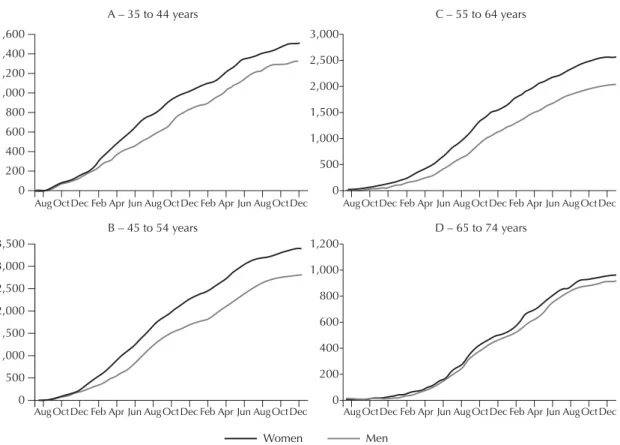
Figure 2. Temporal distribution of participants according to sex and age groups. ELSA-Brasil, 2008–2010.
A – 35 to 44 years
B – 45 to 54 years
C – 55 to 64 years
D – 65 to 74 years
Women Men
1,600 1,400 1,200 1,000 800 600 400 200 0
Aug Oct Dec Feb Apr Jun Aug Oct DecFeb Apr JunAug Oct Dec Aug Oct Dec Feb Apr Jun Aug Oct DecFeb Apr JunAug Oct Dec
0 3,000
2,500
2,000
1,500
1,000
500
Aug Oct Dec Feb Apr Jun Aug Oct DecFeb Apr JunAug Oct Dec Aug Oct Dec Feb Apr Jun Aug Oct DecFeb Apr JunAug Oct Dec
0 1,200
1,000
800
600
400
200
0 3,500
3,000
2,500
2,000
1,500
1,000
500
Goal n = 15,000
Recruited n = 16,435 (109.6%)
Stage 1 n = 15,821 (105.6%)
Stage 2 n = 15,105 (100.7%) Losses to Stage 2
n = 716 (4.5%) Losses to Stage 1
n = 614 (3.7%)
CI ES 1,055
CI RJ 1,764
CI BA 2,029
CI RS 2,061
CI MG 3,115
CI SP 5,061
in the cohort. The losses were of 3.7% between recruitment and Stage 1, and 4.5% between Stage 1 and Stage 2.
The number of women was slightly higher in recruit-ment and at Stages 1 and 2 (Table). In the cohort, they corresponded to 54.4% of the total.
Analyzing the distribution per age group, occupational group and employment situation at the distinct stages, it is possible to notice that the percentages did not show great variations between women and men, except in the extreme age groups (Table).
The temporal distribution of the constitution of the cohort shows the earlier adherence of the women, except between 65 and 74 years of age (Figure 2) and in the group of support level (Figure 3), where the differences practically disappear.
The ethnic-racial heterogeneity of the cohort is evidenced in Figure 4: while the IC in the State of Bahia – the only one in the Northeast region – has a majority of blacks and browns (78.4%), this proportion is reduced in the centers located in the Southeast, and in the South of the country, in the IC located in the State of Rio Grande do Sul, the composition is inverted, with 75% of its population self-reporting themselves as whites.
DISCUSSION
ELSA-Brasil had a good receptiveness. It reached the recruitment goals with few losses between the distinct stages after the initial recruitment. Several elements may have contributed to facilitate and maintain adherence.
Table. Results achieved at each stage of the cohort
constitution, according to selected characteristics and sex. ELSA-Brasil, 2008–2010.
Characteristics Recruitment Stage 1 Stage 2
Women
% (n = 8,913)
% (n = 8,616)
% (n = 8,211) Age group
35 to 44 21.1 21.4 18.0
45 to 54 39.2 39.6 39.7
55 to 64 29.0 28.8 30.7
65 to 74 10.7 10.2 11.6
Level of the employment category
Support 25.9 25.7 26.1
High School 38.5 38.4 38.4
Higher education/ Professor
35.6 35.9 35.5
Employment Situation
Active 78.6 79.1 78.6
Retired 21.4 20.9 21.4
Men
% (n = 7,522)
% (n = 7,205)
% (n = 6,894) Age group
33 to 44 22.2 22.3 18.7
45 to 54 38.2 39.0 39.2
55 to 64 27.0 26.8 28.9
65 to 74 12.6 11.9 13.2
Level of the employment category
Support 29.5 30.2 30.8
High School 32.2 32.2 32.5
Higher education/ professor
38.3 37.6 36.8
Employment Situation
Active 83.4 84.7 84.4
Retired 16.6 15.3 15.6
a The employment categories were grouped according to
the required level of schooling. “Support” represents the set of occupations to which incomplete elementary education is required. In the absence of a more appropriate name, it was called support level.
Figure 3. Temporal distribution of participants according to sex and level of the employment category. ELSA-Brasil, 2008–2010.
A – Support
0 2,500
2,000
1,500
1,000
500
Aug Oct Dec Feb Apr Jun Aug Oct DecFeb Apr JunAug Oct Dec
B – High School
0 3,500 3,000 2,500 2,000 1,500 1,000 500
Aug Oct Dec Feb Apr Jun Aug Oct DecFeb Apr JunAug Oct Dec
C – Higher education/Professor
0 3,500 3,000 2,500 2,000 1,500 1,000 500
Aug Oct Dec Feb Apr Jun Aug Oct DecFeb Apr JunAug Oct Dec
The community’s preparation for the study, by means of multiple awareness-raising strategies, resulted in a good acceptance of the project in all the centers. The information was transmitted with clear messages and many resources were systematically used to maintain the study in the memory of potential participants at all the stages until recruitment was concluded.
Two strategies that contributed to maintain adherence between stages were the fl exibility of times in sched-uling contacts15 and the service “ELSA calls”, which
recalled the scheduled date and time and the procedures that should be carried out before the tests.
The literature emphasizes that multiple strategies and actions obtain higher participation rates, especially if they take into account specifi cities of subgroups.10,13-15
Retirees, especially the older ones, had greater diffi culty in mobility and in the access to information about the study, as it has been described in the literature.14 Unlike
what we might suppose, they have little available time, as many of them continue working, and mainly the women are busy performing domestic chores, taking care of children and of ill people.4 In these cases, fl
ex-ible scheduling favored greater participation.
As they are outside the institutional spaces, except at specifi c moments and places, the retirees required differentiated means of communication. Many of them do not have the habit of using the internet, which makes the sending of electronic messages and the dissemi-nation via website become little effective strategies. However, they responded positively to personalized telephone contacts, which were interpreted as a way to value the retired employees, and this was refl ected on the increase in the adherence to the study. Due to The study being of the observational type, with only
one minimally invasive procedure (blood collection), and the large experience in research of the institutions that develop the study, contributed to the good results that have been achieved.
The choice of civil servants with stable employment facilitated the access to eligible individuals and will contribute to their follow-up. Although it excludes the participation of less favored social strata and informal workers, the recruited cohort is fairly heterogeneous in socioeconomic and ethnic-racial terms, and it comes from different cultural contexts of Brazil.
There were few exclusion criteria, so as to amplify participation and the possibility of reaching the goals. Temporary ineligibility was an adequate decision, as it enabled even more to reach the goals, and also consoli-dated the study’s inclusive image.
The operationalization of the baseline in two stages was a great challenge, with long interviews and multiple tests and measurements until the enrollment was concluded.
The broad age range and the relative heterogeneity of the cohort demanded “cultural sensitivity”14 in
approaching potential volunteers, with careful recog-nition of the research contexts before beginning to conduct the study. The effort targeted at cultural adap-tation was present in the training of the team, in the production of specifi c messages for subgroups – like health professionals, retirees and elderly individuals –, in the care with the language of the communication products, and in the incorporation of participants as multipliers, as it has been described in other studies.14
Figure 4. Relative distribution of the cohort participants according to self-reported color/race per Investigation Center. ELSA-Brasil, 2008–2010.
100% 90% 80% 70% 60%
Yellow Indigenous Black Brown White 50% 40% 30% 20% 10% 0%
1.2% 1.4% 33.5% 44.9% 19.0% BA
1.7% 1.0% 11.8% 41.6% 44.0% ES
2.3% 0.6% 13.0% 35.0% 49.1% MG
2.0% 0.8% 13.5% 30.9% 52.8% RJ
4.3% 1.1% 13.7% 21.5% 59.4% SP
0.7% 1.4% 14.0%
8.7% 75.3%
RS
their age, this segment has more physical and cognitive limitations and lower concentration capacity, which increased the duration of the interviews.14 To overcome
these diffi culties, care with accessibility at the ICs and the training of the team were important, like what has been observed in other contexts.13,14
The group belonging to the employment category of support, with lower level of schooling and income, has less autonomy to get away from work, which demanded negotiations to obtain their bosses’ authorization. Lower participation rates and higher resistance to adhering to longitudinal studies have been described by other authors, who have emphasized the importance of multiple approaches to reach larger representation of less favored strata.10,13,18
The women responded more promptly to the recruit-ment actions, confirming other studies10 and their
greater engagement in health care. The male resistance was remarkable, especially in the State of Bahia, which required specifi c communication strategies until the
end of the baseline. In traditional gender relations, the role of provider is given to men, who focus on work, are “strong” and resistant to health care, especially to preventive measures,6,8,9 which probably explains the
greater diffi culty in incorporating them.
The experience described here is a contribution that has been scarce in Brazil, and although it refers to the specifi c population of civil servants, it may be useful to be reproduced in similar studies.
As it has been emphasized in the international litera-ture,10,14,18 more than describing recruitment strategies,
in new studies it is necessary to evaluate the relation between the cost and effectiveness of the actions, mainly when we are dealing with research funded by public resources.
The Brazilian Longitudinal Study for Adult Health (ELSA-Brasil) was fi nanced by the Ministry of Health (DECIT – Departamento de Ciência e Tecnologia – Science and Technology Department) and by the Ministry of Science and Technology (FINEP – Studies and Projects Finance Organization and CNPq – Conselho Nacional de Desenvolvimento Científi co e Tecnológico (National Council for Scientifi c and Technological Development) (Processes N. 01 06 0010.00 RS, 01 06 0212.00 BA, 01 06 0300.00 ES, 01 06 0278.00 MG, 01 06 0115.00 SP, 01 06 0071.00 RJ).
The authors declare that there are no confl icts of interest.
This manuscript was submitted for publication and underwent a peer review process as any other manuscripts submitted to this publication, and anonymity was guaranteed for authors and reviewers. Editors and reviewers declare no confl icts of interest that may affect the peer-review process.
1. Aitken L, Gallagher R, Madronio C. Principles of recruitment and retention in clinical
trials. Int J Nurs Pract. 2003;9(6):338-46.
DOI:0.1046/j.1440-172X.2003.00449.x
2. Alvarez RA, Vasquez E, Mayorga CC, Feaster DJ, Mitrani VB. Increasing minority research participation
through community organization outreach. West
J Nurs Res. 2006;28(5):541-60; discussion 61-3. DOI:10.1177/0193945906287215
3. Aquino EML, Barreto SM, Bensenor IM, Carvalho MS, Chor D, Duncan BB, et al. Brazilian Longitudinal Study of Adult Health (ELSA-Brasil): objectives
and design. Am J Epidemiol. 2012;175(4):315-24.
DOI:10.1093/aje/kwr294
4. Bruschini C. Trabalho doméstico: inatividade econômica ou trabalho não-remunerado?
Rev Bras Estud Popul. 2006;23(2):331-53. DOI:10.1590/S0102-309820060
5. Carneiro M, Figueiredo Antunes CM, Greco M, Oliveira E, Andrade J, Lignani Jr L, et al. Design, implementation, and evaluation at entry of a prospective cohort study of homosexual and bisexual HIV-1-negative men in Belo
Horizonte, Brazil: Project Horizonte. J Acquir Immune
Defi c Syndr. 2000;25(2):182-7.
6. Courtenay WH. Constructions of masculinity and their infl uence on men’s well-being: a theory of gender and
health. Soc Sci Med. 2000;50(10):1385-401.
7. Dennis BP, Neese JB. Recruitment and retention of African American elders into community-based
research: lessons learned. Arch Psychiatr Nurs.
2000;14(1):3-11.
8. Figueiredo WS, Schraiber LB. Concepções de gênero de homens usuários e profi ssionais de saúde de serviços de atenção primária e os possíveis impactos na saúde da população masculina, São Paulo, Brasil.
Cienc Saude Coletiva. 2011;16(Supl 1):935-44. DOI:10.1590/S1413-81232011000700025
9. Galdas PM, Cheater F, Marshall P. Men and health help-seeking behaviour: literature
review. J Adv Nurs. 2005;49(6):616-23.
DOI:10.1111/j.1365-2648.2004.03331.x
10. Gilliss CL, Lee KA, Gutierrez Y, Taylor D, Beyene Y, Neuhaus J, et al. Recruitment and retention
of healthy minority women into
community-based longitudinal research. J Womens
Health Gend Based Med. 2001;10(1):77-85. DOI:10.1089/152460901750067142
11. Khoo SK, O’Neill S, Travers C, Oldenburg B. Age-related changes relevant to health in women: design, recruitment, and retention strategies for the Longitudinal Assessment of Women (LAW) study.
J Womens Health (Larchmt). 2008;17(1):135-46. DOI:10.1089/jwh.2006.0291
12. Lee C, Dobson AJ, Brown WJ, Bryson L, Byles J, Warner-Smith P, et al. Cohort Profi le: the Australian Longitudinal Study on Women’s
Health. Int J Epidemiol. 2005;34(5):987-91.
DOI:10.1093/ije/dyi098
13. Nicholson LM, Schwirian PM, Klein EG, Skybo T, Murray-Johnson L, Eneli I, et al. Recruitment and retention strategies in longitudinal clinical studies
with low-income populations. Contemp Clin Trials.
2011;32(3):353-62. DOI:10.1016/j.cct.2011.01.007
14. Ridda I, MacIntyre CR, Lindley RI, Tan TC. Diffi culties in recruiting older people in clinical trials: an examination of barriers
and solutions. Vaccine. 2010;28(4):901-6.
DOI:10.1016/j.vaccine.2009.10.081
15. Robinson KA, Dennison CR, Wayman DM, Pronovost PJ, Needham DM. Systematic review identifi es number of strategies important for retaining study
participants. J Clin Epidemiol. 2007;60(8):757-65.
DOI:10.1016/j.jclinepi.2006.11.023
16. Sutmoller F, Souza CTV, Monteiro JC, Penna T. The Rio de Janeiro HIV vaccine site. I. Recruitment strategies and socio-demographic data of a HIV negative homosexual and
bisexual male cohort in Rio de Janeiro, Brazil.
Mem Inst Oswaldo Cruz. 1997;92(1):39-46. DOI:10.1590/S0074-02761997000100009
17. Szklo M. Population-based cohort studies. Epidemiol
Rev. 1998;20(1):81-90.
18. Yancey AK, Ortega AN, Kumanyika SK. Effective recruitment and retention of minority research
participants. Annu Rev Public Health. 2006;27:1-28.
DOI:10.1146/annurev.publhealth.27.021405.102113