Suzana Alves de MoraesI Isabel Cristina Martins de FreitasII
I Departamento Materno Infantil e Saúde Pública. Escola de Enfermagem de Ribeirão Preto. Universidade de São Paulo. Ribeirão Preto, SP, Brasil.
II Programa de Pós-Graduação de Enfermagem e Saúde Pública. Escola de Enfermagem de Ribeirão Preto. Universidade de São Paulo. Ribeirão Preto, SP, Brasil.
Correspondence: Suzana Alves de Moraes Avenida dos Bandeirantes, 3900 14040-902 Ribeirão Preto, SP, Brasil E-mail: [email protected]
Received: 11/3/2011 Approved: 3/15/2012
Article available from: www.scielo.br/rsp
Ischemic heart disease and
correlates in adults from
Ribeirão Preto, Brazil
ABSTRACT
OBJECTIVE: To identify the prevalence of ischemic heart disease (IHD) and correlates in an adult population.
METHODS: Cross-sectional population-based epidemiological study including a weighted sample of 2,471 adults of both sexes and with age 30 years or older residing in Ribeirão Preto, Southeastern Brazil, in 2007. The Rose Questionnaire was administered, and IHD prevalence was calculated with point estimates and 95% confi dence intervals. To identify correlates (sociodemographic, cardiovascular risk factors, and those related to access to health services and to physical activity level), crude and adjusted prevalence ratios were estimated using Poisson regression.
RESULTS: IHD prevalence was higher in females than males at all age strata. In the fi nal model, the following variables were independently associated with IHD: work status (PR = 0.54 [0.37;0.78]); family history of IHD (PR=1.55 [1.12;2.13]); hypertension (PR = 1.70 [1.18;2.46]); self-reported health status (PR = 2.15 [1.40;3.31]); smoking duration (third tertile) (PR = 1.73 [1.08;2.76]); adjusted waist circumference (PR = 1.79 [1.21;2.65]) and hypertriglyceridemia (PR = 1.48 [1.05;2.10]). Linear trend test of PR across self-reported health status categories was statistically signifi cant (p < 0.05).
CONCLUSIONS: A high prevalence of IHD was found, and the factors associated with the outcome are almost all modifiable and potentially infl uenced by public policy interventions.
DESCRIPTORS: Adult. Myocardial Ischemia, epidemiology. Risk Factors. Cross-Sectional Studies.
INTRODUCTION
In regions that attain or pass the intermediate transitional variant of the epidemiological transition, progressive aging of the population results in an increased prevalence of chronic diseases, with cardiovascular diseases (CVD) making a large contribution.19 Although ecological studies indicate a decline
in mortality from CVD,17 changes in lifestyle have contributed to increase risk
factors, which together with the marked aging of the population, promotes an increased prevalence and incidence of ischemic heart disease (IHD), especially in developing countries.31
Estimates from the Global Burden of Disease Studyfor 202018 revealed that
and contributor to DALYs in developing countries. In Brazil, CVD corresponded to 13% of DALYs in 1998, surpassed only by infectious diseases, maternal and perinatal conditions and nutritional defi ciencies (24%). CVD was responsible for the greatest health spending in the country; in 2007, it was responsible for 12.7% of hospitalizations unrelated to pregnancy and 27.4% of hospitalizations among older adults.22
In Brazil, a substantial portion of the epidemiologic understanding regarding CVD comes from ecological, descriptive or non-representative studies. Population based analytic studies are still rare, although they contribute to identify specifi c risk factors for IHD or interactions between these factors and the environment, given the geographic differences of Brazil. On the other hand, although CVD is still the leading cause of death in Brazil,22 little is known about its prevalence
or incidence in the population, which is a weakness in comparison to developed countries.
Considering the above, the present study sought to determine the prevalence of IHD and identify associ-ated factors, in adult residents of Ribeirão Preto, São Paulo, Brazil, in 2007.
METHODS
A population based cross-sectional epidemiological study was conducted in Ribeirão Preto, São Paulo, in 2007, as part of a study entitled “Prevalence of cardio-vascular disease and identifi cation of risk factors in adult residents of Ribeirão Preto, SP – Project EPIDCV”. The sampling strategy was performed in three stages: in the fi rst, 81 census tractsa (primary sampling unit)
were randomly selected. Then 1,672 households and 1,395 participants corresponded to the second and third stages of sampling. The cluster randomized method, with probability proportional to size was adopted in the fi rst stages. Stratifi cation by average income of the head of household was performed in the second stage, and in the third stage, one person aged 30 or older was selected among the residents of the households. Pregnant women and women with recent deliveries were excluded (selection criteria), since their anthropo-metric measurements would not be comparable to the general population. In total, 1,133 participants of both sexes were interviewed. The response rate was 81.2%. Loses (18.8%) were due to change of address (4.8%), death (0.5%) and refusals (13.5%), with people consid-ered as refusals after fi ve attempts to contact them for interview at different days and times. The variability resulting from the multiple stages of sampling was corrected by calculating a sample weight that consid-ered the eligible number of people in each household and the rate of non-respondents for each census tract,
a Instituto Brasileiro de Geografi a e Estatística. Censo demográfi co 2000. Rio de Janeiro; 2001.
resulting in a weighted sample of 2,471 participants with age 30 years or more, living in the urban area of the municipality.24 The sample weight (sw) was
calcu-lated from the inverse product of the sample fractions w1 and w2, where:
The outcome was represented by the combination of angina with possible myocardial infarction, after administration of the complete version of the Rose questionnaire (Q-Rose).20 According to the
question-naire, angina is defi ned by affi rmative response to the following questions: 1) presence of pain or discomfort in the chest at some time in life (cumulative event); 2) worsening of the pain with effort; 3) relief of pain within ten minutes or less after cessation of effort; and 4) loca-tion of pain on the sternum (upper, middle or lower), left anterior chest or the left arm. The defi nition of possible infarction, according to Q-Rose, corresponds to an affi rmative response to the following question: “have you ever had severe chest pain (very strong) that lasted from 30 minutes or longer?”. These two variables were subsequently combined into a single binary vari-able that was coded “1” for participants classifi ed as positive for angina and/or possible infarction and coded “0” for people without these conditions.
The independent variables were classifi ed into three groups: sociodemographic factors, cardiovascular risk factors, and factors related to access to health services and to physical activity level.
Participants from both sexes were included in the group of sociodemographic factors. Age in years completed was obtained by this calculation: [(date of interview – date of birth/365.25], subsequently classifi ed in intervals of 10 years. Level of education was classifi ed into four categories according to the number of years completed in formal education. Individual monthly income, in Reais, using the month before interview as the reference period, was classifi ed according to tertiles of the distribution, and participants that did not report a monthly income were classifi ed as without income. The presence or absence of a partner at the time of interview was also considered, irrespective of a formal union, with marital status clas-sifi ed as with or without partner. Employment status was classifi ed in two categories, using the month before interview as the reference period.
w1 = number selected number eligible
w2 =
number interviewd
Cognitive performance was evaluated using the Mini-Mental State Exam (MMSE),8 and the participants were
classifi ed according to the cutoff that corresponded to the median of the distribution. The presence of family history of angina and/or infarction was reported to the third generation of ancestors. Three consecutive measurements of arterial pressure, both systolic and diastolic, were taken, using portable sphygmomanom-eters (Geratherm Medical AG, Geschwenda, Germany), considering respectively the average of them. Arterial hypertension (AH) was defi ned as a history of AH diag-nosed by a physician, use of anti-hypertensive medica-tion or blood pressure levels ≥ 140 mmHg for systolic pressure, and ≥ 90 mmHg for diastolic,16 with the
vari-able classifi ed in a dichotomous manner. Health status, compared to friends, was classifi ed in three categories: same as yours, worse than yours or better than yours. This classifi cation of self-perceived health status, besides being a proxy for morbidity, allows for evaluation of an effect gradient between the fi rst and third categories. The duration of the habit of cigarette smoking was classifi ed according to the tertiles distribution, with non-smokers as the reference category. Anthropometric measurements were taken by trained and calibrated interviewers.5
Weight in kilograms was obtained by electronic scales made by Tanita (model BF 680), with a precision of 100 grams. Height in centimeters was obtained using wall stadiometers (SECA, Hamburgo, Germany), using the techniques recommended by Habicht & Bultz.10 The
stadiometer was fi xed at 2.20 vertical meters, in relation to the fl oor, and calibrated with a technical square of 60 degrees, which was also used to fi nd the right angle between the fl oor and the wall where the stadiometer was affi xed. Nutritional status was classifi ed in three catego-ries: normal, pre-obese and obese according to cutoff for body mass index (BMI).30 For the measures of abdominal
circumference (in centimeters) inelastic measuring tapes were used (SECA, Hamburgo, Germany), including the shortest circunference between the costal border and the iliac crest and using sex-specifi c cutoffs.1 All
measure-ments were obtained twice, and the average of the two measurements was used. Diabetes mellitus (DM) was defi ned as a history of DM diagnosed by a physician, and also by oral glucose tolerance tests performed with fasting of 12 hours and after 2 hours following ingestion of 75 grams of pure glucose. Blood sugar (mg/dL) was ascertained from capillary blood by the colorimetric refl ection method, using Accutrend portable glucom-eter (Roche Diagnostics GmbH, Mannheim, Germany) and the cutoffs recommended by WHO.29 Biochemical
levels were measured (in mg/dL) for total cholesterol, cholesterol fractions, triglycerides, C reactive protein and plasma fi brinogen, after 12 hours fasting, in a refer-ence laboratory with a certifi cation of profi ciency for laboratory trials, using recommended cutoffs, with the exception of plasma fi brinogen, which was classifi ed according to the tertiles distribution.
Physical activity was ascertained by the International Physical Activity Questionnaire (IPAQ) short-version.14 Total metabolic energy expenditure
(METs*minutes*week-1) was classifi ed according to
the median of the distribution. The variable for “sitting time” was also obtained per the IPAQ protocol and clas-sifi ed into tertiles distribution. The number of medicines taken in the last 15 days was classifi ed in four catego-ries: none; 1-2; 3-4; 5 or more. The variables for seeking ambulatory health services (in the past six months) and for the occurrence of hospitalization (in the past two years) were classifi ed in a dichotomous manner. The data were collected by structured interviews performed in eligible houses by a team of trained inter-viewers. Before fi nal data entry (double data-entry), quality control was evaluated by replicating 12.5% of interviews, using kappa statistic6 to evaluate
repro-ducibility. The kappa coeffi cient for all the questions included in the repeated interviews was above 0.80. Specifi c IHD prevalences, according to sex and age and 95% confi dence intervals were calculated. The prevalence of IHD was also estimated, with point estimates and confi dence intervals, for specifi c strata of sociodemographic factors, cardiovascular risk factors and behavioral factors. In the descriptive phase of the study, overall associations between the above mentioned factors and the outcome were tested using the F statistic (signifi cance level α = 0.05). In the analytical phase, Poisson regression was used to obtain prevalence ratios, estimated by points and confi dence intervals.3 After univariate analysis, the variables with
p values ≤ 0.25 for the Wald statistic were selected for subsequent models. Then prevalence ratios were estimated in partially adjusted models, including respectively sociodemographic factors, cardiovascular risk factors and behavioral factors. In the subsequent phase, the model was begun, including the variables from each of the three groups with a p value < 0.10 for the Wald statistic. The fi nal model consisted of variables that after simultaneous adjustment remained signifi cant at p < 0.05. The estimates were calculated considering the design effect,24 using specifi c commands for surveys
in Stata, version 10.1.
Project EPIDCV was approved by the Research Ethics Committee of the Nursing School of Ribeirão Preto, University of São Paulo, and registered under number 0725/2006. All participants signed voluntary informed consent forms, per the recommendations of Resolution nº 196/96 of the National Health Council.
RESULTS
In regards to marital status, 66.6% lived with a partner, while 65.7% participated in the job market. The crude prevalence of IHD was 12.3% (95%CI 10.4:14.4). The design effect was 1.07214.
The prevalence of IHD for females was greater in magnitude than the estimates for males at all age groups (Table 1). The prevalences for the fi rst two age groups among females were almost twice the respective preva-lence among males. In bivariate analysis, the variables sex, income, employment status and level of education were associated with the outcome (p < 0.05) (Table 2). The prevalence of IHD declined with increased income and education (p < 0.02).
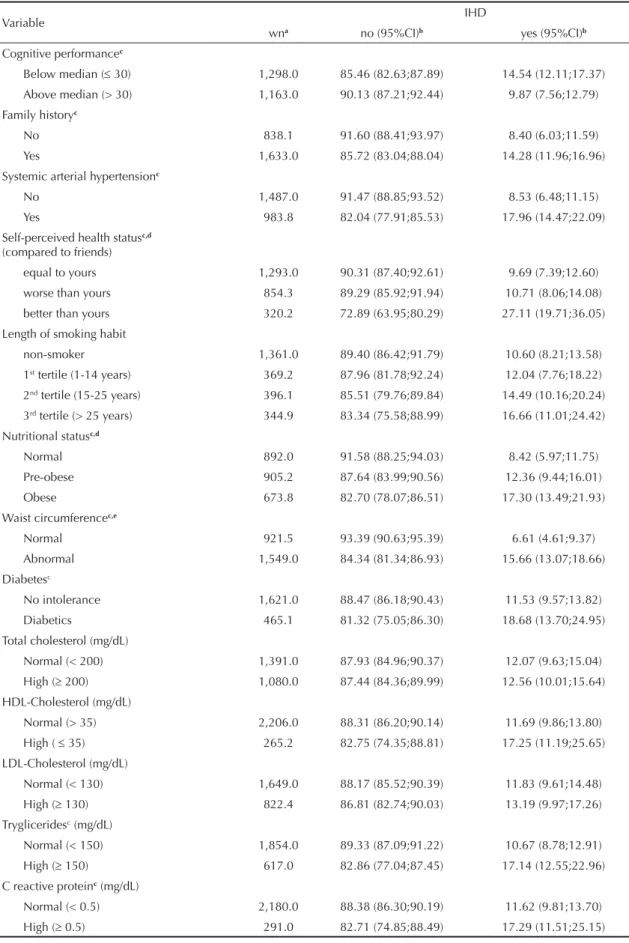
Cognitive performance, family history of IHD, hyper-tension, self-perceived health status, nutritional status, waist circumference, diabetes, triglycerides and C reac-tive protein showed statistically signifi cant associations in relation to the outcome in crude analysis (p < 0.05) (Table 3). A linear trend was observed for IHD preva-lence (p < 0.05) for the categories of self-perceived health status and nutritional status.
The number of medicines taken in the past 15 days and hospitalization in the past two years were also associ-ated with the outcome (p < 0.05), depicting a linear trend in IHD prevalence with increased consumption of medicines (p < 0.05) (Table 4).
The fi nal model (Table 5) was adjusted by sex and age. Besides that adjustment, the following variables remained independently associated with IHD: employ-ment status, family history of IHD, hypertension, self-perceived health status, smoking duration, waist circumference and triglycerides. The prevalence ratios for self-perceived health status presented a statistically signifi cant linear trend (p < 0.01).
DISCUSSION
The results of the study show a high prevalence of IHD in the population, especially among women aged less than 50 years. Potentially modifi able risk factors, such as arterial hypertension, smoking duration, central
obesity and hypertriglyceridemia, were associated with the outcome.
Recent results15,17,26 from epidemiological studies
carried out in Ribeirão Preto may explain the fi nding of a higher prevalence of IHD among women less than 50 years of age. Two population-based cross-sectional studies indicated that women less than 50 years of age presented greater daily averages for sitting time26 and
less adherence to recommended consumption levels of fruits and vegetables.15 In this same population,
results from a time series study17 regarding the period
1980-2004 indicated a declining trend in mortality rates from diseases of the circulatory system, across all age groups and both sexes. The largest proportion in average annual decreases occurred among women aged 30 to 39 years (-7.1%).
In regards to level of education and income, it is plau-sible to assume that the inverse relationship with IHD prevalence can be attributed to greater access to infor-mation, adoption of a healthy lifestyle, greater access to health services and adherence to prevention programs for chronic and degenerative diseases.
The methodological rigor applied in all steps of the study, including design and data analysis, the high response rate, and the reproducibility of the informa-tion, together lend credibility to the results and reinforce their internal validity, since the results did not suffer from selection bias, information bias or confounding. The use of the Rose questionnaire20 to detect angina
and possible infarction is a strategy of fundamental importance in prevalence studies conducted in different areas of the world, especially in developing countries. The questionnaire has a high specifi city, low cost and ease of administration by a duly trained team. Results from the Isfahan Healthy Heart Program, conducted among Iranian adults in 2000,21 in which
the authors applied the Rose questionnaire revealed that IHD prevalence was higher among Iranian women than men at all age groups. In this study, prevalence measures, obtained from electrocardiographic results coded by the Minnesota Code, indicated the same
Table 1. Prevalence of ischemic heart disease (IHD) with confi dence intervals, according to sex and age groups. Ribeirão Preto, São Paulo, Brazil, 2007.
Variable Male IHD Female IHD
Age group (years) wna no (95%CI)b yes (95%CI)b no (95%CI)b yes (95%CI)b
30-39 661.3 91.42 (85.91;94.90) 8.58 (5.10;14.09) 84.39 (77.94;89.21) 15.61 (10.79;22.06) 40-49 765.7 92.33 (86.74;95.68) 7.67 (4.32;13.26) 86.04 (81.81;89.41) 13.96 (10.59;18.19)
50-59 507.3 89.03 (80.48;94.11) 10.97 (5.89;19.52) 88.03 (81.88;92.30) 11.97 (7.70;18.12) 60 and older 536.6 87.32 (77.58;93.20) 12.68 (6.80;22.42) 85.07 (78.45;89.92) 14.93 (10.08;21.55)
awn = weighted n
trend in regards to sex. Alves et al,2 in a population
based cross-sectional study, conducted in a sample of adults residents in Pelotas, Rio Grade do Sul, Brazil, in 2007, found that the prevalence of angina based on the Rose questionnaire was also greater among females (9.8%; 95%CI 7.9-11.7) than among males (5.9%; 95%CI 4.1-7.6). In addition, that study found a direct relationship with age and inverse relationships with education and income, trends that agree with the current study. In Ribeirão Preto, higher IHD prevalence in both sexes and all age groups may be the result of the fact that the present study considered as an outcome the combination of angina and potential infarction, in contrast to Alves et al,2 who considered only angina as
the dependent variable.
Different hypotheses appear to at least partially explain the apparent contradiction related to the sex-specifi c incidence, prevalence and mortality rates of IHD: 1) higher mortality rates among men may infl ate the
relative prevalence among women; 2) in incidence studies, lower IHD rates among women may be explained by the fact that a large portion of women that report typical symptoms do not present obstruc-tive disease when measured by catheterization, which may result in under-estimation of rates in relation to men;23 3) cohort studies have shown that women
with symptomatic IHD delay more than men to seek care and present ambiguous symptoms, delaying or complicating diagnosis, with a resultant decrease in incidence rates;13,25,28 and 4) results from time series
studies conducted in Olmsted County, Minnesota, USA, showed that while the incidence of infarction and the prevalence of atherosclerosis decreased among men, they remained stable or even increased among women and older adults, which may indicate less effective primary prevention among these groups.9
In a recent review of studies conducted in different countries, Blum & Blum4 investigated potential
Table 2. Prevalence of ischemic heart disease (IHD) with confi dence intervals, according to sociodemographic factors. Ribeirão Preto, São Paulo, Brazil, 2007.
Variable IHD
wna no (95%CI)b yes (95%CI)b
Sexc
Male 995.7 90.43 (87.28;92.86) 9.57 (7.14;12.72)
Female 1,475.0 85.89 (83.10;88.28) 14.11 (11.72;16.90) Age group (years)
30-39 661.3 87.99 (84.50;90.78) 12.01 (9.22;15.50)
40-49 765.7 88.31 (85.23;90.82) 11.69 (9.18;14.77)
50-59 507.3 88.40 (83.13;92.18) 11.60 (7.82;16.87)
60 and older 536.6 85.88 (80.41;90.01) 14.12 (9.99;19.59) Marital status
Single 824.8 86.89 (82.82;90.12) 13.11 (9.88;17.18)
With partner 1,646.0 88.13 (85.17;90.57) 11.87 (9.43;14.83)
Monthly income (in R$)c,d
None 848.9 81.46 (77.07;85.16) 18.54 (14.84;22.93)
1st tertile (≤ 700.00) 549.7 90.60 (86.44;93.59) 9.40 (6.41;13.56) 2nd tertile (> 700.00 ≤ 1,400.00) 506.0 90.18 (85.66;93.39) 9.82 (6.61;14.34) 3rd tertile (> 1,400.00) 566.4 92.09 (87.19;95.22) 7.91 (4.78;12.81)
Employment statusc
No 847.8 81.42 (76.98;85.16) 18.58 (14.84;23.02)
Yes 1,623.0 91.01 (88.54;92.99) 8.99 (7.01;11.46)
Education (years)c,d
0-3 343.8 81.12 (75.04;85.99) 18.88 (14.01;24.96)
4-7 739.8 86.47 (82.89;89.39) 13.53 (10.61;17.11)
8-11 821.5 89.12 (85.42;91.98) 10.88 (8.02;14.58)
12 or more 540.8 91.31 (85.84;94.79) 8.69 (5.21;14.16)
a wn = weighted n
b Weighted estimates, considering the design effect of the sampling strategy c p value < 0.05 for the F statistic
Table 3. Prevalence of ischemic heart disease (IHD), according to cardiovascular risk factors. Ribeirão Preto, São Paulo, Brazil, 2007.
Variable IHD
wna no (95%CI)b yes (95%CI)b
Cognitive performancec
Below median ( 30) 1,298.0 85.46 (82.63;87.89) 14.54 (12.11;17.37)
Above median (> 30) 1,163.0 90.13 (87.21;92.44) 9.87 (7.56;12.79) Family historyc
No 838.1 91.60 (88.41;93.97) 8.40 (6.03;11.59)
Yes 1,633.0 85.72 (83.04;88.04) 14.28 (11.96;16.96)
Systemic arterial hypertensionc
No 1,487.0 91.47 (88.85;93.52) 8.53 (6.48;11.15)
Yes 983.8 82.04 (77.91;85.53) 17.96 (14.47;22.09)
Self-perceived health statusc,d
(compared to friends)
equal to yours 1,293.0 90.31 (87.40;92.61) 9.69 (7.39;12.60)
worse than yours 854.3 89.29 (85.92;91.94) 10.71 (8.06;14.08) better than yours 320.2 72.89 (63.95;80.29) 27.11 (19.71;36.05)
Length of smoking habit
non-smoker 1,361.0 89.40 (86.42;91.79) 10.60 (8.21;13.58)
1st tertile (1-14 years) 369.2 87.96 (81.78;92.24) 12.04 (7.76;18.22) 2nd tertile (15-25 years) 396.1 85.51 (79.76;89.84) 14.49 (10.16;20.24)
3rd tertile (> 25 years) 344.9 83.34 (75.58;88.99) 16.66 (11.01;24.42) Nutritional statusc,d
Normal 892.0 91.58 (88.25;94.03) 8.42 (5.97;11.75)
Pre-obese 905.2 87.64 (83.99;90.56) 12.36 (9.44;16.01)
Obese 673.8 82.70 (78.07;86.51) 17.30 (13.49;21.93)
Waist circumferencec,e
Normal 921.5 93.39 (90.63;95.39) 6.61 (4.61;9.37)
Abnormal 1,549.0 84.34 (81.34;86.93) 15.66 (13.07;18.66) Diabetesc
No intolerance 1,621.0 88.47 (86.18;90.43) 11.53 (9.57;13.82) Diabetics 465.1 81.32 (75.05;86.30) 18.68 (13.70;24.95)
Total cholesterol (mg/dL)
Normal (< 200) 1,391.0 87.93 (84.96;90.37) 12.07 (9.63;15.04)
High ( 200) 1,080.0 87.44 (84.36;89.99) 12.56 (10.01;15.64) HDL-Cholesterol (mg/dL)
Normal (> 35) 2,206.0 88.31 (86.20;90.14) 11.69 (9.86;13.80) High ( 35) 265.2 82.75 (74.35;88.81) 17.25 (11.19;25.65)
LDL-Cholesterol (mg/dL)
Normal (< 130) 1,649.0 88.17 (85.52;90.39) 11.83 (9.61;14.48)
High ( 130) 822.4 86.81 (82.74;90.03) 13.19 (9.97;17.26) Trygliceridesc (mg/dL)
Normal (< 150) 1,854.0 89.33 (87.09;91.22) 10.67 (8.78;12.91) High ( 150) 617.0 82.86 (77.04;87.45) 17.14 (12.55;22.96)
C reactive proteinc (mg/dL)
Normal (< 0.5) 2,180.0 88.38 (86.30;90.19) 11.62 (9.81;13.70)
High ( 0.5) 291.0 82.71 (74.85;88.49) 17.29 (11.51;25.15)
mechanisms to better understand sex difference in IHD incidence, comparing the size and location of atheromatous plaques. The authors found that despite men having a greater average percent blockage from atheromatous plaques compared to women, women present a greater incidence of chest pain than men and worse clinical outcomes accentuated by age. Also in the majority of these studies, although women presented greater prevalence of arterial hypertension, obesity, elevated plasma lipids and triglycerides
when compared to men, women were less disposed to atheromatous plaques.
Results from the Rotherdam Study12 indicate that calcium
deposits in coronary arteries were greater among men than women at all age groups. Nonetheless, in regards to corotid thickness, small differences were reported in regards to sex and age. Results from the Interheart Study32 revealed that modifi able risk factors can explain
more than 90% of acute infarctions, in both sexes, inde-pendent of age group or ethnicity. The following factors
Table 3. Continuation
Variable IHD
wna no (95%CI)b yes (95%CI)b
Plasma fi brinogen (mg/dL)
1st tertile ( 302.5) 857.3 89.66 (86.19;92.33) 10.34 (7.67;13.81) 2st tertile (> 302.5 355.22) 819.7 88.24 (84.32;91.28) 11.76 (8.72;15.68) 3rd tertile (> 355.22) 794.0 85.08 (80.70;88.60) 14.92 (11.40;19.30)
a wn = weighted n
b Weighted n, considering the design effect of the sampling strategy c p value < 0.05 for the F statistic
d p value < 0.05 for the test of linear trend e Cutoffs: male 94 cm and female 80 cm
Table 4. Prevalence of ischemic heart disease (IHD) with confi dence intervals, according to factors related to access to health services and level of physical activity. Ribeirão Preto, São Paulo, Brazil, 2007.
Variable IHD
wna no (95%CI)b yes (95%CI)b
Nº of medicines (past 15 days)c,d
None 504.7 92.70 (88.74;95.34) 7.30 (4.66;11.26)
1-2 1,102.0 89.11 (85.79;91.74) 10.89 (8.26;14.21)
3-4 530.8 85.68 (80.89;89.42) 14.32 (10.58;19.11)
5 and more 333.1 78.78 (71.04;84.90) 21.22 (15.10;28.96) Health services (past six months)
No 647.9 91.27 (86.77;94.34) 8.73 (5.66;13.23)
Yes 1,823.0 86.45 (83.81;88.72) 13.55 (11.28;16.19)
Hospitalization (past two years)c
No 2,010.0 88.82 (86.57;90.73) 11.18 (9.27;13.43)
Yes 461.4 82.90 (77.31;87.34) 17.10 (12.66;22.69)
METs*minutes*week-1
less than median ( 346.5) 1,244.0 87.89 (84.65;90.52) 12.11 (9.48;15.35) more than median (> 345.5) 1,227.0 87.54 (84.41;90.11) 12.46 (9.89;15.59) Average sitting time (minutes*day-1)
1st tertile ( 180.0) 873.9 87.67 (84.47;90.29) 12.33 (9.71;15.53)
2nd tertile (> 180.0 308.6) 709.0 90.53 (86.93;93.21) 9.47 (6.79;13.07) 3rd tertile (> 308.6) 886.5 85.49 (81.26;88.90) 14.51 (11.10;18.74)
a wn= weighted n
b Weighted estimates, considering the design effect of the sampling strategy c p value < 0.05 for the F statistic
d p value < 0.05 for the test of linear trend
were prominent: smoking habits, increased plasma lipids, central obesity, hypercaloric diets and stress. The authors concluded that the primary prevention of acute infarction should include complementary interventions upon these risk factors, in both sexes.
In comparison to a medical history of angina or electro-cardiographic signs, the Rose questionnaire presented a higher level of specificity (close to 100%) than sensitivity in validation studies conducted in different countries.7 There was a small proportion of false
posi-tives in relation to false negaposi-tives. The authors also identifi ed a higher prevalence of IHD in women than in men in a study in Southeast Asia (India and Pakistan). These fi ndings appear to reinforce the current study, lending credibility to the positive results identifi ed by the Rose questionnaire, which certainly have a great probability of being true positives.
In the current study, the factors independently associ-ated with IHD, with the exception of family history,
are potentially modifi able and are compatible with the results from the Interheart Study.32
In the present study the authors opted to run the analysis for the full sample, instead of stratifying by sex. The decision was made because tests for interaction between sex and hypertension, waist circumference and triglyc-erides were not statistically signifi cant (p > 0.05). In addition, the dilution of the sample after stratifi cation by sex resulted in unstable estimates and lower statis-tical power.
Among the limitation of cross-sectional studies, the bias of reverse causality merits attention, as represented in the present study by the overall associations observed in the descriptive phase between IHD and the variables: consumption of medicines (past 15 days), health service access (past 6 months), hospitalization (past two years) and METs*minutes*week-1(metabolic expenditure in
physical activity). However, the independent effect of the variables remained in the fi nal model does not
Table 5. Crude and adjusted prevalence ratios with respective confi dence intervals for the fi nal model. Ribeirão Preto, São Paulo, Brazil, 2007.
Variable Crude PR 95%CI Adjusted PRa 95%CI
Employment status
No 1 1
Yes 0.48 0.35;0.67 0.54 0.37;0.78
Family history
No 1 1
Yes 1.70 1.20;2.41 1.55 1.12;2.13
Arterial hypertension
No 1 1
Yes 2.11 1.49;2.98 1.70 1.18;2.46
Self-perceived health status (compared to friends)
Equal to yours 1b 1b
Worse than yours 1.10 0.74;1.64 1.17 0.80;1.72
Better than yours 2.80 1.82;4.31 2.15 1.40;3.31
Length of smoking habit
non-smoker 1 1
1st tertile (1-14 years) 1.14 0.68;1.89 1.27 0.78;2.07 2nd tertile (15-25 years) 1.37 0.90;2.08 1.41 0.94;2.09
3rd tertile (>25 years) 1.57 1.00;2.48 1.73 1.08;2.76 Waist circumferencec
Normal 1 1
High 2.37 1.60;3.51 1.79 1.21;2.65
Tryglicerides
Normal (< 150) 1 1
High ( 150) 1.61 1.12;2.30 1.48 1.05;2.10
a In the fi nal model, prevalence ratios are also adjusted by sex and age. b p value < 0.01 for the of linear trend test
1. Alberti G, Zimmet P, Shaw J, Grundy SM. The IDF consensus worldwide defi nition of the metabolic syndrome. Brussels: International Diabetes Federation; 2006.
2. Alves L, Cesar JA, Horta BL. Prevalência de angina pectoris em Pelotas, RS.
Arq Bras Cardiol. 2010;95(2):179-85.
DOI:10.1590/S0066-782X2010005000075
3. Barros AJ, Hirakata VN. Alternatives for logistic regression in cross-sectional studies: an empirical comparison of models that directly estimate the prevalence ratio. BMC Med Res Methodol. 2003;3:21. DOI:10.1186/1471-2288-3-21
4. Blum A, Blum N. Coronary artery disease: are men and women created equal? Gend Med. 2009;6(3):410-8. DOI:10.1016/j.genm.2009.09.005
5. Castro V, Moraes SA, Freitas ICM, Mondini L.
Variabilidade na aferição de medidas antropométricas: comparação de dois métodos estatísticos
para avaliar a calibração de entrevistadores.
Rev Bras Epidemiol. 2008;11(2):278-86.
DOI:10.1590/S1415-790X2008000200009
6. Cohen JA. Coeffi cient of agreement for nominal scales.
Educ Psychol Meas. 1960;20(1):37-46.
7. Fischbacher CM, Bhopal R, Unwin N, White M, Alberti KGMM. The performance of the Rose angina questionnaire in South Asian and European origin
populations: a comparative study in Newcastle,
UK. Int J Epidemiol. 2001;30(5):1009-16.
DOI:10.1093/ije/30.5.1009
8. Folstein MF, Folstein SE, McHugh PR. Mini-mental state: a practical method for grading the cognitive state of patients for the clinician. J Psychiatr Res. 1975;12(3):189-98. DOI:10.1016/0022-3956(75)90026-6
9. Gerber Y, Jacobsen SJ, Frye RL, Weston SA, Killian JM, Roger VL. Secular trends in deaths from cardiovascular diseases: a 25-year community study. Circulation. 2006;113(19):2285-92. DOI:10.1161/CIRCULATIONAHA.105.590463
10. Habitch JP, Butz WP. Measurement of health and nutrition effects of large-scale nutrition intervention projects. Santa Monica: Rand Corporation; 1980
11. Hemingway H, Langenberg C, Damant J, Frost C, Pyörälä K, Barret-Connor E. Prevalence of angina in women versus men: a systematic review and meta-analysis of international variations across 31 countries. Circulation. 2008;117(12):1526-36. DOI:10.1161/CIRCULATIONAHA.107.720953
12. Kardys I, Vliegenthart R, Oudkerk M, Hofman A, Witteman JC. The female advantage in
cardiovascular disease: do vascular beds contribute equally? Am J Epidemiol. 2007;166(4):403-12. DOI:10.1093/aje/kwm115
REFERENCES
appear to be due to this bias. Also, it was not possible to investigate the effect of sex-specifi c variables such as menopause, age of menopause onset and hormone replacement therapy, since they were not available for analysis. Nevertheless, even if it was possible, the inclusion of these variables would not explain the differences in IHD prevalence between men and women under 50 years of age.
The higher prevalence of IHD in women than in men is similar to results from Hemingway et al11 in a
meta-analysis of 74 studies carried out in different countries. The authors found, through the use of random effect models, that the prevalence of IHD among females was consistently greater than among men, independent of age, the baseline year of the study, the birth cohort, ethnic origin and mortality rates.
Epidemiological studies have not provided a consis-tent understanding of risk and protective factors that could explain sex differences in IHD prevalence. On the other hand, results reported by Ueshima,27 in
2007, are controversial: the decrease in IHD mortality among Japanese, in the past 50 years, have occurred inversely to the trend of increasing cholesterol rates. This evidence may be explained in part by the cohort effect, since those that most contributed to the increased in cholesterol were young adults, and principally explained by the fact that the deleterious
effects of hypercholesterolemia upon IHD mortality were compensated for by effective programs to control arterial hypertension and tobacco use.
Although ecological studies and individual-level studies have different inherent constructs, both study types appear to consolidate the paradigm where the effect of variables such as diabetes and C reactive protein upon IHD may by attenuated by the strong infl uence of variables such as arterial hypertension, smoking habits, dyslipidemia and central obesity. In the present study, although those variables presented crude associations with the outcome, they were not kept in the fi nal model.
The existing lack of population based studies in Brazil, which consider the prevalence of IHD and the
13. Marrugat J, Sala J, Masiá R, Pavesi M, Sanz G, Valle V, et al. Mortality differences between men and women following fi rst myocardial infarction. JAMA. 1998;280(16):1405-9. DOI:10.1001/jama.280.16.1405
14. Matsudo SM, Araújo T, Matsudo V, Andrade D, Andrade E, Oliveira LC, et al. Questionário Internacional de Atividade Física (IPAQ): estudo de validade e reprodutibilidade no Brasil. Rev Bras Ativ
Fis Saude. 2001;6(2):5-18.
15. Mondini L, Moraes SA, Freitas ICM, Gimeno SGA. Consumo de frutas e hortaliças por adultos em Ribeirão Preto, SP. Rev Saude Publica. 2010;44(4):686-94. DOI:10.1590/S0034-89102010000400012
16. Moraes SA, Szklo M, Knopman D, Sato R. The relationship between temporal changes in blood pressure and changes in cognitive function: Atherosclerosis Risk in Communities (ARIC) Study. Prev Med. 2002;35(3):258-63. DOI:10.1006/pmed.2002.1077
17. Moraes SA, Suzuki CS, Freitas ICM, Costa Jr ML. Mortalidade por doenças do aparelho circulatório no município de Ribeirão Preto - SP, de 1980 a 2004. Arq Bras Cardiol. 2009;93(6):637-44. DOI:10.1590/S0066-782X2009005000002
18. Murray CJL, Lopez AD. Alternative projections of mortality and disability by cause 1990-2020: Global Burden of Disease Study.
Lancet. 1997;349(9064):1498-504.
DOI:10.1016/S0140-6736(96)07492-2
19. Omran AR. The epidemiologic transition in the Americas. Washington (DC): Pan American Health Organization; 1996.
20. Rose GA. The diagnosis of ischaemic heart pain and intermittent claudication in fi eld surveys. Bull World
Health Organ. 1962;27:645-58.
21. Sadeghi M, Ruhafza H, Shirani Sh, Tabib AA, Aghdak P, Hosseini Sh. The prevalence of coronary artery disease according to Rose Questionnaire and ECG: Isfahan Healthy Heart Program (IHHP).
ARYA J. 2006;2(2):70-4.
22. Schmidt MI, Duncan BB, Silva GA, Menezes AM, Monteiro CA, Barreto SM, et al. Doenças crônicas não transmissíveis no Brasil: carga e desafi os atuais. Lancet. 2011;May 9:61-74. DOI:10.1016/S0140-6736(11)60135-9
23. Sharaf BL, Pepini CJ, Kerensky RA, Reis SE, Reichek N, Rogers WJ, et al. Detailed angiography
analysis of women with suspected ischemic chest pain (pilot phase data from the NHLBI-sponsored Women’s Ischemia Syndrome Evaluation [WISE] Study Angiographic Core Laboratory). Am J Cardiol. 2001;87(8):937-41; A3. DOI:10.1016/S0002-9149(01)01424-2
24. Silva NN. Amostragem probabilística: um curso introdutório. 2.ed. São Paulo: EDUSP 2001.
25. Sonke GS, Beaglehole R, Stewart AW, Jackson R, Stewart FM. Sex differences in case fatality before and after admission to hospital after acute cardiac events: analysis of community based coronary heart disease register. BMJ. 1996;313(7061):853-5. DOI:10.1136/bmj.313.7061.853
26. Suzuki CS, Moraes SA, Freitas ICM. Média diária de tempo sentado e fatores associados em adultos residentes no município de Ribeirão Preto-SP, 2006: Projeto OBEDIARP.
Rev Bras Epidemiol. 2010;13(4):699-712.
DOI:10.1590/S1415-790X2010000400014
27. Ueshima H. Explanation for the Japanese paradox: prevention of increase in coronary heart disease and reduction in stroke. J Atheroscler Thromb. 2007;14(6):278-86.
28. Vaccarino V, Parsons I, Every NR, Barron HV, Krumholz HM. Sex-based differences in early mortality after myocardial infarction: National Registry of Myocardial Infarction nº 2 Participants. N Engl J Med. 1999;341(4):217-25. DOI:10.1056/NEJM199907223410401
29. World Health Organization. Defi nition, diagnosis and classifi cation of diabetes mellitus and its complications: report of a WHO Consultation. Geneva; 1999. (WHO/NCD/NCS/99.2).
30. World Health Organization. Obesity: preventing and managing the global epidemic: report of a WHO Consultation. Geneva; 2000. (Who Technical Report Series, 894).
31. Yach D, Hawkes C, Gould CL, Hofman KJ. The global burden of chronic diseases: overcoming impediments to prevention and control. JAMA. 2004;291(21):2616-22. DOI:10.1001/jama.291.21.2616
32. Yusuf S, Hawken S, Ounpuu S, Dans T, Avezum A, Lanas F, et al. Effect of potentially modifi able risk factors associated with myocardial infarction in 52 countries (the INTERHEART Study): case-control study. Lancet. 2004;364(9438):937-52. DOI:10.1016/S0140-6736(04)17018-9
Project sponsored by Fundação de Amparo à Pesquisa do Estado de São Paulo (FAPESP) Award no 2006/50495-2. Freitas ICM was supported by the Conselho Nacional de Desenvolvimento Científi co e Tecnológico (CNPq – Award nº 141102/2007-1; doctorate grant).