Rev Saúde Pública 2006;40(2)
Continuing or discontinuing
BCG revaccination in
adolescents
ABSTRACT
BCG revaccination was introduced in Brazil in the mid-90’s but no study has evaluated vaccine coverage through direct assessment of the scar. BCG scars were assessed in 2,785 public school adolescents, aged 13 to 14 years, in Southeastern Brazil, between September 2001 and May 2002. The prevalence rate of revaccination was 64.3% (95% CI: 62.5-66.0). Despite the efforts to implement and sustain revaccination, continuing this practice should be reevaluated by public health authorities due to the lack of evidence on its effectiveness.
KEYWORDS: BCG vaccine. Vaccination. Vaccinal coverage. Effectiveness. Adolescent.
Paulo A M CamargosI
Maurício L BarretoII
Cristina AlvimI
Renata BedranI
I Departamento de Pediatria. Faculdade de
Medicina. Universidade Federal de Minas Gerais. Belo Horizonte, MG, Brasil
I I Instituto de Saúde Coletiva. Universidade
Federal da Bahia. Salvador, BA, Brasil
Correspondence:
Paulo Camargos
Departamento de Pediatria da Faculdade de Medicina - UFMG
Av. Alfredo Balena, 190 sala 4061 30130-100 Belo Horizonte, MG, Brasil E-mail: [email protected]
Received: 11/3/2005. Approved: 1/11/2006.
2 BCG revaccination in adolescents Rev Saúde Pública 2006;40(2)
Camargos PAM et al
INTRODUCTION
The administration of the second dose of BCG vac-cine in Brazilian school students has started in the mid 1990s assuming that, among other rationale, neonatal BCG vaccination would become less effective over the years. Besides, revaccination was assumed to yield a booster effect and thus would prevent increasing tu-berculosis rates in teenage years. Given high school dropout rates seen in Brazil, revaccination would pref-erably take place at school admission. The Brazilian Ministry of Health has left up to State Health Depart-ments to set the best time for revaccinating this popu-lation. But estimating vaccine coverage based on the number of vaccine doses administered and population information is quite a complex undertaking by health services, as the target population has a wide range of age groups, i.e., it includes first to eighth grade school children aged between 6–7 years and 15–17 years.
Moreover, no Brazilian studies have assessed BCG vaccine coverage through direct assessment of the scar, which has proved to be a highly sensitive and specific marker of first BCG vaccination in the first
14 years of life.4
The present study was conducted aiming at assessing the prevalence of vaccine scar associated to the first BCG vaccination and revaccination among public school students.
METHODS
A cross-sectional study was carried out in the city of Belo Horizonte, Southeastern Brazil. BCG revacci-nation basically comprised children and adolescents aged 10 or more. First, a census of local public el-ementary and middle schools was conducted. Of 182 schools identified, for operating matters those with less than 200 students were excluded. Then, of 43 remaining schools, 14 (32.5%) were randomly se-lected using Epi Info 6.04 software package.
Between September 2001 and May 2002, data were collected only from those students aged 13 and 14. To minimize loss due to absenteeism, each school was visited two or three times.
BCG scar was defined as a flat or slightly hollowed out oval atrophic scar, 3–10 mm diameter, at the level of the lower insertion of the right deltoid muscle. No questions were asked to the students regarding their previous BCG vaccination and they were also blinded to the purpose of the study. Identification and count-ing of vaccine scars were conducted by specially trained people.
Given the difficulty of clinically differentiating first BCG vaccination from revaccination scars, students were classified as first vaccinated when there was one scar only and as revaccinated when there were two scars.
RESULTS
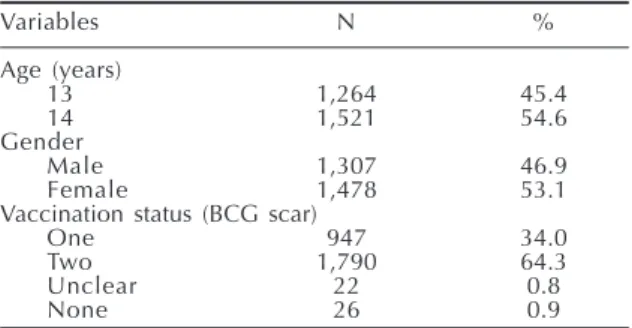
The Table shows the characteristics of the study population.
There is a slight preponderance of female students (53.1%) and those aged 14 years (54.6%). The preva-lence of first BCG vaccination was 98.3% (95% CI: 97.8–98.7), estimated by summing up those students who had one scar only (34.0%) with those who had two scars (64.3%, 95% CI: 62.5–66.0). About two-thirds of first vaccinated students were revaccinated.
DISCUSSION
The finding of two scars does not necessarily mean that the subject was first BCG vaccinated in the first years of life and then revaccinated after turning 10 years old. However, the study results show similar coverage of first BCG vaccination to that reported in official estimates for the city of Belo Horizonte. One can thus reasonably assume as valid the BCG revac-cination rate found in this study. Based on the study sampling process, it is most likely that the propor-tion of revaccinated students reflects revaccinapropor-tion rate in the study population.
A BCG revaccination coverage reaching about two-thirds of the target population can only be achieved by allocating and mobilizing economic, human and other resources. Yet, such logistic effort has been made with no definite evidence on the efficacy of BCG
revaccination1,3 and despite the World Health
Organi-zation’s recommendations against this practice.2
A recent randomized studyconducted in Brazil,5
pub-lished in 2005, found that the efficacy of BCG
revac-Table - Demographic characteristics and vaccination status of the study population (N=2,785). Belo Horizonte, Brazil, 2001-2002.
Variables N %
Age (years)
13 1,264 45.4
14 1,521 54.6
Gender
Male 1,307 46.9
Female 1,478 53.1
Vaccination status (BCG scar)
One 947 34.0
Two 1,790 64.3
Unclear 22 0.8
3
Rev Saúde Pública 2006;40(2) BCG revaccination in adolescents
Camargos PAM et al
cination in preventing tuberculosis among school children was only 9% (95% CI: –16% to 29%), which was not significant. Based on this evidence, it seems advisable to take actions aimed at discontinuing BCG revaccination in Brazil.
This result shows that adolescents who were revaccinated during school years are not protected against tuberculosis. Besides, BCG vaccination cov-erage in Belo Horizonte and other Brazilian cities favors further observational case-control studies. It is suggested to study different age groups from that of
the study mentioned above,5 with different time point
for either revaccination or outcome assessment (pul-monary or extra-pul(pul-monary tuberculosis or not). The present study indicates that, in Belo Horizonte,
stu-dents were on average older at the time of BCG
revac-cination than those included in the randomized study.5
But if outcomes are assessed at a later age, let’s say, at the age of 25-30, these new observations could pro-vide additional clinical and epidemiological informa-tion, which are undoubtedly important for understand-ing the impact of BCG revaccination as well as the particular epidemiology of tuberculosis disease.
ACKNOWLEDGEMENTS
To Maria Jussara Fontes MD, Cláudia Andrade MD, medical students Lucas Andrade, Marcelo Freire, Ma-rina Fonseca, MaMa-rina Azevedo and Raquel Santos, from the Faculdade de Medicina, of Universidade Federal de Minas Gerais, for their help with data collection.
REFERENCES
1. Fine PEM, Rodrigues LC. Vaccination against mycobacterial diseases. Lancet.
1990;335(8696):1016-20.
2. Global programme on tuberculosis and global programme on vaccines: statement on BCG
revaccination for the prevention of tuberculosis. Wkly Epidemiol Rec. 1995;70(32):229-31.
3. Karonga Prevention Trial. Randomised controlled trial of single BCG, repeated BCG, or combined BCG and killed mycobacterium leprae vaccine for prevention of leprosy and tuberculosis in Malawi. Lancet. 1996;348(9019):17-24.
4. Pereira SM, Bierrenbach AL, Dourado I, Barreto ML, Ichihara MY, Hijjar MA, et al. Sensibilidade e especificidade da leitura da cicatriz vacinal do BCG. Rev Saúde Pública. 2003;37(2):254-9.
5. Rodrigues LC, Pereira SM, Cunha SS, Genser B, Ichihara MY, Brito SC, et al. Effect of BCG